
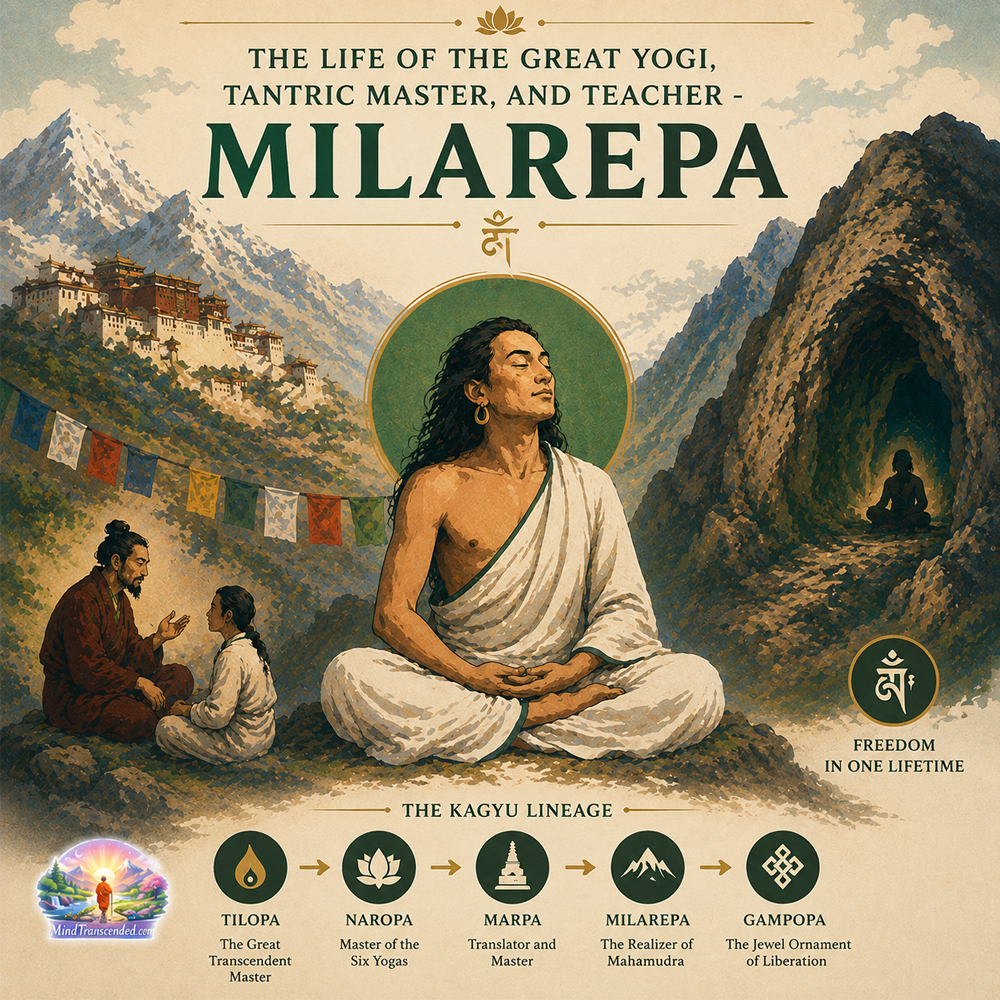
 tantric master and teacher milarepa“ width=“1000″ height=“1000″ />
Milarepa can be said to be the person most responsible for the spiritual character of Tibet as we know it today. He lived during the 11th and 12th centuries – a time when Buddhism had already entered Tibet, yet after Milarepa, nothing remained quite the same. He is a figure comparable to individuals such as Socrates, who drew a line between philosophers “before Socrates” and “after Socrates,” or Jesus Christ, after whom time itself became divided into “before Christ” and “after Christ.” In the same way, one can speak of Tibetan spirituality as existing “before Milarepa” and “after Milarepa.”
Early years
Milarepa’s story begins with the death of his father while he was still a child. His father had owned considerable property – houses and land – but after his death, Milarepa’s uncle unjustly seized everything. His mother and younger sister were reduced to servants in their own home and subjected to constant humiliation and cruelty.
In Milarepa’s heart, hatred and a thirst for justice and revenge gradually accumulated. Over the years, this became the driving force of his life. When he reached adolescence, he left home determined to acquire occult powers through which he could avenge his family.
Tibet, being a land where the mystical and occult dimensions of Buddhism have remained deeply rooted even to this day, provided him with such an opportunity. After years of searching and training under various masters, Milarepa acquired a range of mystical abilities and, in the process, became even more fierce and determined. The only thing sustaining his will was the desire for revenge.
After a long time, he finally returned home. But when he arrived, he discovered that both his mother and sister had already died. This shattered him. His desire for vengeance grew even stronger, and he resolved to finish what he had begun. He learned that his uncle’s son was about to be married and decided to wait.
When the day arrived, Milarepa used his occult powers to unleash a devastating storm that destroyed the house and killed around eighty people, including his uncle and aunt.
At first, this brought him immense satisfaction. But soon he began to feel the consequences of his actions consuming him from within. Gradually, he realized that what he had done had changed something deep within his very being.
Thus a new search was born within him – the search for liberation from suffering.
He began wandering from teacher to teacher, but none could give him what he sought: complete liberation and enlightenment within a single lifetime. In Buddhism, enlightenment is generally viewed as a process unfolding across many lives. The possibility of attaining complete liberation from the cycle of life and death and reaching Nirvana within a single lifetime existed only among a handful of extraordinary yogis.
After many years without success, Milarepa became a broken man, filled with conflicting emotions, thoughts, and guilt. His past devoured him from the inside, and no one seemed able to help him.
Then he heard of a man named Marpa.
Marpa
Upon hearing about him, Milarepa set out for Marpa’s village. As he approached, he saw several children playing. He asked them where Marpa lived. One child replied, “Come with me – I know where he is,” and led him to a field where Marpa was plowing.
As soon as Marpa saw him, he stopped working, offered him some beer, and, without much explanation, instructed him to begin plowing. Milarepa started working while Marpa walked away. Only the child remained.
When he finished, the child approached him and said, “Come on, it’s time. Follow me.” Together they walked to Marpa’s house. Only then did Milarepa realize that the child was actually Marpa’s son.
Thereafter, Marpa assigned Milarepa all kinds of physically demanding tasks. Eventually, exhausted, Milarepa bowed before him and pleaded:
– “Please, give me a teaching – a method by which I may find Liberation in this lifetime. And please, grant me food and shelter.”
Marpa replied:
– “You must choose. If I give you the teaching, you must find your own food and shelter. If I give you food and shelter, then find your teaching somewhere else.”
Milarepa chose the teaching. He became a beggar, traveling from village to village. So that he could devote himself entirely to the path, he managed to gather enough wheat to sustain himself for an entire year and returned to Marpa. When he entered, he dropped the huge sack of wheat onto the floor with a loud thud. At that moment, Marpa was eating lunch in the next room. Hearing the noise, he appeared and said:
– “You seem very angry. Are you trying to bring down this house as you did your uncle’s? Leave.”
Milarepa attempted to explain that the sack had simply been heavy. But Marpa would not accept the explanation. He expelled him from the house and ordered him to remain outside, plow the fields, and perform various tasks.
Milarepa did not understand Marpa. Yet even at that moment, his teacher had already shown him the method. He simply lacked the ears to hear it.
Marpa was trying to help him see himself beyond his own self-image. He wanted him to understand that a person’s true nature is revealed most clearly through unconscious actions rather than conscious ones. Anyone can pretend to be something they are not and deceive themselves, but small, unconscious actions reveal the depths of one’s being.
A single careless throw of a sack – instead of placing it down gently – immediately revealed what was hidden within him.
The path begins when a person becomes willing to pay attention to the “small things,” because those things reveal the condition of the heart. If a person cannot see their illness, they cannot be healed.
But Milarepa began making excuses – and in doing so showed that he was not yet ready.
Despair
Years passed, yet Milarepa received no teachings, even though many other students came and were given instructions and initiations. Marpa, known as “the Translator,” had traveled repeatedly to India, studied under great masters, and translated numerous tantric texts into Tibetan. He had brought this knowledge into Tibet. One day, driven by desperation, Milarepa secretly attended one of Marpa’s gatherings. Marpa sat with his eyes closed. Milarepa hoped to receive something – anything. But Marpa suddenly rose, approached him, discovered him hiding, beat him, and threw him out.
This happened several times.
A full thirteen years passed without Milarepa receiving a single teaching. At last, he could endure no more. He begged Marpa’s wife to intercede on his behalf. Moved by compassion, she spoke with Marpa. Marpa said:
– “Let him build a house for my son. A triangular one.”
Then a square one. Then a pentagonal one.
The years continued to pass. Finally, Marpa ordered that the house should have towers about twenty meters from each corner. Milarepa was growing old. For the first time in his life, he experienced true despair. Falling at Marpa’s wife’s feet, he cried from the depths of his soul:
– “My life is running out… I have given everything. What more can I give?”
It was not even a plea – simply the final breath of his remaining strength. Out of compassion, she arranged for him to receive an initiation from another teacher. Yet nothing happened within Milarepa afterward.
Realization
When Marpa learned of this, he revoked that teacher’s authority to grant initiations. Filled with remorse, Milarepa decided to end his life. But Marpa called him back and said:
– “Until now, I have been giving you methods to work through your past. Had you listened to me from the beginning, none of this would have been necessary. But now, you are ready.”
In such a state, a person lets go of the ego. All inner barriers collapse. A profound sensitivity emerges – a state of innocence combined with maturity.
Marpa then initiated him.
Three days later, Milarepa received a vision. A dakini – tantric deity regarded as an embodiment of enlightened energy – told him that a crucial element was missing. When Milarepa described the vision to Marpa, Marpa admitted that even he did not know this missing element. Together they traveled to India to see Marpa’s teacher, Naropa, who, according to Marpa, would know.
When they reached Naropa, Milarepa told him everything. After listening, Naropa bowed toward Tibet and said:
– “At last – a spark of light has arisen in the northern darkness.”
He then transmitted the complete teaching – the path to liberation within a single lifetime. From that moment onward, Marpa became a disciple of Milarepa, and Milarepa became the light of Tibet.
The book The Hundred Thousand Songs of Milarepa became one of Tibet’s greatest spiritual treasures. His words are songs believed to possess the power to guide a person from darkness into light.
Excerpt
“I, Milarepa, the yogi of Tibet,
Possess little knowledge, yet my guidance is great.
I sleep little, but I am steadfast in my meditation.
Humble is my heart, yet great is my perseverance.
Knowing one thing, I know all things;
Knowing all things, I know they are one.
I am an expert in the Absolute Truth.
My bed is small, yet I am free to stretch my legs.
My clothes are thin, yet my body is warm.
I eat little, yet I am satisfied.
I am the one whom all yogis honor,
The one to whom all devotees come –
A guide along the fearful path of life and death.
Unattached to any home, without fixed dwelling,
Forsaking all things, I follow my own way.
I do not crave possessions.
I make no distinction between pure and impure.
With little passion and little self-importance,
I untie the knots leading to Nirvana.
I comfort the old in their sorrow,
And to the young I am a friend.
A yogi wandering through all religions,
Hoping that all beings may live in happiness.”
Read More:
- Naropa – Life, Teachings, and the Six Yogas | The Path to Enlightenment
- Tilopa – The Mystical Master of Mahamudra and the Beginning of a Spiritual Lineage
- What Are Yoga and Tantra: Differences, Philosophy, and the Role of “Sexual Energy”
Author: Vasil Stoyanov