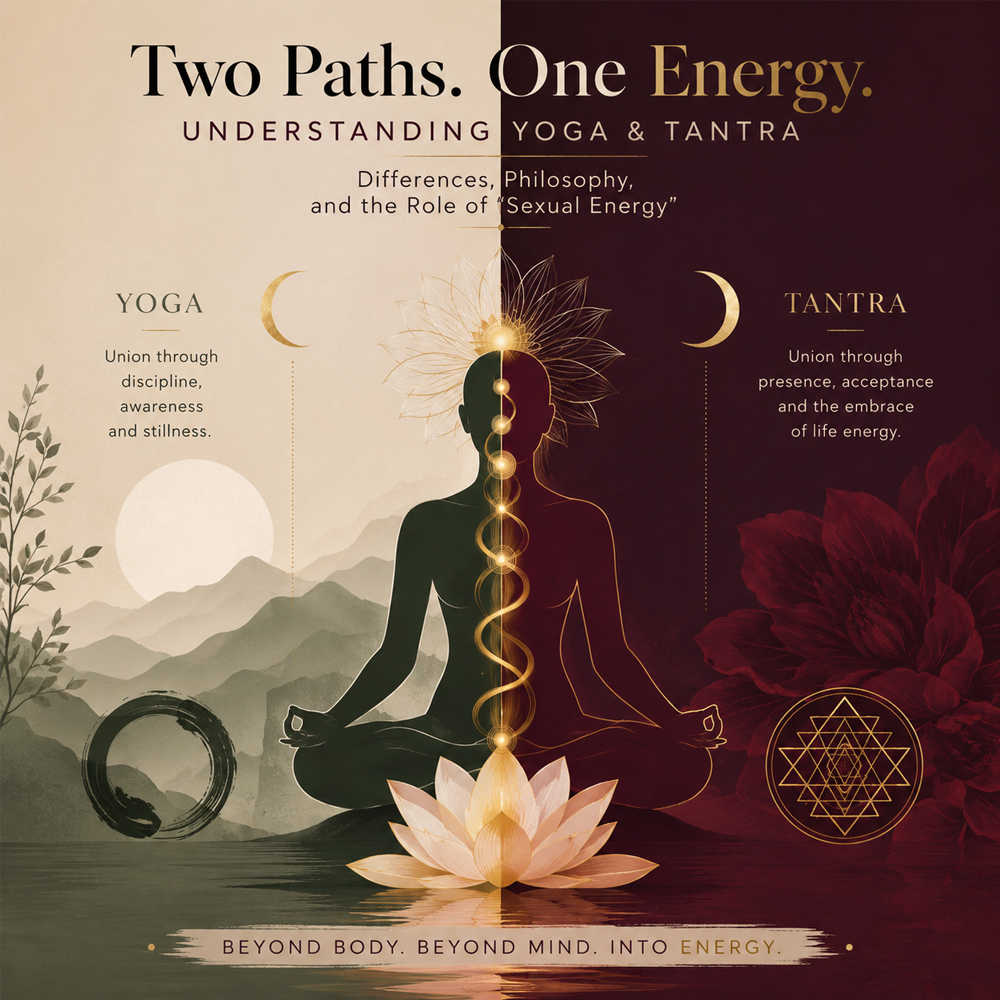
Yoga and Tantra
When we speak about the sciences of the objective external world, they are precise and definitive. But the sciences of the inner, subjective world cannot be so. Every person experiences inner reality differently, and therefore the paths toward its realization are also different.
According to the Hindu tradition, there are 112 methods for working with the inner world, which can be applied in various ways. Yoga and Tantra both employ these methods, but they approach them differently.
Yoga begins with the ultimate goal – the Supreme, God, the highest potential of the human being. It involves discipline, effort, renunciation, and ultimately surrender. In Yoga, there is a clearly defined destination toward which one moves through various practices.
Tantra, on the other hand, begins with the person’s present condition – their nature exactly as it is. There is no struggle there, but acceptance. What is the end point in Yoga is the starting point in Tantra. Complete relaxation and surrender are the foundation.
While Yoga seeks to transcend the animal nature through control and restraint, Tantra uses that very nature as a means of transformation. One of its primary tools is what in the West is commonly known as “sexual energy,” a term that often creates misconceptions mixed with inadequate fantasies about Tantra.
Sexual Energy
When Tantra speaks of this energy, it refers to it as the most powerful creative force available to human beings. It is the energy of creation – the force capable of bringing forth new life, but also ideas, emotions, art, aspirations, and actions.
The energy itself is the same; only the form through which it manifests differs. It is this form that determines the result of creation. The desire for reproduction, knowledge, food, creativity, success – all of these are different expressions of the same fundamental energy.
By its very nature, this energy is creative. Sexuality is one of its manifestations – the transformation of this energy into pleasure or the creation of new life. Yet the same energy can be transformed into love, aspiration, spiritual seeking, and awareness.
Tantra does not suppress this energy – it utilizes it. It begins with its lowest manifestation in order to transform it into something higher.
When this energy finds no expression, it creates tension. The easiest way to release that tension is through sex. This brings temporary relief – the mind calms down, the tension disappears. But the energy replenishes itself, and the cycle repeats. This is not the goal of Tantra.
Tantra aims neither at suppression nor at mechanical release. Its goal is awareness. When a person fully understands this process, desire itself begins to transform without the need for forceful control. Tantra seeks to work with this energy in order to transform it into fuel for spiritual development. The emphasis is on direction rather than repression.
Tantra and Sexuality
Tantra does not reject the sexual act, but it approaches it differently and seeks to turn even the most basic expenditure of this energy into an opportunity for spiritual growth. In animals, the act serves reproduction; in humans, it most often serves pleasure. When pleasure becomes the goal, the act tends to accelerate because climax is perceived as the most important moment.
However, if a person lets go of this goal and enters the experience without expectations or control, the energy begins to manifest differently. It is no longer exhausted through release – it is transformed.
Modern people often enter the sexual act carrying pre-established ideas about what should happen, how it should look, and what should be achieved. This creates tension and diverts attention away from the experience itself.
In Tantra, there is no drive toward an endpoint – there is no goal. Movement becomes natural, and the experience takes on a meditative quality. In this process, the partners do not merely interact – they merge.
This union is not merely physical but inward. The sense of separate individuality begins to disappear. Love becomes the key to this experience.
Love and Beyond
Love is a state in which a person forgets themselves and surrenders completely. They cease to be the center of their own existence and begin to live through another.
For this reason, love is regarded as one of the paths to enlightenment in both Yoga and Tantra. When a person loses themselves, they merge with life itself.
After experiencing such unity, it remains as a deep inner imprint. Over time, a person may access this state even without an external stimulus – first through memory, then through imagination, and eventually spontaneously.
Tantra begins with the acceptance of human nature rather than its rejection, and through that very nature it moves beyond it. Yoga employs the same energy, but directs it through discipline and practice toward the same ultimate goal.
The highest potential of this energy is the creation of a “Universal Self” – a transition from individuality to universality. From a consciousness filled with matter to a consciousness filled with complete independence and freedom.
This is the journey from unconsciousness to full consciousness.
Author: Vasil Stoyanov