
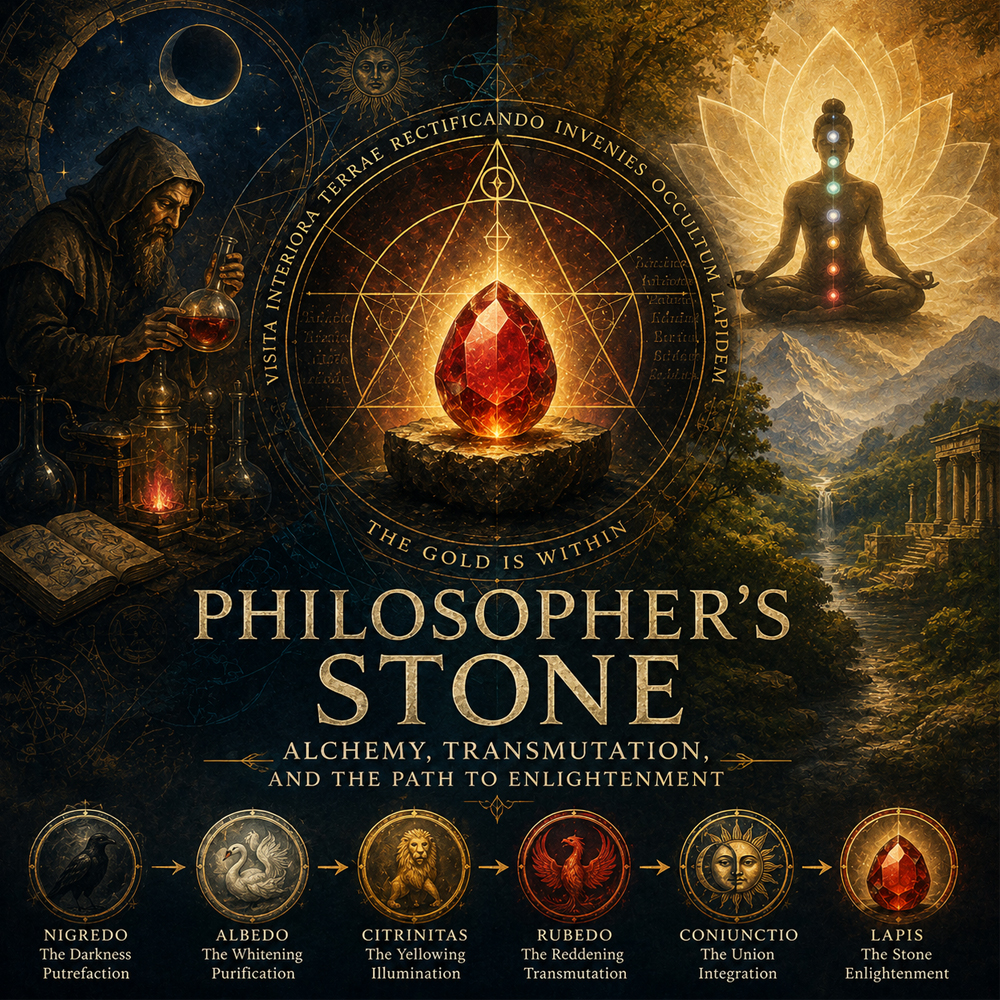
The Philosopher’s Stone (lapis philosophorum) was regarded as the highest goal of alchemy. According to this ancient doctrine, it possessed the power to transform mercury into gold or silver. However, the term “mercury” in alchemical texts should not be understood literally, but rather as a symbol representing aspects of existence unknown to the purely material world.
Mercury was seen as analogous to the vital essence present within all living beings, while gold and silver – the most perfect of metals – symbolized its purest, most refined, and most beautiful expression.
In this sense, the Philosopher’s Stone was not merely a substance capable of changing metals, but a symbol of ultimate transformation itself. It represented the process through which the imperfect becomes perfected, the ordinary becomes extraordinary, and the hidden potential within all things is brought into full realization.
For many alchemists, the quest for the Philosopher’s Stone was therefore both an external and an internal journey. While it was often described as a means of physical transmutation, it also symbolized the refinement of the human soul, the purification of consciousness, and the attainment of spiritual wisdom. The transformation of mercury into gold reflected the transformation of the human being – from a state of ignorance and fragmentation into one of wholeness, clarity, and enlightenment.
To transform the mercury of a stone means to actualize its potential to become a diamond – the most perfect form of its existence. The transmutation of human mercury into gold symbolizes the regeneration of true human nature, or what the Eastern spiritual and philosophical traditions call enlightenment.
The process of working with the mercury within all things so that they may become their highest and most perfected form is known as transmutation. This principle can be applied even in everyday life.
“Every situation is the right one, provided you have the eyes to see it as such.”
Through the art of alchemy, every event can be turned into gold. Life may present anyone with unexpected difficulties and painful experiences, yet the human mind possesses the capacity to transform them into wisdom, growth, and understanding.
According to alchemical thought, mercury is the essence of all realms of existence, which in the physical aspect of the universe are described as:
- The mineral kingdom
- The plant kingdom
- The animal kingdom
- The human kingdom
It is also considered the essence of all celestial realms, where divine beings – such as angels, archangels, cherubim, and other spiritual intelligences – are believed to dwell.
In its deeper symbolic meaning, mercury is analogous to spirit, vital force, or life energy itself. It is the living principle that exists beyond mind and body, the invisible essence that animates every form of existence.
From this perspective, the Philosopher’s Stone is not merely an object but a symbol of the highest realization of that essence. It represents the possibility that everything – whether a stone, a plant, an animal, a human being, or an experience – contains within itself the potential for perfection. Alchemy is the art of recognizing that potential and bringing it into reality.
Mercury as the Prima Materia and Spiritual Energy
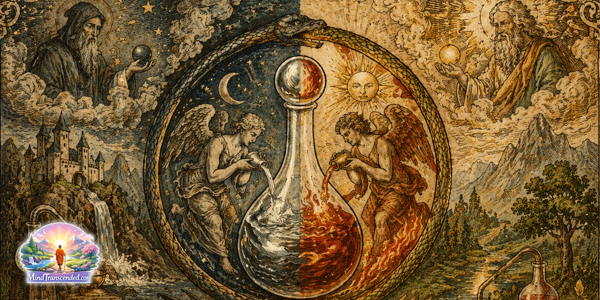
Mercury is regarded as a manifestation of what alchemists called Shamaim, translated in the Bible as “Heaven,” known in Hermeticism as the Fiery Waters, in Hindu philosophy as Chit (Pure Consciousness), and in Jewish Kabbalah as the sephirah Keter.
Hermeticism offers one of the most accessible analogies for understanding this source. Referred to as the Fiery Waters, it represents the primordial energy in which all opposites are united within a single whole. From this concept arises the very term itself. Darkness and light, whose interaction gives birth to all existence, are understood as inseparable expressions of one underlying reality. According to alchemy, this unified source is the very nature of what is called “God.”
This nature, or primordial energy, is known as prima materia – the First Matter – from which Creation itself was forged. Prima materia is considered the highest state that mercury, the vital essence within any being, can ultimately attain. According to the doctrine, Creation began when prima materia differentiated itself, giving rise to duality.
Within alchemical symbolism, fire, being the highest of the elements, represents the spiritual realm of existence, known in Kabbalah as Atziluth. Water, together with Earth, symbolizes the physical world, which stands in apparent opposition to Atziluth.
Yet because both the physical and celestial worlds are manifestations of the same prima materia – because they emerge from the same source – they are understood as two sides of a single coin. For this reason, the material world is often viewed as a reflection of the heavenly world. A reflection is an identical image, yet reversed as in a mirror.
Thus, if everything in the physical realm appears material and dual, everything in the spiritual realm is understood to be immaterial and unified. The world of multiplicity and separation is therefore seen not as independent from the world of unity, but as its mirrored expression.
From the alchemical perspective, the journey of transformation is ultimately the movement from apparent division back toward the recognition of this original unity – from fragmented existence toward the realization of the One Reality from which all things emerge.
The Great Work and Alchemical Transmutation
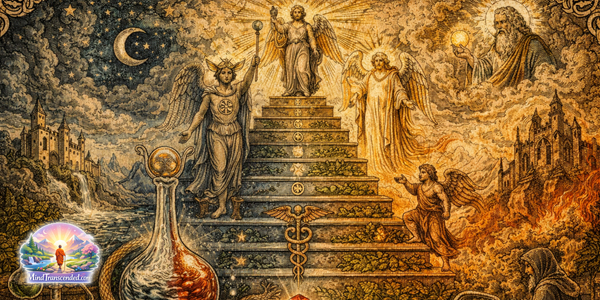
According to ancient alchemical texts, the interaction between Fire (the celestial realm) and Water (the physical realm) naturally gives rise to what is called Mercury. Mercury is understood as an intelligent principle containing within itself limitless potential.
Alchemy depicts its transmutation as a journey through seven stages, symbolic of the seven states it must pass through before returning to Paradise – the primordial source from which it originated. The first stage is the mineral realm, followed by the plant realm, the animal realm, the human realm, two divine stages, and finally the ultimate state: God.
This symbolism presents a complete picture of how the divine intelligence that gives life to every being is fundamentally one and the same, yet manifests itself through different stages of evolution. The final destination of this journey is Shamaim – Heaven itself. According to this view, the last two stages beyond Homo sapiens continue within the celestial worlds.
The transmutation of Mercury into Gold – which is analogous to the return of life to Paradise – is accomplished through the Philosopher’s Stone.
The creation of this Stone, known as the Magnum Opus (“The Great Work”), is achieved through the First Matter (prima materia). In this sense, the Philosopher’s Stone represents the very art of transmutation itself, acquired through the various faculties and capacities bestowed upon human beings by nature.
Through these capacities, a person transforms themselves into what mystics call a yogi, a term derived from yoga, meaning “union.” The Philosopher’s Stone is therefore also analogous to the key to enlightenment, through which the individual attains the Elixir of Immortality – or, in other words, becomes liberated from the endless cycle of birth and death known as samsara.
Seen in this light, the Great Work is not merely the transformation of metals but the transformation of consciousness itself: the journey from fragmentation to wholeness, from limitation to freedom, and from individuality back to the source from which all existence arises.
Conclusion
What ancient alchemy ultimately seeks to reveal can be summarized as follows:
- The Philosopher’s Stone is not a literal object, but a profound symbol of the inner transformation and spiritual development of the human being.
- Alchemy presents itself as a teaching of the transformation of consciousness, in which “Mercury” – the vital force and latent potential within every being – can be elevated to its most perfected state, symbolized by Gold.
- All existence originates from a single primordial substance in which all opposites are united, and both the material and spiritual worlds are understood as different manifestations of the same source.
- The process of transmutation, symbolized through the stages of evolution, leads to a gradual awakening and a return to the primordial origin.
- The Great Work (Magnum Opus) is not merely an alchemical operation, but a path of personal and spiritual growth through which a person uses their inner capacities to attain a state of unity, wholeness, and enlightenment.
- In this sense, the Philosopher’s Stone represents the key to understanding our own true nature and to realizing a state of perfection that transcends the limitations of the material world.
Ultimately, the central message of alchemy is that transformation is woven into the fabric of existence itself. Just as nature transforms seed into tree, coal into diamond, and experience into wisdom, the human being possesses the capacity to transform ignorance into understanding, fragmentation into unity, and ordinary consciousness into awakened awareness. The Philosopher’s Stone is therefore not something to be found outside oneself, but something to be realized within – the hidden potential for complete transformation that exists in every human life.