
Some books teach us how to live, while others compel us to confront the greatest mystery of existence. The Tibetan Book of the Dead belongs to both categories. Behind its familiar Western title stands a religious tradition that regards death not merely as an occasion for fear and silence, but as a decisive moment in the journey of consciousness. Its pages contain images of dazzling light, peaceful and wrathful deities, immense spaces, karmic visions, and opportunities for liberation. It is a spiritual map of transition, developed within a culture whose teachers have devoted generations to examining the mind, suffering, and the nature of reality.
The extraordinary strength of this work lies in its courage. It does not offer consolation to the living alone. It addresses the dying and the deceased as though attention, recognition, and spiritual preparation continue to matter beyond the final breath. Within Tibetan Buddhist tradition, death is described through a succession of states in which the mind encounters profound manifestations of its own nature. The central task is not to defeat an external enemy, but to recognize the nature of what appears.
This article follows the major stages of the journey described in the tradition of Liberation Through Hearing in the Intermediate State, widely known as the Bardo Thodol. We will explore the history of the text, the dissolution of the elements, the radiance of clear light, the visions of peaceful and wrathful deities, karmic appearances, and the movement toward another birth. We will also examine the six bardos, the ritual role of the spiritual guide, the symbolism of forty-nine days, and the philosophical meaning of the teachings. Accounts of postmortem states are presented as teachings of Tibetan Buddhism, not as scientifically established descriptions of what happens after biological death. That distinction allows the mystical narrative to retain both its depth and its integrity.
The Book That Speaks Beyond the Threshold of Death
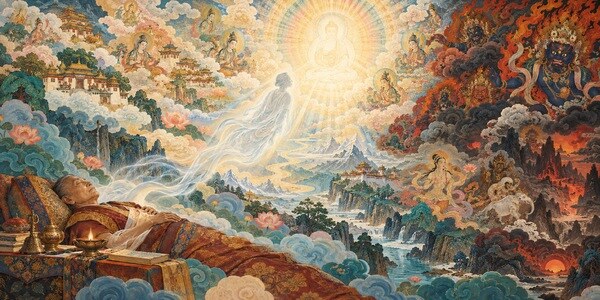
The familiar title The Tibetan Book of the Dead is a Western designation that became established during the twentieth century. It evokes the funerary literature of ancient Egypt, but the similarity of the titles does not imply that the religious systems are identical. The Tibetan text belongs to a Buddhist tradition concerned with liberation through recognizing the nature of mind. Bardo Thodol is commonly translated as Liberation Through Hearing in the Intermediate State. Its underlying proposition is remarkable: properly transmitted instruction can support consciousness precisely when familiar points of reference dissolve.
This is not a single text that appears in exactly the same form in every edition. Different translations, compilations, and ritual traditions present different selections from the larger cycle associated with the peaceful and wrathful deities. Some editions emphasize the sequence of postmortem visions; others include additional prayers, instructions, and ritual formulas. Consequently, the details and ordering of particular images are not identical in every volume published under this title.
Its central purpose, however, remains consistent. The listener is taught that fear and attraction are unreliable guides. A light that terrifies may signify an opportunity for liberation; a vision that seduces may perpetuate the cycle of conditioned existence. Again and again, the text calls for recognition. This is the source of its extraordinary spiritual tension: the decisive event is not the appearance of a vision, but the way consciousness responds to it.
Padmasambhava, Karma Lingpa, and the Tradition of Hidden Treasures
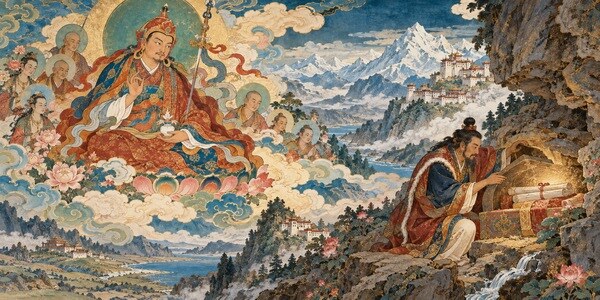
In Tibetan tradition, the origin of the Bardo Thodol is associated with Padmasambhava, the great teacher known as Guru Rinpoche, who is credited with a decisive role in establishing tantric Buddhism in Tibet during the eighth century. Traditional accounts describe how he and his disciples concealed teachings intended to be discovered by future generations when the appropriate conditions arose. These hidden spiritual treasures are known as terma. Within the tradition, they are not understood simply as lost manuscripts, but as teachings deliberately preserved for a time when people would be ready to receive them.
The discovery and transmission of the cycle containing the Bardo Thodol are associated with Karma Lingpa, a fourteenth-century Tibetan treasure revealer. Historical scholarship distinguishes the traditional attribution to Padmasambhava from the documented medieval transmission of the material. This distinction does not erase the religious meaning of the narrative. It illuminates how the tradition understands continuity through the relationships between teacher, disciple, revelation, ritual, and the transmission of knowledge.
The image of a hidden treasure gives the book a distinctive atmosphere. Its teaching is conceived as a message awaiting its appointed moment, like a seed lying beneath winter soil. When conditions mature, it emerges and begins a new life. Historically, this process belongs to the rich literary and religious culture of the Nyingma school. Spiritually, it expresses the conviction that wisdom must not merely be preserved in writing; it must awaken within the person who hears it.
What Bardo Means: The Space Between Two States
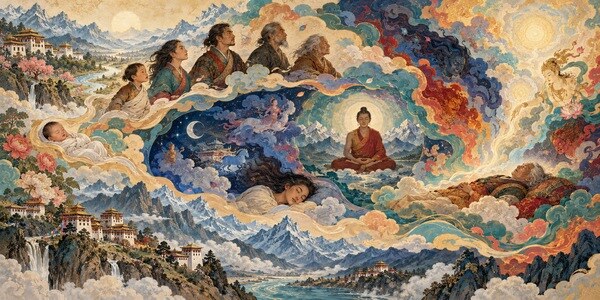
The word bardo means an intermediate state or interval. Popular accounts often restrict it to the period between death and the next birth. Tibetan teachings, however, employ the term more broadly. Life itself can be understood as a bardo because it is a transition between birth and death. Sleep, dreaming, meditation, and the process of dying can also be described as transitional states. Bardo is therefore not simply another world beyond death; it expresses a fundamental characteristic of existence: nothing conditioned remains fixed.
This perspective transforms the way death is understood. If every moment is a transition, the final moment of life does not arise in isolation from everything that preceded it. Habits of attention, susceptibility to fear, the force of attachment, and spiritual preparation already matter now. In traditional Buddhist language, one does not prepare for bardo only when dying. Preparation takes place through the way one lives, responds, dreams, and observes the movements of the mind.
The intermediate state is not depicted as passive waiting in an empty space. It is dynamic, filled with manifestations and decisions expressed through elaborate symbolism. Each appearance can be met with recognition or confusion. Hence the text’s persistent instruction: do not cling, do not flee, and do not allow terror or desire alone to determine your course. Recognize the nature of what appears.
The Six Bardos: Life and Death as One Continuous Training
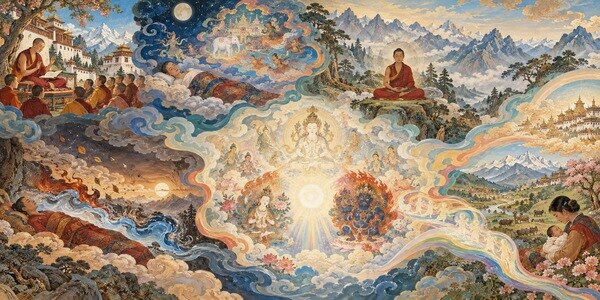
A widely used Tibetan presentation distinguishes six bardos. The first is the bardo of this life, during which a person has the opportunity to hear teachings, reflect, and practice. The second is the bardo of dreaming, where the mind experiences worlds that appear real for as long as the dream continues. The third is the bardo of meditative concentration, in which the cultivation of attention makes it possible to observe experiences without the usual compulsion to grasp them.
These are followed by three bardos especially important to the narrative of death: the bardo of dying, the bardo of reality or dharmata, and the bardo of becoming. Their names appear in different transliterations and translations. The first describes the dissolution of the ordinary supports of bodily and sensory experience. The second concerns clear light and the manifestations of peaceful and wrathful deities. The third describes the karmically conditioned movement toward another birth.
The six bardos are more than a scheme for arranging supernatural events. They form a pedagogy of attention. In a dream, a person may be convinced that everything happening is ultimate reality; upon waking, the dreamer realizes how completely the mind was absorbed in its images. Meditation teaches a person to observe thoughts without immediately turning them into an identity. According to the tradition, precisely this capacity for recognition is needed during the decisive transitions of death.
Before the Final Breath: Why Preparation Begins During Life
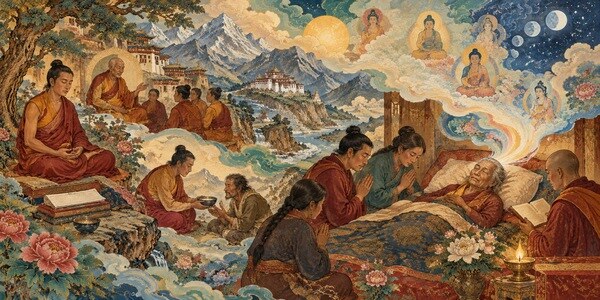
The Bardo Thodol is not an invitation to postpone spiritual work until one’s final hours. On the contrary, its dramatic sequence becomes meaningful against the background of sustained preparation. In Tibetan Buddhism, teachings about death belong to a broader system of ethics, meditation, compassion, and training under qualified teachers. Certain tantric practices require initiation and belong to specific lines of transmission. They cannot be reduced to reading a translation or imaginatively recreating the visions described in a book.
For the general reader, the most accessible lesson is profoundly human. The way we relate to uncertainty, loss, and change shapes our relationship with life. When every change is experienced as an assault on personal security, fear acquires enormous power. When a person learns to observe impermanence, greater clarity and steadiness gradually become possible. In the Buddhist context, such training is inseparable from compassion for other beings.
Traditional instructions also emphasize the condition of the dying person. Calm surroundings, familiar prayers, the presence of trusted people, and respect for spiritual convictions all matter within the ritual context. None of this overrides medical care, pain relief, or personal choice. It shows that death is not merely a physiological event for relatives and the community. It gathers together the body, memory, relationships, and deepest values of a human life.
The First Threshold: The Dissolution of Earth
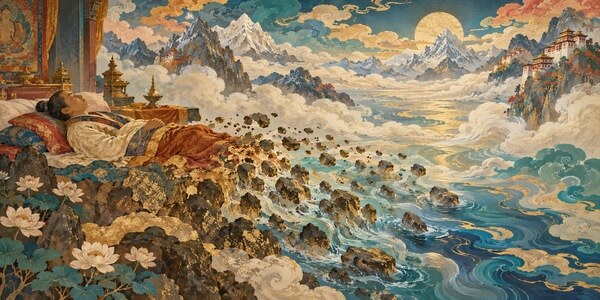
The traditional description of dying begins with the gradual dissolution of the supports through which a person experiences body and world. Tibetan teachings frequently express this process as the dissolution of the elements. Earth, water, fire, and air should not be understood simply as chemical substances. They belong to a traditional system of bodily and contemplative symbolism associated with solidity, fluidity, warmth, and movement.
First, the earth element dissolves into the water element. In traditional descriptions, this is associated with a loss of physical stability, a sense of heaviness, weakening strength, and the body’s inability to support itself in the customary way. Some instructions mention inner visual appearances resembling a shimmering mirage. These images belong to the traditional contemplative map and are not universal medical symptoms that every dying person should be expected to experience.
The symbolism of earth also has a philosophical dimension. Throughout life, people seek firm ground: a home, a name, a position, familiar routines, and a body that obeys their wishes. In the account of death, this very solidity begins to disappear. The lesson is severe and magnificent: everything we have regarded as a final foundation belongs to the world of change. The tradition does not tell this story to humiliate the individual, but to direct attention toward what cannot be secured through ordinary ideas of possession.
Water, Fire, and Air: The Fading of the Familiar World
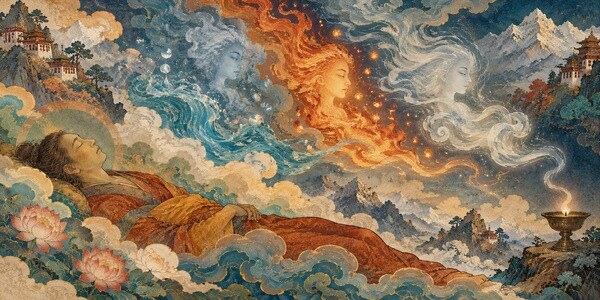
After earth, the traditional sequence describes water dissolving into fire. This transition is associated with changes in bodily fluids, moisture, and certain sensory capacities. The inner appearance is often compared to smoke. Fire then dissolves into air: bodily warmth and the capacity to sustain ordinary functions diminish, while the symbolic inner vision is compared to sparks or fireflies.
Finally, the air element dissolves into subtler levels of consciousness. Breathing, which has sustained the rhythm of life for so long, reaches its end. Some traditional descriptions evoke an image resembling the flame of a lamp just before it goes out. Here the symbolism becomes particularly powerful. Air is movement, and breath is the most immediate sign of bodily life. When breathing ceases, those present encounter a moment of profound silence.
A clear distinction must be maintained between this spiritual sequence and medical criteria for death. Tibetan descriptions belong to a religious system of experiences, symbols, and practices. Contemporary medicine determines death through established physiological and neurological criteria. One framework cannot simply be translated into the language of the other. As a spiritual narrative, however, the dissolution of the elements expresses something universally recognizable: the gradual loss of control and the need to confront impermanence without one’s customary defenses.
The White Appearance, Red Radiance, and Darkness

In more detailed Tibetan tantric descriptions, the coarse dissolution of the elements is followed by subtle inner stages. These are often presented as white appearance, red increase, and black near-attainment. Terminology and details depend on the particular system of practice. The white appearance can be compared to moonlight filling space; the red to a warm radiance like sunset; and the black to a descent into profound darkness preceding the most subtle awareness.
These stages are not decorative details added to a story about death. They express the progressive weakening of ordinary conceptual thought, which organizes the world through oppositions. The familiar division between an external object and an internal observer loses its usual force. For practitioners trained in the relevant tradition, this is a moment when previously assimilated instructions are meant to be recognized, not recalled merely as abstract theory.
Here mystical language reaches its limits. Light, color, and darkness are human words used to describe states that the tradition regards as subtler than ordinary sensory perception. It is important not to turn these images into a compulsory scenario for every person. Their power becomes clear within the specific teaching: when the familiar world disappears, attention is directed toward the very nature of awareness.
Clear Light: The Deepest Moment of Recognition
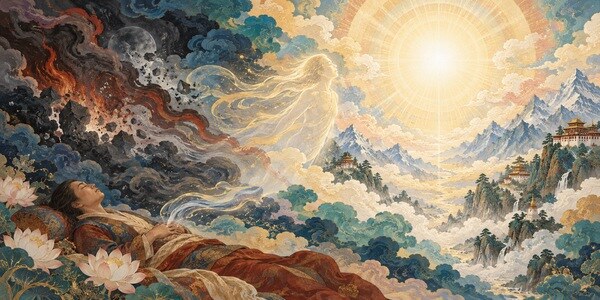
One of the most exalted images in Tibetan teachings on death is clear light. It is not merely a bright physical radiance appearing before the eyes. In the context of the relevant Buddhist practices, it designates the subtlest level of awareness and the possibility of directly recognizing the nature of mind. In the Dzogchen tradition, teachings speak of primordial purity and intrinsic awareness, while other tantric systems employ their own terminology. What unites these approaches is that liberation is not sought by acquiring a new external object, but by recognizing what has previously been misunderstood.
The texts maintain that someone who has received appropriate instruction and developed the corresponding practice may recognize this decisive moment. For unprepared consciousness, according to the traditional description, it passes unrecognized. This is not a condemnation of the individual. It underscores the importance of training: we cannot assume that in a moment of overwhelming confusion we will automatically display a clarity we have never cultivated.
Clear light lies at the heart of the mystical beauty of the Bardo Thodol. After heaviness, dissolution, smoke, sparks, and darkness comes not an image of punishment, but an opportunity for insight. This reverses ordinary expectations. Death, which appears to be an absolute loss, is presented in the religious text as a moment in which the deepest truth about mind may be revealed. The existence of such a postmortem experience has not been scientifically established; its spiritual meaning, however, is clearly articulated within the tradition.
Why Liberation Depends on Recognition
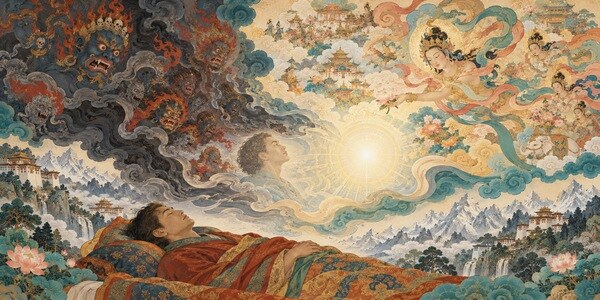
To understand why clear light occupies such a central place, we must turn to the Buddhist philosophy of ignorance. According to Buddhist teachings, suffering is sustained by the mistaken perception of phenomena as independent, permanent, and capable of providing final satisfaction. A person clings to experiences, relationships, and images of self as though they could remain unchanged. When they change, fear, anger, and despair arise.
Recognition in this context does not mean simply remembering a name or identifying a symbol. It means seeing experience without the habitual error of attributing an independent and unchanging essence to it. This is why the instructions for bardo repeatedly insist that visions must be understood in light of the nature of mind. Something terrifying should not immediately be treated as an independent enemy, nor something attractive as a guarantee of salvation.
This idea gives the book philosophical depth extending far beyond curiosity about the afterlife. A similar mechanism can be observed during ordinary life. A thought of danger produces fear, and fear strengthens the conviction that danger is everywhere. Desire embellishes its object and transforms it into a promise of happiness. The practice of recognition aims to interrupt this automatic cycle. The Tibetan text unfolds the same principle in the most dramatic context imaginable: the passage through death.
The Bardo of Reality: When Radiance Takes Form
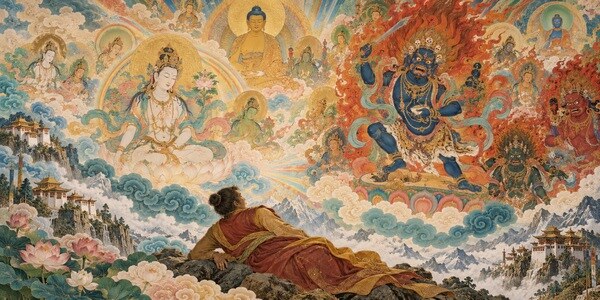
If the initial opportunity for recognition is not realized, the traditional narrative moves into the bardo of dharmata, reality as understood within the relevant Buddhist system. Here appears the magnificent and unsettling gallery of peaceful and wrathful deities. To readers encountering these descriptions for the first time, they resemble an extraordinary celestial procession. Light fills space, colors intersect, deities appear with specific attributes, and sounds acquire tremendous force.
In tantric Buddhism, these images are not simply fantastic characters. They belong to an intricate system of symbols, mandalas, meditative practices, and teachings about transforming ignorance into wisdom. Peaceful and wrathful forms express different aspects of enlightened knowledge. Their contrasting appearances do not mean that one group is good and the other evil. A wrathful appearance can represent compassionate power that destroys delusion rather than hatred directed toward living beings.
At precisely this point, the text delivers one of its boldest messages. The visions should not be regarded solely as alien beings invading from outside. Within the tradition, they are connected with manifestations of the nature of mind itself. Liberation therefore depends on recognizing them. If consciousness becomes terrified and treats them as enemies, confusion continues. If their nature is recognized, another possibility opens.
The Peaceful Deities: The Majestic Radiance of the Five Wisdoms
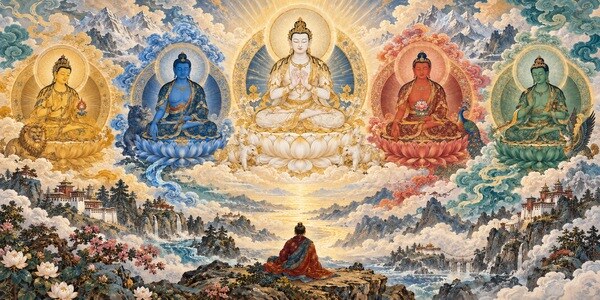
In a widely transmitted sequence of the bardo of dharmata, peaceful deities associated with the five Buddha families appear. Central figures include Vairocana, Akshobhya, Ratnasambhava, Amitabha, and Amoghasiddhi. Each is represented through characteristic colors, directions, symbols, and qualities of wisdom. The details of their iconography and the order of their appearance follow particular tantric systems; they are not arbitrary ornaments added to the narrative.
Vairocana is associated with the all-encompassing wisdom of the dharmadhatu, the dimension of reality. Akshobhya is associated with mirror-like wisdom, which reflects phenomena without distortion. Ratnasambhava represents the wisdom of equality, overcoming prideful comparison. Amitabha is linked to discriminating wisdom, which perceives distinctions without attachment. Amoghasiddhi embodies all-accomplishing wisdom, free from envious rivalry. These are traditional symbolic correspondences that gain their full meaning within their ritual and meditative contexts.
In the Bardo Thodol, the brilliant radiances of wisdom are contrasted with dimmer lights that draw conditioned consciousness toward different realms of existence. A remarkable psychological drama unfolds. A person may recoil from dazzling clarity and prefer something familiar, gentler, and closer to old habits. The tradition uses this image to show how ignorance prefers comfort to liberation. The brightest light is not the danger; the danger lies in the inability to recognize it.
The First Visions: From Vairocana to Amitabha
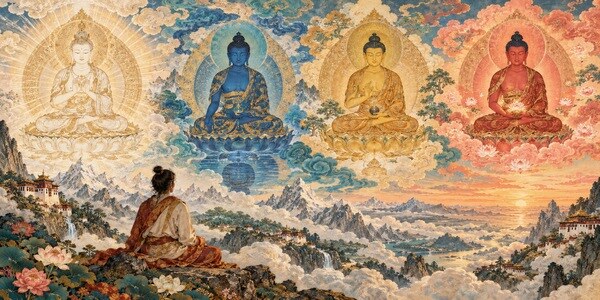
In popular presentations of the text, the first days of the bardo of dharmata are described through successive appearances of particular deities and their radiances. The beginning is associated with Vairocana, whose presence is represented by dazzling light and all-encompassing wisdom. He is followed by Akshobhya, whose mirror-like knowledge neither adds anything to phenomena nor takes anything away. Ratnasambhava then appears, directing attention toward the equality of beings beyond pride and the hierarchies constructed by the ego.
Amitabha, whose name means Infinite Light, holds a special place in Buddhist devotion and traditions associated with the Pure Land. In bardo descriptions, his radiance is linked with wisdom that overcomes attachment and transforms desire. His image is among the most beautiful in Buddhist art: serenity, boundless light, and compassionate presence. These qualities should not be reduced to a literal stage set for the afterlife. They belong to the spiritual language of the tradition.
Each appearance is accompanied by a call to recognize the true nature of its radiance. The listener is not simply required to memorize a list of names. The instruction seeks to transform the response to fear and attraction. When bright light provokes terror, the text reminds the listener that it is not an enemy. When a dimmer light appears comforting, it warns against impulsive attachment. The days thus become successive lessons in freedom from automatic reactions.
Amoghasiddhi, the Five Families, and the Complete Mandala
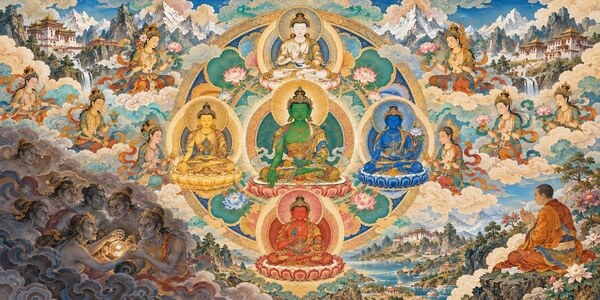
In subsequent visions, Amoghasiddhi is associated with effective wisdom and the overcoming of envy. His symbolism shows that enlightened action does not arise from anxious comparison with others. It is free from the need to prove its own worth. In traditional mandalas, the five Buddha families form an interconnected structure in which different qualities of wisdom complement one another. No single figure should be isolated from the larger spiritual context.
In certain sequences, the peaceful deities also appear as a complete mandala together with accompanying figures. This multiplicity carries a profound meaning. A mind accustomed to seeing the world as a collection of separate objects and competing forces encounters an image of unity expressed through diversity. The colors, gestures, and attributes do not negate a shared nature; they reveal it from different perspectives.
The mandala is one of the most exalted symbols of Tibetan Buddhism. It is not merely a decorative circle, but an organized space of spiritual knowledge. In the context of bardo, its appearance suggests that the apparent chaos of experience can be recognized as an ordered structure of wisdom. This does not mean that every frightening experience automatically constitutes enlightenment. It means that, according to the teaching, liberating understanding changes the very way appearances are experienced.
The Wrathful Deities: The Terrifying Faces of Compassion
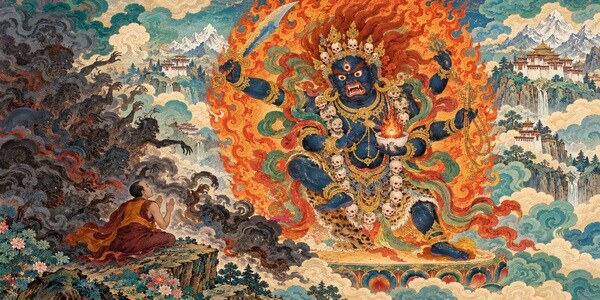
After the peaceful manifestations come the wrathful deities of the traditional narrative. Their images can shake an unprepared viewer: flaming halos, wide-open eyes, fearsome ornaments, symbolic weapons, skulls, and dancing figures. Their appearance is deliberately terrifying. It overturns the expectation that the spiritual must always look gentle, quiet, and pleasant. Tibetan tantric symbolism recognizes a compassion that also manifests as uncompromising force against ignorance.
Among these wrathful forms, the herukas and other protective or transformative figures occupy an important place. Their attributes have specific meanings within their respective ritual systems. Flames can express transformative wisdom, weapons the cutting of delusion, and fierce faces a power that does not yield to attachment. These figures should not be treated as demons in the sense of hostile forces opposed to goodness. In traditional interpretation, they are wrathful manifestations of enlightened qualities.
The deepest lesson concerns fear. When a person sees something horrifying, the natural response is to flee. The text calls for the opposite: recognize the nature of the vision. This is not advice to ignore real dangers in daily life, but a religious instruction concerning symbolic manifestations in bardo. The wrathful deity becomes a mirror before which consciousness confronts its own inability to remain clear when the world ceases to be comforting.
The Herukas and the Dance of Transformation
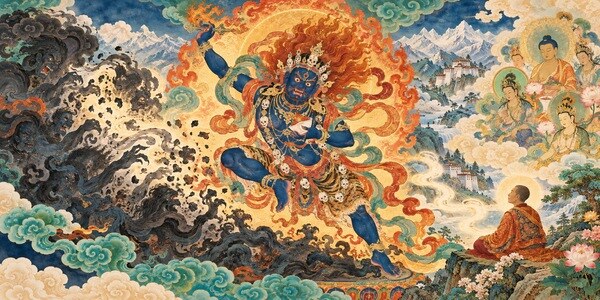
Within the cycle of peaceful and wrathful deities, wrathful manifestations are often associated with particular Buddha families and the transformation of destructive mental tendencies. Their names, colors, consort figures, and attributes follow an intricate iconographic system. A reader unfamiliar with this system may easily perceive the images as a chaotic mixture of terror and violence. Within the tradition, however, each detail participates in the language of spiritual transformation.
The wrathful dance does not glorify cruelty. It symbolizes energy that cuts through attachment to mistaken ideas. This distinction is essential. Compassion and nonviolence remain fundamental values in Buddhist ethics; tantric imagery uses a powerful symbolic language that should not be transferred literally to human relationships. The wrathful form is a ritual image of wisdom, not permission for aggression.
Bardo thus becomes a stage upon which the deepest contradictions of the human mind are brought to an extreme. The same consciousness that seeks peace is terrified by the force required to destroy its delusions. It desires liberation but fears losing its familiar identity. The wrathful deities embody this confrontation with the limits of attachment. In their fearsome beauty, Tibetan tradition finds not the denial of compassion, but its unstoppable determination.
Fifty-Eight Wrathful and Forty-Two Peaceful Deities
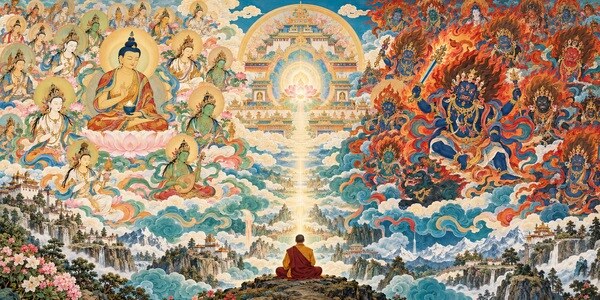
The well-known cycle of one hundred peaceful and wrathful deities speaks of forty-two peaceful and fifty-eight wrathful manifestations. These numbers belong to a specific tantric system and its mandalic organization. They do not mean that every person must necessarily observe exactly one hundred separate figures after death. Within the tradition, the numbers express the completeness of a symbolic structure through which enlightened qualities and their manifestations are described.
The peaceful deities direct attention toward the serenity and clarity of wisdom, while the wrathful ones express its transformative aspect. The two groups are not opposing camps. They belong to a single spiritual vision in which enlightened knowledge can be represented both as silence and as fire. This is one of the most important keys to reading the descriptions. Without it, one can easily fall into the mistaken idea of a struggle between good and evil deities.
In the iconography, numerous figures are connected with particular directions, families, and aspects of consciousness. For initiated practitioners, these relationships have ritual significance. For readers studying the text historically and philosophically, they demonstrate how precisely Tibetan tradition organizes its symbols. Mystical imagination here is not disorderly. It constructs an elaborate architecture in which every face and color contributes to the same message: liberation is possible through recognition, not through panicked flight.
The Light That Frightens and the Light That Seduces
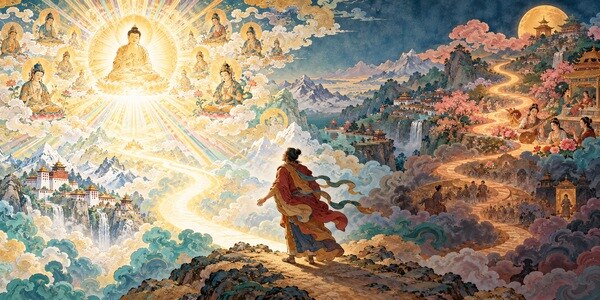
One of the most memorable motifs in the Bardo Thodol is the contrast between intense, dazzling radiances and weaker, attractive lights. The brilliant rays are associated with the wisdom of enlightened manifestations. The dimmer lights correspond to conditioned realms of existence. Consciousness unprepared to face boundless clarity is drawn toward what seems more familiar and less threatening.
This is an extraordinarily precise spiritual image of attachment. People often choose not what liberates them, but what confirms their old habits. Truth can wound pride, while a comfortable illusion offers immediate reassurance. The text transforms this inner dilemma into a luminous cosmic scene. Yet the essential challenge remains recognizable in ordinary life.
In the traditional instructions, the answer is neither to hate the dimmer light nor to glorify fear. It is to see how clinging itself creates dependence. Brilliant radiance does not demand possession, but clarity. This is precisely why light is such a fitting image. It makes things visible without being something that can be held in one’s hand. The wisdom represented through it is not an object to acquire, but a transformation in the way reality is seen.
When the Visions Pass: The Bardo of Becoming
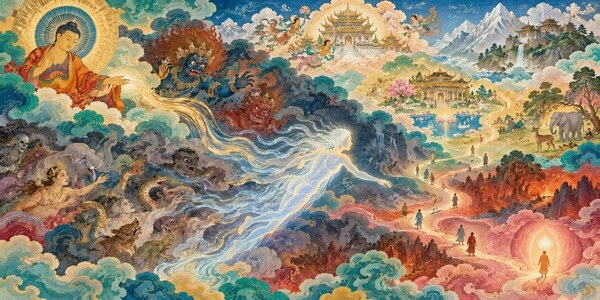
If liberation has not occurred in the preceding states, according to the traditional narrative, attention turns toward the bardo of becoming. The imagery changes. Instead of the magnificent mandala of peaceful and wrathful deities, karmic visions, fears, longings, and movements toward a new existence appear. The text describes consciousness no longer possessing the ordinary physical body, yet still conditioned by habits and tendencies.
Traditional accounts speak of a kind of intermediate body, rapid movement, sudden changes in experienced space, and difficulty finding a stable foundation. These scenes belong to Buddhist religious cosmology. They have not been observed and confirmed by modern science as universal phenomena. As a symbolic and spiritual narrative, they depict a state in which the desire for security becomes acute while old patterns of attachment operate with tremendous force.
It is here that the Bardo Thodol displays remarkable compassion. It does not abandon consciousness that has failed to recognize earlier opportunities. The instructions continue. New appeals are made for clarity, calm, and freedom from impulsive clinging. This renewed possibility is essential to the text’s spiritual logic. The path is not described as a single test after which every door closes. It is a succession of opportunities in which wisdom can be remembered.
Karma: Why Past Actions Matter
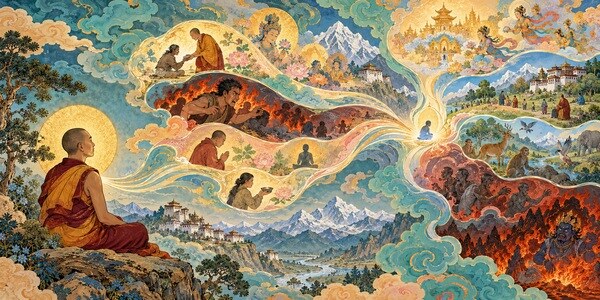
In Buddhism, karma refers primarily to intentional action and its conditioned consequences. It is not an all-powerful judge distributing punishments according to human notions of revenge. Karma belongs to the teaching of causality: actions, intentions, and habits help shape future experience. Different Buddhist schools offer different philosophical explanations of this process, but the central emphasis falls on the moral significance of intention and the interdependence of phenomena.
In the bardo of becoming, karma is represented through vivid imagery. Attraction and aversion, fear and desire, direct consciousness toward particular possibilities. The text does not merely offer a moral fable in which the good receive rewards and the bad receive punishments. It describes a complex process in which the quality of mind itself matters. Habits do not disappear simply because external conditions have changed.
This lesson has immediate value during life. Each time we respond with anger, we strengthen a particular way of perceiving. Each time we act with compassion, we develop another possibility. It is not necessary to accept the postmortem cosmology literally to understand how repeated actions shape character. Within Buddhist tradition, however, this principle extends beyond a single human lifetime and is connected with the teaching of rebirth.
A Judgment Without an Eternal Judge: Karmic Images
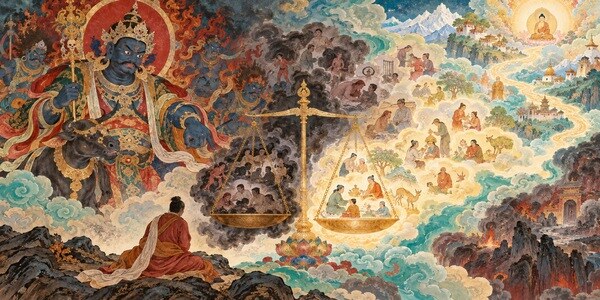
Some traditional descriptions of bardo contain frightening scenes resembling judgment, pursuit, or reckoning. Their symbols may include figures associated with Yama, the lord of death, and images of weighing or accounting for actions. Such motifs have a long history in Asian religious thought and acquired specific meanings in Tibetan culture.
These scenes should not automatically be equated with the idea of an eternal judge delivering an irreversible sentence. In the Buddhist context, they are understood in relation to karma, conditioned existence, and the possibility of liberation. The fearsome figures express the weight of one’s own actions and the impossibility of simply escaping the consequences of intention. Even when the images appear external, the instructions again direct attention toward the nature of experience.
This is one of the text’s most powerful moral moments. In everyday life, we can hide actions from others, change the story we tell about them, or construct excuses. In the karmic scenes, such defenses lose their power. The tradition presents consciousness as confronting its own history. The encounter is not merely punitive. It contains a call to awareness: a person bears responsibility for the direction given to life and for the traces left in the world.
The Six Realms of Existence
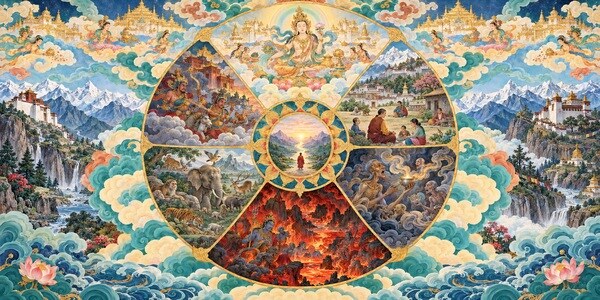
The bardo of becoming is also connected with the Buddhist teaching of the six realms of samsara: the realms of gods, jealous demigods, humans, animals, hungry ghosts, and beings in hellish states. In traditional cosmology, these are possible forms of conditioned existence. Contemporary philosophical interpretations also frequently use them as images of human psychological states. These two approaches are not identical and should not be blended without explanation.
The realm of the gods is associated with pleasure and longevity, but it does not offer final liberation because it too is impermanent. The world of jealous demigods expresses rivalry and envy. The human realm is especially valuable because it combines suffering with the opportunity for spiritual practice. The animal realm is associated with ignorance and limitation, the realm of hungry ghosts with insatiable desire, and hellish states with extreme suffering and hatred.
Considered as philosophical symbols, these six realms reveal different ways the mind can become imprisoned. Pride constructs its own heavenly palace; envy transforms life into a competition; insatiability leaves a person perpetually hungry regardless of how much is acquired. Yet in the classical religious context, the realms are not merely psychological metaphors. They form part of the cosmological teaching of samsara and rebirth. This dual significance makes depictions of the wheel of life so rich and compelling.
Attraction, Aversion, and the Movement Toward Another Birth
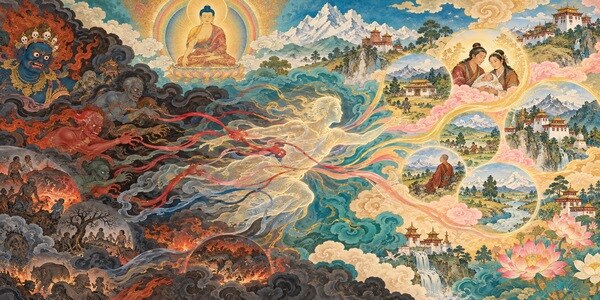
In traditional instructions for the bardo of becoming, consciousness is depicted as subject to powerful impulses directing it toward a new embodiment. Images of future parents, places, and circumstances of birth appear in some descriptions as part of this process. Desire and aversion play central roles. The text warns that impulsively following these tendencies perpetuates conditioned existence.
It is important to understand how the Buddhist teaching of rebirth differs from the idea of an eternal, unchanging soul that simply changes bodies. In classical Buddhism, the teaching of non-self, or anatman, rejects the notion of a permanent, independent essence of personhood. At the same time, causal continuity between states of existence is affirmed. Different philosophical schools explain this continuity through different models, but do not reduce it to the transfer of an unchanged personal substance.
The account of rebirth is therefore much more than a fantastic story about choosing another body. It expresses the conviction that ignorance and craving for existence continue to generate conditioned experiences. As long as the mind clings to them, samsara continues. Liberation is not simply a more pleasant next biography, but the overcoming of the very mechanism that sustains suffering.
The Womb Entrances and the Final Instructions
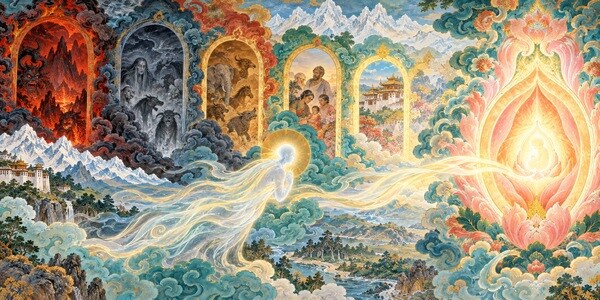
One of the most unusual motifs in the Bardo Thodol is the instruction to close or avoid certain womb entrances as consciousness moves toward another birth. These words belong to the particular symbolic and ritual language of the tradition. They should not be turned into literal medical claims about conception or embryonic development. Within the religious text, they express the aspiration to interrupt the automatic movement produced by desire, fear, and karmic tendencies.
When liberation has not been achieved, some instructions direct the listener toward a more favorable birth that will allow future spiritual practice. This is an important detail. The text does not reduce everything to an opposition between absolute success and irreversible failure. In the Buddhist worldview, there are different degrees of favorable conditions, and human birth is valued precisely because it provides an opportunity for conscious spiritual development.
These final instructions complete the great dramatic arc of bardo. From the dissolution of the elements and clear light, through majestic deities and karmic visions, the narrative reaches a new beginning. Yet this beginning is not presented as an unconditionally happy ending. It is the continuation of causality if ignorance remains unovercome. The deepest message of the book is that liberation does not consist in endlessly repeating life, but in awakening from the delusion that makes repetition inevitable.
Forty-Nine Days: The Rhythm of Transition
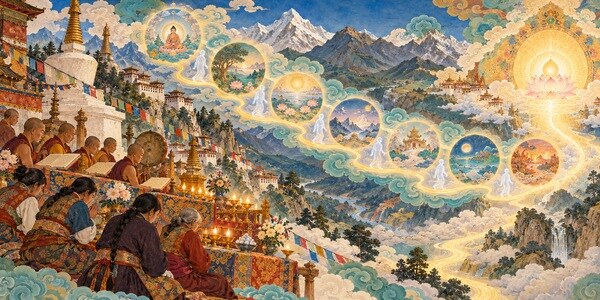
In Tibetan funerary traditions, the period of forty-nine days holds particular significance. It is commonly associated with seven weeks during which prayers, readings, and rituals are performed for the deceased. In certain Buddhist explanations, this is the maximum duration of the intermediate state before another birth, although different schools and texts do not present every detail in the same way. It should not be assumed that every translation of the Bardo Thodol describes an absolutely identical chronology.
The number seven carries ritual and symbolic weight, while the repetition of seven-day periods organizes the time of mourning. For a family, these days create a space in which loss is not pushed into silence. Through prayers, offerings, and virtuous actions, relatives express their love and direct attention toward the welfare of the deceased according to their religious tradition.
There is no need to treat this period as a scientifically measured timetable of postmortem consciousness. Its religious function is clear: to sustain attention, memory, and compassion during a time when the community undergoes profound change. The ritual calendar prevents death from being reduced to a single day. It acknowledges that separation unfolds over time and that the living need actions through which to express reverence and affection.
The Guide’s Voice: Why the Text Is Read to the Dying
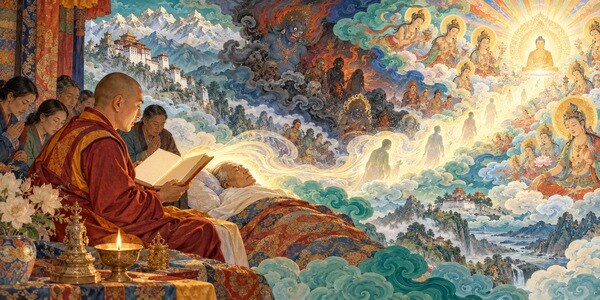
The very title Liberation Through Hearing places the voice at the center of the ritual. In traditional practice, a qualified teacher, lama, or other appropriate ritual participant may read the instructions to the dying or deceased person. It is believed that spiritual guidance can help consciousness recognize the states that arise. The reading is not simply a literary performance for those present. It is a religious act directed toward a specific purpose.
The text frequently addresses the listener directly. It speaks as though guiding someone through a dangerous passage: do not be afraid, recognize the light, do not become attached to visions. The repetition of such instructions has particular force. In a moment of confusion, elaborate philosophical explanations give way to clear, insistent words. The voice becomes a symbol of remembering the teaching, which must remain alive when ordinary supports disappear.
This ritual also has a human dimension. The presence of a calm, trusted voice beside a dying person can express care and respect. Specific practices must, of course, follow the wishes of the person and their loved ones without interfering with medical care. Not everyone shares Tibetan Buddhist beliefs, and rituals should never be imposed. Within its own tradition, however, the reading of the Bardo Thodol is a profoundly compassionate gesture: an attempt to ensure that no one is left without spiritual support in the face of the greatest change.
Why the Peaceful and Wrathful Deities Are Not Merely External Beings
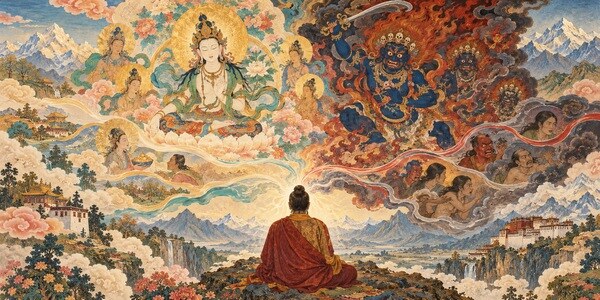
One of the most common mistakes in popular presentations of the Tibetan Book of the Dead is to describe all its deities as independent beings that will necessarily appear before everyone after death. Such an interpretation misses the heart of tantric symbolism. In the relevant teachings, peaceful and wrathful manifestations are closely connected with the nature of mind and the possibility of recognizing reality.
This does not mean they can simply be reduced to psychological fantasies in the modern sense. For practitioners, they belong to a living religious system in which ritual, meditation, initiation, and philosophy are inseparable. Yet the text clearly insists that the relationship of consciousness to a vision is decisive. Fear and clinging produce confusion; recognition reveals the liberating perspective.
Here mysticism and philosophy meet. People are inclined to turn their own experiences into an unquestionable external reality. Anger appears to prove that the world is hostile. Desire appears to prove that a particular object will bring complete happiness. Tibetan tradition proposes a radically different discipline: observe how the mind participates in constructing experience. In bardo, this discipline is presented as a matter of liberation. In life, it becomes a path toward less delusion and greater responsibility.
Death and the Teaching of Impermanence
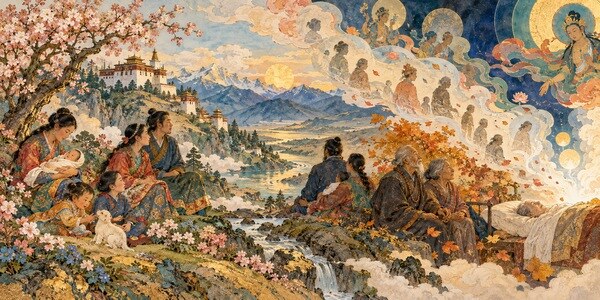
Impermanence, or anicca, is one of the foundational insights of Buddhism. Everything that arises through causes and conditions changes. The body ages, relationships transform, thoughts appear and vanish, and even the strongest feelings do not remain fixed. Death is the ultimate expression of this principle within a human life. Tibetan instructions about dying are therefore not isolated mystical curiosities. They continue a fundamental Buddhist reflection on transience.
Understanding impermanence does not mean becoming indifferent to life. On the contrary, realizing that everything passes can make each moment more precious. When a person knows that a meeting will never be repeated in exactly the same form, listening can become more attentive. When one understands that time is limited, there is reason to arrange priorities with greater honesty. Buddhist practice connects this insight not with despair, but with compassion and wisdom.
In the Bardo Thodol, impermanence takes on majestic imagery. The elements dissolve, lights change, deities appear and disappear, and karmic visions draw consciousness onward. None of these appearances is to be held as permanent property. The movement of the narrative itself shows how attachment to permanence creates suffering. The book teaches us to regard change not only as loss, but also as an opportunity to release the mistaken ideas that keep us captive.
No Unchanging Soul: The Paradox of Buddhist Rebirth
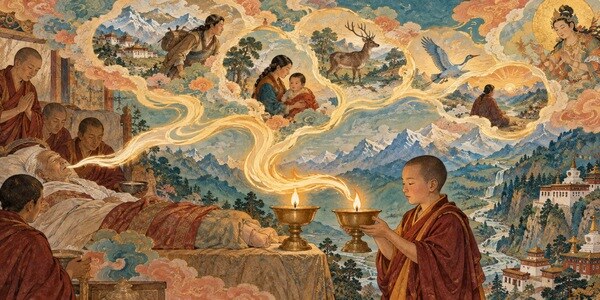
For readers raised with the idea of a soul as a permanent essence, the Buddhist teaching of rebirth presents a difficult question. If there is no unchanging self, what continues from one life to another? Buddhist philosophy understands personhood as an interdependent process involving bodily form, feeling, perception, volitional formations, and consciousness. None of these components is eternal or independent. Nevertheless, actions and conditions produce consequences, just as the flame of one candle can light another without the two flames being numerically identical.
This comparison does not resolve every philosophical question, but it reveals the basic direction of the teaching. Continuity does not require an unchanging substance. A causal relationship can exist without a permanent personal essence. Different Buddhist schools develop this idea through different concepts, and Tibetan Buddhism inherits the richness of Indian philosophical debates on the subject.
In the context of bardo, this perspective is particularly important. The account of consciousness passing through intermediate states should not automatically be translated into a story about an eternal soul traveling through space. The tradition speaks of conditioned continuity, karma, and the possibility of ending ignorance. The mystical journey thereby becomes a philosophical inquiry into the very nature of personhood. Who is the one who fears? Who desires to continue? And what remains of the idea of me when all its familiar supports dissolve?
Liberation Is Not Simply a Happier Rebirth
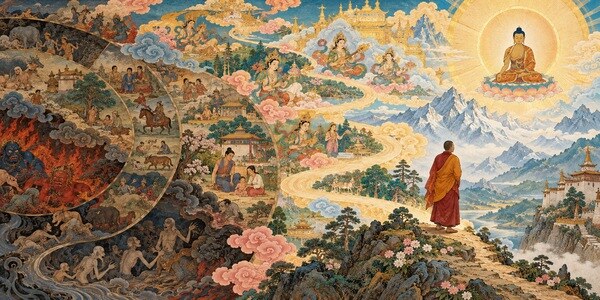
In Buddhist tradition, samsara denotes the cycle of conditioned existence associated with suffering, ignorance, and craving. A more favorable birth may provide a valuable opportunity for practice, but it is not equivalent to final liberation. Even heavenly realms are impermanent in classical Buddhist cosmology. This distinguishes the spiritual goal from the ordinary wish to obtain a more pleasant version of the present life.
The Bardo Thodol repeatedly directs attention toward liberation through recognition. When this does not occur, its instructions offer other possibilities, including guidance toward favorable conditions for future practice. This layered approach reveals the practical pedagogy of the tradition. The teaching addresses beings with different degrees of preparation and different capacities. It does not demand that everyone reach the same insight in the same way.
In its deepest sense, liberation is not escape from one world into another, but the overcoming of the ignorance that produces clinging. This is why clear light, the mandala of deities, and karmic visions belong to a single narrative. They are not three unrelated spectacles. They represent different possibilities before consciousness: to recognize, to fear, to become attached, or to continue being driven by old habits. The greatness of the text lies in its unwavering orientation toward awakening.
The Mandala, Colors, and the Symbolic Architecture of Mind
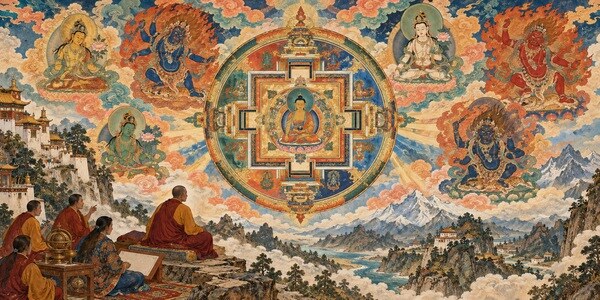
Tibetan religious art is inseparable from the way the Bardo Thodol has been understood and explained. Mandalas, thangkas, and depictions of peaceful and wrathful deities give visible form to complex teachings. Colors are not chosen merely for beauty. They participate in a system of correspondences between Buddha families, wisdoms, directions, and mental tendencies to be transformed. This system must be examined within its specific tradition, since different ritual cycles may employ different details.
At the center of a mandala there is often a figure organizing the other manifestations. Around it unfold directions, spaces, and relationships. For practitioners, this is not an ordinary picture, but a sacred map of spiritual transformation. For scholars, it testifies to the remarkable ability of Tibetan culture to unite philosophical ideas, ritual instructions, and visual symbolism.
This is why images associated with bardo should be approached with respect for their context. A wrathful figure may appear monstrous when separated from the teaching of compassion. A peaceful figure may look merely decorative when detached from the idea of wisdom. Seen as parts of a shared spiritual architecture, these images reveal their real power: they transform the invisible movements of mind into a world of forms that can be contemplated, remembered, and understood.
Dreaming as Preparation for the Great Transition
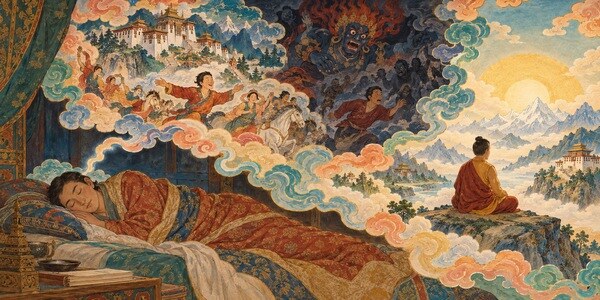
Dreaming occupies an important place among the intermediate states in Tibetan teachings. During sleep, a person may experience events that seem completely real. One rejoices, fears, flees, and desires until awakening occurs. Then the dream world loses its apparent independence. This feature makes dreaming a powerful image of the failure to recognize reality that Buddhist philosophy identifies within ordinary conditioned experience.
Some Tibetan traditions develop specialized practices of dream yoga, in which practitioners train to recognize dreaming while the dream continues. These practices belong to specific spiritual systems and should not be reduced to recreational techniques for controlling dreams. Their purpose concerns insight into the nature of experience and freedom from automatic attachment to appearances.
The connection with bardo is clear. If a person can recognize a dream without being completely absorbed in its images, this provides a symbolic model for recognizing other transitional states. It does not prove that dreaming and postmortem experience are the same. It reveals the logic of Tibetan spiritual training: the capacity for clarity must be developed during life, across ordinary and extraordinary states of mind. Death is not a separate lesson, but the final great examination of attention.
Compassion for the Dying and Those Who Remain
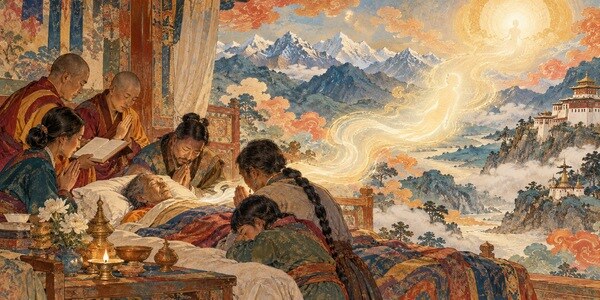
Mystical visions often attract the strongest attention from readers, but at the foundation of the Bardo Thodol lies a profound ethic of compassion. The text exists within a tradition that seeks to help a being confronted by fear and confusion. Readings, prayers, and rituals express the conviction that spiritual support should not disappear when physical presence changes.
For loved ones, death is a test of love. They cannot hold back the person they are losing, but they can accompany the departure with attention, reverence, and good wishes. In Buddhist communities, practices of accumulating and dedicating merit are understood as ways to direct virtuous actions toward the welfare of the deceased. This is a religious conviction and should be presented as such. Its human value can be seen in the way it transforms the helplessness of grief into acts of care.
Compassion also requires respect for difference. Not every dying person wishes for a Buddhist ritual, and some find support in other religions or in nonreligious forms of presence. Genuine care does not impose beliefs. It listens. In this sense, the tradition’s deepest lesson is universal: when someone approaches the end of life, that person deserves calm, dignity, and a presence that does not turn suffering into a stage for someone else’s ideas.
How the Tibetan Book of the Dead Reached the West
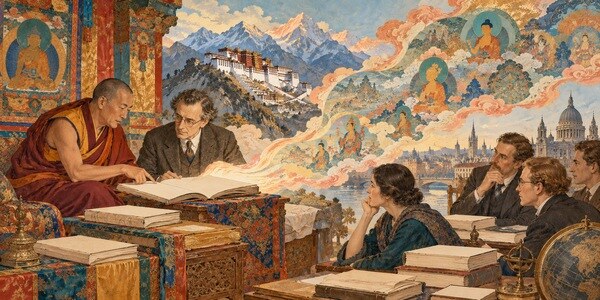
During the twentieth century, the Tibetan Book of the Dead became widely known beyond the Tibetan religious world. An especially influential role was played by the English edition associated with Walter Y. Evans-Wentz and the translation work of Lama Kazi Dawa-Samdup, published in 1927. It introduced a large Western readership to a text that had previously been almost unknown to it. At the same time, the editorial and philosophical framework of that early edition reflected the interests of its era and did not always coincide with the way Tibetan teachers explained the tradition.
Later translations and studies have provided richer context, more precise terminology, and clearer distinctions between different textual cycles. They demonstrate that the Bardo Thodol should not be read as a universal encyclopedia of every Tibetan belief about death. It belongs to a particular religious lineage, even though ideas about bardo and rebirth occupy a much wider place in Tibetan Buddhism.
The book’s Western popularity also inspired bold comparisons with psychology, mysticism, and the study of consciousness. Some of these parallels are philosophically productive, but they cannot replace historical understanding. The Tibetan instructions arose within a world of Buddhist practice, ritual, and philosophy. When they are transformed solely into a modern theory of the subconscious or an exotic account of the afterlife, part of their essence is lost. The strongest reading combines admiration with attention to their origins and purpose.
What Science Can Say and What Remains a Matter of Faith
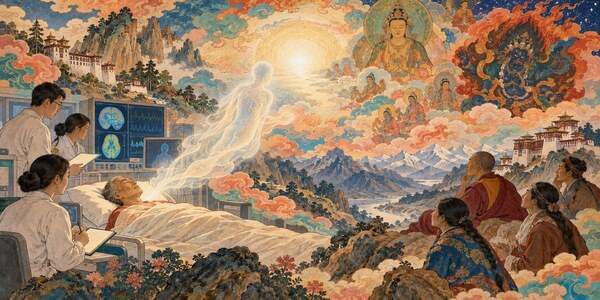
Modern science studies dying through physiology, neuroscience, medicine, and psychology. It can describe changes in brain activity, cardiac function, breathing, and subjective experiences reported by people who have survived critical conditions. Such research is important, but it does not establish the traditional sequence of bardo, the appearance of peaceful and wrathful deities, or rebirth as fact. Scientific methods require verifiable evidence and a clear distinction between testimony, interpretation, and conclusion.
Near-death experiences often attract public interest. Some people describe light, sensations of separation from the body, or intense emotional experiences. Such reports are not identical to the descriptions in the Bardo Thodol and do not, by themselves, prove Tibetan religious cosmology. Different cultures provide different symbols through which people understand extraordinary experiences. Comparisons therefore demand care rather than haste.
This distinction does not diminish the text’s spiritual value. Religious tradition asks questions about meaning, liberation, and moral preparation that are not exhausted by laboratory measurements. Science, in turn, should not be used as a decorative seal of approval for unverified claims. The most authoritative approach is to name the boundaries of knowledge clearly. The Tibetan Book of the Dead is a great testimony to Buddhist spiritual thought; it is not a medical protocol describing life after death.
Death as a Mirror of the Way We Live
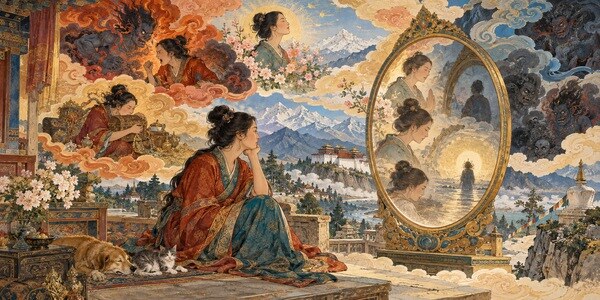
The most astonishing feature of the Bardo Thodol is that after leading us through so many celestial lights and terrifying images, it returns us to the question of how we live today. Recognition does not begin after death. It begins the moment we notice our anger before turning it into action; when we see attachment before it becomes suffering; when we accept change instead of demanding that the world remain motionless for our sake.
Tibetan tradition regards life as a precious opportunity for training. In this sense, everyday meetings, losses, and joys prepare us for the greatest transition. A person who constantly flees discomfort and clings to pleasure reinforces a habit that, according to the text, may become especially powerful in bardo. A person who develops compassion and clarity creates a different inner direction. Spiritual work is not separate from character; it is expressed through character.
This makes the book much more than a description of death. It is a mirror held before the living. In it we see how easily we mistake the familiar for the true, how often fear makes us flee our own experiences, and how persistently desire convinces us that the next possession will bring final satisfaction. The text offers another path: learn to see without immediately clinging. Here its wisdom extends beyond the boundaries of religious curiosity.
The Great Journey: From Dissolution to the Possibility of Awakening
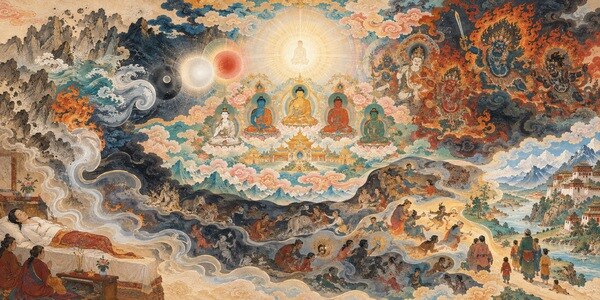
Let us bring together the narrative’s great sequence. At the beginning, a person loses the supports of the familiar bodily world. Earth, water, fire, and air dissolve within the traditional symbolism of dying. Subtle states follow, described through white appearance, red radiance, and darkness. At the decisive moment, the teaching speaks of clear light: an opportunity to recognize the nature of mind directly.
If this opportunity is not realized, the narrative moves into the radiant mandala of peaceful deities. The five Buddha families and their qualities of wisdom appear through lights and images to be recognized rather than possessed. They are followed by wrathful manifestations that shake fear and confront consciousness with its deepest attachments. If recognition still does not occur, the bardo of becoming unfolds karmic visions, movements of desire and aversion, and a trajectory toward another birth.
Each part of this account has its own atmosphere, but all are united by one idea. Liberation is not achieved by fleeing visions, but by understanding their nature. This is why the instructions recur: recognize, do not fear, do not cling. That is the heart of the spiritual journey. The book presents death as the greatest test of clarity, but also as a succession of opportunities in which wisdom can awaken.
Why This Book Continues to Move the World
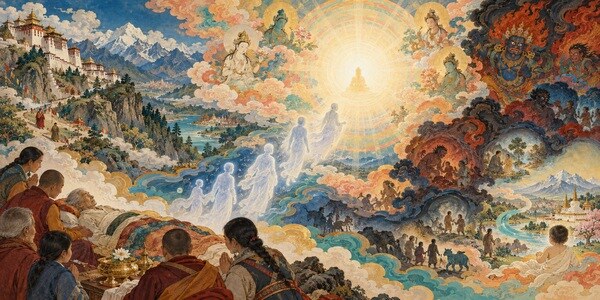
The Tibetan Book of the Dead remains one of the most compelling works of world spiritual literature because it refuses to regard death only as the end of biological functions or an occasion for fear. It places death within an immense philosophical vision in which life, dreaming, meditation, dying, and rebirth are connected through the question of the nature of consciousness. This vision belongs to Tibetan Buddhism, yet the questions it raises reach every human being.
What remains of our identity when we lose everything through which we have defined it? Why do we fear change even when we know it is inevitable? Why do we prefer familiar illusions to truths that demand inner transformation? What does it mean to face the unknown with clarity and compassion? These questions do not belong to one monastery, one culture, or one historical era alone.
The magnificence of Tibetan tradition lies in its ability to transform these questions into an unforgettable spiritual journey. The dissolving elements, dazzling light, peaceful deities, wrathful dances, and karmic visions are not a random series of fantastic scenes. They belong to a coherent teaching about ignorance and liberation. When read with respect for their origins, they reveal not only mystical beauty, but extraordinary philosophical rigor.
The Final Door and the First Light
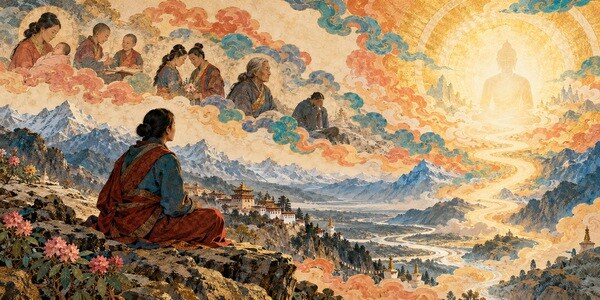
At the end of this journey, the most powerful image is neither the terrifying face of a wrathful deity nor the mysterious judgment of karma. It is the light that must be recognized. That image unites every part of the narrative because it points toward the same possibility: liberation from the ignorance that causes consciousness to fear its own experiences and cling to what is impermanent.
The Bardo Thodol does not provide a scientifically proven map of life after death. It offers something different and immensely valuable: the testimony of a spiritual tradition that has transformed the encounter with impermanence into a path of wisdom. Its authority arises from the richness of Buddhist philosophy, ritual, and meditative culture, not from a claim that otherworldly realms have been confirmed in laboratories. Precisely for this reason, we can admire the book without distorting its meaning.
When we close its pages, the most important question remains before us. If death is the ultimate transition, what are we doing with the transitions we experience every day? Can we meet loss without bitterness, change without despair, and the unknown without blind flight? Tibetan tradition responds through its most enduring appeal: cultivate clarity, compassion, and recognition now. For the true spiritual journey does not begin with the final breath. It begins in this moment, while we still have the opportunity to awaken.
Author: Vasil Stoyanov