
Introduction
What actually makes a person truly happy? This is a question that philosophers, spiritual teachers, and scientists have been asking for thousands of years. Some believe that happiness lies in wealth, others in fame, success, or personal achievements, while still others seek it in spiritual growth and inner peace. In the modern world, filled with constant comparisons, social media, and the pursuit of ever more material possessions, this question seems more relevant than ever.
In recent decades, science has begun to study happiness in ways that were previously unimaginable. Instead of relying solely on philosophical reflections or momentary surveys, researchers have followed the lives of real people over decades. This allows them to see not only what makes people feel happy at a given moment, but also which factors influence their health, satisfaction, and quality of life throughout their entire lifespan.
Among all such studies, one stands out as unprecedented. It has lasted for more than eight decades, includes several generations of participants, and is often described as the longest scientific study of human life and happiness ever conducted. Its findings challenge many popular ideas about success and reveal something surprisingly simple – the factor that has the strongest impact on our well-being is not what most people pursue.
The Longest Study of Human Happiness in History

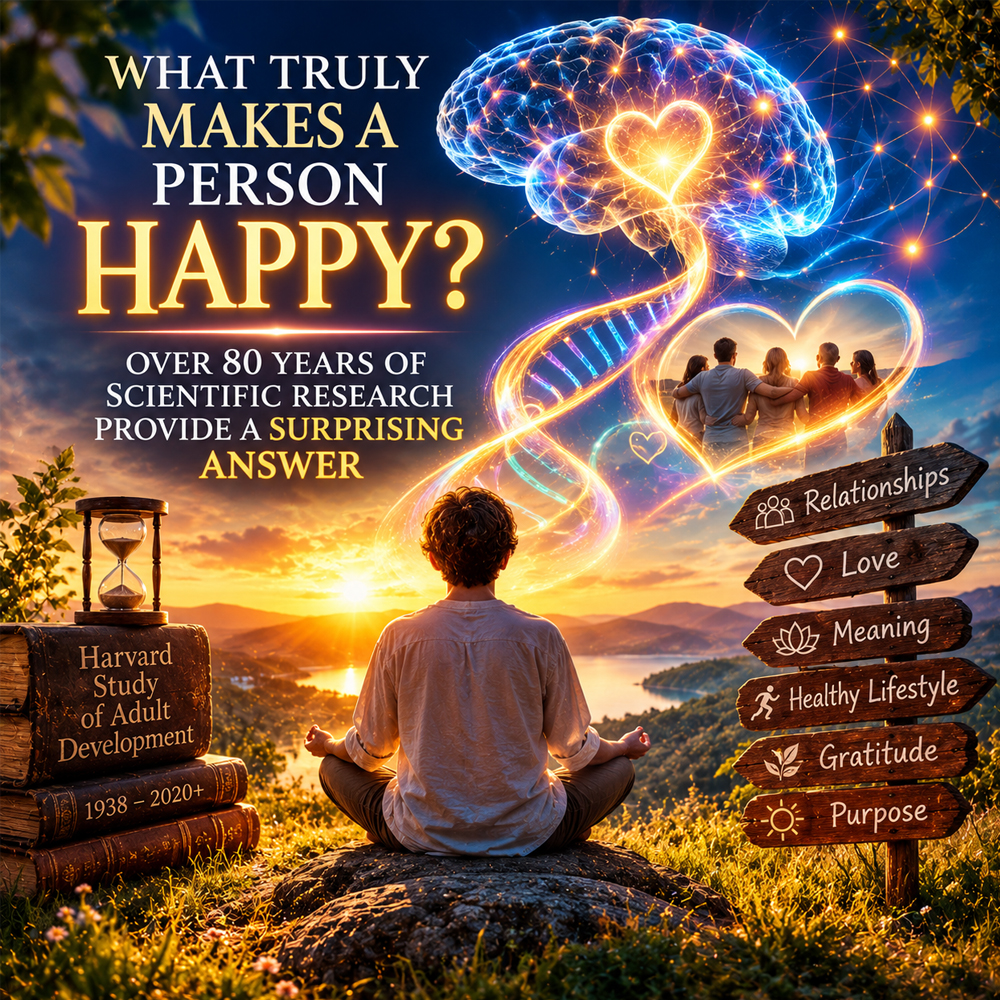
In 1938, scientists at Harvard University launched an ambitious project that initially seemed like just another academic study. The goal was to track the development of a group of young men over many years in order to understand which factors lead to good health, a successful career, and a fulfilling life. None of the original researchers imagined that the project would continue for decades and become one of the most cited psychological and medical studies in the world.
The first participants came from two completely different social backgrounds. One group consisted of Harvard University students – young men with excellent academic performance and promising futures. Among them were future lawyers, doctors, scientists, and even a President of the United States. The other group included boys from some of the poorest neighborhoods in Boston, who grew up in conditions of poverty, family conflict, and limited opportunities. This combination allowed scientists to observe how different starting points in life influence human development.
Over time, the study expanded significantly. In addition to the original participants, researchers began to follow their wives, children, and even grandchildren. In this way, the project gradually evolved from observing individuals into a large-scale study of multiple generations of families. This made it possible to analyze how habits, relationships, and lifestyle affect people throughout their entire lives.
How Scientists Track the Lives of Participants

One of the reasons the Harvard Study of Adult Development is so valuable is its exceptional depth. Instead of relying on one-time interviews or short questionnaires, participants have been followed regularly for decades. They complete detailed surveys, undergo medical examinations, psychological assessments, and cognitive tests, while researchers conduct in-depth conversations with them about their families, work, friendships, dreams, and the challenges they face.
As medical technology has advanced, the study has incorporated increasingly precise methods of analysis. Scientists examine blood markers, genetic factors, brain function, cardiovascular health, and various biological indicators related to aging. As a result, the project combines psychology, medicine, neuroscience, and sociology, making it one of the most comprehensive studies of human life.
Perhaps most impressively, participants are not observed only during moments of success. Researchers track divorces, the loss of loved ones, professional failures, financial crises, serious illnesses, and all the other events that accompany a human life. This makes it possible to identify the factors that truly make people resilient and fulfilled, rather than just the temporary causes of good mood.
Why This Study Is So Important

Most scientific studies last a few months or a few years. They can show connections between different factors, but they rarely track how these relationships change over an entire lifetime. The Harvard Study of Adult Development does exactly that. Thanks to its extensive time span, scientists can distinguish between short-term effects and those factors that influence people for decades.
This makes its findings far more reliable than the popular claims often seen in the media or on social networks. Instead of being based on personal impressions or motivational ideas, the conclusions come from decades of real-life observations of hundreds of people. That is why the results of this study are used not only in psychology, but also in medicine, education, social policy, and research on human well-being.
However, the most interesting part is yet to come. After analyzing tens of thousands of pages of interviews, medical data, and psychological assessments, scientists reached a conclusion that contradicts many of the most widespread beliefs about success and happiness. This discovery proved to be so consistent that it remains valid regardless of age, social status, income, or profession.
Money, Success, and Fame – Why They Are Not Enough for a Happy Life

If we ask random people what would truly make them happy, many would likely give similar answers. Some would say they need more money, others would point to a successful career, a bigger house, financial security, or social recognition. These goals often seem completely logical because they promise comfort, freedom, and the ability to live the way we want. That is why a large part of modern life is spent pursuing professional and material success.
However, scientists from the Harvard Study of Adult Development have found that reality is far more complex. After decades of observation, they discovered that high income alone does not guarantee long-term life satisfaction. Many participants who achieved impressive professional success later reported loneliness, chronic stress, or a lack of meaning, while others with far more modest financial means turned out to be among the happiest people in the study.
This does not mean that money does not matter. Financial security can reduce anxiety, provide access to quality healthcare and education, and make everyday life more comfortable. The problem arises when we begin to see wealth as the main source of happiness, because scientific evidence shows that once basic human needs are met, its influence gradually diminishes.
Why We Always Want More

Psychologists use the term “hedonic adaptation” to describe one of the most interesting features of the human brain. When we achieve a long-awaited goal – a new home, a higher salary, or a dream car – we initially feel a strong sense of satisfaction. However, after some time, the new reality becomes ordinary, and our level of happiness gradually returns almost to where it started.
This is why so many people live with the feeling that happiness is always one step ahead. After the first promotion, they begin to dream of the next one. After buying their first home, they start thinking about a bigger one. After receiving professional recognition, they strive for an even higher position. Desire constantly shifts the horizon and creates the impression that true satisfaction lies somewhere in the future.
Participants in the Harvard study are no exception. Those who devote almost all their energy solely to career and material achievements rarely report that they have found lasting happiness after reaching them. Instead, they often begin pursuing new goals without ever feeling that they have reached enough.
Success Without Closeness Can Be Surprisingly Lonely

One of the most interesting conclusions of the study is that professional success does not always go hand in hand with personal well-being. Among the participants are people who build impressive careers, manage large companies, or hold prestigious public positions. Despite this, some of them describe their lives as emotionally empty because success has gradually replaced time for family, friends, and personal relationships.
This pattern is not uncommon today. More and more people spend most of their day working, attending meetings, and completing professional tasks. By the end of the week, they are physically and mentally exhausted, and conversations with their closest ones are reduced to just a few minutes. In the short term, such a lifestyle may seem justified, but when it becomes a permanent pattern, the consequences begin to accumulate.
Researchers have found that people rarely regret not having worked more. Much more often, especially in later years of life, they regret missed family moments, lost friendships, and time they will never be able to get back. This observation appears so frequently that it becomes one of the strongest themes throughout the entire project.
How Society Misleads Us

Modern culture constantly sends us the message that a person’s value depends on their achievements. Advertisements show successful, wealthy, and flawless-looking people. Social media presents carefully selected moments from others’ lives, creating the impression that everyone around us is living more interesting, happier, and more successful lives. Gradually, we begin to believe that if we reach the same level of success, we will automatically become happier.
The Harvard Study of Adult Development shows that this idea is misleading. The study finds no evidence that social recognition or prestige alone protects people from loneliness, depression, or chronic stress. On the contrary, some of the most successful participants experience serious personal crises precisely because they have neglected the most important human relationships in their pursuit of success.
This does not mean that we should give up our ambitions. Work, creativity, and professional development can be sources of meaning and satisfaction. The question is whether they become a natural part of a balanced life or gradually begin to replace everything else.
The Big Question Scientists Ask

After decades of analyzing vast amounts of medical data, psychological assessments, and personal stories, researchers began to notice a pattern. Some participants remain physically healthy, mentally resilient, and satisfied with life even when going through difficult periods. Others, despite financial success and high social status, experience more loneliness, anxiety, and health problems.
What causes this difference? What distinguishes people who age not just longer, but happier? The answer gradually begins to take shape, and it turns out to be far simpler than many might expect. This discovery becomes the most famous conclusion of the Harvard Study of Adult Development and changes the way psychology and medicine understand human well-being.
The Big Discovery: What Actually Makes People Happy

After more than eight decades of observations, thousands of interviews, and a vast amount of medical and psychological data, researchers from the Harvard Study of Adult Development have reached a conclusion that at first glance seems surprisingly simple. The strongest factor that predicts whether a person will be happy, healthy, and satisfied in the long term is not wealth, intelligence, fame, or professional success. What matters most is the quality of human relationships.
This conclusion appears so consistently in the data that over time it has become the central idea of the entire study. People who maintain close, trusting, and stable relationships with family, friends, or partners not only report higher levels of happiness, but also enjoy better physical health, a lower risk of depression, and longer lives. It turns out that the quality of our connections matters more than many other factors we traditionally associate with a successful life.
It is important to emphasize that the scientists are not talking about the number of friends on Facebook, popularity, or having a wide social circle. The study shows that what truly matters is the quality, not the quantity, of relationships. Even a few sincere, deep, and trust-filled connections can have a profound impact on human well-being.
It’s Not About Never Having Conflicts

One of the most common misconceptions is that happy people live in relationships without arguments or tension. The data from the Harvard Study of Adult Development shows exactly the opposite. Almost all long-term families and friendships go through conflicts, disagreements, and difficult periods. This is a natural part of any human relationship.
The difference lies in how people deal with these challenges. The most satisfied participants do not avoid conflict, but manage to resolve it through trust, respect, and open communication. They understand that disagreements are not a sign of a failing relationship, but an inevitable part of closeness between two people.
Researchers have also discovered something else interesting. People who feel that they have someone to rely on during difficult times recover more quickly from life crises, job loss, illness, or personal disappointments. Simply knowing that you are not alone turns out to be a powerful psychological resource.
How Relationships Affect the Brain and Body

In recent decades, modern medical research has been added to the project, helping to explain why close relationships have such a strong effect. When a person lives in an environment filled with trust, support, and emotional security, the body produces fewer chronic stress hormones. This has a positive impact on the cardiovascular system, the immune system, and even on how the brain processes emotions.
Chronic stress acts like a slow erosion on the human body. Elevated levels of cortisol can increase the risk of high blood pressure, heart disease, sleep disturbances, and a weakened immune system. However, when a person has stable and supportive relationships, the negative effects of stress are significantly reduced. Not because problems disappear, but because we no longer carry them alone.
The results related to aging are particularly impressive. Participants who had high-quality relationships in midlife were more likely to maintain good cognitive health and better memory in later years. Although aging is an inevitable process, social connection appears to play an important role in maintaining mental well-being.
Loneliness – The Silent Risk to Health

If good relationships bring so many benefits, it is logical to ask what happens in their absence. This is where the Harvard Study of Adult Development reaches one of its most concerning conclusions. Prolonged loneliness is not just an unpleasant emotional experience, but a real risk factor for physical and mental health.
Loneliness does not necessarily mean living alone. A person can be surrounded by people every day and still feel isolated and lacking true connection. The opposite is also true – a person may have a small social circle, but if those relationships are sincere and deep, they can feel fully connected to others.
Researchers have found that people who feel lonely for extended periods are more likely to develop health problems, experience higher levels of anxiety and depression, and generally report a lower quality of life. This makes social isolation a topic that modern medicine and psychology are taking increasingly seriously.
Small Moments Turn Out to Be More Important Than Big Events

One of the most beautiful conclusions of the study is that happiness rarely comes from single grand events. It is much more often built gradually through dozens of seemingly insignificant moments – a dinner with family, a sincere conversation with a friend, a walk with a loved one, a hug after a difficult day, or laughter without a specific reason.
Many participants share that when they look back on their lives, their most vivid memories are not related to promotions, purchases, or public achievements. What they remember most strongly are the moments spent with the people they loved. These experiences are what give meaning to all other accomplishments.
This conclusion may sound almost obvious, but that is precisely what makes it so valuable. In the rush of everyday life, we often underestimate the power of small human gestures because we are convinced that happiness will come after the next big achievement. The Harvard Study of Adult Development shows that in many cases, we already possess the most important prerequisite for a happy life – we simply need to give it more attention.
How We Can Apply These Scientific Findings in Our Own Lives

One of the most valuable qualities of the Harvard Study of Adult Development is that its conclusions are not intended only for scientists or psychologists. They offer practical guidance that anyone can apply in their daily life. After more than eighty years of research, it has become clear that happiness is not a mysterious gift that some people are born with, but largely the result of the habits, choices, and relationships we build day by day.
The first and perhaps most important step is to rethink our own priorities. In the modern world, it is easy to believe that work should always come first, that productivity defines our worth, and that rest is wasted time. The study shows that this way of thinking often leads us, almost without noticing, to sacrifice exactly what will later prove to be most valuable – the time we spend with the people we love.
This does not mean giving up our ambitions or neglecting our professional development. The real idea is to build a life in which success does not come at the expense of human connection. A career can bring satisfaction, but it can hardly replace a sincere conversation with a close friend, a dinner with family, or quiet time spent with the person we love.
Small Everyday Gestures Have Greater Value Than We Assume

One of the most interesting ideas that emerges from the participants’ stories is that strong relationships are rarely built through grand gestures. Much greater importance lies in the small actions that are repeated daily. A short phone call with a parent, a walk with a partner after work, genuine interest in a friend’s day, or time spent without a phone and other distractions – these seemingly insignificant moments gradually build trust and closeness.
This is especially important in an era when technology allows us to be constantly connected, but not always truly close. We can send dozens of messages throughout the day and still not have a single meaningful conversation. The study reminds us that human relationships need more than just contact – they require attention, presence, and genuine interest.
Time is the only resource we can never get back. That is why the way we choose to spend it gradually shapes the quality of our lives. We often fail to realize the value of ordinary moments until one day they become our most cherished memories.
It Is Never Too Late for Change

The good news is that the results of the Harvard Study of Adult Development do not suggest that our fate is predetermined in youth. Many participants significantly changed their lives later on. Some restored broken relationships with their children, others found new friendships after retirement, and still others built stable partnerships after years of loneliness.
This is especially encouraging because it means it is never too late to invest in our relationships. Whether we are thirty, fifty, or seventy years old, our brains and emotional worlds continue to respond positively to genuine human connection. Every step toward better communication, forgiveness, or restoring an important relationship can have a real impact on the quality of our lives.
Of course, not all relationships can or should be preserved. Sometimes the healthiest decision is to distance ourselves from toxic people or environments that constantly cause us pain. The study does not encourage maintaining every relationship at any cost, but rather highlights the importance of those based on mutual respect, trust, and support.
When Science Meets Philosophy

One of the most impressive aspects of the Harvard Study of Adult Development is how strongly its conclusions overlap with ideas that have existed for thousands of years. Although the study uses modern scientific methods, its findings echo the wisdom of many philosophical and spiritual traditions.
Buddhism teaches that compassion and interconnectedness are the foundation of human well-being. Taoism speaks of harmony between the individual and the world, rather than the endless pursuit of material possessions. The Stoics emphasize that true wealth lies in character, virtue, and relationships with others, not in external circumstances. Although these teachings emerged in different eras and cultures, they remarkably converge with what science confirms today.
This does not mean that philosophy replaces science or vice versa. Rather, it shows that when different approaches arrive at similar conclusions, the likelihood that they have captured something fundamental about human nature becomes even greater. In this case, that fundamental insight is the simple truth that humans are social beings, and their well-being depends to a great extent on the relationships they build.
What a Successful Life Really Means

Perhaps the most valuable lesson from the Harvard Study of Adult Development is that it encourages us to rethink the very concept of success. Society often measures success through income, titles, possessions, or public recognition. These achievements can certainly be meaningful, but the study shows that they are not the most reliable indicator of happiness at the end of life.
A truly successful life likely looks very different. It is a life in which a person has someone to share their joys with, someone to lean on in difficult moments, and someone for whom they themselves are a source of support. It is a life filled with meaningful conversations, trust, mutual care, and the feeling of belonging to something greater than our individual achievements.
In the end, people rarely remember the exact size of their bank account from twenty years ago or all the professional awards they received. What remains much more vividly are memories of family celebrations, late-night conversations with friends, children’s laughter, support during difficult times, and the feeling of having been truly loved.
Conclusion
The Harvard Study of Adult Development is one of the most remarkable scientific studies ever conducted on human life. By following several generations of participants over more than eight decades, it reaches a conclusion that is both surprising and deeply human. True happiness does not lie in the constant accumulation of wealth, prestige, or social status, but in the quality of the relationships we build throughout our lives.
This does not mean that material success is unimportant. Financial security, a good job, and personal achievements can make life easier and more comfortable. But when they become the sole goal, leaving no room for love, friendship, family, and genuine human connection, they can hardly bring lasting fulfillment.
Perhaps that is why the most important question is not how much we have earned, how much we have achieved, or how our lives appear in the eyes of others. The more important question is whether, at the end of the day, there are people with whom we can share our joys and struggles, whether we have been good friends, loving partners, caring parents, or people someone can truly rely on. If more than eighty years of scientific research teach us anything, it is that these relationships are the most valuable investment we can make – not only for our happiness, but also for our health, resilience, and sense of meaning throughout life.
Author: Vasil Stoyanov