
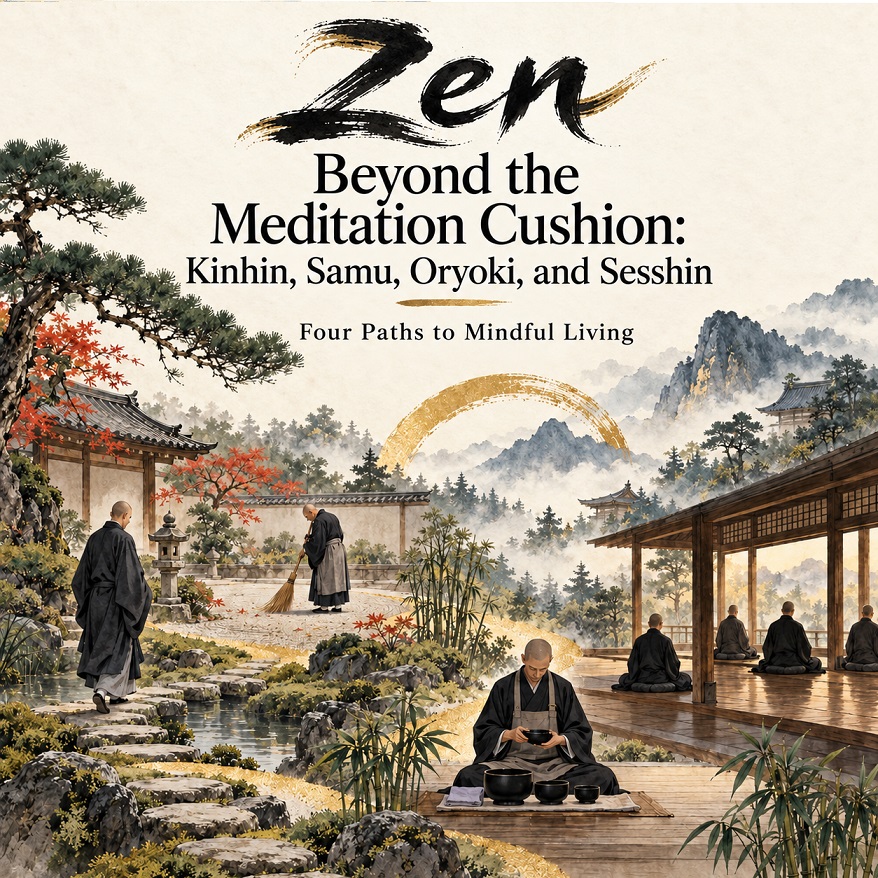
Imagine a Zen monastery in the early morning. In the meditation hall, monks sit motionless until a bell marks the end of another period of zazen. They rise and begin to walk slowly, following an established order. A little later, some will clean the courtyard, others will work in the kitchen, and everyone will gather for a meal. Then they will return to meditation. From the outside, these activities may seem like separate parts of a daily schedule, but in Zen they are connected by one underlying idea: practice does not end when someone rises from the meditation cushion.
We often associate spirituality with silence, stillness, and withdrawal from everyday responsibilities. But what happens to our attention when we walk down the street, wash the dishes, or sit down to lunch? If mindfulness exists only during specially reserved minutes, it remains isolated from most of our lives. This is why many Zen communities include ordinary activities in their training. Walking, working, and eating are not merely breaks between spiritual exercises; they are opportunities to observe the mind under different circumstances.
Four practices illustrate this perspective particularly clearly: kinhin – meditation in motion; samu – mindful physical work; oryoki – ritualized eating; and sesshin – an intensive meditation retreat. Each has its own history, rules, and place in monastic life. Together, they raise the question of whether we can learn not merely to perform everyday actions but to be genuinely present in them. To understand their meaning, we will explore their origins and context, followed by practical ways to apply their principles in modern life without confusing home adaptations with traditional monastic discipline.
Kinhin – Meditation in Motion and the Art of Mindful Walking
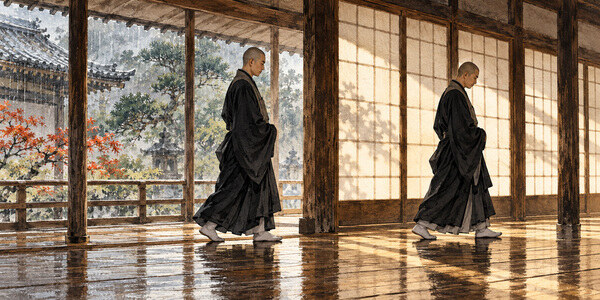
Walking is so natural that we rarely notice it. We walk to work, climb stairs, cross streets, and move from one task to another while our thoughts are already somewhere else. The body moves in the present, but the mind is often occupied with the past or future. Kinhin invites us to notice precisely this separation. The Japanese term kinhin (経行) refers to meditative walking, commonly practiced in Zen communities between periods of seated meditation. Its purpose is not simply to stretch the legs, although this can be beneficial after prolonged sitting, but to continue the practice of attention as the body changes position.
The roots of meditative walking predate Japanese Zen. Early Buddhist teachings already considered awareness while walking, standing, sitting, and lying down part of spiritual training. Buddhism subsequently developed in different cultural environments, including China, where the Chan tradition took shape, and Japan, where several Zen schools emerged. The practices did not remain unchanged: walking methods, posture, and the order followed in the meditation hall came to reflect particular communities. In Japanese monasteries, kinhin became an organized transition between periods of zazen, allowing practitioners to change posture without abandoning mindful awareness.
In many Soto Zen communities, kinhin is performed with especially slow, smooth steps. Some instructions coordinate movement with the breath, while the hands are held in a traditional position in front of the body known as shashu. In certain Rinzai Zen lineages, walking between sitting periods is more energetic and may also help counteract drowsiness. These descriptions are general guides, not universal rules: differences exist even within individual schools. What matters is not speed itself but the quality of attention with which a person moves from one step to the next.
Ordinarily, we walk in order to arrive somewhere and treat the movement itself as secondary. In kinhin, the step ceases to be merely a means to an end. The practitioner notices the shifting of weight, the contact of the foot with the ground, posture, and the natural rhythm of breathing. There is no need to analyze every movement or pursue an extraordinary state of consciousness. When thoughts arise, the practitioner notices them and gently returns to the immediate experience of walking. In this way, the practice reveals how easily attention drifts away from what we are doing and how naturally it can return.
Kinhin – Mindful Walking
How can we begin at home? Choose a quiet hallway, room, or safe path where you can take several steps without obstacles. Stand upright, relax your shoulders, and let your gaze rest naturally ahead and slightly downward. Before the first step, notice how your body weight is distributed across your feet. Then begin walking at a comfortable pace, somewhat slower than usual. Notice the lifting of the foot, its movement, and its contact with the ground, without forcing your breathing into a prescribed rhythm.
Practice for five to ten minutes. If your mind begins planning or replaying a conversation, do not try to stop it by force. Simply recognize the distraction and return to the next step. When you reach the end of your walking space, turn calmly and continue. Finally, stop for a moment and feel your entire body in stillness. This is an accessible home practice of mindful walking inspired by kinhin, not necessarily an exact substitute for the ritual instructions of a particular Zen school.
We can apply the same principle while walking to the store, through a park, or between rooms. There is no need to walk conspicuously slowly on a busy sidewalk or disregard the traffic around us. We can simply put the phone away and feel ourselves moving for thirty steps. Kinhin reminds us that we do not have to reach a particular destination before we begin to be present in our own lives.
Samu – Why Do Zen Monks Turn Physical Labor into Meditation?
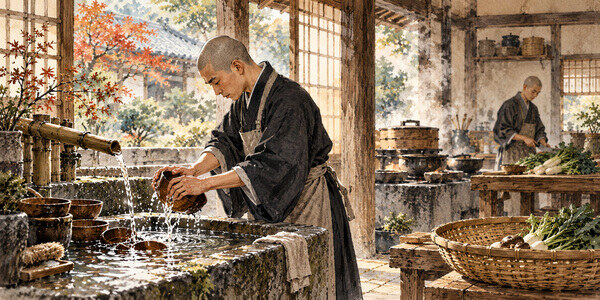
Imagine a monk sweeping a temple courtyard. The wind keeps scattering fresh leaves across the path he has just cleared. If we judge the work solely by how long its results last, the effort may seem pointless. Yet in Zen practice, the question is also what happens to the person while working. Does he become irritated because the task is never permanently finished? Does he think only about the moment when he can put down the broom? Or can he work attentively without constantly resisting the action taking place? Here we encounter the meaning of samu (作務) – physical work as part of spiritual training.
Samu includes practical duties within a Zen community: cleaning the halls, maintaining buildings, gardening, working in the kitchen, and caring for shared spaces. Its historical development is connected to Chinese Chan and Japanese Zen, where the organization of monastic life gradually established labor as an important discipline. Traditional accounts associate this work ethic with the Chinese teacher Baizhang Huaihai, known in Japan as Hyakujo, and with the principle that a day without work is a day without food. These stories strongly influenced the understanding of Zen labor, although historians approach some details cautiously because they were transmitted and shaped in later sources.
On a practical level, a community cannot function without people who cook, clean, and maintain its surroundings. Zen adds the idea that such labor need not be separated from spiritual discipline. When washing dishes, we can feel the water, the surfaces of the objects, and the movement of our hands. When tidying a room, we can notice our impatience and our desire to finish as quickly as possible. Work does not cease to be work, but our relationship with it changes: rather than waiting for life to begin after our obligations are complete, we can be present while fulfilling them.
Samu also has a communal dimension. The person cleaning the meditation hall cares for a space others will use. The person preparing food supports everyone’s practice. In this way, labor can cultivate awareness of our interdependence. Humility here does not mean self-abasement; it means being willing to do what is needed without constantly seeking recognition. Nonattachment does not mean indifference to quality: we carry out a task carefully without turning every imperfection into a personal failure. At the same time, we should not romanticize exhaustion or exploitation. Mindful work does not remove the need for rest, healthy boundaries, and fair conditions.
Samu – Mindful Work
How can we practice samu in daily life? Choose a short task that needs doing anyway: washing dishes, organizing a desk, watering plants, or cleaning the floor. Set aside ten or fifteen minutes and, if possible, reduce distractions. Before beginning, pause briefly and become aware of your intention. Then perform the task calmly and carefully, without artificially slowing your movements. Notice the contact with objects, the sequence of actions, and your own reactions to the work.
You will probably feel an urge to check your phone or finish faster. Rather than blaming yourself, notice the impulse and return to the task. When finished, put away the tools and leave the space orderly. In professional life, a similar approach might mean completing a routine assignment attentively instead of constantly switching between notifications and conversations. This does not turn every office activity into traditional monastic samu, but it allows us to apply its central principle: ordinary work can be performed with extraordinary clarity.
Oryoki – Ritual Eating in Zen and the Philosophy of Every Movement
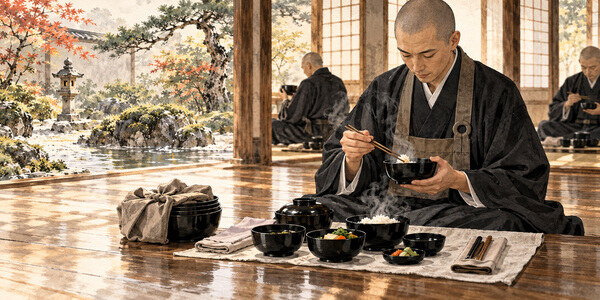
We eat every day, yet often barely notice the act of eating. We have lunch in front of a screen, read messages, think about the next meeting, and reach for another bite before fully experiencing the previous one. In Zen, eating can be organized as a deliberate practice of attention. One of the best-known examples is oryoki (応量器) – the name of a special set of bowls and of the formal method of eating with them, characteristic of certain Zen communities, especially in Soto Zen.
Oryoki typically includes several bowls of different sizes that nest inside one another, along with utensils and cloths. Participants follow an established order for unfolding the items, receiving food, eating, cleaning, and putting everything away. The precise set, number of bowls, and sequence of movements depend on the particular tradition. To an outside observer, such a procedure may seem unnecessarily complicated for a simple meal, but this very sequence creates an opportunity to notice our habits. When each movement has its place, it becomes easier to see when we rush, become distracted, or act without awareness.
The historical roots of this approach to eating lie in the wider Buddhist monastic tradition, with its rules for receiving food, using bowls, practicing moderation, and relating to offerings. As Buddhism spread through China and Japan, these practices changed and took on new ritual forms. In Japanese Zen, the care and preparation of food hold particular importance. The thirteenth-century teacher Dogen, associated with the Soto school, treated the monastery cook’s work as spiritually significant. In his instructions known as Tenzo Kyokun, food preparation requires responsibility, sincerity, and attention. This does not mean that contemporary oryoki rituals have remained unchanged since early Buddhism; they are the product of a long historical development.
In some communities, the largest bowl has special significance and is associated with the tradition of the Buddhist monastic begging bowl. However, there is no single symbolic scheme that applies to every bowl in every Zen lineage. More important is the overall attitude: objects are handled with care, food is received with gratitude, and unnecessary waste is avoided. A single meal results from many conditions – soil, water, sunlight, farmers’ labor, transportation, and preparation. Ritual eating makes this interdependence more visible and reminds us that even the simplest bite is connected to an immense network of living beings and human effort.
Oryoki is not merely an exercise in good manners or attractive bowl arrangement. It directs attention toward actions we usually overlook: picking up a utensil, moving the hand, chewing, swallowing, and cleaning. Through this sequence, we may notice our impatience, our desire for more, and our tendency to judge everything according to personal preference. The practice does not necessarily demand that these reactions disappear. The first step is simply to see them.
Oryoki – Ritual Eating
How can we apply the principles of oryoki at home? The complete ritual is usually learned through specific instruction, and there is no need to imitate it approximately. Instead, we can create a short practice of mindful eating. Set the table and, if possible, put away your phone and turn off the television. Before the first bite, pause for a few seconds, look at the food, and remember how many different efforts were needed to bring it to you. Then take the first bite calmly, noticing its flavor, temperature, and texture.
Continue eating at a natural pace without turning every movement into a tense exercise. Notice when you begin to hurry, when attention drifts, and when you feel full. After eating, store leftovers appropriately, wash the dishes, and leave the space tidy. Not every family meal needs to take place in silence: conversation and shared enjoyment have value too. A home practice inspired by oryoki simply helps us discover that eating deserves more attention than we usually give it.
Sesshin – Days of Silence, Meditation, and Meeting Our Own Mind
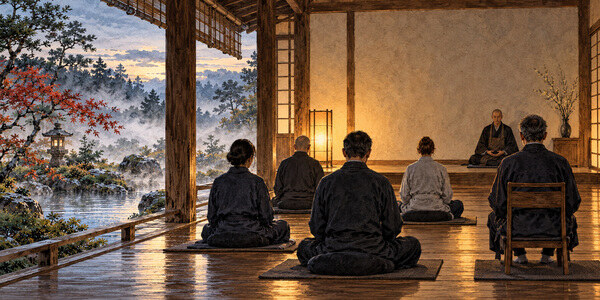
Modern life offers an almost continuous stream of stimulation. We check our phones in the morning, switch between tasks and conversations during the day, and often seek fresh content in the evening to unwind. Even when alone, we rarely remain without an external activity for long. What would happen if we temporarily reduced distractions and directed attention toward immediate experience? Sesshin offers such an opportunity: an intensive Zen meditation retreat in which participants follow an organized daily schedule of practice.
The term is written in Japanese as 接心, and in some Buddhist contexts also as 摂心, and is associated with gathering or concentrating the mind. Sesshin may last several days or sometimes longer. Its program usually includes repeated periods of zazen alternating with kinhin, as well as meals, rest, and sometimes samu. Depending on the school and center, there may also be chanting, ceremonies, teachings, and individual meetings with a teacher. It is not simply one unusually long sitting session but an overall organization of time in which nearly every activity becomes part of the discipline.
Intensive periods of practice have roots in the broader history of Buddhism, including seasonal retreats and special periods devoted to meditation. In Japanese Zen, sesshin developed characteristic forms that differ according to monastery, school, and historical period. A well-known example is Rohatsu sesshin, associated with the traditional commemoration of the Buddha‘s awakening in December. Today, such retreats are also held at Zen centers outside Japan. Some are intended for experienced practitioners, while others offer gentler programs for beginners.
A day of sesshin may begin very early. Periods of seated meditation follow, interspersed with walking, formal meals, and other scheduled activities. Some communities maintain silence for much of the day, while necessary communication with organizers and teachers remains possible. Repetition is essential: practitioners encounter their own attention, impatience, fatigue, and desire for stimulation again and again. Alternating sitting, walking, and work allows the mind to be observed under different conditions rather than confining practice to one physical posture.
Extended silence does not guarantee a pleasant or peaceful experience. When external distractions diminish, boredom, anxiety, irritation, and memories may become more noticeable. In Zen training, these reactions can be observed rather than immediately followed. But intensive meditation is not universally suitable or safe for everyone. A strict schedule, prolonged sitting, and lack of sleep can be especially challenging for people with certain physical or mental health conditions. When in doubt, it is sensible to seek appropriate medical advice and discuss the conditions with organizers beforehand. Spiritual discipline does not require neglecting one’s health.
Sesshin – An Intensive Meditation Retreat
How can we apply the principles of sesshin in everyday life? A traditional sesshin is usually undertaken under the guidance of an experienced teacher within an organized community. At home, we can begin with a short personal retreat of one or two hours, without claiming that it is equivalent to monastic practice. Choose a time without urgent obligations, put your phone aside, and prepare a quiet space. Begin with about ten minutes of seated meditation in a comfortable position, including on a chair if that better suits your body.
Then move into five minutes of mindful walking, perform a short practical task attentively, and take a break for water and gentle movement. If you feel well, repeat a short period of sitting. Finally, spend a few minutes writing down what you noticed: when the mind wandered, when impatience appeared, and how you responded to silence. Do not judge the experience as a success or failure. You do not need to achieve a special state of consciousness for the exercise to be meaningful. Sometimes simply discovering how difficult it is to remain without distraction is a sufficient beginning.
Four Practices, One Shared Direction

Kinhin is walking, samu is work, oryoki is eating, and sesshin is an organized meditation retreat. The differences between them matter, but together they reveal a shared perspective: spiritual practice need not exist only in rare, specially designated moments. We can cultivate attention when the body moves, when we perform a necessary duty, when we receive food, and when we spend time in silence. Rather than treating everyday life as an obstacle to mindfulness, we can begin to see it as the very place where mindfulness is practiced.
It is important, however, to respect the religious and historical context of these practices. Zen is not merely a collection of stress-reduction techniques. It belongs to the Buddhist tradition and includes teachings, rituals, communal life, and relationships between teachers and students. When we use individual principles at home, we create an adaptation rather than reproducing the entire tradition. This distinction does not diminish the value of everyday exercises; instead, it allows us to apply them responsibly without claiming experience we do not possess.
We can begin with a simple rhythm: a few minutes of mindful walking in the morning, a short household task performed with full attention during the day, the first bites of a meal without a screen, and ten minutes of silence in the evening. Once a week, we might set aside a slightly longer period alternating sitting, walking, and work. This should not become another system of obligations or a reason for self-criticism. The aim is to explore what changes when we stop moving automatically through the actions we already perform.
Mindfulness Is Not Perfection

When speaking about Zen, it is easy to imagine an idealized person who never becomes distracted and always remains calm. But such an image can become another source of pressure. The human mind inevitably moves through thoughts, emotions, memories, and desires. Even during attentive walking, we may become absorbed in planning; while washing dishes, we may feel irritation. Practice does not demand that these reactions disappear forever. It begins with the possibility of noticing them and returning to the action taking place.
That return is available at any moment. We can once again feel the foot touching the ground, the water on our hands, the taste of food, or the breath in silence. We do not have to turn every minute into a special ritual or constantly monitor whether we are mindful enough. Sometimes excessive control takes us further away from the simplicity we seek. Attention can be clear and calm without being tense or perfect.
Zen as the Art of Not Missing Our Lives

The modern world offers countless ways to fill our time. We can turn a morning walk into planning the workday, lunch into reading the news, and cleaning into an irritating obstacle before the next enjoyable activity. In this way, much of life passes while we wait for something else. The four Zen practices invite us to examine this attitude. Kinhin reminds us that walking is not merely a means of arriving. Samu shows that work need not be time we wish to escape. Oryoki directs us toward gratitude for food and the labor behind it. Sesshin offers an opportunity to observe the mind when familiar distractions temporarily diminish.
None of these practices promises an easy solution to life’s difficulties. But together they raise a simple and important question: Can we stop waiting for life to begin and pay attention to what is happening right now? Perhaps not every moment needs to be extraordinary to deserve our presence. Sometimes it is enough to take the next step, wash the next dish, taste the next bite, or remain in silence for a little while. Then we may discover that ordinary life holds more depth than we have allowed it to reveal.
Author: Vasil Stoyanov