
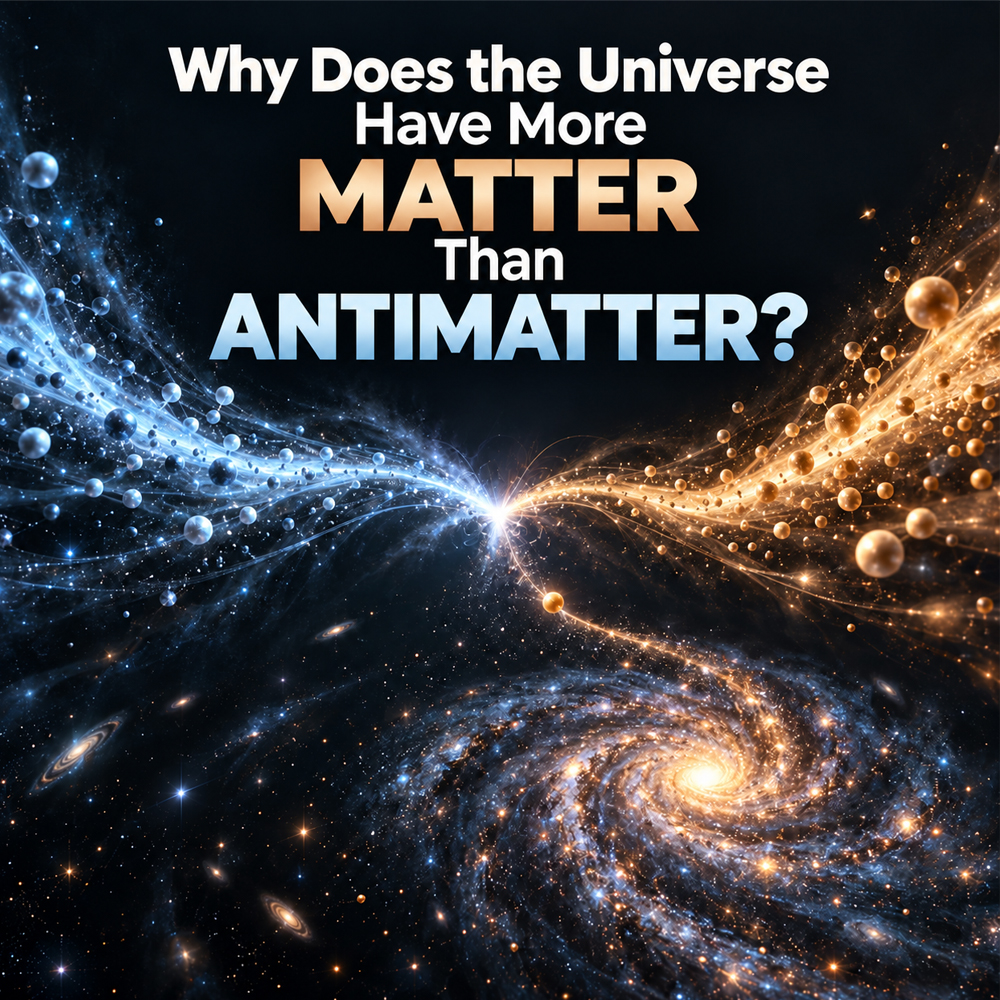
The Sky That Should Not Look This Way
Imagine stepping outside on a clear night, far from the lights of the city. Above you stretches a sky filled with stars, each one an immense amount of matter gathered by gravity and ignited by nuclear reactions. Beneath your feet lie rocks, iron, water, and layers of history belonging to a planet that took billions of years to form. Within your body, that same universe has organized its atoms into cells, nerves, and thoughts capable of asking where all of this came from. At first glance, the existence of this world seems natural, because we have never known any other.
For physics, however, this scene contains an unresolved problem. Processes we understand can turn energy into particles and antiparticles, and when a particle meets its corresponding antiparticle, the two can annihilate. If the early universe began with equal amounts of matter and antimatter, and nothing disturbed the balance between them, the vast majority of these pairs would have disappeared into other particles and radiation as the universe cooled. We must therefore explain where the surplus came from that later became stars, planets, and people. The problem is not why matter can exist, but why so much of it remained without a corresponding amount of antimatter.
From the outset, we need to distinguish what is established from what remains unknown. The observable universe is dominated by ordinary matter, but the mechanism that gave it this advantage has not yet been identified. Physicists have experimentally confirmed differences in the behavior of certain particles and antiparticles, along with theoretical scenarios for the emergence of the cosmic imbalance. None of these scenarios, however, has been confirmed as the actual history of our universe. The question in the title therefore has a precise scientific answer: we know that matter gained an advantage, but we do not yet know which process gave it that advantage.
The Particle That First Appeared on Paper
The story of antimatter begins in an unusual way: with an attempt to describe something already familiar more accurately. During the 1920s, physicists were developing quantum mechanics, but they also needed to reconcile it with special relativity. The electron could not be convincingly described by one theory at low speeds and another, incompatible theory when it moved close to the speed of light. Paul Dirac sought a mathematical description that would unite these requirements. In 1928, he formulated an equation whose solutions proved richer than initially expected.
As this theory developed, it led to the prediction of a particle with the same mass as the electron but the opposite electric charge. The ordinary electron carries a negative charge, while its partner would have to carry a positive one. This was not simply a second kind of electron arbitrarily added to nature’s inventory. Its existence was connected to the mathematical structure of a description combining quantum laws with relativity. Theory was pointing toward an object that no one had yet recognized in an experiment.
In 1932, Carl Anderson was studying cosmic rays using a cloud chamber – an instrument in which passing charged particles leave visible tracks. A magnetic field curves their paths, allowing researchers to infer their charge and motion. Among the photographed tracks appeared one belonging to a particle that behaved like a lightweight, positively charged counterpart of the electron. Anderson had discovered the positron. The object toward which theory had guided physicists had now left a trace in a laboratory instrument.
This story changed our understanding of what the world contains. Antimatter turned out to be a physical reality that could be created, measured, and studied. The electron has the positron as its counterpart, the proton has the antiproton, and the neutron has the antineutron. Even an electrically neutral particle can have a distinct antiparticle, because electric charge is not the only property that distinguishes them. The word “anti” describes a particular relationship between particles, rather than an absence of reality or some negative form of existence.
A World Made of Antimatter Would Look Surprisingly Familiar
To understand the mystery, we must set aside the image of antimatter as a strange substance inherently incapable of forming anything stable. The positron has the same mass as the electron, and the antiproton has the same mass as the proton within our established physical framework and the limits of precise measurements. An antiproton and a positron can form antihydrogen, just as a proton and an electron form hydrogen. If no ordinary matter surrounds such an antiatom, its existence does not require it to disappear immediately. The dangerous encounter is between corresponding particles and antiparticles, rather than between antimatter and empty space.
Under suitable conditions, antimatter could form more complex structures. A star made of antimatter would have mass, exert gravitational attraction, and emit light. Its radiation alone would not carry a label telling a telescope that it came from antiatoms. The photon is its own antiparticle, and ordinary light is not divided into “matter light” and “antimatter light” according to its origin. Determining whether a distant object contains antimatter therefore requires more than examining its brightness.
This makes the cosmic imbalance even more intriguing. Matter did not gain an obvious advantage simply because it can form atoms while antimatter cannot. Nor do we have an established difference between the masses of the proton and the antiproton that would, by itself, explain why one filled the universe while the other did not. Experiments such as BASE at CERN compare their properties with extraordinary precision precisely because even a small discrepancy would have enormous implications for the foundations of physics. The agreement found so far between their fundamental properties makes the mystery more demanding: an explanation must identify a specific process rather than rely on a general impression that matter is somehow “more natural.”
What “Destroying Each Other” Actually Means
The word “annihilation” easily conjures an image of two particles colliding and turning into absolute nothingness. In reality, their energy and momentum must be conserved. When an electron meets a positron, one possible outcome is the production of photons. The energy previously associated with the pair’s mass and motion is now carried by the products of the reaction. The original pair disappears, but the physical content of the process does not.
For a proton and an antiproton, the picture is more complicated because they are composite particles. They contain quarks and antiquarks bound through the strong interaction, and their annihilation can produce other particles that subsequently decay. The idea that every encounter between matter and antimatter immediately ends in two flashes of light is therefore an oversimplification. The possible products depend on the participants, their energy, and the laws governing their interactions. The general principle remains the same: the initial particles are transformed in accordance with physical laws.
This process also has a reverse direction. Sufficiently energetic interactions can create particle–antiparticle pairs when the necessary conditions for conserving energy, momentum, and other quantities are satisfied. Energy can become mass, and mass can be converted into other forms of energy. This is why the hot early universe should not be imagined as a warehouse of prearranged particles merely waiting to destroy one another. It was an environment of continuous reactions in which pairs were being created and disappearing.
When the Universe Was Too Hot for Atoms
If we trace cosmic history backward, stars disappear from the picture, followed by atoms. Temperatures rise so high that structures we now regard as basic building blocks of the world cannot remain bound together. At still earlier stages, even protons and neutrons are not the stable participants familiar to us from atomic nuclei. Instead, we must think of a hot environment of more fundamental particles and strongly interacting fields. In that world, there are no solid surfaces, no chemistry, and no places where an observer could stand.
High temperature means high typical particle energies. Collisions can produce pairs whose creation today requires specialized laboratory conditions. Annihilation occurs alongside reverse reactions and does not automatically lead to the permanent depletion of the particles involved. While the environment remains sufficiently hot, the disappearance of one pair can be followed by the creation of another. This is a crucial feature of the early universe: what matters is the balance between processes, rather than annihilation alone.
The expansion of the universe changes that balance. As it cools, a progressively smaller fraction of interactions has enough energy to create particular massive pairs. Annihilation continues, but replenishment can no longer compensate for it in the same way. For different types of particles, this transition occurs under different conditions; it is not a single moment when all matter and antimatter disappear simultaneously. Cosmic history is a sequence of such changes, and the surviving surplus must pass through them.
This is where the question determining the future of the familiar world arises. If particles and antiparticles exist in equal numbers, and reactions treat them completely symmetrically, there is no reason for a large, systematic advantage to remain on either side. To produce the universe we observe, either an initial imbalance must have existed or some process must have created one as the universe evolved. Physicists seek mechanisms for the second possibility because it allows the observed advantage to be explained through laws and testable consequences. The creation of a net surplus of baryons is called “baryogenesis,” but naming it does not yet tell us exactly how it happened.
The Tiny Remainder That Becomes an Immense World
To appreciate the scale of the problem, we can use a simplified thought experiment. Imagine a collection in which one billion antiparticles are matched by one billion and one particles. If every antiparticle finds its corresponding partner and the pairs annihilate, one particle remains. Almost the entire original collection has been transformed, but the balance was not perfect, and the remainder survives. These numbers illustrate the extraordinarily small advantage rather than provide an exact inventory of all particles at a particular second in cosmic history.
Now imagine that this small relative surplus is distributed throughout the immense early universe. The word “small” no longer means a small total amount, but a small difference between two very large quantities. Atomic nuclei and atoms subsequently form from the surviving ordinary matter, and gravity gathers gas into the first stars. Within stars, and during the violent events surrounding the end of their lives, elements are formed and dispersed, giving rise to new generations of cosmic structures. Billions of years later, some of this material takes part in the formation of Earth.
This perspective changes how we look at the visible world. A mountain does not show that matter defeated antimatter through an enormous initial numerical advantage. It shows that even a minute relative advantage can leave a colossal remainder when the initial scale is cosmic. The same applies to oceans, the atmosphere, and the atoms in our bodies. The mystery is how nature produced precisely such a remainder instead of preserving the balance.
Antimatter Has Not Disappeared Completely
The absence of large amounts of antimatter does not mean that none exists today. Positrons arise in certain radioactive decays and high-energy astrophysical processes. Antiparticles are also detected in cosmic rays, and accelerators can produce them through collisions. Nature therefore continues to create antimatter in a universe dominated by ordinary matter. This is entirely compatible with the cosmic imbalance, because the local production of antiparticles does not automatically build a second world of antigalaxies.
In the laboratory, the challenge is often to protect the antimatter produced from its surroundings. Container walls, air, and conventional equipment are made of matter, so contact with them can lead to annihilation. Scientists therefore use high vacuum and specialized electromagnetic devices to confine charged antiparticles, while neutral antiatoms require other suitable trapping methods. Storage demands careful control of the conditions, and the quantities produced are extraordinarily small. These experiments make antimatter an object of precise measurement through which we test fundamental laws of nature.
What If the Other Half Is Somewhere Far Away?
One appealing idea is that antimatter did not lose the cosmic contest but simply occupies other regions. Our galaxy would be made of matter, another distant galaxy of antimatter, and the overall balance would remain equal. Since an antistar could emit light similar to that of an ordinary star, the idea cannot be rejected solely on the basis of how the sky looks. It must, however, withstand comparison with the actual cosmic environment. Gas exists between galaxies, and large structures interact, exchange material, and collide.
If neighboring extensive regions contained matter and antimatter respectively, interactions around their boundaries should produce characteristic radiation. Gamma rays provide a way to search for the consequences of such annihilation. Observations do not reveal the required signals for the simple picture of an observable universe divided into large, comparable regions of the two kinds. Studies of galaxy clusters and the cosmic gamma-ray background place strong constraints on these scenarios. Hiding antimatter in neighboring cosmic districts therefore does not provide a convincing general solution.
This conclusion has a defined limit. Our observations concern the region of the universe from which information could have reached us; they do not constitute an inventory of everything beyond it. Nor can we declare every unusual cosmic object definitively examined for the presence of antimatter. The major conclusion is more specific: the available evidence requires an explanation for why the cosmos accessible to us is so strongly dominated by matter. An unexplored distant region does not, by itself, explain the process that shaped our own.
The Mystery Moves from the Sky to the Laws
Once we examine what antimatter is, the question takes a clearer form. We are not searching for a reason why it cannot exist, because it exists and can be measured. We are not searching for an ordinary loss of energy, because annihilation conserves energy through its products. We are searching for a mechanism that changed the relative numbers of particular particles and antiparticles and allowed that imbalance to persist. Such a mechanism must explain both how the advantage arose and how it survived in the hot early environment.
This is a far more difficult task than inventing a story about matter’s victory. Every proposed reaction must respect conservation laws and account for reverse processes that can erase the surplus it produces. If the mechanism acts too weakly, it will not create enough matter. If it operates under unsuitable conditions, subsequent reactions will return the system to balance. The explanation must fit the narrow window in which nature creates a difference and manages to preserve it.
Here we encounter a possibility that once seemed particularly bold: the laws do not treat matter and antimatter identically in every process. Certain decays show a measurable violation of a symmetry called CP, and this difference is an established experimental fact. The known violation within the Standard Model, however, is insufficient to explain the observed cosmic surplus. It is a clue showing that absolute symmetry is not a compulsory rule of nature, but it is not yet the complete solution. The next step is to understand how physicists discovered this clue and why an almost imperceptible difference in particle decays becomes a key to the question of why stars exist at all.
The Mirror That Does Not Show the Same World
Imagine a laboratory in which every movement can be reproduced as a mirror image. If a particle flies to the left, in the mirrored version it flies to the right, and the entire spatial arrangement is reversed. For many physical processes, this transformation does not break the rules: the mirrored event is just as permissible as the original. The idea seems natural because space carries no visible sign declaring one direction more legitimate than another. In the middle of the twentieth century, however, physicists discovered that weak interactions do not obey this intuition.
In an experiment conducted by Chien-Shiung Wu and her colleagues, radioactive cobalt nuclei were cooled and aligned using a magnetic field. The researchers examined the directions in which electrons were emitted during their beta decay. If nature preserved mirror symmetry, the distribution would have to satisfy a particular equality between the two opposite directions relative to the orientation of the nuclei. The result revealed a preference that violated this expectation. Published in 1957, the experiment established that, in this process, nature distinguishes a spatial arrangement from its mirror image.
This discovery does not mean that the universe has a privileged geographical direction. The broken symmetry concerns the relationship between motion, spin, and the participants in a particular interaction. Physicists call it a violation of parity, represented by the letter P. Its implications reach beyond the peculiar behavior of one radioactive isotope: a rule once considered universal turned out to have limits. Nature is not obliged to preserve every symmetry that human intuition finds convincing.
There was still a possibility of a broader equivalence. If, in addition to reversing the spatial arrangement, we replaced particles with their antiparticles, the two transformations together could restore the symmetry. Replacing particles with antiparticles is represented by the letter C, and the combination of the two operations is called CP. The question was therefore no longer whether the mirrored world alone followed the same laws, but whether a mirrored world made of antimatter reproduced the behavior of our own. For a time, this combined symmetry seemed to be the last firm foundation of equal treatment between the two.
The Decay That Defied Expectations
In 1964, an experiment at Brookhaven National Laboratory put this conviction to the test as well. James Cronin, Val Fitch, and their collaborators studied neutral kaons – unstable particles whose behavior involves quantum mixing between particle and antiparticle states. The system is more complicated than two tiny balls with opposite charges because its evolution over time connects these states. This feature makes kaons a sensitive tool for testing symmetries. The detectors searched for specific decay products that could reveal whether the expected rule was actually being obeyed.
The long-lived neutral kaon occasionally decays into two pions. If CP symmetry were exact, this decay would be forbidden for the corresponding pure CP state. The experiment nevertheless recorded such events, showing that the actual particle did not possess the expected perfect symmetry. The violation was small but clear enough to change physics. Nature had left a measurable difference where complete equivalence had been expected.
The significance of the result extended far beyond kaons. The combined replacement of particles with antiparticles and reversal of the spatial arrangement does not invariably reproduce the same behavior. In certain processes, this manifests as different probabilities for a particular decay and its CP-transformed counterpart. In others, particle–antiparticle mixing plays a role, as it did in the historic kaon experiment. Later measurements established additional manifestations of CP violation, confirming that the discovery was not an isolated peculiarity of one instrument.
Here we must resist the temptation to declare the mystery solved immediately. A difference in decay probabilities does not automatically mean that more of the matter making up stars is being produced. A process can violate CP symmetry while still conserving the quantity whose surplus we are trying to explain. Another process can create a temporary advantage that the surrounding environment subsequently erases. The discovery provides a necessary possibility for distinguishing the two sides, but a successful cosmic history requires further conditions.
Sakharov Turns the Mystery into a Problem to Be Solved
In 1967, Andrei Sakharov formulated the conditions a mechanism must satisfy to create a baryon imbalance from an initially symmetric state within the conventional physical framework. He did not identify one conclusively proven process but outlined the structure of the explanation required. There must be reactions that change baryon number, certain symmetries between particles and antiparticles must be violated, and there must be a departure from thermal equilibrium. These requirements became known as the Sakharov conditions. They allow elegant ideas to be subjected to specific tests rather than remain unrestricted stories about the early universe.
To understand the first condition, we need to introduce a kind of bookkeeping quantity. Protons and neutrons are baryons, and each is assigned a baryon number of plus one. Their corresponding antiparticles have a baryon number of minus one, while photons and electrons have zero baryon number. A system containing equal numbers of baryons and antibaryons therefore has a total value of zero. A system with more baryons has a positive value measuring the net surplus.
Imagine that every permitted reaction preserves this total value absolutely. We can create baryon–antibaryon pairs, annihilate them, or redistribute energy among different participants. In every operation, however, the positive and negative contributions continue to cancel each other out. If the initial total is zero, the final result remains zero as well. A mechanism that creates a net baryon surplus must therefore include a way for this balance to change.
The second condition requires more than an open door to change. If reactions produce positive and negative baryon contributions on completely equal terms, they will not build a systematic advantage for matter. Violations of C and CP provide the necessary distinction in the standard Sakharov scenario. They allow the corresponding processes to have different probabilities or different dynamics. Without such a distinction, the mechanism would have the ability to change the balance but no consistent preference in the required direction.
Why Hot Equilibrium Can Erase Everything
The third condition is the hardest to grasp intuitively because the word “equilibrium” sounds like stillness. In a hot environment, it can involve continuous collisions and the creation and destruction of particles. Equilibrium means that the statistical state is maintained by the entire network of reactions under the given conditions. Each individual event does not need to be followed by a literal reversed copy of itself. It is enough for the overall action of the processes to prevent the accumulation we are seeking.
We can imagine a reservoir that fills through one pipe and drains through another. If the inflow and outflow continually balance, the existence of an inlet does not guarantee a rising water level. For a change to persist, the regime compensating for it must be disrupted. Cosmic reactions are incomparably more complex than plumbing, but the analogy shows why creating a surplus is not enough. It must arise under conditions in which the processes restoring the balance cannot erase it.
The expansion of the universe provides a way for such a departure to occur. The temperature changes, and the rates of different reactions do not necessarily keep pace with that change. If certain particles decay when reverse processes can no longer maintain their equilibrium abundance, the evolution acquires a direction that leaves a lasting trace. A phase transition can also create suitable conditions outside equilibrium. The crucial comparison is between the time over which the environment changes and the time interactions need to return it to equilibrium.
The three conditions must work together. Changing baryon number allows a net remainder to appear, broken symmetries distinguish the two directions, and departure from equilibrium allows the result to survive. None of them alone guarantees success, and the amount of surplus produced must agree with observations. A scenario that creates too little or too much does not explain our universe. This quantitative demand is what makes baryogenesis a problem in physics rather than merely a plausible storyline.
Why Known Physics Falls Short
The Standard Model contains a genuine source of CP violation in the behavior of quarks. Its explanation is connected to mixing among their different varieties through weak interactions. Makoto Kobayashi and Toshihide Maskawa showed how such a mechanism could be incorporated into the theory through a sufficiently rich structure of quark families. This framework predicted the existence of additional quarks and subsequently received experimental support. Broken symmetry thus became part of a mathematically coherent theory that successfully describes many measurements.
But successfully describing laboratory decays does not mean having a mechanism strong enough to produce the cosmic asymmetry. In calculations of baryogenesis, the known quark source of CP violation proves insufficient. The reason cannot be reduced to a small percentage read from a detector; it concerns how the entire mechanism operates under early cosmic conditions. The theory must account for masses, interactions, temperatures, and the dynamics of the environment. When these elements are combined, they do not produce the required observed remainder.
This mismatch is particularly valuable because it connects cosmology with the search for new physics. The universe presents us with a result that known interactions do not adequately explain. It does not follow that we can arbitrarily add any particle we wish and declare the problem solved. New participants must be consistent with measurements already made and must produce testable consequences. The cosmic imbalance guides the search, but experiment determines which proposals deserve to remain.
Bubbles in the Early Universe
One scenario under investigation connects the emergence of the surplus with a change in the state of the Higgs field. To picture the idea, we can think of a cooling environment in which a new phase appears at separate locations and begins to expand. Regions resembling bubbles emerge, with boundaries moving through the surrounding plasma. On either side of a boundary, the conditions governing particle motion and interactions differ. The transition thus provides a dynamic environment in which broken symmetry and departure from equilibrium can come together.
In models with suitable additional interactions, passage through these boundaries can generate different distributions of particles and antiparticles. Electroweak processes known as sphaleron transitions also operate in the hot environment and can change baryon and lepton numbers. Combining these effects allows certain initial asymmetries to become a baryon surplus. After the boundary has passed, reactions that would erase the result must be sufficiently suppressed. This general idea is called electroweak baryogenesis and is studied in various extensions of the Standard Model.
There is, however, an important obstacle to the simplest version of this story. With the measured mass of the Higgs boson, the Standard Model predicts a smooth electroweak crossover rather than the required strong transition involving the formation and expansion of bubbles. The picture described here is therefore not an established scene from the universe’s past. It is a possible mechanism in theories with additional ingredients that change the nature of the transition and provide suitable sources of CP violation. This distinction is crucial: the scientific scenario has clear conditions under which it works and equally clear conditions under which it fails.
Its appeal lies in the possibility that some of the necessary new physics could leave observable traces. Additional particles or altered interactions can be sought using accelerators and highly precise measurements. Some versions also predict gravitational waves from the early phase transition. These tests are not interchangeable because each examines a different aspect of the proposed history. Together, they can constrain the models and show whether the cosmic “bubbles” have a physical basis.
The Clue That Begins with Other Particles
There is another route in which the initial imbalance does not arise directly among baryons. It begins in the lepton sector – the family to which the electron and neutrinos belong. Classic scenarios introduce heavy neutral particles whose decays can produce different amounts of leptons and antileptons. This requires suitable properties and interactions, including CP violation and conditions outside equilibrium. Creating such a surplus is called leptogenesis, and it represents a family of mechanisms rather than one proven reaction.
The connection to ordinary matter arises through electroweak processes in the hot early universe. Sphaleron transitions can redistribute a suitable initial lepton asymmetry so that a baryon remainder also appears. This is not a literal conversion of an individual neutrino into a fully formed proton. It concerns the collective evolution of interacting particles and their quantum numbers. The explanation for the origin of atomic nuclei can therefore begin with events in a sector that initially seems far removed from them.
This possibility gives neutrinos particular significance. They already show that the simplest original description of known particles is incomplete, and their properties raise questions reaching back to the early universe. The heavy particles involved in classic leptogenesis have not yet been discovered, and the mechanism itself remains unconfirmed. Nevertheless, it connects two specific tasks: understanding neutrino masses and explaining why ordinary matter remained. In the final part, we will follow how experiments test these connections and what would be required to move from a convincing scenario to an established cosmic history.
The Particles That Pass Through Us
As you read these words, vast numbers of neutrinos are passing through your body. Some come from the Sun, where nuclear reactions release the energy that sustains life on Earth. They cross your skin, bones, and organs without producing any sensation and usually without interacting with a single atom along the way. To them, the human body is almost transparent, as are thick layers of rock. This unusual ability to pass through matter makes them both difficult to study and valuable carriers of information.
The neutrino does not fit comfortably into the picture of a particle with one unchanging identity. We know three varieties, called electron, muon, and tau neutrinos, according to the interactions through which we identify them. As a neutrino travels, it can be detected as a different variety from the one in which it was produced. This phenomenon is called neutrino oscillation and arises from the quantum mixing of states with different masses. Its observation established that neutrinos have mass and demonstrated the need to extend the simplest original version of the Standard Model.
These oscillations provide one way to test the symmetry between matter and antimatter. Scientists compare the probability that a neutrino of one variety will be detected as another with the probability of the corresponding change for an antineutrino. If an appropriate difference remains after all other effects have been accounted for, it will establish CP violation in neutrino oscillations. This would add a new experimental piece to the picture of broken symmetries. By itself, however, it would not prove which mechanism created the cosmic surplus of matter.
A Journey Through the Earth
Measuring such a difference requires more than a sensitive detector. We need to know which particles were produced, how far they traveled, and the energies with which they arrived. Neutrinos interact so rarely that a large proportion of the incoming stream passes through the instruments without leaving a trace. Experiments therefore use powerful sources, large amounts of detector material, and prolonged data collection. Each recorded interaction is a small part of an enormous stream whose statistical behavior must be reconstructed.
The DUNE project is designed around such a journey through the Earth. A neutrino beam from Fermilab will be directed toward distant detectors in South Dakota, about thirteen hundred kilometers from the source. Liquid-argon detectors will record the tracks left by rare interactions, while a detector complex near the source will help characterize the initial beam. By comparing the initial and final pictures, scientists will investigate how its composition changes. Operating with both neutrinos and antineutrinos is essential to testing CP symmetry.
In Japan, Hyper-Kamiokande has a similar scientific goal but uses a different detector approach. An immense volume of water and sensitive light detectors will make it possible to record the consequences of neutrino interactions. A beam from the J-PARC accelerator complex provides a controlled source for comparing neutrino and antineutrino oscillations. The different technology and measurement conditions allow the results to be checked against one another. For such a fundamental question, agreement between independent approaches is particularly valuable.
The comparison, however, contains a trap that physicists must carefully avoid. Earth is made of ordinary matter, and traveling through it affects neutrino and antineutrino oscillations differently. Different recorded numbers are therefore not automatically evidence of intrinsic CP violation. The analysis must separate environmental effects from the properties of neutrino mixing itself and account for differences in how the particles are produced and detected. A genuine discovery requires an explanation of the entire distribution of events, rather than merely an impressive difference between two numbers.
Two Electrons and an Absence
Another experimental path begins with a question that sounds paradoxical: can the neutrino be its own antiparticle? Its electrical neutrality allows this possibility but does not prove it. The neutron also has no net electric charge, yet it differs from the antineutron. Establishing the nature of the neutrino requires observations of processes that distinguish the two possibilities. A particle that is its own antiparticle is called a Majorana particle.
A particularly important test is the search for neutrinoless double beta decay. In ordinary double beta decay, certain nuclei can transform two neutrons into two protons, emitting two electrons and two antineutrinos. In the sought-after neutrinoless process, the two electrons appear, but no neutrinos are emitted. Such an event would violate lepton number and establish a fundamentally new property of neutrinos. It would show that the distinction between particle and antiparticle in this sector differs from the familiar distinction between the electron and positron.
To discover this rare process, experiments monitor suitable materials under exceptionally low-background conditions. Detectors are often placed underground, where rock reduces interference from cosmic rays. Scientists search for a characteristic signal in the energy of the two electrons and check whether it could be explained by other radioactivity or by the behavior of the instrument. Even when no signal is found, the result constrains how frequently the process could occur. The absence of events thus becomes quantitative information about the properties of nature.
A confirmed discovery would have major implications for leptogenesis scenarios, but it would not automatically reconstruct the history of the early universe. Researchers would need to establish the mechanism behind the observed decay, the interactions it requires, and their connection to cosmic conditions. Furthermore, CP violation in oscillations and the CP violation required in a particular model involving heavy neutral particles are not universally the same measurable quantity. Some theories connect them, while in others the connection is weaker or absent. Every new clue must therefore be placed within a consistent model that also explains the remaining data.
The Difference Appears Among Baryons Too
While neutrino experiments investigate one sector, accelerators continue to test another. Collisions in the Large Hadron Collider produce unstable particles whose decays can be reconstructed from tracks in the detectors. The LHCb experiment is particularly well suited to studying particles containing heavy quarks. Each individual particle lives only briefly, but the large number of events allows small differences in probabilities to be measured. Fleeting processes thus become robust statistical results.
In 2025, the LHCb collaboration reported the first observation of CP violation in baryon decays. The study compared a particular decay of a heavy lambda baryon containing a b quark with the corresponding decay of its antibaryon. The analysis established an asymmetry with sufficient statistical significance to qualify as an observation. This extended the experimentally established picture beyond mesons, in which the phenomenon had been known for decades. Broken symmetry had now been directly observed in the family to which protons and neutrons belong.
The result does not mean that the process responsible for producing cosmic matter has been discovered. The decay under investigation does not create the required net baryon surplus merely because its probability differs from that of the corresponding antibaryon decay. Moreover, CP violation among baryons is also expected within the Standard Model. The importance of the measurement is that it provides a new system for testing the theory and searching for deviations from it. The more different processes are measured, the harder it becomes for an incomplete explanation to remain consistent with all the results.
Antimatter Falls Toward Earth
Not every important test requires particles moving at enormous energies. Some of the most demanding experiments begin with the opposite task: slowing antimatter down, confining it, and measuring its behavior under controlled conditions. This requires careful management of fields, temperature, and vacuum. Contact with surrounding matter destroys the object being studied, so keeping it intact is itself part of the experimental achievement. In this environment, physicists can ask questions about fundamental properties that remain difficult to examine in a high-speed collision.
One such question is how antimatter responds to Earth’s gravity. In 2023, the ALPHA-g experiment at CERN established that released antihydrogen atoms fall downward under its influence. The result is consistent with the expected gravitational attraction and rules out the simple idea that antimatter should fall upward. The measurement is not infinitely precise and does not exclude every possible small deviation from hydrogen’s behavior. It does, however, turn a basic theoretical expectation into a directly observed property of antiatoms.
Falling downward does not itself solve the problem of cosmic asymmetry. It tests a particular aspect of the relationship between gravity and antimatter, while baryogenesis requires a mechanism that generates and preserves a net surplus. A similar distinction applies to comparisons of masses, magnetic properties, and spectra between particles and antiparticles. These measurements can discover new physics or constrain its possibilities, but not every successful test directly explains the cosmic remainder. The overall picture emerges from combining different investigations, each with its own task.
The Universe Also Preserves the Size of the Remainder
Physicists are not merely searching for a story in which some matter remains at the end. They must explain its observed abundance relative to the rest of the universe’s contents. One source of information is the cosmic microwave background, whose small temperature variations carry traces of conditions in the young universe. Another is the abundance of light elements formed during primordial nucleosynthesis. The two approaches investigate different stages and allow the cosmological picture to be cross-checked.
This imposes a specific discipline on every proposed mechanism. It is not enough for it to violate a symmetry or contain unusual particles. It must produce the correct surplus, preserve it, and avoid undermining successful predictions about later cosmic history. If it requires a new particle, that particle’s properties must be consistent with laboratory constraints. If it predicts additional signals, they must be sought where the model says they should appear.
Here we see the difference between an explanation and a compelling image. Bubbles of a new phase, decays of heavy neutral particles, and cosmic fields can look like complete stories. In physics, each must be translated into calculations, observable consequences, and comparisons with data. Some models are ruled out, others remain viable, and still others require experiments that have not yet reached the necessary sensitivity. Progress also consists of reducing the number of possible answers before the actual one is established.
Why the Question Remains Open
We do not know whether the decisive process occurred at energies future accelerators will reach or under conditions accessible only through indirect traces. The explanation could connect neutrino properties with new particles we have not yet discovered. It could require a change in our understanding of early phase transitions. These are separate, testable lines of investigation rather than different formulations of an already known answer. The available results constrain the search, but they do not yet identify a single established cosmic history.
This lack of knowledge has clear boundaries. Antimatter is real, annihilation is a measured process, and CP violation has been experimentally confirmed in particular systems. The observable cosmos contains an enormous surplus of ordinary matter that must be explained. The missing link is the mechanism that combines the necessary properties under early conditions and leaves precisely the observed remainder. Physicists can therefore formulate the question rigorously even while they cannot yet provide a final answer.
The Remainder That Learned to Ask Questions
When we look at the night sky again, the stars carry a different meaning. They are the visible consequence of a history in which the balance between matter and antimatter did not remain perfect. Gravity built structures from the surviving material, while nuclear reactions created the conditions for richer chemistry. Later, that chemistry contributed to the emergence of living organisms and minds capable of reconstructing the distant past. The question of the cosmic imbalance reaches us because we ourselves are among its consequences.
There is no established evidence that this advantage was planned or directed toward the emergence of life. Physics searches for interactions, probabilities, and conditions that operated independently of future observers. Yet the scale of the consequence remains astonishing: a small relative difference left enough material for the entire familiar world of stars. Today, some of that material is arranged into instruments that measure antiatoms, track neutrinos, and record decays. The cosmic remainder is thus investigating the process that allowed it to remain.
The final explanation will need to do more than tell a story about how matter gained an advantage. It must show why, when, and by how much that advantage arose, while also withstanding independent tests. Until then, every precise measurement brings the question closer to an answer, even when it does not reveal the anticipated new particle or effect. The sky above us already shows that some history allowed matter to survive. The task of physics is to establish which history it was.
Author: Vasil Stoyanov