
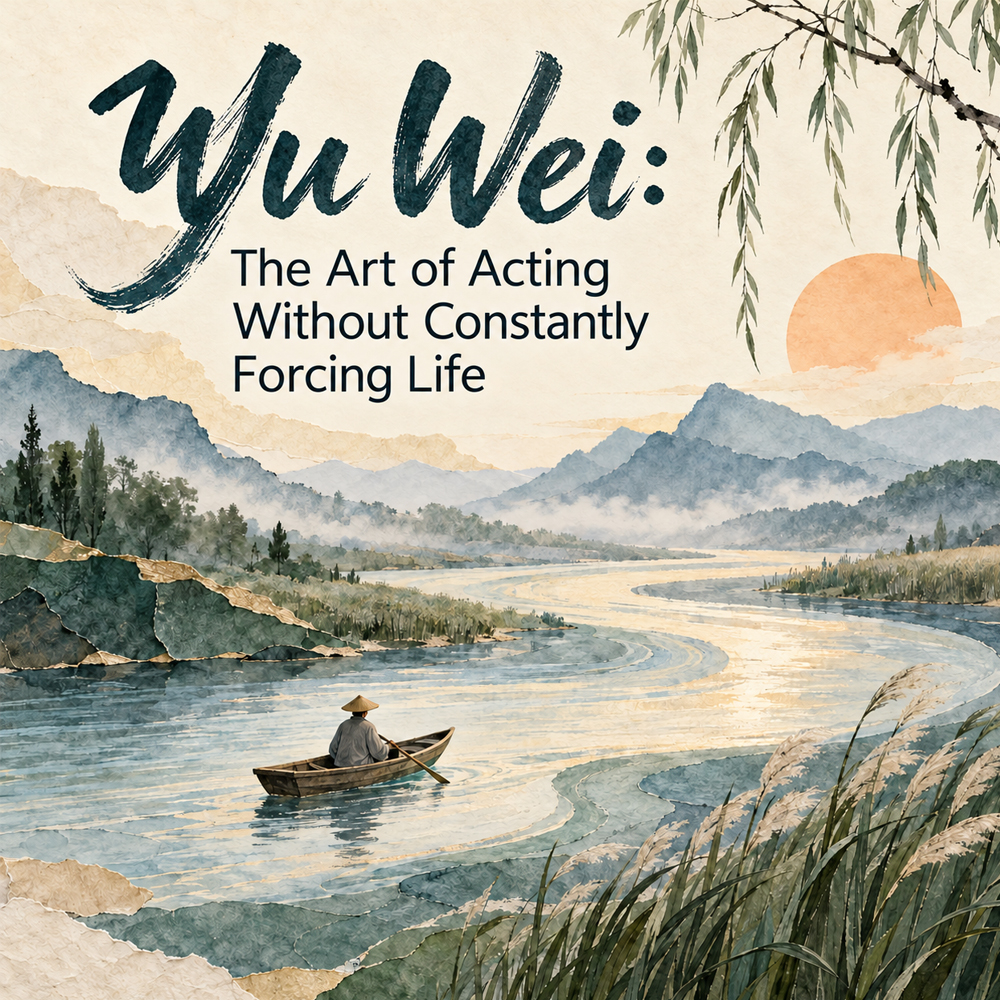
Part one – The Master Who Did Not Struggle Against Life
In the spacious hall of an ancient Chinese court, Lord Wenhui watched an extraordinary sight unfold before him. Standing nearby was an ordinary cook named Ding, whose task was to carve up an ox. The work appeared rough, demanding, and devoid of beauty, yet the man’s movements were unlike anything the ruler had ever witnessed. His hands glided with astonishing precision, his shoulders moved freely, his feet followed a natural rhythm, and his blade passed through the animal’s body with an ease that transformed an ordinary craft into an art. Every gesture seemed part of an invisible choreography, as though the cook were not performing difficult labor but dancing to music that only he could hear.
The ruler was struck not so much by the speed of the movements as by their complete absence of tension. Ding did not appear concentrated in the way a person concentrates when afraid of making a mistake. His face showed no trace of the strain that usually accompanies difficult work, and his hands never hesitated in search of the correct movement. The blade seemed to find its own path, encountering no resistance, never striking against the bones, and requiring no brute force. At last, the ruler could no longer contain his amazement and exclaimed that he had never imagined such an ordinary skill could reach such extraordinary perfection.
The cook set down his knife and explained that what interested him had long since ceased to be merely the skill of cutting up animals. When he first began his work, he saw nothing before him but the entire ox – a massive body that had to be divided through strength and precision. After three years of practice, he no longer perceived the animal as an indivisible whole and began to distinguish the natural connections between its parts. Now, he explained, he no longer relied on ordinary sight, for his senses had given way to a deeper understanding that guided his movements. Instead of forcing the blade through solid obstacles, he followed the spaces between them, moved along the natural openings, and allowed the very structure of the body to reveal the way forward.
Ding then revealed a detail that astonished the ruler even more. Ordinary cooks replaced their knives every month because they damaged them by hacking through bones, while more experienced craftsmen replaced theirs once a year because their blades gradually wore down. His own knife, however, was nineteen years old and still looked as though it had just come from the sharpening stone. The reason lay neither in some extraordinary metal nor in the superhuman strength of the person holding it. Ding simply did not attempt to pass through what could not be passed through, but found the natural spaces where movement encountered no unnecessary resistance.
The cook did not claim that his work never required attention. When he reached a difficult place where the connections between the parts were intricate, he slowed his movements, focused his gaze, and proceeded with particular care. It was precisely there that his mastery revealed itself most clearly, because he did not attempt to overcome difficulty through brute force. Instead, he waited, observed, and discovered the precise path along which the blade could continue. When the work was finished, he set down his knife, examined the result, and experienced the quiet satisfaction of someone who had acted in complete harmony with what lay before him.
The ruler listened to his words and realized that he had just received a lesson that had nothing to do with cooking. Before him stood a man whose wisdom had not been acquired through studying government, moral rules, or philosophical treatises. It had emerged from direct interaction with reality, from thousands of repeated movements, and from the gradual liberation from the desire to subordinate everything to one’s own will. In Zhuangzi‘s account, the ruler realizes that he has learned something essential about nourishing life. And at the heart of this lesson lies one of the deepest ideas in Taoist philosophy – wu wei, the art of acting without constantly forcing the natural course of things.
What It Means to Act Without Forcing
At first glance, the concept of wu wei seems almost contradictory. The Chinese characters 無為 are commonly translated as „non-action“ or „non-doing,“ but a literal translation can easily create a misleading impression. One might imagine a sage who spends his days motionless, refuses to intervene in the world, and observes life from a safe distance. Such an image, however, misses the essence of the Taoist understanding, because wu wei is not a call to laziness, indifference, or escape from responsibility. It describes a way of acting in which a person does not impose unnecessary force upon what can unfold naturally.
Cook Ding is not an inactive man but an exceptionally skilled master whose movements are filled with vitality and precision. He does not abandon his task when he encounters difficulty, nor does he wait for some invisible force to complete the work for him. The difference between him and the other cooks lies in the way he approaches obstacles. Where others see something that must be conquered, he sees a structure that must be understood. Where others increase the pressure, he changes direction, and where they exhaust their strength in struggle, he preserves his energy by discovering the appropriate moment and the correct movement.
This distinction seems simple until it is brought into human life. People are accustomed to associating success with effort, and effort with tension, self-imposed pressure, and the constant overcoming of resistance. From an early age, a person learns that they must insist more strongly, exercise greater control, strive more persistently, and refuse to yield to circumstances. In many situations, such determination is necessary, but it can gradually become a habit that is applied even when it becomes an obstacle. A person then begins to struggle not only against actual difficulties but against the very way life unfolds before them.
Taoist philosophy questions the belief that every difficulty must be met with even greater tension. It does not reject effort but examines the boundary beyond which effort ceases to help and begins to disrupt the natural course of action. Someone who tries to force themselves to fall asleep often discovers that the more insistently they pursue sleep, the more awake they become. A person who constantly monitors whether they are speaking naturally in front of others begins to stumble over their own words, while a musician who consciously thinks about every movement of their fingers during a well-practiced composition can lose the freedom developed through years of training. In such moments, the problem is not a lack of desire or dedication, but the excessive interference of conscious control.
Wu wei directs attention precisely toward this subtle boundary between useful intention and destructive forcing. It does not require a person to abandon their goals but to stop turning every goal into a battle against the present moment. Instead of imposing a predetermined form upon reality, one learns to recognize the possibilities that already exist within it. Like Cook Ding, who discovers the spaces between the bones, a person gradually develops sensitivity to circumstances, to appropriate timing, and to the limits of their own influence. Action does not disappear; it becomes more precise, more liberated, and less burdened by unnecessary struggle.
The River That Has No Need for Victory
To understand why this idea occupies such an important place in Taoism, we must turn to one of the most beloved images in ancient Chinese philosophy – water. Imagine a river descending from the mountains and encountering an enormous rock in its path. The water does not stop before the obstacle to gather strength, nor does it attempt to destroy it with one decisive movement. It divides around it, finds the cracks, follows the slope of the earth, and continues its journey without abandoning its own nature. Over time, that same soft and flowing water can carve through the stone that appears incomparably harder and more enduring than itself.
In the Tao Te Ching, traditionally attributed to Lao Tzu, water is presented as a model of behavior that closely resembles the Tao. It benefits countless beings without competing with them and naturally moves toward the low places that people ordinarily overlook. Its strength does not arise from a desire to dominate but from its ability to follow the characteristics of the world without losing its own movement. Water is not weak because it yields before the rock, just as the rock is not necessarily stronger because it remains motionless. Both possess different qualities, but it is flexibility that allows water to continue where rigidity becomes a limitation.
This image reveals something essential about the way Taoists understand strength. In ordinary human thinking, strength is often identified with the ability to impose one’s will, withstand every influence, and force the world to conform to one’s intentions. From the Taoist perspective, however, true strength also includes the ability to yield when yielding is wise, to change when circumstances require it, and to preserve one’s direction without clinging to a single method of reaching it. This is not surrender to life but liberation from an unnecessary war against it. The river reaches the valley not because it has defeated every rock along its path, but because it has not turned any rock into a reason to stop flowing.
Behind this image stands the concept of the Tao, most commonly translated as „the Way.“ It does not describe a path in the ordinary sense of a predetermined route that all beings must follow. In Taoist philosophy, the Tao is the inexhaustible source and natural course of reality, from which countless things arise and through which they are transformed. Words can point a person toward it, but they cannot fully encompass it, because every definition separates one part of reality while leaving the rest outside its boundaries. This is why the Tao Te Ching begins with the warning that the Tao which can be expressed in words is not the constant Tao.
To live in harmony with the Tao does not mean possessing secret knowledge of the future or discovering hidd;en messages in every event. It means developing sensitivity to the nature of things and ceasing to constantly replace reality with one’s own ideas about how it should be. A farmer must understand the seasons, a sailor must understand the winds, and a skilled craftsman must understand the properties of the material with which he works. None of them achieves genuine mastery by denying the conditions upon which their work depends. On the contrary, the more deeply they understand those conditions, the less they need brute force, and the more naturally they begin to act.
The Tree That Survived Because of Its Uselessness
Among the stories collected in the Zhuangzi, there is one about an enormous tree that attracted the attention of a wandering sage. Its trunk was so wide that several people would barely have been able to encircle it, and its crown cast shade over a vast area. At first glance, such a tree should have represented a genuine treasure to any carpenter, for it could provide an enormous quantity of timber. But when the sage examined it more closely, he discovered that its branches were crooked, its trunk was unsuitable for construction, and its wood lacked the qualities that craftsmen valued. It was precisely for this reason that the tree had been allowed to grow undisturbed, while all the other, straighter and more useful trees had long since been cut down.
The story overturns the ordinary human way of judging things. People tend to measure the value of things according to the benefit they can derive from them and to assume that whatever serves no particular purpose is without significance. Yet the tree that could not become a beam, a boat, or a piece of furniture had preserved something that the useful trees had lost – the opportunity to continue existing according to its own nature. Its unsuitability for human purposes had become the condition of its longevity. In this way, Zhuangzi raises the question of whether the relentless pursuit of usefulness and achievement causes human beings to sacrifice the very life they are trying to make successful.
This parable does not teach that a person should become useless or abandon their abilities. Its meaning is more subtle, for it reveals the danger of evaluating every being according to an external standard. The tree does not attempt to straighten its branches to earn the carpenter’s approval, nor is it ashamed of the shape it has acquired over the years. It grows wherever its roots find soil, spreads its crown according to the sunlight and the weather, and does not strive to become something other than what it is. Its existence is a reminder that life possesses a value that cannot be exhausted by human ideas of success, productivity, and social recognition.
In this image, another important dimension of wu wei emerges – liberation from the compulsion to constantly prove one’s worth. A person who measures every minute of life according to the results achieved gradually begins to regard rest as a loss, silence as emptiness, and activities without immediate benefit as unnecessary distractions. Even pleasure becomes a task that must be performed correctly, while personal development turns into an endless competition with one’s own past. Such an attitude creates a life filled with actions but deprived of the freedom to be immediately present within them. The Taoist tree reminds us that existence does not require constant justification before the expectations of others.
And yet there is an important distinction here between naturalness and simply following every impulse that arises. Human habits, fears, and desires do not always express a person’s deepest nature, because many of them are shaped by imitation, anxiety, and prolonged adaptation to external demands. To act naturally does not mean obeying every passing mood, just as living freely does not mean rejecting all discipline. Taoist naturalness involves gradually freeing oneself from the artificial pressures that distort perception and behavior. It is a state in which a person no longer needs to constantly perform a role before themselves and the world.
The Path That Reveals Itself When You Stop Forcing It
In the story of Cook Ding, there is one detail that can easily go unnoticed amid the beauty of his movements. He did not begin his journey as a master capable of carving an ox with apparent ease. For years, all he saw before him was the enormous animal, whose body had to be overcome through careful work. Only after prolonged practice did his perception begin to penetrate beyond the external form and distinguish the connections, spaces, and natural possibilities for movement. This means that the freedom the ruler witnessed was not the opposite of effort but the result of its gradual transformation.
At the beginning of every genuine mastery, a person must consciously think about things that they will later perform without deliberate effort. A student of calligraphy pays attention to how they hold the brush, how they press it against the paper, and how they change the direction of each stroke, until the hand gradually absorbs the movements. A beginning musician counts the beats, watches their fingers, and struggles not to lose the rhythm, while an experienced performer already hears the entire musical phrase and allows the body to follow it. Someone learning to swim initially struggles against the water, tries to control every movement, and often becomes exhausted precisely because of unnecessary tension. Over time, they discover that water is not an enemy to be defeated but an environment whose properties must be understood.
This gradual transformation reveals why wu wei cannot be achieved through a simple command to oneself. A person cannot become natural by constantly checking whether they are behaving naturally enough, just as they cannot achieve spontaneity by calculating every spontaneous gesture in advance. Such effort merely creates another level of tension, turning freedom into yet another goal that must be conquered. Genuine change occurs when attention gradually frees itself from unnecessary control and begins to turn toward reality itself. A person then stops constantly observing their own performance and begins to see more clearly what is happening before them.
Cook Ding does not spend every moment thinking about his mastery, because his attention is entirely absorbed in the work. He does not strive to impress the ruler, even though his movements inspire admiration, nor does he attempt to prove that he has attained some higher spiritual state. His freedom reveals itself precisely through the absence of such inner display. The blade follows the openings, the body follows the movement, and skill manifests through action that requires no constant self-affirmation. This is one of the most beautiful paradoxes of Taoist philosophy: a person begins to act with greater perfection when they cease to be obsessed with their own perfection.
But this ease does not mean that life suddenly becomes a smooth path without obstacles. Even Master Ding encounters difficult places that require him to slow down and proceed with particular care. The difference is that he does not perceive these obstacles as an insult to his own will, nor does he insist that reality should be simpler than it is. He accepts the complexity of what lies before him and adapts his actions accordingly. It is precisely here that wu wei ceases to be merely a philosophical idea and becomes an art of attention – the ability to distinguish when to continue, when to slow down, when to change direction, and when insistence itself has become the greatest obstacle.
This ability is far more difficult to cultivate than it appears, because people rarely notice how much of their suffering arises not from what is happening but from their insistence that it should be different. When circumstances do not conform to their expectations, they often increase the pressure, as though stronger desire must inevitably produce a better result. When their efforts bear no fruit, they blame themselves for not having done enough, without asking whether their very approach might be mistaken. In this way, the will that should serve them gradually becomes a source of exhaustion. Taoist wisdom begins with recognizing this moment – the moment when greater force no longer means greater understanding.
And it is here that the next, more difficult question begins. If excessive effort can become an obstacle, how can a person distinguish necessary perseverance from fruitless forcing? How can they know when they should act decisively and when it is wiser to allow things to follow their natural course? The ancient Taoist stories do not provide ready-made rules that can be mechanically applied to every situation. Instead, they lead us toward a deeper understanding of attention, practice, and that extraordinary state in which action ceases to be a struggle and begins to resemble the free movement of water.
Part two – When Effort Becomes an Obstacle
At the foot of steep mountain cliffs, a river descended with such ferocity that its waters crashed against the rocks and formed deep whirlpools. The current was so powerful that even experienced swimmers avoided the place, while the roar of the water drowned out human voices. One day, Confucius was passing by the river with his disciples when he noticed a man approaching the dangerous rapids. Before anyone could warn him, the stranger entered the water and disappeared among the foaming waves. Confucius was convinced that the man had decided to end his life and immediately sent his disciples downstream to search for his body.
But a little farther along the river, something happened that none of those present had expected. The same man calmly emerged from the water, stepped onto the bank, and walked away humming a song, as though he had just finished an ordinary swim. His face showed no trace of fear, exhaustion, or the relief of someone who had miraculously escaped death. Confucius caught up with him and asked how he had managed to survive in waters where even fish would struggle to maintain their direction. The stranger looked at him in surprise, for to him, what had just happened was not an extraordinary achievement at all.
In Zhuangzi‘s account, the swimmer explains that he possesses no special technique for conquering the river. He grew up near the water, gradually became accustomed to its movements, and transformed that understanding into his second nature. When the current pulls him downward, he descends with it, and when the water carries him upward, he follows its movement toward the surface. He does not attempt to impose his own will upon the river, nor does he exhaust his strength in useless resistance against its power. He simply enters with the whirlpool and emerges with the current, never placing his personal desires above the nature of the water.
To someone observing the scene from the riverbank, the swimmer’s behavior appears almost supernatural. He survives where others would perish, yet he possesses no secret power that makes him stronger than the river. His advantage lies in the fact that he does not turn the water into an opponent but understands it as an environment with which he must move in harmony. The water remains just as dangerous, the rocks do not become softer, and the whirlpools do not weaken because of his presence. What changes is only the relationship between the man and his circumstances, because instead of trying to subdue the river, he has mastered the art of not opposing it unnecessarily.
This story reveals one of the most difficult lessons of Taoist philosophy to accept. People are inclined to believe that control provides safety and that the more insistently they manage events, the less dependent they will be on the unpredictable. Yet there are circumstances in which the desire for complete control creates greater danger than uncertainty itself. A beginning swimmer who panics tenses their muscles, moves chaotically, and exhausts their strength much faster than someone who has preserved the ability to assess the situation. In the same way, the human mind, obsessed with the need to manage every detail, gradually loses the sensitivity required to respond wisely to change.
The swimmer in the story is not a reckless man who disregards danger. His apparent freedom is the result of a profound understanding of water, acquired through direct experience and prolonged adaptation. For an inexperienced person, imitating his actions would be dangerous, because outward ease cannot replace the skill that makes it possible. It is precisely here that the essential distinction between wu wei and blindly surrendering to circumstances becomes clear. To act without forcing does not mean abandoning reason, but developing such an accurate understanding of reality that one’s actions cease to be an unnecessary struggle against it.
The Farmer Who Wanted His Rice to Grow Faster
In another ancient Chinese story, preserved in the writings of Mencius, we are told of a farmer from the state of Song who was extremely impatient to see his harvest grow. Every morning, he went to his field and carefully examined the young plants that had barely emerged from the soil. He had invested considerable effort in preparing the earth, sowing the seeds, and tending the crops, yet despite his hard work, the seedlings grew at their own almost imperceptible pace. The longer he watched them, the more he was tormented by the conviction that nature was not working quickly enough. Eventually, he decided that he could no longer stand idly by while his plants wasted valuable time.
One morning, the farmer went out to the field determined to help his crops. He bent over the first seedling, carefully grasped it between his fingers, and gently pulled it upward so that it would become taller. Then he repeated the same procedure with the second, the third, and all the others until he had worked his way across the entire field. The task continued throughout the day and demanded enormous patience, because the farmer wanted every plant to receive equal assistance. When he finally finished, he returned home exhausted but filled with satisfaction and proudly announced to his family that he had helped the crops grow.
His son went to the field to see the results of his father’s extraordinary efforts. There, he discovered that the young plants had withered because the forceful pulling had damaged their delicate roots. The farmer had indeed succeeded in making the seedlings taller in a single day, but in doing so, he had destroyed the natural process through which they could have grown strong and healthy. His desire to help had been sincere, and his effort had certainly not been insufficient. He failed precisely because he confused growth with the outward appearance of growth and attempted to achieve the result without respecting the conditions that made it possible.
This parable originates in the Confucian tradition, but it reveals a problem that lies at the very heart of the understanding of wu wei. There are processes that can be supported but cannot be accelerated arbitrarily through pressure. The farmer must prepare the soil, provide water, and protect the plants from pests, but he cannot replace time, sunlight, and natural development with his own impatience. If he abandons the field, the plants may die from neglect, but if he constantly pulls them upward, he will destroy them just as surely. Wisdom consists in recognizing the boundary between necessary intervention and action that arises solely from an inability to wait.
Human life is filled with similar invisible seedlings that people attempt to pull upward. A parent wants their child to become independent and begins demanding a maturity that the child has not yet had the opportunity to develop. A teacher wants a student to understand a difficult idea and repeats the explanation with increasing frustration instead of searching for another way to reach the student’s understanding. A person strives for inner peace and begins blaming themselves every time they experience anxiety, as though tranquility could be achieved by forcibly suppressing every restless thought. In each of these cases, the desire for a good result gradually becomes a force that interferes with the very process necessary to achieve it.
The most deceptive feature of such behavior is that it often appears to be a virtue. The impatient person sees themselves as determined, the excessively controlling person as responsible, and the one who never allows themselves to rest as disciplined. These qualities can indeed be valuable, but their worth depends on the circumstances and the manner in which they are expressed. Determination without understanding becomes stubbornness, responsibility without trust becomes suffocating control, and discipline without moderation becomes exhaustion. Taoist wisdom does not reject these human capacities but insists that they be guided by a deeper sensitivity to the nature of each situation.
When the Mind Gets in the Way of Its Own Skill
Imagine a young musician who has spent years studying a difficult composition. In the beginning, every note required conscious effort, his fingers moved uncertainly, and his attention constantly shifted between the sheet music and the keys. Gradually, however, his movements became more precise, the rhythm began to feel natural, and the individual sounds joined together into a complete musical expression. After sufficient practice, he could perform the piece freely without deliberately thinking about every note. But on the day of an important concert, standing before a packed hall, he suddenly began monitoring his movements with anxious precision, as though he were sitting at the instrument for the very first time.
At first, the musician simply tries to make sure that everything is going correctly. He begins consciously controlling the position of his fingers, checking whether he is maintaining the rhythm, and anticipating every difficult passage before it arrives. But the more he strives to prevent mistakes, the more unnatural his performance becomes. The music, which until recently had flowed as one continuous movement, breaks apart into separate tasks requiring constant supervision. In his desire to maintain control over his skill, the musician begins interfering with the automatic movements that years of practice have already established.
Modern psychology investigates similar phenomena in the performance of well-learned skills under pressure. Under certain circumstances, directing excessive conscious attention toward individual movements can disrupt the fluency of actions that are ordinarily performed automatically. This does not mean that conscious control is always harmful, because it remains necessary when acquiring new abilities, correcting mistakes, and encountering unfamiliar situations. The problem arises when a person continues to manage every detail of a process that now requires a different kind of attention. The very instrument that helped build the skill then begins to interfere with its free expression.
The ancient Taoist thinkers did not possess the terminology of modern psychology, but their stories demonstrate remarkable insight into similar human experiences. Cook Ding had not ceased to be attentive; he had ceased to rely on the crude, continuous calculation of every movement. The swimmer had not lost awareness of the water; he had developed the ability to respond to its changes without struggling against every wave. In both cases, attention had become more complete because it was no longer fragmented by constant attempts at control. The master does not observe himself as an external judge evaluating every action, but participates directly in what he is doing.
Here we also discover the difference between genuine concentration and tense attachment to results. A concentrated person is entirely present in their work, while someone obsessed with success constantly abandons the present action to check whether they are approaching the desired future quickly enough. The first notices details because their attention is free to perceive them, while the second often overlooks what matters most because their mind is occupied with its own expectations. Outwardly, both may appear equally hardworking, but the inner quality of their actions is different. One works with reality, while the other constantly compares it to an imagined version of how it ought to be.
Wu wei does not require the disappearance of thought, nor does it deny the human capacity to plan and reason. It places thinking in its proper role, allowing it to serve action rather than constantly interrupt it. There is a time to study the notes and a time to perform the music, a time to consider the route and a time to follow the road directly. A wise person does not abandon preparation but learns not to carry the entire weight of preparation into every moment of the action itself. It is precisely this ability that transforms accumulated knowledge from a burden into freedom.
The Wheelwright and the Knowledge That Cannot Be Passed on Through Words
In one of Zhuangzi‘s stories, Duke Huan of the state of Qi was sitting in his hall reading the writings of ancient sages. Nearby, an old wheelwright named Bian was working on wooden components for carriages. While the ruler studied the text, the craftsman put down his tools, approached him, and asked what exactly his lord was reading. When he heard that these were the words of sages who had lived many generations earlier, he wanted to know whether those men were still alive. The duke replied that they had long since died, and the wheelwright boldly concluded that what his lord was reading was merely the remnants left behind by the ancients.
The words angered the ruler, who was not accustomed to an ordinary craftsman questioning the value of great books. He demanded an immediate explanation and warned the wheelwright that if he failed to defend his statement, he would be punished. The old man remained untroubled and began speaking about the craft he had practiced for decades. When shaping a wooden wheel, he explained, the blows of the tool had to be neither too strong nor too weak. If he worked too slowly and cautiously, the wood would not yield as it should, while if he acted too roughly, he would damage the material and destroy the precision of the work.
True mastery existed in that difficult-to-define middle ground which the hand understood but language could never fully describe. The old man knew how the tool should move because his body had absorbed that knowledge through years of work. But when he tried to pass it on to his son, he discovered that words were not enough to transfer the whole understanding from one hand to another. His son could hear the explanations, observe the movements, and memorize the rules, but he still had to undergo the experience that transforms knowledge into skill. The wheelwright therefore concluded that an essential part of the wisdom of the ancients had disappeared along with their living presence, while the written words were merely the traces they had left behind.
The story is not simply an attack on books or education. It reveals the limitations of knowledge that exists only as description, without being experienced and applied. A person can read hundreds of pages about balance but will not learn to ride a bicycle until their body has absorbed the movement. They can study the art of conversation for years but will not fully understand when to speak and when to remain silent if they have never truly listened to another person. In the same way, someone can memorize every explanation of wu wei and still continue forcing their life, because intellectual understanding alone is not enough to transform deeply rooted habits.
The old wheelwright and Cook Ding belong to the same world of Taoist wisdom. Both are ordinary craftsmen whose understanding of reality has reached a depth inaccessible to those who know life only through abstract rules. They do not despise skill or reject discipline, for their entire lives testify to the value of prolonged practice. But they understand that there comes a moment when rules must cease to be external commands and become an immediate sense of the appropriate action. The master then no longer follows a formula mechanically but recognizes the particular characteristics of every new situation.
This is one of the reasons wu wei cannot be reduced to a collection of simple life advice. There is no universal rule determining how long one should persist before yielding, or how much effort is necessary before it becomes unnecessary forcing. The answer depends on the nature of the particular action, the abilities of the individual, and the circumstances, which are constantly changing. Like the craftsman who senses the exact force of a blow, a person gradually develops the ability to recognize the appropriate measure. This knowledge is not opposed to reason, but it extends beyond what can be fully captured through instructions formulated in advance.
The Empty Space That Makes Action Possible
In the eleventh chapter of the Tao Te Ching, Lao Tzu directs our attention toward three perfectly ordinary objects – a wheel, a vessel, and a house. A wheel is constructed from spokes, but its usefulness also depends on the empty space at its center, where the axle is placed. A vessel is shaped from clay, but it can hold water precisely because its interior is empty. A house has walls, a roof, and doors, but people live in the space enclosed by these boundaries. In this way, the philosopher demonstrates that what is absent is not necessarily without value, because emptiness is often the very condition that allows visible form to fulfill its purpose.
At first glance, this seems like a poetic observation about objects, but behind it lies a profound understanding of human life. People ordinarily value what they can add – more knowledge, more actions, more possessions, more achievements, and more opportunities. They rarely devote the same attention to the space necessary for all these things to be used wisely. A day filled with uninterrupted tasks gradually loses the freedom that allows a person to notice an unexpected opportunity or reflect on the direction in which they are moving. A mind overloaded with preconceived conclusions begins to perceive new events only through the lens of what it already believes it knows.
In this sense, emptiness does not mean the absence of life but space for its free unfolding. Music needs pauses so that its rhythm can breathe, and conversation needs silence so that what has been said can be understood. A person who never leaves any space between an emerging desire and their response gradually becomes a prisoner of their impulses. They answer before listening, decide before understanding, and act before clearly seeing the circumstances. Their life is filled with movement, but that movement does not always have direction.
Taoist emptiness is closely connected to the ability to refrain from filling every moment with one’s own will. When a person stops insisting that they already know how every situation should develop, their attention becomes more open to the possibilities that actually exist. This does not mean losing one’s own position or abandoning judgment, but refusing to allow personal convictions to silence everything that does not fit within them. The empty space inside a vessel does not oppose its walls; it allows them to fulfill their purpose. In the same way, inner freedom does not destroy the human will but allows it to act without the unnecessary weight of constant compulsion.
In the story of the swimmer, this freedom appears as the ability to follow the movement of water. In the parable of the farmer, its absence is revealed through the impatience that destroys the plants. In the account of the wheelwright, it exists as living knowledge that cannot be entirely confined within words and rules. The three stories describe different aspects of the same art – recognizing the nature of what one is interacting with and refusing to replace that understanding with brute insistence. For the Taoist sage, freedom does not consist in the ability to do everything one desires, but in liberation from the need to constantly desire that reality should be different.
It is precisely here that the philosophy of wu wei begins to acquire its deepest human significance. For the true test does not come when a person observes a river, constructs a wheel, or studies an ancient parable, but when they confront their own fears, ambitions, disappointments, and attachments. It is easy to admire the water flowing around a rock, but far more difficult to recognize when you yourself have turned an obstacle into an endless personal battle. It is easy to smile at the farmer who pulls his seedlings upward, but much harder to notice your own impatience when waiting for the results of your efforts. And if wu wei possesses a power that extends beyond the beauty of ancient stories, it lies precisely in its ability to transform the way a person lives amid the inevitable uncertainty of the world.
Part three – Living in Harmony with the Flow
Imagine a person who wakes up every morning with the feeling that they are already falling behind in life. Before even getting out of bed, their thoughts turn toward the tasks they must complete, the problems they have not yet resolved, and the future that is not unfolding quickly enough according to their expectations. While eating breakfast, they think about work; while working, they think about responsibilities at home; and when evening finally arrives, their mind is already occupied with the following day. Even moments of rest bring no genuine peace, because somewhere deep within, they carry the conviction that they could always be doing something more useful. Life gradually becomes an endless succession of tasks whose completion promises a satisfaction that is continually postponed.
This person is not necessarily unhappy, nor is their life devoid of achievements. They may be respected, capable, and successful by every conventional measure, yet their inner experience remains marked by constant tension. Whenever they achieve one goal, they almost immediately discover another that must be pursued, and when circumstances fail to develop according to their intentions, they perceive it as a personal failure. Gradually, they lose the ability to distinguish their own desires from the expectations they have absorbed from society, family, and their surroundings. They no longer know whether they genuinely want what they are pursuing, because they have become accustomed to regarding the pursuit itself as proof that they are living correctly.
Taoist philosophy calls precisely this constant inner mobilization into question. It does not claim that a person should abandon ambition, neglect responsibilities, or stop building their future. Instead, it invites them to examine how much of their effort arises from genuine necessity and how much is driven by an inability to accept the present as it is. There is an enormous difference between working diligently toward something valuable and believing that one has no right to peace until it has been achieved. The former can be an expression of creativity and vitality, while the latter transforms every action into a means of escaping one’s own existence.
A person who understands wu wei does not cease to have goals, but changes their relationship with them. They can work for long hours, confront difficulties, and demonstrate remarkable perseverance without turning every obstacle into evidence that the world is working against them. When their efforts produce results, they continue forward, and when circumstances demand change, they do not perceive adaptation as humiliation. Their determination does not arise from blind attachment to a preconceived scenario, but from a clear understanding of the direction in which they wish to move. Like a river, they can change their course without necessarily abandoning their movement.
This attitude does not eliminate pain, loss, or disappointment from human life. Taoism does not promise an existence in which every event will be pleasant and every effort will end in success. Its insight is that people often add a second, unnecessary layer of suffering to unavoidable difficulties, created by their constant resistance to the very fact that things are not unfolding according to their wishes. When reality changes, they continue insisting that it should remain the same, and when something comes to an end, their mind attempts to hold on to what has already passed. Wu wei does not teach them to become indifferent to these experiences, but to avoid turning natural pain into an endless war against reality.
When We Try to Control Others
Among the most difficult areas in which a person can apply Taoist wisdom are relationships with other people. Everyone has experienced the desire to change the behavior of someone close to them, persuade them to make a wiser choice, or help them avoid a mistake whose consequences seem obvious. Such a desire often arises from genuine concern, but it can gradually develop into the conviction that love grants the right to constant interference. Advice then becomes insistence, insistence turns into demands, and demands provoke resistance, which only intensifies the desire for control. Two people who initially wanted to understand each other gradually find themselves drawn into a struggle in which each defends their own freedom.
Imagine a father who wants his son to choose a profession that guarantees security and social recognition. The father knows the difficulties of life and sincerely believes that his experience will protect the young man from unnecessary suffering. But the son shows an interest in an entirely different occupation, one that appears uncertain and difficult to understand from the perspective of the older generation. The more the father insists, the more strongly the son feels that he must defend his right to make his own choices. At a certain point, the conversation is no longer about a profession, but about who has the authority to determine the direction of a human life.
From the perspective of wu wei, wisdom does not consist in the father ceasing to care about his son’s future. It reveals itself in his ability to distinguish concern from the desire to subordinate another person to his own conception of a proper life. He can share his experience, explain the risks, and offer support without turning love into an instrument of coercion. The son, in turn, can listen to the advice without perceiving every disagreement as an attack on his freedom. Such an attitude does not guarantee that the two will reach the same decision, but it creates a space in which understanding can replace the struggle for dominance.
In the Tao Te Ching, good governance is often represented through the image of a ruler who does not constantly seek to demonstrate his authority. Instead of subordinating every movement of society to countless commands, he creates conditions in which people can live and act without unnecessary interference. This is a philosophical ideal rather than a universal formula for political government, but its meaning extends beyond the relationship between rulers and subjects. The same question arises within families, friendships, education, and every situation in which one person bears responsibility for another. Good influence does not always reveal itself through the most visible intervention, because sometimes the most valuable help is to create the conditions in which another person can develop their own abilities.
This does not mean that all human relationships should be left to chance or that establishing boundaries contradicts naturalness. There are situations in which clear disagreement, decisive intervention, and the defense of one’s dignity are necessary. Wu wei does not require a person to tolerate injustice, nor to abandon the responsibility of protecting those who depend on them. It asks a different question – whether an action arises from a clear understanding of the situation or from an inability to tolerate the fact that other people possess wills of their own. Once this distinction is recognized, a person begins to understand that genuine closeness is not built through constant control, but through trust, attention, and respect for another person’s natural development.
The Tree That Would Not Bend and the Bamboo That Survived
Imagine a powerful storm sweeping through a forest, shaking the crowns of the trees and forcing their branches to bend beneath the pressure of the wind. Some ancient trees possess enormous trunks that appear immovable, but when the strain exceeds the limits of their endurance, the wood breaks. Nearby, slender bamboo stalks bend almost to the ground, following the direction of the gusts, and when the storm passes, they gradually rise again. Their resilience does not arise from the ability to remain motionless, but from the flexibility that allows them to withstand the force without being destroyed. This image expresses one of the most characteristic ideas of Taoist philosophy – that softness and yielding can possess a strength that brute rigidity does not understand.
In the Tao Te Ching, Lao Tzu associates life with softness and flexibility, and death with hardening and rigidity. A newborn being is tender and yielding, while a dead body gradually loses its living flexibility. Young plants are soft, but when they dry out, they become rigid and easily broken. These observations serve as images of a broader philosophical principle, according to which the capacity for change is an essential part of vitality. That which insists on remaining unchanged under all circumstances gradually becomes a prisoner of its own form.
In human life, such rigidity often manifests as an inability to change one’s beliefs. A person constructs a particular image of themselves, the world, and the proper way to live, and then begins defending that image even when experience reveals its limitations. They perceive changing their mind as weakness, admitting a mistake as defeat, and abandoning an unsuccessful plan as evidence of a lack of character. Gradually, their convictions cease to be tools for understanding reality and become a fortress that must be defended at any cost. A person can thus remain loyal to an idea long after they have ceased to understand why they originally embraced it.
Taoist flexibility is not the same as having no principles. Bamboo does not lose its nature when it bends, just as a river does not cease to be a river when it flows around an obstacle. In the same way, a person can preserve their deepest values without insisting that they must always be expressed through the same actions. Courage sometimes requires standing firm, but at other times it requires admitting that one was wrong, while perseverance can mean not continuing along the same path, but finding a new way to serve what truly matters. Wisdom reveals itself not through mechanical adherence to a predetermined form, but through the ability to recognize what must be preserved and what must change.
This understanding is particularly significant in a world that is constantly transforming. Professions disappear, social attitudes change, relationships pass through different stages, and the human body and its abilities never remain entirely the same. Attempting to hold all these processes in a fixed state creates tension that cannot be overcome through even greater control. Wu wei offers another way of existing – not abandoning stability, but discovering a resilience that includes the capacity to adapt. Such resilience does not depend on whether the world will remain as we know it, but on the ability to move wisely through its changes.
The Silence in Which Life Begins to Reveal Itself
In one of Zhuangzi‘s most mysterious stories, the philosopher describes a conversation between a teacher and a student devoted to an extraordinary state called „sitting in forgetfulness.“ The student gradually announces that he has left behind the familiar distinctions and attachments that determine his understanding of the world. Finally, he explains that he has ceased clinging even to the conception of his own body and knowledge, as though the boundaries through which he constantly separates himself from the rest of existence have lost their absolute authority. The teacher does not regard this as ordinary distraction or a rejection of thought, but as an expression of a profound transformation of consciousness. In this account, freedom appears not through the accumulation of more knowledge and abilities, but through liberation from what obstructs the direct experience of reality.
The meaning of such a story is easily lost when it is regarded solely as a description of an extraordinary spiritual experience. Its significance lies in the understanding that people constantly perceive the world through ideas, expectations, fears, and judgments that they have either constructed themselves or absorbed from others. When they meet a stranger, they often have already formed an opinion before listening to them, and when they encounter difficulty, they immediately begin comparing it with their conception of a fair and successful life. In this way, an entire world of preconceived conclusions gradually accumulates between the individual and reality. A person ceases to see only what is happening and begins to see primarily the meaning that their own habits assign to it.
Taoist liberation from these limitations does not require a person to destroy their memory or abandon their capacity to reason. It involves ceasing to treat every thought as an ultimate truth and every desire as a command that must necessarily be obeyed. When anger arises, a person can notice it without immediately transforming its energy into words or actions. When fear appears, they can examine the actual danger instead of automatically surrendering to their darkest assumptions. And when they experience a powerful desire to control a situation, they can ask whether their intervention will improve the circumstances or merely provide a temporary feeling of power over uncertainty.
In this respect, silence acquires a meaning that extends beyond the simple absence of noise. It is an inner space in which a person ceases to react mechanically to everything that passes through their consciousness. Such silence is not the opposite of action, because it is precisely what allows actions to become clearer and more precise. When the mind is not compelled to constantly defend its own expectations, it becomes more receptive to the particular characteristics of the present moment. A person gradually begins to distinguish genuine necessity from the inner anxiety that merely disguises itself as necessity.
Here, wu wei reaches one of its most subtle dimensions. A person does not free themselves from tension by turning tranquility into yet another obligation, nor do they achieve naturalness by constantly checking whether they are living naturally enough. The very desire to control one’s inner state can become a new form of coercion that reproduces the problem one is trying to escape. Instead, a person learns to allow their experiences to arise without being entirely governed by them, and to act when action is genuinely necessary. Freedom gradually ceases to mean complete power over what happens and begins to mean less dependence on the constant need to subordinate everything to one’s own will.
Becoming Part of the Flow
Let us return one final time to Cook Ding, standing before the ruler with his nineteen-year-old knife. His movements appear extraordinary, but he himself does not regard them as a miracle, because he knows the long path that has brought him to this mastery. In the beginning, he had to overcome his own clumsiness, study the structure of the body, and correct countless mistakes. Gradually, he stopped seeing the work as a battle between the blade and the bones, because he had discovered the natural path along which movement could unfold. His skill had not eliminated the need for action, but had removed much of the unnecessary resistance that ordinarily accompanies it.
The same understanding unites all the stories we have encountered. The swimmer survives among the whirlpools because he understands the movement of water, while the farmer destroys his crops because he fails to respect the natural rhythm of growth. The old wheelwright possesses knowledge that cannot be fully expressed through words, while the enormous useless tree continues to live because it does not fit human conceptions of usefulness. Each story reveals a different aspect of the same problem – the human tendency to place personal intentions above reality instead of first understanding its nature. And each demonstrates that genuine mastery begins where the will ceases to be blind.
Wu wei is not a promise of an easy life, nor is it a philosophical justification for inactivity. It does not free a person from the need to make decisions, exert effort, or take responsibility for the consequences of their actions. On the contrary, it demands deeper attention, because ready-made rules and mechanical reactions are rarely sufficient to reveal the particular nature of each situation. Sometimes the appropriate action is decisive and swift, at other times it requires patience, and sometimes the wisest choice is not to interfere with a process that unfolds better without one’s intervention. What these different possibilities share is not the outward form of behavior, but its correspondence with the actual conditions.
Here lies the profound difference between a life governed by constant struggle and a life guided by understanding. The first person continually attempts to impose a predetermined form upon the world, while the second seeks to discover what is possible within the circumstances at hand. The first measures their strength by the obstacles they have managed to overcome, while the second understands that some obstacles need not be turned into battles at all. The first often expends enormous energy defending their conception of the correct path, while the second preserves the ability to recognize a new path when the old one ceases to be appropriate. This does not mean that one never makes mistakes, but that the other is more inclined to turn every mistake into a reason for even greater resistance.
To live according to wu wei means gradually discovering this distinction in one’s everyday life. It reveals itself when you listen to someone until they have finished speaking instead of preparing your response while they talk, or when you allow a difficult task the time it genuinely requires without turning slow progress into a personal insult. It appears when you acknowledge that a particular plan is no longer working and find the courage to change it instead of continuing solely because you have already invested too much effort in it. It is also present in the ability to enjoy an ordinary experience without immediately searching for a way to make it more useful, more impressive, or more perfect. In such moments, a person does not withdraw from life but stops placing between themselves and life the constant demand that everything should be different.
And yet the deepest meaning of wu wei is not exhausted by achieving our goals more easily or reducing unnecessary tension. If this philosophy is transformed merely into a technique for greater productivity, it loses its essence and becomes yet another instrument of the same pursuit of control that it seeks to overcome. The Taoist sages direct us toward something more fundamental – the understanding that human beings do not stand outside the world as independent rulers who must constantly subdue it. Each person is part of the ceaseless movement of nature, of the changes that shape their body, of the time that transforms their thoughts, and of the relationships through which their life acquires meaning. The more insistently they attempt to separate themselves from this movement and place it under complete control, the more easily they lose the sense of belonging to it.
The river does not need to believe that it must be a river in order to continue flowing. The tree does not measure the value of its existence by the usefulness of its shade, and the bird does not turn every movement of its wings into proof of its own perfection. Human beings possess the ability to reflect upon their lives, choose their direction, and transform the world around them, but that same ability can distance them from the immediacy of existence. They begin to live not only in reality, but also among countless ideas of what reality ought to be. Wu wei does not call upon them to abandon reason, but to discover the wisdom of using it without turning every experience into a problem that must be solved.
Somewhere among the ancient stories of Zhuangzi, Cook Ding puts away his knife after finishing his work. He does not deliver a grand speech about the meaning of life, proclaim himself a sage, or attempt to turn his skill into a doctrine that everyone must follow. He has simply done what needed to be done, with attention, precision, and without unnecessary struggle. Within his calm movements lies an insight that many people spend their entire lives searching for – that freedom does not always come when we acquire greater power over the world, but when we cease demanding that it constantly submit to our will. And then life does not necessarily become easier, but we begin to move through it differently – not as conquerors who must defeat every obstacle, but as masters who have gradually learned to recognize the natural path of their own blade.
Author: Vasil Stoyanov