
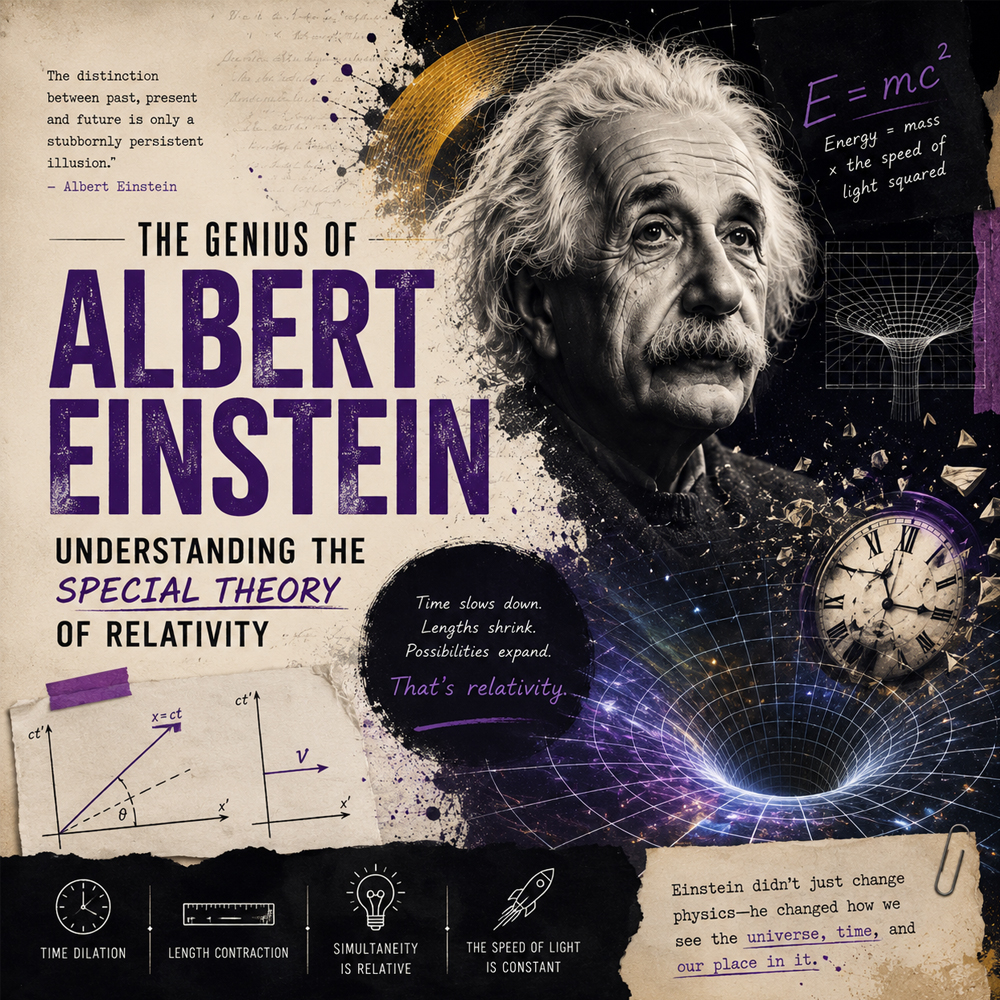
In 1905, Albert Einstein published his Special Theory of Relativity, a revolutionary framework that permanently changed humanity’s understanding of space, time, motion, and reality itself. Before Einstein, scientists generally believed that space and time were absolute and unchanging. Time was assumed to flow at the same rate for everyone, regardless of their circumstances, while space was considered a fixed stage on which the events of the universe unfolded.
Einstein’s work challenged these assumptions. Building upon earlier discoveries made by scientists such as James Clerk Maxwell, Hendrik Lorentz, and Henri Poincaré, he demonstrated that measurements of space and time depend on the motion of the observer. Objects moving at different speeds do not necessarily agree on distances or durations. Instead, space and time are intertwined aspects of a single entity that physicists now call space-time.
This realization was not merely a correction to existing physics. It represented one of the greatest conceptual revolutions in human history. Ideas that seemed obvious and intuitive suddenly became incomplete, while reality turned out to be far stranger than anyone had imagined.
Motion and Reference Frames

One of the central principles of Special Relativity is that the laws of physics are identical in all inertial reference frames. An inertial reference frame is simply a frame of reference that is either at rest or moving at a constant velocity without accelerating.
This principle leads to an important observation: there is no such thing as absolute motion or absolute rest. Motion can only be described relative to something else. If you are sitting on a park bench and a car drives past you, it appears that you are stationary while the car is moving. From the driver’s perspective, however, the car is stationary and it is you who appear to be moving backward.
Neither perspective is more correct than the other. Motion is always relative to the observer’s frame of reference. The same object can be considered moving from one perspective and stationary from another. This idea may seem simple, but it forms the foundation upon which Einstein built his theory.
The Constant Speed of Light
The truly revolutionary aspect of Einstein’s theory emerged when this principle of relativity was combined with another surprising discovery: the speed of light in a vacuum is always constant.
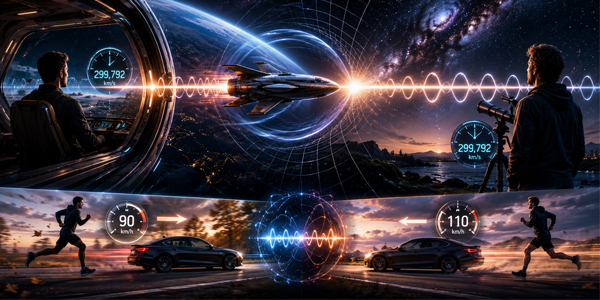
Light travels at approximately 299,792 kilometers per second, commonly rounded to 300,000 kilometers per second. What makes this remarkable is that every observer measures the same value regardless of their own motion or the motion of the light source.
To understand why this is unusual, consider an ordinary car moving at 100 kilometers per hour. If you begin running in the same direction at 10 kilometers per hour, the car appears to move away from you at only 90 kilometers per hour. If you run in the opposite direction, the car appears to move at 110 kilometers per hour relative to you.
This is how velocities normally combine in everyday life. However, light behaves differently.
Imagine a spaceship emitting a beam of light while traveling through space. An observer inside the spaceship measures the speed of the light as 300,000 kilometers per second. Surprisingly, an observer watching from outside the spaceship also measures the speed of that same light as 300,000 kilometers per second, even though the spaceship itself is moving.
This result has been confirmed repeatedly through experiments and is one of the most thoroughly tested principles in modern physics. The speed of light remains constant for all observers, regardless of their relative motion.
The Birth of Space-Time

At first glance, the constancy of the speed of light appears impossible. If all observers measure the same speed, then something else must adjust in order to preserve this value.
Einstein realized that the quantities that must change are space and time themselves. Distances and durations cannot remain fixed if the speed of light is to remain constant for every observer. This insight led to the concept of space-time, a four-dimensional framework that combines the three dimensions of space with the dimension of time.
Rather than being separate and independent entities, space and time are interconnected. Changes in one are accompanied by changes in the other. As an object’s velocity increases, the structure of space-time changes in measurable ways.
The Light Clock Thought Experiment
To illustrate this concept, physicists often use a thought experiment known as the light clock.
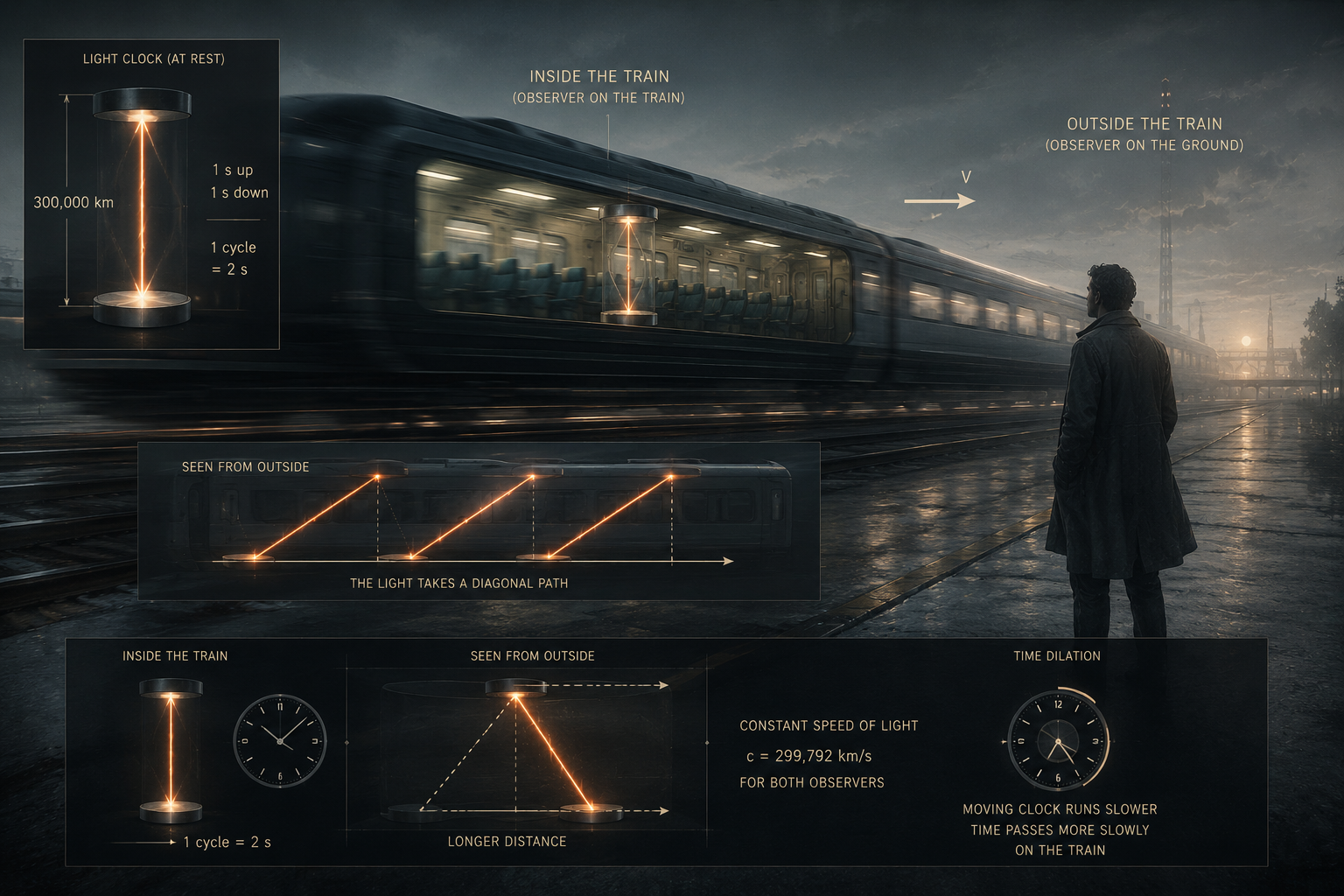
Imagine two mirrors facing each other vertically, with a beam of light bouncing back and forth between them. Each round trip of the light beam acts like the ticking of a clock. If the mirrors are separated by 300,000 kilometers, the light requires one second to travel upward and one second to return, producing a complete cycle every two seconds.
Now imagine placing this light clock inside a train moving at an extremely high speed.
For passengers inside the train, nothing appears unusual. The light simply travels vertically between the mirrors exactly as before. However, an observer standing beside the tracks sees something different. Because the train moves forward while the light travels, the light follows a diagonal path rather than a purely vertical one.
From the external observer’s perspective, the light travels a longer distance between each tick of the clock. Yet the speed of light must remain exactly the same for both observers.
[Click to Zoom]
This creates an apparent paradox. If the speed remains constant but the distance is greater, the only remaining quantity that can change is time itself.
The conclusion is unavoidable: the moving clock must run more slowly. Time passes more slowly for the passengers aboard the train relative to the stationary observer. This phenomenon is known as time dilation, and it is one of the most famous predictions of Special Relativity.
Time Dilation
Time dilation is not an illusion or a trick of perception. It is a real physical effect that has been measured countless times.
Experiments involving highly accurate atomic clocks have shown that clocks moving at high speeds genuinely tick more slowly than stationary clocks. The effect is extremely small at everyday velocities, which is why we do not notice it in daily life. However, it becomes significant as an object’s speed approaches the speed of light.
Astronauts aboard the International Space Station, for example, age very slightly less than people on Earth because they are moving faster relative to Earth’s surface. Although the difference amounts to only fractions of a second over long periods, it confirms Einstein’s predictions with extraordinary precision.

[Click to Zoom]
Experimental Proof: The Muon Experiment

One of the strongest experimental confirmations of Special Relativity comes from a tiny subatomic particle known as the muon. Muons are produced when high-energy cosmic rays from outer space collide with atoms in Earth’s upper atmosphere. These particles are unstable and have an average lifetime of only about 2.2 microseconds before they decay into other particles.
At first glance, this creates a puzzling problem. Even though muons travel at speeds close to the speed of light, their lifetime appears far too short for them to reach Earth’s surface. A simple calculation shows that a muon moving at nearly 300,000 kilometers per second should travel only a few hundred meters before decaying. Since they are typically created at altitudes of ten to fifteen kilometers, most of them should disappear long before reaching the ground.
Yet this is not what scientists observe. Detectors placed on Earth’s surface measure enormous numbers of muons arriving every second. According to classical physics, this should be impossible. Something must be allowing these particles to survive far longer than their normal lifetime.
The explanation comes directly from Einstein’s Special Theory of Relativity. Because the muons are moving at speeds very close to the speed of light relative to Earth, time passes more slowly for them from our perspective. Their internal „clocks“ run slower than clocks on Earth. As a result, a lifetime that is only 2.2 microseconds at rest appears much longer to an observer on Earth, giving the particles enough time to travel through the atmosphere and reach the surface before decaying.
The experiment becomes even more fascinating when viewed from the perspective of the muons themselves. In their frame of reference, their lifetime remains unchanged at 2.2 microseconds. Instead, the distance between the upper atmosphere and Earth’s surface becomes shorter due to another relativistic effect known as length contraction. From the muon’s perspective, the atmosphere is compressed, allowing the ground to reach it before it decays.
Both explanations describe the same physical reality and lead to identical predictions. This agreement between theory and observation is one of the most elegant demonstrations of Special Relativity ever performed. Every second, billions of muons created high above our heads provide a natural experiment that confirms Einstein’s revolutionary ideas about time, space, and motion.
Length Contraction
Time is not the only quantity affected by motion. Space itself changes as well.
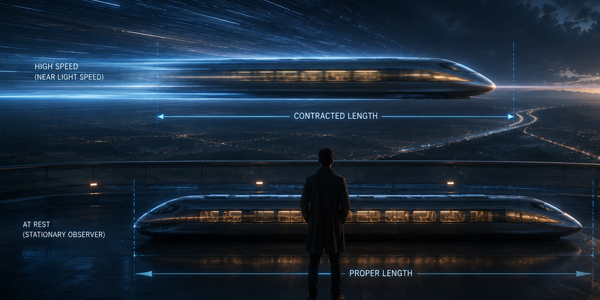
According to Special Relativity, objects moving at very high speeds become shorter along the direction of their motion when viewed by an external observer. This effect is called length contraction.
The faster an object moves relative to an observer, the more pronounced the contraction becomes. Once again, the effect is negligible at ordinary speeds but becomes dramatic as velocities approach the speed of light.
Time dilation and length contraction work together to ensure that all observers measure the same speed of light. Although these effects seem strange from an everyday perspective, they are necessary consequences of the structure of space-time.
The Legacy of Special Relativity

Einstein’s Special Theory of Relativity fundamentally transformed physics. It demonstrated that space and time are not fixed backgrounds but dynamic quantities that depend on motion. Concepts once considered absolute became relative, while the speed of light emerged as one of the fundamental constants of nature.
The theory also laid the groundwork for Einstein’s later masterpiece, the General Theory of Relativity, published in 1915. While Special Relativity describes the relationship between space, time, and motion, General Relativity extends these ideas to include gravity and the curvature of space-time itself.
More than a century later, Special Relativity remains one of the most successful scientific theories ever developed. Its predictions are used in particle accelerators, GPS satellites, astrophysics, and countless modern technologies. What began as a series of thought experiments conducted by a young patent clerk ultimately changed humanity’s understanding of reality forever.
Read More:
- Einstein’s General Theory of Relativity: How Gravity Shapes Space, Time, and the Universe
- Quantum Field Theory – Does Anything Truly Exist?
- Black Holes: What They Are and Why They Hold the Greatest Secrets of the Universe
- How Do Solar Systems and Meteor Showers Form?
Author: Vasil Stoyanov