
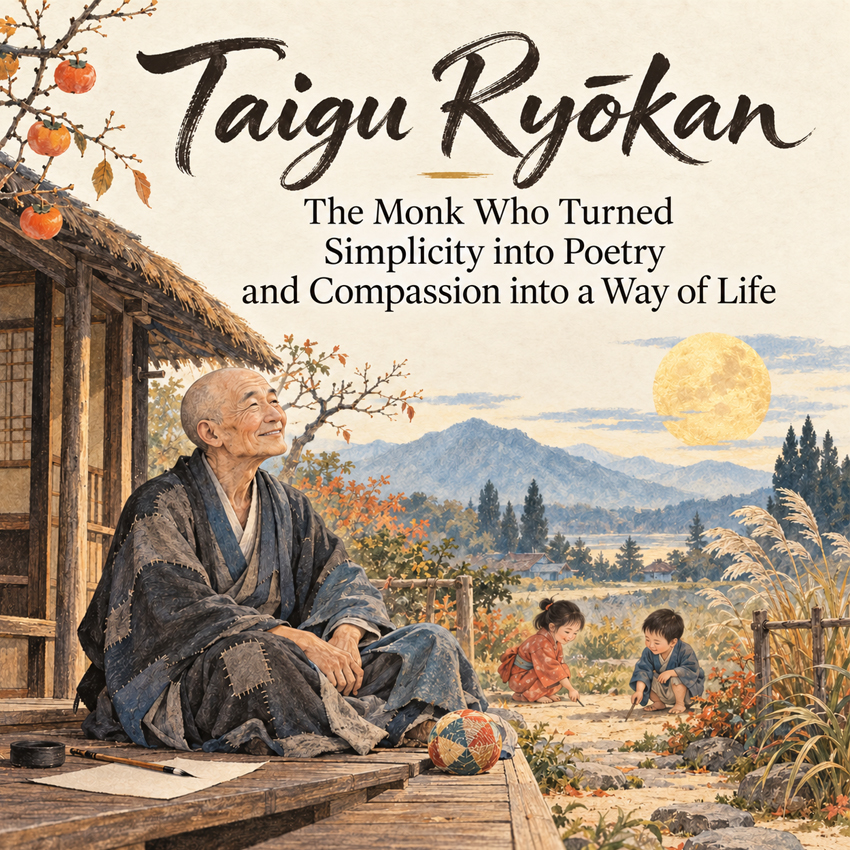
In the history of spirituality, some people impress us with magnificent temples, elaborate philosophical systems, and extraordinary public achievements. Others possess a greatness so quiet that we might easily pass them by. They leave no empires, establish no powerful schools, and seek no followers to repeat their words. Instead, they leave behind a way of being. Taigu Ryōkan, the Japanese Zen monk, poet, and calligrapher who lived from 1758 to 1831, belongs to this second kind. His life is one of the most beautiful testimonies to the possibility that spiritual depth can reveal itself not through greatness before the world, but through tenderness toward it.
Ryōkan loved mountains, snow, children, moonlight, simple food, and silence. He lived in poverty, often begged for food, and wrote poems on whatever paper came into his hands. He laughed, played, experienced loneliness, grew old, became ill, and felt affection. Nothing about this life resembles the flawless image of a saint separated from ordinary human feelings. That is precisely why he feels so close to us. In him, spiritual practice did not destroy humanity. It made humanity more transparent, more attentive, and more capable of love.
This article is a tribute to his extraordinary life and an attempt to understand why his poems still move people who have never entered a Japanese temple. We will follow his journey from his birthplace to monastic training, from his mountain hut to his final years. We will listen to his poetry and explore what poverty, freedom, humility, and compassion meant in his world. The poetic passages below are free English poetic renderings of well-known themes associated with his work, rather than verified, literal translations from Japanese originals. This distinction matters because Ryōkan’s beauty deserves both admiration and honesty.
The Boy from Echigo Who Did Not Choose the Path of Power
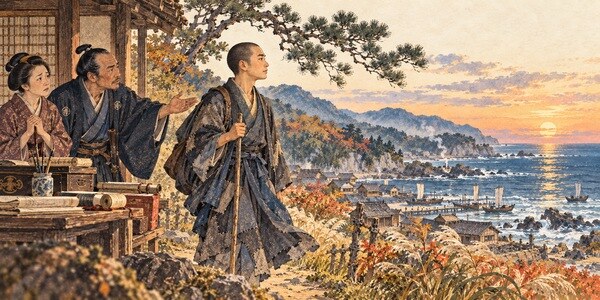
Ryōkan was born in 1758 in Izumozaki, a coastal settlement in Echigo Province, now part of Niigata Prefecture. His birthplace faced the Sea of Japan, a world of wind, changing seasons, fishing boats, and austere beauty. His family was connected with local administration and cultural life. The boy was expected to assume responsibilities appropriate to his position. Yet another longing gradually formed within him, one that could not fit within the duties he had inherited.
For a young man of that period, family responsibility was not merely a professional choice. It determined his place in society, his relationships with relatives, and the meaning of a respectable life. Renouncing that path therefore carried a weight difficult to imagine today. Ryōkan did not choose comfortable independence. He moved away from security, recognition, and a predictable future in order to follow a question that worldly success could not answer.
His early biography combines historical facts with later stories that present his decision as a moment of destiny. We need not transform every detail into legend to recognize the courage involved. It is enough to imagine a young person standing between respect for his family and an irresistible desire to investigate his own mind. Ryōkan chose the second path, not because he despised the first. His later life reveals how deeply he valued human bonds.
The coast of Echigo remained an inner landscape in his poetry. Sea and mountains were never merely decorative scenery. They formed a world in which impermanence could be seen directly: a wave arrives and withdraws, snow covers footprints, and the autumn wind strips the trees. Ryōkan would spend years studying Zen, yet his deepest lessons often sound like the observations of someone who simply stayed beside a window long enough to notice.
Zen Training and the Demanding School of Silence
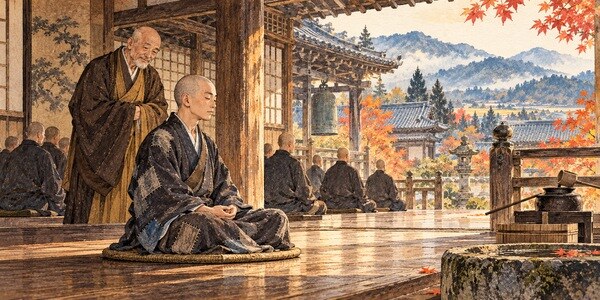
Ryōkan entered monastic life and later trained at Entsūji Temple in Tamashima, in present-day Okayama Prefecture. His teacher was Kokusen, a Zen master of the Sōtō tradition. This training was not an endless succession of beautiful revelations. It included discipline, seated meditation, communal living, rules, labor, and sustained observation of the mind. A practitioner encounters not only noble intentions but boredom, irritation, pride, and fear.
Within Sōtō Zen, zazen, or seated meditation, holds a central place. The practitioner does not chase extraordinary experiences but settles into direct presence. Such practice is not a method for collecting spiritual distinctions. It is training in no longer fleeing continually from reality. We sit, breathe, and allow thoughts to arise and pass without turning every one of them into a story about ourselves.
Ryōkan spent a substantial period under Kokusen’s guidance and received recognition for his progress. Yet what is most remarkable is what he did not do with that recognition. He did not build a career as a spiritual authority or turn his monastic education into a reason to demand reverence. After his teacher’s death, he left the temple and lived as a wandering monk. Later he returned to his native region, where he chose a life many would have regarded as failure.
Here we encounter Ryōkan’s first great paradox. The man who had undergone lengthy spiritual training began to appear increasingly ordinary. Rather than demonstrate how much he had learned, he seemed gradually to forget the need to impress. This was not ignorance but freedom from constant self-justification. In his presence, Zen ceased to resemble an obscure system and began to look like the ability to be genuinely present wherever one happened to be.
Why He Called Himself the Great Fool
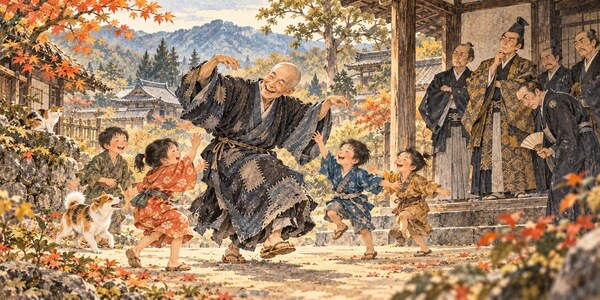
The name Taigu is often rendered as the Great Fool. At first glance, this seems a strange designation for a man revered as one of Japan’s most beloved Zen poets. Yet it contains an essential part of his spiritual character. The fool in this sense is not someone without intelligence. He is someone unwilling to compete for social importance and unafraid of appearing ridiculous.
Many spiritual traditions include the figure of a sage who violates expectations. Such a person might ask a simple question when everyone anticipates a complicated theory, or prefer a child’s game to ceremonial recognition. In Ryōkan, however, this spontaneity was not theater. He did not pretend to be carefree to demonstrate enlightenment. His openness belonged naturally to his life.
The name also challenges vanity. We continually construct images of ourselves: the knowledgeable person, the successful person, the spiritual person, the respected person. The more attached we become to these identities, the harder it is to admit an error, laugh at our own seriousness, or show tenderness without fearing disapproval. Ryōkan laid down this burden. He did not need a magnificent posture in order to be magnificent.
His foolishness was extraordinarily courageous. To remain openly kind in a world that admires power is to accept vulnerability. To live poorly when one might seek recognition is to accept uncertainty. To play with children instead of lecturing adults is to prefer immediate life to personal reputation. This is why Taigu Ryōkan is not merely an appealing historical figure. He quietly challenges our assumptions about success.
Gogoan – The Little Hut That Contained an Entire Universe
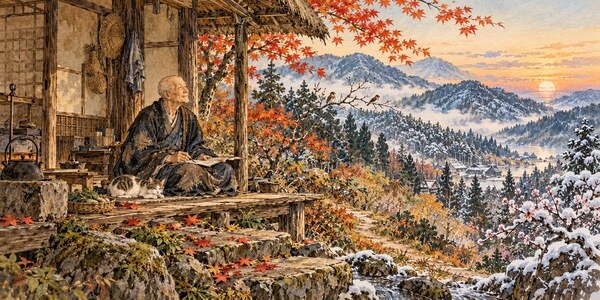
After years of wandering, Ryōkan settled near Mount Kugami, where he lived in the modest hut known as Gogoan. The name became inseparable from his image. There was no wealthy monastery, noisy school, or comfort comparable to the home he had left. There were a roof, walls, a few possessions, paths through the forest, and endlessly changing seasons. This small space became one of the most beautiful dwellings in the history of Japanese spiritual literature.
Living in such circumstances did not mean enjoying romantic poverty. Winters in Echigo are severe, and snow can isolate mountain dwellings. Insufficient food, cold, and loneliness were real hardships. Ryōkan was not a literary character placed in a beautiful landscape for our pleasure. He was a person with a vulnerable body who accepted deprivation as part of his chosen life. His poems sometimes express joy and sometimes unmistakable sadness.
One recurring theme in his poetry is the freedom of a person who owns almost nothing. Freely expressed in English poetic form, that spirit sounds like this:
How beautiful it is
to possess so little,
to walk without
the weight of things.
These lines do not demand that everyone abandon their home. They raise a subtler question: how much of what we possess actually possesses us? Ryōkan’s hut was small, but his attention was not confined. He noticed clouds, rain, grasses, birds, and light. The world did not belong to him, yet he belonged to the world in a way that required no ownership.
Gogoan was also a place of sustained practice. Meditation, reading, writing, gathering food, and everyday chores formed a single rhythm. In such a life, the boundary between the spiritual and the ordinary gradually faded. Sweeping the floor was not an interruption of practice. Done attentively, it was practice itself. Ryōkan did not search for enlightenment beyond the day. He discovered its meaning in how the day was lived.
The Moon the Thief Could Never Carry Away
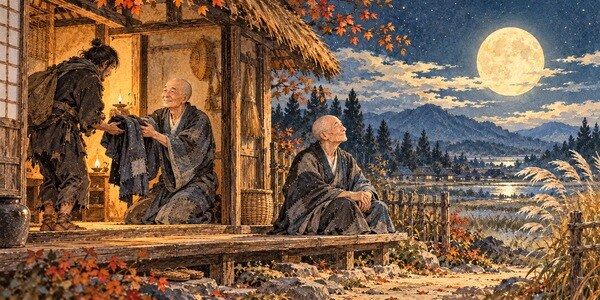
Among the most famous stories about Ryōkan is the account of a thief who entered his poor hut and found nothing worth stealing. According to the popular legend, the monk offered him his clothing so that he would not leave empty-handed. After the visitor departed, Ryōkan gazed at the moon and regretted that he could not give him that as well. The story circulates in different versions and should be understood as an instructive narrative rather than an independently verified report of an event.
In a free poetic rendering of the familiar motif, we hear:
The thief went away.
He left the moon
beside my window.
How extraordinary this shift of attention is. In an ordinary story of theft, we would expect anger, fear, or indignation. In the story about Ryōkan, the focus moves toward the person who came to take something. The monk recognizes his need, then notices a beauty that no one can own. The moon belongs neither to the rich nor the poor, neither to the thief nor the saint. It shines for everyone.
Compassion, of course, does not mean excusing theft or abandoning reasonable boundaries. This legend is not a practical guide to personal safety. It is an image of freedom from possessiveness. Someone who has little need to defend possessions as proof of personal worth can encounter another person without immediately surrendering to hatred. This difficult ideal asks whether we can still see a human being when we condemn the person’s actions.
The moon is one of the gentlest symbols in Ryōkan’s poetic world. It is distant yet immediate, constant in its cycles yet always changing in our perception. When he looks at it, he does not attempt to explain it completely. Being with it is enough. In that simplicity lies a spiritual richness no thief can carry away.
The Monk Who Preferred Playing with Children
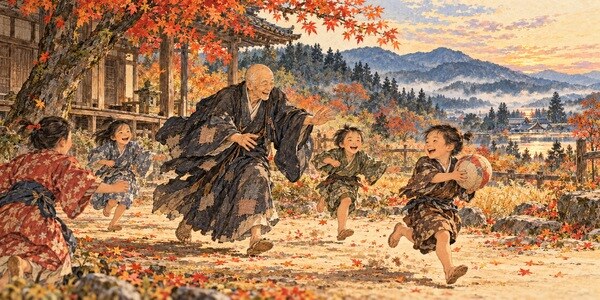
Ryōkan is remembered for his unusual affection for children. Stories depict him playing ball, hiding, laughing, and losing track of time. In a world where monastic dignity might be associated with seriousness and distance, such behavior could seem almost scandalous. For him, however, play was not the opposite of spiritual practice. It offered an opportunity to be fully present without calculating how one appeared to others.
His poetry includes playing children, balls, autumn fields, and the delight of shared movement. A freely rendered poetic motif captures the atmosphere:
The spring day stretches on.
With the children I toss a ball-
and time disappears.
Here lies a distinctive wisdom. Adults often participate only halfway in what they are doing. During conversation they think of the next task; during a walk they plan tomorrow; while playing with a child they glance at the clock. Ryōkan demonstrates another possibility: surrendering to an activity without treating it as a means to some further achievement.
Play also dissolves hierarchy. A child does not care whether the person standing opposite is a celebrated poet or a spiritual teacher. The child wants someone who will genuinely play. Ryōkan accepted that invitation. He did not use children as an audience for sermons. He entered their world and found uncomplicated joy. Our admiration for him arises precisely here: his spiritual development did not make him less approachable but more so.
There is a deep connection between play and Zen. Both can require attention to the present moment. Yet not every game is automatically meditation. What matters in Ryōkan is the absence of pretense. He did not play to illustrate a philosophical principle. He played because he loved children and because life at that moment offered a happiness requiring no justification.
Poetry as Breathing Rather Than Ornament
Ryōkan wrote poems in Japanese and classical Chinese, as educated monks and literary figures of his time commonly did. His work includes short Japanese forms, including waka, and poetry in Chinese styles. His language is frequently simple, but that simplicity should not be confused with a lack of literary education. He knew the tradition and nevertheless preferred immediacy to ostentatious virtuosity.
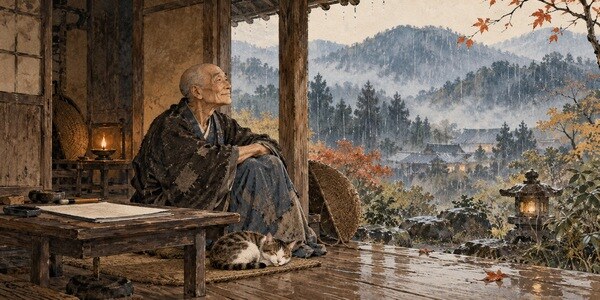
Small events fill his poems: a visitor who does not arrive, wind stirring leaves, a cold night, sounds from a village, a begging bowl, a children’s game. Nothing extraordinary needs to happen. A brief encounter with nature is sufficient because attention makes an ordinary moment irreplaceable. His poetry does not add artificial mysticism to the world. It removes our habit of looking without seeing.
A familiar atmosphere of everyday simplicity can be expressed in a free poetic adaptation:
All day, nothing remarkable.
I sit quietly
and listen to the rain.
The power of such poetry lies in its refusal of grandeur. We are accustomed to judging our days by what we accomplish. If we have not produced, earned, or demonstrated something, we feel the time has been wasted. Ryōkan proposes another measure: a day has been real when we have lived it with an open heart. This does not diminish work. It releases human worth from the demand that every minute be justified by a result.
His poetry is also honest. It does not conceal loneliness, fatigue, or sorrow behind a permanent smile. That honesty is its maturity. Ryōkan did not deny pain in order to appear spiritually advanced. He allowed sorrow to belong to life. When his poems console us, they do not promise that suffering will disappear. They quietly acknowledge that suffering, too, can be met attentively.
Calligraphy – The Trace of an Unburdened Hand
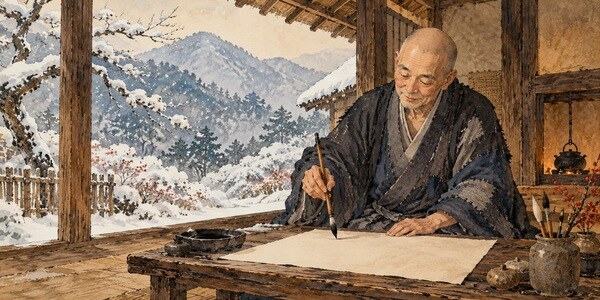
Besides being a poet, Ryōkan was an exceptional calligrapher. His inscriptions are admired for their living lines, spontaneity, and sense of an immediate gesture. In Japanese tradition, calligraphy is not merely the beautiful formation of characters. It is an art in which bodily movement, breathing, concentration, and the writer’s character become visible. The mark left by the brush cannot be separated from the moment of its creation.
This does not mean accomplished calligraphy requires no training. A master’s freedom grows from long familiarity with form. When a movement has been thoroughly learned, the artist no longer struggles against it. The line becomes natural without becoming arbitrary. In this respect, Ryōkan’s calligraphy resembles his life: beneath the ease lies discipline that no longer needs to announce itself.
Imagine a monk in a small hut with a sheet of paper before him. Snow is falling outside. He dips his brush into ink and writes a few characters. He is not erecting a monument; he is leaving a trace of presence. This image helps explain why his work is treasured far beyond Zen circles. It carries the sense of a person who did not separate art from the way he lived.
There is another reason to admire his calligraphy. It does not seek cold perfection. It has human warmth. The same monk who played with children and wrote about moonlight left in his brushstrokes a movement that seems both confident and vulnerable. Art was not a mask behind which the person disappeared. It was a continuation of his breathing.
Compassion That Needs No Sermon
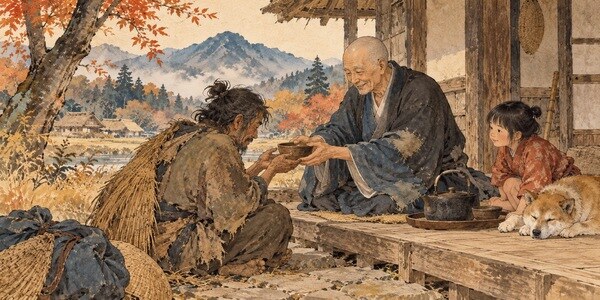
One of Ryōkan’s loveliest qualities is that his compassion rarely takes the form of superior instruction. In stories about him, he helps, shares, listens, and accepts people without constantly telling them how they should live. This does not mean he lacked convictions. It shows his trust that a human encounter can matter even when no one pronounces a great truth.
Within Zen, compassion is more than a feeling of tenderness. It involves recognizing another person’s suffering and responding to it. Ryōkan is not known for founding large public institutions. His care was personal and immediate. It appeared in his treatment of a visitor, a child, a neighbor, or someone in need.
This closeness is particularly important because spirituality can easily become another form of pride. A person begins to consider themselves more aware, purer, or more enlightened than everyone else. Ryōkan seems to refuse the game of comparison itself. He did not strive to stand above people. He wanted to live among them without losing his inner freedom. His greatness lacked the desire to look great.
Admiring this monk does not require presenting him as incapable of error. He belonged to a particular time and lived with the limitations and difficulties of his circumstances. Yet the image preserved in his poetry and biographical tradition reminds us of a rare spiritual possibility: wisdom need not create distance. The more deeply one understands suffering, the fewer reasons one has to look down on someone who suffers.
Poverty and Freedom – What Did Ryōkan Truly Possess?
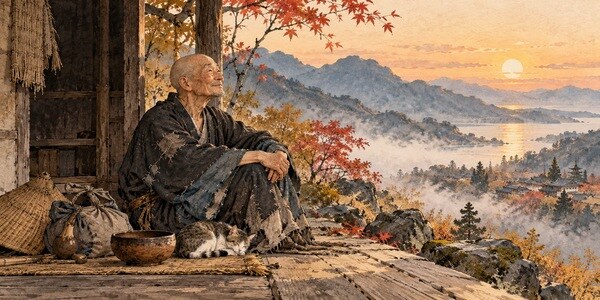
In modern culture, poverty is sometimes romanticized by those who have never experienced its deprivations. That would be unfair to Ryōkan. He did not choose a poor life in order to create a picturesque image for future readers. Lack of resources, cold, and dependence on the generosity of others were real circumstances. Admiration for him requires acknowledging the cost of his choice.
Yet his poverty reveals an important philosophical question. What remains of a person when the signs of social position disappear? Without property to impress others or a position that demands respect, one encounters another kind of dignity. Ryōkan does not prove that everyone should renounce material security. He shows that human worth cannot be measured solely by possessions.
His freedom was freedom from constant comparison. He did not need to monitor whether a neighbor lived better, another monk received more recognition, or his poetry would survive him. The paradox is that the man apparently unconcerned with fame became one of Japan’s most beloved poets. History preserved his name not because he demanded remembrance, but because of the unmistakable humanity of his words.
We can apply this lesson without embracing extremes. We can reduce what is unnecessary, stop purchasing approval through objects, and enjoy things we do not own: light, air, conversation, music, a walk. Ryōkan teaches that the wealth of attention differs from the wealth of ownership. The former can increase even when the latter is limited.
The Four Seasons and the Beauty of Impermanence
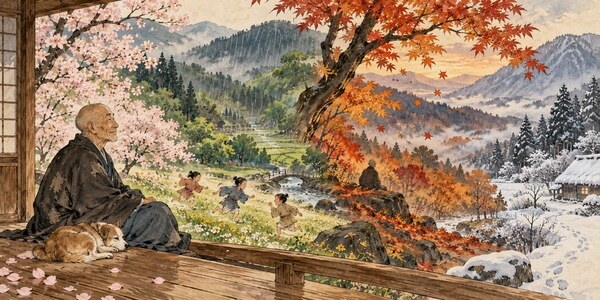
Nature never stands still in Ryōkan’s poetry. Spring brings fresh grasses and children’s games; summer carries rain and greenery; autumn unfolds loneliness and brilliant leaves; winter covers the paths with snow. Each season possesses its own beauty, but none can be held. This transience lies at the heart of the Buddhist understanding of impermanence.
Impermanence is often experienced as a sorrowful truth: everything we love will change. In Ryōkan it is also a source of tenderness. A flower is beautiful partly because it will not remain forever. An encounter is precious because its time is limited. A child’s game shines because no one can return to exactly the same afternoon. His poems do not deny loss. They teach us to look more attentively precisely because loss is inevitable.
A freely rendered seasonal motif suggests the feeling:
The autumn wind passes.
Nothing remains unchanged-
how clear the world appears.
This is a poetry of acceptance, not indifference. Ryōkan formed attachments to people and places, rejoiced in meetings, and grieved at separation. Spiritual practice did not turn him into stone. It allowed him to experience change without insisting that life stop moving. Nature, in this sense, was not a teacher delivering lectures. It taught through its own movement.
We can sense this lesson in ordinary life. Notice the light shifting across a wall, the particular sound of a loved one’s voice today, or a tree transformed by rain. Such attention does not solve every problem, but it returns us to reality. Ryōkan seems to tell us not to wait until life becomes perfect before noticing that it is already happening.
Solitude That Was Not an Escape from Humanity
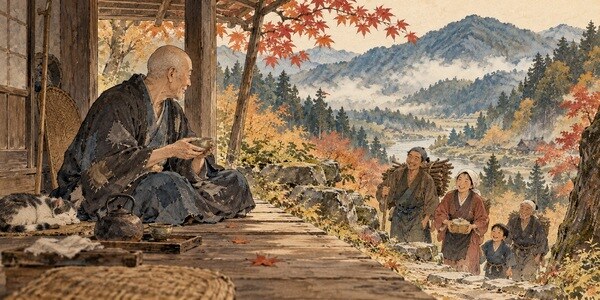
Ryōkan’s mountain life can easily be misunderstood as a rejection of the human world. Yet he maintained relationships with people nearby, visited settlements, met friends, and welcomed guests. His solitude was not hatred of society. It was a space in which inner noise could gradually quiet down and encounters with others become more genuine.
Being alone does not necessarily mean being peaceful. Silence often brings worries, memories, and unfulfilled desires to the surface. Zen practice does not promise immediate deliverance from them. It teaches us to observe without constantly fleeing. Ryōkan spent long hours among the mountains, but his poetry shows that solitude did not extinguish his human sensitivity.
Some of his poems wait for a friend who does not come or notice the length of a winter evening. These moments are especially valuable. They release us from the idea that a spiritually mature person must always be happy. Ryōkan knew absence. He could be lonely without making loneliness the final verdict on life.
In our age, continuous connectivity seldom leaves room for genuine solitude. A phone fills every pause, and silence feels like an emptiness that must be eliminated. Ryōkan offers a different experience: remain for a while without external entertainment and see what appears. Not to withdraw from humanity, but to return to others with greater attention and less inward distraction.
Meeting Teishin – Affection in the Final Years
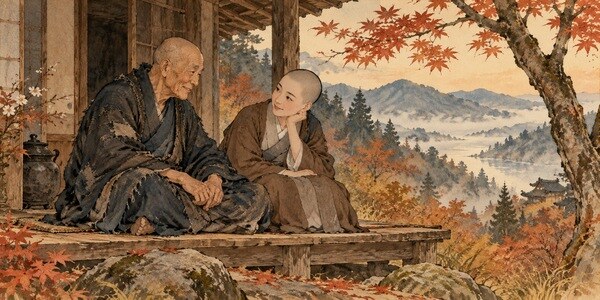
Among the most moving chapters of Ryōkan’s life is his relationship with the Buddhist nun and poet Teishin. She was considerably younger, and they shared spiritual closeness, conversation, and poems. Their meeting belongs to the later period of his life, when age and illness were already limiting his strength. Their poetic exchange contains tenderness, respect, and a profound awareness of the transience of human encounters.
Teishin was not merely a secondary character in the story of a celebrated monk. She was a poet with a voice of her own and played an important role in preserving his legacy. The collection associated with her, Hachisu no Tsuyu, often translated as Dewdrops on a Lotus Leaf, is particularly important to how later generations came to know Ryōkan. Their communication shows that spiritual closeness can be expressed through the simplest words.
In one of their best-known poetic exchanges, Teishin expresses the joy of meeting, while Ryōkan answers in a spirit of intimacy that seems to reach beyond ordinary separation. A free English poetic response, conveying the emotional atmosphere rather than reproducing a verified literal translation, reads:
When shall we meet again?
You ask.
Yet are we not together
within every moment?
This is a poetic adaptation of the closeness that fills their exchange, not a word-for-word rendering. The historical context does not allow us to reduce their relationship to a ready-made romantic narrative. It contains spiritual friendship, admiration, and human tenderness whose nuances emerge through the poems themselves. Refusing to oversimplify their bond makes the story more beautiful, not less.
Ryōkan, who had spent so many years in solitude, did not end his life emotionally inaccessible. He remained capable of meeting another person deeply. This is one of the strongest lessons of his biography: nonattachment in a Buddhist sense is not a prohibition against love. It is the effort not to turn love into possession and not to demand that another person stop time.
The Final Silence and the Poetry of Farewell
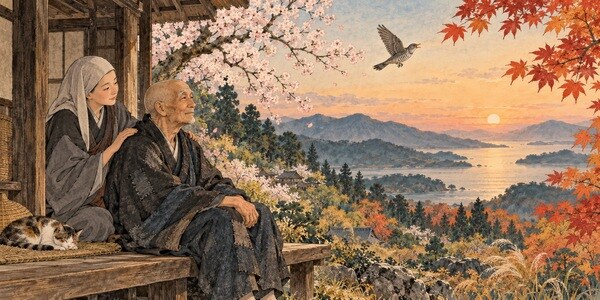
In his final years, Ryōkan lived near relatives and received care from people who loved him. His health weakened, and the physical independence he had known in the mountains gradually narrowed. This period should not be idealized. Old age brings real limitations, pain, and dependence. Yet it is precisely here that the tenderness of human relationships becomes especially visible.
One of the most celebrated poems associated with the end of his life gathers the seasons into a handful of images. In a free English poetic rendering:
What shall I leave behind?
Flowers of spring,
the summer cuckoo,
the colors of autumn.
This poem is astonishing in its modesty. A man whose work would be read for generations does not list achievements, students, or honors. He points toward the world. Flowers, a bird, and autumn colors are not his possessions, yet they are enough to express gratitude for life. There is something infinitely more powerful in this gesture than self-praise.
Ryōkan died in 1831. With him disappeared the particular human voice that had sounded in the hut, along the paths, and among children. Yet an extraordinary intimacy remains. Reading his poems, we do not feel that we are listening to a distant authority speaking from a high platform. We feel that someone has sat beside us and pointed toward something we had overlooked: light, wind, a flower, another person’s presence.
His death gives deeper meaning to his poetry of impermanence. He did not write about transience as an abstract theory. His own life passed through youth, training, wandering, solitude, friendship, and old age. These stages did not cancel one another. Each left a distinct tone in the poet’s voice. That is why his final poems sound not like defeat, but like a grateful farewell.
What Nonattachment Really Meant for Ryōkan
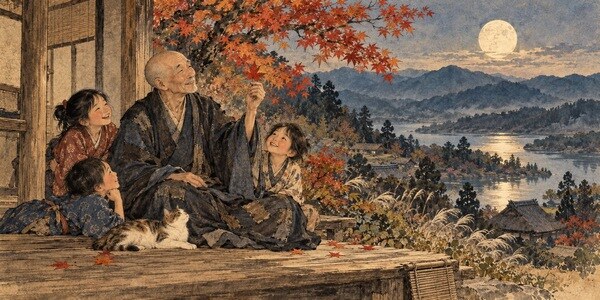
The word nonattachment often creates misunderstandings. Some interpret it as emotional coldness, withdrawal from relationships, or the pursuit of indifference. Ryōkan’s life contradicts this picture. He loved people, delighted in meetings, felt sadness when alone, and responded tenderly to the world. What he sought to release was not the ability to feel, but the demand that everything beloved must belong to him.
Nonattachment means refusing to turn what changes into a promise of permanence. We can love spring without insisting that it never end. We can cherish friendship without controlling another person’s every movement. We can enjoy a beautiful possession without building our identity around it. This is a difficult freedom because it requires us continually to distinguish love from ownership.
Ryōkan did not present this freedom as a cold achievement. It had the face of a man watching the moon, playing with children, and writing a poem to a friend. He did not flee beauty because it was temporary. He loved it more attentively. Impermanence did not make the world worthless. It reminded him that no encounter should be taken for granted.
That is why his example is so valuable today. We live among promises that everything can be preserved: photographs, conversations, memories, versions of ourselves. Yet stored information cannot stop time. Ryōkan returns us to the living moment, which can never be fully possessed. True attention does not attempt to lock life away. It meets life while it unfolds.
Five Lessons from Ryōkan for Everyday Life
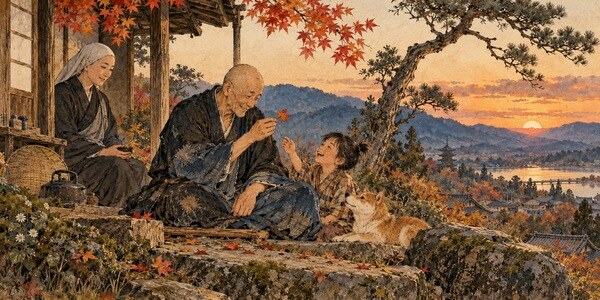
The first lesson is to simplify without turning simplicity into another competition. We do not need to live in a mountain hut to release some of what is unnecessary. We can begin with one cupboard, fewer needless purchases, or a decision not to measure success through other people’s possessions. What matters is not how little we own, but whether our belongings serve us or continually demand our attention.
The second lesson is to make room for silence. Ten minutes without a phone, conversation, or music can reveal how restless our minds are. We need not expect a mystical experience. It is enough to sit comfortably, feel the breath, and notice thoughts arriving and passing. This practice does not replace professional help when psychological difficulties require it, but it can be an ordinary exercise in attention.
The third lesson is to be genuinely present with people. When a child wants to play, a loved one shares something important, or a friend speaks of a worry, we can temporarily set aside the impulse to offer advice. Ryōkan reminds us that compassion begins with presence. Sometimes the best thing we can give is not an elaborate thought but undivided attention.
The fourth lesson is to learn to notice the ordinary. We can take a short walk without a particular destination, watch trees, listen to birds, or observe how evening light transforms the city. This habit requires no special location. Nature does not begin only beyond the limits of a town. It is also in the small plant by a window, the cloud above a street, and the changing air before rain.
The fifth lesson is to preserve the ability to laugh at ourselves. Someone who constantly defends a personal image lives under continual tension. Taigu, the Great Fool, gives us permission to be imperfect, acknowledge ignorance, and stop turning every situation into a test of dignity. Such laughter is not self-contempt. It is release from the unnecessary weight of the ego.
None of these lessons requires us to imitate the monk’s life literally. Spiritual imitation becomes superficial when we copy outward forms and miss their inner meaning. Ryōkan is not valuable because everyone should carry a begging bowl. He is valuable because he shows how a person can live with greater attention, fewer pretensions, and deeper kindness.
Why the World Still Needs Taigu Ryōkan
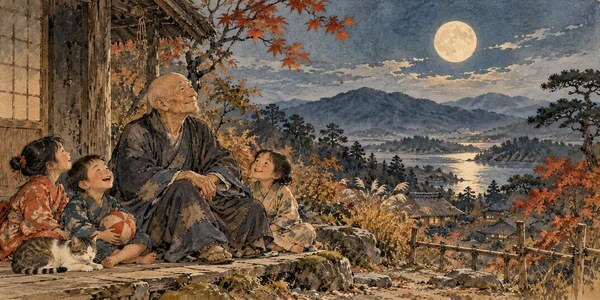
Ryōkan offers no system for rapid success. He does not promise that a certain number of meditation sessions will make us invincible, attract wealth, or eliminate pain. His life is too honest for such promises. He knew cold, solitude, old age, and the limitations of the human body. Nevertheless, he found reasons for joy. It is precisely this joy, free from self-deception, that makes him so compelling.
In an age of continuous self-promotion, he was a man who did not insist on being seen. In a world that measures worth through possessions, he lived with almost nothing. Amid a culture that often mistakes seriousness for wisdom, he played with children. Where we expect a spiritual teacher to be inaccessible, Ryōkan appears as a neighbor, a friend, a guest, and someone who loved looking at the moon.
We should not turn him into a flawless icon. Such idealization would be unfair to his real humanity. His greatness does not consist in never having been vulnerable. It lies in the way vulnerability did not destroy his tenderness. He reveals a spirituality that does not require cruelty toward oneself or superiority over others.
Reading Ryōkan, we gradually understand why a few words about snow, moonlight, or a child’s ball can be more powerful than a long sermon. They do not persuade by force. They leave us space to see for ourselves. In this sense, his poetry is hospitable: it does not require us to accept every one of his religious beliefs before we can feel the beauty of a moment.
There is something deeply consoling in the thought that one of Japan’s most beloved spiritual poets was a person who owned almost nothing but noticed so much. This is a different understanding of wealth. It does not deny the necessity of food, shelter, and security. It simply reminds us that once we care for what is necessary, an immense world remains that cannot be purchased.
The Monk’s Final Gift – Seeing the World with New Eyes
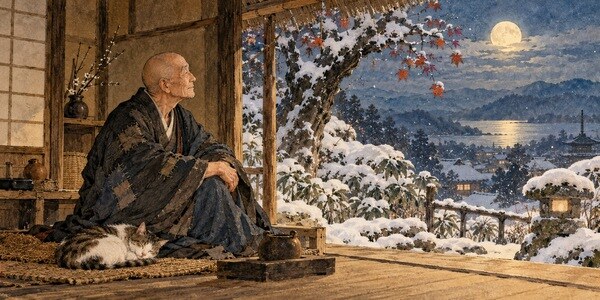
Imagine the final scene not as a historically authenticated event, but as an image gathering the spirit of his life. A small room. Quiet breathing. Outside, the season changes. There is no crowd of admirers waiting for a miracle and no golden doorway to secret knowledge. There is a person who loved the world deeply enough not to demand possession of it. His poems remain like footprints on a path anyone can follow.
Taigu Ryōkan deserves admiration not because he transcended everything human, but because he embodied some of humanity’s most beautiful possibilities. He transformed poverty into an exercise in freedom, silence into listening, play into presence, poetry into gratitude, and old age into a final lesson in impermanence. These are not grand victories that can be measured. They are victories over the habit of missing our own lives.
After encountering his story, ordinary things begin to look different. The moon above rooftops is no longer merely background scenery. A conversation with a friend is not an interruption between more important tasks. Children’s laughter is not noise interfering with serious pursuits. Each can become a place of attention. Not because the world has suddenly changed, but because we have begun to be present within it.
We may not remember every date in Ryōkan’s life or the names of the temples where he studied. But we can remember his way of looking. Be humble enough to learn, free enough to play, tender enough to love, and awake enough to notice beauty before it passes. This is a legacy that cannot be locked inside a museum and does not belong exclusively to one religious tradition.
Somewhere in history stands the little hut of a monk. Snow falls outside, and light rests upon the threshold. He has nothing to sell, nothing to prove, and no desire to be admired from a distance. It is as though he simply invites us to sit for a moment, fall silent, and look. The world is here. And what we have been searching for so insistently begins with our willingness to see it.
Author: Vasil Stoyanov