
Imagine setting off on a long journey with two impeccably maintained navigation instruments showing different speeds. One insists that you are traveling at 67 kilometers per hour, while the other reads 73. You check the settings, replace the batteries, repeat the measurements, and discover that the disagreement refuses to disappear. In everyday life, you would look for a malfunction. In cosmology, a comparable discrepancy raises questions about how we describe the history of the entire universe.
For decades, astronomers have measured how quickly space is expanding. Results obtained from the nearby and relatively late universe systematically differ from the value inferred from the light of the early cosmos within the standard cosmological model. This disagreement is known as the Hubble tension. It does not mean that galaxies are literally moving at two speeds simultaneously. It means that two powerful approaches to determining the same present-day cosmological quantity do not yield fully compatible answers.
The story is fascinating because it brings together exploding stars, pulsating stellar beacons, ancient microwave radiation, space telescopes, and profound questions about the invisible ingredients of the cosmos. To understand what is at stake, we must first understand what it actually means for the universe to expand.
What Hubble Discovered and How Cosmic Expansion Is Measured
During the 1920s, astronomers gradually established that many of the hazy objects in the sky were independent galaxies lying far beyond the Milky Way. Edwin Hubble used observations of variable stars to determine distances to some of them. Combined with measurements of spectral shifts made by astronomers such as Vesto Slipher, these data revealed a remarkable relationship: more distant galaxies generally displayed greater redshifts.
Redshift means that light arrives with a longer wavelength than it had when emitted. For distant galaxies, the principal cause is the expansion of space during the photons’ journey. Imagine a wave drawn on a stretchable ribbon. When you pull the ribbon, the distance between the wave’s crests increases. In a similar way, cosmic expansion stretches the wavelength of traveling light.
In the nearby universe, the relationship is approximately described by the Hubble–Lemaître law: recession speed equals the Hubble constant multiplied by distance. Here, “speed” refers to the increase in cosmological distance, not necessarily motion through space like a car on a road. The present-day Hubble constant is denoted H₀ and is usually expressed in kilometers per second per megaparsec.
One megaparsec is approximately 3.26 million light-years. If H₀ equals 70 kilometers per second per megaparsec, two sufficiently separated points one megaparsec apart in the idealized cosmic flow increase their separation by about 70 kilometers each second. At two megaparsecs, the corresponding figure is about 140 kilometers per second. This does not mean that the Solar System or the human body expands: gravity and other binding forces hold local systems together.
It is this number, H₀, that lies at the heart of the modern dispute. At first glance, the difference between 67 and 73 seems small. In precision physics, however, it is enormous when the individual measurements claim substantially smaller uncertainties.
The Cosmic Distance Ladder: How We Measure Faraway Galaxies
Imagine trying to determine the distance to a ship barely visible on the horizon. If you know the actual height of its lighthouse-like mast and measure how small it appears, you can estimate the distance. Astronomers use similar reasoning, but instead of lighthouses they observe stars and stellar explosions whose intrinsic luminosities are known or calibrated.
One of their most important tools is the Cepheid variable: a star whose brightness changes periodically. In the early twentieth century, Henrietta Swan Leavitt discovered a relationship between the pulsation period and the true luminosity of these stars. For appropriately calibrated Cepheids, longer periods correspond to greater luminosity. By comparing their intrinsic luminosity with their observed brightness, astronomers can determine their distances.
But Cepheids are not bright enough to reach every distant galaxy. Cosmologists therefore construct a distance ladder. Its first rung includes nearby objects whose distances have been measured geometrically, for example through parallax. The second rung calibrates Cepheids. The next uses galaxies in which astronomers can observe both Cepheids and Type Ia supernovae. The supernovae then become distance indicators reaching much farther into the universe.
Type Ia supernovae are extraordinarily luminous stellar explosions. After corrections for the shape and color of their light curves, they allow comparatively precise distance measurements. Imagine a chain of beacons, each bright enough to be seen from the next island. By calibrating the nearer ones, we can reach increasingly distant locations.
This is the approach used by the SH0ES program, associated with Adam Riess and his collaborators. Its influential results yield a value around 73 kilometers per second per megaparsec, with an uncertainty of roughly one kilometer per second per megaparsec in some published analyses. This is a measurement of relatively late cosmic history through a succession of calibrated observations.
The method demands extraordinary precision. Stars can overlap in images, interstellar dust alters observed brightness, and chemical composition influences some calibrations. Research teams investigate these effects because even a small systematic error can propagate through the entire ladder. That is why independent measurements are so important.
Ancient Light Gives a Different Answer
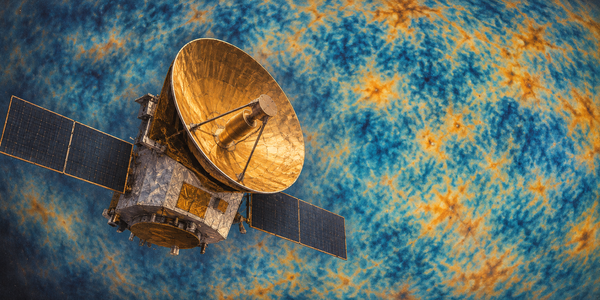
Now imagine a second approach. Instead of measuring present-day expansion through relatively nearby galaxies, you study the oldest light we can directly observe: the cosmic microwave background. It was released when the universe was approximately 380,000 years old and had become transparent enough for photons to travel freely.
This radiation is nearly uniform in every direction, but it contains tiny temperature differences. They form a distinctive statistical pattern that depends on the composition of the early universe, the distribution of matter, and the geometry of space. The European Space Agency’s Planck observatory measured this pattern with impressive accuracy.
Here comes the crucial distinction: Planck does not measure H₀ directly in the same way as the cosmic distance ladder. Scientists use the observed microwave background and the equations of the standard ΛCDM cosmological model to infer what today’s H₀ should be. This model includes ordinary matter, cold dark matter, a cosmological constant, and specific assumptions about early-universe physics.
The resulting value is approximately 67.4 kilometers per second per megaparsec, with a small statistical uncertainty in Planck’s baseline analysis. The difference from the SH0ES result is not simply a disagreement between two readings of the same instrument. One value comes from observations of the relatively nearby universe, while the other is an inference about the present based on ancient light and a particular physical model.
That is the essence of the Hubble tension. If the measurements and the model are accurate, they should converge on a compatible value. Yet leading results remain separated. The discrepancy between some of them exceeds five standard deviations, although its exact statistical significance depends on which datasets and methods are compared.
This makes the subject particularly important. If the cause is a hidden systematic error, we will learn how to measure cosmic distances more accurately. If the cause is an incompleteness in ΛCDM, we will have to reconsider part of our understanding of cosmic evolution.
Why the Disagreement Has Survived New Measurements
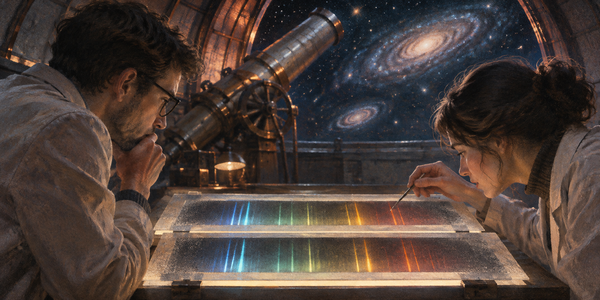
Science has seen many cases in which conflicting results converge as instruments improve. The Hubble tension is especially interesting because those improvements have not produced simple, definitive agreement. New observations refine the numbers, but the overall picture remains complicated.
The James Webb Space Telescope provides high-resolution images at infrared wavelengths. They allow astronomers to examine stars in crowded regions of distant galaxies more clearly and test whether overlapping light sources distorted measurements made with the Hubble Space Telescope. Some studies using Webb support the higher values from the Cepheid distance ladder, while other analyses and calibrations paint a more complex picture.
Independent approaches are crucial. Astronomers use the tip of the red giant branch, a characteristic luminosity reached by a particular class of old stars. Others study stars used in the JAGB method, associated with a stage in the evolution of carbon-rich stars. These methods do not share all the systematic uncertainties of Cepheids and therefore provide valuable checks.
Some measurements using red giants and other independent calibrations produce intermediate or lower values of H₀. They show why we should not present all late-universe observations as unanimous. At the same time, the existence of different results does not erase the tension between particular high-precision measurements. It emphasizes the importance of distinguishing the individual methods.
Imagine an investigation in which several witnesses describe the same car. Two give almost identical estimates of its speed, a third offers a lower estimate, and a camera records additional details. The correct approach is not to choose the most exciting account. We must understand how each estimate was obtained, which errors are possible, and which observations are genuinely independent.
Standard Candles Are Not Our Only Cosmic Measuring Tools
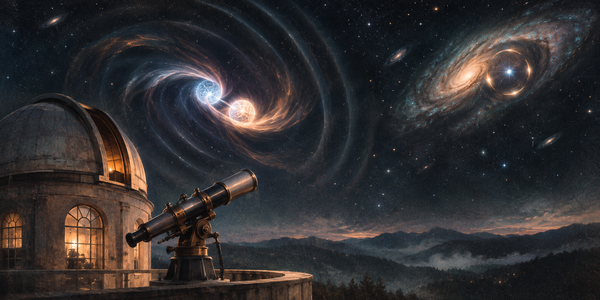
One of the most exciting features of modern cosmology is that the universe offers several ways to measure the same quantity. Alongside standard candles, scientists use standard rulers. One example is baryon acoustic oscillations: traces of sound waves that traveled through the hot plasma of the early universe.
Imagine throwing a stone into water. Concentric ripples spread outward from the point of impact. In the young cosmos, interactions between matter and radiation established a characteristic scale through a mathematically related wave process. Traces of this process remain in the distribution of galaxies. By measuring them, astronomers reconstruct information about cosmic distances and the expansion history.
Projects such as DESI map enormous numbers of galaxies and quasars to investigate this imprint. Their results are especially useful when combined with supernova and microwave-background data. However, the inferred value of H₀ depends on how the early-universe sound horizon is calibrated and on the cosmological model chosen. Consequently, not all such estimates are fully independent of early-universe physics.
Another approach uses gravitational lenses. When a massive galaxy bends light from a more distant variable source, we can see multiple images of the same object. The light reaches us along different paths and with different time delays. If we measure those delays and model the mass distribution of the lens, we obtain information about cosmic distances and H₀.
The main challenge is accurately describing the mass of the lensing galaxy and its surroundings. Different assumptions can change the result. Nevertheless, the method is valuable because it relies on different physics from Cepheid measurements.
There is an even more unusual measuring tool: gravitational waves. When compact objects merge, the shape of the detected signal allows scientists to estimate the distance to the source. If information about its redshift is also available, they can determine H₀. These events are called standard sirens. At present, statistical limitations remain substantial, but as observations accumulate, the method promises an important independent test.
Early Dark Energy: Could Missing Physics Explain the Numbers?
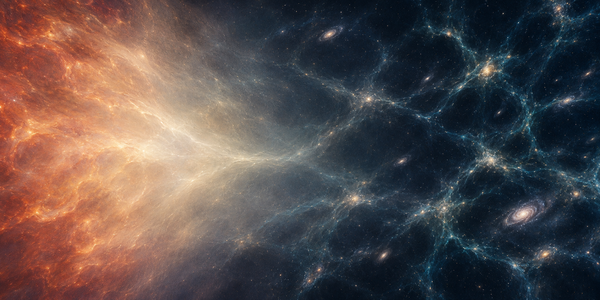
If we assume the disagreement is not entirely the result of measurement errors, the next question is which part of the physical model needs to change. One candidate under discussion is early dark energy. The idea is not simply to add an arbitrary invisible ingredient, but to test whether a temporary additional energy component before the release of the microwave background could alter the relationship between ancient observations and today’s expansion rate.
The key quantity here is the sound horizon: the characteristic distance acoustic waves could travel through the early plasma by a particular stage. It acts as a cosmic ruler. If the physics of the early universe differs from that in the baseline model, the ruler’s actual length may also differ. Then the same observed angular sizes can imply a different value of H₀.
Imagine measuring a room with a tape measure whose markings are printed slightly closer together than you assume. All your measurements will appear consistent, but the calculated dimensions will be systematically shifted. In cosmology, of course, the “ruler” is determined by real physical processes rather than a manufacturing error. The analogy shows why a change in early physics can affect the inference about the present.
Early dark energy models are attractive because they can raise the inferred value of H₀ in some analyses. But they must simultaneously agree with the detailed structure of the microwave background, galaxy observations, and the growth of cosmic structure. This is a stringent test, not an invitation to add arbitrary components.
Other proposals involve changes in the number or behavior of relativistic particles, unconventional interactions in the dark sector, and modifications to gravitational dynamics. Every idea comes at a cost: additional parameters, new predictions, and potential conflicts with observations that the standard model already explains successfully. So far, no generally accepted new-physics explanation has conclusively resolved the tension.
What If the Problem Lies in Measurement Rather Than the Laws of Nature?
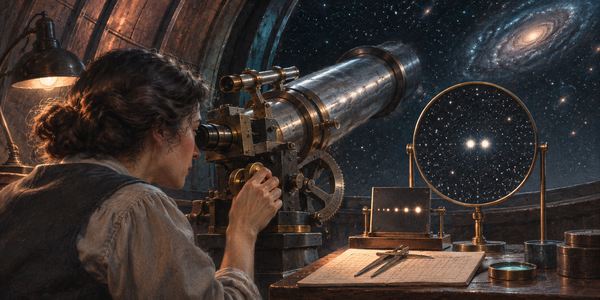
The history of science contains cases in which an extraordinary apparent discovery turned out to result from an unfamiliar instrumental effect. Cosmologists therefore investigate systematic errors as seriously as they investigate new theories. A systematic error is a bias that shifts results in a particular direction rather than merely adding random noise.
For Cepheids, possible sources include dust, metallicity, differences among stellar populations, and the blending of light from neighboring objects. For supernovae, important factors include brightness calibration, selection effects, and properties of their host galaxies. For gravitational lenses, results depend on mass modeling. For the microwave background, data processing and the assumptions of the cosmological model are crucial.
Why are these problems so difficult? Because nobody can place a galaxy on a laboratory bench and measure its distance with a ruler. We observe objects millions or billions of light-years away, whose light has traveled through dust, gas, and evolving space. Every measurement requires a chain of physical assumptions.
Yet astronomy has a powerful response: overlapping independent checks. When different instruments, teams, and methods arrive at consistent results, confidence grows. When results diverge, scientists can trace precisely where the difference arises in the measurement chain.
The most productive approach is not to declare a winner in advance. It is to improve calibrations, enlarge samples, use different stellar indicators, and compare methods under explicitly stated assumptions. The Hubble tension is both a scientific problem and a demonstration of how precision astronomy works.
What Will Settle the Debate in the Coming Years?
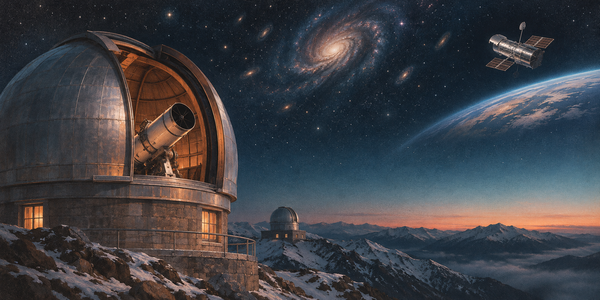
The future of this question will not depend on a single sensational image. It will be decided by the accumulation of independent evidence. The James Webb Space Telescope continues to provide opportunities to test stellar calibrations. Large spectroscopic surveys such as DESI improve our picture of cosmic expansion. Observations of gravitational lenses and new gravitational-wave events offer alternative routes to H₀.
Imagine several teams building bridges toward the same island, each starting from a different shore. If all the bridges meet in one place, we will have powerful confirmation. If one consistently ends somewhere else, we will know where to investigate. Independent cosmological methods work in much the same way.
Measurements that do not inherit the same calibration dependencies will be especially important. New standard sirens can provide geometric information about distances. More precise stellar indicators will test the distance ladder. More complete maps of galaxies will constrain alternative models of dark energy and the early universe.
The solution could turn out to be a combination of several effects rather than one dramatic error or one new physical law. That is why researchers compare more than final numbers. They investigate how each hypothesis changes different observations and whether it improves the overall agreement among them.
Why the Hubble Tension Is So Exciting
The most beautiful aspect of this story is that it begins with a simple question: how quickly is the universe expanding today? To answer it, we must understand the pulsations of stars we will never visit, light from explosions that occurred millions of years ago, and temperature fluctuations in radiation released before the first stars existed. Few scientific problems connect so many different cosmic eras through a single measurable parameter.
The Hubble tension does not prove that the standard cosmological model is wrong. It shows that a persistent discrepancy exists between some of its most precise inferences and certain direct measurements. That is serious enough to warrant investigation without sensational exaggeration.
If a systematic effect is discovered, we will have taken an important step toward more reliable cosmic measurements. If new physics is established, the consequences will extend far beyond one value of H₀. We will have to reconsider how energy, matter, and space interacted during the early epochs of the cosmos.
This is where the true excitement of cosmology lies. The universe does not hand us a textbook filled with ready-made answers. It leaves traces of light, spectra, waves, and statistical patterns. We build instruments, compare them, and gradually turn those traces into a history. Sometimes two carefully developed methods tell different versions of one chapter. That is when the most interesting part of the scientific adventure begins.
The Hubble tension is precisely such a moment: not a final verdict on cosmology, but an open door toward a more precise understanding. And whichever answer survives future tests, the search itself is already teaching us to see the universe more clearly.
Author: Vasil Stoyanov