

Imagine driving along a road at night. You pass one town, then another, then a third. There are lights, houses, gas stations, and busy intersections. Suddenly you enter a region where not a single settlement is visible for miles. No illuminated windows, no roads crossing the horizon. Only darkness. Your first question would be entirely natural: why is there almost nothing here?
Astronomers discover something similar when they begin mapping the positions of galaxies across immense volumes of the universe. The cosmos does not resemble a sphere evenly sprinkled with stars and galaxies. It contains nodes, filaments, walls, and enormous regions with remarkably few galaxies. One of the most famous of these regions is called the Boötes Void. It is so vast that light needs hundreds of millions of years to cross a distance comparable to its diameter.
This discovery changes the way we imagine the universe. It shows that empty space is not an uninteresting background between stellar worlds. The distribution of matter itself tells the story of cosmic evolution. And the most exciting part is that we can begin to understand that story through something familiar: the way people live in cities, neighborhoods, and settlements.
What Exactly Is the Boötes Void?
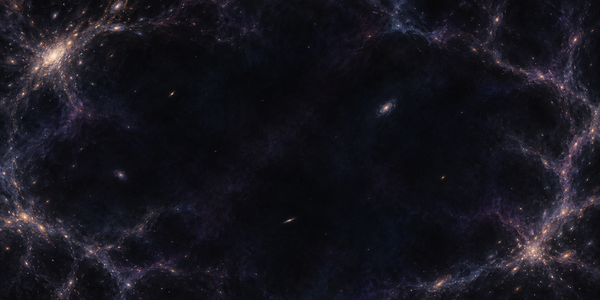
Let us establish the most important point first: the Boötes Void is not a black hole, not a hole torn in space, and not a region from which matter has mysteriously disappeared. It is an enormous area where the concentration of galaxies is much lower than the cosmic average. Astronomers call such regions cosmic voids.
The distinction matters. Imagine a map of a country showing every town and village. You would see large cities, clusters of settlements, roads connecting them, and regions with very few communities. Those quieter regions are not literally empty: they contain forests, rivers, rocks, soil, and living creatures. They simply lack what the map is designed to emphasize-settlements. Cosmic voids are similar, except that instead of counting towns, we count galaxies.
The Boötes Void lies in the direction of the constellation Boötes, the Herdsman. This does not mean that the void sits physically inside a constellation as though it were an object enclosed by its stars. Constellations are patterns seen from Earth against the celestial sphere. The stars that form them lie at different distances, while the void occupies an enormous volume in the distant universe. Its name tells us which direction to look.
A characteristic diameter of approximately 250 to 330 million light-years is often cited, although the exact value depends on how researchers define the region’s boundaries. This qualification is important. Cosmic voids do not have solid walls like rooms in a building. They gradually give way to regions more densely populated with galaxies. As a result, different studies can report different dimensions depending on their observations and definitions.
To appreciate that scale, recall what a light-year means. It is the distance light travels in one year, moving at almost 300,000 kilometers per second. Sunlight reaches Earth in about eight minutes. Light from Proxima Centauri, the nearest star to the Sun, takes more than four years to arrive. Crossing a distance of hundreds of millions of light-years would take light hundreds of millions of years in a simplified static picture that sets aside the expansion of the universe.
In everyday life, the distance between two continents seems enormous. In astronomy, even the gap between neighboring stars is colossal. Yet the Boötes Void is measured not in ordinary distances between stars, but on scales encompassing entire populations of galaxies. That is what makes it fascinating: it reveals the structure of the universe at a level far beyond direct human intuition.
And one more thing: there are galaxies inside the Boötes Void. Astronomers have identified objects within it, and observations continue to refine the picture. The word void therefore means a severely underdense region, not the absolute absence of matter. This distinction prevents the common misconception that scientists discovered a literal black sphere cut out of the universe.
The Discovery: How Astronomers Noticed Something That Was Almost Missing
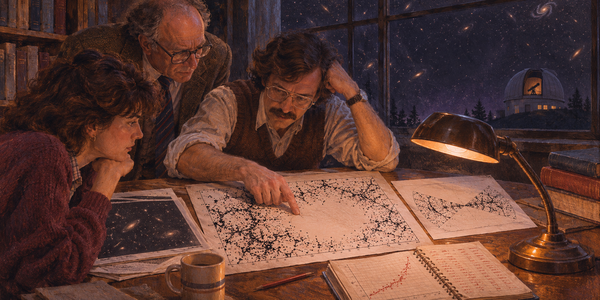
Discovering a bright star is relatively straightforward: point a telescope toward its light and measure it. But how do you discover the absence of thousands of expected lights? You must first know where you would expect to find them. That is where the story of the Boötes Void begins-not with a dark shape suddenly appearing in a photograph, but with a surprise emerging from the systematic counting and mapping of galaxies.
In 1981, astronomers Robert Kirshner, Augustus Oemler Jr., Paul Schechter, and Stephen Shectman reported an unusually large region containing very few galaxies during a survey of galaxy redshifts. Their observations belonged to a broader effort to understand the three-dimensional distribution of galaxies rather than merely their apparent positions on the sky.
There is a seemingly small but decisive detail here. When we look at the night sky, we see a two-dimensional picture. Two galaxies can appear close together while one is much farther away than the other. The same thing happens when looking out of a train window: two utility poles can momentarily line up even though they are not next to each other. To build a cosmic map, we need a third dimension-distance.
Astronomers study the spectrum of light to measure redshift. Light from distant galaxies stretches as the universe expands, shifting characteristic spectral lines toward longer wavelengths. Within a cosmological model, that shift helps estimate distance. For relatively nearby galaxies, astronomers must also account for their individual motions. The result is not merely a photograph of the sky, but a three-dimensional map containing approximate distances.
Imagine examining a photograph of a crowded street. It shows people in the foreground and background, but it does not tell you their precise distances from the camera. Now imagine knowing how many meters away each person stands. You could reconstruct the crowd’s arrangement in space. Astronomers do something comparable with galaxies, using spectroscopy instead of a measuring tape.
When the observations toward Boötes were assembled, an unusual result emerged: a substantial three-dimensional volume contained far fewer galaxies than a relatively uniform distribution would lead researchers to expect. At first this was striking. Over time, larger surveys revealed that the universe truly contains an interconnected system of voids and denser structures surrounding them.
The story offers an important lesson about science. Researchers do not simply look at a picture and receive a ready-made answer. They identify a pattern in measurements, then test whether it arises from observational limitations, the selection of objects, or genuine cosmic structure. The Boötes Void became famous because it was one of the early spectacular demonstrations of the enormous scale of that structure.
The Universe as a Giant Network of Filaments, Nodes, and Empty Spaces
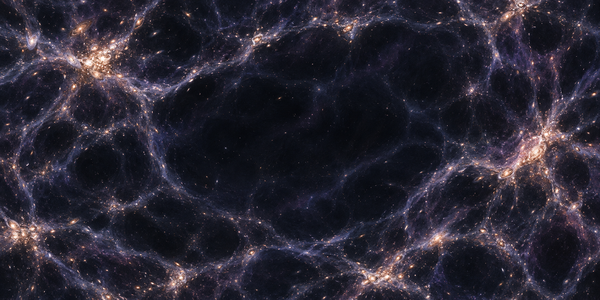
If you remember one image from this article, let it be this: the universe resembles an immense three-dimensional network. Galaxies are not distributed like grains of rice sprinkled evenly across a table. They gather into clusters, connect through long filaments, and form expansive walls. Between these structures lie regions of low density-the cosmic voids.
You can see a visual analogy in soap foam. Bubbles have relatively open interiors, while the material outlining them is concentrated along thin surfaces and lines. This is only a visual comparison, not a literal physical description of the cosmos. Still, it helps us imagine why matter might form a network containing large underdense volumes between denser structures.
Another useful example is a map of Earth’s lights at night. From space, cities appear as bright points and patches. Roads and populated corridors connect them, while dark regions lie between. Neither the cities nor the dark areas are perfectly uniform, and the dark areas are not entirely empty. The crucial difference is that cities arise through human decisions and geography, whereas the cosmic web emerges through gravity acting on primordial variations in matter density.
On relatively small cosmic scales, our galaxy, the Milky Way, belongs to the Local Group, which also includes Andromeda. The Local Group participates in a much broader arrangement of galaxies. As we pull back our imaginary camera, individual galaxies stop being the main features. We begin to recognize clusters, superclusters, filaments, and voids. The cosmic web becomes visible only when our view encompasses a sufficiently large volume.
That is why a single photograph of a distant galaxy cannot reveal the Boötes Void. We need observations of many galaxies and information about their distances. The map emerges from the statistics of a vast population of objects. Just as a photograph of one house cannot explain the urban layout of an entire country, an image of one galaxy cannot reveal the architecture of the cosmic web.
Cosmic voids also take many shapes. Some are relatively compact; others are elongated; still others merge into surrounding underdense regions. Thin bridges of galaxies and smaller groups can appear between them. The actual universe contains no collection of perfectly drawn spheres with identical densities. When researchers describe a void by its diameter, they are often using a convenient way to characterize a complicated three-dimensional region.
The Boötes Void is remarkable precisely as part of this network. It is not an isolated marvel that overturns every known rule. It is an impressive example of a general process: gravity amplifies differences in density, and the universe gradually develops a structure resembling a web.
How a Cosmic Void Forms: The Story Begins After the Big Bang
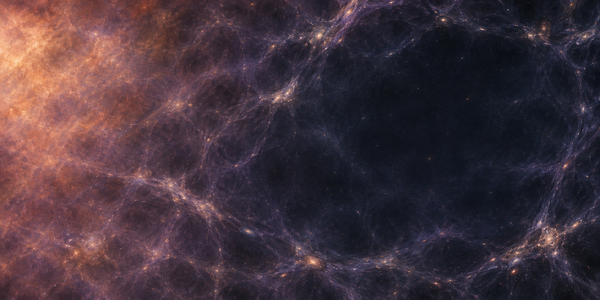
To understand why voids exist, we must travel back toward the beginning of cosmic history. The early universe was far hotter and denser than it is today. Matter was distributed relatively uniformly on large scales, but not perfectly uniformly. Tiny variations in density already existed-places with a little more matter and places with a little less.
Those small differences mattered enormously. Imagine a bowl of dough containing tiny irregularities. At first, they barely stand out. But as the dough develops under the right conditions, some differences grow and help determine its final texture. In the cosmos, the force driving the growth of density contrasts is gravity.
Regions that begin slightly denser exert slightly stronger gravitational attraction. Over time, they draw in additional matter and become denser still. Regions that begin less dense experience weaker accumulation. Compared with the structures around them, they become increasingly underdense. This is how tiny primordial differences develop into the enormous cosmic web.
Picture a crowd spreading across a large public square. Initially, people are distributed fairly evenly. Then several interesting events begin at different locations, and groups gather around them. As crowds grow, those locations attract even more people, leaving wide open spaces between the gatherings. The analogy is not exact physics-galaxies do not make decisions like people-but it illustrates how accumulation in some places accompanies relative depletion in others.
Dark matter plays a central role in the modern cosmological model. It does not emit light in the way stars do, but its gravity contributes to the growth of structure. Ordinary matter-the material making up stars, planets, and our bodies-responds to the gravitational potentials produced by the overall distribution of matter. Galaxies form where conditions allow gas to gather, cool, and produce stars.
A cosmic void is therefore not necessarily a region devoid of dark matter. It is a region whose overall density is below the average. It can contain dark-matter structures, gas, and galaxies, although their abundance and properties differ from those in denser parts of the cosmic web. This makes voids valuable scientific environments: they allow researchers to examine galaxy formation under comparatively quiet gravitational conditions.
As the universe evolves, the voids change too. Because gravity holds underdense regions together less strongly, they can expand relatively faster than surrounding dense structures. Matter does not leak through a punctured cosmic wall. Instead, different parts of the universe evolve differently, and the contrast between dense and sparse regions grows.
One of the most beautiful ideas in cosmology lies here. Vast empty-looking regions do not require a mysterious gigantic mechanism that swept galaxies out of them. They are a natural consequence of gravity acting on small initial irregularities over billions of years. The universe builds its structure both where matter gathers and where matter remains comparatively scarce.
What Would a Traveler See Inside the Boötes Void?
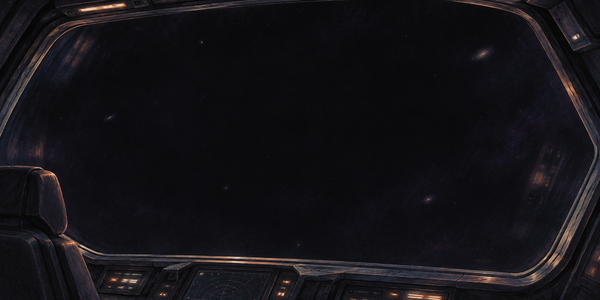
For a moment, let us leave the observatory on Earth and try a thought experiment. Imagine a spacecraft capable of traveling distances far beyond the reach of present-day technology. We head toward the interior of the Boötes Void and stop far from familiar concentrations of large galaxies. What would the sky look like?
The first surprise is that it would not necessarily resemble a completely black screen. If the spacecraft were near one of the galaxies inside the void, the stars belonging to that galaxy could fill the sky in a way reminiscent of the stars we see from Earth. The void is underdense in galaxies across an enormous volume, not necessarily in stars within any particular galaxy.
If we were far from every galaxy, the view would be different. The nearest major galaxies could lie at tremendous distances and appear very faint. Yet we still would not see the boundary of the void as a black wall. Cosmic voids are not opaque. Light from distant objects can pass through them, allowing an observer to see galaxies beyond the underdense region.
Think of the view from a desert road. A lack of nearby settlements does not mean the horizon is blocked. Often you can see farther precisely because there are no buildings in the way. Of course, visibility in space depends on brightness, distance, dust, cosmic expansion, and telescope sensitivity. But the central idea remains: an absence of nearby objects does not automatically conceal more distant ones.
What if we transmitted a radio signal? It would propagate through space according to the laws of electromagnetism. The void would not swallow it like an enormous mouth. The real question would be who could receive it. If there were few galaxies nearby, potential locations for receivers would be relatively scarce. That does not mean the signal travels more slowly or that the region possesses strange prohibitive properties.
And what about gravity? There is no sharp boundary there either. Gravitational conditions depend on the distribution of matter across many distances. The local gravitational environment of an underdense region differs from that of a rich galaxy cluster, but gravity does not disappear. If you were aboard a freely moving spacecraft, feeling weightless would not prove you had entered a cosmic void. Astronauts orbiting Earth experience weightlessness even though Earth’s gravity remains strong at their altitude.
This thought experiment reveals an important truth: the Boötes Void is not an exotic zone where familiar physical laws stop working. Its extraordinary nature is statistical and cosmological. It becomes evident when we compare immense volumes and discover how few galaxies occupy one of them.
Why Scientists Study Voids Instead of Looking Only at Galaxies
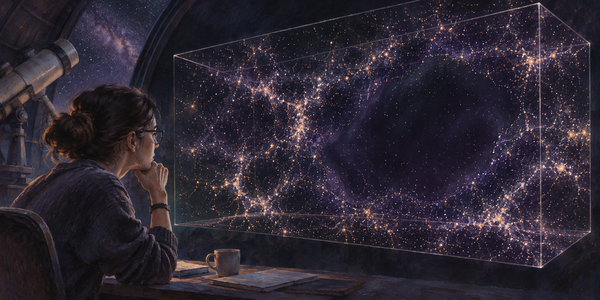
At first glance, it seems logical for astronomers to prefer the brightest objects. Galaxies contain stars, gas, dust, black holes, and countless fascinating processes. Cosmic voids look like places where there is almost nothing to investigate. Yet that is exactly why they are so valuable. Sometimes the absence of expected objects tells us as much as their presence.
Imagine a physician examining not only the organs in a medical image, but also the spaces between them. Their arrangement, distances, and shapes can be essential to understanding the whole system. Cosmologists likewise study more than individual galaxies. They want to know how galaxies are distributed and how that distribution has changed over time.
Voids help scientists test cosmological models. Computer simulations begin with specified initial conditions and physical laws, then follow the evolution of matter. A successful model must reproduce not only the approximate number and clustering of galaxies, but also the statistical properties of voids: their sizes, shapes, densities, and connections to the surrounding web.
Here is an example from the kitchen. If you bake bread and want to understand whether the dough rose properly, you do not examine only its solid parts. You look at the air pockets-how large they are, how they are distributed, and whether they form a characteristic pattern. Those pockets contain information about the process that shaped the loaf. Voids play a comparable diagnostic role in cosmology, although the physics of bread and the universe is entirely different.
Underdense regions are also useful for investigating dark energy, the name given to the unknown physical mechanism or component associated with the universe’s accelerating expansion in the standard cosmological description. The shapes and statistics of voids can help test cosmic geometry and the history of expansion. That does not mean one individual void can deliver a final answer about dark energy. Reliable conclusions come from large datasets and comparisons with other observations.
Gravity is another major subject. Einstein’s general theory of relativity describes how matter and energy influence the geometry of spacetime. Cosmologists test whether the observed motions and distribution of matter agree with the theory’s predictions on immense scales. Voids are particularly interesting because they offer low-density environments unlike the interiors of massive galaxy clusters.
There are also questions about the galaxies themselves. How does a galaxy develop when it has relatively few large neighbors? How often does it interact with other galaxies? How rapidly does it form new stars? How much gas does it contain? Galaxies inside voids allow scientists to compare different environments. This helps separate processes occurring within a galaxy from those influenced by its neighbors.
Voids can also be studied through gravitational lensing-the subtle distortion of light from distant objects caused by the distribution of mass along its path. Because voids contain less matter than average, their statistical lensing signature differs from that of dense structures. This approach helps researchers investigate not only where visible galaxies are located, but also how mass itself is distributed.
A void, then, is not simply nothing that astronomers study out of curiosity. It is a laboratory for cosmology. Its shape and population carry information about the universe’s initial conditions, gravity, galaxy formation, and the history of cosmic expansion.
Common Misconceptions: A Black Hole, Absolute Emptiness, or a Mysterious Anomaly?
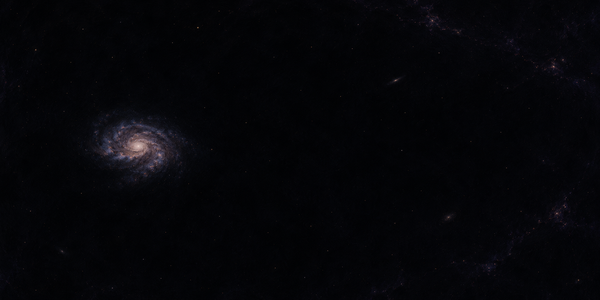
Online, the Boötes Void is often represented by dramatic images: an enormous black circle cut out of a star-filled sky, as though someone erased part of the universe. Such pictures are striking, but they can create a misleading impression. The actual void does not resemble a black ball that a telescope could photograph from outside. It is identified through the spatial distribution of galaxies.
The first misconception is that it is a black hole. A black hole is a region of spacetime bounded by an event horizon, beyond which light cannot reach a distant observer. A cosmic void has no such horizon. Light travels through it, and its gravitational conditions are nothing like those of a gigantic black hole. The two concepts are physically very different, despite the dark imagery sometimes used in popular descriptions.
The second misconception is that it contains absolutely no matter. As we have seen, this is false. The void contains relatively few galaxies for its enormous volume, but it is not devoid of everything. Diffuse gas, dark matter, and individual galactic systems can be present. In astronomy, empty often means low-density, not literally nothing.
The third misconception is that the void is a motionless object with a clearly defined surface. The universe evolves, galaxies move, and the cosmic web changes over time. Researchers define void boundaries using measurements and analytical methods. They are not physical walls a spacecraft could collide with. Think of the transition between a densely built neighborhood and a sparsely populated suburb: the change in density is real, but it need not follow one perfectly sharp line.
The fourth misconception is that the existence of a large void automatically disproves modern cosmology. In fact, cosmic voids are a natural part of structure formation in the standard model. Scientists ask more precise questions: how large are particular voids, how frequently do they occur, how are they distributed, and how closely do their statistics match predictions? An unusually large structure deserves careful investigation without automatically representing a crisis for all of physics.
The fifth misconception is that every dark region in an astronomical photograph is a cosmic void. A dark patch can result from dust obscuring light, the limitations of an image, or simply a lack of bright objects within a particular field of view. Identifying a genuine cosmic void requires distance measurements and analysis of the three-dimensional galaxy distribution.
There is another important question: how do we know we have not missed many faint galaxies? Astronomical observations have limits. Telescopes do not detect every object equally well. Researchers therefore account for how faint a galaxy their instruments can detect, how much sky they have surveyed, and whether different areas were observed under comparable conditions. As instruments improve, the maps become more complete. This does not invalidate the original discovery; it makes the measurements more precise.
Science becomes even more exciting when we separate the real mystery from exaggeration. The genuine question is not who erased an enormous piece of the cosmos. It is how tiny differences in the early universe produced such striking structures, and how we can read that history in today’s galaxy maps.
What the Boötes Void Reveals About Our Place in the Universe
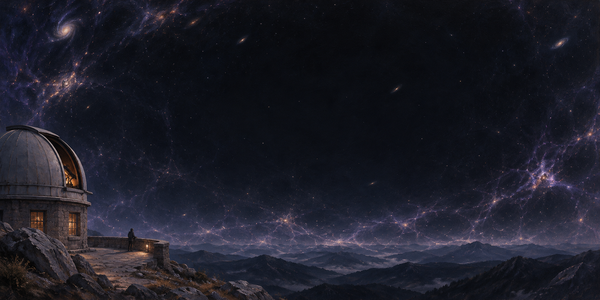
There is something deeply moving about discovering a structure defined not by an enormous concentration of light, but by its relative absence. We usually imagine cosmic discoveries as the detection of new stars, planets, or galaxies. The Boötes Void teaches us another way to look: sometimes the shape of the world is revealed by the spaces between things.
In music, pauses belong to the composition. If every instrument played continuously at the same volume, the melody would lose contrast. In architecture, empty spaces between columns allow us to recognize the building’s rhythm. In conversation, silence can emphasize the meaning of words. These comparisons do not explain the physics of cosmic voids, but they help us appreciate why the absence of objects can be so informative.
The Boötes Void also reveals how extraordinary the scale of cosmology is. Our daily lives unfold over meters and kilometers. We travel between cities, watch clouds, and see mountains on the horizon. Astronomy then carries us outward to stars, galaxies, and finally structures hundreds of millions of light-years across. At every new scale, patterns emerge that were invisible at the previous one.
What makes this especially beautiful is that we can study such enormous structures through light. The photons reaching our telescopes have traveled through space since long before humanity existed. Their spectra contain information about distance, while the distribution of galaxies traces the three-dimensional network. From tiny signals recorded by detectors, researchers build maps of regions no human being could ever traverse with present technology.
That is why we should not confuse the word void with meaninglessness. Underdense regions participate in the universe’s overall history. They develop alongside galaxy clusters and filaments. Without them, the cosmic web would look entirely different. Dense structures and empty spaces are two aspects of the same process of gravitational evolution.
The next time you see a photograph of a distant galaxy, imagine not only the light within it, but also the immense distances separating it from neighboring systems. Imagine billions of galaxies forming filaments and walls, with vast underdense spaces opening between them. Among those spaces is the Boötes Void-not a tear in the universe, but one of the most impressive traces of how the cosmos has evolved.
That is what makes cosmology so captivating. It allows us to begin with a simple question-why are there almost no galaxies here?-and arrive at the Big Bang, dark matter, gravity, the expansion of space, and the history of the cosmic web. Sometimes the greatest discoveries do not begin with a brilliant light. They begin with a carefully noticed silence among the stellar worlds.
Author: Vasil Stoyanov