
The Astrologer and the Buddha
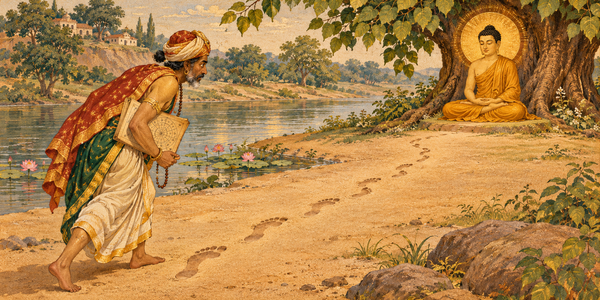
A renowned astrologer went to bathe in a river. On the bank he noticed a human footprint and stood motionless. According to everything he knew about the markings on the soles of the feet, the print belonged to someone destined to become a great ruler. Yet there was neither a palace nor an army nearby. There were only trees and silence.
The astrologer followed the footprints and soon found Gautama Buddha sitting peacefully beneath a tree. He looked at the man’s simple clothes and became confused. Had all his knowledge deceived him? He asked the stranger who he was and why someone bearing the signs of an emperor lived like a monk.
The Buddha replied that he possessed no kingdom and had no wish to conquer anyone. The astrologer insisted that the signs indicated a master of the world. Then the Buddha showed him another way to understand power: a person can try to claim the world through force, or cease to draw boundaries between himself and life. The first path demands an endless struggle; the second needs no throne.
The astrologer, who had come looking for a ruler, found himself before a monk whose serenity could not be contained within any of his predictions.
Nachiketa at the Door of Death
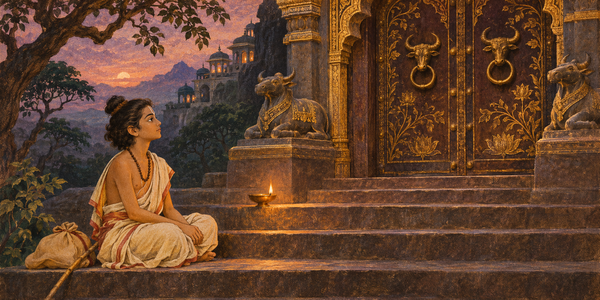
In ancient India lived a boy named Nachiketa. His father was performing a sacrificial ritual in which he was supposed to give away his possessions. Nachiketa noticed that some of the cows being donated were old and weak. He could not understand how a gift that was no longer useful to its giver could be a genuine sacrifice.
The boy began asking his father to whom he would give him. After repeated questions, the irritated father declared that he was giving him to Yama, the lord of death. Nachiketa took the words seriously and set out for Yama’s dwelling.
When he arrived, the lord was absent. The boy waited for three days without leaving the threshold. Upon his return, Yama was astonished by the young guest’s determination and offered him three wishes. Nachiketa asked that his father be comforted and welcome him lovingly; he asked to learn about the sacred fire; and finally he posed the question that had brought him there: what happens to a human being after death?
Yama offered him riches, a long life, and every imaginable pleasure if he would abandon that final question. Nachiketa refused. Everything being offered would eventually come to an end, while he sought that which does not disappear. And the lord of death agreed to initiate him into the knowledge the boy had refused to exchange for anything else.
The Temple Built in the Heart
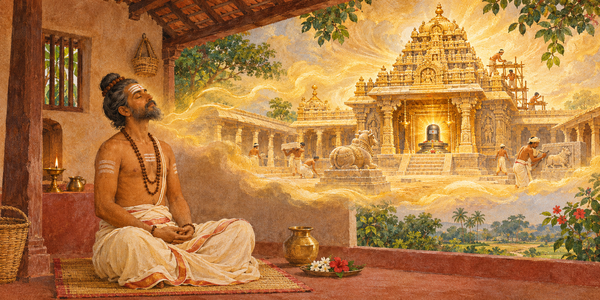
Poosalar was a poor devotee of Shiva. He owned no land, employed no stonecutters, and had no money, yet he carried an unwavering dream: to build a temple for the deity to whom he had devoted his life. Instead of giving up, he began a construction project that no one else could see.
Every day he imagined laying the foundations. Then he raised the walls, shaped the pillars, decorated the sanctuary, and carefully arranged every part of the future temple. The years passed, and the invisible building grew through the constancy of his devotion. At last he chose a day for its consecration.
At the same time, the king of the land had built a magnificent stone temple and was preparing for its ceremonial opening. On the eve of the celebration, Shiva appeared to him in a dream and announced that he would not attend, because on that very day he had to visit Poosalar’s temple.
The king awoke in bewilderment. How could someone have built a temple without the ruler knowing about it? After a long search he found Poosalar in a humble hut and asked to see the building. The devotee pointed to neither courtyard nor tower. He explained that the temple existed within his heart and had been built there with all the love he possessed.
The Demon Behind the Door
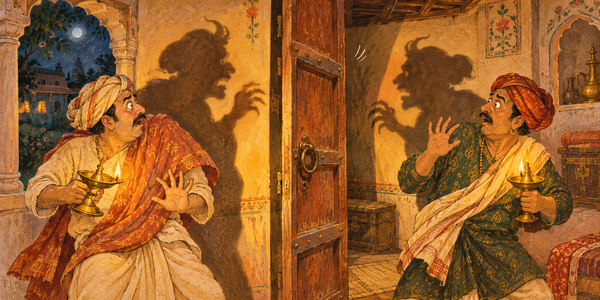
In a small town stood an old house that everyone said was haunted by a demon. Nobody dared spend a night inside. One day a man, convinced of his own courage, announced that he would stay in the dreadful building until morning. He entered at dusk and closed the door.
A little later, another resident decided that he would not allow the first man to become famous as the bravest person in town. He went to the same house and pushed against the door. A noise came from inside. The man already in the room was terrified: at last the demon had come for him. He braced his shoulder against the door and held it shut with all his strength.
Outside, the second man felt the resistance and became equally frightened. He was certain that the demon was trying to keep him out. He pushed harder. On the other side, the first man struggled desperately to hold the door closed. The two men shoved, strained, and trembled, each convinced that a terrifying creature stood against him.
Throughout the night, fear turned an ordinary door into a battlefield. Yet there was no demon behind it-only another human being who was just as afraid.
The Beggar Who Became a Minister
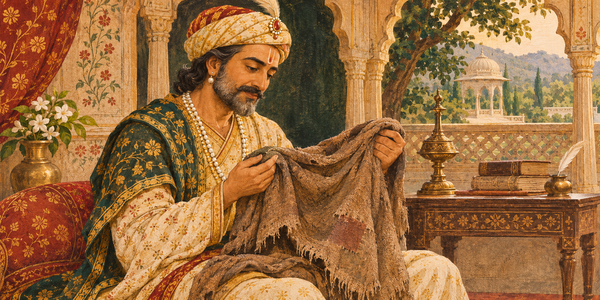
Once there lived a beggar who owned nothing but a worn-out cloak. Despite his poverty, he was renowned for his clear thinking. People began coming to him for advice, and word of his wisdom eventually reached the king. The ruler invited him to the palace, spoke with him many times, and finally offered him a position as minister.
The beggar accepted. He put on suitable clothes and began carrying out his duties. But he kept one room into which nobody was allowed to enter. Soon the courtiers began whispering that the minister was hiding treasure or plotting a conspiracy. At first the king dismissed the rumors, but suspicion gradually took hold of him.
One day he insisted on seeing the locked room. The minister warned him that if the door were opened, he would resign from his position. Nevertheless, the king demanded entry. Inside he found neither gold nor secret letters. The room was almost empty. Hanging on the wall was only the old beggar’s cloak.
The minister explained that every evening he removed his fine clothes, put on the cloak, and slept on the floor. In this way he never forgot who he had been before the palace welcomed him. The king understood what the man had been protecting behind the door. But the promise had already been made, and the wise man left his position, returning to the freedom he had never ceased to value.
Ashtavakra and King Janaka
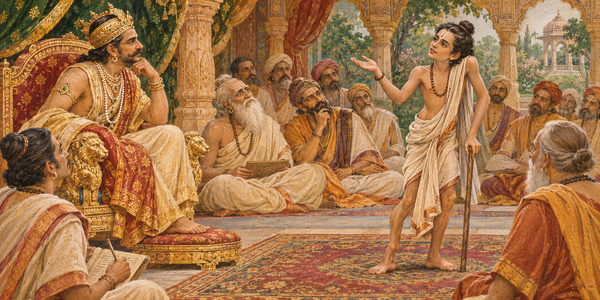
Scholars and sages gathered at the court of King Janaka to discuss the deepest questions of human existence. One day the young Ashtavakra arrived. His body was bent in several places, and his unusual gait attracted the courtiers’ attention. Some of those present burst into laughter.
Ashtavakra was not disturbed. Instead of retreating, he began to laugh himself. The king asked why he was amused when everyone else was mocking him. The young man replied that he had come expecting to meet people who knew the truth, but saw only people skilled at judging skin and the shape of a body.
His words changed the atmosphere in the hall. Those who considered themselves knowledgeable had judged the stranger solely by his appearance. Janaka sensed that a person of extraordinary insight stood before him and asked to hear more.
Thus began the relationship between king and teacher, in which the ruler gradually learned to question his own ideas about identity, possession, and freedom. The young visitor whom the court had greeted with laughter became the king’s spiritual guide.
Krishna and the Serpent Kaliya
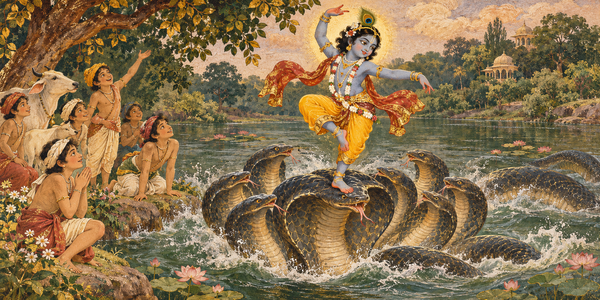
Near Vrindavan there was a lake that people feared. An enormous serpent named Kaliya lived in its waters, together with many other snakes. Cattle approaching the lake to drink were in danger, and the herdsmen avoided its shores.
One day the boys led their cows toward the lake. Several animals were bitten and fell dead. The children were frightened-not only by the loss, but also because they would have to return to their families with the news. Krishna decided to confront the danger.
He entered the water despite the warnings. His movement attracted Kaliya, who rushed toward him. Panic broke out on the shore. The other boys ran toward the village, and soon the people gathered beside the lake, convinced that they were about to witness Krishna’s death.
But he subdued the serpent and brought it out of the water. Instead of leaving the lake under the rule of fear, he sent Kaliya away from the place, and the other snakes followed. The water once again became accessible to animals and people. When Krishna stepped onto the shore, the villagers greeted him with delight, as though they had watched the impossible happen before their eyes.
The Two Novices on the Road to the Market
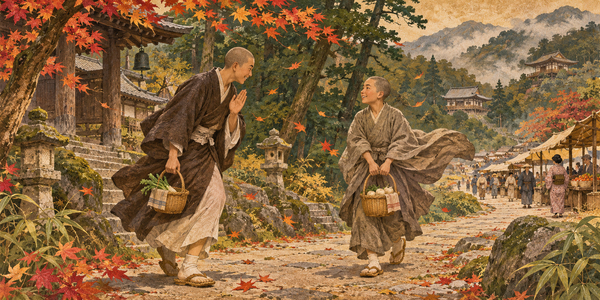
Two young novices lived in neighboring Zen monasteries. Every morning they went out to carry out errands for their teachers and often met on the road to the market. One liked clear answers, while the other had a habit of responding unexpectedly.
One day the first boy asked the other where he was going. Instead of naming a destination, the neighboring novice replied that he was going wherever the wind carried him. The boy was left speechless. He returned to his teacher and described the conversation.
His teacher suggested that the next day he should ask the same question, and if he heard about the wind again, he should ask what would happen when the wind stopped. The boy carefully memorized the advice. The following morning he met the other novice and confidently asked where he was heading.
This time the answer was different: wherever his feet took him. The prepared reply was useless. Once again the boy returned to his teacher, frustrated that he had failed to win the exchange. Meanwhile, the other novice continued along the road to the market, unconcerned with answers prepared in advance.
Vivekananda and His Question to Ramakrishna
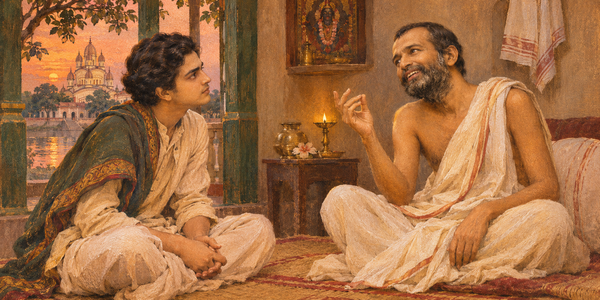
Young Narendranath, who would later become known as Swami Vivekananda, was sharp-minded and demanding of every claim. It was not enough for someone to speak confidently about God. He wanted evidence that did not rest solely on books, traditions, or the testimony of others.
When he met Ramakrishna, he asked the question he had carried within him: had this man seen God? Ramakrishna did not hide behind complicated philosophical explanations. He answered with the immediate confidence of someone speaking about his own experience. This surprised the young man more than any scholarly lecture could have done.
Narendranath continued to return. He challenged, questioned, and tested. Ramakrishna did not try to win arguments through eloquence. An extraordinary relationship gradually developed between them, in which the student’s doubt was not rejected but met by a teacher who was unafraid of it.
Over time, the young seeker who had come demanding proof embarked on a spiritual path that transformed his entire life. Later he began speaking before enormous audiences, carrying a message he himself had once refused to accept without personal conviction.
The Wedding of Shiva and Parvati
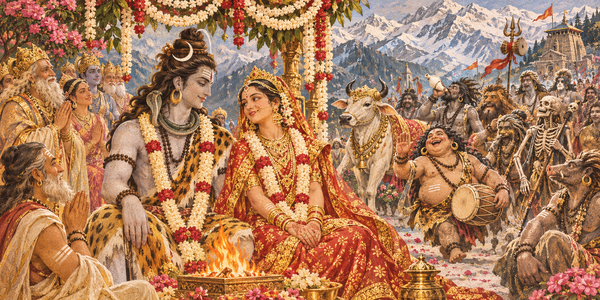
As the wedding day of Shiva and Parvati approached, the bride’s family expected the ceremonial arrival of a magnificent groom. Instead, an extraordinary procession appeared before them. Shiva was accompanied by his ganas-strange and frightening beings who looked nothing like the noble entourage expected at a royal wedding.
Parvati’s relatives were horrified. They could not understand how she could choose as her husband someone who disregarded custom and displayed neither wealth nor noble ancestry. They asked about his family, his forefathers, and the signs by which the marriage’s auspiciousness should be determined. Shiva remained silent, as though these questions did not concern him at all.
Anxiety spread among those assembled. Then Parvati asked Shiva to appear in a form her loved ones could accept. He transformed himself into Sundaramurti-an exceptionally beautiful and radiant bridegroom. Those who had been filled with horror only moments earlier stood astonished by his beauty.
The celebration continued. But those who had seen both of his appearances now knew that Shiva could not be confined within their ideas of propriety, ancestry, and outward appearance. He could appear as a stranger whom nobody wished to welcome, or as the most splendid guest at the celebration-without changing in his essential nature.
Author: Vasil Stoyanov