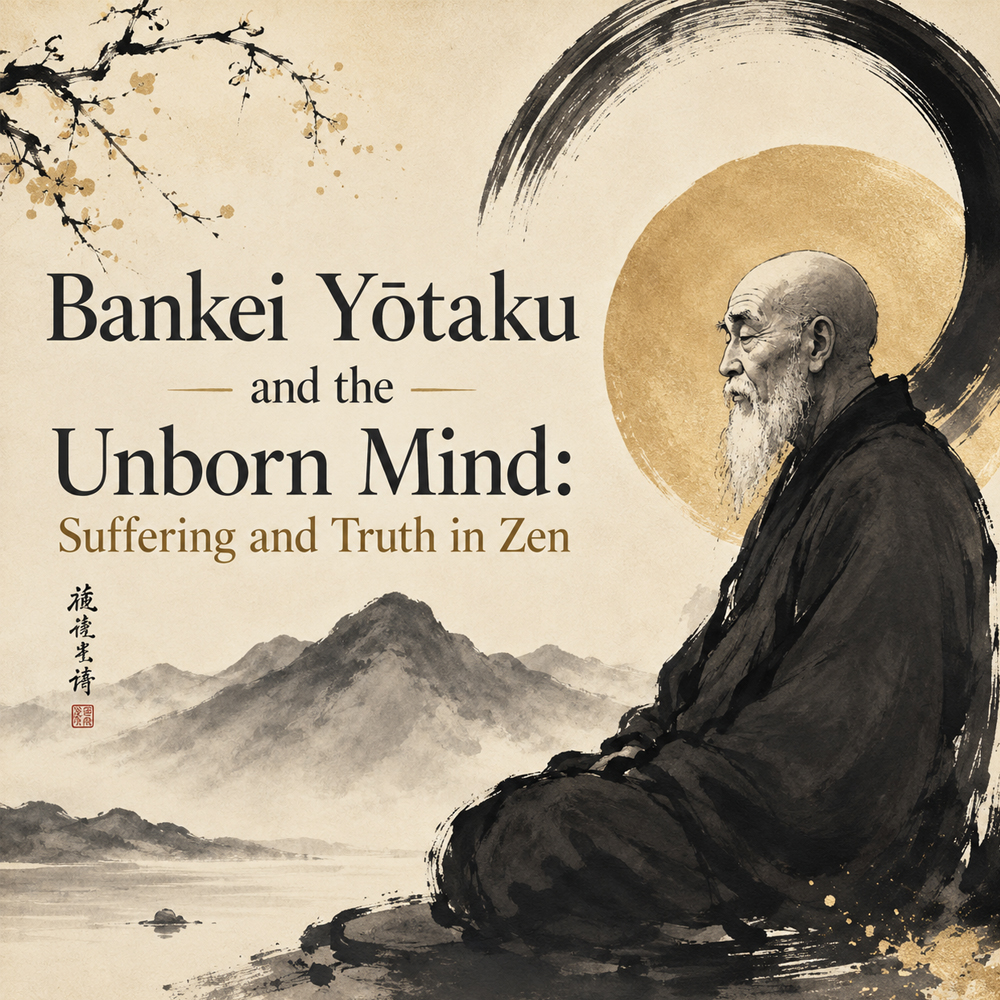
The Path to the Unborn Mind: The Life and Teaching of Bankei Yōtaku
There are individuals in history whose influence is measured not in institutions, armies, or political power, but in the silence they leave behind – a silence in which one begins to hear something deeper than words.
One of these rare spiritual teachers is Bankei Yōtaku, a seventeenth-century Japanese Zen master who transformed the way people understood enlightenment, not through complex doctrines, but through something surprisingly simple: returning to our own natural nature.
Early Years: A Restless Search
Bankei was born in Japan in 1622, during a period of social stability but also strict cultural norms. As a child, he became obsessed with a question that would haunt him for years.
One day at school, his teacher quoted a Confucian text that spoke of the „Bright Virtuous Mind.“ Yet no one could explain what this phrase truly meant.
For most students, it would have been just another abstract concept. For Bankei, it became an all-consuming mystery.
What was this „Bright Mind“? How could it be understood not merely intellectually, but directly experienced?
Driven by this inner longing, he abandoned the conventional path. He left home and began searching for teachers, monasteries, and practices that could provide an answer.
The Path Through Suffering
What distinguished Bankei from many other spiritual seekers was the intensity of his search.
He did not simply study scriptures or meditate casually. He devoted himself to practice with relentless determination.
He spent long periods in rigorous meditation, often to the point of exhaustion. He deprived himself of food and sleep. Eventually, his health deteriorated so severely that he contracted tuberculosis – a disease that was often fatal in those days.
Yet it was precisely during this period of extreme weakness and proximity to death that something extraordinary occurred.
Awakening: Discovering the Unborn Mind
While gravely ill, Bankei experienced an insight that would become the foundation of his entire teaching.
He realized that the true nature of mind is „unborn“ – pure, unchanging, and always present.
It is not something that must be created or attained through effort. It is not the result of years of discipline or accumulated knowledge.
Rather, it is a state that already exists – here and now.
Bankei called it the Unborn Mind.
This realization changed everything.
What Does the Unborn Mind Mean?
Within the context of Zen Buddhism, „unborn“ does not refer to something mystical or supernatural.
Instead, it points to something remarkably practical.
At its core, your mind is not corrupted. Thoughts, emotions, and worries arise and pass away. Yet there is something within you that remains unchanged – the witnessing awareness itself.
Bankei taught that suffering does not arise from thoughts themselves, but from identifying with them.
When anger arises, for example, you do not merely experience anger – you become angry. You lose yourself within it.
But when you remain in the Unborn Mind, anger comes and goes without taking possession of you.
A Teacher Without Dogma
One of the most fascinating aspects of Bankei’s teaching was his style.
Unlike many Zen masters, he did not rely heavily on kōans, paradoxes, or elaborate rituals.
He spoke simply.
Directly.
Humanly.
His audiences often consisted of ordinary people – farmers, merchants, women, and children – not only monks.
His message was clear:
Enlightenment is not reserved for an elite few or for those who live in monasteries.
It is available to everyone.
One of the most famous stories about Bankei tells of a student who complained about his uncontrollable anger.
Bankei asked:
„Show me this anger.“
The student replied:
„I can’t. It appears suddenly.“
Bankei responded:
„Then it cannot be your true nature. If it were, you could show it to me whenever you wished.“
With this simple exchange, he dismantled a deeply rooted belief – that we are our emotions.
Practice Without Effort
One of Bankei’s most radical teachings is that there is no need to „practice“ in the conventional sense.
This sounds almost scandalous within spiritual traditions that emphasize discipline, effort, and years of training.
Yet Bankei was not rejecting practice.
He was redefining it.
According to him, true practice is simply remaining in your natural state.
Not becoming lost in unnecessary thoughts.
Not being carried away by emotions.
Simply being.
Why Does His Teaching Feel So Modern Today?
In a world where we are constantly bombarded by information, anxiety, and mental noise, Bankei’s teachings feel surprisingly contemporary.
Consider:
- How often do you become lost in thought?
- How often do you react automatically without awareness?
- How often do you feel overwhelmed by emotions?
Bankei would say that these are not problems to be solved.
They are experiences to be seen clearly.
And once they are seen clearly, they begin to lose their power.
The Difference Between Knowledge and Experience
One of the central themes in Bankei’s teaching is the distinction between intellectual understanding and direct experience.
You can spend your entire life reading about the Unborn Mind and never truly realize it.
But the moment you simply stop and observe – without judgment, without analysis – you may notice something different.
Something quiet.
Something stable.
Something unmoving.
That is the beginning.
How Can We Apply This in Daily Life?
Bankei’s teaching does not require a dramatic change of lifestyle.
You do not need to retreat to a mountain monastery or meditate for hours every day.
You can begin with simple moments:
- When anger arises, simply notice it.
- When anxiety appears, observe the thoughts behind it.
- When your attention wanders, gently return to the present moment.
Do not try to control.
Do not try to fix yourself.
Simply be aware.
The Legacy of Bankei
Bankei Yōtaku passed away in 1693, but his teaching remains alive.
Not through institutions or rigid schools, but through people who continue to discover his words and apply them in their lives.
He left behind not a system, but a direction.
Not rules, but understanding.
Perhaps Bankei’s most important message is that you do not need to become something more in order to be enough.
You do not need to search for something outside yourself.
What you seek is already here.
Quiet.
Unborn.
Real.
And if you stop for just a moment – just a moment – you may begin to notice it.
Read More:
-
- If You Meet the Buddha, Kill Him: The Radical Zen of Linji
- Hakuin Ekaku – The Great Master Who Revived Zen in Japan
- Buddha – The Story of Siddhartha Gautama and His Enlightenment
- Huineng – The Extraordinary Story of the Sixth Zen Patriarch
- Bassui Tokushō – From Demon Child to Great Zen Master
- Bodhidharma – The Fierce Zen Master Who Brought Buddhism to China
Author: Vasil Stoyanov