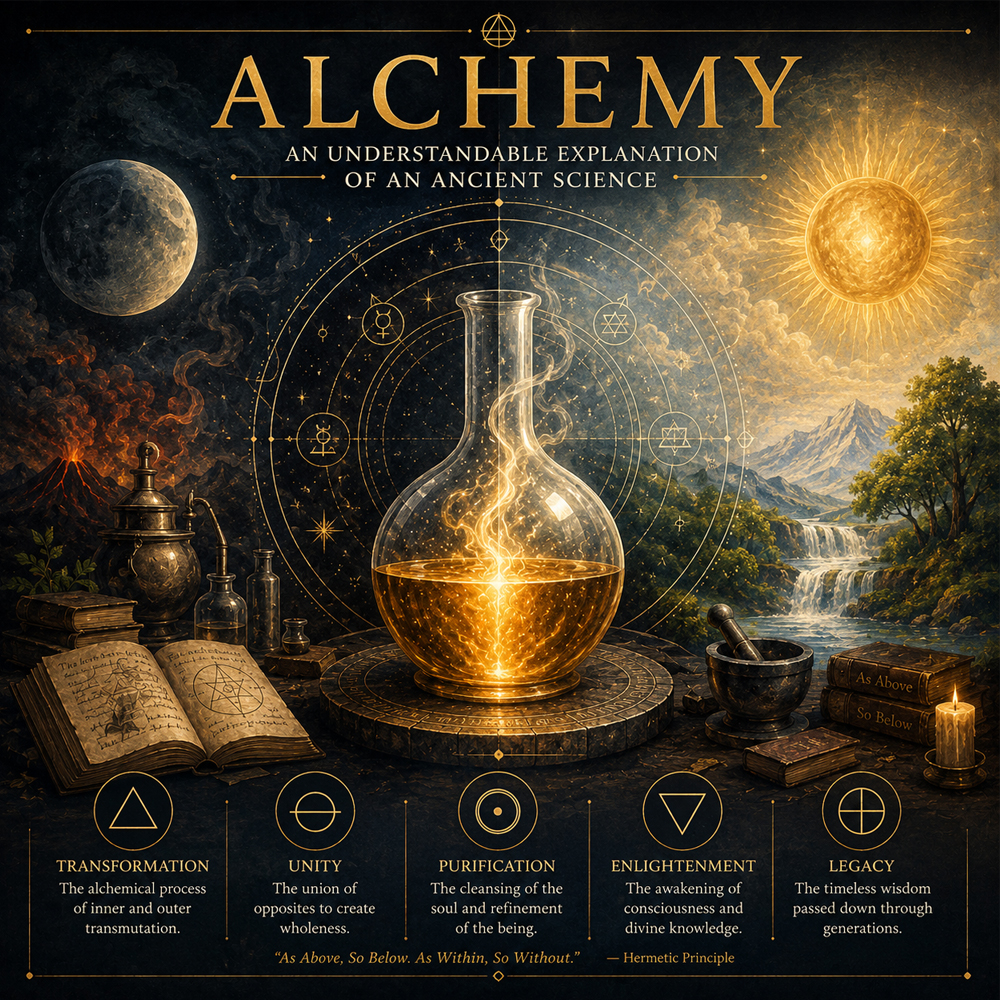
Alchemy is considered one of the oldest sciences, alongside astrology. The word itself originates from a blend of ancient cultures and carries the meaning of “divine chemistry.” While ordinary chemistry deals with physical elements, alchemy focuses on the deeper, invisible principles behind them – those that lie beyond the purely material.
In other words, alchemy is not simply about substances and metals, but about processes of transformation – both in the external world and within the human being.
How Alchemy Views the World
According to alchemy, nothing arises from nothing. Everything that exists is the result of transformation. Just as a tiny seed can become a massive tree, the entire universe is seen as the unfolding of a “divine seed” that has developed through time.
Alchemists believed that the same principles operate everywhere – in nature, in human beings, and even in the cosmos. For this reason, they divided existence not only into material and immaterial realms, but also into four h2fundamental domains: the mineral, plant, animal, and human worlds.
Each of these worlds follows its own path of evolution. For example, within the mineral world, the ultimate “goal” is not the human being but the perfect crystal or precious gemstone. This suggests that development within every realm follows its own unique trajectory.
What Transmutation Means
The central concept of alchemy is transmutation – the transformation of one thing into another.
Any stone, given the proper conditions, can eventually become a diamond. This is not magic but a process dependent on pressure, temperature, and time. The same principle applies to plants: every seed contains within itself the potential to become a fully developed organism, unfolding according to its inherent nature.
The alchemist is one who understands these processes and seeks to work consciously with them. He does not create something out of nothing; rather, he works with the potential that already exists.
This is why alchemy speaks of turning base metals into gold – not merely as a literal act, but as a symbol of revealing the highest form hidden within all things.
The Human Being as a “Small Universe”
One of the most fascinating ideas in alchemy is that the human being is a microcosm – a miniature reflection of the universe.
Within us exist all the elements found in nature. Our blood contains minerals, our bodies operate through processes similar to those found in plants and animals, and our consciousness introduces something additional: awareness and reason.
Even ordinary biological processes can be viewed as forms of alchemy. When food is transformed into energy, a transmutation has taken place. Nature performs such transformations constantly, and so do we, often without realizing it.
The Alchemy Within Us
The true power of alchemy becomes evident when it is understood as an inner process.
Every human being carries latent potential – wisdom, intelligence, creativity, even genius. Yet this potential is not always fully developed. Alchemy teaches that through conscious work upon oneself, ignorance can be transformed into knowledge, weakness into strength, and chaos into harmony.
This is the essence of inner transmutation.
At a deeper level, alchemy speaks of the evolution of the soul. Similar ideas appear throughout many spiritual traditions. In Buddhism, this is enlightenment. In Kabbalah, it is the attainment of the highest spiritual state. In Christianity, it is the return to God. In many Eastern teachings, it is union with the Infinite.
Although the language differs, the underlying principle remains the same: the unfolding of inner potential into its highest possible expression.
The Path of Transformation
Alchemy does not offer simple formulas, but it does provide guiding principles. One of these comes from ancient Egypt – the principle of Ma’at.
Ma’at represents truth, balance, order, morality, and justice.
According to this principle, a person should live in harmony with themselves and with the world around them. In Egyptian mythology, after death the heart of a person is weighed. If it is “light,” it signifies a life lived in accordance with truth and balance.
This is a symbolic way of expressing a deeper idea: inner purity and equilibrium are essential to genuine transformation.
Alchemy is not merely an ancient mystical science. It is a way of understanding the processes of change that occur both in nature and within ourselves.
And perhaps its most important message is this: everything already contains its own potential – the key is acquiring the right understanding to allow that potential to unfold.
Author: Vasil Stoyanov