
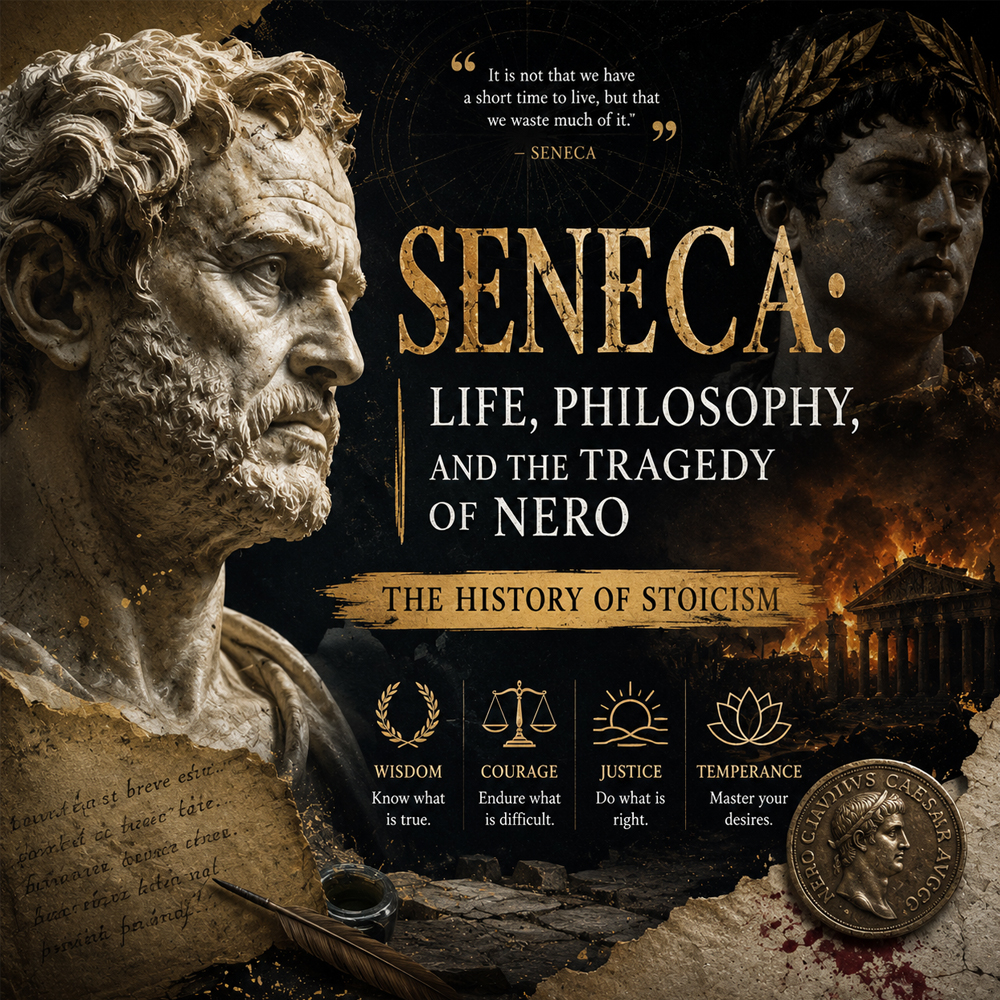
In the history of philosophy, there are figures who did not merely think – they burned. Their lives were not dry sequences of ideas, but tense journeys shaped by power, fear, morality, and fate. One such figure was Lucius Annaeus Seneca – a man who spoke of inner tranquility while living at the heart of one of history’s most ruthless empires.
The deeper one delves into his story, the clearer it becomes that his philosophy was not an abstract theory. It was a means of survival.
The Beginning: A Frail Body and a Strong Mind
Lucius Annaeus Seneca was born around 4 BCE in the Spanish city of Corduba, but he grew up in Rome – the capital of the world. His father was a renowned rhetorician, a master of eloquence, and from an early age Seneca absorbed the art of argumentation and public speaking.
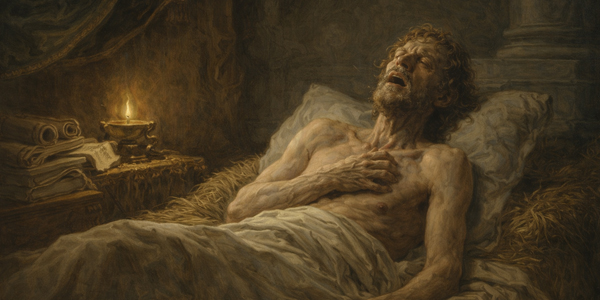
Yet fate did not grant him an easy beginning. Frail and often ill, he suffered from severe attacks of breathlessness, so intense that he later admitted there were moments in his youth when he contemplated suicide. And yet he endured. Not because the suffering disappeared, but because he began to understand it.
One early experience seems to foreshadow the course of his entire life. Seneca would lie awake at night, struggling to breathe, convinced that each breath might be his last. There, in the darkness – without an audience, without philosophical lectures or scholarly debates – he learned his first great lesson: fear does not come from death itself, but from the anticipation of it.
This physical fragility drew him toward philosophy. For Seneca, Stoicism was not merely an intellectual pursuit; it was a refuge. The doctrine that suffering arises not from events themselves but from our judgments about them became a form of inner armor. He adopted an austere lifestyle, deliberately practicing hardship. He slept on hard surfaces, ate simple meals, and subjected himself to voluntary discomfort, as if training his soul for the worst that life could bring.
Exile: The First Encounter with Fate
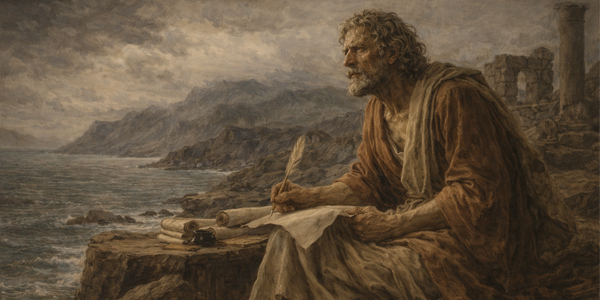
Seneca’s life did not follow a straight path. During the reign of Emperor Claudius, he was accused of adultery and exiled to the island of Corsica. Eight years away from Rome. Eight years of isolation during which political prestige faded away, leaving only a man alone with himself.
A person accustomed to the crowded halls of Rome, intellectual debates, and the attention of the elite suddenly found himself on a rugged island where no one knew his name. At first, he suffered. He wrote letters that almost pleaded for mercy and sought to regain the favor of those in power. This was not the image of the unshakable Stoic sage – it was the image of a man still learning.
Yet it was there that something deeper began to take place.
Gradually, his tone changed. From despair to acceptance. From resentment to understanding. He began writing texts that were no longer appeals for sympathy but reflections on life itself. He started to see exile not as an injustice, but as an opportunity to free himself from his dependence on Rome.
Later, he would write that no place can be exile for the wise person, because their true home lies within themselves. For Seneca, this was not a beautiful phrase or a philosophical slogan – it was a hard-earned truth, forged through suffering and experience.
Return and Power: Too Close to the Throne
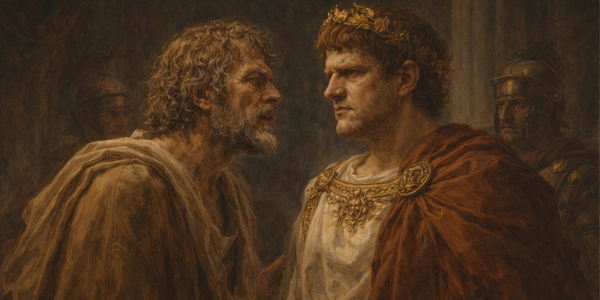
Fate turned once again. Thanks to the influence of Agrippina the Younger, Seneca was recalled to Rome and appointed tutor to the young Nero. Here began the most intense chapter of his life – the chapter in which philosophy had to coexist with power.
At first, their relationship was almost that of a father and son. Seneca saw in Nero an opportunity – a chance to shape a just ruler. He taught him moderation, mercy, and mastery over his passions. He even wrote the speech with which the young emperor promised to govern with reason and fairness.
For a brief period, it seemed to work.
The early years of Nero’s reign were relatively stable. Seneca and the prefect Burrus governed largely behind the scenes, helping to keep the emperor’s impulses in check. But power is not something that is easily shared.
Gradually, Nero began to free himself from their influence. The first major rupture came with the murder of his own mother – the very same Agrippina who had brought Seneca back to Rome. History tells us that it was Seneca who was tasked with writing the speech that justified the killing.
Imagine that moment: the philosopher who wrote about virtue composing words to defend matricide.
It remains one of the darkest episodes of his life. Not because he failed to understand what was right, but because he could not – or would not – stand against it.
As time passed, Nero became increasingly unpredictable. He began to see himself as an artist, a god, a figure above the law itself. Seneca could feel his influence slipping away. He attempted to withdraw from public life and even offered to return his immense wealth in order to free himself from the imperial court.
Nero refused.
No one walks away from power so easily – especially not someone who knows too much.
Inner Conflict: Wealth and Morality
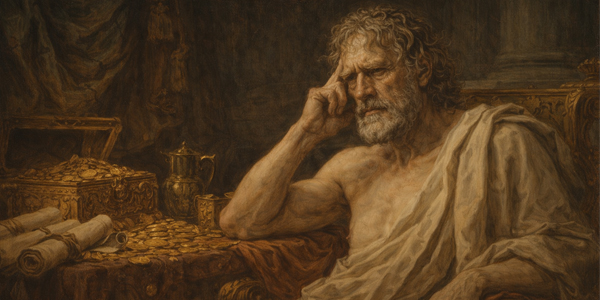
Seneca is often criticized for his immense wealth. How can a Stoic who preaches simplicity and inner freedom be so extraordinarily rich? This contradiction is not merely a philosophical question – it is a personal wound that runs through his life and legacy.
Seneca himself offered a defense. He argued that he did not belong to his wealth; rather, he simply made use of it. He claimed that he could relinquish it at any moment if circumstances required. But was it really that simple?
In his Letters to Lucilius, there are moments when it seems as though he is speaking not to the reader, but to himself. Like a man trying to reassure himself that he remains faithful to the principles he teaches. Beneath the polished arguments and philosophical reflections, one can occasionally sense an internal struggle – a tension between conviction and circumstance.
And this is precisely where Seneca becomes truly fascinating.
He is not a flawless sage standing above ordinary human weaknesses. He is a man caught between ideal and reality, between philosophy and power, between what he believed and the life he actually lived.
Perhaps that is exactly what makes his philosophy feel so alive. It is not the wisdom of someone who never stumbled, but of someone who spent a lifetime trying to rise above his own contradictions.
The Final Act: Choosing Death
The end came inevitably.
Seneca was accused of involvement in a conspiracy against Nero – the so-called Pisonian Conspiracy. Whether he was truly part of the plot or had simply become an inconvenient figure remains uncertain. What is clear is that Nero’s decision was final.
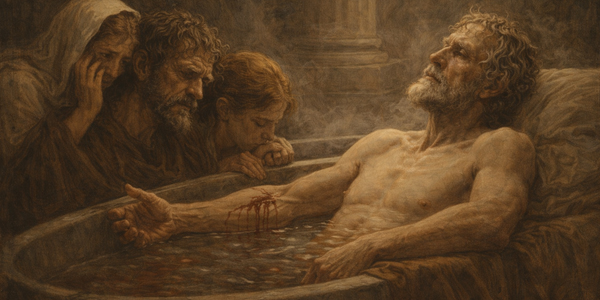
When the soldiers arrived, Seneca did not resist. According to historical accounts, he showed no sign of fear. He sat calmly, speaking with his friends and companions. He even tried to comfort his wife, who insisted on dying alongside him. Instead, he urged her to live.
Then he opened his veins.
The blood flowed slowly. His body was old and weakened, and death did not come quickly. He was forced to drink poison, but even that failed to bring an immediate end. Finally, he entered a hot bath, where the steam and heat accelerated the process.
It was not a beautiful death. It was long, painful, and difficult.
Yet there was something about it that is hard to deny: consistency.
Seneca died much as he had written. Without hysteria. Without despair. With a clear awareness of what was happening and an acceptance of what could not be changed.
According to the ancient chroniclers, some of his final words concerned philosophy itself – as a source of comfort, guidance, and strength. Even in the face of death.
For a man who had spent his life teaching that fate could take everything except one’s character, the final test had arrived. Whether Seneca lived up perfectly to his ideals remains a matter of debate. But in his last moments, he faced the one thing he had reflected upon his entire life: mortality itself.
Seneca’s Philosophy: The Art of Being Free
Seneca’s greatest contribution to philosophy was not the creation of complex theories, but his ability to translate Stoicism into the language of everyday life. His Letters to Lucilius are not academic treatises – they are conversations. They read like a voice from the past speaking directly to the reader.
“We suffer more often in imagination than in reality,” and more broadly, the idea that we suffer not from events themselves but from our judgments about them, runs throughout his work. This was not an abstract philosophical concept. It was a conviction forged through exile, fear, illness, and life in the shadow of tyranny.
Seneca believed that true freedom comes from within. A person could be imprisoned, wealthy, powerful, or condemned – and still remain free if they had mastered their own mind. It is an idea that almost sounds impossible, yet it was one he spent his life attempting to embody.
He wrote about time, arguing that we waste it as though it were limitless, even though it is our most precious possession. He wrote about anger, describing it as a brief form of madness that alienates us from our own nature. He wrote about death, not as an end to be feared, but as a natural part of life that should not become a source of terror.
What makes Seneca’s philosophy endure is its practicality. His writings are not concerned with distant metaphysical questions as much as they are with the challenges every person faces: fear, loss, uncertainty, ambition, grief, and mortality. More than two thousand years later, his words still feel surprisingly relevant because the human struggles he addressed have never truly changed.
Why Is Seneca Still Relevant Today?
In a world defined by speed, anxiety, and constant noise, Seneca feels remarkably modern. His reflections on inner peace, mastery over one’s thoughts, and acceptance of the inevitable resonate in a way that is difficult to ignore.
When he writes about how people waste their lives consumed by trivial worries, he seems to be describing the modern individual. When he argues that we often fear the anticipation of suffering more than suffering itself, his words sound less like ancient philosophy and more like an observation of contemporary life.
Seneca does not promise an easy existence. Quite the opposite. He insists that hardship is unavoidable, that setbacks, loss, and uncertainty are woven into the fabric of human life.
What he offers instead is something far more valuable: a way to endure those difficulties without losing oneself in the process.
For Seneca, peace does not come from controlling the world around us. It comes from learning to govern the one thing that truly belongs to us – our own mind.
A Life Between Light and Shadow
Seneca is not a hero in the traditional sense. He is contradictory, complex, and at times even uncomfortable to admire. A man who wrote about virtue while living in a court filled with intrigue. A man who taught moderation while possessing immense wealth. A man who believed deeply in reason, yet witnessed firsthand the madness of Nero.
But that is precisely what makes him real.
His life is a story of the tension between ideals and reality. Between what we know to be right and what we actually do. Between fear and dignity.
And when you close the pages of his writings, one feeling remains: philosophy is not something distant or abstract. It is here, in the choices we make when life places us under pressure. It is present in the way we endure loss, in the way we confront uncertainty, and in the decision to remain calm when the world around us begins to shake.
Seneca did not merely teach people how to think.
He showed them how to live.
And when the time comes, how to leave this world without fear.
- Stoicism: A Complete Guide to Inner Strength, Philosophy, and Resilience
- Buddhism and Stoicism: “A Complete Philosophical Comparison and Practical Application”
Author: Vasil Stoyanov