
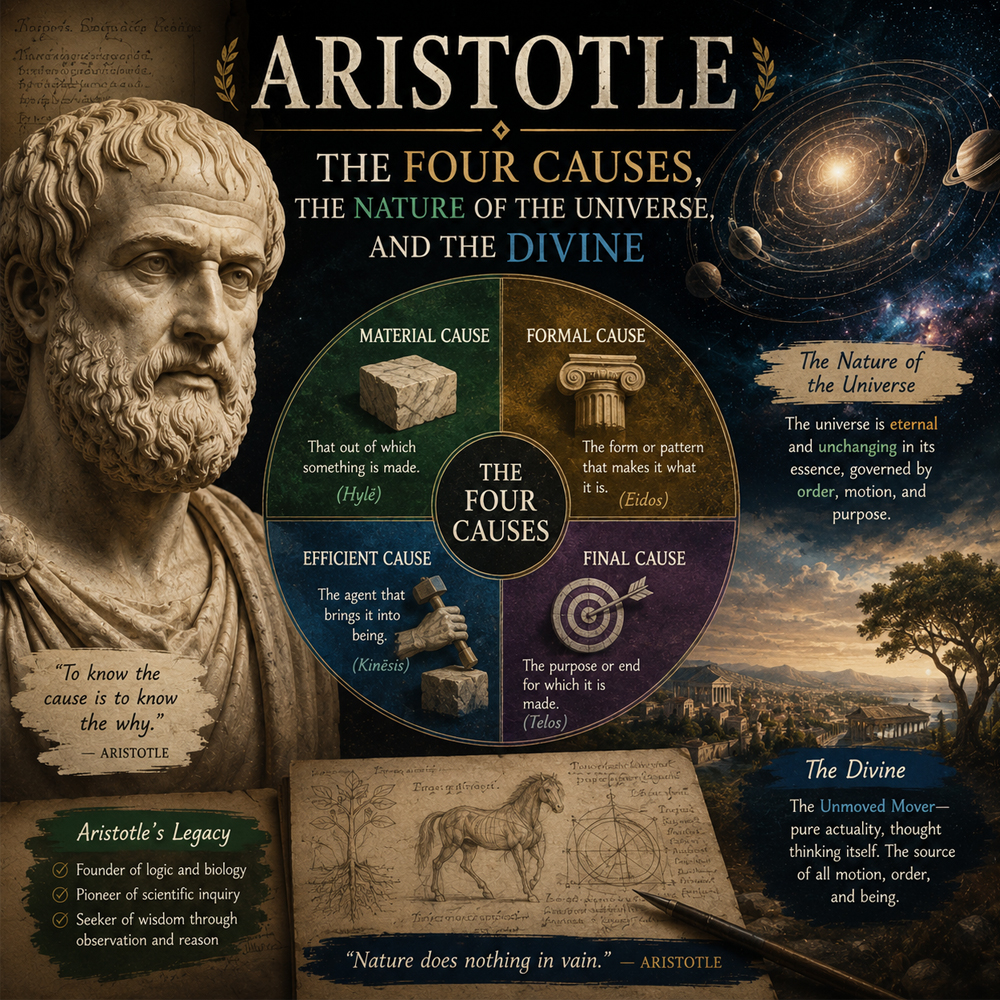
One of Aristotle’s greatest contributions to philosophy is his theory of the Four Causes – a framework designed to explain why things are the way they are. Unlike later theological arguments that seek an ultimate first cause or God, Aristotle’s system was primarily concerned with explaining individual objects and phenomena in the world around us.
Aristotle’s Four Causes and Their Application to the Universe
According to Aristotle, the first reason something is what it is lies in its material cause – the substance from which it is made. A wooden chair, for example, is a chair partly because it is constructed from wood. Without the appropriate material, the object could not exist in its present form.
However, possessing the material alone is not enough. The wood must be shaped and transformed into a chair by some external influence. Aristotle called this the efficient cause – the agent or process responsible for bringing something into existence.
The third cause is the formal cause, the form, structure, or defining idea of a thing. Even if a craftsperson possesses wood and the ability to work with it, they cannot create a chair unless they have some conception of what a chair is. The formal cause is the pattern or blueprint that gives an object its identity.
The fourth and final cause is the final cause, often called the purpose or end. Human beings create things for reasons. A chair is made to be sat upon. A house is built to provide shelter. The final cause answers the question: „What is this for?“
Together, these four causes provide a comprehensive explanation of why something exists and why it takes the particular form that it does.
The theory can also be applied to things that are not physical objects. Consider a piece of music. The material cause consists of sound waves. The efficient cause is the musician or instrument producing them. The formal cause is the structure and arrangement of the composition. The final cause might be artistic expression, enjoyment, fame, or any other purpose motivating its creation.
Applying the Four Causes to the Cosmos
The universe clearly possesses a material cause because matter exists. It also appears to possess an efficient cause, since the matter composing the universe exhibits order rather than complete chaos.
The question becomes more complicated when we consider formal and final causes.
If the universe possesses a purpose, then one might argue that it was brought into existence according to some guiding idea or design. If there is a purpose, there is also a form toward which the universe is directed.
Imagine a painter. The painter possesses brushes and paint – the material causes. They possess the ability to paint – the efficient cause. But if they have no idea of what they wish to create and no purpose in mind, then any image that appears on the canvas would arise by chance.
Likewise, some philosophers have argued that if the universe lacks a final cause, then its present order must ultimately be the result of randomness. If it possesses a final cause, however, then its structure may reflect an underlying intention or design.
These questions continue to shape philosophical debates today, appearing in modern discussions concerning cosmology, fine-tuning, intelligent design, and the origins of the universe.
Aristotle’s God: The Unmoved Mover
At this point it is important to distinguish Aristotle’s own position from later theological interpretations.
Aristotle did not imagine God as a creator who consciously designed the universe in the way an artist creates a painting. Instead, he proposed the existence of what he called the Unmoved Mover.
Everything in nature is in motion or undergoing change. Every movement appears to require a cause. Aristotle reasoned that if every cause itself required another cause, an infinite regress would follow.
To avoid this, he proposed a first principle that causes motion without itself being moved. This Unmoved Mover does not create the universe through direct intervention. Rather, it functions as the ultimate object of desire and aspiration, drawing all things toward their fulfillment.
For Aristotle, God is pure actuality – perfect, eternal, unchanging, and fully realized. Unlike human beings, who possess unrealized potential, the Unmoved Mover lacks nothing and therefore undergoes no change.
Purpose in Nature
One of Aristotle’s most distinctive ideas is that nature itself is goal-directed.
An acorn develops into an oak tree. A seed grows into a mature plant. Human beings develop their capacities through learning and experience. Aristotle viewed these processes as examples of teleology – the tendency of things to move toward their natural ends.
This belief profoundly influenced Western thought for centuries. Even today, traces of Aristotelian thinking remain in biology, ethics, and discussions about human flourishing.
Aristotle’s Lasting Legacy
The influence of Aristotle extends far beyond ancient philosophy. His ideas shaped medieval theology, Islamic philosophy, Renaissance science, and the intellectual foundations of the modern world.
Although many of his scientific theories have been replaced, his method of asking questions remains remarkably powerful. Instead of asking only what something is made of, Aristotle encouraged us to ask four deeper questions:
- What is it made of?
- What produced it?
- What gives it its form?
- What is its purpose?
These questions continue to influence philosophy, science, and everyday reasoning more than two thousand years after they were first proposed.
Whether one ultimately views the universe as the product of chance, necessity, design, or something beyond human comprehension, Aristotle’s Four Causes remain one of the most influential attempts ever made to understand why things are the way they are.
Author: Vasil Stoyanov