
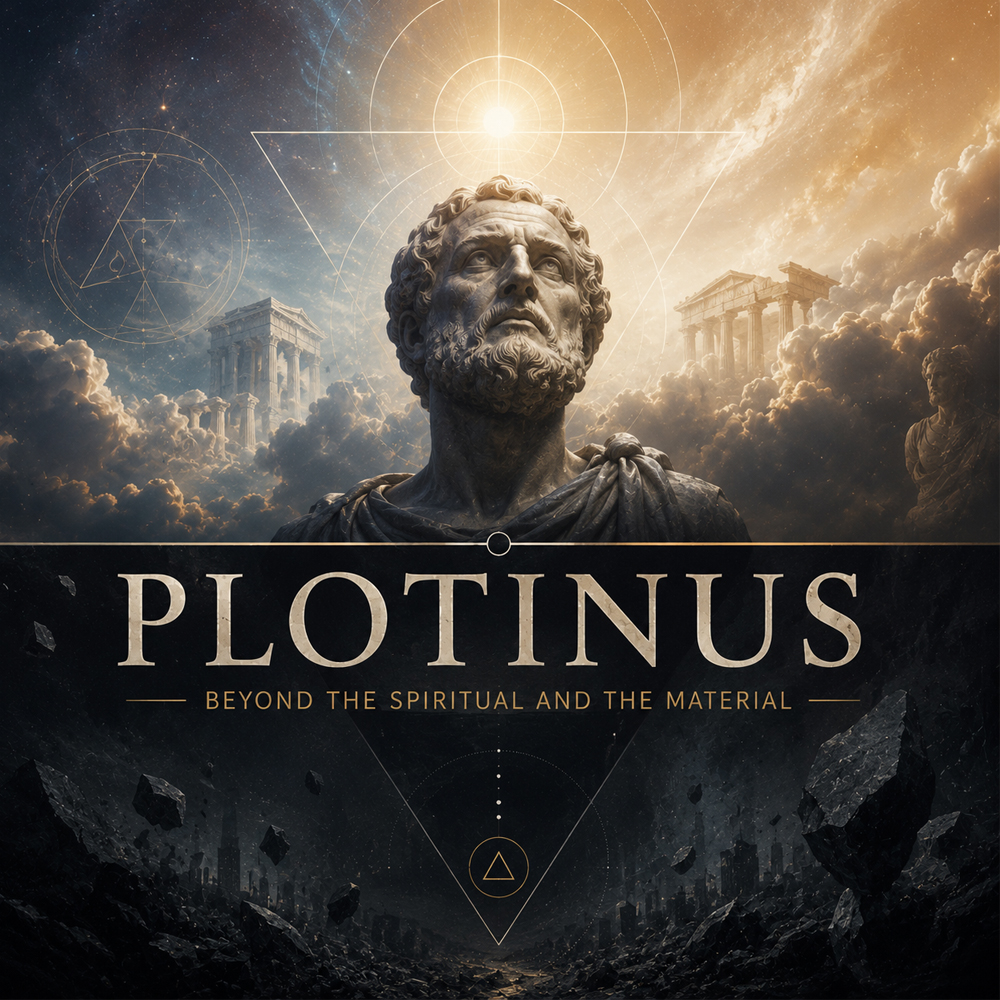
Few philosophers have influenced the history of spirituality as profoundly as Plotinus. Although his name is less widely known than those of Plato, Aristotle, or Socrates, his ideas helped shape the foundations of Christian theology, Islamic philosophy, Jewish mysticism, and much of Western metaphysics. His philosophical system became one of the most important bridges between the ancient world and the religious traditions that would dominate the centuries that followed.
At the heart of Plotinus’ philosophy lies a bold and fascinating claim: reality is far greater than the physical universe we experience through our senses. The material world, according to him, is not the ultimate reality but the final expression of a much deeper and more fundamental source. What we perceive through sight, touch, and hearing represents only the outermost layer of existence rather than its true foundation.
This source he called the One. For Plotinus, the One is not merely the highest being among other beings but the ultimate principle from which all reality flows. Everything that exists ultimately depends upon it, even though it transcends all ordinary categories of thought and language.
To understand Plotinus is to embark on a journey beyond matter, beyond thought, and even beyond existence itself. It is a journey toward the origin of all things – a reality so transcendent that language can barely describe it. His philosophy challenges us to reconsider our assumptions about the nature of reality and our place within it.
Who Was Plotinus?
Plotinus was born around 204 CE in Roman Egypt, likely in the city of Lycopolis. Very little is known about his early life, and much of what historians know comes from later accounts written by his followers. What we do know comes primarily from his student Porphyry, who later compiled Plotinus’ writings into a collection known as The Enneads.
Unlike many philosophers who focused primarily on logic, politics, or science, Plotinus was interested in the deepest questions imaginable. He sought answers not only through rational inquiry but also through spiritual contemplation and personal transformation. His philosophy was intended to guide individuals toward a direct understanding of reality rather than merely providing abstract theories.
Among the questions that occupied Plotinus throughout his life were:
- What is the source of existence?
- Why does anything exist at all?
- What is the nature of the soul?
- Why do human beings experience suffering?
- Can we reunite with the ultimate source of reality?
For Plotinus, philosophy was not merely an intellectual exercise. It was a path of spiritual transformation that required discipline, self-reflection, and a sincere desire for truth. Knowledge, in his view, was valuable only if it helped the soul move closer to its divine origin.
He believed that genuine wisdom required more than reading books or constructing arguments. It required an inner ascent – a gradual movement of the soul toward its divine origin. Through contemplation and philosophical insight, human beings could awaken to a reality far greater than the material world around them.
The Birth of Neoplatonism
Plotinus is generally regarded as the founder of Neoplatonism, one of the most influential philosophical movements in history. Although deeply inspired by Plato, he developed a system that extended far beyond the ideas found in Plato’s dialogues. His work provided a comprehensive explanation of reality that would influence philosophers and theologians for more than a thousand years.
The name „Neoplatonism“ means „new Platonism,“ but the term can be misleading. Plotinus did not simply repeat Plato’s teachings, nor did he consider himself the founder of an entirely new philosophy. Instead, he developed Plato’s insights into a vast metaphysical system capable of explaining everything from the existence of matter to mystical experiences.
Like Plato, Plotinus believed that the visible world is not the ultimate reality. However, he expanded this idea dramatically by describing multiple levels of existence that connect the material world to its transcendent source. In doing so, he created one of the most sophisticated metaphysical systems in the history of philosophy.
Where Plato spoke of Forms or Ideas, Plotinus described an entire hierarchy of reality flowing from a single transcendent source. This hierarchy explains how perfect unity can give rise to diversity without losing its own perfection. It also provides a framework for understanding the relationship between the soul, the cosmos, and the divine.
This hierarchy begins with the One. Everything else in existence emerges from it through a process that Plotinus called emanation. Understanding this principle is essential for understanding the rest of his philosophy.
The One: Beyond Being and Non-Being
The central concept in Plotinus’ philosophy is the One. It stands at the summit of reality and serves as the ultimate source of everything that exists. Yet despite its importance, Plotinus insists that it cannot be adequately described through ordinary language.
The moment we attempt to describe the One, we encounter a problem. Every description imposes limits and distinctions upon the thing being described. Language works by separating one thing from another, but the One exists prior to all separation and distinction.
Every description imposes limits. To say that something is large means it is not small, and to say that something is good implies the existence of what is not good. Every concept depends upon distinction and contrast, which means that concepts cannot fully capture a reality that transcends all distinctions.
But the One exists prior to all distinctions. It is not one object among many objects, nor is it one being among many beings. Rather, it is the source from which all distinctions ultimately arise.
For this reason, Plotinus insists that the One cannot properly be described as a thing. Any attempt to define it risks reducing it to something less than what it truly is. The One transcends every category that human thought can create.
It is not a being among other beings. It is not a god in the ordinary sense, nor is it a mind, a substance, or even existence itself. Each of these concepts belongs to a lower level of reality and therefore cannot adequately describe the ultimate source.
The One is beyond existence because existence already implies a distinction between what exists and what does not. Since the One precedes all distinctions, it cannot be confined within either category. It transcends both existence and non-existence as they are ordinarily understood.
This idea is difficult for the modern mind because we instinctively imagine reality as a collection of objects. Plotinus asks us to think beyond objects entirely and to consider the possibility of a source that exists beyond all categories of thought. Such a perspective requires a radical shift in the way we understand reality.
Imagine attempting to find the source of every distinction, every category, every form, every thought, every physical object, every law of nature, and every possible universe. Imagine stripping away every layer of reality until nothing remains except the ultimate foundation upon which everything depends. Whatever remains beyond all of those would be closer to what Plotinus means by the One.
The One has no beginning because beginnings require time. It has no location because locations require space, and it cannot change because change requires movement from one state to another. Likewise, it cannot be divided because division requires parts, whereas the One is absolute unity.
Why Does Anything Exist?
A natural question immediately arises when considering the One. If it is perfect, complete, and self-sufficient, why does anything emerge from it at all? Why is there a universe instead of only the One?
Plotinus answers with one of the most important concepts in Neoplatonism: emanation. This concept allows him to explain how reality can arise from the One without implying that the One undergoes change or loses its perfection. Emanation is not an act of creation in the ordinary sense but a natural expression of the One’s overflowing abundance.
Many religious traditions describe creation as an act of will in which God decides to create the universe. Plotinus offers a different picture that avoids attributing human-like decision-making to the ultimate source of reality. For him, the One does not deliberate, choose, or plan.
The One does not choose to create, and creation is not an event that occurs at a particular moment in time. Instead, reality flows from the One naturally and inevitably. The emergence of existence is simply the consequence of the One’s infinite perfection.
Plotinus compares this process to sunlight radiating from the sun. The sun does not deliberate before shining, nor does it consciously decide to emit light. Its light overflows simply because of what it is.
Likewise, the One overflows with reality. Existence streams outward from absolute unity in the same way that light radiates from a luminous source. This process is called emanation because reality unfolds from the One without diminishing it.
Importantly, the One loses nothing in the process. Just as a candle can light another candle without diminishing its own flame, the One remains unchanged while reality unfolds from it. Its perfection remains complete even as all levels of existence emerge from it.
The First Emanation: Nous, the Divine Intellect
The first reality to emerge from the One is called Nous, often translated as the Divine Intellect. Nous occupies the highest level of reality after the One and serves as the realm of perfect knowledge and understanding. It represents the first stage at which multiplicity appears within existence.
If the One is beyond thought, Nous is the realm of thought itself. Here we find something resembling Plato’s World of Forms, though Plotinus develops the concept in a more systematic way. Within Nous exist all eternal truths and perfect archetypes.
Every perfect pattern, every eternal principle, and every ideal form exists within the Divine Intellect. Mathematical truths, beauty, justice, harmony, and the archetypes underlying all existence reside here. Nothing within Nous is subject to change, decay, or imperfection.
Nous is the first level at which multiplicity appears. Unlike the One, which is absolute unity, Nous contains countless Forms and principles. Yet these Forms remain perfectly unified because they exist within a single divine intellect.
Plotinus describes Nous as eternal self-contemplation. The Divine Intellect contemplates the One, and in doing so becomes the repository of all intelligible reality. Through this contemplation, all knowledge and all forms of understanding become possible.
In a sense, everything that can ever be known already exists within Nous. Every truth, every principle, and every perfect form is present there eternally. Human knowledge is possible because the soul participates, however imperfectly, in this higher realm of reality.
The World Soul
From Nous emerges the next level of reality: the World Soul. This level serves as the bridge between the eternal realm of Forms and the changing physical universe. Without the World Soul, there would be no connection between perfect intelligible reality and the world of matter.
The World Soul serves as a bridge between the eternal realm of Forms and the changing physical universe. It receives the patterns contained within Nous and communicates them to the lower levels of existence. Through this process, order and structure become possible within the cosmos.
If Nous contains perfect archetypes, the World Soul is the principle that animates and organizes reality according to those archetypes. It is responsible for the harmony and coherence that we observe throughout nature. The World Soul ensures that the universe reflects, however imperfectly, the higher realities from which it originates.
Through the World Soul, order enters the cosmos. Nature acquires structure, living beings emerge, movement becomes possible, and time begins to exist. The dynamic processes of the physical universe are therefore rooted in a deeper spiritual principle.
Plotinus believed that individual human souls originate from this greater World Soul. Each person therefore contains something divine that connects them to the higher levels of reality. Human beings are not isolated entities but participants in a vast spiritual order.
Each person therefore contains something divine. We are not merely biological organisms whose existence begins and ends with the body. We are expressions of a deeper spiritual reality that ultimately traces its origin back to the One itself.
This idea would profoundly influence Christian mysticism, Islamic philosophy, Renaissance thought, and countless spiritual traditions for centuries to come. The belief that the soul possesses a divine origin became one of the most enduring aspects of Plotinus’ legacy. Even today, his vision of reality continues to inspire philosophers, theologians, and spiritual seekers around the world.
Matter and the Physical Universe
From the perspective of Plotinus, the physical universe occupies the lowest level within the hierarchy of reality. This does not mean that the material world is evil or entirely unreal. Rather, it means that it is the most distant expression of the One and therefore possesses the least degree of unity and perfection.
This point is often misunderstood, especially by readers who associate spiritual philosophies with a rejection of the material world. Many later thinkers, particularly certain Gnostic movements, portrayed matter as something fundamentally corrupt or evil. Plotinus strongly rejected this view and insisted that matter, despite its limitations, still derives its existence from the ultimate source of reality.
He argued that matter is not evil in itself and should not be viewed as an opposing force to the divine. If everything ultimately originates from the One, then even the lowest level of reality must possess some degree of goodness. The problem, therefore, is not that matter is evil, but that it is incomplete and lacks the fullness of perfection found in higher levels of existence.
As reality descends further from the One through successive levels of emanation, it becomes increasingly fragmented and diverse. Unity gives rise to multiplicity, eternity gives rise to time, and perfection gives rise to imperfection. Each stage of this process represents a greater distance from the absolute simplicity and completeness of the One.
The physical universe is therefore characterized by constant change and instability. Everything within it comes into existence, develops, decays, and eventually disappears. Stars are born and die, civilizations rise and fall, bodies age, and mountains slowly erode under the forces of nature.
For Plotinus, this perpetual change reveals something important about the nature of material existence. Anything that changes cannot be fully complete, because change implies the possibility of becoming something different. If something can become different tomorrow, then it has not yet achieved perfect actuality today.
The material universe therefore exists in a state of perpetual becoming rather than complete being. Unlike the eternal realities found within Nous, physical objects are never fully stable or self-sufficient. They are temporary reflections of deeper principles that exist beyond time and space and derive their significance from those higher realities.
Why Matter Appears Imperfect
To understand Plotinus’ view of matter, it is helpful to imagine a beam of light gradually fading as it travels farther from its source. The light does not suddenly disappear, nor does it become something entirely different. Instead, it becomes weaker and weaker as the distance from its origin increases.
Similarly, reality becomes less unified and less perfect as it moves farther from the One. At the highest level there is absolute unity, while at lower levels diversity begins to emerge. As the process continues, fragmentation increases until we eventually arrive at matter itself, the point at which unity appears most diluted.
Plotinus sometimes describes matter almost as the absence of form rather than a substance possessing qualities of its own. Matter by itself is not a completed thing with a definite identity or purpose. It is a potentiality waiting to receive structure, order, and determination from higher levels of reality.
Without form, matter would be pure indeterminacy and would possess no recognizable characteristics. It would have no shape, no organization, and no identity through which it could be understood. This is why Plotinus often speaks of matter as a kind of metaphysical darkness – not because it is evil, but because it lacks the fullness of intelligibility found in the higher realms.
Everything beautiful that we observe in the physical universe originates not from matter itself but from the Forms reflected within it. A flower is beautiful because it participates in beauty, and a mathematical equation is elegant because it participates in rational order. Likewise, a human being possesses dignity because the soul reflects higher realities that transcend the physical world.
Matter serves as the medium through which these principles become visible and manifest themselves in the world of experience. Without matter, the Forms would not appear in physical existence. Yet without the Forms, matter would remain formless and incapable of producing the ordered universe we inhabit.
The Soul’s Descent into the Material World
One of Plotinus’ most fascinating ideas concerns the relationship between the soul and the material universe. According to him, the human soul originates from higher levels of reality and possesses a nature that transcends the physical world. Its deepest essence belongs to the intelligible realm rather than the realm of matter and change.
Yet somehow the soul becomes involved with material existence and begins to identify with it. This involvement is often described as a descent, although Plotinus does not mean that the soul literally travels through physical space. Rather, the descent refers to a shift in attention, awareness, and identification.
The soul becomes increasingly absorbed in the world of sensory experience and external appearances. Instead of contemplating eternal truths, it becomes fascinated by temporary objects and fleeting pleasures. Instead of identifying with its divine origin, it gradually begins identifying with the body and its changing conditions.
The result of this process is forgetfulness. Human beings gradually forget who they truly are and lose awareness of their higher nature. They come to believe that they are merely physical organisms struggling for survival within a material universe.
As this forgetfulness deepens, people begin to mistake the surface of reality for its foundation. They assume that what can be seen and touched is all that exists. In doing so, they lose sight of the deeper realities that give meaning and structure to the visible world.
This condition lies at the heart of the human predicament according to Plotinus. We suffer because we identify ourselves with what is constantly changing and therefore unstable. We fear death because we identify ourselves exclusively with the body, and we become anxious because we attach ourselves to things that inevitably pass away.
The more deeply the soul becomes entangled in the material world, the further it drifts from its true nature. This alienation is not imposed from outside but arises from the soul’s own misdirected attention. The path back to wisdom therefore begins with remembering what the soul truly is and where it ultimately comes from.
The Myth of Narcissus and the Human Condition
Although Plotinus rarely relied on mythology as heavily as some later thinkers, the ancient story of Narcissus provides a powerful illustration of his philosophy. The myth captures the tendency of human beings to become captivated by appearances and to mistake reflections for reality. For this reason, many later Neoplatonists saw it as a symbolic representation of the soul’s condition.
According to Greek mythology, Narcissus saw his reflection in a pool of water and became captivated by it. Unable to recognize that the image was merely a reflection, he fell in love with it and eventually perished while pursuing an illusion. His tragedy arose not from the existence of the reflection itself but from his inability to distinguish appearance from reality.
For many later Neoplatonists, this story symbolized the condition of the human soul within the material world. The soul gazes upon its reflection within the realm of matter and becomes fascinated by appearances. It falls in love with wealth, status, pleasure, power, beauty, and countless other temporary things that seem capable of providing fulfillment.
Gradually the soul forgets that these objects are only reflections rather than ultimate realities. Like Narcissus, it mistakes the image for the source and becomes trapped in a pursuit that can never fully satisfy. The more intensely it seeks fulfillment in transient things, the more distant it becomes from its true origin.
Plotinus believed that much of human suffering arises from precisely this confusion. We seek permanence in what is impermanent, fulfillment in what is finite, and ultimate meaning in things that inevitably change. Because these objects cannot provide what we seek, dissatisfaction becomes unavoidable.
The solution is not to reject the world entirely but to understand its proper place within the hierarchy of reality. The material world is not the destination toward which the soul is ultimately directed. Instead, it functions as a signpost pointing toward something greater and more enduring than anything found within the realm of appearances.
Evil According to Plotinus
One of the most challenging questions in philosophy concerns the existence of evil. If reality originates from the One, which is perfect and the source of all goodness, how can evil exist at all? Plotinus approaches this problem in a way that differs significantly from many religious and philosophical traditions.
He argues that evil does not possess independent existence and should not be understood as a substance or force in its own right. Evil is not a rival power competing against goodness, nor is it an equal opposite standing against the One. Instead, evil is best understood as the absence or privation of good.
A useful analogy is darkness. Darkness does not exist as a positive substance that can be added to a room. It is simply the absence of light, and it disappears whenever light is present.
Likewise, evil represents a deficiency of goodness rather than an independent reality. The farther something moves from unity, order, beauty, and truth, the more it participates in what we call evil. Evil therefore arises not because there is a separate source of corruption in the universe, but because beings can become increasingly distant from the fullness of the good.
This idea would later exert enormous influence on Christian thinkers such as Augustine, who adopted a remarkably similar understanding of evil. Rather than viewing evil as a created thing, Augustine came to see it as a lack or distortion of goodness. In this respect, the influence of Plotinus on later religious thought cannot be overstated.
For Plotinus, goodness corresponds to participation in the higher levels of reality and alignment with the divine source. Evil corresponds to separation, fragmentation, ignorance, and alienation from one’s true nature. The more disconnected a being becomes from unity and truth, the more it experiences the consequences of that separation.
The solution to evil is therefore not merely moral behavior in the conventional sense. It is spiritual awakening and the restoration of proper orientation toward the One. The more clearly the soul recognizes its divine origin, the more fully it participates in the good and overcomes the deficiencies that give rise to evil.
The Return to the One
The central goal of Plotinus’ philosophy is not merely understanding reality through intellectual analysis. Knowledge is important, but it serves a higher purpose. The ultimate aim is returning to the source from which all things originate.
Everything emanates from the One, and everything ultimately longs to return to the One. This return does not involve physical movement through space or travel to another location. Instead, it is an inward journey through which the soul rediscovers its deepest identity.
The soul ascends by turning away from excessive attachment to the material world and directing its attention toward higher realities. This process begins with ethical self-discipline and the cultivation of virtue. A person learns to govern desires rather than being governed by them and develops qualities such as wisdom, courage, moderation, and justice.
From there, the soul turns toward philosophical contemplation and the pursuit of truth. It seeks understanding rather than distraction and reality rather than appearances. Through sustained contemplation, the mind gradually becomes capable of perceiving deeper levels of existence.
Eventually contemplation leads beyond thought itself. At the highest stage, the soul approaches a state that Plotinus describes as mystical union. This experience cannot be fully expressed through language because language depends upon distinctions, while mystical union transcends all distinctions.
In that moment, the separation between subject and object dissolves. The soul no longer merely thinks about the One as something external to itself. Instead, it experiences unity directly in a manner that surpasses ordinary knowledge and perception.
Plotinus himself claimed to have undergone such experiences several times during his life. For him, these moments represented the highest achievement possible for a human being and the fulfillment of philosophy’s deepest purpose. They were glimpses of ultimate reality beyond thought, beyond individuality, and beyond the limitations of ordinary consciousness.
Plotinus and Christianity
One of the reasons Plotinus remains such an important figure in intellectual history is that his ideas became deeply intertwined with the development of Christian theology. Although Plotinus himself was not a Christian and lived before Christianity became the dominant religion of the Roman Empire, many of the concepts that later Christian thinkers used to explain God, the soul, and spiritual reality bear a remarkable resemblance to Neoplatonic philosophy.
The most influential example is Saint Augustine. Before converting to Christianity, Augustine struggled for years with philosophical and theological questions concerning evil, the nature of God, and the origin of the soul. He found many of his answers in the writings of Plotinus and other Neoplatonists. Augustine himself later admitted that Neoplatonism helped him understand how God could exist beyond space and time and why evil should not be understood as a substance but as the absence of good.
Many of the characteristics attributed to God in Christian theology closely resemble Plotinus’ description of the One. God is often described as eternal, unchanging, beyond human comprehension, and the source of all existence. While Christianity differs significantly from Neoplatonism in many respects, particularly regarding creation and the personal nature of God, the philosophical language used to discuss these ideas was heavily shaped by Neoplatonic thought.
The influence extends beyond Augustine. Throughout the Middle Ages, Christian theologians repeatedly turned to Neoplatonic concepts when attempting to explain divine transcendence, mystical experience, and the relationship between God and creation. Thinkers such as Pseudo-Dionysius the Areopagite integrated many of Plotinus’ ideas directly into Christian theology, creating a tradition of negative theology that emphasized the impossibility of fully describing God through language.
This approach argued that the highest knowledge of God comes not from describing what God is but from understanding what God is not. Such a method closely parallels Plotinus’ insistence that the One transcends all categories and concepts. In many ways, large portions of Christian mysticism would be difficult to imagine without the philosophical foundations laid by Plotinus.
Plotinus and Eastern Philosophy
Modern readers are often surprised by how closely some aspects of Plotinus’ philosophy resemble certain traditions of Eastern thought. Although there is no definitive evidence that Plotinus directly studied Hinduism or Buddhism, the similarities are striking enough that scholars have debated them for centuries.
One parallel appears in the concept of ultimate reality. In several schools of Hindu philosophy, particularly Advaita Vedanta, the ultimate reality known as Brahman transcends all distinctions and categories. Like the One, Brahman is often described as beyond ordinary language and beyond the dualities that structure human thought. Both traditions emphasize that ultimate reality cannot be fully captured through concepts.
Another similarity appears in the notion that ordinary human consciousness is trapped in a limited perspective. In both Neoplatonism and many Eastern traditions, human beings tend to identify with temporary forms and appearances while remaining unaware of a deeper reality. The spiritual journey therefore involves awakening to a more fundamental truth about existence.
The process of mystical union described by Plotinus also bears a resemblance to experiences reported in various contemplative traditions. In each case, there is a movement beyond ordinary distinctions between subject and object. The individual self becomes less prominent, and reality is experienced as a profound unity that transcends conceptual understanding.
Despite these similarities, important differences remain. Plotinus preserves a hierarchy of reality in which the soul ascends through distinct levels of being, whereas some Eastern traditions emphasize a more direct realization of ultimate reality. Nevertheless, the parallels reveal something fascinating about the human search for meaning: philosophers separated by vast distances and different cultures often arrived at remarkably similar insights regarding consciousness, reality, and transcendence.
The Influence of Plotinus on Western Civilization
The impact of Plotinus extends far beyond philosophy departments and theological discussions. His ideas helped shape the intellectual foundations of Western civilization in ways that are often invisible to modern readers.
During the late Roman Empire, Neoplatonism became one of the dominant philosophical systems. Educated individuals throughout the Mediterranean world encountered its concepts and incorporated them into their understanding of reality. Even after the decline of the Roman Empire, Neoplatonic thought continued to influence scholars, theologians, and mystics across Europe and the Middle East.
In the Islamic world, philosophers such as Al-Farabi, Avicenna, and others engaged deeply with Neoplatonic concepts. Although they interpreted them through an Islamic framework, many aspects of their metaphysical systems reveal the influence of Plotinus. Through these thinkers, Neoplatonic ideas entered new intellectual traditions and continued evolving for centuries.
The Renaissance witnessed another revival of interest in Plotinus. Scholars such as Marsilio Ficino translated and promoted Neoplatonic texts, helping to inspire new ways of thinking about beauty, creativity, and the relationship between humanity and the divine. Many Renaissance artists and philosophers were influenced by the idea that visible beauty reflects deeper spiritual realities.
Even modern discussions concerning consciousness, idealism, metaphysics, and the nature of reality occasionally echo themes first articulated by Plotinus. Although contemporary philosophy often operates within very different frameworks, the questions he raised remain as compelling as ever. What is the ultimate foundation of reality? Is consciousness fundamental or secondary? What is the relationship between mind and matter? These questions continue to shape intellectual inquiry today.
The Goal of Human Life According to Plotinus
For Plotinus, philosophy was never merely about constructing theories. The ultimate purpose of philosophy was transformation. Knowledge mattered because it could change the soul and help it move closer to its true source.
The goal of human life, therefore, is not the accumulation of wealth, power, status, or pleasure. These things belong to the realm of change and cannot provide lasting fulfillment. A person who bases their identity entirely upon them inevitably becomes vulnerable to loss, anxiety, and disappointment.
True fulfillment comes through the cultivation of the soul. Plotinus believed that every human being possesses a divine dimension that remains connected to higher realities regardless of how deeply it becomes immersed in the material world. The task of life is to awaken this dimension and allow it to guide one’s actions and understanding.
This process begins with self-discipline. A person must learn to govern desires rather than becoming enslaved by them. They must develop virtues that bring order to the soul and reduce its attachment to temporary things. Ethical living is therefore not merely a social obligation but a spiritual practice that prepares the soul for higher forms of understanding.
From ethical discipline arises contemplation. The mind gradually turns away from distractions and becomes capable of perceiving deeper truths. Through sustained reflection, the individual begins to recognize patterns and principles that transcend ordinary experience. The world starts to appear less as a collection of isolated objects and more as an interconnected expression of a deeper reality.
Eventually, according to Plotinus, the soul may experience moments of profound insight in which its connection to the One becomes directly apparent. These moments cannot be fully explained or communicated because they transcend ordinary thought. Yet they represent the highest fulfillment available to human beings and the culmination of the philosophical life.
Conclusion: Beyond the Spiritual and the Material
Plotinus offers one of the most ambitious visions of reality ever developed in the history of philosophy. His system begins with the One, an ultimate source that transcends all categories, distinctions, and limitations. From this source emerges a hierarchy of reality that includes the Divine Intellect, the World Soul, and ultimately the material universe itself.
Unlike many philosophies that focus exclusively on the physical world or exclusively on spiritual realities, Plotinus attempts to explain both within a single framework. Matter and spirit are not separate realms engaged in conflict but different levels within a continuous process of emanation. Everything that exists ultimately traces its origin back to the same source.
His philosophy also presents a powerful account of the human condition. We suffer because we become attached to appearances and forget our deeper nature. We identify ourselves with what changes and therefore fear loss, aging, and death. Yet beneath these temporary identities lies something far more profound – a soul that participates in realities beyond the physical world.
The solution, according to Plotinus, is neither blind faith nor mere intellectual analysis. It is a transformation of consciousness. Through virtue, contemplation, and self-knowledge, the soul gradually remembers its origin and begins the journey back toward the source from which all things emerge.
Whether one accepts his metaphysical conclusions or not, Plotinus remains one of humanity’s greatest explorers of the inner world. His writings continue to challenge readers to look beyond appearances and ask deeper questions about existence, consciousness, and the ultimate nature of reality. Nearly eighteen centuries after his death, those questions remain as alive as ever.
- Aristotle: The Four Causes, the Nature of the Universe, and the Divine
- Платон: Светът на идеите, душата, животът и човекът
- Buddhism and Stoicism: “A Complete Philosophical Comparison and Practical Application”
- Buddhism, Hinduism, and Taoism – “The Deep Differences Behind the Apparent Similarities”
- Seneca: Life, Philosophy, and the Tragedy of Nero | The History of Stoicism
Author: Vasil Stoyanov