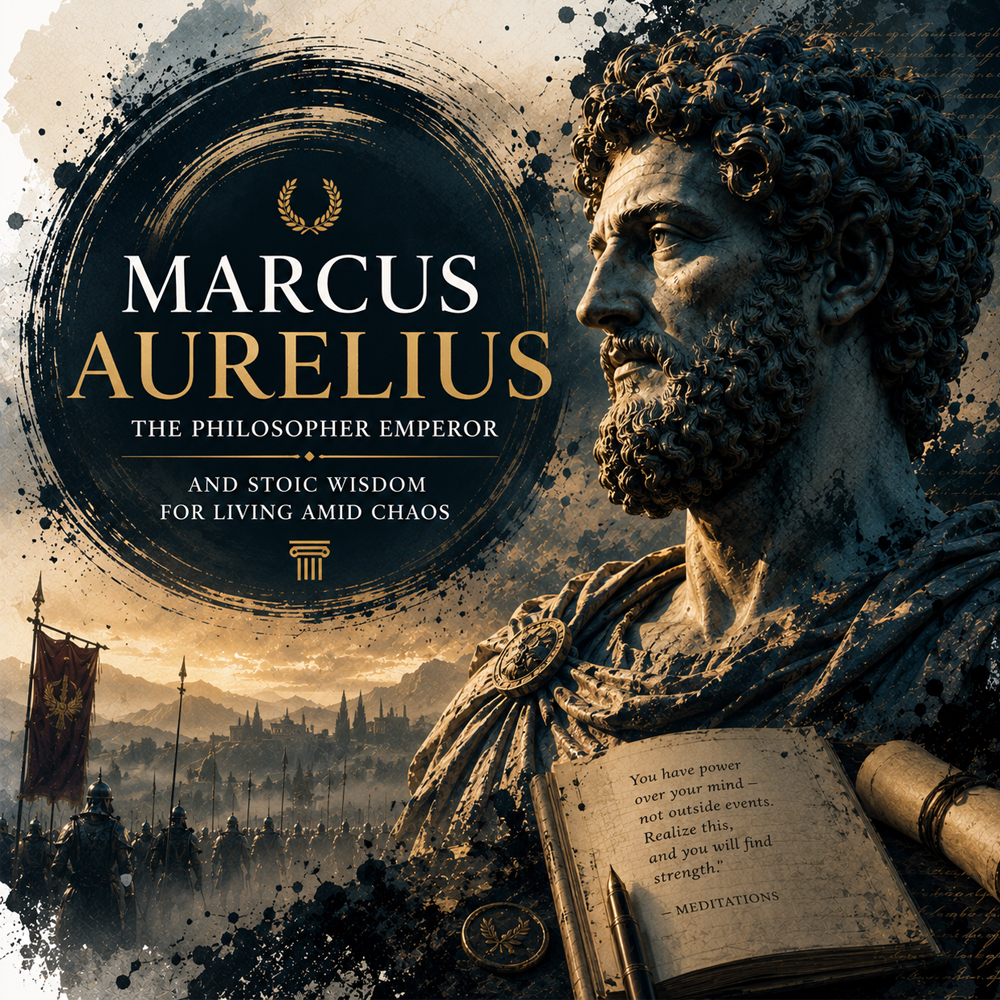
Introduction: The Ruler Who Sought Victory Over Himself
Marcus Aurelius is one of the most remarkable figures in history because he embodies two roles that rarely seem compatible: the power of a Roman emperor and the inner humilty of a philosopher. He ruled one of the most powerful empires in the world, yet his deepest thoughts were not directed toward glory, conquest, or personal exaltation. In his reflections, he constantly returns to the question of how a person can remain honest, rational, and inwardly free when the world around him is filled with wars, disease, intrigue, loss, and uncertainty.
Marcus Aurelius is important not only as a historical figure but also as a spiritual example. He is not a philosopher who writes from the calm of an isolated school, far removed from the responsibilities of life. On the contrary, his philosophy is born at the very center of tension-amid political pressure, military campaigns, personal tragedies, and constant encounters with human unpredictability.
This is what makes his wisdom so powerful even today. He does not speak as someone who has never been tested, but as someone who has been placed under immense weight and yet sought a way not to lose himself. That is why Marcus Aurelius remains one of the clearest voices of Stoicism and one of the deepest witnesses to the human struggle for inner order.
The Historical World of Marcus Aurelius
Marcus Aurelius lived in the 2nd century, at a time when the Roman Empire was vast, wealthy, and powerful, yet also beginning to feel internal and external tensions. At first glance, Rome appeared invincible, but beneath its grandeur, problems were already accumulating-problems that would unfold even more strongly in the centuries to come. The empire had to defend long borders, govern diverse peoples, cope with economic challenges, and maintain order in a constantly changing world.
Marcus Aurelius did not inherit an easy era. His reign was marked by wars along the northern frontiers, tensions with the Parthians in the east, internal political difficulties, and a severe epidemic known as the Antonine Plague. This meant that much of his life as emperor was spent not in palaces and celebrations, but in military camps, amid uncertainty and constant responsibility.
This historical context is extremely important because it shows that his Stoicism was not an abstract theory. When Marcus Aurelius writes about patience, death, duty, self-control, and acceptance of fate, he does not write as someone observing life from the sidelines. He writes as someone who must make decisions every day that affect the fate of thousands of people.
The Childhood and Education of the Future Emperor
Marcus Aurelius was born into an aristocratic Roman environment and from an early age received an education suitable for someone destined for high public life. Yet something different from ordinary ambition for power appeared in him early on. He was drawn to philosophy, discipline, simplicity, and inner order, which set him apart from many around him.
Roman aristocracy was often associated with prestige, influence, and the pursuit of public recognition. Marcus Aurelius, however, showed from a young age a tendency toward restraint and moral seriousness. He did not view education merely as a means for a career, but as a form of inner development.
His teachers had a particularly strong influence on him, introducing him to philosophy and especially to Stoicism. For Marcus Aurelius, philosophy was not just an intellectual pursuit, but a way to shape character. He understood that true education is not only about knowing more, but about becoming a better, more conscious, and more resilient person.
Stoicism as the Foundation of His Life
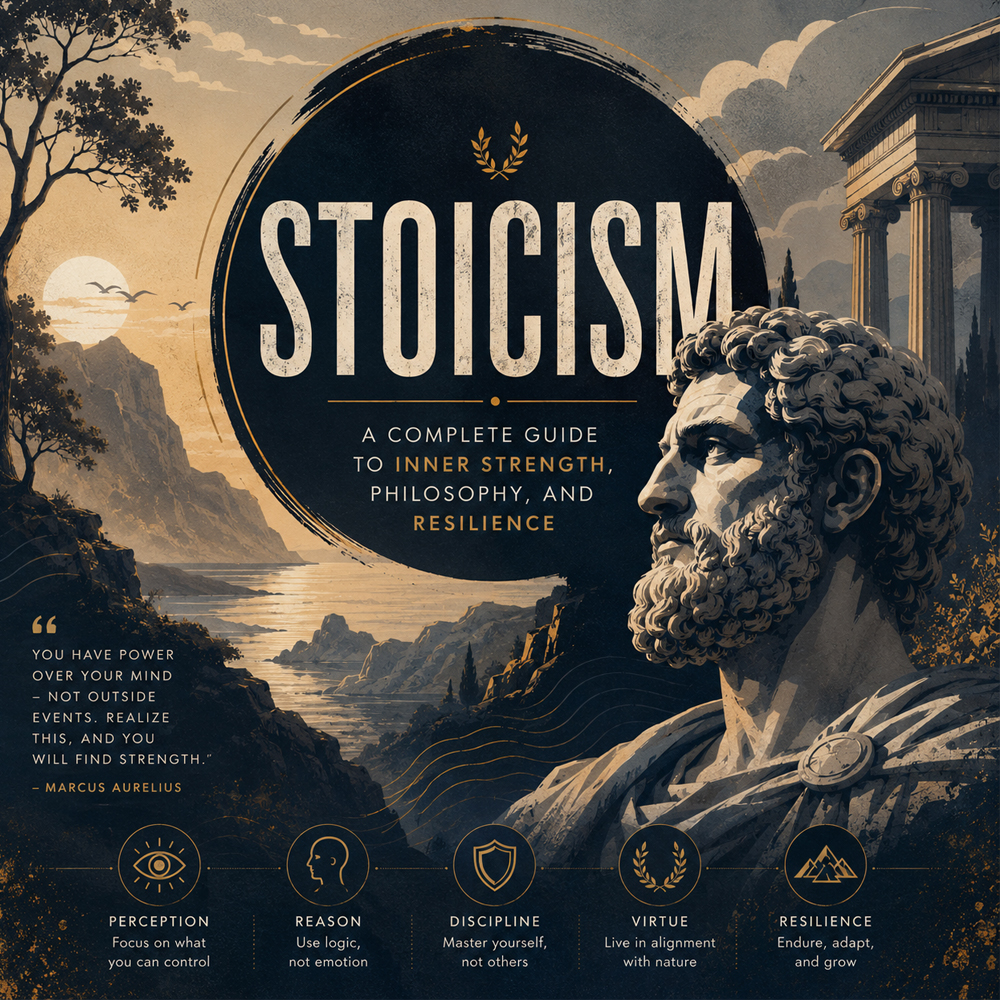
Stoicism is a philosophy that teaches that a person cannot control everything that happens around them, but can control how they respond to what happens. This is a simple principle, but its application requires deep inner work. For the Stoics, true freedom does not depend on external circumstances, but on the state of the mind and character.
Marcus Aurelius embraced this philosophy not as an intellectual ornament, but as a daily practice. He constantly reminded himself that fame is fleeting, the body is fragile, life is short, and the opinions of others should not govern the soul. These are themes that recur again and again in his personal writings.
For him, Stoicism was a way to remain human under the weight of power. The imperial position can easily corrupt character, as it grants access to authority, pleasures, flattery, and reverence. Yet Marcus Aurelius seems to constantly resist this temptation, reminding himself that he is simply a human being-part of nature, mortal, and accountable to reason.
“To Himself” as a Book Not Written for the World
The most famous work of Marcus Aurelius is known today as Meditations or To Himself. It is one of the most extraordinary books in the history of philosophy because it was likely not written for publication. It consists of personal notes, spiritual exercises, and inner reminders that the emperor addressed to himself.
This is precisely what makes the book so powerful. It does not sound like a speech intended to impress an audience, but like a conversation between a person and his own conscience. There is no pose of a great thinker seeking admiration, but a constant effort to return to the right attitude toward life.
Marcus Aurelius often writes briefly, strictly, and directly. He reminds himself not to be angry, not to complain, not to fear death, not to give in to vanity, and not to forget his duty. These notes feel relevant because the human weaknesses he struggles against are the same ones we face today.
Power as a Test of Character
For many people, power is a dream, but for Marcus Aurelius it is above all a test. To be emperor does not only mean to possess strength, but to bear immense responsibility. Every whim, every weakness, and every mistake of the ruler can affect the lives of countless people.
Stoic wisdom helped him view power not as personal possession, but as service. He could not escape his role, so he had to fulfill it with dignity. This is a crucial Stoic principle: a person does not always choose their circumstances, but chooses whether to act within them with honesty and reason.
Marcus Aurelius understood that the greatest danger for a ruler does not come only from enemies, but from himself. Pride, anger, suspicion, the thirst for glory, and contempt for others can destroy the soul more quietly than any external threat. Thus, his true struggle was not only against barbarian tribes or political problems, but against his own ego.
Death as a Constant Teacher
One of the strongest themes in Marcus Aurelius’ thought is death. He constantly reminds himself that life is short and that everything that seems so important today will soon disappear. This is not dark pessimism, but spiritual clarity.
For the Stoics, reflecting on death is not meant to depress us, but to awaken us. When a person realizes that their time is limited, they begin to distinguish the essential from the trivial. Many worries, insults, and ambitions lose their power when seen against the backdrop of transience.
Marcus Aurelius does not use death as a cause for despair. He sees it as a natural part of the order of nature. A person comes, lives, fulfills their role, and departs-just as a leaf appears in spring and falls in autumn.
Nature and the Order of the Universe
Marcus Aurelius sees the human being as part of a larger cosmic order. He does not think of life as a random sequence of personal desires and troubles, but as participation in a greater whole. This is a typical Stoic understanding, according to which the universe is permeated by rational order, and the human being must live in harmony with it.
To live according to nature does not mean to follow every impulse. For the Stoics, human nature is rational and social, so living according to nature means living according to reason, justice, and inner balance. Marcus Aurelius constantly reminds himself that he is not an isolated individual, but part of the human community and the order of the world.
This understanding helps him accept difficulties with greater dignity. If everything is part of a larger order, then one should not treat every obstacle as a personal offense from fate. Instead of asking why this is happening to him, he asks how he can respond to it in the best possible way.
Control Over the Mind
Perhaps the most practical lesson from Marcus Aurelius is that a person must guard their mind. The external world constantly offers reasons for anger, fear, envy, self-pity, and confusion. But between the event and our reaction lies a space where human freedom resides.
Marcus Aurelius knows that he cannot control the actions of others, political crises, diseases, wars, or inevitable aging. But he can observe his own judgment about these things. Stoicism teaches that it is not events themselves that destroy us, but the opinions we form about them.
This does not mean becoming insensitive. It means not allowing the first emotional reaction to become our master. A person can feel pain and yet not become a slave to it.
Anger as Weakness, Not Strength
Marcus Aurelius often returns to the theme of anger. As a ruler, he had countless reasons to become angry: betrayals, incompetence, enemies, political intrigues, and human foolishness. Yet his philosophy teaches him that anger is rarely a sign of strength.
Anger often appears powerful because it is loud and aggressive. But inwardly, it shows that a person has been overtaken by something outside themselves. True strength is to see injustice clearly, to act decisively, but without losing control over oneself.
Marcus Aurelius does not say that evil should go unanswered. He says that the response must come from reason, not rage. This is an extremely difficult distinction, but it is precisely what separates wisdom from impulsiveness.
Attitude Toward People
In Meditations, Marcus Aurelius often reminds himself that he will encounter ungrateful, arrogant, deceitful, envious, and rude people. This sounds very modern, as everyone faces difficult personalities in daily life. Yet his advice is not to hate these people, but to understand that they act out of ignorance and confusion.
The Stoic position is not naive. It does not claim that all people are pleasant or that we should allow others to harm us. It says that hatred does not correct the person who errs, but only corrupts the soul of the one who hates.
For Marcus Aurelius, people are meant to live in community. Even when others are difficult, they remain part of the same human family. Therefore, the task is to act justly, without poisoning oneself with contempt.
Duty as a Form of Freedom
For the modern person, the word “duty” often sounds heavy, as if it implies restriction. For Marcus Aurelius, however, duty is a path to inner freedom. When a person knows what must be done and does it without complaint, they free themselves from the chaos of hesitation.
Duty does not mean blind obedience. In the Stoic sense, it means action that aligns with reason, justice, and the role life has given us. Marcus Aurelius did not always desire the burden of rule, but he carried it because it was his place in the order of things.
This idea can be very useful today. We often suffer not only from difficult tasks, but from our inner resistance to them. When we stop constantly fighting what is necessary, we discover that even heavy things can be done with greater calm.
The Humility of a Man at the Top
One of the most impressive aspects of Marcus Aurelius is his humility. He was one of the most powerful people of his time, yet in his personal notes he constantly reminds himself that he is mortal, limited, and part of nature. This is a rare form of inner clarity.
Power often leads people to identify with their role. They begin to believe that their title is their essence. Marcus Aurelius seems to constantly guard against this illusion.
He knows that fame is short-lived and that even the greatest names gradually fade. This does not lead him to reject life, but to place it in proper perspective. To be great in the eyes of the world is nothing if one has lost integrity before oneself.
The Loneliness of the Ruler
To be emperor means to be surrounded by people, yet often inwardly alone. Marcus Aurelius had to judge which advisors were sincere, which sought advantage, and which might prove dangerous. Power creates distance, because people rarely speak completely freely before someone who can change their fate.
This loneliness is likely one of the reasons why Meditations feels so intimate. In these notes, Marcus Aurelius could be honest in a way he perhaps could not be at court. There, he does not play the role of emperor, but speaks with his own soul.
This reminds us that every person, regardless of their position, needs an inner space of honesty. Without a place where we can see ourselves without a mask, we easily begin to believe the image we present to the world. Marcus Aurelius seeks precisely this space through philosophy.
War and Inner Peace
Much of Marcus Aurelius’ reign was spent in military campaigns. This creates a strong contrast between the external reality of war and the inner striving for peace. He did not live in ideal conditions for contemplation, yet this is precisely what makes his example so powerful.
To be a Stoic in times of peace is one thing; to be a Stoic in times of war is quite another. Marcus Aurelius had to apply his philosophy not in theory, but in mud, cold, fear, and uncertainty. His wisdom was tested not in comfort, but in hardship.
This shows that inner peace does not depend entirely on external comfort. It does not mean the absence of problems, but the ability not to be completely destroyed by them. This is what makes Stoicism so practical.
Family, Loss, and Human Fragility
Marcus Aurelius experienced many personal losses, including the deaths of children and loved ones. This is an important part of his human image, because behind the figure of the emperor stands a man who knew pain. His reflections on death and transience are not cold theory, but a reflection of real suffering.
Stoicism is often misunderstood as a philosophy of emotional numbness. But in Marcus Aurelius we see not a denial of pain, but an attempt to place it within a larger order. He does not say that one should not feel, but that one should not be completely consumed by feelings.
This is a crucial distinction. To accept loss does not mean not to love. It means to understand that loving a mortal being always involves the risk of pain, but that this pain does not invalidate love.
Commodus and the Tragedy of Inheritance
One of the most discussed questions about Marcus Aurelius is his decision to leave power to his son Commodus. History often views this as a tragic mistake, because Commodus turned out to be a ruler very different from his father. This raises a painful question about the limits of wisdom and human control.
Marcus Aurelius may be an example of personal virtue, but even he could not guarantee what another person would become. This is an important lesson from a Stoic perspective. We can work on ourselves, educate, advise, and hope, but we cannot fully control another person’s soul.
The tragedy of Commodus shows that even the wisest individuals can be limited by circumstances, family attachments, and historical conditions. This does not diminish the greatness of Marcus Aurelius, but makes him more human. He is not a flawless icon, but a person striving for wisdom in a world where complete control is impossible.
Why Marcus Aurelius Is Relevant Today
Marcus Aurelius remains relevant today because modern people also live amid uncertainty, anxiety, conflict, and constant informational noise. Although we are not Roman emperors, we all carry some form of responsibility, fear, loss, and inner struggle. His thoughts help us distinguish what depends on us and what does not.
Today, many people suffer from the desire to control everything. They want to control the future, the opinions of others, the results of their efforts, and even the emotions of those around them. Marcus Aurelius reminds us that this struggle is endless and exhausting.
His philosophy does not make us passive, but more focused. It teaches us to invest our energy where we have real power: in our character, actions, judgments, and attitudes. This is wisdom that remains practical in every era.
Practical Lessons from Marcus Aurelius
The first major lesson from Marcus Aurelius is that a person must begin with themselves. It is much easier to criticize the world, people, and circumstances than to examine our own reactions. Yet according to Stoic wisdom, the real work begins precisely there.
The second lesson is that life is short and should not be wasted on petty insults, empty vanity, and endless postponement. Marcus Aurelius constantly reminds himself that death is not a distant abstraction, but a natural boundary of every day. This awareness can make a person more serious, but also more free.
The third lesson is that virtue is more important than success. Success depends on many external factors, but character is built through the choices we make. To act justly, rationally, and with dignity is more important than whether the world immediately rewards us.
Conclusion: Marcus Aurelius and the Quiet Greatness of Inner Victory
Marcus Aurelius remains in history not only because he was a Roman emperor, but because he showed that even at the height of power, a person can seek humility, reason, and inner purity. His life is proof that philosophy is not an escape from reality, but a way to face it with greater dignity. He did not live in easy times, and that is precisely what makes his example so powerful.
His greatest victory is not military, political, or historical. His greatest victory is the effort not to be defeated from within by anger, fear, pride, and despair. This is a victory that is not seen on triumphal arches, but is far deeper.
Marcus Aurelius reminds us that a person does not always choose the time in which they live, the people they meet, the pains they will endure, or the difficulties that will test them. But they always have the opportunity to choose whether to respond with chaos or with reason, with bitterness or with justice, with weakness or with inner discipline. It is in this choice that true freedom lies.
That is why Marcus Aurelius does not belong only to ancient Rome. He belongs to every person who strives to remain whole in a difficult world. His voice continues to resonate through the centuries because it speaks not to empires, but to the human soul.
Read more:
- Stoicism: A Complete Guide to Inner Strength, Philosophy, and Resilience
- Seneca: Life, Philosophy, and the Tragedy of Nero | The History of Stoicism
- Buddhism and Stoicism: “A Complete Philosophical Comparison and Practical Application”
- Stoicism: 50 Timeless Quotes from the Greatest Stoic Philosophers
- Marcus Aurelius: 30 Profound Quotes on Stoicism, Inner Peace, and Resilient Living
Author: Vasil Stoyanov