
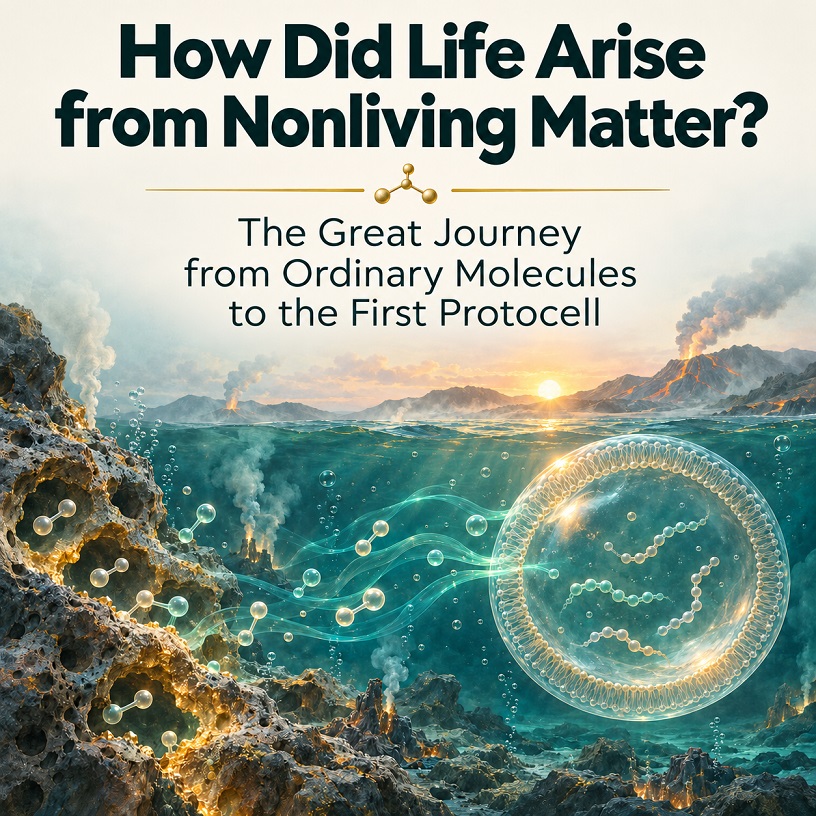
Imagine standing on the shore of Earth almost four billion years ago. No birds sing. There are no trees, grasses, or insects. Not even the smallest animal leaves tracks in the wet sand. There is only water, rock, volcanoes, clouds, sunlight, and countless substances meeting, separating, and combining again. At first glance, this is a world without life. Yet this is precisely the kind of world in which we must search for the beginning of everything living.
What is most astonishing is that a living body is not made from some special kind of matter absent from rocks and oceans. Carbon, oxygen, hydrogen, nitrogen, and other chemical elements exist throughout nonliving nature. The difference lies in how they are arranged and how they work together. Think of a pile of bricks and a house. The bricks may be identical, but the house has walls, doors, rooms, and a roof performing different functions. With life, the difference goes deeper still: its parts do not merely remain arranged; they continuously interact, exchange substances, and maintain the entire system.
This article tells the story of how scientists investigate the transition from ordinary chemistry to the earliest systems possessing the fundamental properties of living things. The scientific name for this subject is abiogenesis. It should not be confused with the evolution of organisms that already exist. We will not trace how different forms of life, plants, animals, and humans emerged from early cells. That is another story. Ours begins earlier, when cells do not yet exist but the conditions from which they can emerge are already present.
To make this journey understandable, we will use examples from cooking, construction, familiar objects, and everyday work. We will compare molecules to building materials, cellular membranes to bags, chemical reactions to recipes, and hereditary information to instructions. Analogies will not replace science; they will help us understand unfamiliar concepts. Where a comparison has limits, we will explain them so that a useful image does not become a misleading explanation.
No single experiment has recreated the entire origin of life. But many experiments show how individual parts of the process can occur without living cells. Scientists have produced important organic substances from simple ingredients, formed bubbles resembling primitive cell membranes, and studied molecules that both store information and participate in chemical reactions. The great challenge is understanding how these possibilities came together in one functioning system.
Earth Before Life: An Enormous Natural Laboratory
If you want to bake bread, you first need flour, water, a suitable temperature, and time. You cannot understand how bread is made without knowing what was available in the kitchen. The same applies to life’s origin. Before searching for the first cell, we need to understand which substances, temperatures, and energy sources existed on young Earth. Our planet formed about 4.54 billion years ago and underwent enormous changes during its early history.
There were volcanoes, hot rocks, water, gases, and countless places where different substances mixed. Ancient minerals indicate that water was present on Earth remarkably early. This matters because water allows molecules to move and encounter one another. Imagine sugar left as a dry heap on a table, and the same sugar dissolved in a glass of water. In water, the particles spread throughout the liquid. Similarly, dissolved substances can reach one another and participate in chemical reactions.
But water also creates difficulties. Large quantities dilute substances. If you pour a teaspoon of syrup into a huge swimming pool, its flavor almost disappears. In the same way, molecules that need to meet and connect can end up too far apart in an ocean. Water can also participate in reactions that break certain chemical bonds. This is why scientists do not simply search for life’s beginning ‘in water.’ They investigate particular places where water, minerals, and other conditions create suitable chemical environments.
Early Earth was not the same everywhere. Imagine a large city with bakeries, workshops, kitchens, and factories. Different work takes place in each location because the tools and materials differ. On the young planet, shallow pools, volcanic regions, the seafloor, and mineral fractures were like different workshops. Some conditions helped particular substances form, others helped them accumulate, and still others helped join them into larger molecules.
Energy also played an important role. Sunlight reached the surface, electrical discharges changed the composition of gases, and hot rocks sustained reactions underwater. Energy is necessary, but it does not create life by itself. If you switch on an oven without putting dough inside, you will not get bread. If you use unsuitable ingredients, you will not get the desired result either. Chemical reactions likewise require suitable substances, conditions, and pathways by which they can be transformed.
And one more thing: this natural laboratory operated for an immense length of time. Pools filled and dried, rocks fractured, volcanoes released fresh material, and water carried substances from one place to another. This does not mean time alone explains life’s origin. If you leave a dismantled watch in a box for a million years, it does not follow that it will necessarily assemble itself. Science must show which specific processes organize the parts and how the result is preserved.
The Lightning Experiment: How Simple Substances Produce Building Blocks
In 1953, a young scientist named Stanley Miller performed an experiment that became one of the most famous stories in research on life’s origin. Under Harold Urey’s guidance, he built a system of glass vessels and tubes. In one vessel, he heated water until it evaporated. The vapor passed through a mixture of gases where electrical sparks played the role of lightning. The substances then cooled, and the liquid returned to the system. The process continued for days.
Imagine a closed kitchen apparatus in which water boils, vapor passes through another chamber, cools, and returns. The difference is that instead of preparing food, Miller was testing whether electrical energy could transform simple chemicals into more complex ones. When he analyzed the liquid, he discovered organic compounds, including amino acids. These are substances from which living organisms build proteins.
What are amino acids? Imagine a collection of differently shaped beads. Connect them in a particular order and you obtain a necklace. Proteins are far more complex than necklaces, but the comparison helps: they consist of amino acids arranged in sequences. Different sequences produce different properties. In the body, proteins help build structures and accelerate chemical reactions. Miller did not create proteins or life; he demonstrated that some of their building blocks can arise without a living organism.
Why was this result so important? Imagine someone claiming that bricks for a house can be manufactured only inside an already completed house. Then you demonstrate a factory that produces bricks without a house. This does not yet explain construction, but it removes a major obstacle. Miller’s experiment showed that at least some substances used by living systems do not require preexisting life in order to form.
It is also important to understand the experiment’s limits. Miller’s gas mixture is not a definitive model of the entire early atmosphere. Later research revealed a more complicated atmospheric history. Scientists therefore test similar reactions with different mixtures, temperatures, and energy sources. This is how science normally advances: a successful experiment does not end the questions; it makes them more precise.
Years later, other researchers examined preserved samples from historical experiments using much more sensitive instruments. They discovered additional organic products that the original methods could not distinguish. Imagine examining an old photograph with better technology and noticing details invisible to its first viewer. In this way, a laboratory investigation can continue revealing information decades after it was conducted.
Ingredients from Space: How Meteorites Expand the Story
When we think about life’s origin, we usually look toward oceans and volcanoes. But some of the organic substances on young Earth could also have arrived from space. In 1969, a meteorite fell near the Australian town of Murchison. Studies of its material revealed diverse organic compounds, including amino acids. This is remarkable because it shows that chemistry producing such substances is not limited to conditions on Earth.
Imagine preparing a complicated soup. Some ingredients come from your garden, others from a market, and still others from far away. The ingredients have different origins but take part in the same preparation. Similarly, early Earth possessed its own chemical sources, while extraterrestrial bodies supplied additional substances. This does not mean life arrived fully formed inside meteorites. We are discussing organic ingredients that can arise without biology.
Space contains icy particles, dust, asteroids, and comets where chemical processes take place. Radiation and interactions among molecules can produce more complex compounds. When extraterrestrial material reaches a planet, some of it enters the planet’s chemical environment. Scientists investigate which substances survive heating during atmospheric entry and the impact of landing.
Why distinguish an organic molecule from a living organism? Because ‘organic’ often sounds synonymous with ‘living.’ In chemistry, it refers to a broad family of carbon compounds, many of which can form through nonliving processes. Sugar in fruit is organic, but finding organic compounds in a meteorite does not mean cells once lived inside it. This distinction makes the discovery scientifically valuable: it expands the known ways that chemical building blocks can be produced.
Meteorites also raise practical questions. If a small quantity of organic material enters an ocean, it becomes diluted. If it falls into a small pool, some substances can accumulate locally. Exposure to strong heat or particular minerals can change them. Knowing that a molecule arrived is therefore not enough. We must understand what happened to it afterward.
Space chemistry gives us a broader picture. Earth was not a sealed laboratory. It received material from outside, while its oceans, rocks, and atmosphere processed that material. The original ingredients of life did not all need to be produced by one method. Different chemical pathways can contribute to the larger story, provided their products reach environments suitable for further reactions.
Underwater Springs: Natural Batteries on the Ocean Floor
Deep beneath the ocean surface, water enters fractures between rocks. There it heats up and reacts with minerals. When it returns to the sea, its chemical composition is often different. Where these two kinds of water meet, chemical differences arise. Scientists call them gradients. The term sounds complicated, but everyday life provides an example: a battery works because differences in electrical potential between its parts can be used to perform work.
Underwater springs are not ready-made electrical batteries like the ones in a remote control. The comparison illustrates the principle: when two regions have different chemical compositions, that difference can represent an opportunity to perform chemical work. Modern cells use comparable differences between their internal and external environments. Researchers therefore investigate whether natural gradients on the seafloor helped sustain the earliest organized reactions.
Alkaline hydrothermal systems are especially interesting. Water interacts with rocks, and porous mineral structures can form. Imagine a sponge full of tiny tunnels. Substances can remain inside these passages instead of being immediately carried away by the vast ocean. Mineral walls can participate in reactions, while different fluids on opposite sides of barriers maintain chemical differences.
One important process is called serpentinization. Water reacts with certain rocks and can release hydrogen. Hydrogen participates in reactions that transform other substances. To understand its role, think of fuel: fuel is not the machine itself, but it can provide what the machine needs to operate. Similarly, hydrogen can be part of a chemical energy source without every such reaction necessarily leading to life.
Underwater springs also have disadvantages. In some, temperatures are too high for unstable organic molecules. Seawater can dilute products, and conditions suitable for one reaction may be unsuitable for another. Scientists must test not only whether energy is present but whether the substances needed for more complex systems can form, survive, and combine there.
This scenario teaches us that life’s beginning need not be sought only on a sunny shore. In the ocean depths, Earth has its own chemical energy sources. Water, rocks, and mineral pores create an environment where reactions are continually sustained. The central question remains how such reactions can lead to a system capable of preserving and passing on its organization.
The Drying Puddle: Why Alternating Wet and Dry Conditions Matters
Think about what happens when you leave saltwater in a shallow dish under the sun. The water gradually evaporates, while the salt remains. If other substances are dissolved in the liquid, they also become concentrated. On early Earth, shallow pools could repeatedly fill with rain, warm up, and dry out. These changes are especially interesting for life’s chemistry because the chance of molecules meeting depends on their concentration.
Imagine two people who need to hand an object to each other in a huge empty stadium. If they stand on opposite sides, meeting is difficult. If they are in a small room, interaction becomes easier. Molecules do not behave like people, but the comparison shows why dilution is a problem. As water evaporates, some substances come closer together, making certain bond-forming reactions more accessible.
The alternation between wet and dry matters for another reason. One reaction may work better in concentrated conditions, while the next needs water to dissolve or transport its products. Imagine cooking a meal in which you first roast ingredients, then add water, and finally let the sauce thicken. Different stages require different conditions. Natural cycles can create a similar sequence without anyone directing the process.
Laboratory experiments show that certain wetting-and-drying cycles can help produce longer molecular chains. Results depend on the specific substances, temperature, salts, and other details. Not every puddle is a suitable chemical laboratory. Under some conditions molecules degrade; under others unwanted products accumulate. Researchers therefore look for the precise combinations that make these cycles productive.
Strong sunlight also has two sides. It can initiate useful reactions but damage molecules already formed. High temperature accelerates chemical processes but often accelerates decomposition as well. Think of baking: appropriate heat turns dough into bread, while excessive heat burns it. Origin-of-life research must identify conditions in which the environment’s constructive effects outweigh its destructive ones.
Shallow pools show why a chemical system need not perform every task simultaneously. At one moment it can concentrate substances, at another join them, and after rain transport them. This rhythm turns a changing environment into an active participant in chemical history. Nature was not merely a storehouse of ingredients; it also supplied changing conditions for processing them in sequence.
Rocks as Helpers: How Minerals Accelerate Reactions
A stone looks motionless and unrelated to life. Yet its chemical surface can be highly active. Imagine a kitchen cutting board on which you arrange ingredients before preparing them. The board does not cook by itself, but it gathers the ingredients in one place and makes work easier. Mineral surfaces can play a comparable role for certain molecules: retaining them, arranging them, and placing them in conditions that assist reactions.
Some clay minerals have layered structures. Imagine a stack of thin sheets between which small particles can become trapped. Such surfaces can interact with organic substances. Laboratory work has shown that certain activated RNA building blocks can join into longer chains in the presence of the mineral montmorillonite. This is not a living system, but it demonstrates how nonliving material can assist the formation of more complex molecules.
Other minerals containing iron and sulfur can participate in reactions involving electron transfer. To understand the significance, imagine a workshop. Materials alone are not enough; tools are needed to make their transformation practical. In chemistry, catalysts serve a similar purpose: they accelerate certain reactions without being consumed in the same way as ordinary reactants.
Minerals can also distinguish substances according to their chemical properties. Some molecules bind more strongly, others less strongly. Imagine a magnet attracting iron objects but not wooden ones. A mineral surface does not work exactly like a magnet, but the analogy shows how certain interactions can concentrate some substances more than others. In a complicated mixture, such separation can make particular reactions more accessible.
There is also a downside. If a molecule sticks too strongly to a mineral, it may not be able to take part in the next reaction. Some minerals encourage decomposition rather than the formation of desired products. This is like a tool that helps one task but damages another. Researchers therefore measure not only whether a substance forms but whether it can be released, preserved, and used in subsequent chemistry.
Rocks are therefore more than scenery in this ancient story. They provide surfaces, small spaces, and chemically active sites. In a world without cells or enzymes, these properties can perform some of the work later organized by living systems themselves. The journey from nonliving to living matter did not begin in empty space, but on a planet whose minerals continually interacted with water and dissolved substances.
From Separate Pieces to Long Chains: The Difficulty of Creating an Information Molecule
Having a pile of letters does not mean you have a book. The letters must be arranged in a particular order to carry information. A similar problem arises with molecules that store hereditary instructions. In modern cells, DNA performs much of this task, while RNA carries out numerous related functions. Origin-of-life researchers are especially interested in RNA because it can combine information storage with certain chemical activities.
RNA is a chain of building blocks called nucleotides. You can imagine them as beads with different markings threaded onto a string. In reality, each unit has a complicated chemical structure involving a sugar, a nitrogenous base, and a phosphate group. The difficulty is that early Earth had no ready-made factory to produce and assemble these parts. Scientists must explain how they could arise through nonliving chemical reactions.
Imagine wanting to build a bicycle without ready-made wheels, a frame, or a chain. First you must manufacture the parts, then bring them together, and finally connect them so that they function. The RNA problem is similar, but chemically much more complicated. Even when individual ingredients exist, they do not always connect easily in the correct way. Some reactions produce unwanted substances; others require very specific conditions.
Research by John Sutherland and colleagues is important because it demonstrates pathways through which certain precursors of biological molecules can arise from interconnected chemical reactions. Instead of assuming that every part already exists, researchers investigate how intermediate compounds form and transform step by step. This resembles a workshop producing several related components from common raw materials.
Phosphorus is particularly important because it participates in building nucleic acids and in other key processes of modern cells. But phosphorus being present in rocks does not automatically make it available for every reaction. Imagine iron locked in a safe: the material exists, but you cannot use it until you can access it. Similarly, scientists investigate the conditions under which phosphorus compounds become chemically available.
There is another problem: the purity of the mixture. In laboratories we often work with carefully selected substances. Nature did not have jars labeled with the names of pure chemicals. Water contained many compounds that could help or hinder one another. The most persuasive scenarios must therefore demonstrate not just one successful reaction but how it works amid realistic impurities and how its products reach the next stage.
The RNA World: When Instructions Can Also Do the Work
In everyday life, we usually separate instructions from tools. A recipe tells you how to make bread, but it does not knead the dough. A screwdriver turns a screw, but it does not contain the entire manual for assembling furniture. Modern cells also divide tasks: DNA preserves much hereditary information, while protein enzymes accelerate countless reactions. This creates a question about the beginning: how did a system arise in which instructions and tools depend on one another?
RNA offers an unusual answer. It can carry information through the order of its building blocks, but certain RNA molecules can also accelerate chemical reactions. Such molecules are called ribozymes. Discoveries associated with Thomas Cech and Sidney Altman demonstrated that catalytic activity is not limited to proteins. This is one reason scientists investigate the hypothesis of an early ‘RNA world.’
Imagine an extraordinary assembly manual that, besides containing instructions, can perform part of the work itself. The comparison is not literal, but it shows why RNA is so interesting. The same molecule can possess a sequence preserved through copying and a shape that allows it to interact with other substances. Information and chemical function can therefore be connected in one system.
Why does shape matter? Imagine a key and a lock. It is not enough for the key to be made of metal; its shape matters. Molecules also interact according to their three-dimensional structures. RNA chains can fold into shapes that allow them to bind certain substances or accelerate reactions. Different sequences influence folding and therefore function.
This does not solve every difficulty. RNA must first form, then be copied, and survive long enough. It can degrade under certain conditions, while copying it without complex enzymes is challenging. Scientists therefore study both early RNA-based systems and simpler molecular predecessors. What matters is identifying a chemical pathway, not merely naming a proposed stage.
In laboratories, researchers create many different RNA sequences and test which perform particular tasks. This resembles testing thousands of keys to find those that fit a particular lock. Such experiments reveal the remarkable diversity of functions RNA can perform. But laboratory selection involves human intervention; for early Earth, researchers must identify natural processes that could have preserved useful properties in a similar way.
Copying a Molecule Without a Machine: The Beginning of Heredity
Imagine having a page of instructions you want to pass to the next generation. If the page disappears, the information is lost. If you copy it, the information can continue. Living cells possess sophisticated molecular machinery for copying hereditary information. At the beginning, however, such machinery did not exist. Scientists therefore investigate whether simpler chemical processes can copy molecular sequences.
One such process uses an existing chain as a template. Imagine a row of colored tiles onto which you place other tiles according to a rule: blue opposite red, yellow opposite green. In RNA, certain chemical bases preferentially pair with one another. These interactions allow an existing chain to guide the arrangement of building blocks for a new complementary chain.
Arranging the parts, however, is not the same as joining them permanently. If you line up beads on a table, they are not yet a necklace. They must be connected. In nonenzymatic copying, scientists investigate how appropriately arranged building blocks can form chemical bonds without modern cellular enzymes. This is difficult because the reactions must proceed quickly enough and accurately enough.
Then another problem arises: the two chains must separate. Imagine a zipper whose two sides have been joined. To use each side as a template for another copy, you must pull them apart. Complementary RNA chains can hold tightly together. Researchers investigate temperature changes and chemical conditions that help separate them without completely destroying the molecules.
Copying errors also matter. If you copy a recipe and change almost every word, the next person will not be able to prepare the same dish. But if the copy is sufficiently accurate, the essential information survives. Chemical heredity likewise requires enough accuracy to preserve working properties. At the same time, differences among copies allow variants with different behavior to exist.
Most importantly, producing a single copy is not enough. A repeated process is needed in which the newly formed molecules participate in further cycles. Imagine a printing press that prints one book and then destroys the machine and all its supplies. That is not sustainable production. Early heredity requires a system in which information continues to be passed on while necessary substances are supplied by the environment.
The First Envelope: How Ordinary Fatty Molecules Form Bubbles
If you drop oil into water, you notice that the two liquids do not mix freely. This reflects the way their molecules interact. Some substances have one region that interacts favorably with water and another that avoids it. These molecules are called amphiphilic. Under suitable conditions, they can arrange themselves into layers and form enclosed bubbles, or vesicles.
Imagine many matchsticks, each with one end that prefers water and another that avoids it. In water, such molecules can arrange themselves so that the water-avoiding regions are hidden. Under certain conditions, an envelope forms around a small volume of water. Real molecules are not matchsticks and do not make decisions; their arrangement follows physical interactions. But the image helps explain why a membrane can appear without an already living cell.
Why is a bubble so important? Imagine trying to keep a handful of small objects together in a flowing river. If you release them, the water carries them away. Put them in a bag, and they stay together. A protocellular envelope can retain certain molecules within a small space. Its interior can then develop a different chemical composition from the water outside.
But the envelope must not be too tightly sealed. If you place a living plant in a completely sealed container without access to necessary resources, its conditions will eventually deteriorate. A protocellular system likewise needs substances from outside. Scientists therefore investigate membranes that retain certain larger molecules while allowing some smaller ones to pass through. It is a balance between protection and exchange.
Laboratory experiments show that vesicles made from certain fatty acids can grow when supplied with additional suitable molecules. Under physical forces or suitable conditions, they can also divide. Imagine a soap bubble stretching and splitting into two smaller bubbles. The analogy helps visualize the shape, although protocellular membranes have different chemistry and the task is much more complicated than simple division.
Growth and division are not sufficient for life. If an empty bubble divides into two, it has not transmitted hereditary information. This is why researchers such as Jack Szostak and colleagues investigate how membranes can be combined with molecular copying reactions. The great question is whether the envelope, internal chemistry, and hereditary information can operate together within the same system.
The Chemical Kitchen Before Genes: Can a Network of Reactions Maintain Itself?
Imagine a small bakery. One machine kneads dough, another shapes it, a third bakes it, and workers continually bring fresh supplies. If an important part stops, the entire operation suffers. Living cells also depend on many connected chemical reactions. Scientists call the collection of such processes metabolism. For life’s origin, the question is whether simpler reaction networks could have existed before sophisticated hereditary systems.
In a chemical network, the product of one reaction can participate in a second, while the product of the second assists a third. Some substances can accelerate the formation of others. Imagine a workshop where one tool helps make another, and the second helps repair the first. If the whole system receives enough material and energy, it can maintain a set of processes.
Such ideas are explored through models of autocatalytic networks. The word sounds difficult, but it means that particular reactions and their products help sustain one another. Every molecule need not manufacture itself. What matters is whether the network as a whole supports its own continuing chemical activity. This is more complicated than a single isolated reaction.
Even so, a reaction network does not automatically become alive. If it exists only while a specially prepared liquid flows through it, it may remain entirely dependent on external conditions. Substances can also degrade, disperse, or participate in competing reactions. To make a convincing case, researchers must measure whether the network really maintains its components and under what conditions.
Here two major ideas about life’s beginning meet. One emphasizes molecules that carry information. The other emphasizes reactions that supply materials and energy. Think again of the bakery: a recipe is useless without flour and an oven, but a working oven does not tell you what to prepare. An early living system needed to connect chemical work with the transmission of information.
Modern research therefore increasingly seeks the combined action of different functions. Information-bearing molecules must have access to building materials. Reactions must take place in an environment that retains useful products. And the resulting organization must survive the formation of descendant systems. At that point, the chemical kitchen begins to resemble not a random mixture but an organized process with continuity.
Why Order Does Not Violate the Laws of Nature
When we see a complex cell, it is natural to ask how such an organized system could arise from nonliving substances. Sometimes people claim this contradicts physics because natural processes lead toward disorder. But an important clarification is needed. The second law of thermodynamics does not prohibit ordered structures from appearing locally. It describes constraints on entropy changes when exchanges with the surroundings are included.
Think of a refrigerator. It maintains a lower temperature inside than in the room, but it uses electricity and releases heat outside. Its local condition is maintained through exchange with the environment. Similarly, Earth is not a sealed box without energy. It receives sunlight, while internal processes maintain additional chemical differences. This permits certain forms of organization to arise and persist.
Nonliving nature contains many examples of ordered structures. Snowflakes have characteristic shapes. Crystals grow according to regular patterns. Under suitable conditions, heating a liquid creates organized flows. Neither a snowflake nor a crystal is alive. They simply show that order itself does not require life or violate physical laws.
Life, however, is more than a beautiful shape. A crystal can grow but does not possess all the functions of a cell. The earliest living systems needed chemical reactions that continued, a boundary creating an internal environment, and a means of transmitting information. Imagine the difference between a beautifully arranged kitchen and one where supplies continually arrive, food is prepared, and recipes are preserved for the next day.
The difference between having energy and using energy is also important. A hot stove does not produce a useful meal from an arbitrary mixture. Chemical reactions require particular substances and suitable pathways. Some proceed slowly even when energetically favorable. Catalysts can accelerate them. Research on life’s origin therefore investigates exactly how energy could support useful chemical transformations.
Physics does not provide a ready-made recipe for the first cell. It determines what is possible and which conditions must be satisfied. Chemistry shows which substances can form and how they react. Biology helps us understand the functions a hereditary system must possess. When these disciplines come together, life’s origin becomes a series of concrete research problems rather than a mystery of incompatible parts.
Left and Right in the Molecular World: A Small Difference with Great Importance
Look at your two hands. They resemble each other, but you cannot put a left-hand glove on your right hand in the same way. Some molecules also exist in two forms that mirror each other. This property is called chirality. Living organisms use particular building blocks predominantly in one of the two possible spatial orientations. This feature matters for how molecules connect and perform their functions.
Imagine two screws, one threaded in one direction and the other in the opposite direction. Both are made of metal and look similar, but they do not fit every nut in the same way. Molecular orientation likewise determines which interactions are possible. Knowing which atoms a molecule contains is therefore not enough; we must also know how they are arranged in space.
Many nonliving chemical reactions produce mixtures of both mirror-image forms. The question is how biological systems came to show a strong preference for particular orientations. Researchers investigate several mechanisms: interactions with minerals, crystallization, the effects of light, and reactions in which a small initial imbalance becomes amplified. Each mechanism must be tested for specific substances and conditions.
How can a small difference become large? Imagine two kinds of seeds planted in limited space. If one kind has a slight advantage under particular conditions, it can eventually occupy more of the area. This is only an analogy, not a description of the molecular mechanism. In chemistry, certain reaction systems can similarly amplify small differences between mirror-image forms. Scientists test whether such processes apply to substances relevant to early heredity.
Why does this matter for RNA and other chains? If building blocks have incompatible spatial orientations, certain structures may form poorly or become unstable. Imagine constructing something from parts designed to connect in opposite directions. Not every combination will work. Molecular compatibility is similarly important for forming organized, functional chains.
Studies of organic compounds in certain meteorites have also detected unequal proportions of mirror-image forms for some substances. This connects chirality with space chemistry. But explaining the orientation of molecules in early hereditary systems requires tracing a whole sequence of chemical steps. A seemingly minor geometric detail becomes part of the larger question of how substances began forming stable, functioning systems.
When a Bubble Becomes More Than a Bubble: The Birth of the Protocell
Imagine two small bags filled with different substances. Both can absorb more material from outside and grow. Inside the first, however, a molecule helps produce additional components for its envelope. The second lacks that molecule. If the first system grows more successfully and, when it divides, passes some useful contents to new bubbles, its internal chemistry begins influencing its continuation.
This is the heart of the concept of a protocell. The prefix ‘proto’ means early or original. A protocell is a model of a system that does not yet possess the complexity of a modern cell but combines some of its basic functions. Having an envelope is not enough. Having molecules inside is not enough. What matters is whether the parts work together so the entire system can maintain itself and produce descendant systems.
Think of a bicycle. A wheel can turn by itself. A chain can move. A pedal can be pressed. But the bicycle fulfills its purpose only when the parts are connected appropriately. A protocell likewise needs integrated functions. Its envelope retains substances, chemical reactions supply necessary products, and informational molecules can pass particular properties to descendants.
Division is especially difficult. If a bubble contains only a few copies of an important molecule, they may be distributed unevenly when it splits. One new bubble receives enough, while the other receives almost none. Imagine a small family business in which all the tools accidentally go to one heir. The other cannot continue the same work. In chemical systems, molecule numbers and their distribution can be decisive.
Another difficulty is supply. If a protocell receives no fresh substances, its internal reactions eventually stop. If its envelope breaks too easily, its contents disperse. If information is copied too inaccurately, useful properties disappear. The first functioning system therefore needed a balance among several tasks that can sometimes interfere with one another.
Researchers today attempt to combine these functions in laboratories. They create simple membrane vesicles, add informational molecules, and investigate chemical reactions inside them. The goal is not something that merely resembles a cell under a microscope. The goal is to understand how a chemical system can use resources, grow, divide, and transmit functional properties to subsequent generations.
What Does ‘Alive’ Mean? Why Growth and Movement Are Not Enough
If you ask a child how to recognize something alive, the answer might be, ‘It moves.’ But clouds move, rivers flow, and clocks have moving hands. None is alive. Another answer might be, ‘It grows.’ Yet crystals can grow too. Life therefore cannot be defined by a single easily observed property.
Living systems use substances and energy, maintain internal organization, and transmit hereditary information. In origin-of-life research, the combination of self-sustaining chemical activity and heritable differences is particularly important. This does not mean every individual cell must perform every possible biological function independently. It means we must understand how a system continues and how its properties are passed onward.
Imagine a flame. It consumes fuel and oxygen, releases heat, and can spread. This makes it an interesting example of a process sustained through exchange with its environment. But a flame does not possess organized molecular heredity like cells. It helps us understand why using energy alone is insufficient to define life.
Conversely, a molecule can carry information without being an entire living system. Imagine a book containing detailed instructions for constructing a machine. The book contains information but does not deliver materials, use energy, or automatically assemble new machines. Similarly, hereditary molecules must be part of a larger organization that allows them to be copied and influence the continuation of the system.
Scientists therefore do not necessarily seek a single instant when nonliving matter suddenly becomes a modern cell. They investigate successive transitions: formation of organic compounds, creation of longer chains, emergence of envelopes, development of reaction networks, and the beginning of hereditary copying. Whether a particular system deserves to be called alive depends on which functions it already possesses.
This distinction keeps our story focused. We are not studying how existing organisms changed over the following billions of years. We are searching for the conditions under which chemical systems acquired the ability to transmit functional differences. That is the boundary where the story of life’s origin meets the beginning of biological evolution.
How Scientists Search for Traces of the Earliest Life
If you wanted to understand what happened in an old house centuries ago, you would look for traces: worn steps, objects, documents, changes in the walls. For early Earth, the task is much harder. Enormous portions of ancient rock have been destroyed, transformed, or buried by geological processes. There is no preserved film showing the first cell’s appearance. Scientists must work with indirect evidence.
One approach is to study the chemical composition of very ancient rocks. Some processes leave characteristic ratios between different varieties of the same chemical element, called isotopes. Imagine two kinds of coins with the same value but slightly different weights. If a process favors one kind, the proportion of the coins changes. Similar shifts in isotopic ratios can provide clues about processes that occurred in the distant past.
The problem is that nonliving reactions can also change isotopic ratios. A single chemical signal is therefore insufficient. Scientists compare it with the type of rock, how the rock formed, and other evidence. This resembles an investigation in which one clue matters only when it agrees with the rest of the evidence.
Researchers also study microscopic structures in ancient rocks. Some resemble forms associated with biological activity. But natural mineral processes can produce complicated and unusual shapes too. Imagine a pattern on a fogged window that resembles a leaf. The resemblance alone does not prove a real plant was there. Similarly, the shape of an ancient microstructure must be evaluated alongside chemical and geological evidence.
Even when scientists establish that life existed at a particular ancient time, this does not directly show how it originated. Traces of a completed house do not reveal every step by which its bricks were made and its walls built. Geological evidence can set time constraints, but chemical mechanisms must also be investigated in laboratories.
Science therefore uses two complementary approaches. It studies ancient rocks and the conditions of early Earth, while also reproducing individual chemical processes and testing whether they work under suitable conditions. The more closely these approaches agree, the more persuasive the picture of possible steps toward the first living system becomes.
Modern Laboratories: Trying to Assemble the First Functioning System
Imagine a team of engineers trying to reconstruct an ancient machine without a surviving example. They know what the machine must accomplish, possess some possible components, and test different ways of connecting them. Scientists studying protocells work in a similar way. They do not possess the original first cell, but they know the basic functions requiring explanation: an envelope, chemical reactions, access to energy, and hereditary continuity.
In one experiment, researchers can create vesicles from simple fatty molecules. They then place selected substances inside and test whether other molecules can cross the envelope. They measure whether internal reactions proceed and whether products remain enclosed. Each part of the proposed protocell is examined separately before being combined with the others.
Other experiments examine how vesicles grow and divide. Imagine a balloon expanding as more material is added to its surface. Under suitable conditions, membrane structures can change shape and split. But the real difficulty is not merely obtaining two bubbles. Researchers must establish whether they retain internal components that allow the same chemical processes to continue.
Modern instruments are extraordinarily sensitive. They can detect tiny quantities of substances, measure reaction rates, and observe microscopic structures. Computer models help track large networks of chemical interactions. But a computer simulation is not the same as a real chemical system. It must be tested experimentally, just as a bridge design must account for the actual properties of its materials.
It is also important to distinguish two kinds of research. Some scientists construct simplified cells using already existing biological components. This helps explain how life works today. Others seek to obtain basic life-like functions from simpler nonliving substances. The two directions complement each other but answer different questions. Assembling a machine from ready-made high-tech parts is not the same as showing how the first parts were manufactured without that technology.
The most important future result will not simply be a photograph of a beautiful bubble under a microscope. It will be a system that uses available substances, maintains its chemical processes, produces descendants, and transmits functional properties between them. This is a much higher standard than producing a single organic molecule. That is why the research is both so difficult and so important.
The Great Questions That Still Need Answers
The first question is how individual reactions were connected. Imagine a recipe in which the first step requires freezing, the second intense heating, and the third an ingredient destroyed by high temperatures. Each step may work separately, but the entire recipe fails without a suitable transition between them. Similarly, scientists must show how the products of one prebiotic reaction reached the next under compatible conditions.
The second question is how substances accumulated in sufficient quantities. If you pour a spoonful of flour into a lake, you cannot knead dough. Concentration mechanisms are needed. Evaporation, mineral surfaces, small pores, and freezing can alter the distribution of substances. But researchers must measure whether these processes provide the required quantities and whether the molecules remain stable enough.
The third question is how different components worked together. A membrane may be stable under one set of conditions, while RNA copying requires another. Certain salts can help one reaction but destroy the vesicle. This is like building a machine from parts that each work perfectly alone but fail when connected. Real success requires a compatible system, not simply a collection of successful experiments.
The fourth question concerns hereditary accuracy. If a useful molecular sequence is copied with too many errors, its function disappears. If all important molecules remain in only one daughter vesicle during division, the other cannot continue the same process. Scientists must determine how sufficiently reliable copying and distribution could operate in simple chemical systems.
The fifth question is how to recognize when a system possesses the essential properties of life. Growth is not enough. Division is not enough. A single informational molecule is not enough either. A combination of chemical activity and hereditary continuity is required. Researchers therefore formulate clear criteria and test which are satisfied in a particular experiment.
The sixth question is how many different routes can lead to a similar result. Underwater springs, shallow pools, and mineral surfaces offer different chemical opportunities. Some processes could have occurred in different places, with their products meeting later. Understanding this picture requires studying the transport of substances between environments. The history of life may involve not one natural workshop but interactions among many.
From Rock and Water to the First Protocell: What the Whole Story Shows Us
Let us return to the ancient shore where our journey began. We now see more than rocks and water. Volcanoes supply substances and energy. Rain transports them. Shallow pools concentrate them. Minerals retain them and assist certain reactions. In the ocean depths, chemical gradients create other opportunities. Additional organic compounds arrive from space. This is not ready-made life, but a world offering different routes for producing and transforming complex molecules.
The next step is for molecules to begin working together. Imagine a kitchen containing flour, water, yeast, salt, and an oven. The ingredients are not bread. They must be combined in a particular sequence under suitable conditions. With life, the challenge is even greater, because the resulting system must not merely exist for a while. It must sustain reactions and pass part of its organization to descendant systems.
RNA shows how a molecule can connect information with chemical function. Simple membrane vesicles show how substances can be enclosed in a small internal space. Minerals and chemical gradients show how a nonliving environment can assist reactions. None of these results solves the whole puzzle by itself. But each explains a particular part of the transition and allows scientists to ask more precise questions.
The most important change occurred when separate functions began connecting into a persistent system. An envelope retained certain substances. Reactions supplied new products. Informational molecules allowed particular properties to survive copying. And descendant systems received part of the organization of their predecessors. This is the central idea behind the search for the first protocell.
The origin of life does not require us to imagine that a stone suddenly turned into a completed cell one day. Scientific research seeks successive chemical transitions in which new possibilities arise through interactions among substances, energy, and environment. Some steps have already been demonstrated in laboratories; others remain challenging. The strength of science lies in distinguishing what has been shown from what still needs investigation.
When we look at our own bodies, we see systems built from atoms that are not themselves alive. The same chemical elements exist in oceans, air, and rocks. What is extraordinary is their interaction: the way they are connected in structures that use energy, maintain themselves, and transmit information. This organization is the great subject of abiogenesis. Not the appearance of unknown matter, but the emergence of a new way for familiar matter to continue its own story.
Author: Vasil Stoyanov