
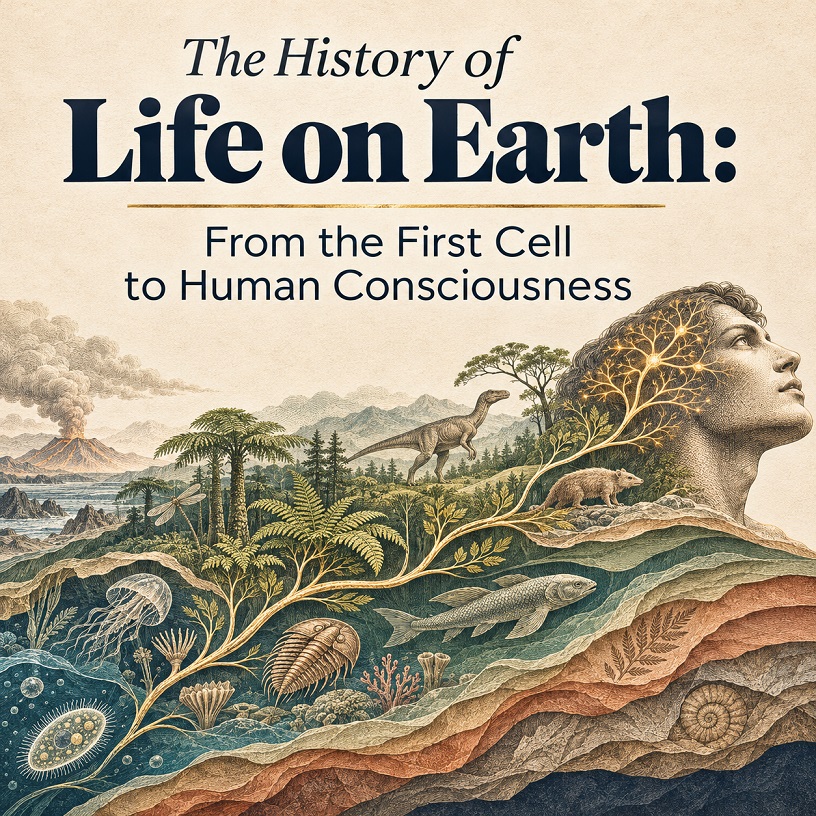
Imagine holding an album containing photographs of all your ancestors. The first pages show your parents, then your grandparents, followed by people whose names have long been forgotten. But the album does not end. It continues backward through centuries, thousands and millions of years, until familiar faces disappear, bodies become increasingly strange, and eventually only beings so tiny that you could not see them without a microscope remain. Such an album would tell one of the most extraordinary stories known to science: the history of life on Earth.
We all belong to this story. The tree outside your window, the bee visiting a flower, the mushroom in the forest, the fish in the sea, and the person reading these words belong to an immense family tree. Its branches have divided countless times. Some disappeared, others expanded, and still others gave rise to entirely new forms. Its roots reach into a world where life already existed as microscopic cells.
We will not repeat the question of how nonliving substances formed the first protocells. That is a separate story, concerning chemistry before biology. Our account begins when living systems already exist on Earth, capable of reproducing and transmitting hereditary information. From that point begins the great journey of biological evolution: life’s continual branching and transformation across billions of years.
To appreciate the scale, imagine Earth’s entire history compressed into a single day. The planet forms at midnight. The earliest evidence of life appears long before dawn, while complex animals arrive only in the day’s final hours. Dinosaurs occupy a short interval near the end. The history of our own species is only an instant before the next midnight. This comparison is not an exact clock for every event; it helps us feel how long life existed without humans, forests, birds, or even animals.
We will travel through ancient oceans, encounter organisms that changed the atmosphere, and discover how one cell came to house another, opening the way to new complexity. We will follow the division of labor within multicellular bodies, the movement of life onto land, the reshaping of the world through mass extinctions, and the gradual development of the human brain within one lineage of primates. We will use familiar comparisons because difficult scientific terms conceal ideas that can be explained clearly without diminishing their grandeur.
Reading a History Written in Stone, Genes, and Time
Before beginning our journey, we must understand how scientists know what happened so long ago. Nobody observed the first ocean microorganisms. There are no photographs of the earliest plants or diaries kept by dinosaurs. Yet Earth preserves traces, just as an old house retains scratches on its walls, layers of paint, and objects beneath its floors. Rocks, fossils, and genes are different pages of the same history.
Fossils form when remains or traces of organisms are preserved in sediments and subsequently in rocks. Imagine a footprint in wet cement. Once the cement hardens, the person has long departed, but the impression remains. Such preservation is rare in nature. Most organisms decay, are eaten, or are destroyed before they can leave fossils. The fossil record therefore resembles an album with many missing photographs, rather than an uninterrupted film.
Rock layers provide a sequence. In an undisturbed succession, lower layers are generally older than those above them. To determine ages more precisely, geologists use radiometric dating, measuring how particular unstable atoms transform into other atoms at known rates. Imagine a clock that measures time not with moving hands but through gradual changes in chemical composition. Different methods work for different materials and periods, so dates are checked against independent evidence.
Genes provide another extraordinarily rich archive. DNA resembles a long text written using four chemical letters. When organisms share an ancestor, portions of this text pass into different descendant lineages. Changes accumulate over time. By comparing sequences, scientists reconstruct relationships. It is rather like comparing ancient manuscripts: if two books share unusual features, they probably descend from an earlier common copy.
The third source is living organisms themselves. Their bodies contain structures that reveal common ancestry: the bones in a human arm, a bat’s wing, and a whale’s flipper are modified versions of an inherited basic arrangement. Like different car models built on a shared platform, these limbs serve different purposes while preserving a recognizable plan. Fossils, geology, anatomy, and genetics together allow scientists to reconstruct the history of life in increasing detail.
That history is continually refined. A new discovery can change the date assigned to an event, while a genetic analysis can alter the position of a branch on the family tree. This does not make the story arbitrary. On the contrary, the scientific picture becomes more accurate as new evidence is compared with existing findings. Like an archaeologist discovering another room in an ancient city, researchers expand the map of the past without having to begin again from nothing.
The First Billions of Years: A Planet Ruled by the Invisible
If we could dive into Earth’s earliest oceans, we would find no fish, jellyfish, or underwater forests of seaweed. For a very long time, life was predominantly microscopic. That did not make it insignificant. Imagine a city without skyscrapers or enormous machines, but filled with billions of tiny workshops continually processing materials. Early microorganisms transformed the chemistry of water, sediments, and eventually the entire planet.
The oldest evidence of life is examined carefully because very ancient rocks have often been altered by heat and pressure. Strong evidence places microbial life more than 3.4 billion years in the past, while some investigated traces are older still. The precise ages and interpretations of the earliest samples remain subjects of research. What matters most for our story is that microorganisms inhabited Earth long before complex bodies appeared.
These organisms were not all alike. Different microbial lineages used different chemical sources of energy and matter. Some lived without free oxygen; others used light through processes different from the oxygen-producing photosynthesis familiar today. If modern nature is an enormous restaurant offering thousands of menus, the early microbial world was developing the fundamental ways of obtaining energy upon which much later life would depend.
Stromatolites are particularly striking. These layered structures can be built through the activity of microbial communities. Imagine a carpet of microorganisms trapping particles and influencing the deposition of minerals. Layers accumulate over time, like pages in a thick book. Ancient stromatolite-like structures reveal the deep roots of microbial life, while living microbial formations help scientists understand the processes involved.
For immense periods, Earth’s most important biological events occurred on a scale invisible to the naked eye. Microorganisms participated in the cycling of carbon, sulfur, nitrogen, and other elements. Without these processes, later ecosystems would have been profoundly different. Even today, invisible life sustains soils, oceans, and our own bodies. Size has never been a reliable measure of importance.
When we think about evolution, it is easy to imagine a steady increase in size, from small to large, simple to complex. But the microbial world teaches a different lesson. Small organisms can be extraordinarily successful and diverse. Bacteria and archaea survive today not as abandoned steps on a ladder, but as modern lineages with billions of years of their own history. Evolution is not a staircase leading everything toward one destination. It is a branching tree.
The Oxygen Revolution: When Life Changed the Sky
Today we breathe almost without thinking. Oxygen seems as natural as daylight entering a window. Yet Earth’s early atmosphere did not contain free oxygen in anything like its present abundance. The great transformation came through organisms capable of using sunlight and releasing oxygen by splitting water. This process, oxygenic photosynthesis, is associated with the ancient ancestors of modern cyanobacteria.
Imagine a factory producing something useful while releasing a substance that changes the entire city. At first the surrounding environment absorbs what the factory releases. Eventually, however, the materials that react with it can no longer consume it at the same rate, and the substance begins to accumulate. Something similar happened with oxygen. It reacted with dissolved chemicals and minerals before building up significantly in the atmosphere.
About 2.4 billion years ago, a period known as the Great Oxidation Event began. This was not a single explosion, but a prolonged transformation of oceanic and atmospheric chemistry. Its traces survive in ancient rocks and in the oxidation of particular elements. Think of an iron fence rusting in contact with oxygen. On a planetary scale, related chemical reactions left evidence of Earth’s transformation.
For many organisms adapted to oxygen-free conditions, oxygen presented a serious challenge. It is chemically reactive and can damage cellular components. Other organisms, however, evolved ways of using oxygen to release energy efficiently from nutrients. Imagine moving from a small stove to a much more powerful heating system. The analogy does not imply that every organism adopted the same way of life; it illustrates how a new chemical opportunity expanded the energy strategies available to certain lineages.
Oxygen also transformed the atmosphere. Over time, oxygen-related processes contributed to the formation of an ozone layer that absorbs some harmful ultraviolet radiation. This mattered for the later spread of life into more exposed environments. A biological activity originating in microscopic cells gradually changed the conditions in which countless other organisms could exist.
Here we encounter one of the most beautiful principles of Earth’s history: life does not merely adapt to the planet; it also transforms it. Oceans, atmosphere, and organisms form an interconnected system. A change in one component creates opportunities and limitations for the others. The air filling our lungs today carries the imprint of biological processes that began immeasurably long before lungs existed.
The Cell with Inner Rooms: The Emergence of Eukaryotes
Examine a modern animal or plant cell with a sufficiently powerful microscope. It does not resemble an empty bag. It contains structures carrying out different tasks: a nucleus, membrane-bound compartments, and mitochondria. Imagine a small workshop gradually becoming a factory with separate rooms, specialized machinery, and organized transport of materials. This comparison helps us appreciate the significance of the eukaryotic cell.
Eukaryotes are organisms whose cells possess nuclei. They include animals, plants, fungi, and numerous single-celled forms. Their origin involved profound changes in cellular organization. One of the most important was the emergence of mitochondria, structures involved in energy metabolism in most modern eukaryotes.
The story of mitochondria is extraordinary. Genetic and cellular evidence shows that they descend from bacteria that became permanent partners inside another cell in the distant past. This process is called endosymbiosis. Imagine two independent workshops beginning to cooperate so closely that, over many generations, they become a single production complex. Responsibilities are redistributed, while their former independence gradually disappears.
Mitochondria still carry their own DNA and possess features recalling their bacterial ancestry. They are like old documents preserved inside a new institution. Many genes necessary for their function are now located in the cell nucleus, and mitochondria depend on the rest of the cell. Their history shows that evolution does not proceed only by the splitting of family lines. Sometimes lasting cooperation between different organisms creates a new level of organization.
Plants and algae tell another part of this story. Their chloroplasts, the structures where photosynthesis occurs, descend from ancient cyanobacteria that became internal partners of eukaryotic cells. Imagine a building acquiring its own solar power station, except that here the ‘installation’ results from a profound biological history rather than engineering. Chloroplasts, too, preserve genetic evidence of their origins.
The emergence of eukaryotes did not immediately produce large animals. Numerous eukaryotic lineages remained single-celled for immense periods. But the new internal organization expanded the possibilities for movement, feeding, interaction, and specialization. Evolution often works this way: one transformation does not create every future form at once. It opens possibilities that different descendants explore in different ways.
When Cells Began Living Together: Multicellularity
A single cell can accomplish many tasks on its own. It takes in materials, carries out chemical reactions, responds to its surroundings, and reproduces. But imagine one person having to work simultaneously as a builder, doctor, cook, teacher, and guard. Some tasks can be accomplished more effectively when labor is divided. In different evolutionary lineages, cells began forming stable communities whose members specialized.
Multicellularity did not arise only once. Different groups developed their own forms of cellular cooperation. In some algae, cells remain connected after division. In other organisms, structures form in which cells interact in increasingly complex ways. Imagine a neighborhood where every house is initially self-sufficient, but roads, water supplies, and shared services gradually emerge. The whole acquires properties its individual parts do not possess alone.
But a multicellular body requires rules. Cells must coordinate when they divide, where they belong, and what tasks they perform. They use chemical signals to influence one another. In the human body, skin, nerve, and muscle cells possess almost the same basic genetic library, but use different parts of it. It resembles an immense library from which different specialists read different books.
Specialization brings benefits but creates dependence. A muscle cell cannot sustain an entire human being alone, while a nerve cell needs oxygen and nutrients delivered through other systems. Imagine an orchestra: the violin, drum, and flute have different roles, but music emerges from their coordinated performance. In organisms, inherited developmental mechanisms and communication among cells maintain this coordination.
The evolution of multicellularity also required ways of limiting conflict among cells. If every cell multiplied without restraint, the entire body would suffer. Modern cancer demonstrates the importance of mechanisms that regulate division and cooperation. Complex organisms require not only new capabilities, but also ways to coordinate them.
When we look at a forest, a coral reef, or our own body, we see different consequences of this ancient principle. Cells can form organisms that move, sense, grow, and change their surroundings in ways unavailable to a single cell. Multicellularity is not simply an increase in numbers. It is the emergence of a new level of cooperation, in which the parts acquire a shared history.
Oceans Filled with Bodies: Early Complex Animals and the Cambrian Period
For much of Earth’s history, nothing swam with fins, pursued prey using eyes, or left footprints across the seafloor. Then, during a period short compared with the preceding billions of years but long by ordinary standards, animal bodies diversified remarkably. Toward the end of the Precambrian and through the Cambrian, the seas filled with increasingly varied forms, methods of movement, and relationships between predators and prey.
Between roughly 575 and 541 million years ago, diverse organisms existed that are known from Ediacaran fossil sites. Some possessed soft, leaf-shaped or disk-shaped bodies that do not immediately resemble modern animals. These discoveries are like strange drawings in an old album: they reveal experiments in body form, some of which have no obvious modern equivalent. Scientists investigate their place in animal history through their shapes, environments, and traces of movement.
The Cambrian Period began about 539 million years ago. Its rocks contain numerous representatives of animal groups and diverse mineralized structures. The word ‘explosion’ is often used for this diversification, but it unfolded over millions of years, not in a single sudden day. Imagine a city developing quietly for a long time and then, within a relatively short historical interval, filling with new streets, workshops, and buildings.
Fossil deposits such as the Burgess Shale in Canada and Chengjiang in China preserve extraordinarily detailed remains of ancient marine organisms. Among them are creatures with unusual appendages, armor, tentacles, and eyes. Some are related to familiar modern groups; others represent extinct lineages. These fossils show that the evolution of animal bodies involved many variations, rather than a predetermined sequence of modern forms.
The emergence and development of vision, active movement, and predation transformed ocean relationships. If one animal becomes better at detecting prey, this creates new pressures on organisms trying to escape attack. Like a constantly changing game in which one player’s move influences the strategies of others, ecological interactions shape different evolutionary changes. Protective coverings, faster movement, and new senses become part of marine communities.
The Cambrian story is particularly compelling because it shows how body plans, embryonic development, and relationships among organisms are connected. Many genes controlling animal body development have deep common origins. An inherited system of instructions can be used differently in different lineages. It resembles a set of fundamental building rules from which strikingly different structures can be constructed.
The Conquest of Land: Plants, Fungi, and Animals Leave the Water
Imagine an ancient continent without forests, meadows, or birdsong. Wind passes over rocks, rivers, and bare surfaces. To us, land is the natural home of trees, insects, and mammals, but life spent immense periods predominantly in aquatic environments. Moving onto land required solutions to numerous problems: avoiding dehydration, remaining anchored, exchanging gases, and reproducing away from permanent water.
Early land plants descended from green algal ancestors. Structures gradually developed that helped retain water, exchange gases, and provide support. Imagine someone leaving a city with a ready water supply and settling where they must collect water and protect themselves from heat. For plants, land offered sunlight and space, but required new ways to cope with drying out.
Fungi and their interactions with plants were important as well. Today many plants live in partnership with fungi whose threads help them obtain water and mineral nutrients. In return, fungi receive organic compounds from plants. This cooperation is called mycorrhiza. Imagine two neighbors, one with an extensive delivery network and the other with an excellent kitchen. Exchanging resources benefits both.
Over time, more complex terrestrial plant communities appeared. Vascular tissues allowed water and other substances to travel through taller bodies. Root systems affected soils and rocks, while leaves changed how plants captured light. Forests of ancient plants transformed landscapes and participated in long-term changes to the carbon cycle. Land gradually became a place with more shelter, food, and varied microenvironments.
Animals also moved toward terrestrial life along different lineages. Arthropods, including the ancestors of modern insects and arachnids, developed diverse adaptations for movement and protection from dehydration. Later, some vertebrates passed through forms combining aquatic and terrestrial ways of life. Changes in limbs, breathing, and bodily support enabled them to use new habitats.
Land was not conquered in one triumphant step. Different lineages adapted at different times and with different degrees of success. Some organisms remained dependent on moist environments; others developed seeds, protected eggs, or additional ways to reduce that dependence. This is a history of multiple solutions to shared challenges. Today’s walk through a forest is possible because of hundreds of millions of years of such changes.
The Five Great Extinctions: When Life Lost Entire Worlds
Evolution is not only a history of appearances. It is also a history of losses. Look at the family tree of a large family and you will see branches that continue and others that end. Across life on Earth, this happens on an incomparably greater scale. The overwhelming majority of species that ever existed are now extinct. Some disappeared gradually, while at certain times many groups were affected within relatively brief geological intervals.
Scientists traditionally identify five major mass extinctions during approximately the last 540 million years. They occurred near the end of the Ordovician, during the Late Devonian, at the end of the Permian, at the end of the Triassic, and at the end of the Cretaceous. Their causes were not identical. Climate and sea-level changes, disruptions to ocean chemistry, immense volcanic activity, and impacts from space played different roles in different events.
The most severe known mass extinction occurred at the end of the Permian Period, about 252 million years ago. It affected an enormous proportion of marine species and many terrestrial groups. Extensive volcanism associated with the Siberian Traps was linked to major climatic and ocean-chemical changes. Imagine a city losing its roads, water supply, and food deliveries simultaneously. Species in ecosystems depend upon one another, so the disruption of many connections can produce consequences far beyond the original disturbance.
More familiar is the extinction at the end of the Cretaceous, around 66 million years ago. A large asteroid struck the region of today’s Yucatán Peninsula, leaving the Chicxulub crater. Dust, aerosols, fires, and changes in light and climate disrupted food webs. All non-avian dinosaurs disappeared, but birds, the surviving dinosaur lineage, continued their history. The next time you see a sparrow, remember that dinosaurs did not vanish completely.
Mass extinctions were not a ‘plan’ for making room for future organisms. They were destructive events, after which surviving lineages spread through transformed ecosystems. Imagine a library fire destroying countless books. The books that survive are not necessarily the most important or sophisticated; they simply happened to remain under conditions that allowed their survival. The library’s history then continues differently.
These events remind us that evolution has no guaranteed direction. A successful species can disappear if its environment changes too rapidly. A small and inconspicuous lineage can survive and later branch into many forms. Life is resilient across the scale of its entire history, but individual expressions of life remain vulnerable. This combination of continuity and loss gives Earth’s past a profound human resonance.
The Age of Dinosaurs, Flowers, and Small Mammals
When we hear the word ‘dinosaur,’ we often picture a gigantic predator with powerful jaws. But dinosaurs were a diverse group including two-legged and four-legged forms, herbivores and carnivores, animals of different sizes, feathered species, and varied ways of life. They appeared during the Triassic Period and became prominent in terrestrial ecosystems during the Jurassic and Cretaceous. Their world was not a frozen backdrop, but a constantly changing network of organisms.
Many other groups flourished during the Mesozoic: marine reptiles, flying pterosaurs, various fish, and invertebrates. Pterosaurs were not dinosaurs, although they were relatives within the broader history of archosaurs. Imagine a large family with several distinct branches. Living at the same time or behaving similarly does not place everyone on the same branch.
Birds descended from a lineage of feathered theropod dinosaurs. Fossils such as Archaeopteryx and numerous subsequently discovered feathered dinosaurs reveal different stages of that history. Feathers did not necessarily evolve initially for flight; they served other functions, including insulation and display. Imagine an object developed for one task that later proves useful for another. In evolution, inherited structures frequently acquire new applications.
Meanwhile, early mammals and their close relatives developed in a world where dinosaurs occupied many large ecological roles. Early mammals were often small, but they did not all live alike. Some fed on insects, while others had different specializations. Their characteristic features included hair, particular changes to the jaw and middle-ear bones, and ways of caring for offspring.
Flowering plants spread during the Cretaceous. Flowers, fruits, and interactions with pollinators gradually transformed many terrestrial ecosystems. Imagine a marketplace suddenly offering new kinds of food, accompanied by new suppliers and visitors. Insects and plants influenced one another’s evolutionary paths. The diversity of colors, shapes, and scents we know today has a deep history.
Following the end-Cretaceous extinction, surviving mammals diversified into many ecological roles. Lineages emerged leading toward whales, bats, hoofed mammals, carnivores, and primates. This does not mean mammals had been insignificant before or that their development started from nothing. They already possessed a long history; changed conditions opened new opportunities for some of their descendants.
From Ancient Primates to the Human Lineage: A Branching Family Story
Look at a human hand and notice how easily it grasps a cup, ties shoelaces, or turns a page. Our eyes face forward, while our brains process complex visual information. These features have deep roots in primate evolution. Our ancestors belonged to an animal world in which navigating branches, recognizing objects, and engaging in social interactions played important roles.
Primates did not emerge with the intention of becoming human. Different lineages branched and adapted to their own environments. Today’s lemurs, monkeys, gibbons, orangutans, gorillas, and chimpanzees are not earlier versions of ourselves. They are modern relatives with separate histories. Humans and chimpanzees share an ancestor that lived millions of years ago; humans did not descend from modern chimpanzees.
After the human lineage separated from the lineage leading to modern chimpanzees and bonobos, different early hominins appeared. Some combined features that resembled neither modern humans nor living great apes completely. The fossil record is incomplete, but it reveals a branching history. Imagine a family tree filled with cousins rather than a ladder on which one creature successively turns into another.
One important transformation was bipedal movement. It involved changes to the pelvis, spine, lower limbs, and feet. Upright walking did not emerge all at once in its modern form. Different early hominins possessed different combinations of abilities for moving on the ground and in trees. Imagine a house being renovated across many generations: separate parts change at different times, and not every transformation occurs simultaneously.
Australopithecines are among the best-known early representatives of human evolutionary history. The skeleton called Lucy belongs to Australopithecus afarensis and lived about 3.2 million years ago. Her bones reveal important features of bipedal movement. Lucy was not ‘the first woman,’ nor was she necessarily a direct ancestor of all later humans. She provides a valuable window into a group of organisms living long before our species appeared.
Across different lineages, body size, teeth, diets, and brains gradually changed. No single feature explains the emergence of humanity. Our history results from interactions among anatomy, environment, behavior, and social life. It becomes even more interesting when we abandon the idea of a predetermined ending.
Hands, Fire, and Language: How Culture Began Changing Evolutionary History
Imagine a stone lying beside a river. For most animals it is simply part of the landscape. But when someone begins striking it in a particular way and produces a sharp edge, the stone becomes a tool. Archaeological discoveries show that ancient hominins manufactured and used stone tools long before Homo sapiens appeared. This marks an important development: behavior begins leaving material traces that can be transmitted through observation and learning.
Tools extend the possibilities of the body. A knife enables actions difficult with a bare hand. A hammer increases the force of a blow, while a container allows water to be carried. Imagine how one simple object changes the tasks available to an entire group. Among ancient humans and their relatives, technology gradually became part of daily life, rather than merely the occasional use of surrounding objects.
Fire was another turning point. Its use and control developed through a long history, whose early stages are investigated through archaeological traces. Fire provides warmth, light, and protection, while cooking changes the physical and chemical properties of food. Imagine the difference between a hard raw ingredient and the same ingredient after suitable heating. Cooking can make certain foods easier to chew and digest, although its specific evolutionary consequences are studied separately.
Social learning allows useful actions to spread between individuals. If one person discovers an effective way to work a material, others can observe and imitate it. This resembles a family recipe passed down not through genes but through generations of teaching. Cultural information can change much faster than inherited biological traits. Over time, biological and cultural histories begin influencing one another.
Language is among the most complex human abilities. It allows us to discuss things that are not immediately present, share plans, and preserve knowledge in stories. The origin of language cannot be dated using a single fossil. Scientists examine anatomy, brains, genetics, behavior, and archaeological evidence to understand the development of the abilities that make it possible. Language is like a bridge between individual minds: it allows one person’s experience to become a resource for others.
During this history, the power of accumulation becomes especially important. One person invents or improves a technique, another learns it, and a third modifies it. After many generations, a community may use skills that no individual could have invented alone from the beginning. Imagine a library to which every generation adds new pages. Culture turns the lives of separate generations into a much longer shared conversation.
Neanderthals, Denisovans, and Homo sapiens: When Human Worlds Met
We often imagine human evolution as a row of figures gradually standing upright until the modern human appears. This familiar illustration is misleading. Several human lineages existed simultaneously during different periods. They inhabited different regions, encountered different climatic challenges, and developed their own cultural practices. Human history resembles a forest of related trees more than a single straight path.
Neanderthals inhabited parts of Europe and western Asia. They adapted to varied environments, made tools, used fire, and cared for members of their groups. Archaeological evidence reveals complex behaviors, although the details of individual practices remain under investigation. Neanderthals were not simply the crude figures of popular cartoons. They were a human lineage with a long history of their own.
Denisovans are known especially through genetic evidence and a limited number of fossil remains. Their discovery shows how much can be learned from small fragments of bone or tooth when hereditary information survives. Imagine finding one page from an unknown family chronicle and, by comparing it with other documents, discovering an entirely new branch of the family.
Homo sapiens appeared in Africa approximately 300,000 years ago. Our species has a long African history, while later dispersals carried human populations into different parts of the world. Along the way, some encountered and had offspring with Neanderthals and Denisovans. Many living people therefore carry small portions of hereditary material originating from those ancient human lineages. Our history involves not only branching but also branches joining again.
This interweaving matters for how we understand human kinship. There is no single line from ‘lower’ to ‘higher’ humans. There are populations that separate, change, meet, and exchange hereditary material. Living humans belong to one species, and the genetic differences among us are small compared with our immense shared inheritance. Differences in skin color, language, or culture do not place people on different evolutionary rungs.
Archaeological finds from human settlements-tools, ornaments, paintings, burials, and evidence of material processing-reveal the gradual development of symbolic behavior and complex social relationships. Not every find has an unambiguous meaning, but together they show a world in which humans did more than survive. They began giving meaning to objects, places, and shared actions. This leads us toward one of the most difficult subjects in the entire history of life: consciousness.
From the Senses to Self-Awareness: How the Brain Creates an Inner World
When you touch a hot cup, your hand may pull away before you consciously describe the sensation. When you hear a familiar voice, memories appear in your mind. When you look at the stars, you can feel wonder and ask questions about your own existence. All these experiences are connected to nervous-system activity, but they are not identical. To understand human consciousness, we must distinguish sensation, perception, memory, attention, thought, and awareness of oneself.
Nervous systems have a long evolutionary history. Many animals respond to light, chemical signals, touch, and movement. Different lineages developed sensory organs and networks of nerve cells that process information. Imagine a building management system: sensors report temperature and light, while central mechanisms coordinate responses. Living nervous systems are far more complex and varied, but the comparison illustrates the value of connecting perception with action.
The brain did not suddenly appear in the human lineage. Different animals possess brains and nervous systems suited to their ways of life. Birds demonstrate complex memory and problem-solving, octopuses display remarkable behavioral flexibility, and numerous mammals engage in social learning and emotional responses. We should not measure all these abilities only by how closely they resemble human ones. Each lineage developed its own responses to the challenges it encountered.
In humans, intricate connections among brain regions involved in memory, planning, language, and social behavior are especially important. The brain is not merely a computer with more storage. It is a living system continually processing information from the body and surroundings, changing its connections through experience, and using previous knowledge to anticipate future events. Imagine a city whose streets do not simply carry traffic, but are constantly rebuilt according to how people use them.
Self-awareness includes the ability to regard our experiences as our own: to remember the past, imagine the future, and tell a story about ourselves. Human language expands this ability because it allows us to name thoughts and feelings, compare them, and share them. When you say, ‘I was a different person years ago,’ you connect different moments of your life into one narrative. This is a distinctive form of inner continuity.
Yet science continues to investigate precisely how brain activity relates to subjective experience-to what it feels like to see red, hear music, or experience joy. Different theoretical approaches and experiments examine attention, conscious perception, and brain states. The question cannot be settled by a single analogy or brain scan. That is why consciousness remains such an inspiring scientific subject: it is a part of nature through which nature begins asking questions about itself.
Evolution Has Not Ended: Life Continues Writing Its History
Sometimes we speak about evolution as though it ended with the appearance of humans. But life continues to change. Hereditary differences still arise, and environments influence which variants spread through populations. Imagine a river flowing through a continually changing landscape. It does not reach a final state merely because it passes a great city. Similarly, evolutionary history does not end with our species.
One of the clearest examples is antibiotic resistance in bacteria. Hereditary differences exist within bacterial populations, and an antibiotic creates conditions under which some variants survive and reproduce more successfully. This does not mean an individual bacterium consciously decides to become resistant. Imagine a large collection of keys, some of which happen to fit a particular lock. When conditions change, differences that already exist or newly arise can acquire new significance.
Evolutionary changes are also observed among insects, plants, viruses, and numerous other organisms. Climate, habitat change, emerging diseases, and human activity affect living conditions. In some species, these changes produce rapid shifts in the frequency of inherited characteristics. In others, populations decline or disappear because they cannot withstand the pressure. Evolution does not guarantee survival.
Humans, too, remain biological organisms. Our bodies carry traces of the ancient history of primates, mammals, vertebrates, and eukaryotic cells. But we transform our environment through technology, agriculture, medicine, and culture. These changes influence the conditions in which we live and the lives of other species. Imagine a traveler who not only follows a path but continually rebuilds it while walking. This feedback makes modern human history especially complex.
Today we know only part of life’s diversity. Enormous numbers of microorganisms remain poorly studied, and new species continue to be described even among larger organisms. Genetic methods reveal relationships that cannot be established from outward appearance alone. Ocean depths, soils, caves, and symbiotic communities continue providing new evidence of biology’s possibilities.
At the same time, human activity is causing serious losses of habitats and biodiversity. When a species disappears, a unique lineage in life’s history comes to an end. Imagine a library in which every book has been written over millions of years and no other copy exists anywhere. Protecting nature is not simply about preserving beautiful scenery. It means caring for an inheritance we cannot simply restore once it has been lost.
We Belong to a Story That Began Long Before Us
Let us return for a moment to the imaginary album of our ancestors. We now know its pages are not arranged as a straight line from ‘imperfect’ to ‘perfect.’ It resembles an enormous tree with branching, reconnection, and interrupted limbs. Some pages show organisms that changed the atmosphere. Others show cells turning cooperation into a new way of existing. Still others reveal animals leaving the oceans and beings beginning to use tools.
Within our bodies, this history is not merely a memory. The mitochondria in our cells carry traces of an ancient partnership. The bones of our hands preserve a common arrangement shared with the limbs of other vertebrates. Our lungs use oxygen whose accumulation was connected to ancient microorganisms. Our genes testify to kinship with countless other forms of life. We are made from inherited solutions, modified and used in new ways across immense spans of time.
This kinship does not mean all organisms are identical. It means diversity has a history. A tree and a human live very differently, but their cells share fundamental features. A bird and a crocodile look different, but belong to related evolutionary lineages. A whale swims in the ocean and a bat flies through the sky, yet both are mammals. Beneath the surface of differences, nature preserves evidence of common ancestry.
One of evolution’s most important insights is that complexity does not require a predetermined final form. Hereditary changes, environmental interactions, natural selection, random processes, and historical circumstances operate over enormous periods. New structures often emerge through modification of existing ones. It resembles the history of an old city whose streets and buildings from different eras intertwine. No single architect designed every century in advance, but the result bears the traces of each generation.
There is something extraordinary about the fact that, after billions of years, life produced beings capable of investigating their own past. We read rocks, compare genes, reconstruct extinct ecosystems, and send instruments beyond Earth. We can ask a question that ancient ocean cells could not formulate: where do we come from? The answer is not one date or one species. It is the history of countless interconnected changes.
The next time you see moss growing on a stone, a bird on a windowsill, or your own hand resting on a table, regard them as different pages of the same story. None is unnecessary, and none represents the final page. Earth continues changing, and life continues discovering new ways to exist. We are its descendants, its witnesses, and, through our choices, participants in the pages that will be written after us.
Author: Vasil Stoyanov