
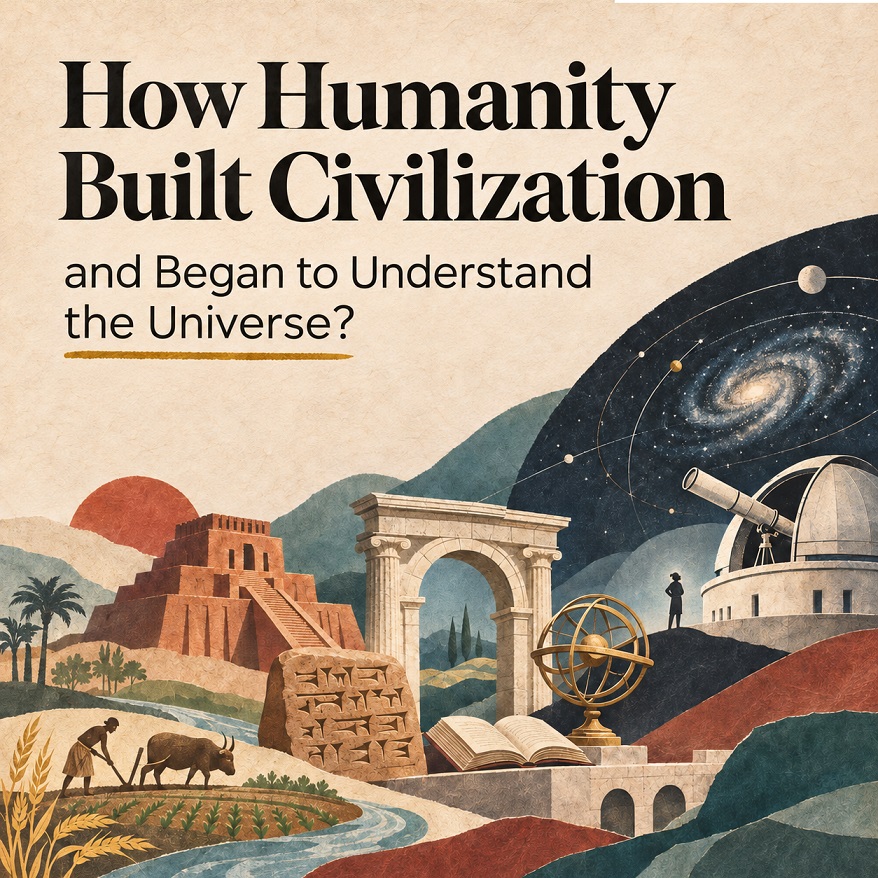
Imagine an evening tens of thousands of years ago. A fire illuminates the faces of people gathered beneath an open sky. Someone tells a story about a distant valley, another demonstrates how to work stone, and a third points toward the stars. There are no libraries, universities, or telescopes. Yet something already exists that will transform the destiny of our species: the ability to pass knowledge from person to person and allow it to outlive the individual who acquired it.
Behind this scene stretches an immense history. The universe produced the chemical elements from which Earth formed. Conditions for the emergence of life developed on the young planet. Over billions of years, evolution produced an astonishing diversity of organisms, including our own species. But the story does not end with the appearance of Homo sapiens. A new chapter begins: the history of culture, which can accumulate, spread, and transform the world at a pace unlike the usual timescales of biological evolution.
This chapter is not merely a history of kings, wars, and inventions. It is the history of cooperation among strangers, languages and symbols, agriculture and cities, writing and mathematics, doubt and verification. Gradually, humanity began turning observations into explanations, explanations into predictions, and predictions into knowledge that other people could test.
We will follow this path from early human communities to modern science without repeating the details of how consciousness arises, which belong to a separate journey through neurobiology. Our interest here is not how an individual brain produces experiences, but how many human minds, connected through language, traditions, and institutions, built a shared body of knowledge greater than the abilities of any one person.
The most remarkable turn comes at the end. Matter formed in ancient stars became beings who build telescopes and study the stars. Earth produced a species able to calculate the planet’s age, discover planets around other suns, and trace its own ancestry back to the earliest living systems. This does not mean the universe intended to be understood. It means that natural processes produced an extraordinary possibility: part of the world began systematically studying the world.
The Invisible Inheritance: Why Human History Never Starts from Zero
If you tried to light a fire today without matches, a lighter, or electricity, you would quickly discover how much knowledge lies behind an ordinary flame. You need to know which materials ignite, how to prepare them, how to supply air, and how to protect the fire from wind. Most people have not discovered these principles independently. They learned them from others or used objects made possible by other people’s knowledge.
This is one of the defining features of human culture: knowledge can accumulate. Each generation does not need to rediscover every useful technique. It can inherit existing solutions, improve them, and pass them forward. Researchers call this cumulative cultural evolution. It is not entirely separate from biology, but it develops through learning, imitation, communication, and social rules.
Imagine a ladder to which each generation adds another rung. If the rungs disappeared whenever someone died, nobody could climb very high. But when knowledge survives, later generations begin from a higher position. This explains why modern technology is not the product of a single brilliant mind. It rests upon countless discoveries, mistakes, tools, and improvements.
Cultural accumulation has not been uniform. Communities have lost skills after migrations, disasters, or broken connections. Some inventions emerged independently in different places, while others spread through exchange. Tradition sometimes preserved useful knowledge and sometimes hindered change. History is not one uninterrupted straight line of progress.
Nor are humans the only animals that learn socially. Traditions, tool use, and transmitted behaviors occur in other species. The human distinction lies in the scale, complexity, and durability of accumulation, especially when language, symbols, and social structures support it. The difference is not a simple boundary between animals without culture and humans with culture, but a remarkable expansion of certain abilities.
This invisible inheritance guides our entire article. Before cities, there must be transmitted skills. Before universities, communities must remember and teach. Before science, generations of observers must be able to compare their experiences and leave something for those who follow.
Language: When Experience Becomes Shared Wealth
Imagine a hunter who discovers water beyond a distant hill. If the hunter can only point, little information can be conveyed. With a rich language, the route, dangers, season, and identifying landmarks can be described. Others can benefit from the discovery without witnessing it. Language transforms individual experience into shared possibility.
The precise origin of human language cannot be dated like a stone tool. Words do not fossilize. Researchers use indirect evidence from archaeology, anatomy, genetics, comparative communication studies, and the development of language abilities. We therefore cannot confidently identify a single day, place, or original language from which every human language necessarily descended.
Language does more than name objects. It allows us to discuss absent people, past events, future intentions, and imagined possibilities. We can say, ‘If it rains, we will move,’ before the first drop falls. We can warn others about dangers they have never seen. We can discuss rules and revise plans without performing every action first.
Language also enables teaching. Someone can explain why a particular stone fractures more easily, why food must be prepared in a certain way, or when an animal appears in a region. Even when learning occurs through observation, words direct attention toward important details. This reduces the cost of trial and error.
Different languages are not more primitive or more advanced rungs on a single ladder. Every natural human language has complex means of communication and expression. Communities develop specialized vocabularies according to their environment, occupations, and history. Sailors, farmers, and astronomers may need different terms, but that does not determine the worth of their languages.
Language is humanity’s first great network for transmitting knowledge. It lets a thought leave the person who conceived it and begin another life in other minds. Writing would later extend that network across time and space, but its foundation was laid in conversation.
Around the Fire: Stories as the First Libraries
Let us return to the people around the fire. A story can entertain, but it can also serve as a map, warning, or lesson. A story about a dangerous river contains geographical information. An account of an unsuccessful hunt may transmit a useful strategy. A memory of an unusually dry season can help the next generation recognize signs of disaster.
In societies without writing, memory was not left entirely to chance. Rhythm, repetition, song, ritual, and narrative structure can help preserve information. We know these devices today: a poem or melody heard repeatedly is easier to remember than a random list of numbers. Human communities developed many ways to make knowledge memorable.
Stories were never merely textbooks. They transmitted values, explained relationships, and gave events meaning. Narratives about the world’s origins, ancestors, and communal rules could strengthen belonging. Different cultures gave these narratives different forms and meanings. We should not reduce the enormous richness of human traditions to a single universal model.
It is important to distinguish cultural value from scientific verification. A myth can be deeply meaningful to a community’s identity without being an empirical account of a cosmic event. Conversely, practical knowledge of seasons or plants may be highly accurate even when conveyed through a story. People in the past did not live within our modern academic categories.
Imagine a family recipe that has never been written down. It survives because someone demonstrates it to another person. Each generation may introduce a small change, but the recipe can disappear if the chain breaks. Oral traditions can likewise be remarkably durable, yet they depend on living communities and the conditions of transmission.
The fire in our story is more than a source of warmth. It symbolizes shared time. When people gather, listen, debate, and remember, they begin building something no individual possesses completely: collective history. This ability would later support laws, schools, archives, and scientific societies.
Symbols, Art, and Shared Worlds
Imagine a picture of an animal on a rock wall. It is not the animal itself and cannot be eaten or hunted. Yet people can recognize it, discuss it, and connect it with memories or meanings. A symbol allows something absent to become present in shared attention. This is an enormous step in social life.
Archaeological discoveries show prehistoric people using pigments, ornaments, engraved objects, and images. Different practices have different ages and distributions. Some are associated with Homo sapiens, while evidence of symbolic behavior in other human lineages is also debated. The history of symbols is complex and cannot be reduced to one sudden moment of ‘awakening.’
An ornament may communicate belonging, status, relationships, or personal choice. A mark on an object may help identify ownership or group identity. An image may carry artistic, ritual, educational, or other meanings. We cannot always reconstruct its makers’ intentions. Scientific honesty requires distinguishing the object we observe from the meaning we infer.
Symbols also facilitate cooperation among people who do not know one another personally. A shared sign can indicate common membership or rules. Consider a modern road sign. It works because many people have learned to interpret the same image. Drivers do not need to know the person who installed it.
Art adds another layer to human history. It is not merely decoration attached to the ‘real’ business of survival. Images, music, dance, and stories can strengthen social bonds, preserve memories, and create shared experiences. Different societies weave art into everyday life in different ways.
When someone leaves a symbol on stone, communication can extend beyond immediate conversation. Another person may encounter it later. This is not yet writing in the full sense, but it demonstrates the power of a lasting sign. The path toward archives and books was neither short nor inevitable, but the underlying principle was present: human meaning could be attached to a material medium.
Cooperation: How Strangers Began Acting Together
Moving a heavy stone alone is difficult. When several people coordinate their efforts, the task becomes possible. This simple example illustrates cooperation, but human societies developed far more complex forms. They organize food sharing, childcare, construction, exchange, defense, and conflict resolution. Collective life is more than the sum of individual actions.
Cooperation requires trust, expectations, and ways to respond when rules are broken. In small communities, people may know one another personally. In large communities, that is no longer sufficient. Shared norms, roles, and institutions become necessary. Imagine a busy market where hundreds of strangers trade goods. It functions because people share certain expectations about measurement, payment, and behavior.
Societies did not all develop according to one sequence from ‘simple’ to ‘complex.’ Different groups built different systems of kinship, leadership, exchange, and resource distribution. Some were more hierarchical; others were more egalitarian in particular respects. Diverse human histories should not be forced onto one ladder that every society supposedly climbs.
Conflict is also part of this story. Cooperation within a group does not guarantee peace between groups, and institutions can both organize shared activity and entrench inequality. Large societies enabled impressive collective projects but also coercion, exploitation, and warfare. Civilization is not synonymous with moral perfection.
One important change was the ability to coordinate people through shared rules and ideas. Laws, contracts, calendars, and systems of measurement can align the actions of people who will never meet. This is invisible infrastructure: it does not resemble a bridge, but it helps people move from individual intention toward collective results.
Without such coordination, major construction projects, trade networks, written archives, and later scientific institutions would have been much harder to establish. Cooperation is not the sole cause of civilization, but it is one of the fundamental abilities on which civilizations depend.
Before the Fields: The World of Hunters, Gatherers, and Travelers
For most of Homo sapiens’ existence, people lived without agriculture in its modern sense. They gathered plants and other resources, hunted, fished, and adapted to diverse environments. There was no single way of life. Arctic coasts, African savannas, forests, and river valleys required different knowledge and strategies.
Imagine how carefully you would need to know a landscape to find food through changing seasons. You would have to recognize plants, animal tracks, weather changes, and safe routes. Such knowledge is not less complex because it is unwritten. It can be exceptionally precise and transmitted across generations.
Some communities were highly mobile, while others remained longer in regions with abundant resources. Coasts and rivers could support relatively reliable food supplies. Technologies included stone, bone, wood, and plant materials, many of which have not survived archaeologically. The absence of a preserved object does not imply an absence of skill.
Human migrations connected distant territories. People reached different continents, adapted to climatic changes, and formed new networks of relationships. The spread of our species was not one journey with a simple map. It involved multiple movements, encounters, and complicated demographic histories.
We should not portray hunters and gatherers as people merely waiting to discover farming. Their societies possessed knowledge, art, social structures, and ways of managing resources. Even today, communities around the world maintain practices associated with hunting, gathering, and local ecological knowledge. They are not ‘living fossils’ from the past, but part of contemporary human history.
Nevertheless, a gradual change took place in certain regions with enormous consequences: people began more deliberately managing the reproduction and cultivation of plants and animals. This was not an instant invention, but a long sequence of relationships between communities and other species.
Agriculture: When Humans Began Transforming Entire Ecosystems
Imagine someone noticing that certain seeds produce better harvests. Saving some for the following season already influences future plants. Repeating this choice over many generations can change cultivated species. Domestication is not merely a decision made on a particular day, but an extended interaction among humans, plants, animals, and environments.
Agriculture emerged independently in different parts of the world and at different times. Important regions include Southwest Asia, China, New Guinea, parts of Africa, and the Americas. Crops and local conditions differed. Wheat, rice, maize, and other plants have distinct histories of domestication. There was no single agricultural center from which all societies simply copied a finished model.
Food production can support larger and more permanent settlements, stored reserves, and new forms of specialization. But it also creates risks. Dependence on a limited number of crops makes communities vulnerable to drought, plant disease, and failed harvests. Dense populations and close contact with domestic animals create new conditions for the spread of some diseases.
Agriculture is often described as an obvious improvement over earlier ways of life. Archaeological evidence, however, reveals a more complex picture. In certain communities, early farming was associated with less varied diets, harder labor, or particular health problems. Changes were uneven. A system’s ability to support more people does not mean that every individual necessarily lived more comfortably.
Farming also transforms landscapes. Forests are cleared, soils cultivated, water diverted, and animals raised in new conditions. Human communities become increasingly influential participants in ecological processes. Imagine a garden expanding year after year until it reshapes its surroundings. In certain places, something like this happened over thousands of years.
These changes created conditions for new social forms. Food surpluses could support people not directly producing food each day: builders, craftspeople, administrators, traders, and specialists in ritual or technical activities. Yet this transition was neither inevitable nor identical everywhere. It opened multiple historical paths.
Settlements Become Cities: A New Scale of Human Life
Imagine a settlement where nearly everyone knows everyone else. Now imagine a place with thousands of residents, workshops, markets, public buildings, and people who have never spoken to one another. Urban life requires new forms of organization. Food must reach residents, water must be managed, conflicts resolved, and shared spaces maintained.
Early urban societies developed in different regions, including Mesopotamia, the Nile Valley, South Asia, China, and parts of the Americas. They did not emerge simultaneously or follow one political structure. Some were organized around palace or temple centers; others had different forms of urban governance. Archaeology reveals diversity that resists a single definition of the ‘first city.’
Cities enable specialization. One person works metal, another builds, a third organizes trade, and a fourth makes pottery. This increases the variety of skills but also makes people more dependent on one another. Consider a modern bakery: its bread depends not only on the baker, but on farmers, transport, tools, fuel, and exchange. Large societies developed such interdependence in increasingly complex forms.
Public projects could reach impressive scales. Canals, fortifications, temples, and roads required planning, materials, and organized labor. Yet monumental construction often accompanied inequality. Archaeological evidence from different houses, burials, and access to resources shows that social complexity can develop alongside hierarchy.
Cities also became places for exchanging ideas. When people with different skills and backgrounds meet, techniques can combine. Trade networks transport not only goods, but measures, symbols, artistic motifs, and knowledge. Transmission is not automatic, however: linguistic, political, and geographical barriers can slow or alter it.
As societies grow, a new problem arises: how can they remember obligations, quantities, transactions, and rules when personal memory is no longer enough? One influential solution is to leave durable marks on material surfaces. This begins the next revolution in human knowledge.
Writing: Memory That Outlives Its Creators
Imagine a merchant who must remember how much grain has been delivered to dozens of people. Memory may suffice for a few transactions, but errors increase as their number grows. A written record changes the situation: information no longer depends solely on what individuals remember. Someone else can examine it in another place or at another time.
Early recording systems and writing developed in different societies. In Mesopotamia, cuneiform emerged from practices of administrative accounting, while hieroglyphic systems developed in ancient Egypt. Independent writing traditions also arose in other regions, including China and Mesoamerica. There is no reason to reduce the entire history of writing to a single line of descent.
Writing did not emerge everywhere primarily to record poetry or philosophy. Many early documents concerned goods, quantities, property, and administration. This makes sense: as societies become more complex, accounting can be as important as storytelling. Imagine running a vast organization without lists, contracts, or archives. Even exceptionally talented people would struggle.
Written systems gradually preserved laws, literature, religious texts, observations, and technical instructions. Knowledge could cross centuries without depending exclusively on an unbroken chain of oral storytellers. This did not make written statements automatically true. It did make it possible to compare claims with earlier versions and debate them without having witnessed their original expression.
Writing materials also mattered. Clay tablets, papyrus, parchment, paper, and later printed books differed in their properties and costs. Some were durable but heavy; others light but vulnerable. The technology of the medium influenced how widely knowledge could circulate. A library is not merely a collection of ideas, but a material infrastructure.
Writing created a new possibility for human memory: a person can engage with an author who lived thousands of years earlier through a surviving text. The conversation is incomplete and requires translation and interpretation, but it is a real intellectual connection across time. The path to scientific publications was long, yet the foundation already existed.
Numbers and Measurement: When the World Becomes Comparable
Imagine two builders making stone blocks of equal size. If one uses the length of their own arm and the other uses theirs, the results will differ. A shared unit solves the problem. It allows people to coordinate work without relying on individual estimates. Measurement is one of civilization’s most practical inventions.
Counting and numerical ideas have a long prehistory, while sophisticated mathematical traditions emerged in different societies. Ancient calculation systems served trade, construction, land distribution, and calendars. Not every culture used the same symbols or counting bases. Today’s positional decimal system resulted from a long history of development and transmission rather than a single universal beginning.
Positional notation and zero are particularly powerful ideas. The difference between 25 and 205 depends on the positions of digits and a symbol marking an empty place. This allows compact representation of large numbers and efficient calculation. Imagine a library in which every book has a clearly defined numbered location. The arrangement itself makes searching and working easier.
Geometry also has practical roots but developed far beyond immediate needs. Land measurement, building construction, and observing the sky raised questions about lengths, angles, and shapes. Different mathematical traditions developed methods of calculation and proof. This was an important change: it was no longer enough to know that a rule worked in a few examples; one could ask why it followed from particular assumptions.
Mathematics is not merely a language for describing existing objects. It allows us to explore relationships that are not obvious to our senses. It can help predict eclipses, describe motion, and estimate measurement errors. It makes observations comparable across places and generations.
When science later developed quantitative laws, mathematics already offered a rich collection of tools. Without numbers and measures, we might say one body falls faster than another. With them, we can establish by how much, under what conditions, and whether different observers obtain the same result.
The Sky as a Clock: The First Systematic Observers
Before electric clocks and digital calendars, the sky was the greatest visible guide to time. Day and night alternate, the Moon changes its appearance, and the Sun and stars follow seasonal patterns. For farmers, sailors, and travelers, these rhythms have immediate practical importance. Recognizing seasons is not abstract curiosity but a useful skill.
Different societies developed sophisticated calendars and astronomical traditions. In Mesopotamia, observers accumulated long records of celestial events. In ancient Egypt, astronomical knowledge was connected with calendars and rituals. China preserved records of sky phenomena, while Mesoamerican societies developed remarkable calendrical systems. These traditions were not identical and should not be collapsed into one universal story of ‘the first astronomy.’
Imagine someone marking the position of a particular star every evening. One note offers little information, but hundreds can reveal a pattern. This is the power of long-term recording: separate impressions become comparable data. The sky begins to appear not as a collection of random lights, but as a system of repeating movements.
Predicting celestial events has special value. If a calendar or calculation can forecast an event, it demonstrates practical power. Yet successful prediction does not necessarily imply a correct physical explanation. One can calculate when something will happen without fully understanding why. The distinction between description and explanation would become central to scientific development.
Celestial observations were intertwined with religious, political, and cultural beliefs. For many societies, heavenly movements carried meanings that we would not now classify as scientific. Nevertheless, precise observations, tables, and mathematical methods were genuine intellectual achievements. The history of science did not begin with the complete separation of observation from every other human activity.
The sky gradually became a laboratory nobody could move but many could observe. The same Moon appears from different places. Planets follow motions that can be recorded over generations. This creates opportunities to test models against phenomena independent of human wishes.
From Explanation to Argument: The Birth of Systematic Doubt
Imagine two people offering different explanations for an eclipse. One appeals to an inherited story; the other proposes a model of celestial movements. How should we decide between them? Competing ideas alone are not enough. We need rules for argument, comparison, and verification. The histories of philosophy and science are closely connected with the development of such practices.
Thinkers in different parts of the world asked questions about nature, knowledge, and causation. Ancient Greek philosophical schools developed different models of the cosmos and traditions of logical debate. India produced rich traditions of logic, epistemology, and argument. Chinese intellectual traditions also included systematic reflection on nature, order, and reasoning. No civilization has a monopoly on human curiosity.
Doubt does not mean refusing to believe anything. It means asking for reasons behind claims. Imagine an engineer declaring that a bridge will hold. Rather than accepting the claim solely because of the engineer’s authority, we can ask how the load was calculated and which materials were chosen. Doubt becomes productive when it leads to better verification.
Logical argument lets us examine whether conclusions follow from premises. But logic alone cannot establish whether those premises describe nature correctly. We can reason flawlessly from a false initial assumption and produce a false description of the world. This is why observation and experiment gradually became increasingly important in the investigation of nature.
Over centuries, philosophical, mathematical, and practical knowledge developed in varied institutions: schools, temples, courts, workshops, and scholarly communities. The change was not one revolution in which ‘superstition’ suddenly gave way to ‘reason.’ It was a complicated history of accumulation, debate, lost texts, translation, and new methods.
One essential idea gradually emerged: nature is not obliged to conform to our preferred explanation. A good theory must answer to observed facts. This requirement would become one of the fundamental principles of modern science.
The Roads of Knowledge: How Civilizations Learn from One Another
Imagine a book written in a language you cannot read. Until someone translates it, its knowledge remains largely inaccessible to you. After translation, however, it may transform the work of people who never met its author. The history of knowledge is filled with such encounters between languages and cultures.
Trade routes transported more than spices, metals, and textiles. Mathematical techniques, astronomical tables, medical ideas, instruments, and books traveled along them. The Silk Roads were not one straight highway but a network of routes and contacts. Maritime trade similarly connected societies across vast distances.
At different historical moments, scholars and translators preserved, commented upon, and developed knowledge inherited from earlier traditions. Intellectual centers in the Islamic world played an especially important role, translating and studying texts while advancing mathematics, astronomy, medicine, and optics. These scholars were not merely intermediaries passing on foreign ideas unchanged. They developed original methods, observations, and theories.
China developed technologies and knowledge of enormous significance, including sophisticated printing practices, applications of the compass, and diverse engineering solutions. Indian mathematical traditions made crucial contributions to positional decimal notation and other ideas. Europe, Africa, the Americas, and Oceania also possessed varied practical and theoretical knowledge shaped by local conditions and social needs.
The spread of knowledge was never entirely peaceful. Conquest, colonialism, and unequal power relations affected who could study, whose texts survived, and whose achievements received recognition. A history of science should consider not only famous names but also translators, observers, craftspeople, and communities whose contributions often remain outside textbooks.
This network of exchange shows why knowledge is collective. An idea may be formulated in one place, transformed in another, and applied in a third. Like a river gathering many tributaries, modern science is the result of a long history of encounters among different human traditions.
Printing and the Spread of Ideas: When Knowledge Accelerates
Imagine every book having to be copied by hand. Producing many copies takes enormous time and labor, and mistakes can accumulate. Printing technologies changed these limitations. Different forms of printing developed in East Asia centuries before the European printing revolution. Later, improvements in movable-metal-type printing in fifteenth-century Europe helped texts circulate on a new scale.
Printing does not automatically produce truthful knowledge. It can spread accurate observations as well as errors, rumors, and propaganda. Its power lies in multiplying and distributing copies. When many people can read the same text, they can discuss, compare, and challenge it.
Imagine a scientific table that exists in only one manuscript. Anyone wishing to verify it must gain access to that document. If the table is printed in many copies, observers in different cities can use it and report whether it works. Thus a technology for reproducing texts also supports the reproduction of checks.
Books, maps, and illustrations make complex instructions easier to share. Craftspeople can study techniques they have never seen demonstrated. Scholars can compare measurements and identify inconsistencies. Educational institutions gradually expanded access to certain kinds of knowledge, although wealth, gender, social status, and politics long imposed severe restrictions.
Printing was only one part of a broader transformation. Postal networks, academies, libraries, and later scientific periodicals allowed researchers to maintain continuing contact. A culture of publicly presenting and criticizing results developed. It was imperfect, but it established new ways for people outside an author’s immediate circle to examine claims.
When an idea can travel faster than its creator, the intellectual world changes. Participants in a debate no longer need to occupy the same room. Questions about nature can be discussed across cities, countries, and generations. This is one of the foundations of modern international science.
A New View of the Sky: From Earth at the Center to a Planet Among Planets
Standing outdoors and watching the sky, it seems that the Sun moves above you while Earth remains still. That impression is perfectly natural. Everyday experience, however, does not always reveal actual motion. On a smoothly moving train, a neighboring train may appear stationary or move in an unexpected direction. Understanding motion requires an appropriate frame of reference.
Different geocentric and heliocentric models existed in astronomical history. Nicolaus Copernicus presented an influential mathematical system in which Earth orbits the Sun. This did not immediately solve every problem and initially retained some older assumptions. Its importance was that it offered a different organization of celestial movements and opened the way to new comparisons.
Tycho Brahe collected planetary observations of exceptional precision for his time. Johannes Kepler used these data to establish mathematical regularities in planetary orbits, including their elliptical shapes. This demonstrates the power of careful measurement. Nature is not obliged to follow a perfect circle merely because we find it beautiful.
Galileo Galilei used a telescope to observe celestial phenomena that seriously challenged certain traditional assumptions. Jupiter’s moons showed that not everything orbited Earth. The phases of Venus placed important constraints on models of the solar system. The telescope was not merely a stronger eye; it made previously inaccessible claims testable.
Isaac Newton later formulated laws of motion and universal gravitation that united terrestrial and celestial phenomena within one mathematical framework. A falling object and the orbiting Moon no longer belonged to two entirely different worlds. They could be understood through shared physical principles. This was one of history’s greatest intellectual transformations.
Earth ceased to be the stationary center of the entire celestial picture and became a planet among planets. This was more than a correction to an astronomical diagram. It showed that the human viewpoint is not a privileged measure of the cosmos. Understanding the world sometimes requires abandoning our most natural first impression.
Experiment: When Nature Has the Final Word
Imagine someone claiming, ‘This material always expands more than that one when heated.’ We could argue for hours, but measurement would be more useful. We must prepare comparable samples, control conditions, and assess errors. This is the essence of experimental investigation: placing claims in a situation where the outcome does not depend solely on the speakers’ eloquence.
Experiments have long histories in different practical and intellectual traditions. Ibn al-Haytham’s investigations of optics were particularly important in emphasizing observation and testing. Later, early modern European researchers developed diverse experimental practices and instruments. No single person invented ‘the scientific method’ in its final form.
Experiments are strongest when investigators know what they are comparing. If temperature, pressure, and material are changed simultaneously, identifying the cause of the result becomes difficult. Controlling conditions is therefore essential. Imagine a cook replacing every ingredient at once and then trying to explain why the dish tastes different. Without careful comparison, the cause remains unclear.
Not every science can place its subject on a laboratory bench. Astronomers cannot move a star, geologists cannot repeat Earth’s formation, and paleontologists cannot resurrect an extinct species. These fields use observations, natural experiments, models, and independent evidence. Scientific rigor is not defined by the presence of a laboratory table, but by how thoroughly explanations can be tested.
Repeatability matters, but it also needs clarification. A laboratory procedure can be repeated under similar conditions. A supernova or ancient collision cannot be recreated on demand, yet different measurements and models can independently test its consequences. Science has different ways to examine claims depending on the nature of the object studied.
The greatest change concerns our attitude toward error. When results do not match expectations, that is not necessarily failure. It may be information. A good researcher asks not only how to defend a favorite idea, but what would demonstrate that it is incomplete or mistaken. This is how knowledge becomes capable of correcting itself.
Instruments Extend the Human Senses
The human eye sees only a small part of electromagnetic radiation. Our ears detect a limited range of sound. A hand senses temperature and pressure but cannot accurately measure an atom’s mass. Instruments allow us to move beyond these boundaries. Telescopes reveal distant objects, microscopes expose tiny structures, and spectrometers help determine substances’ composition through light.
Imagine trying to read a sign on a distant building. Without help, the letters blur together. Binoculars do not change the building; they increase the information available to you. Scientific instruments do something similar, often transforming invisible phenomena into measurable signals. A detector may register particles or radiation nobody could sense directly.
Microscopy revealed a world of cells and microorganisms, transforming medicine and biology. Telescopes revealed planetary moons, star clusters, galaxies, and distant cosmic processes. Accurate clocks and measuring devices allowed comparisons of phenomena unfolding over extremely short or long intervals. Every instrument opened a new window onto nature.
Instruments can also introduce errors. Lenses have optical limitations, detectors produce noise, and measurements depend on conditions. Calibration is therefore essential. If a kitchen scale consistently adds a hundred grams, every recipe will be distorted. Scientific measurements likewise require researchers to identify and assess systematic deviations.
Sometimes a new instrument changes not only accuracy but the questions we can ask. Before spectroscopy, the chemical composition of distant stars seemed almost inaccessible. Analyzing their light, however, reveals characteristic spectral lines. We can study substances in places no human spacecraft has ever reached.
The history of science is also a history of material ingenuity. Theories need instruments, and instruments generate new theories. Craftspeople, engineers, technicians, and observers participate alongside famous scientists. Knowledge is not only thinking; it is also the skill of building a reliable way to question nature.
From Light to Chemical Elements: How We Learned What Stars Are Made Of
Look at a star in the night sky. It appears as a tiny point of light. You cannot collect a handful of its material and place it in a laboratory. Yet scientists can determine important aspects of its chemical composition. The key lies in the light that reaches us. It carries information about interactions between atoms and electromagnetic radiation.
When light is separated into a spectrum, characteristic lines may appear. Different atoms and ions absorb or emit light at particular wavelengths under certain conditions. Imagine a musical instrument with a recognizable collection of notes. Similarly, spectral features help identify elements present in an observed object. The analogy is imperfect, but it illustrates how invisible composition leaves an identifiable signature.
The development of spectroscopy in the nineteenth century connected laboratory physics with astronomy. Researchers established that the same chemical elements studied on Earth could be detected in stars. This was an enormous unification of knowledge. The sky ceased to appear as a realm made of entirely different matter. It proved to be part of the same physical universe.
Spectra also reveal information about temperature, motion, and other properties. Shifts in spectral lines can indicate movement along our line of sight. Their width and shape may contain further clues, although interpretation requires careful modeling. From light that has traveled for years or millions of years, researchers extract measurable characteristics.
This method helped prepare one of modern cosmology’s most remarkable discoveries: distant galaxies are not simply a static background. Their spectra reveal patterns associated with the universe’s expansion. Light thus became a tool not only for studying individual stars but also for reconstructing cosmic history.
Consider the extraordinary circle that closes here. In the first article of our journey, we followed how stars produced the chemical elements that built Earth. Now we see how humans, made of those same elements, learned to read light and determine what exists inside stars. The history of matter and the history of knowledge meet.
The Scientific Revolution Was Not One Moment: Building Self-Correcting Knowledge
Textbooks often offer a short list of great scientists and discoveries. It is useful for orientation, but it can create the false impression that science advances only through sudden insights by isolated geniuses. In reality, every major discovery rests on observations, instruments, mathematical methods, earlier ideas, debates, and the work of many people.
Modern science has no magical recipe that automatically produces truth. Different disciplines use different methods. What they share is the effort to support claims with evidence, make procedures clear, allow results to be checked, and revise explanations when better data appear. This matters more than any simplified list of steps.
Imagine a city map corrected whenever a new street or error is discovered. The map is never the city itself, but it can become increasingly useful. Scientific theories are similar: models of reality that explain and predict particular phenomena. Some are extraordinarily accurate within their domains, but none is immune to examination.
Public discussion and criticism are essential. Scientific publications allow other researchers to evaluate arguments and methods. Independent replication or confirmation increases confidence. Yet scientific communities are human: prestige, competition, funding, and bias can influence them. That is why transparency and verification matter so much.
Sometimes a theory turns out to be an approximation that works extremely well under certain conditions but needs a broader description. Newtonian mechanics, for example, remains enormously useful in engineering even though relativity provides a more general framework in particular circumstances. Scientific progress does not always mean discarding everything old. Often it means defining more precisely where earlier knowledge works.
This is one of humanity’s strongest ideas: creating a system in which correcting errors is a normal part of the work rather than an admission of final defeat. Science is not infallible, but its best practices allow mistakes to be discovered and understanding improved.
When Earth Acquires an Age and Life Acquires a History
For much of human history, people had no reliable way to measure our planet’s age. Rocks, mountains, and oceans appeared ancient, but how ancient? Geology gradually revealed that rock layers preserve sequences of events. Rocks form, deform, and break down, while fossils show that living organisms have changed over time.
Imagine an enormous book whose pages have no numbers, with some missing and others out of order. Geologists use the positions of layers, their fossils, and other clues to reconstruct relative sequences. Later, radiometric methods made it possible to assign numerical ages to particular rocks and minerals. Earth’s history acquired a measurable scale of billions of years.
Evolutionary biology added another vast perspective. Species are not unchanging actors on a motionless natural stage. They have histories of ancestry, change, and extinction. The work of Charles Darwin and Alfred Russel Wallace was important in formulating natural selection, while later discoveries in genetics and other fields expanded evolutionary explanations.
We will not repeat the detailed history of life from the first cell to humans; that is already a separate part of our journey. What matters here is that humanity learned to understand itself as part of natural history. We do not merely observe living nature from outside. Our species shares ancestry with other organisms and is subject to the same fundamental biological principles.
Geology and biology began reinforcing each other. Fossils help reconstruct ancient ecosystems, while rock dating places those ecosystems within chronological frameworks. Genetic comparisons reveal relationships that can be compared with paleontological evidence. Different kinds of evidence contribute to a larger picture.
This transforms our sense of time. The history of civilizations, spanning thousands of years, becomes a brief episode in the history of our species; our species’ history is a brief episode in the history of life. Life occupies only part of Earth’s history, and Earth is billions of years younger than the universe. The scales unfold like doors opening into ever larger spaces.
Electricity, Machines, and New Communications: Civilization Accelerates
Imagine a message that must reach a distant city. In the past, it traveled at the speed of a walker, horse, or ship. The telegraph changed this limit by transmitting information through electrical signals. Later, the telephone, radio, television, and digital networks expanded communication further. Distance ceased to be the same obstacle to sharing knowledge.
Industrialization also transformed the scale of human activity. Machines powered by different energy sources, including steam, enabled production and transport in new quantities. This increased access to certain goods but brought serious social and environmental consequences. Factory labor, pollution, and dependence on fossil fuels belong to the same history.
Scientific knowledge and technology became increasingly intertwined. Electromagnetism offers an example: fundamental investigations of electrical and magnetic phenomena led to explanations and devices that changed daily life. At the same time, practical engineering problems stimulated new measurements and theories. Influence does not flow only from science to technology; it moves in both directions.
Consider how many people contribute to making a modern phone. It requires physics, chemistry, mathematics, materials science, computer science, and engineering. No individual could independently reconstruct the entire technological chain from raw materials to global networks. This is an extreme expression of the cumulative culture with which our story began.
New communications also accelerate the spread of errors. A false claim can reach millions almost instantly. Evaluating sources, evidence, and arguments therefore becomes even more important. More information does not automatically mean more knowledge. The difference lies in the quality of verification and how we use what we learn.
Modern civilization has capabilities that would have seemed unimaginable to the people around the prehistoric fire. Yet the fundamental principle remains: knowledge is transmitted, accumulated, and transformed through cooperation. Speed, scale, and tools have changed, not the need for people to learn from one another.
From Earth to the Cosmos: How We Learned That Galaxies Are Worlds of Stars
Before modern telescopes, many distant objects appeared as faint patches of light. Astronomers gradually discovered that some were enormous stellar systems beyond the Milky Way. This transformed the scale of the known universe. Our galaxy, itself containing vast numbers of stars, turned out to be one among many galaxies.
Measuring cosmic distances requires a ladder of methods. For relatively nearby stars, astronomers can use parallax: a tiny shift in apparent position when the observer changes location. Hold a finger before your face and close each eye in turn. The finger appears to shift against the distant background. Astronomical parallax applies a related geometric principle on vastly greater scales.
For more distant objects, other methods are needed, including certain classes of variable stars and additional measurable properties. Henrietta Swan Leavitt’s work on the relationship between the period and luminosity of Cepheid variables was especially important. It showed how careful analysis of stellar observations could provide a tool for measuring distances we cannot physically traverse.
Observations of distant galaxies and their spectra revealed a relationship between distance and cosmological redshift. This pattern fits the picture of an expanding universe. Modern cosmology uses many independent observations, including the cosmic microwave background and the distribution of galaxies, to study the history of that expansion.
We need not repeat the details of the Big Bang here; they belong to a separate cosmology article. What matters is humanity’s path toward the discovery. From points of light in the sky, we progressed to measuring distances of millions and billions of light-years. With instruments built on Earth, we obtained information about processes that began long before the Sun existed.
Scientific knowledge overturned our intuitive sense of place. Earth is not the center of the solar system. The Sun is not the center of the Milky Way. The Milky Way is not the entire universe. With each new measurement, our cosmic address becomes more accurate-and at the same time more modest.
The Space Age: When Humanity Looks Back at Earth from Outside
For thousands of years, people observed the sky from Earth’s surface. In the twentieth century, something qualitatively new occurred: human-made spacecraft reached space. Artificial satellites, interplanetary probes, and crewed flights allowed us to study our planet and other celestial bodies from perspectives unavailable to earlier generations.
Imagine someone who has lived in a large house all their life without ever seeing it from outside. They know the rooms, corridors, and windows, but not the overall shape. Photographs of Earth from space provide a similar shift in perspective. Continents, clouds, and oceans appear as parts of one planet, without the political boundaries we draw on maps.
Space missions are not merely symbolic achievements. Satellites observe the atmosphere, oceans, ice, and land. They support weather forecasting, navigation, and the study of climate change. Spacecraft orbiting or exploring other planets send data about their surfaces, atmospheres, and geological histories. Comparative planetology gains new evidence.
Lunar exploration has provided samples and measurements that help explain the early solar system. Mars missions reveal ancient watery environments and a complex geological history. Probes to the outer planets and their moons reveal diverse icy, rocky, and gaseous worlds. Our planet can now be studied in the context of an entire system of different celestial bodies.
Space exploration also has a political history. It has involved international rivalry, national programs, major public expenditures, and later various forms of cooperation. Technological achievements do not exist outside the societies that finance and use them. Yet the scientific value of the data can extend beyond their original political purposes.
Perhaps the strongest change is in how we imagine Earth. From space, it appears both immense to its inhabitants and small against planetary distances. Its atmosphere is a thin envelope, its oceans are connected, and changes in one part of the system can affect others. The view from outside turns the abstract idea of a shared planetary home into visible reality.
The Telescopes of a New Era: A Universe Visible in Many Kinds of Light
Looking at the sky with our eyes reveals only a small fraction of what the cosmos emits. Modern astronomy observes radio waves, infrared, visible, ultraviolet, X-ray, and gamma radiation. Different ranges reveal different processes. Imagine a physician using several ways to examine the body. Each reveals features the others may miss.
Radio telescopes help study certain gas clouds, pulsars, and other objects. Infrared observations are valuable for examining dusty environments, young stars, and distant galaxies. X-ray telescopes reveal hot gas and high-energy phenomena. These are not different universes, but different ways of observing the same physical reality.
Space telescopes avoid some limitations imposed by Earth’s atmosphere. The atmosphere is essential for us, but it absorbs or alters certain kinds of radiation. Some observations are therefore most effective from above it. Large ground-based observatories remain indispensable, however, and use technologies that compensate for some atmospheric disturbances.
Observing distant objects also means looking backward in time. Light has a finite speed. We see the Moon as it was a little more than a second ago. When observing a galaxy billions of light-years away, we receive information from a much earlier stage of cosmic history. A telescope is a kind of machine for observing the past, although it does not allow us to travel backward and change events.
Modern detectors collect enormous quantities of data requiring complex processing. An image of a distant galaxy is not simply a phone photograph. It may combine measurements at different wavelengths, calibration, noise removal, and scientifically chosen color representations. That does not make it imaginary. It means we must understand how signals were transformed into a visible image.
Between people around a fire pointing at stars and teams analyzing space-observatory data lies an enormous technological distance. Yet the question remains strikingly similar: what are we seeing above us, and what does it mean? The difference is that today we can test answers with instruments, mathematics, and observations our ancestors could scarcely have imagined.
Planets Around Other Suns: A New Chapter of Cosmic Curiosity
For centuries, people wondered whether other stars possessed planets. Today we know that planets beyond the solar system-exoplanets-are widespread. They are detected through several methods, including the slight dimming of a star when a planet passes in front of it and changes in a star’s motion caused by an orbiting companion’s gravity.
Imagine a distant lamp periodically crossed by a small object. With sufficiently precise measurements, you might notice a brief reduction in brightness. This is the basic idea behind the transit method. The repeating signal can reveal orbital periods, while its depth can help estimate the planet’s size relative to its star under suitable conditions.
Another method uses the gravitational interaction between a star and planet. A planet does not simply orbit a perfectly stationary star; both bodies move around a common center of mass. This can produce small changes in the star’s spectrum. Imagine two dancers of different masses turning while connected. From the larger dancer’s motion, we can infer a smaller partner.
Discovered worlds are astonishingly diverse: hot gas giants close to their stars, rocky planets, bodies with sizes between Earth and Neptune, and systems with multiple orbits. This variety shows that our solar system is not the only possible outcome of planet formation. Comparing other systems helps us understand our own history.
Discovering a planet does not mean discovering life. Even its presence within a habitable zone does not prove the existence of oceans, a suitable atmosphere, or biological processes. Studying exoplanet atmospheres is difficult, and interpreting individual molecules requires care. Many nonbiological processes can produce chemical signals that initially seem intriguing.
Humanity thus reaches the next natural question: have conditions similar to Earth’s produced life elsewhere? That is another great journey deserving its own article. Our task here is to understand how we acquired the ability to ask the question scientifically and begin seeking testable answers.
The Price of Power: When Knowledge Changes an Entire Planet
Scientific knowledge and technology give humanity enormous capabilities. We can treat diseases, produce food, transmit information, and study distant worlds. But those same abilities allow us to transform ecosystems, exhaust resources, and create weapons of destructive power. Knowledge alone does not determine how it should be used.
Consider fire. It can warm a home and cook food, but it can also destroy a forest. The difference is not whether fire obeys natural laws-it does in both cases. The difference lies in context, decisions, and consequences. Technology similarly expands our ability to act without automatically providing wisdom about which goals to pursue.
Today human activity influences climate, land use, oceans, and biodiversity on a global scale. Burning fossil fuels increases greenhouse gas concentrations and is the main driver of contemporary global warming. Habitat changes, pollution, and overexploitation place pressure on many species and ecosystems. These processes are studied through independent observations and measurements.
Science can describe the consequences of different actions, but social decisions also involve values. How should resources be distributed? Which risks are acceptable? How should the most vulnerable people be protected? Answers cannot be derived from physical equations alone. They require ethics, politics, public participation, and open discussion.
This does not mean every opinion about facts has equal support. Whether a particular gas absorbs infrared radiation is an empirical question. How society should distribute the costs of reducing emissions is also a political and ethical question. Distinguishing factual questions from value choices makes discussion clearer and more responsible.
The greatest challenge for technological civilization is combining its power with an understanding of its limitations. We can now alter planetary processes. We must learn to evaluate the consequences well enough not to undermine the conditions on which we depend.
Why No One Can Know Everything-and Why That Is an Advantage
Imagine having to build a modern computer yourself, starting with raw ore and sand. You would need to extract and refine materials, manufacture electronic components, create tools, and write software. The task is practically impossible for one person. Yet societies accomplish it through enormous networks of specialized knowledge.
Modern science is organized similarly. An astrophysicist need not master every detail of molecular biology, and a geologist need not command every branch of mathematics. Researchers specialize, but their results can be connected through shared standards for measurement, publication, and verification. Collective knowledge thus exceeds the abilities of any individual mind.
Specialization also creates a risk of isolation. If disciplines do not communicate, important connections can be missed. Investigating Earth’s origin, for example, requires astronomy, physics, chemistry, geology, and computer modeling. Habitability adds climatology and planetary science. Great questions rarely respect university departmental boundaries.
Imagine an orchestra. Each musician masters an instrument, but the composition emerges from coordination. Scientific research also relies on combining skills. Not everyone must play every instrument. Participants do need to listen to one another and understand the shared task.
Education has a special role here. It cannot turn everyone into an expert on everything, but it can provide foundational concepts, habits of verification, and respect for evidence. Scientific literacy also includes recognizing when a question requires specialized knowledge and learning how to evaluate the reliability of sources.
Most importantly, collective knowledge is not a weakness of our species but one of its greatest achievements. We did not arrive at today’s picture of the universe because one person understood everything. We arrived because many people connected their limited observations into a shared, testable history.
The Universe Begins to Be Studied by Its Own Matter
Let us return once more to the beginning of our great journey. Billions of years ago, stars formed in the universe. Chemical elements arose inside them and during other cosmic events. The solar system formed from enriched gas and dust. Earth underwent collisions, melting, cooling, and a long geological history. Life later appeared, and biological evolution began.
Our species emerged from that history-not as the cosmos’s predetermined goal, but as one branch of life’s evolutionary tree. Humans began transmitting skills, creating symbols, telling stories, and building communities. Cities, writing, mathematical traditions, instruments, and institutions for preserving knowledge gradually followed. Every step depended on numerous particular historical circumstances.
Then came an extraordinary turn. The same chemical elements once scattered through space became parts of researchers’ bodies as they measured the ages of stars. The atoms in telescopes and computers also belong to the nature we investigate. Human knowledge does not occupy a separate realm outside the physical universe. Knowing is an activity taking place within it.
This is the power of saying that the universe begins to know itself. It is a philosophical metaphor, not a scientific claim that the cosmos as a whole has intentions or a unified consciousness. It describes something more concrete and sufficiently astonishing: some of the universe’s matter is organized into living beings capable of building testable explanations of their own physical origins.
Imagine a book whose characters gradually discover what its paper is made of, what language it uses, and how the library containing it came to exist. The comparison is not literal, but it captures the feedback between origins and understanding. Humanity studies processes that made humanity’s own existence possible.
This is not the end of the story. Enormous unknowns remain: the nature of dark matter, the reasons behind certain cosmic regularities, details of life’s origins, and the possibility of biology beyond Earth. These questions do not diminish what has been learned. They show that the journey continues-not toward final omniscience, but toward deeper and more accurate understanding.
From the First Story to the Next Question
At the beginning, we imagined people around a fire sharing stories and pointing at stars. Now imagine a research team analyzing light from a distant planet. Between those scenes lie thousands of generations, countless languages, societies, and discoveries. Yet one enduring human activity connects them: the effort to turn observation into knowledge that can be passed onward.
Civilization is not one invention and has no single creator. It is a collection of human relationships, institutions, technologies, and traditions that arose along different paths. Science, too, is not a gift from one genius or culture. It is a historically evolving system of practices through which people test their ideas about nature and learn to correct mistakes.
This story also reveals something about the scale of time. Earth’s formation took immense geological intervals. Life evolved over billions of years. Yet many technologies with which we now study the universe appeared only during the last few centuries. Cultural accumulation accelerated changes in the human world without canceling our dependence on natural laws.
We inherit the achievements of people who recognized seasons without clocks, remembered routes without maps, and taught skills without textbooks. We also inherit the work of mathematicians, translators, craftspeople, astronomers, geologists, and countless others whose names we will never know. Every new discovery stands upon the labor of many earlier generations.
Looking at the night sky, we can now see more than beautiful lights. We know stars are physical objects, planets form around them, galaxies have histories, and our bodies contain elements of cosmic origin. Yet knowledge does not destroy wonder. It deepens it. The more we understand, the more clearly we see how extraordinary the path leading here has been.
And so we reach the next natural question. If the universe produced conditions for life on Earth, and if our planet gave rise to a species capable of studying it, has a similar story unfolded elsewhere? Are there worlds around other stars with water, complex chemistry, and living organisms? Might other beings also look toward the sky and search for answers? That will be our next journey. This one ends with humanity having learned enough to begin asking these questions scientifically.
Author: Vasil Stoyanov