
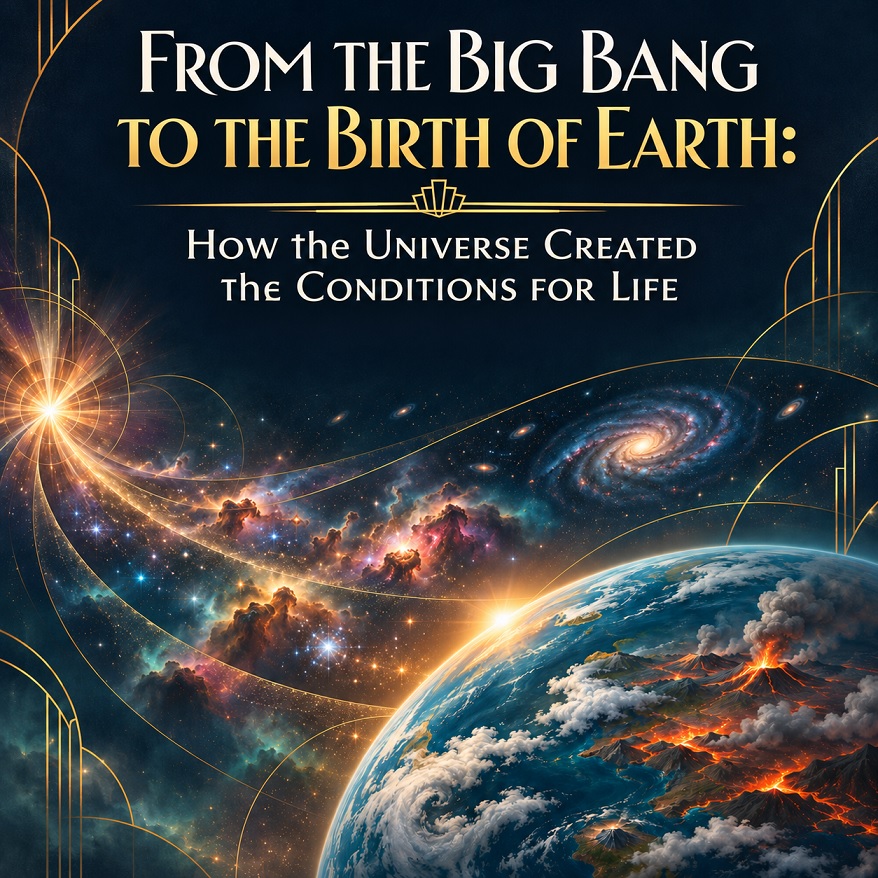
Take a handful of soil. Between your fingers are minerals, water, air, and traces of countless living things. Nothing about this ordinary handful seems cosmic. Yet the iron it contains, the oxygen bound into its minerals, and the carbon in its organic matter have histories that began long before Earth existed. To understand how our planet became a home for life, we must first travel far beyond it, to the stars that prepared the materials for its birth.
This is the story of scattered matter becoming a world with oceans: dust grains colliding and accumulating until they became planets; molten iron sinking toward Earth’s center; a colossal collision associated with the Moon’s formation; and a young world of volcanoes, steam, cooling rock, and sunlight arriving from a star roughly 150 million kilometers away.
We will keep the earliest history of the universe brief. The Big Bang, the first particles, and the earliest cosmic epochs deserve a separate, detailed exploration. Our central question begins where that story leaves off: how did the universe manufacture the chemical elements needed for rocky planets, how did the solar system and Earth form, and how did our planet acquire environments in which life could eventually emerge?
We will also draw a clear boundary at the other end. This article does not explain how nonliving chemistry produced the first protocells, or how biological evolution eventually led to human beings. Those are the next two chapters. Here we prepare the stage: the materials, the planetary setting, and the sources of energy that existed before the first living organisms.
Imagine Earth as a house that nature assembled over billions of years. First the building materials had to exist. Then they had to gather in one place. Finally the house needed a suitable temperature, liquid water, an atmosphere, and conditions stable enough to persist. The construction of that extraordinary home is the subject of our journey.
A Brief Glimpse of the Beginning: A Universe Without Planets

About 13.8 billion years ago, the universe entered the early hot, dense phase of expansion we call the Big Bang. This was not a bomb exploding into an already empty room. Space itself expanded, and the temperature and density of cosmic matter changed as it did. The full explanation belongs to cosmology; what matters here is that neither the Sun nor Earth nor familiar rocks existed yet.
In the earliest stages, conditions were too hot for stable atoms of the kind we know today. As the universe cooled, the lightest atomic nuclei formed, mainly hydrogen and helium, with tiny amounts of lithium. Later, electrons joined nuclei to form neutral atoms. Think of a kitchen stocked with only a few basic ingredients. Those ingredients are essential, but they cannot yet provide the enormous variety of materials needed to build a planet.
Roughly 380,000 years after the beginning, light could travel relatively freely through space. We detect a remnant of that ancient radiation today as the cosmic microwave background. It is one of our strongest sources of evidence about the young universe. Yet it does not show a finished landscape of stars and planets. It records conditions from which the later cosmic structures developed.
Gravity gradually amplified small differences in the distribution of matter. Regions containing slightly more material attracted still more. Over millions of years, the first stars and galaxies formed. Imagine a snowball gathering more snow as it rolls, although the actual cosmic processes are vastly more complicated. The universe began producing the luminous objects that would transform its chemistry.
That is where we will leave the detailed story of the earliest cosmic epochs. The essential point for Earth’s history is simple: the young universe contained mostly light elements, whereas our planet required silicon, magnesium, iron, oxygen, carbon, and many others. To discover their origins, we must look inside the stars.
Stars: The Factories That Prepared the Materials for Worlds

Consider a stainless-steel spoon. Its iron and other elements were not manufactured in the first minutes of the universe. The same is true of calcium in our bones, oxygen in water, and silicon in sand. Their histories lead to stars. These brilliant spheres are not merely lights scattered across the night sky. Nuclear reactions inside them change the composition of matter.
A star forms when part of a gas cloud contracts under gravity. Its interior becomes hot and dense enough for nuclear fusion. In stars like the Sun, the main long-lasting process converts hydrogen into helium and releases energy. Imagine a power station that does not burn wood or coal but draws energy from changes within atomic nuclei. That is why stars can shine for millions or billions of years.
During later stages of stellar evolution, different stars can produce heavier elements. Massive stars pass through successive phases of fusion, building a variety of atomic nuclei. Not every star follows the same path. Its mass influences the temperatures it reaches, its lifetime, and the changes within its interior. Just as a household oven and an industrial furnace operate under different conditions, stars of different masses have different nuclear capabilities.
Carbon and oxygen have particularly important stellar origins. Under suitable conditions, helium nuclei participate in reactions that produce carbon and subsequently oxygen. Both are essential to Earth’s chemistry. Carbon can form an immense variety of compounds, while oxygen is part of water and many minerals that make up rocks.
Iron has another remarkable history. It is associated with nuclear processes in massive stars and certain stellar explosions. On Earth, iron contributes a large proportion of the core’s mass. Imagine that the material used for a house’s foundations was manufactured in a distant factory long before the building site itself existed. That is the relationship between ancient stars and Earth’s interior.
Not every element was produced in the same star or by the same process. Some of the heaviest elements are associated with stellar explosions and events such as neutron-star mergers. The real history is richer than the familiar expression that we are made of stardust. But its central meaning is sound: much of the material that eventually became Earth is inherited from earlier generations of cosmic objects.
When Stars Return Their Riches to Space

A factory would contribute little to the outside world if everything it produced remained locked inside forever. Likewise, elements created in stars must reach interstellar space before they can participate in the formation of new stars and planets. This happens through stellar winds, the shedding of outer layers, and powerful explosive events.
Stars of certain masses end their lives by releasing substantial amounts of gas enriched with elements formed during their evolution. More massive stars can undergo core collapse and explode as supernovae, scattering material into surrounding space. Imagine a dandelion releasing seeds into the wind. Stars scatter not biological seeds but atoms and atomic nuclei that can take part in future cosmic histories.
Some particularly heavy atomic nuclei form through rapid neutron-capture processes under extreme astrophysical conditions. Observations of neutron-star mergers demonstrate the importance of such events for producing heavy elements. It is astonishing that phenomena occurring at immense distances are connected to the chemistry of ordinary objects we hold in our hands.
Once released, matter mixes with interstellar gas and dust. Some of it later joins new generations of stars. Over time, certain galactic regions become richer in elements heavier than helium. Astronomers often call all these heavier elements ‘metals,’ even when chemistry does not classify them as metals. This specialized term helps describe how chemically enriched a gas cloud has become.
Dust grains are especially important. They can contain silicate and carbon-rich materials and provide the solid matter from which larger objects eventually accumulate. Household dust is something we usually try to remove. Cosmic dust, by contrast, is one of the raw materials without which rocky planets could not form in the familiar way.
Earth’s history therefore begins with an inheritance. The solar system was not made solely from primordial hydrogen and helium. It formed from matter that had passed through earlier cosmic generations. Granite, water, and iron all remind us that our world was not the opening act of the universe’s history, but the outcome of a long sequence of transformations and recycling.
The Milky Way: The Galactic Home of the Future Sun
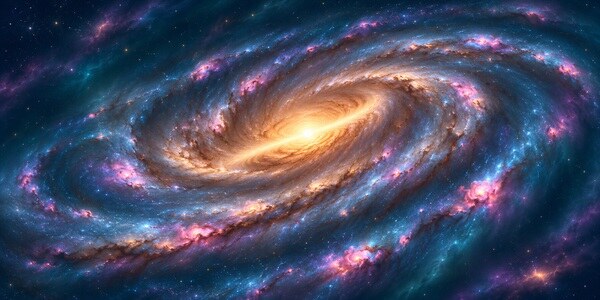
Our Sun did not appear in an empty, lonely universe. It belongs to the Milky Way, an enormous galaxy containing stars, gas, dust, and dark matter. When we see the Milky Way’s luminous band from a dark location, we are looking through part of its disk from the inside. It is like standing among trees and trying to imagine the shape of the entire forest.
The Milky Way has a history of growth, interactions, and mergers with other stellar systems. Galaxies are not motionless islands. New stars form, old stars complete their lives, and gas moves between regions. Different parts of the galaxy offer different conditions for star formation. Our Sun arose in one such environment after the Milky Way had already existed for billions of years.
The Sun lies within the galactic disk, tens of thousands of light-years from the galactic center. A light-year measures distance, not time. By comparison, sunlight reaches Earth in a little over eight minutes. Even within our own galaxy, distances are so enormous that everyday kilometers quickly become inconvenient.
Rocky planets require a gas cloud containing sufficient heavier elements and dust. Such materials were far scarcer during the earliest cosmic epochs. After generations of stars, however, parts of galaxies contained the necessary ingredients. Imagine a settlement that initially has only timber but gradually gains metal, glass, bricks, and tools. More types of material make more types of construction possible.
This does not mean the galaxy was designed to produce Earth. Gravity, stellar evolution, and chemistry do not follow a predetermined script. Looking backward, however, we can identify a necessary sequence: without earlier generations of stars, the cloud that formed the Sun would not have possessed the same wealth of rock-forming elements.
Our home is also part of a much greater movement. The Sun orbits the center of the Milky Way over hundreds of millions of years. Earth does not remain fixed while the stars circle it. It travels with the Sun through the galaxy, carrying oceans, continents, and all the life we know.
The Interstellar Cloud Where Our Story Begins

About 4.6 billion years ago, part of a vast cloud of gas and dust began to contract. It contained hydrogen, helium, and numerous heavier elements accumulated throughout the galaxy’s earlier history. Among its particles were grains that would eventually become parts of planets, asteroids, and meteorites. Imagine an immense warehouse filled with materials from different manufacturers and different ages. An entire system of worlds would be assembled from them.
Gravity drove the contraction. Matter attracted matter, and denser regions gathered additional gas. But the cloud was not motionless or perfectly symmetrical. It had movement, rotation, magnetic fields, and uneven density. Consequently, much of the material did not simply fall straight toward the center. Conservation of angular momentum helped produce a rotating disk around the growing young star.
Think of a figure skater spinning with arms extended and then drawing them inward. The skater rotates faster as the distribution of mass changes. The cosmic process differs greatly in scale and detail, but the principle of conserved rotational motion is related. The contracting system formed a disk rather than collecting all its matter into one ball.
A protostar-the young Sun-grew at the center. Around it remained a protoplanetary disk containing gas, dust, and increasingly large solid particles. Astronomers observe similar disks around young stars today. This is one reason the general picture of our solar system’s origin is persuasive: elsewhere in the galaxy, we can observe systems undergoing comparable stages of development.
The precise event that may have assisted the cloud’s contraction has not been established. Possible influences include motions and compressions within interstellar gas. There is no need to invent one dramatic spark. Observations show that dense regions of molecular clouds naturally collapse under suitable conditions.
Most of the system’s mass accumulated in the central star, while a much smaller fraction remained in the disk. Yet that smaller fraction would build the planets. It resembles a construction project in which the main structure consumes nearly all the material, but the remainder becomes a complex collection of rooms and instruments. For us, those ‘leftovers’ are the most important part.
From Dust Grain to Planet: The Greatest Construction Project Without a Builder

Imagine two dust grains meeting in the air. Sometimes surface forces allow them to stick together. In a protoplanetary disk, dust grains also collide, and some form larger aggregates. This begins a long process that can lead from microscopic particles to rocky bodies. Yet the difference between a grain of dust and a planet is enormous. Bridging that gap is a central problem in the science of planet formation.
Small particles move through the disk’s gas and experience drag. Under certain conditions, they can become concentrated in denser regions. Processes such as streaming instability provide a mechanism through which clusters of solids can collapse under their own gravity into larger objects. These are planetesimals, early building blocks of planets.
Imagine vehicles gradually gathering in a parking lot, except that the vehicles sometimes combine into larger groups. The comparison is limited: cosmic collisions can join, fragment, or scatter material. Not every impact produces growth. Speed, size, and composition matter. Planet formation involves both accumulation and destruction, not endless sticking.
As some bodies grow massive enough, their gravity attracts neighboring objects more effectively. Growth can accelerate and produce planetary embryos. These interact, alter one another’s orbits, and sometimes collide. The inner solar system underwent a prolonged history of such encounters, gradually giving rise to the rocky planets.
Why are the inner planets rocky, while gas and ice giants occupy the outer system? Temperatures within the disk and the availability of different condensed materials played important roles. In warmer inner regions, volatile substances were less readily retained as solids; farther out, additional ices could exist. Large planetary cores in the outer disk could also accumulate substantial gaseous envelopes. The full picture includes planetary migration and complex gravitational interactions.
The solar system was not a collection of objects placed on finished orbits. It emerged through growth, impacts, rearrangement, and gravitational negotiation among many bodies. Today’s planets are the surviving large participants. Asteroids and comets preserve some of the remaining material, like fragments left at a building site that tell us how construction proceeded.
Cosmic Fossils: What Meteorites Tell Us About Earth’s Birth
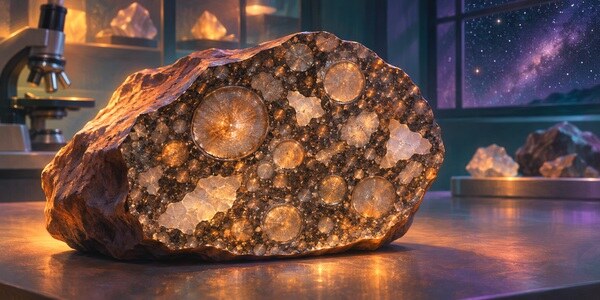
A meteorite displayed in a museum may look like an ordinary dark stone. Yet some meteorites contain material formed before Earth acquired its present character. They are witnesses to the early solar system. If Earth’s rocks are pages from our planet’s history, ancient meteorites preserve pages from the time when the planet was still being assembled.
Chondrites are particularly important. These stony meteorites often contain small rounded structures called chondrules. Some also contain calcium-aluminum-rich inclusions, or CAIs, among the oldest dated solids in the solar system. Their ages are approximately 4.567 billion years, providing a crucial reference point for the beginning of planetary history.
How are such ages measured? Radiometric dating uses the known rates at which radioactive isotopes decay. Imagine an hourglass whose flow rate is known. If you know how much sand has moved and the system has remained closed, you can estimate the elapsed time. Real isotope methods are more complex, but the underlying idea is similar: chemical composition contains a record of time.
Meteorites also reveal the materials present in the young disk. They contain minerals, metals, and sometimes organic compounds. Some were heated; others interacted with water within their parent bodies. These differences show that even small objects in the early solar system experienced varied histories. They are chemical archives, not interchangeable stones.
Presolar grains are especially remarkable. These microscopic particles formed around stars that existed before the Sun. Some survived inside meteorites and can be identified through unusual isotope ratios. Imagine discovering a brick in a new house that is older than the town itself. It reveals that some building materials have biographies far older than the structure containing them.
Meteorite research connects astronomy with laboratory geochemistry. Telescopes show us disks around distant stars, while meteorites allow us to examine materials from a similar process that occurred in our own system. Earth’s origin is therefore not inferred solely from its present appearance. Physical samples preserve traces of its earliest environment.
The Birth of Earth: A World Built by Collisions
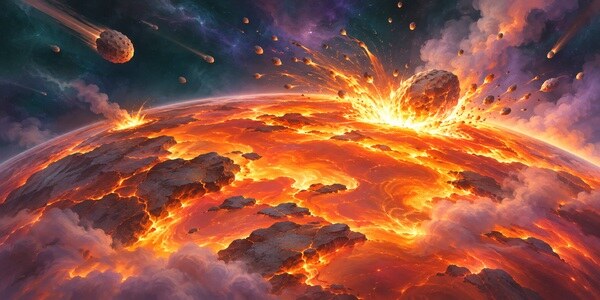
About 4.54 billion years ago, Earth was taking shape as a distinct planet. It did not appear as a smooth blue sphere with oceans and clouds. It grew through the accumulation of material and collisions with other bodies. Some impacts added mass, others melted large regions, and the most energetic reshaped the planet’s structure. Imagine construction in which each new delivery sometimes demolishes and rearranges what has already been built.
Energy released by impacts became heat. Additional heating came from gravitational processes and the decay of radioactive isotopes, especially significant during early stages. As a result, young Earth experienced episodes of extensive melting. Scientists speak of magma oceans-large regions of molten silicate rock, entirely unlike today’s water-filled oceans.
When we imagine lava, we usually picture a stream emerging from a volcano. Early planetary melting could occur on a vastly greater scale. Large impacts could melt substantial portions of the surface and interior. This does not mean the planet remained completely molten throughout its entire early history. Heating and cooling occurred during different stages of development.
Growing Earth interacted with numerous smaller bodies, while its orbit developed within the gravitational influence of the Sun and other planets. Some objects were absorbed, others expelled, and some remained elsewhere in the solar system. Today’s relatively orderly planetary arrangement is the outcome of a long dynamic history, not the starting condition.
At this stage there was no familiar stable surface on which to stand. But processes were beginning that would define the planet: the separation of materials according to density, the formation of a core, the cooling of the silicate exterior, and the release of gases. Earth gradually became more than a growing collection of rock and metal. It developed its own internal structure.
We should not picture this as a single day of creation. The planet formed over millions of years and has continued changing ever since. Earthquakes, volcanoes, and the movement of continents remind us that its interior is still active. Modern Earth is a cooler but living geological descendant of that turbulent young world.
Iron Sinks and Rock Rises: How Earth Acquired Its Layers
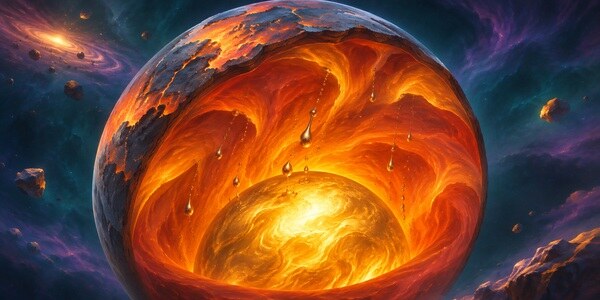
Pour water and oil into a transparent container. After a while, the liquids separate into layers because their densities differ and they do not mix completely. This provides a simple first analogy for a crucial process on young Earth: differentiation. When large portions of the planet were molten, materials could redistribute, and denser metallic components moved toward the interior.
Iron, together with nickel and other elements, contributed to Earth’s core. Lighter silicate materials remained mainly in the mantle and crust. This was not literally the same as oil separating from water: it involved immense pressures, complex chemistry, and moving molten material. But the analogy explains why Earth is not a uniform ball of stone.
Today the core has a solid inner portion and a liquid outer portion. The mantle consists mainly of solid rock that can deform and flow very slowly over geological time. The crust is a relatively thin outer shell. If Earth were an apple, the crust would resemble its thin skin, though the comparison is approximate. Most of our planet lies far beneath our feet, beyond direct human access.
How can scientists know what is inside? Earthquakes send seismic waves through the planet. Different waves travel differently through solid and liquid materials. Imagine a doctor examining the inside of a body using signals that pass through it. Seismology allows researchers to reconstruct Earth’s structure without drilling a tunnel to the core.
Differentiation was important for later habitability. It produced a planet with a metallic core, silicate mantle, and surface capable of supporting varied rocks and minerals. Internal heat and the movement of materials influence volcanism and long-term geological activity. These processes eventually contribute to exchanges between Earth’s interior, atmosphere, and oceans.
When we hold an ordinary stone, we see only a tiny piece of this construction. Yet the stone exists on a planet that separated into layers and developed an internal geological life. Without that history, Earth would not have the same surface, chemistry, or long-term processes that shape its environments today.
The Giant Impact: The Story of the Moon

Look at the Moon on a clear evening. It appears peaceful, almost motionless, yet its origin is associated with one of the most dramatic events in Earth’s history. The leading scientific model explains its formation through a giant collision between young Earth and a large protoplanetary body often called Theia. The model continues to be refined; it is not a recording of an event whose every detail has been settled.
Imagine two enormous bodies moving along orbits around the Sun. Their collision releases tremendous energy. Material melts or vaporizes, and some is thrown into orbit around Earth. The Moon forms from material associated with that aftermath. The precise conditions of the impact, mixing of matter, and subsequent assembly are studied using computer simulations, laboratory analyses, and lunar samples.
One reason the model matters is the chemical relationship between Earth and lunar rocks. Isotope ratios of certain elements reveal striking similarities. At the same time, the Moon has a comparatively small metallic core and a different inventory of volatile materials. These characteristics impose demanding conditions on any explanation. A model must account not only for the existence of a satellite but for its observed composition.
After its formation, the Moon was closer to Earth than it is today. Tidal interactions gradually changed Earth’s rotation and the Moon’s orbit. Today the Moon moves away on average by a few centimeters each year, a change measured using laser experiments and reflectors on the lunar surface. It is extraordinary that we can measure such slow motion across hundreds of thousands of kilometers.
The Moon influences ocean tides and contributes to the long-term dynamics of Earth’s rotational axis. But it would be an exaggeration to declare that life is impossible without a moon. Science investigates how this satellite shaped our planet’s particular history, not whether it is a universal requirement for every habitable world.
The next time you see moonlight on water, consider the connection between beauty and catastrophe. The object that inspires poetry and marks the rhythm of tides carries traces of the age of planetary collisions. Calm celestial scenes can have violent beginnings.
The First Solid Surface: How a Fiery World Began to Cool
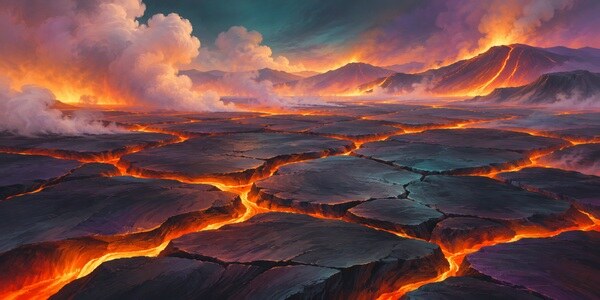
Remove molten metal from a furnace and its exterior begins to cool and solidify. Something broadly similar, though vastly more complicated, occurred on young Earth. After major episodes of heating and melting, silicate material gradually released heat. Solid minerals and rocks formed, only to be altered by later impacts, volcanism, and movement within the planet.
Earth’s earliest crust does not survive as one continuous ancient continent we can simply visit. Later geological processes reworked enormous amounts of early rock. Earth is active: rocks melt, become buried, deform, and break down. Imagine a notebook whose pages are repeatedly erased and written over. That is why the opening chapters of Earth’s geological history are so difficult to reconstruct.
Some mineral grains, however, survived. Zircons from Western Australia have been dated to approximately 4.4 billion years old. They are among the oldest known terrestrial mineral witnesses. Zircon is small and durable, capable of preserving information about the conditions in which it formed. Imagine a single strong stone surviving from a demolished ancient building. The building is gone, but the stone still reveals something about its time.
Chemical features of certain ancient zircons have been interpreted as evidence of interaction with water and relatively early cooling of parts of Earth’s surface. These interpretations are investigated and debated because minerals can have complicated histories. It is important to distinguish the reliably measured age of a mineral from the more difficult question of exactly what environment existed when it formed.
Over time Earth developed different kinds of rocks: igneous, sedimentary, and metamorphic. Igneous rocks form as molten material cools. Sedimentary rocks arise from accumulated particles or chemical deposits. Metamorphic rocks change under heat and pressure without necessarily melting completely. These are different ways in which the planet continually rewrites its stony record.
The emergence of solid surfaces matters not because it immediately created life, but because it provided diverse places where water, gases, and minerals could interact. Cracks, shores, volcanic regions, and the seafloor could differ in temperature and chemistry. A planet that looks uniform from a distance gradually developed an enormous range of local environments.
Where Did Earth’s Water Come From?
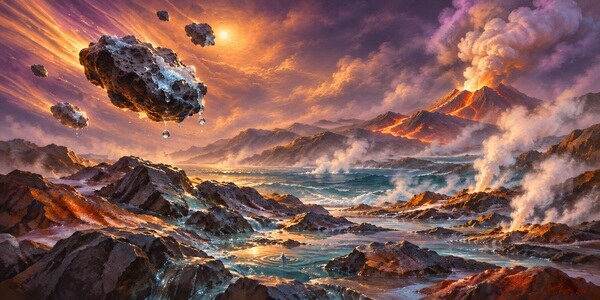
Turn on a tap and fill a glass. Water seems so ordinary that we rarely ask how it arrived on Earth. Yet our planet formed in the relatively warm inner solar system. Where did the enormous quantity of water in today’s oceans come from? The answer involves the materials from which Earth grew, later deliveries of volatile substances, and processes that redistributed water between its interior and surface.
Water consists of hydrogen and oxygen. It can exist as ice, vapor, liquid, or as part of mineral structures. When we speak of water being delivered, we should not imagine only icy comets crashing into an already finished ocean basin. Hydrogen and oxygen can be incorporated into different substances, while processes inside a hot planet can release water as vapor.
Hydrogen isotope ratios, particularly the ratio of deuterium to ordinary hydrogen, help scientists compare possible water sources. Some types of meteorite material show chemical characteristics consistent with important contributions to Earth’s volatile inventory. Comets are also investigated, but their contribution is not automatically assumed to be the only or dominant source. Researchers combine geochemistry, planetary models, and observations.
Imagine trying to discover how a large lake filled up without having any record of the event. You could analyze its water, examine surrounding rocks, observe streams, and reconstruct past climate. Earth’s case is harder still because the clock must be turned back billions of years. No single sample tells the whole story.
Water also existed within Earth in hydrogen-bearing minerals and components dissolved in magma. Volcanic activity can release water vapor that condenses when conditions permit. There is a long-term exchange between the surface and the interior. Today’s oceans are not simply an unchanged reservoir placed on the planet at one moment.
The crucial outcome is that Earth retained substantial water and, under suitable conditions, maintained liquid oceans. This is a major reason we call it the blue planet. But the blue seen from space is the result of a complex history of delivery, gas release, cooling, and geological exchange.
When Steam Became Ocean: Early Watery Earth

Imagine a bathroom filled with hot steam. As the air and walls cool, droplets appear on surfaces. Young Earth also experienced periods when water existed in the atmosphere as vapor and cooling permitted condensation. The scale, however, was planetary, involving high pressures, a different atmosphere, and heat from Earth’s interior and the Sun.
After sufficient cooling, water could gather in low-lying regions of the surface. The exact sequence of the earliest oceans is difficult to reconstruct because ancient rocks are rare and often altered. Nevertheless, geochemical evidence indicates that water interacted with Earth’s crust very early. This is a remarkable realization: our planet did not remain an entirely fiery sphere indefinitely.
Liquid water transforms rock. It enters cracks, dissolves some substances, transports ions, and participates in the formation of new minerals. Leave sugar in a cup of tea and watch the solid gradually disappear into the liquid. Rock dissolution is slower and chemically more complicated, but the underlying ability of water to transport substances is similar. Oceans became active participants in geological processes.
Water also influences temperature. Its high heat capacity means it can absorb or release considerable heat with relatively moderate changes in temperature. Large bodies of water can therefore moderate climatic fluctuations. Think of a stone and a large container of water left in the sunlight: they do not heat and cool in the same way. On a planetary scale, oceans store and redistribute heat.
We should not imagine the earliest oceans as exact copies of today’s seas. Their chemistry, temperature, dissolved substances, and interactions with atmosphere and rock changed over time. Even their appearance cannot be confidently reconstructed from popular illustrations. The scientific task is to establish what conditions were possible and what the surviving evidence supports.
With the emergence of lasting water bodies, Earth gained a new kind of surface activity. Waves, currents, evaporation, precipitation, and chemical exchanges connected different regions. The planet was no longer merely a rocky object orbiting a star. It was becoming a system in which water, air, and stone continuously exchanged energy and matter.
The Early Atmosphere: Air We Could Not Breathe
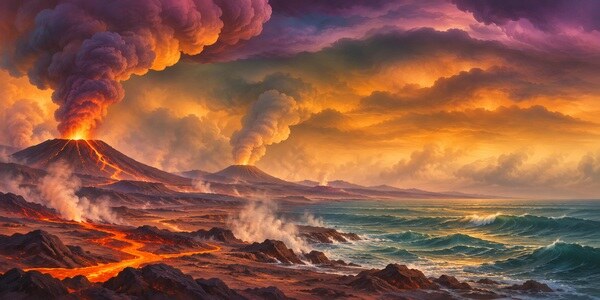
Today’s air consists mainly of nitrogen and oxygen, with small quantities of other gases. This mixture feels so natural that it is difficult to picture anything else. But young Earth had an atmosphere with a different composition and history. Some early gaseous envelopes may have been lost, while others formed through gases released from the interior and substances delivered by impacting bodies.
Volcanoes are important to this story. As magma rises and pressure decreases, dissolved gases can escape. Think of opening a carbonated drink: lowering the pressure allows bubbles to emerge. Volcanic conditions and substances are very different, but the comparison helps explain how gases dissolved in molten rock can enter an atmosphere.
Water vapor, carbon dioxide, and various sulfur compounds are among the important components of volcanic gases, alongside other substances. Their precise proportions and changes over time are not known with equal certainty. The atmosphere was not a fixed mixture. It interacted with oceans, rocks, and solar radiation, while chemical reactions continually altered its components.
Crucially, free oxygen was not present in today’s abundance during Earth’s earliest history. The oxygen we breathe is closely connected with much later biological evolution. We should therefore not imagine young Earth as a modern landscape with the trees removed. Its air, water chemistry, and interactions with rocks were different.
An atmosphere performs several important functions. It creates surface pressure, transports heat, contains gases that absorb and emit infrared radiation, and influences the stability of liquid water. Think of a blanket: it does not generate heat but changes how heat escapes. Greenhouse gases are not literally a blanket, yet the comparison helps explain why atmospheric composition affects temperature.
For future habitability, the important issue was not air suitable for human lungs. It was the existence of physical and chemical conditions capable of supporting liquid water and varied reactions. Human lungs belong to a much later story. Young Earth did not need to be comfortable for us to become a setting where life could eventually begin.
The Faint Young Sun and the Puzzle of a Warm Earth

Today the Sun provides nearly all the energy driving surface climate and the water cycle. But the young Sun was less luminous than it is now. Stellar evolution models indicate that its output during Earth’s early history was significantly lower. This raises an important question: how could the planet maintain liquid water while receiving less solar energy?
This problem is called the faint young Sun paradox. ‘Paradox’ does not mean that the laws of nature were broken. It means we must reconcile two bodies of evidence: models of solar evolution and geological signs of liquid water on early Earth. Imagine a heating bill showing less energy supplied while evidence inside the house suggests the pipes were not permanently frozen. We need to understand the whole system.
One important factor is the greenhouse effect. Gases such as carbon dioxide can reduce the rate at which heat escapes from the surface to space. A different early atmospheric composition could have compensated for some of the weaker sunlight. Scientists also investigate clouds, surface reflectivity, atmospheric pressure, and changes in geological cycles.
Reflectivity is called albedo. Snow and ice reflect more sunlight than dark ocean surfaces. Think of a black shirt and a white shirt worn in strong sunshine: they absorb different amounts of light. On a planetary scale, similar differences influence temperature and contribute to feedbacks among ice, oceans, and atmosphere.
There is no reason to assume early Earth maintained one unchanging climate for hundreds of millions of years. Temperatures and conditions varied, and the surviving evidence is incomplete. The scientific challenge is to identify plausible climate states and the mechanisms that sustained them, rather than settle for a picture of a world that was always scorching or always frozen.
This puzzle teaches a fundamental lesson: distance from a star does not determine a planet’s temperature by itself. Atmosphere, water, clouds, reflectivity, and internal processes matter too. Habitability is not a single measurement. It emerges from the interaction of an entire planetary system.
The Right Distance Is Not Enough: What a Habitable Zone Means
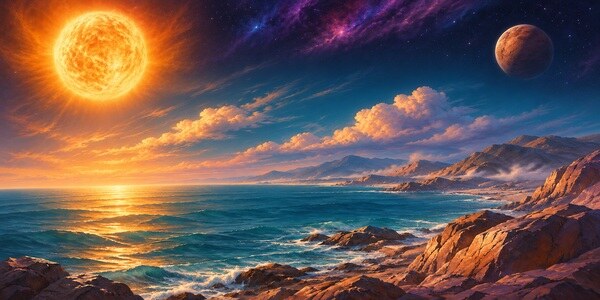
We often hear that Earth lies at the ‘right distance’ from the Sun. That is a useful starting point, not a complete explanation. Astronomers use the term habitable zone for the region around a star where a planet with a suitable atmosphere and other conditions could sustain liquid water on its surface. This describes a physical possibility, not proof that oceans or life are actually present.
Imagine finding the right place in a kitchen to cook a particular dish. The correct temperature does not cause the meal to appear. You still need a pot, water, ingredients, and a process. Likewise, distance from a star is insufficient. A planet needs the appropriate properties and history to retain water and maintain suitable conditions.
Venus and Mars show how different neighboring worlds can become. Venus has a dense atmosphere dominated by carbon dioxide and extremely high surface temperatures. Mars has a thin atmosphere and is cold today, although geological evidence shows that water once flowed across parts of its surface. All three planets formed in the same solar system, yet their histories diverged dramatically.
Earth has enough gravity to retain a substantial atmosphere, but atmospheric evolution also depends on temperature, chemistry, interactions with the solar wind, and geology. Planets are not simply balls of different sizes. They are systems in which mass, internal heat, orbit, and atmospheric history interact.
Even a planet with surface liquid water is not automatically a planet where life will emerge. Water is essential to biology as we know it, but the origin of life is a separate scientific problem. Here we are examining the preparation of an environment, not treating favorable conditions as an unproven guarantee.
The habitable-zone concept is valuable when searching for planets around other stars. It helps identify promising targets, but it cannot replace studying their atmospheres, water, and geology. Earth’s history teaches us that genuine habitability develops over time and depends on far more than one orbit.
Earth’s Magnetic Field: An Invisible Sign of Its Active Interior

A compass is a simple object that reveals something invisible. Its needle aligns with Earth’s magnetic field. We cannot see the field directly, but we can measure its effects. Most of the present global magnetic field is generated by the movement of electrically conducting liquid iron in Earth’s outer core. This process is known as the geodynamo.
Think of a bicycle dynamo, which connects movement with electrical effects. Earth’s geodynamo is not the same machine, but the analogy introduces the relationship among motion, conducting material, and magnetism. Heat, composition, and planetary rotation contribute to complex flows in the core, sustaining electrical currents and a magnetic field.
The magnetic field interacts with charged particles from the solar wind and helps shape the magnetosphere. This region deflects many particles and influences their access to near-Earth space. Auroras are beautiful visible results of interactions among charged particles, magnetic fields, and the upper atmosphere. Something happening deep below our feet can affect the sky far above us.
It is often claimed that the magnetic field is an absolute shield without which any atmosphere would inevitably disappear. The reality is more complicated. Atmospheric escape depends on gravity, temperature, composition, radiation, and plasma interactions. Some planets can retain dense atmospheres without a global magnetic field like Earth’s. The magnetosphere’s role deserves careful study, not exaggeration.
Ancient rocks can preserve traces of magnetic fields that existed when they formed. Certain minerals retain information about magnetic orientation as they cool or develop. Imagine an old compass needle frozen inside a stone. Researchers use these records to investigate the geodynamo’s early history, although the oldest evidence is difficult to interpret.
Earth’s magnetic field reminds us that our planet is not passive rock illuminated by the Sun. Its interior continues moving and influencing the space around it. This connection between a deep metallic core and the surrounding cosmic environment is one of the most unexpected relationships in our planetary home.
Volcanoes, Carbon, and the Planet’s Slow Thermostat

Leave a home’s heating system running without control and the temperature can become too high. Switch it off during a cold winter and the building cools. Earth has no thermostat designed by an engineer, but geological processes influence climate over long timescales. Among the most important are exchanges of carbon among rocks, atmosphere, oceans, and the planet’s interior.
Volcanoes release carbon dioxide from Earth’s interior. In the atmosphere, this gas contributes to the greenhouse effect. Meanwhile, chemical weathering of certain rocks can remove carbon dioxide from the atmosphere-ocean system and carry it in dissolved forms. Under suitable geological conditions, carbon becomes incorporated into sediments and minerals. Different processes move carbon among reservoirs.
Imagine a bathtub with water entering through a tap and leaving through a drain. The water level depends on the balance between inflow and outflow. Earth’s carbon cycle has many taps and drains, and their rates respond to temperature, rainfall, tectonics, and rock chemistry. Still, the analogy shows why long-term balance matters.
Warmer, wetter conditions can under some circumstances accelerate chemical weathering. This may help reduce atmospheric carbon dioxide and contribute to cooling. Such negative feedback is one reason scientists investigate silicate weathering as a mechanism for long-term climate regulation. The process has limitations and does not guarantee permanently pleasant temperatures.
Tectonics-the movement and reworking of large portions of Earth’s rigid outer shell-is part of this history. Modern Earth has a system of lithospheric plates, but when and how the modern style of plate tectonics began remain active research questions. We should not automatically project today’s exact mechanism onto the earliest Earth.
The general principle is clear: climate and geology are connected. Rocks are not merely scenery beneath oceans and atmosphere. They participate in exchanges that affect which conditions can persist over millions of years. This slow planetary rhythm is a fundamental part of habitability.
Young Earth Under Bombardment: Asteroids, Comets, and the Limits of Our Knowledge

The early solar system contained many more leftover bodies on orbits capable of crossing the paths of planets. Impacts were a normal part of planet formation. Some left craters, others transformed large regions of the surface, and the largest released enough energy to melt or vaporize substantial amounts of material. Young Earth endured this turbulent era.
The Moon is a valuable archive because it lacks oceans, rain, and active plate tectonics like Earth’s. Many ancient impact structures are therefore better preserved. Imagine two notebooks: one is repeatedly erased and rewritten, while the other retains much of its earlier writing. The lunar surface resembles the second notebook, though it has changed over time too.
A hypothesis known as the Late Heavy Bombardment once proposed a relatively concentrated episode of intense impacts around 3.9 billion years ago. Today the precise timing, character, and even the existence of a distinct global spike remain debated. Some evidence can also be explained by a more extended decline in impact frequency. Scientific care requires us not to turn a disputed reconstruction into a certain scene.
Impacts destroy, but they can also deliver material. Some asteroids and comets contain water and other volatile substances. That does not mean every delivery was beneficial or that a single impact supplied everything needed. What matters is the overall balance among accumulation, loss, heating, and subsequent cooling.
The size of an impact determines much of its effect. Small collisions may be local events, while giant ones can alter planetary conditions. Think of the difference between a pebble falling into a lake and a massive landslide reshaping its shore. On a cosmic scale, the differences in released energy are even more dramatic.
Over time, the population of large leftover bodies declined, allowing longer intervals for Earth’s surface to cool and develop. That mattered for lasting water-rich and rocky environments. But the exact sequence of the earliest impacts and their consequences for water and atmosphere are still investigated. The broad history is compelling even when individual details remain uncertain.
Why Earth Did Not Become Venus or Mars

Imagine three children raised in the same family who go on to lead very different lives. Earth, Venus, and Mars are related in a similar sense: they formed within one solar system from broadly related materials, but their present surfaces and atmospheres are dramatically different. Comparing them is one of the best ways to understand what makes Earth’s history distinctive.
Venus is nearly Earth’s size, yet its surface is extraordinarily hot. Its dense carbon-dioxide-dominated atmosphere creates an intense greenhouse effect. Venus’s possible early water history remains an active area of research. Its present conditions demonstrate that similar size and a nearby orbit do not guarantee a similar climate.
Mars is smaller and today has a very thin atmosphere. Its surface contains ancient valleys, deltas, and minerals indicating interactions with liquid water in the past. It is like discovering a dry riverbed in a desert: the landscape itself records that conditions were once different. But ancient water does not mean Mars had oceans and a climate identical to Earth’s.
Planetary size influences heat retention and atmospheric evolution, but it never acts alone. Orbit, atmospheric composition, internal activity, solar radiation, and impact history all contribute. Earth developed a combination of conditions that allowed liquid water to persist on its surface over long periods. No single magical factor explains that outcome.
When we call a planet ‘suitable,’ we should remember to ask suitable for what. Venus is not a failed Earth. Mars is not an unfinished one. They are worlds with their own physical histories. Comparing them reveals different possible outcomes of planetary evolution without assigning nature a predetermined goal.
This comparative perspective makes Earth’s history especially valuable. Our planet is more than another rocky sphere. It is an example of a world in which geology, atmosphere, and water evolved together. By studying its neighbors, scientists identify which processes are common to rocky planets and which reflect Earth’s particular biography.
A Planet of Many Environments: Why Variety Matters
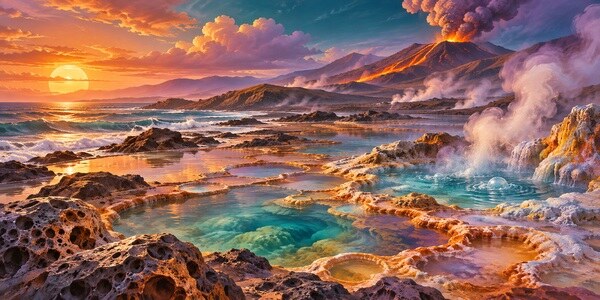
Imagine a house containing just one room, with nearly identical temperature, lighting, and humidity everywhere. Now imagine a house with a kitchen, cellar, attic, garden, and courtyard. Each offers different conditions. Young Earth gradually developed a comparable diversity: water basins, mineral surfaces, volcanic regions, shallow shores, fractures in rock, and areas with different temperatures.
Environmental variety matters because physical and chemical processes depend on local conditions. Substances dissolve differently at different temperatures, some minerals remain stable only under certain pressures, and moving water carries materials from one place to another. We need not yet enter the chemistry of life’s origin. It is enough to understand that Earth provided not one laboratory setting but many.
The ocean floor is not a smooth plate. It includes volcanic regions, faults, and places where water enters rock and later emerges warmer and chemically altered. On land and along shores, rainfall, evaporation, and erosion also create changing conditions. Imagine a city with many workshops, each using different tools and temperatures. Diversity increases the range of possible processes without guaranteeing any particular result.
Minerals matter not only as a solid foundation. They interact with water and dissolved substances, participate in chemical exchanges, and influence local composition. Different rocks have different properties. Basalt, granite, and iron-rich minerals are not interchangeable. Just as wooden, metal, and glass surfaces behave differently when heated or exposed to water, mineral environments have distinct characteristics.
Water movement connects these places. Rivers, underground flows, and ocean circulation transport heat and dissolved materials. Evaporation and precipitation move water between surface and atmosphere. Geological activity supplies new rock, while weathering transforms older material. Earth developed a system of connected but unequal environments.
This is the bridge to our next article. To investigate life’s origin, we first need to understand the physical settings available on the planet. Young Earth was not a sterile laboratory performing a single experiment. It was a dynamic world containing a tremendous variety of places where water, minerals, and energy interacted.
How Scientists Reconstruct a World Nobody Witnessed

The farther we travel into the past, the scarcer Earth’s surviving evidence becomes. The oldest rocks have been altered, remelted, and destroyed. The history of young Earth therefore cannot be reconstructed from one location or one kind of evidence. Researchers combine meteorites, lunar samples, ancient terrestrial minerals, geophysical measurements, laboratory experiments, and computer models.
Imagine a detective reconstructing an event from the distant past. There are a few witnesses, incomplete documents, fingerprints, and traces left on objects. No single source is sufficient. But when independent clues point in the same direction, the reconstruction becomes more persuasive. Science connects cosmic and geological history in much the same way.
Radiometric dating establishes the ages of particular minerals and materials. Isotope ratios provide information about origins and transformations. Seismic waves reveal Earth’s internal structure. Astronomical observations show planetary disks forming around other stars. Each method answers different questions and has its own limitations.
Computer models allow scientists to investigate events impossible to reproduce at full scale: giant planetary impacts, cooling magma oceans, and gas movement within a protoplanetary disk. But a model is not proof simply because its images look impressive. It must be compared with observations. If a simulation produces a Moon unlike the real one in composition or orbit, the model needs refinement.
Some questions have highly reliable answers. We know the approximate age of the solar system, the main layers of Earth, and the stellar origins of many heavy elements. Others remain open: the exact details of the Moon-forming impact, the earliest atmospheric composition, the timing of stable oceans, and the beginning of modern-style plate tectonics.
Naming these uncertainties does not weaken the story. It makes the story more truthful. Science combines wonder with discipline: it allows us to imagine an ancient world while requiring us to test important details. Earth’s history remains a living field of discovery because new evidence continues to sharpen the picture.
Earth on the Threshold of Life: When the Stage Was Ready

Let us return to our imaginary house. Its building materials came from earlier generations of stars. Gravity gathered some of them around the young Sun. Dust became larger bodies, and collisions built Earth. Metals moved inward, rocks formed the outer shell, and water and gases contributed to oceans and atmosphere. The house now had walls, internal heat, water, and a constantly changing environment.
But nature did not build this house with the intention of accommodating life. Stars did not produce carbon for the sake of future plants, and volcanoes did not release gases for the sake of future oceans. These were physical and chemical processes following their own laws. Looking back from the present, we can see how their outcomes established conditions necessary for the next chapter.
Those conditions involved more than water. They included varied chemical elements, mineral surfaces, energy sources, suitable temperatures in particular settings, and intervals long enough for processes to unfold. Imagine a kitchen already equipped with water, cookware, ingredients, and a stove. It is not a finished meal, but it is profoundly different from an empty room.
Early Earth was not equally welcoming everywhere or at all times. Large impacts, volcanism, and climatic changes created both limitations and distinct local conditions. Habitability does not mean perfect calm. It means that environments exist where certain processes can persist. Our planet’s story is one of opportunities appearing, changing, and sometimes disappearing.
Here our journey must stop at an extraordinary threshold. We have followed the origins of Earth’s materials and the processes through which it acquired water, atmosphere, rocks, and sources of energy. We have not yet explained how these nonliving substances gave rise to a system capable of reproducing and passing on information. That is the question of the next article: how life arose from nonliving matter.
After that comes the third great chapter: billions of years of biological evolution leading to plants, animals, and human beings. Together the three accounts form a continuous story-from cosmic beginnings and the construction of a habitable Earth, through life’s emergence, to creatures able to look at the stars and ask where they came from.
Now look again at the handful of soil with which we began. It is no longer merely soil. It is material inherited from ancient stars, reworked by planetary collisions, internal heat, water, and time. Within that handful, the history of the galaxy meets the history of Earth. And from a world rich in matter, energy, and possibilities begins the next, even more extraordinary chapter.
Author: Vasil Stoyanov