
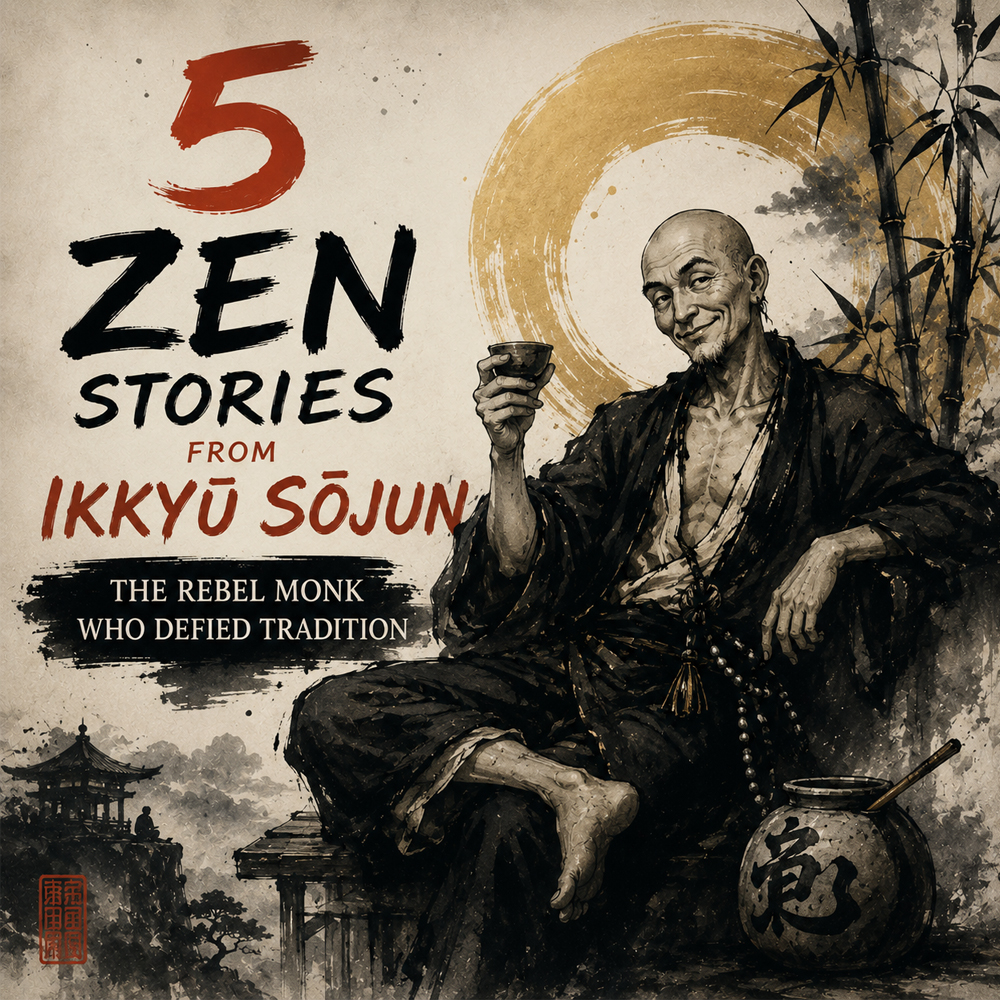
Ikkyū Sōjun (1394–1481) was a Zen master from Japan, born during a period of political turmoil and civil war.
As a child, he entered a monastery, where he began his training in Zen and his search for the true nature of the mind. From an early age, he showed a tendency to question established norms and seek deeper understanding beyond scriptures and rigid rules.
On his path toward enlightenment, Ikkyū endured doubt, loneliness, and profound inner struggles. His awakening came through direct experience rather than blind adherence to tradition. This transformed him into a sharp critic of hypocrisy and formalism within religious institutions.
He chose to live close to ordinary people, often visiting taverns and interacting with individuals from all walks of life. For Ikkyū, Zen was not something separate from everyday existence-it was expressed through it.
This understanding found its way into his poetry and calligraphy, both of which combined spirituality, humor, and a deep appreciation for human experience.
Toward the end of his life, Ikkyū became the abbot of an important Zen temple, yet he never lost his independent spirit or his critical way of thinking. His teachings emphasized that truth is not found in words or forms, but in direct experience itself.
According to Ikkyū, enlightenment is available here and now, within life itself. In this article, we will explore five stories from his remarkable life, beginning with one of the most famous and fascinating-an episode that reveals his attitude toward formality and the dogmas of Zen Buddhism. It illustrates his courage and determination to place truth above social expectations and religious conventions.
1. The Naked Meditation
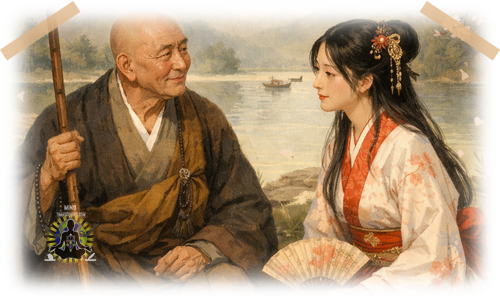
One day, Ikkyū was passing through a village when he met a beautiful woman who invited him for tea. During their conversation, she said something that stayed with him:
“Perhaps you will find the truth only when you free yourself completely from all the external restrictions imposed by society and religion.”
Her words deeply affected him. Rather than dismissing them, Ikkyū decided to put his own understanding of Zen to the test.
The following day, he returned to the monastery where he taught and did something no one expected.
He sat down to meditate completely naked.
When the other monks saw him, they were shocked. They gathered around and demanded an explanation, asking why he had abandoned his monastic robes and chosen to meditate without clothing.
With his characteristic bluntness and humor, Ikkyū replied:
“True Zen is not found in following rules or maintaining appearances. It is found in experiencing the present moment exactly as it is. What deceives you is not the robes or the formalities themselves, but your attachment to them.”
The story quickly spread throughout Japan, and Ikkyū became increasingly known as a symbol of nonconformity within the Zen tradition.
For him, genuine wisdom did not arise from obedience to external rules. It arose from inner freedom, direct experience, and the courage to question even the things that others considered sacred.
2. The Crime of Being Human
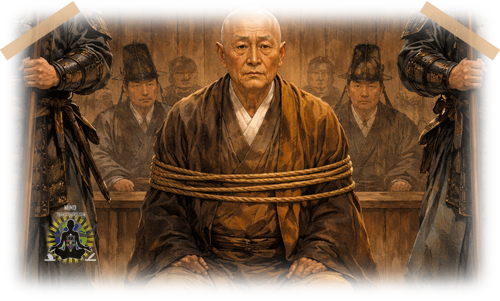
One day, while traveling, Ikkyū arrived in a large city. There, he took residence in a temple where he was already well known and continued his meditation practice and teachings.
Before long, however, rumors began to spread that he had committed a serious offense.
The following day, a group of monks arrived at the temple, led by a senior monk who confronted him with the accusation.
„Ikkyū,“ he said, „we have heard that you have violated the monastic rules and committed a terrible transgression. How do you explain yourself?“
Ikkyū remained completely calm. He neither became defensive nor attempted to justify his actions.
Instead, he stepped forward and said:
„Yes, I have indeed committed a crime. I fell in love with a woman and gave in to those human desires that you call ‘sin.’ But what is the true crime? Is it that I am human and allowed my heart to experience love? Or is it that I wished to experience life in its full depth and authenticity?“
His response unsettled the monks, who did not know how to react.
They had expected a confession followed by repentance and self-punishment. Instead, Ikkyū challenged them with a deeper question concerning the true nature of monasticism and morality.
Then he added:
„Do you not see that you suppress your own feelings and desires beneath the strict rules you have imposed upon yourselves? Yet you fail to understand that life is not about avoiding passions, but about recognizing them and transforming them into something higher.“
In the end, his accusers could find no answer to his words. Unable to refute him, they could not bring themselves to impose a punishment.
Ikkyū was never condemned, but the story endured as a testament to his courage in confronting hypocrisy and living a life that could not be confined within the limits of tradition.
The Lesson
This story is not a rejection of discipline, nor is it an argument that every desire should be followed without restraint. Rather, it raises a fundamental question: is spirituality achieved by suppressing our humanity, or by understanding it?
Ikkyū believed that many forms of religious hypocrisy arise when people pretend to have transcended desires they have merely buried. What is pushed into the shadows does not disappear. Instead, it often returns in more destructive forms. Genuine growth begins not with denial but with honest self-awareness.
Zen emphasizes direct experience over rigid conformity. Rules may provide guidance, but they cannot replace understanding. A person may follow every regulation and still remain trapped by fear, attachment, and self-deception.
For Ikkyū, the goal was not to become less human but more conscious. Love, desire, joy, grief, and longing are all part of the human condition. The challenge is not to eradicate them, but to encounter them with awareness and transform them into wisdom.
The story reminds us that authenticity often requires courage. It is easier to hide behind rules than to confront ourselves honestly. Yet true freedom begins the moment we stop pretending to be something we are not.
3. The Broken Cup
One morning, Ikkyū invited several of his students into his quarters for a teaching.
They expected one of his usual lectures on Zen and enlightenment. But instead of beginning with words, Ikkyū picked up a cup that was sitting on the table and held it before them.
„Look at this cup,“ he said.
„It is only a cup, yet each of you sees it differently. Some see an object useful for drinking. Others see something beautiful or valuable. Still others see something fragile that could be destroyed if it fell.“
He paused for a moment.
„But the true nature of the cup is not what you see. It is simply a cup.“
The students looked at one another, unsure of where the lesson was leading.
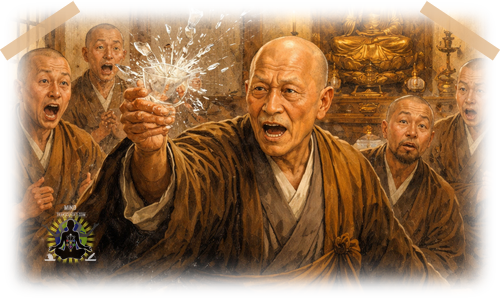
Then, without warning, Ikkyū slammed the cup onto the floor.
It shattered into pieces.
The room fell silent.
„What happened to the cup?“ he asked.
The students stood frozen in shock.
Ikkyū continued:
„What you see is only form. Form is temporary; it is not eternal. The true nature of the cup has not changed. What you called a cup was merely your perception. Though it is broken, it remains what it has always been, only in a different form.“
Then he looked at his students and added:
„The same is true of enlightenment. As long as you search for it in external forms and appearances, you will fail to see the true nature of things.“
Through this demonstration, Ikkyū sought to show his students that the ‘humanness’ of a human being, the ‘waterness’ of water, and the ‘windness’ of the wind all point toward the same underlying reality expressed through different forms.
When he said that the true nature of the cup was „simply a cup,“ he meant that reality is exactly what it is-prior to names, concepts, explanations, and judgments. This nature is not born when a form appears, nor does it die when that form disappears. It remains unchanged beyond the transformations we perceive.
The Lesson
One of the central teachings of Zen is that we rarely encounter reality directly. Instead, we encounter our ideas about reality. We label, categorize, judge, and interpret everything we see until we begin to mistake our descriptions for the thing itself.
The students believed the cup existed as a fixed object. When it shattered, they assumed something fundamental had been lost. Ikkyū’s lesson was that what changed was the form, not the deeper reality underlying it.
This story also points to the impermanent nature of all things. Relationships change, bodies age, possessions break, and circumstances shift. Much of our suffering comes from clinging to temporary forms as though they were permanent.
Zen encourages us to see beyond appearances. When we become attached to names, identities, and forms, we lose sight of the deeper reality that exists beneath them. The cup is not merely the cup. The broken cup is not merely the broken cup. Both are expressions of the same unfolding process of existence.
For Ikkyū, enlightenment was not about escaping the world of forms but about seeing through them. The moment we stop confusing our concepts with reality itself, we begin to encounter life more directly, more clearly, and more freely.
4. Burning the Buddha
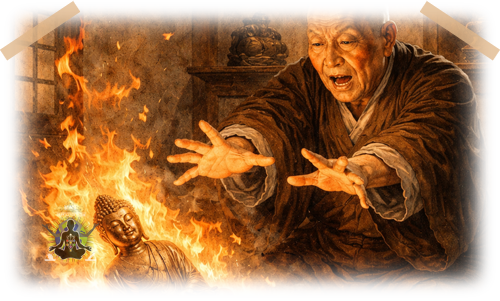
One bitterly cold winter night, Ikkyū was staying at a small temple.
The temperature dropped so low that it became almost impossible to endure. Seeking warmth, Ikkyū took one of the temple’s wooden Buddha statues and threw it into the fire.
A little later, another monk entered the room.
When he saw what was happening, he was horrified.
„How can you burn the Buddha?“ he cried. „That is sacrilege!“
Ikkyū calmly stirred the ashes with a stick and replied:
„I am looking for the Buddha’s bones.“
The monk stared at him in disbelief.
„But it’s a wooden statue,“ he protested. „There are no bones in it!“
Ikkyū smiled and said:
„Then bring me another statue so I can keep warm.“
This was one of many occasions on which Ikkyū demonstrated his profound understanding of the essence of Buddhism. For him, statues, scriptures, rituals, traditions, and the entire religious structure of Buddhism were merely fingers pointing toward the moon-they were not the moon itself.
The Lesson
This story is not an attack on Buddhist symbols, sacred art, or religious traditions. Rather, it challenges a tendency that exists in every spiritual path: the tendency to confuse the symbol with the reality to which it points.
The monk saw a sacred object. Ikkyū saw a piece of wood. The difference was not a lack of respect but a deeper understanding of what Buddhism actually teaches. If enlightenment is found within direct experience, then no statue, scripture, or ritual can possess it on our behalf.
Zen frequently warns against becoming attached to forms. Teachings are useful because they point toward truth, but they are not truth itself. A map can guide a traveler, but it is not the destination. Likewise, a statue of the Buddha may inspire devotion, but it is not the Buddha.
Ikkyū understood that people often become so attached to religious symbols that they forget their purpose. They begin worshiping the finger instead of looking at the moon. The symbol becomes more important than the insight it was meant to evoke.
The story invites us to ask a difficult question: what things in our lives have become idols? Not only religious objects, but beliefs, identities, traditions, and ideas that we cling to without questioning. Zen encourages us to see beyond all forms and encounter reality directly.
For Ikkyū, genuine spirituality was never about preserving appearances. It was about awakening to what is real, even when that awakening challenges convention, tradition, or comfort.
5. Nothing Special
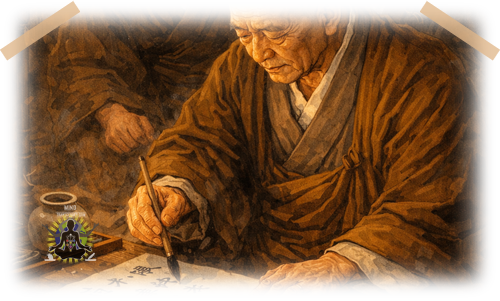
As Ikkyū grew old and sensed that the end of his life was approaching, his students gathered around him and asked him to leave them with a final teaching-something that would guide them after his death.
Everyone expected a profound insight, a mysterious kōan, or a final revelation worthy of a great Zen master.
Instead, Ikkyū picked up a brush and wrote only two words:
„Nothing special.“
The students were puzzled.
„Is that all?“ they asked.
Ikkyū nodded calmly.
Those were his final words.
For Ikkyū, life and death were simply two sides of the same coin. Neither possessed ultimate reality in themselves. Both belonged to the ever-changing world of appearances.
The truth beyond duality was not something extraordinary, mystical, or hidden. It simply is. Nothing can truly be said about it. Either it is realized directly, or it is not.
From this perspective, endless philosophizing becomes unnecessary.
The Lesson
Many people imagine enlightenment as a dramatic event-a supernatural experience that separates enlightened individuals from everyone else. They expect profound revelations, mystical powers, or secret knowledge unavailable to ordinary people.
Zen repeatedly dismantles this expectation.
The deepest truths are often hidden behind our constant search for something extraordinary. We become so busy looking for special experiences that we overlook the reality already present before us.
Ikkyū’s final message points toward the simplicity at the heart of Zen. Reality does not need to become extraordinary in order to be complete. The present moment does not need improvement. Life does not need embellishment. What we seek is often hidden beneath our desire to seek.
„Nothing special“ is not a statement of indifference. It is a statement of freedom. It means that truth is not somewhere else. It is not reserved for saints, sages, or future versions of ourselves. It is here, in this moment, exactly as it is.
For Ikkyū, enlightenment was not about becoming someone special. It was about seeing through the illusion that anything special was required in the first place.
- 13 Zen Stories That Can Change the Way You See Life
- Here and Now: Zen Stories That Reveal the True Nature of Life
- The Story of Nagarjuna and the Thief
- 3 Rare Eastern Spiritual Stories That Can Change the Way You See Life
Author: Vasil Stoyanov