

What does it mean to live well? We can possess wealth, receive recognition, and experience pleasures, yet still feel that our lives lack direction. We can also pass through difficulties, make tremendous efforts, and fail to receive the reward we expected, yet believe that we have lived with dignity. There is a difference between external success and a genuinely good life, and Aristotle makes that difference one of philosophy’s most important questions.
In the Nicomachean Ethics, Aristotle does not offer a quick recipe for happiness. He asks what human actions ultimately aim at, how good character is formed, and why right decisions require not only knowledge but also practice. His answer connects happiness with activity, virtue with habits, and moral wisdom with the ability to judge particular circumstances. Ethics thus becomes not merely a theory of what is permitted and forbidden, but an art of shaping an entire human life.
This article is a natural continuation of our philosophical journey through Socrates and Plato. After the questions of knowledge, justice, and the ideal state, it is time to examine how a person actually learns to live well. We will see why Aristotle calls happiness eudaimonia, what the famous golden mean means, why friendship is part of a good life, and what roles community, reason, and circumstances play. We will also consider the limitations of his ethics, because a philosophy becomes more useful when we understand it critically rather than treating it as an infallible authority.
From Plato’s Academy to Aristotle’s Own Path

Aristotle was born in 384 BCE in Stagira and spent a substantial part of his youth at Plato’s Academy in Athens. From his teacher he inherited the conviction that philosophy should seek the foundations of goodness, truth, and justice. But he gradually developed a different method of inquiry, paying particular attention to concrete living beings, human practices, and the diversity of actual experience. This difference matters when we move from Plato’s ideal city to Aristotle’s investigation of the good human life.
For Plato, knowledge of the Good occupies a central place in the formation of the just soul and the just community. Aristotle likewise believes that human actions have purposes, but he is interested in how these purposes appear in different areas of life. Ethics cannot be studied like geometry, because human decisions depend on changing circumstances. It requires sound judgment, attention to character, and an understanding of how people actually develop.
After Plato’s death, Aristotle left the Academy and later founded his own school, the Lyceum. His works encompass logic, biology, physics, metaphysics, politics, rhetoric, and poetics. Ethics forms part of this broad project of understanding nature and human action. The question of how we should live is inseparable from the questions of what kinds of beings we are and what capacities we can develop.
Why Every Action Aims at Some Good
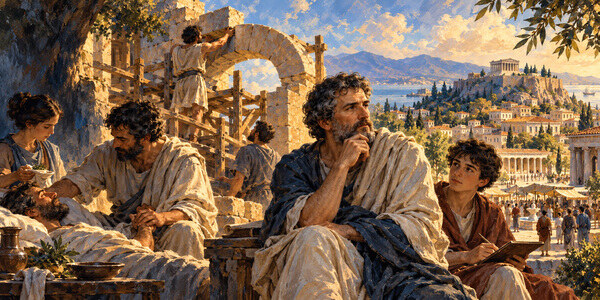
The Nicomachean Ethics begins with the observation that every craft, inquiry, action, and choice aims at some good. The physician aims at the patient’s health, the builder at a completed building, and the person who studies at acquiring knowledge. These goals are not identical, and they are often subordinated to one another. For example, we may earn money to obtain the means for something we consider more important than money itself.
Aristotle asks whether there is an ultimate goal that we desire for its own sake, rather than merely as a means to something else. If every desire led endlessly to another goal, human action would lose its final direction. He therefore seeks the highest practical good that gives meaning to our other pursuits. This does not mean that every person consciously recognizes such a goal or that everyone understands it in the same way.
In everyday life, we easily confuse means with ends. We work in order to live, but sometimes we begin to live solely for work. We seek recognition to affirm our worth, but we may become dependent on other people’s approval. Aristotle’s question prompts us to examine whether our individual efforts are building a good life or merely sustaining an endless movement from one temporary goal to another.
Eudaimonia: Happiness, Well-Being, and Human Flourishing

Aristotle calls the highest human good eudaimonia, a word commonly translated as happiness, well-being, or flourishing. None of these translations captures its meaning completely. In contemporary language, happiness often means a pleasant feeling, a good mood, or satisfaction at a particular moment. For Aristotle, it concerns the quality of life as a whole, assessed through the way a person realizes their capacities.
Eudaimonia is not simply a reward we receive after performing the right actions. It is connected with the very activity of living well. A person does not become a good musician merely by owning an instrument, but by developing skill and playing well. Similarly, a good human life requires the actual exercise of reason, character, and virtue, rather than merely the possession of favorable circumstances.
This understanding explains why temporary pleasure cannot be the only measure of happiness. Someone may experience pleasant feelings while neglecting relationships, health, or opportunities for development. Another person may make difficult efforts, endure temporary discomfort, and nevertheless build a meaningful life. Eudaimonia requires a broader perspective that is not confined to a momentary state of mind.
The Human Function: What It Means to Fulfill Our Nature

To clarify the human good, Aristotle uses what is known as the function argument. In many activities, we speak of good performance when something successfully fulfills its characteristic function. A good flute player plays well, and a good craftsperson masters their work. Aristotle asks whether human life also has a characteristic activity that can guide our assessment of its quality.
He observes that nourishment and growth also belong to plants, while perception and movement are shared with many animals. What is distinctively human, according to his argument, is life organized through reason. He therefore describes the human good as activity of the soul in accordance with virtue and, if there is more than one virtue, in accordance with the best and most complete. This is a philosophical account of the good life, not empirical proof that everyone must have identical professions, abilities, or life goals.
The argument also raises questions. Is reason the only or most important quality by which human well-being should be assessed? How should we understand the dignity of people with different cognitive abilities? A modern reader can appreciate the idea of developing human capacities without accepting that human worth depends on the degree of intellectual achievement. This distinction is necessary if we want to use Aristotelian ethics responsibly.
Why Happiness Is an Activity Rather Than a Possession

Aristotle makes an important distinction between the capacity to do something and the actual exercise of that capacity. Someone may possess knowledge but never use it, or have good intentions that never become actions. For a good life, it is not enough to be potentially just, courageous, or generous. We must display these qualities in the particular situations we encounter.
Happiness therefore cannot be entirely separated from how we spend our time. A life filled with reasonable and worthy actions has a different character from one in which possibilities remain unused. This does not mean that a person must be constantly productive or turn every minute into a test. Rather, a good life has a particular shape and direction that is revealed through our enduring choices.
Here Aristotle offers a useful correction to the desire for constant external proof of success. Recognition may follow good activity, but it is not its fundamental meaning. Being a good friend, parent, colleague, or citizen requires presence and actions that no one may publicly reward. It is precisely through such ordinary practices that our character gradually acquires stability.
Virtue as an Enduring Quality of Character

In Aristotelian ethics, virtue is not a single heroic deed but a relatively stable condition of character. A courageous person does not display courage only once by accident, but has developed the ability to respond appropriately to danger. A just person does not act properly solely out of fear of punishment, but has developed an inclination to treat others fairly. Virtue is a way of being that shapes both choices and feelings.
Aristotle distinguishes moral from intellectual virtues. Moral virtues are formed through habits, upbringing, and repeated action, whereas intellectual virtues develop through teaching and experience. The two groups are not completely separate, because good character needs sound judgment, while correct practical judgment depends on an orientation toward worthy goals. Someone may be extraordinarily clever, but if they pursue unjust aims, cleverness alone is not a virtue.
This conception shifts attention from the question of which rule to follow in a single case to the question of what kind of person we are gradually becoming. Our actions do not merely express an already completed character; they participate in its formation. Moral development is therefore a process rather than a momentary decision. It requires persistence, self-observation, and the ability to correct our mistakes.
Habits: How We Become Just, Courageous, and Temperate
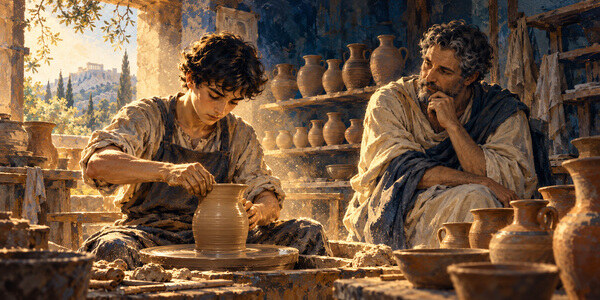
One of Aristotle’s most influential ideas is that moral virtues are acquired through practice. We become just by performing just actions, and we develop temperance by learning to govern our desires. This does not mean that mechanical repetition is sufficient. Gradually, a person must begin to understand why particular behavior is good and choose it consciously.
Habits matter enormously because we do not make every decision from the beginning. How we respond to criticism, spend money, keep promises, or speak with those close to us is often shaped by repeatedly performed actions. If we constantly avoid difficult conversations, avoidance may become an enduring pattern. If we practice patience and honesty, these qualities can gradually become a more natural part of our behavior.
Aristotle also emphasizes the role of early upbringing. People who have learned from childhood to take pleasure in what is worthy and to dislike what is unworthy have a better starting point for moral life. This does not mean that adults are condemned by their childhood. It means that character is formed in a social environment and that good education should include not only information but also the practical formation of habits.
The Golden Mean: Between Excess and Deficiency

Aristotle’s famous golden mean is often misunderstood as an invitation always to choose the middle option or to avoid strong feelings. In fact, Aristotle argues that moral virtue generally lies between two vices, one of excess and the other of deficiency. Courage, for example, lies between recklessness and cowardice. Generosity lies between wastefulness and stinginess.
This mean is not a mathematical average that can be calculated identically for everyone. The right response depends on the situation, the person, the reason, the moment, and the manner of acting. In one setting, it is reasonable to show firmness, while in another the same firmness may become unnecessary aggression. Aristotle defines virtue as a mean relative to us, determined through rational judgment of the kind a practically wise person would make.
Another clarification is important: not every action has a virtuous mean. Aristotle explicitly notes that certain acts are wrong in themselves and do not become good when performed “moderately.” The golden mean therefore does not mean compromising between truth and falsehood or between justice and cruelty in every possible situation. It is a theory of the appropriate expression of feelings and actions where there is genuine room for reasonable measure.
Courage: Knowing Fear Without Submitting to It

Courage is one of the clearest examples of the golden mean. The cowardly person retreats from dangers that ought to be faced, while the reckless person disregards real risks that should be considered. The courageous person is not free from fear. They fear the appropriate things in an appropriate way but are able to act honorably when circumstances require it.
In the ancient context, Aristotle discusses courage particularly in relation to military danger and the risk of death. Modern readers can find analogies in other situations, but should remember the concept’s original meaning. Admitting a mistake, defending someone falsely accused, or resisting pressure may require moral firmness. Nevertheless, not every daring act is courageous, because some risks are unnecessary and cause harm.
Courage requires us to distinguish a worthy goal from the desire to appear heroic. Someone may undertake a dangerous action to impress others without displaying genuine virtue. Another person may quietly and consistently fulfill a difficult duty without anyone noticing their effort. For Aristotle, moral value depends not only on the external outcome but also on the reason and manner of the choice.
Temperance: Pleasure Is Not the Enemy, but It Must Not Become the Master

Aristotle does not believe that all pleasures are bad or that a virtuous person must renounce joy. He distinguishes pleasures according to the activities with which they are associated and the ways they enter our lives. Temperance concerns especially bodily desires and the ability not to submit unconditionally to every pleasant sensation. The aim is not to eliminate desires but to incorporate them into a rationally organized life.
Excess arises when pleasure becomes the sole criterion for action. Deficiency can also be problematic when someone is unable to enjoy appropriate human goods. The virtuous person takes pleasure in what is worthy and is not constantly torn between rational judgment and personal impulses. This is a deeper condition than the simple suppression of desire.
This perspective is useful in an environment that continually offers new stimuli and opportunities for immediate satisfaction. The question is not whether we should enjoy food, entertainment, or rest. The question is whether these pleasures support the life we want to build or gradually displace everything else. Aristotelian temperance is the ability to order our desires, not a war against pleasure itself.
Generosity and Our Relationship with Wealth

In the Nicomachean Ethics, Aristotle examines generosity as a virtue connected with giving and using material resources. The generous person does not simply give a great deal, but gives to the appropriate people, at the appropriate time, and for the appropriate reason. Wastefulness is an excess that disregards measure and consequences. Stinginess is a deficiency in which someone becomes attached to possession and refuses to use their resources worthily.
This distinction shows why moral evaluation cannot be reduced to the size of a donation. A small gesture can be generous if it corresponds to someone’s means and to a genuine need. A large donation may be motivated by vanity, a desire for influence, or the pursuit of public recognition. Aristotle treats money as a means whose good use depends on character and purpose.
More broadly, this virtue raises the question of how wealth fits into a good life. Material resources can support security, education, and care for others. But if accumulating them becomes an independent ultimate goal, a person may lose sight of the goods for which they originally sought them. Aristotelian ethics does not deny the importance of property; it requires that property be subordinated to reasonable use.
Anger, Gentleness, and the Right Emotional Response

Aristotle does not insist that a good person should never become angry. Anger can be a response to genuine injustice and can sometimes show that someone is not indifferent to humiliation or abuse. The problem is whether we become angry with the right person, for the right reason, to the appropriate degree, and for an appropriate length of time. Virtue thus concerns not the absence of feelings but their rational formation.
Excessive anger can destroy relationships and turn justified indignation into a desire for revenge. A complete inability to respond to serious wrongdoing can also reveal a moral problem. Between these extremes lies the ability to express a firm position without losing control of our behavior. This requires not only intellectual understanding but also long practice in shaping character.
Modern discussions of emotional self-regulation can find an interesting philosophical predecessor here, but the two perspectives should not be treated as identical. Aristotle is not developing a clinical theory of emotions. He is concerned with when feelings are appropriate to a worthy life. In this sense, the question is not simply how to calm ourselves, but how to respond rightly.
Practical Wisdom: Why the Good Life Cannot Be Reduced to Rules

One of the most important concepts in Aristotelian ethics is phronesis, or practical wisdom. It is the ability to judge well what we should do in particular human situations. Knowing the general rule that we should be honest, courageous, or just is not enough. We must understand how these virtues are expressed among real people and in actual circumstances.
The practically wise person recognizes significant details that an abstract formula might overlook. They consider consequences, relationships, responsibilities, and the limitations of the situation. This does not mean that every decision is relative or that there are no general moral principles. It means that good action requires the ability to apply principles intelligently rather than mechanically.
Practical wisdom is not the same as cunning. A cunning person may find effective means to achieve any goal, including an unjust one. A practically wise person is oriented toward worthy goals and chooses suitable means to achieve them. That is why Aristotle connects genuine practical wisdom with moral virtue: good character helps us desire what is right, and wisdom helps us understand how to realize it.
Choice and Responsibility: When Is an Action Truly Ours?

Aristotle devotes considerable attention to voluntary and involuntary actions. If someone is forced from outside or acts through certain forms of ignorance, the moral assessment may differ. Not every unfavorable consequence results from a consciously bad choice. To understand responsibility, we must examine what a person knew, what possibilities they had, and how they reached their decision.
Especially important is the concept of deliberate choice, which combines desire for a particular end with reasoning about the means of achieving it. We do not choose everything that happens in the world, but we can deliberate about what depends on our own actions. Moral life is therefore not simply a succession of impulses. It involves reason in the shaping of our behavior.
This theory does not eliminate every question about freedom and the influence of circumstances. Character is built through habits, but habits also depend on upbringing, environment, and opportunities we did not choose. Aristotle nevertheless maintains that in many situations we are responsible for the actions through which we gradually become particular kinds of people. The tension between personal responsibility and the power of circumstances remains an important topic in contemporary ethics.
Weakness of Will: Why We Sometimes Act Against Our Better Judgment

Many people know what they consider right but nevertheless act differently. Someone may decide to practice moderation and then yield to a momentary desire. They may understand that anger will damage their relationships but still say words they later regret. Aristotle examines this problem through the concept of akrasia, commonly translated as incontinence or weakness of will.
The question is especially interesting because it challenges the simple belief that knowledge automatically leads to right action. Aristotle analyzes the different ways a person may possess general knowledge without fully using it in a particular moment. Strong desire can alter their attention to the situation and weaken practical judgment. Moral education must therefore address not only arguments but also habits and feelings.
The distinction between a self-controlled person and a virtuous person is also important. The self-controlled person manages to act rightly despite a strong opposing desire. The virtuous person has developed a more harmonious relationship between desire and reason, so right action does not require an endless internal struggle. This does not mean that virtuous people never face difficulties, but that their character is better prepared to meet them.
Friendship: Why Nobody Flourishes Entirely Alone

Aristotle devotes a substantial part of the Nicomachean Ethics to friendship, showing how important a place it holds in the good life. Even someone possessing many other goods would find it difficult to choose a life without friends. Friendship is not merely a pleasant addition to personal well-being. It is a relationship in which care, reciprocity, trust, and shared life find expression.
Aristotle distinguishes friendships based on utility, pleasure, and virtue. In the first case, people value one another primarily for the benefits they provide. In the second, they are connected by pleasant experiences and common interests. In the fullest kind of friendship, each wishes the other well for that person’s own sake and values their character.
This does not mean that relationships based on usefulness or pleasure are necessarily false. They are genuine human connections, but they may change when the reason for them disappears. Friendship between virtuous people has a more stable foundation because it is connected with mutual respect and concern for the person. It nevertheless requires time, shared life, and consistent actions, not merely good intentions.
The Friend as Another Self and the Limits of Self-Sufficiency

Aristotle describes a close friend as a kind of “another self.” Through friendship, a person shares joys, difficulties, reflections, and activities that gain deeper meaning through mutual presence. A friend is not simply a means of achieving personal goals. A friend is someone whose good we desire as valuable in itself.
This understanding also changes the idea of self-sufficiency. The highest good should make life desirable and complete, but that does not mean living in isolation. Human beings are social creatures who develop through relationships with family, friends, and fellow citizens. Virtue needs situations in which we can demonstrate justice, generosity, loyalty, and care.
Friendship also has a moral dimension, because good friends can help us recognize our own shortcomings. They are not obliged to approve every decision we make. Sometimes the most valuable support appears in honest disagreement expressed respectfully. Friendship can thus become a space for mutual moral development rather than merely a source of comfort.
Justice: Virtue in Our Relations with Others
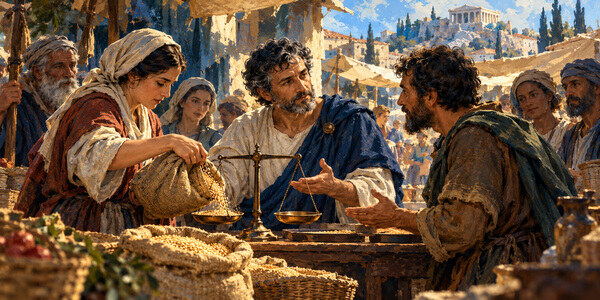
Among the moral virtues, Aristotle gives justice a special place. It has a broad meaning when it describes conduct toward others in accordance with law and virtue, but it also has narrower meanings connected with distribution and the correction of harms. Justice is particularly important because it manifests itself directly in shared life. We cannot be just only in our thoughts without this affecting other people.
Aristotle distinguishes distributive justice, which concerns the allocation of goods and honors, from corrective justice, which seeks to restore a disturbed balance in certain relationships and cases of harm. His criteria for distribution do not automatically coincide with modern principles of equal rights. Different political communities may disagree about which merits and grounds matter. His analysis is therefore useful as a distinction between kinds of justice without requiring us to accept every historical assumption of his system.
Especially interesting is the idea of equitable correction of a general rule through sound judgment, often associated with the concept of epieikeia, or equity beyond the literal strictness of the law. Laws are formulated generally, but actual cases may have particular features the lawgiver did not foresee. Sometimes a just decision requires attention to the purpose of the rule rather than only its mechanical application. This is not permission for everyone to ignore the law at will, but recognition of the complexity of just judgment.
Pleasure and the Good Life: A More Complex Relationship Than It Seems

Aristotle devotes separate discussions to pleasure because it is present in almost all human choices. He accepts neither that every pleasure is the supreme good nor that pleasure is inherently evil. Instead, he examines how pleasure relates to the activity it accompanies. Some pleasures support worthy pursuits, while others can divert us from them.
When someone enjoys a good activity, pleasure can make that activity more complete. A musician may find joy in practice, and friends may find joy in shared conversation. But pleasure alone does not indicate whether an activity is morally good. A person can also derive satisfaction from behavior that harms others.
Educating desires is therefore essential to the good life. It is not enough to learn to resist particular temptations. The deeper goal is gradually to begin valuing and enjoying activities that deserve to be chosen. Pleasure is thus not excluded from eudaimonia but placed in relation to character and reason.
External Goods: Why Virtue Does Not Make Us Invulnerable

Aristotle does not claim that a virtuous person can flourish fully independently of all external circumstances. Health, material security, friends, and the social environment matter to the possibility of living well. Severe losses and prolonged misfortunes can restrict human opportunities even when character remains honorable. This makes his ethics more attentive to real conditions of life than a theory according to which inner attitude alone determines well-being.
At the same time, external goods are not sufficient. Someone may possess wealth and influence but use those opportunities destructively. Another may have fewer resources yet display remarkable justice and reason. Aristotle seeks the interaction between good character and the conditions that allow its exercise.
This position has important social implications. If happiness depends on real opportunities for action, then poverty, violence, and lack of education are not merely private inconveniences that everyone must overcome through willpower. They can restrict the very conditions for human development. Aristotle does not formulate a modern theory of social rights, but his recognition of the importance of external goods opens space for such questions.
Politics and Ethics: Why the Good Life Requires Community

For Aristotle, ethics and politics are closely connected. Laws, education, and social customs influence the character that citizens develop. If a community continually rewards greed, deception, or irresponsibility, it makes moral education more difficult. If it encourages just relationships and reasonable participation, it can support the good life.
Here we see the difference between the individual desire to be good and the social conditions that support such an effort. Not everyone can independently create a fair court, good education, or a safe public environment. Some goods are possible only through cooperation and institutions. The political community therefore matters not only for survival but also for the quality of human existence.
We must, however, read this theory critically. Aristotle accepts historical hierarchies and restrictions, including defending views about slavery and the role of women that are incompatible with modern understandings of human equality. His claim that the community should support the good life does not automatically justify every form of state intervention. Today we can retain the question of the conditions of human flourishing while rejecting the unequal assumptions of the ancient model.
The Contemplative Life: Why Aristotle Gives Special Importance to Thinking

In the final book of the Nicomachean Ethics, Aristotle examines contemplative activity as an especially elevated form of happiness. It is connected with the exercise of reason in knowledge that does not serve only an immediate practical purpose. According to his argument, such activity can be enduring, valuable in itself, and worthy of the best human capacities. This emphasis belongs to his understanding of intellectual virtue.
At first glance, a tension arises between this praise of contemplation and the preceding books devoted to moral virtues, friendship, and political life. If the highest happiness is philosophical thought, what place remains for practical responsibilities? Different interpreters offer different answers, including the view that Aristotle recognizes more than one dimension of the good life. The text genuinely leaves room for philosophical debate.
It is important not to understand contemplation as contempt for everyday work or for people who do not engage professionally in philosophy. In the ancient theory, it has a specific place connected with the understanding of reason and the human function. A modern reader may find in it a defense of the free pursuit of truth, learning, and reflection. But there is no justification for measuring human dignity solely by the capacity for abstract contemplation.
Aristotle and Socrates: Is Knowing What Is Good Enough?

Socratic philosophy places strong emphasis on the relationship between knowledge and virtue. Aristotle accepts that reason is necessary for the good life, but pays greater attention to habits, desires, and practical weaknesses. People can understand certain moral principles without having developed the character needed to apply them consistently. Ethics therefore does not end with correct definitions and persuasive arguments.
This difference does not mean that Socrates is uninterested in life or that Aristotle rejects knowledge. Both see reason as an important guide to human existence. But Aristotle systematically investigates how behavior is formed through repetition and how feelings can support or hinder right choice. He makes moral education an essential part of the philosophy of virtue itself.
For our philosophical journey, this shift is especially important. The Socratic question prompts us to examine our beliefs, while the Aristotelian question prompts us to examine our habits as well. We may explain beautifully why honesty is valuable and nevertheless lie when we are afraid. Philosophical development therefore requires not only better thoughts but also better-formed actions.
Aristotle and Plato: From Ideal Order to Concrete Judgment
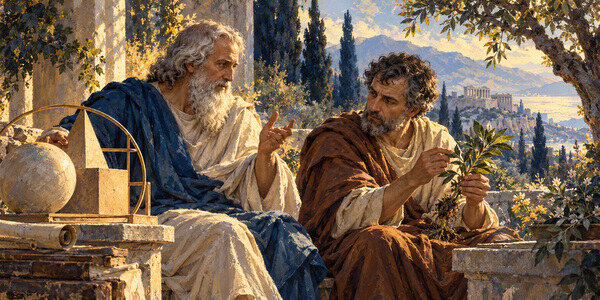
Plato seeks justice through the ordering of the soul and the city, giving central importance to knowledge of the Good. Aristotle is more cautious about the idea that one universal Form of the Good can directly resolve every practical question. Different human activities have different aims and require different kinds of knowledge. Ethics must investigate this diversity rather than expect a single abstract formula to replace sound judgment.
Despite their differences, both thinkers share the conviction that the good life is not simply a succession of pleasures. They believe that character, reason, and education are essential to human well-being. Both connect personal virtue with social organization, although they offer different political solutions. Aristotle therefore does not end the conversation with Plato but continues it through new questions and methods.
The difference can also be expressed in another way. Plato invites us to ask what a just order should look like if reason truly governs. Aristotle invites us to ask how a particular person develops the ability to choose well amid changing circumstances. One perspective emphasizes the philosophical ideal, while the other emphasizes the practical formation of character.
How to Apply the Golden Mean Without Turning It into a Cliché

The golden mean does not simply tell us to be “a little courageous,” “moderately honest,” or “somewhere in the middle” of every dispute. It asks us to investigate which response is appropriate to a particular situation. Sometimes the right action requires great determination, and at other times patience and yielding. The measure is not determined by the quantity of emotion expressed, but by the fit between action, reason, and circumstances.
Imagine someone who must give difficult feedback to a colleague. If they conceal a serious problem merely to avoid discomfort, they may show insufficient frankness. If they attack the colleague with humiliating words, they may display excessive aggression. Virtuous action would seek an honest, clear, and respectful conversation that considers both truth and the other person’s dignity.
Such judgment cannot be reduced to an automatic instruction. It requires experience, attention, and a willingness to learn from consequences. Sometimes we will err by being too cautious, and at other times by acting too hastily. Aristotelian ethics does not promise a life without mistakes, but offers a way to develop more reliable character and better judgment over time.
Modern Life and the Ancient Idea of Flourishing

Today, success is often measured through income, popularity, professional status, or public visibility. These indicators may be useful for certain purposes, but they do not provide a complete picture of the quality of human life. Aristotle’s eudaimonia prompts us to ask different questions. Are we developing abilities that matter to us and others, building reliable relationships, and acting in ways we can reasonably defend?
Virtue ethics is especially useful when thinking about long-term change. Instead of expecting one decisive action to transform our lives, we can examine the small repetitions that gradually create character. How we listen to others, respond to disappointment, and keep promises may have greater moral significance than rare moments of public heroism. The good life is built over time.
But this perspective should not become an accusation against people facing severe circumstances. Not everyone has equal opportunities for education, security, and development. Aristotle himself recognizes the importance of external goods, although he does not arrive at modern ideas of equal rights. A responsible application of his ethics must combine personal work on character with attention to the social conditions that make flourishing possible.
The Limitations of Aristotelian Ethics

Aristotle’s influence does not mean that his views should be accepted without criticism. He lived in a society marked by slavery, unequal status for women, and restricted citizenship, and some of his philosophical arguments defended these hierarchies. These are substantial moral problems, not minor historical details. We cannot discuss human flourishing today without recognizing the dignity and freedom of those whom the ancient model excluded.
Another difficulty concerns who determines what virtuous character looks like. Societies can have different traditions, values, and ideas of worthy behavior. If we uncritically accept a single model of the good person, we risk turning moral education into pressure to conform. Contemporary virtue ethics must therefore combine attention to character with respect for human diversity and the right to reasoned disagreement.
Finally, virtue does not always provide an easy answer when values conflict. We may hesitate between loyalty and honesty, or between care for someone close to us and justice toward a stranger. Practical wisdom is a valuable guide, but it is not an algorithm that eliminates every tragic choice. Aristotle’s strength is that he recognizes the complexity of action; it would be a weakness to invoke his name to conceal that complexity.
Conclusion: Happiness as a Life We Build

Aristotle offers us an understanding of happiness that is both more demanding and deeper than the pursuit of a constantly good mood. Eudaimonia is not an object we can acquire or a moment we can preserve forever. It is connected with how we use our abilities, build our relationships, and direct our actions toward worthy goals. The good life is therefore inseparable from good character.
The golden mean teaches us that virtue is neither mechanical adherence to extremes nor a universal formula for compromise. Courage, generosity, temperance, and justice require appropriate responses to particular circumstances. Practical wisdom helps us understand those circumstances, while habits gradually allow us to transform good judgment into stable behavior. Friendship and community remind us that nobody builds a meaningful life entirely alone.
In our philosophical journey, Socrates taught us to question our beliefs, Plato showed us the connection between justice, the soul, and society, and Aristotle directed our attention to the everyday practice of virtue. He does not promise perfection or eliminate the role of chance, loss, and difficult circumstances. Instead, he offers us a lifelong task: to develop our reason, character, and relationships so that our actions gradually shape a life that deserves to be called good.
Author: Vasil Stoyanov