
What would a person say about death if they knew that only a few hours remained? Would they be afraid, plead for a delay, or try to understand what the end of life actually means? In the dialogue Phaedo, Plato portrays Socrates’ final day as an extraordinary encounter between human mortality and the philosophical search for truth. While his friends grieve, the condemned philosopher discusses the soul, knowledge, change, and the possibility that something of a human being continues to exist after the body dies.
Phaedo is more than an account of someone facing death calmly. It is one of the most influential works in the history of philosophy because it brings together several arguments for the immortality of the soul, exposes them to objections, and explores what it means to defend one’s convictions in the face of one’s own death. The dialogue does not provide scientific proof of life after death. Instead, it allows us to examine the reasoning behind a philosophical position, its strengths, and the difficulties that continue to inspire debate.
To understand the work, we must return to Socrates’ final hours, consider each argument carefully, and distinguish the historical philosopher from the literary figure through whom Plato develops his ideas.
1. Athens After the Verdict: Why Must Socrates Die?
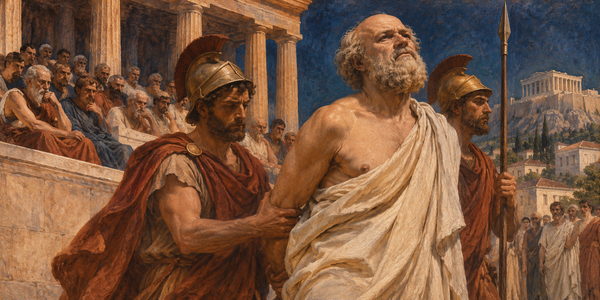
In 399 BCE, Socrates was brought before an Athenian court on charges of impiety and corrupting the young. He was found guilty and sentenced to death. The historical context matters: Athens was experiencing political turmoil after the Peloponnesian War, and relations among civic traditions, education, and independent philosophical inquiry were tense.
In Plato’s Apology, Socrates defends his way of life and refuses to portray philosophical questioning as a crime. In Crito, a friend offers him a chance to escape, but Socrates rejects the proposal while considering his obligations toward the laws of the city. Phaedo continues this dramatic sequence and takes us into the prison on his final day.
The execution had been delayed because of a religious custom associated with a sacred ship sent to Delos. While the ship was away, the city did not carry out executions. Once it returned, the day arrived when Socrates would have to drink the poison.
This situation transforms the philosophical conversation into something more than an abstract exercise. Questions about the soul and death are no longer distant speculations. They directly concern the person discussing them and the friends who are about to lose him.
2. Who Tells the Story, and Can We Treat It as an Exact Historical Record?
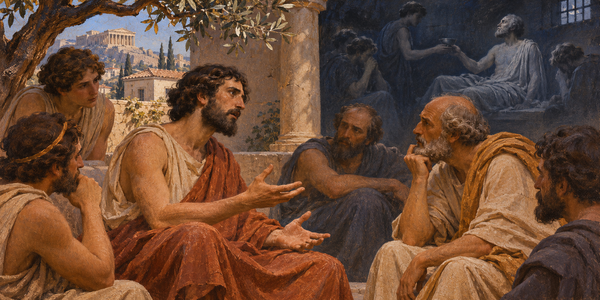
The dialogue is presented through the account of Phaedo of Elis, who later describes the events to Echecrates. This narrative framework creates the impression of eyewitness testimony, but Phaedo is a philosophical literary work, not a verbatim transcript of Socrates’ final words.
Plato himself is mentioned among those absent because of illness. This detail emphasizes that the author does not present himself as a direct participant in the conversation. We cannot reliably separate every historical remark made by Socrates from Plato’s philosophical ideas and literary composition.
Among those present, Simmias and Cebes play especially important roles. They are not passive listeners. Both raise difficult questions and challenge Socrates’ arguments, allowing the dialogue to develop through criticism rather than unquestioning acceptance of authority.
That is precisely what makes the work philosophically significant. Its value does not depend on assuming that every scene occurred exactly as described. It lies in the arguments, objections, and the way the discussion explores the limits of human knowledge.
3. Why Does Socrates Call Philosophy a Preparation for Death?
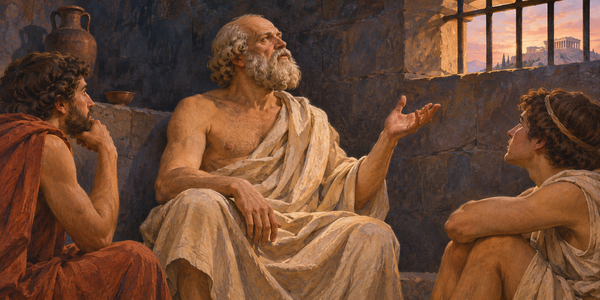
One of the most provocative ideas in Phaedo is the claim that those genuinely devoted to philosophy are, in a certain sense, preparing themselves for death. This is not an invitation to suicide. Socrates explicitly considers why a person should not take their own life, even though a philosopher might face death without the usual fear.
The argument begins with the relationship between soul and body. According to the position presented in the dialogue, sensory desires, pain, pleasure, and bodily needs frequently distract us from the search for truth. The philosopher strives to think as clearly as possible without being completely governed by them.
Death is defined as the separation of the soul from the body. If the soul can truly exist independently, then the philosophical practice of distancing oneself from bodily attachments resembles preparation for that separation.
Yet there is an assumption here that must not be overlooked. For the hope that the soul will continue to know after death to make sense, one must first defend the claim that it can exist without the body at all. Establishing this becomes the central task of the arguments that follow.
4. Soul and Body: Two Distinct Principles or One Unified Reality?
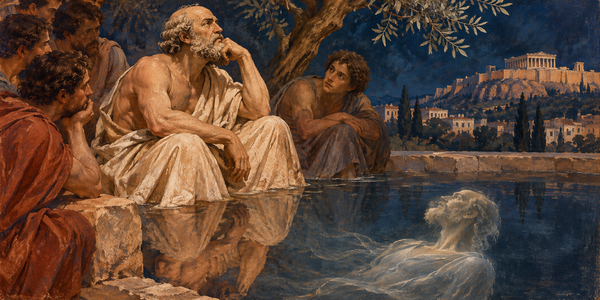
In Phaedo, the soul is presented as that which thinks, knows, and can seek unchanging truths, while the body is associated with sensory perception and material change. This distinction underlies several of the dialogue’s arguments.
For Plato’s Socrates, the physical world is constantly changing. Things come into being, deteriorate, and appear differently under different circumstances. Genuine knowledge, however, seems to concern something more stable than shifting sensory impressions.
This leads to the suggestion that the knowing principle may be related to a more enduring, immaterial realm. But this is a philosophical argument, not an observation directly demonstrating a separable soul.
Modern research on the brain establishes profound relationships between mental functions and neural activity. That does not by itself resolve every metaphysical question about consciousness, but it helps explain why a soul completely independent of the body cannot be treated as an empirically established fact.
The dialogue is most rewarding when read as a defense of a particular view of human nature whose assumptions can be analyzed and challenged.
5. The First Argument: Do the Living Come from the Dead?
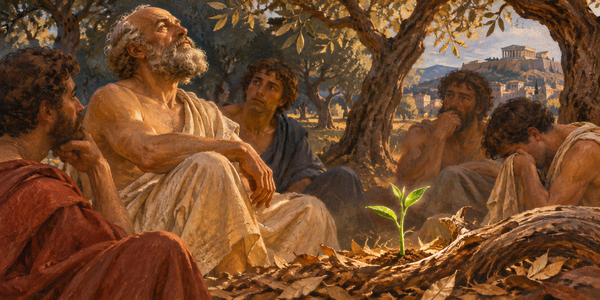
The first major proof is often called the argument from opposites or the cyclical argument. Socrates considers pairs of opposite states and the processes through which one becomes the other. Something greater comes from something smaller through increase, and something smaller comes from something greater through decrease. Waking is a transition from sleeping to being awake, while falling asleep is the reverse transition.
He then applies a similar pattern to life and death. Living beings die; if nature operates through reciprocal transitions between opposites, the argument suggests there must also be a transition from the dead to the living.
This idea supports the picture of departed souls existing somewhere from which they can return to living bodies. Otherwise, Socrates reasons, the process would move in only one direction and life would eventually disappear.
The weakness of the argument is that not every pair of opposite states requires symmetrical processes. The fact that living organisms die does not logically establish that the same individual souls must return from a state after death. The biological emergence of new life is not equivalent to the return of a previous consciousness.
The argument matters as part of Plato’s picture of a cyclical natural order, but by itself it does not establish the immortality of an individual person.
6. The Second Argument: How Do We Know Perfect Equality?
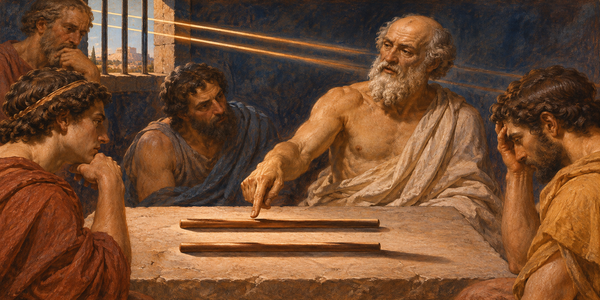
The next argument concerns the theory of recollection. Socrates draws attention to the way we recognize that two visible things are approximately equal, while neither perfectly embodies equality itself.
Two sticks may appear equal in length but turn out to differ when measured more precisely. Nevertheless, we use the concept of equality as a standard against which imperfect examples are judged.
According to Socrates, sensory objects remind us of something that we do not derive entirely from them: Equality itself. If we can judge that apparently equal things fall short of perfect equality, it seems that we already possess some understanding of the standard.
The dialogue then makes the bold move toward the claim that the soul knew such truths before birth and that learning during earthly life is a form of recollection. This is intended to support the soul’s preexistence.
An obvious objection is that using ideal concepts does not require us to have known them before birth. The mind might develop them through abstraction, comparison, or other cognitive capacities. Furthermore, preexistence does not automatically prove that the soul will continue to exist after death. This distinction later becomes important to Cebes.
7. Plato’s Forms: What Is It That Never Changes?
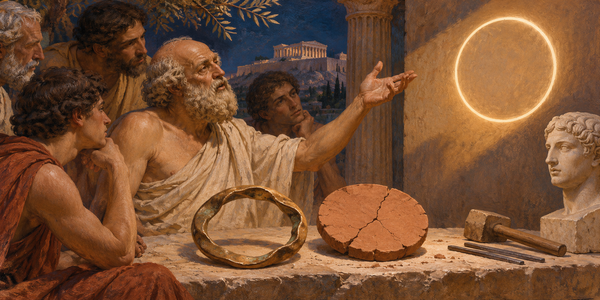
The argument from recollection is inseparable from the theory of Forms. In Plato’s philosophy, particular beautiful objects may change, age, or lose their beauty, but Beauty itself is conceived as something distinct from them. Similarly, particular equal objects differ from Equality itself.
The Forms are not merely images in someone’s imagination. Within this philosophical system, they are enduring objects of genuine knowledge, independent of changing sensory examples.
This distinction allows Socrates to associate the soul with the unchanging realm of Forms. If the soul can know what is stable and invisible, perhaps its own nature is more closely related to that realm than to the body.
Yet the ability to think about unchanging mathematical or logical relationships does not immediately imply that the thinking subject is eternal. A person can understand a concept without possessing all the properties of the thing understood.
The theory of Forms is therefore central to the internal reasoning of Phaedo, but accepting it requires a separate philosophical defense. It is not an undisputed assumption shared by every philosophical tradition.
8. The Third Argument: The Soul’s Affinity with the Invisible
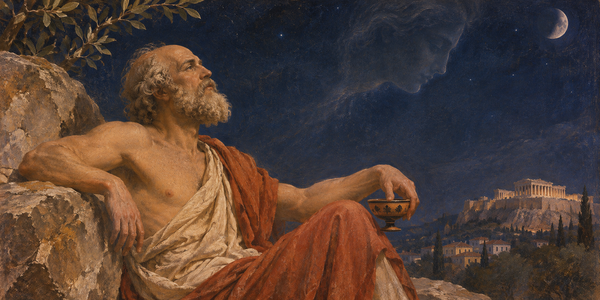
The third major argument is called the affinity argument. Socrates distinguishes two kinds of reality: the visible, composite, and changing, and the invisible, stable, and noncomposite. The body belongs more clearly to the first category, while the soul, he argues, resembles the second.
The body can be observed and undergoes destruction. The soul, understood as the principle of knowledge, is not visible in the same way. When it reasons independently, it seeks enduring truths rather than constantly changing sensory objects.
From this Socrates concludes that the soul is likely less susceptible to dissolution than the body. He also connects its fate with the way a person lives: a soul wholly attached to bodily pleasures is portrayed as more strongly bound to material existence, while a philosophically purified soul seeks the invisible and divine.
This argument is more a consideration of likely affinity than a strict logical demonstration of immortality. What is invisible is not necessarily indestructible. Something can be inaccessible to direct sight yet remain dependent on material conditions.
That weakness becomes the starting point for one of the most powerful objections in the entire dialogue.
9. Simmias’ Objection: What If the Soul Is a Harmony?
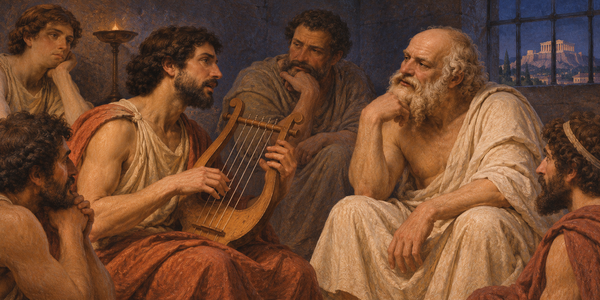
Simmias proposes a striking analogy. Imagine a lyre whose strings are tuned to produce harmony. The harmony is invisible and seems more refined than the wood and strings, but it cannot continue to exist once the instrument is destroyed.
Could the soul be something similar? Perhaps it is the harmonious arrangement of bodily elements rather than an independent substance. In that case, the soul might seem immaterial while remaining entirely dependent on the body.
This objection is particularly important because it attacks the reasoning of the affinity argument itself. It is not enough to say that the soul is invisible and therefore more durable. Harmony is also not visible in the same way as a wooden instrument, yet it disappears when the conditions sustaining it cease.
Socrates replies in several ways. First, he recalls that if the soul existed before the body, as the recollection argument suggests, it cannot simply be a product of the body’s organization. Second, he argues that the soul often resists bodily desires rather than merely expressing their harmony.
His reply is coherent within Plato’s assumptions, but it does not compel every reader to accept it. If the soul’s preexistence has not been established, the first line of defense weakens. And the capacity for self-control can be explained in different ways, including through interactions among psychological processes.
10. Cebes’ Objection: Could the Soul Outlive the Body but Eventually Perish?
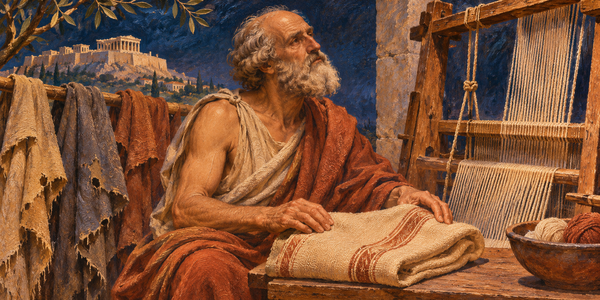
Cebes raises another, even more precise objection. Suppose the soul is more durable than the body and can survive several bodily lives. That still does not prove it is absolutely immortal.
To explain his point, Cebes uses the analogy of a weaver and his cloaks. A weaver may make and wear out many garments during his lifetime. He lasts longer than each individual cloak, but eventually he dies. His final garment might even survive him.
Likewise, a soul might survive many bodies yet eventually reach its own final destruction. Evidence that the soul is more enduring than the body is therefore insufficient to establish that it cannot be destroyed.
This is a crucial logical distinction. The claim that something lasts longer than something else is not equivalent to the claim that it lasts forever. Even the soul’s preexistence does not settle the question of its future.
The objection forces Socrates to move beyond analogies and probabilities toward a more rigorous attempted proof based on the relationship among the soul, life, and the Forms.
11. The Danger of Hating Reason: What Is Misology?
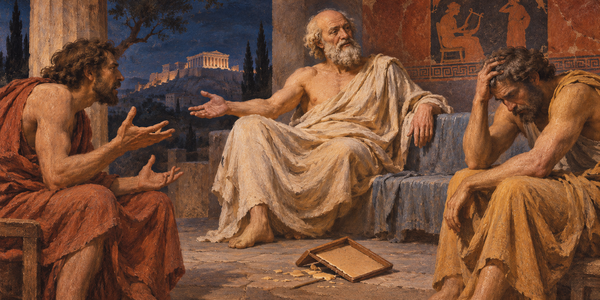
When the arguments encounter serious objections, the participants become discouraged. Socrates uses the moment to warn against misology-hatred or distrust of reasoning itself.
He compares this danger to misanthropy. Someone who trusts other people too readily and is repeatedly disappointed may conclude that no one deserves trust. Something similar can happen with arguments: if we treat every persuasive proof as final and later discover its weaknesses, we may decide that reason cannot lead to truth at all.
Socrates insists that the error does not necessarily lie in reasoning itself but in our lack of experience evaluating arguments. We should examine them carefully rather than abandon the search at the first contradiction.
This passage is especially valuable for modern readers. Philosophy does not require us to accept every argument Socrates makes. It requires us to understand why an argument seems persuasive, what challenges it, and whether the reply is adequate.
Even someone who rejects the immortality of the soul can find an important lesson in critical thinking in the warning against misology.
12. Causes and Explanations: Why Is Socrates Dissatisfied with Merely Mechanical Answers?
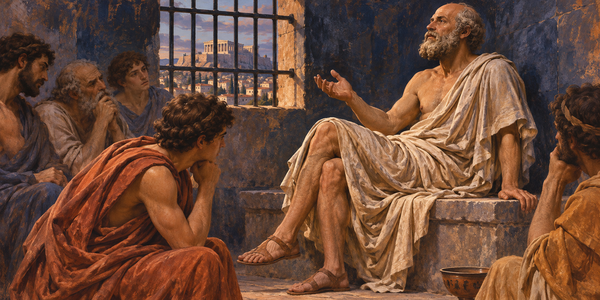
Before presenting his final argument, Socrates recounts his disappointment with certain explanations of nature. He had been interested in why things come into existence, change, and cease to exist. He pays particular attention to Anaxagoras, who introduced Mind as a principle of cosmic order.
Socrates expected such a theory to explain not only the physical processes through which events occur but also why a particular arrangement is best or most reasonable. Instead, according to his account, he encountered mainly descriptions of material mechanisms.
He gives the example of his own presence in prison. One can explain how his bones and muscles allow him to sit, but that is not the same as explaining why he chose to remain and accept his sentence. The latter explanation must refer to his decisions and reasons.
This passage is not a scientific refutation of physical causes. It distinguishes different kinds of explanation: the mechanism through which something happens and the reasons or purposes for which a rational person acts.
The distinction prepares the transition to the Forms as explanatory principles. In the context of Phaedo, it shows why Socrates seeks not merely a physical account of life but a philosophical explanation of what makes the soul a source of life.
13. The Final Argument: The Soul as the Bearer of Life
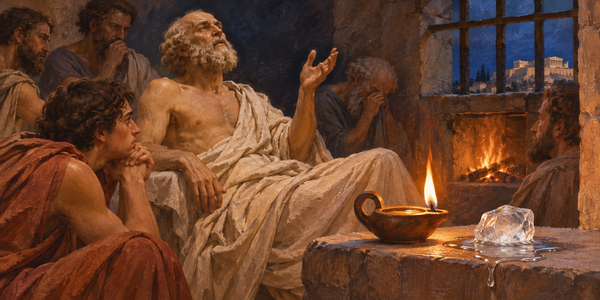
In his concluding attempt at proof, Socrates develops the idea that certain things necessarily carry a particular property and cannot admit its opposite without ceasing to be what they are. Fire, for example, is associated with heat, and snow with cold.
He then asks what makes a body alive. The answer within the dialogue is the presence of a soul. The soul is presented as that which brings life wherever it is present.
If the soul necessarily brings life, Socrates reasons, it cannot admit life’s opposite-death. The soul is therefore immortal in the sense that it cannot take death into itself as a property.
The dialogue takes an additional step toward the conclusion that what is immortal is also indestructible. This allows Socrates to claim that the soul does not perish when the body dies.
Here lies the central philosophical dispute. Even if we accept that the soul is defined as a principle of life, it does not automatically follow that each particular soul cannot cease to exist. Something might be incapable of acquiring an opposite property yet still disappear when the conditions of its existence are destroyed. For the proof to succeed, the move from not admitting death to being incapable of destruction needs independent justification.
The final argument is the most systematic in the dialogue, but it too depends on Plato’s understanding of the Forms, causation, and the nature of the soul.
14. Does Phaedo Prove Personal Immortality?
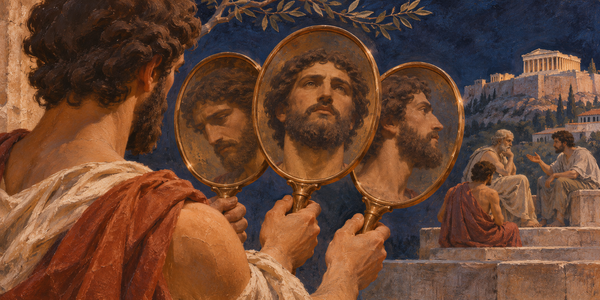
When discussing immortality, we need to clarify exactly what is supposed to survive. Is it the capacity to think, an immaterial principle of life, individual memory, or the entire person with their experiences and character?
In Phaedo, the soul is portrayed as existing before birth and potentially continuing after death. Yet the arguments do not establish with equal rigor how individual identity is preserved. Even if an immaterial principle exists, we must still ask why it would be the very same person.
Contemporary philosophy of personal identity examines different criteria, including continuity of memory, psychological connectedness, and bodily continuity. Each raises difficulties when we try to imagine existence after death without the familiar body and brain.
This does not make Plato’s question meaningless. On the contrary, it reveals that the statement the soul is immortal can mean different things. Proof of an eternal life principle would not automatically establish the preservation of personal memories, relationships, and self-awareness.
15. The Myth of the Afterlife: Why Does Plato End with a Story Rather Than Another Proof?
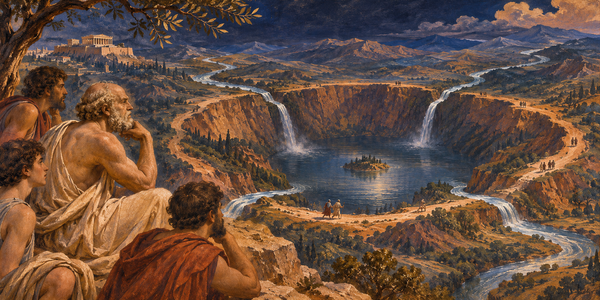
After the philosophical arguments, Socrates describes the fate of souls after death through a mythological account. He speaks of different regions of the afterlife, purification, punishment, and reward, as well as the destinies of souls according to how they lived.
This narrative has a different status from the preceding proofs. Socrates does not insist that every detail must be accepted as a literally established description of an invisible world. The myth offers an imaginative picture of the moral significance of life and death.
In that picture, justice is not exhausted by public recognition or the immediate consequences of actions. The way a person lives leaves a mark on the condition of the soul. Philosophy is therefore associated not only with knowledge but also with moral transformation.
The myth cannot serve as empirical evidence for an afterlife. Its philosophical function is to show how the belief in moral responsibility might appear within a broader vision of human existence.
Through it, Plato combines logical reasoning with images that speak to human imagination and emotion. The transition is especially powerful in a work whose central figure is about to die.
16. The Final Hours: Why Do Socrates’ Friends Weep?
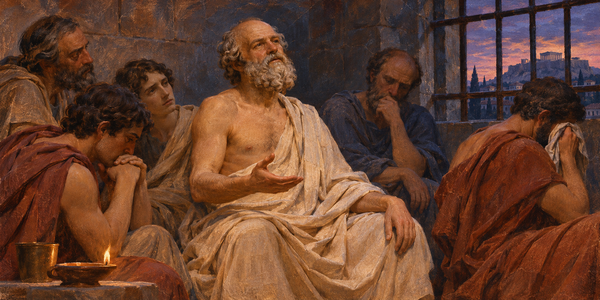
One of the most human features of Phaedo is the contrast between Socrates’ philosophical composure and his friends’ grief. They listen to arguments for immortality, but the approaching separation remains painful. Even a persuasive theory does not erase the immediate experience of loss.
Plato does not portray those present as people who have completely overcome fear and sadness. Their uncertainty is part of the drama. They want to believe that Socrates will continue to exist, yet they also see that he will soon no longer be among them.
As the execution approaches, Socrates continues to speak with characteristic clarity. He attends to practical details and tries to direct his friends’ attention toward the meaning of what is happening rather than only toward the terror of losing him.
This does not mean that fear of death is irrational or that grief represents a philosophical failure. Instead, the narrative reveals the tension between convictions and emotions. A person may defend a particular view of death and still experience pain when someone close to them dies.
17. The Cup of Poison: How Does Plato Describe Socrates’ Death?
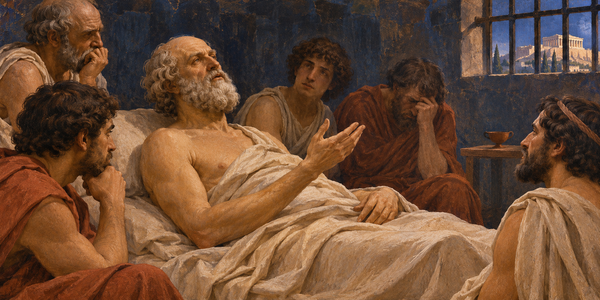
In the concluding scene, the official responsible for carrying out the sentence brings the poison and explains what Socrates must do. The philosopher accepts the cup calmly and drinks without turning his final moment into a theatrical performance.
The narrative follows the gradual onset of bodily symptoms. Socrates walks for a while and then lies down as sensation in his limbs diminishes. The attendant examines his body and describes the poison’s effects spreading.
The poison is traditionally identified as hemlock, but the details of the historical procedure and its precise pharmacological description cannot be reconstructed with complete certainty from the literary text alone. Plato’s main concern is not the medical mechanism but Socrates’ moral conduct.
His friends cannot hold back their tears. Socrates reproaches them for the commotion and calls for calm. The scene is both severe and moving: the philosopher speaks of the soul, yet his body is actually dying before the eyes of people who love him.
The episode is powerful because the philosophical question no longer remains abstract. The reader confronts what Socrates’ friends confront: can our beliefs about death change the way we face it?
18. “We Owe a Cock to Asclepius”: What Do Socrates’ Last Words Mean?
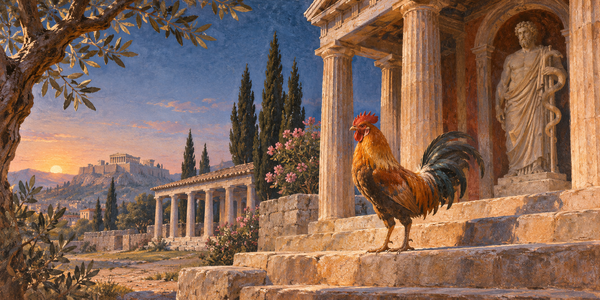
Among the most famous and enigmatic moments in ancient philosophy are the last words Plato attributes to Socrates. He reminds Crito that they owe a cock to Asclepius and asks him not to neglect the obligation.
Asclepius was a deity associated with healing. Some interpreters therefore understand the words as symbolic gratitude for a cure-as though death releases the soul from bodily existence. This interpretation is well known, but it is not the only one and cannot be established as Plato’s definitive intention.
The remark may instead have a more literal religious meaning connected with an outstanding vow or customary offering. Other readings explore irony, philosophical symbolism, or a final demonstration of Socrates’ concern for fulfilling obligations.
The important point is not to present one interpretation as indisputable fact. The text leaves room for different readings. The last words are affecting precisely because they combine an ordinary practical concern with the immense philosophical weight of the moment.
19. What Would Contemporary Philosophy of Mind Object?
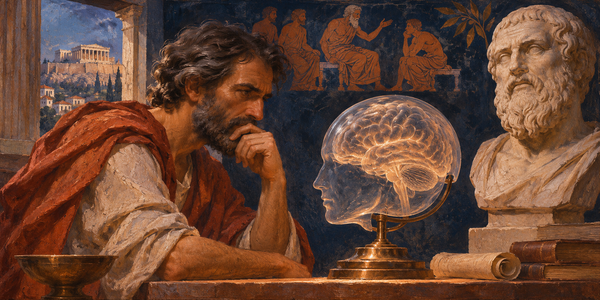
Today the question of the soul is often discussed through concepts such as consciousness, personal identity, brain processes, and subjective experience. Some philosophers defend materialist or physicalist positions according to which mental states depend on physical processes. Others explore dualist, idealist, or alternative theories.
Modern neuroscience provides extensive evidence that memory, perception, language, and personality traits are connected to the functioning of the brain. Injuries and illnesses can alter precisely those capacities traditionally attributed to the soul.
This poses a serious challenge to the idea of a completely independent and unchanged person existing apart from the brain. Yet empirical dependence does not automatically settle every philosophical problem concerning the nature of subjective experience.
Conversely, Plato’s arguments cannot substitute for modern empirical investigation. They examine logical and metaphysical assumptions; they do not measure whether consciousness survives biological death.
The most productive comparison is neither to declare ancient philosophy scientifically proven nor to dismiss it as entirely obsolete. It is to identify which questions remain alive, how the language used to discuss them has changed, and what new evidence must be considered.
20. The Fear of Death and the Meaning of a Philosophical Life
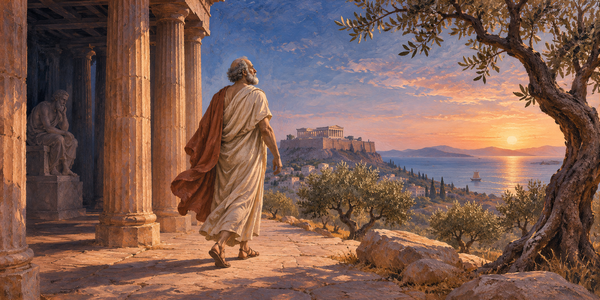
Phaedo is often read as a defense of immortality, but its broader subject is how a person ought to live while knowing that death is inevitable. Socrates does more than propose theories about an afterlife. He demonstrates how convictions can be connected with choices, virtues, and an attitude toward one’s own fate.
Even if a reader accepts none of the arguments for immortality, the question remains whether fear of death should govern an entire life. Can the pursuit of truth, justice, and inner consistency possess value regardless of how long we exist?
Socrates’ composure is not empirical proof that the soul survives. Someone can face death confidently and still be mistaken about what follows. Yet his composure has moral and existential significance: he refuses to abandon his central principles merely because he faces the end.
Phaedo thus leaves us with two different tasks. The first is to assess whether its arguments for immortality genuinely establish what they claim. The second is to ask what kind of life would be worthy of us even if the question of existence after death remains without a final answer.
Perhaps the dialogue’s most enduring message is not that everyone must believe in an immortal soul, but that we should have the courage to investigate the hardest questions without abandoning reason when answers remain uncertain. In Socrates’ final hours, philosophy does not abolish death. It changes the way a human being stands before it.
Author: Vasil Stoyanov