
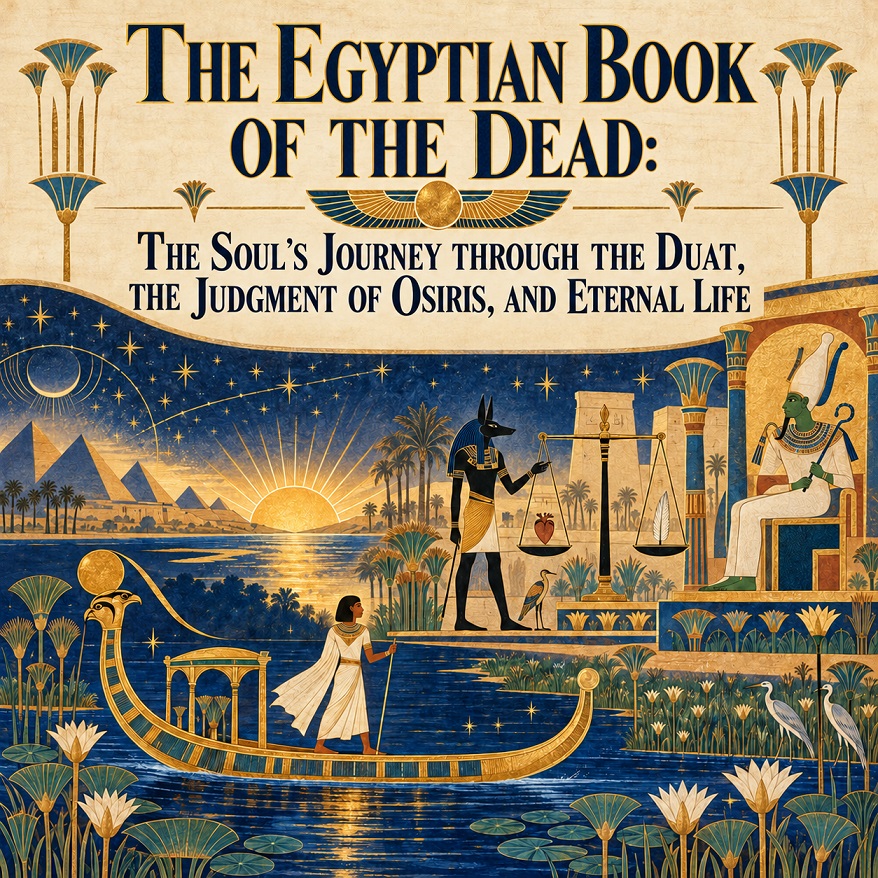
In the beliefs of the ancient Egyptians, death did not destroy human existence. It marked the beginning of a passage through an invisible world inhabited by deities, guardians, dangers, and sacred places. The deceased had to preserve their integrity, know the names of the powers they encountered, overcome the trials of the afterlife, and be recognized as righteous before Osiris. Their ultimate goal was renewed life, membership among the blessed spirits, and participation in the perpetual regeneration of the cosmos.
This journey is described in one of the most celebrated bodies of ancient Egyptian religious literature: the collection now known as the Egyptian Book of the Dead. Its ancient title is generally translated as “Spells for Going Forth by Day.” That title reveals an important difference from the modern idea of a book concerned exclusively with death. The spells were intended to secure freedom of movement, rebirth, and access to light. The deceased did not wish to remain confined to the tomb. They sought to emerge, see the sun, assume desired forms, and live among the gods.
This article examines the collection’s origins, its religious foundations, the preparation of the body, the components of the person, the nature of the Duat, the trials awaiting the deceased, the weighing of the heart, the roles of Osiris, Isis, Anubis, and Thoth, the fields of the blessed, solar regeneration, and victory over annihilation. Short passages from ancient spells are incorporated in English paraphrase and identified by spell number. Their wording varies across manuscripts, recensions, and modern translations. The Egyptian Book of the Dead was not a single unchanging narrative by one author, but a body of religious texts that developed over many centuries.
What Is the Egyptian Book of the Dead?
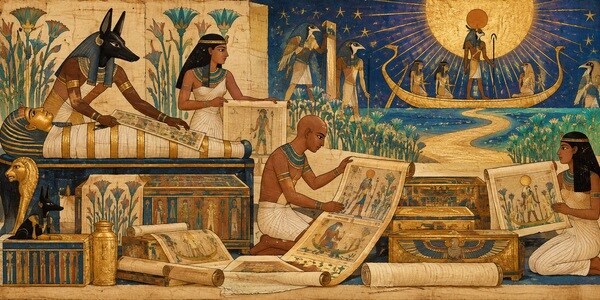
The title “Book of the Dead” became established in nineteenth-century European Egyptology. It designates a collection of funerary spells, hymns, prayers, ritual instructions, and illustrations inscribed on papyri, linen wrappings, coffins, and other objects. Ancient Egyptians did not possess one compulsory canonical volume reproduced identically for every deceased person. Surviving copies differ in length, order, selection of spells, quality of illustrations, and the personal names inserted into the texts.
One papyrus might contain several dozen spells, while another contained substantially more. Certain compositions occur frequently; others belong to particular periods or scribal workshops. The familiar modern numbering of the spells is a scholarly system devised to compare and study manuscripts. It should not be mistaken for an ancient, universally prescribed sequence of events through which every soul passed.
The collection served a practical religious purpose. Its words were meant to be spoken, read, or present within the burial environment to provide protection and knowledge. In Egyptian religion, sacred speech possessed effective power. It did not merely describe a desired condition; it helped bring that condition about. Many formulas therefore speak in the first person, as though the deceased were personally addressing a god, a gate, a guardian, or their own heart.
From the Pyramid Texts to the Papyri of the New Kingdom
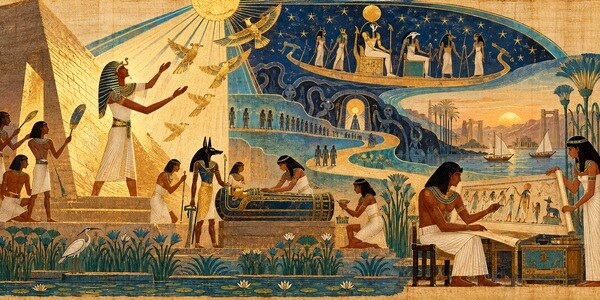
The history of Egyptian funerary literature begins long before the appearance of the familiar illustrated papyri. The earliest major corpus is the Pyramid Texts, inscribed in royal tombs beginning with the pyramid of Unas in the late Old Kingdom, during the twenty-fourth century BCE. These formulas were primarily intended for the king. They helped him ascend to the heavens, join divine powers, and participate in the cosmic order.
During the Middle Kingdom, numerous funerary formulas appeared on the coffins of a broader circle of prominent individuals. This body of material is known as the Coffin Texts. It developed themes concerning the underworld, personal rebirth, protection against danger, and access to divine realms. Earlier formulas were adapted, while other compositions introduced additional religious ideas.
During the New Kingdom, beginning around the middle of the second millennium BCE, the papyrus collections now called the Book of the Dead became established. They circulated among educated and prosperous groups able to commission them. The tradition continued to change, and more standardized arrangements developed during the Late Period. Its history reveals both continuity and transformation. Ancient Egyptian religion was not a frozen system but a living tradition that evolved over centuries.
The Papyrus as a Sacred Object
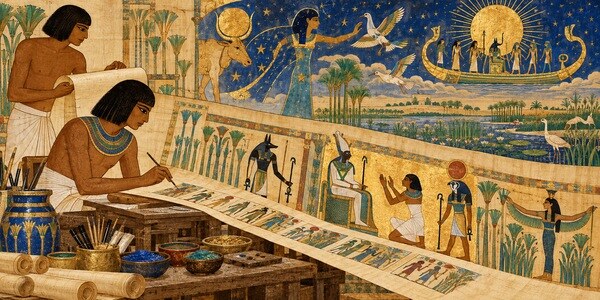
Book of the Dead papyri were simultaneously texts, images, and ritual objects. Their production required preparing sheets from the papyrus plant, professional scribal work, arranging columns, and frequently painting colorful vignettes. Some examples were exceptionally elaborate, while others were relatively modest. These differences reflected the resources of patrons, local traditions, and historical circumstances.
The owner’s name was generally inserted at appropriate points so that the spell applied to a specific individual. This made the papyrus a personal possession intended for the afterlife. Scribes sometimes employed prepared models and subsequently added the deceased person’s name and titles. Corrections, omissions, and discrepancies between words and images also survive. Such details provide valuable evidence of how ancient workshops actually operated.
The vignettes were not merely decorative. They depicted essential scenes: the deceased before deities, the solar boat, the judgment of Osiris, the fields of the blessed, and transformation into different beings. Image and word functioned together. In the Egyptian worldview, the correctly written name, recognizable image, and ritually spoken formula were interconnected means of preserving existence.
Death in Egyptian Religion: Destruction and Restoration
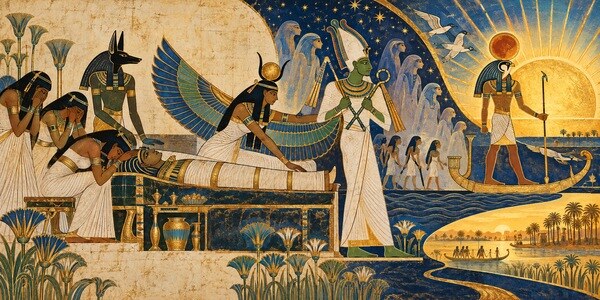
Ancient Egyptians did not deny death’s destructive power. The body decomposed, relatives mourned, and the tomb separated the deceased from the living. Their religious culture nevertheless opposed this disintegration through an elaborate system of rites, images, and promises of restoration. The central model was the myth of Osiris: the murdered god was gathered together and restored through the actions of Isis and other divine helpers. He did not simply resume his former earthly position; he became ruler of the afterlife.
The deceased sought to participate in the same pattern of transformation. Funerary formulas frequently identified the deceased with Osiris, attaching the individual’s name to that of the god. This does not mean that every Egyptian held precisely the same theological beliefs. It demonstrates how the power of a divine model was applied to the fate of an individual human being.
Alongside Osirian restoration stood the solar model. Ra crossed the sky by day, entered the nocturnal realm, and appeared again in the east. These two models overlapped. The deceased wished both to be restored like Osiris and to participate in the sun’s daily renewal. In Egyptian religion, eternal life was not motionless existence but the continuous reestablishment of order.
The Body and the Need to Preserve It
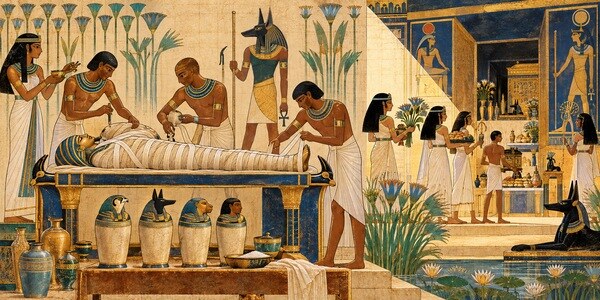
Mummification is among the most recognizable practices of ancient Egypt. It rested on the conviction that the physical body retained lasting importance for existence after death. Preserving the body, making it recognizable, and providing an appropriate burial environment supported the continuation of the person. Techniques varied across historical periods and social groups, and the complexity of treatment depended on available resources.
In developed forms of mummification, the body was dehydrated with natron, treated with oils and resins, and wrapped in linen. Internal organs could be removed and preserved through established procedures. The heart held particular significance and was often left in the body because it was associated with thought, memory, and moral responsibility. The brain did not occupy the same central position in Egyptian religious understandings of the person.
The tomb was more than a place for storing remains. It was a ritual environment equipped with images, inscriptions, offerings, and objects needed for life after death. It maintained a relationship between the living and the deceased. Food offerings, the recitation of the name, and care for the tomb belonged to the system through which death was opposed by remembrance.
The Opening of the Mouth Ceremony
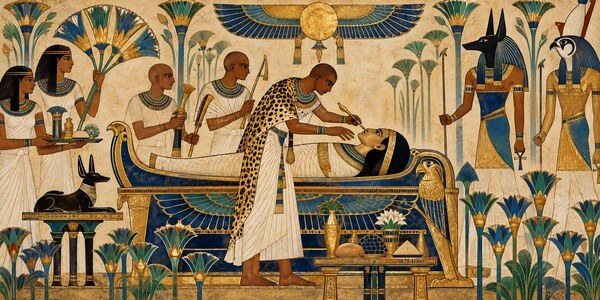
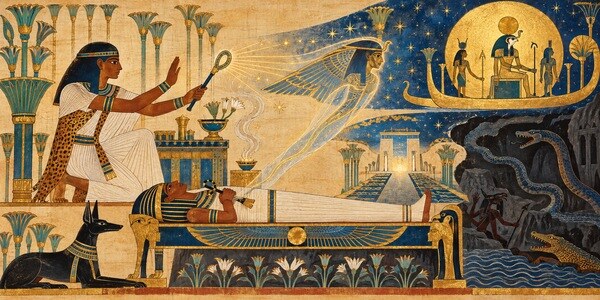
Among the important funerary rites was the ceremony known as the Opening of the Mouth. Its actions were performed upon the mummy, coffin, or an image of the deceased. Through specialized implements, gestures, and formulas, the ceremony symbolically restored the ability to breathe, speak, see, eat, and participate in life. This was an act of religious animation, not medical resurrection.
The ritual had a long history and involved numerous successive actions. Priests performed roles associated with the divine helpers of Osiris. The body was treated as an image whose senses and capacities had to be restored. Burial thereby acquired the character of a new birth, in which the deceased passed from immobility to renewed activity.
The ceremony’s meaning is closely connected to the Book of the Dead. The deceased needed to pronounce names, address guardians, and declare their righteousness. They needed to see the way, receive offerings, and exist as an active being. Sacred texts were not isolated from funerary practice: they belonged to a comprehensive system for restoring the person.
Ka, Ba, and Akh: Dimensions of Human Existence
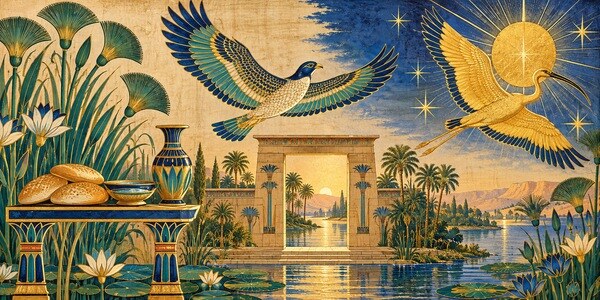
Ancient Egyptian understandings of the person cannot be reduced to the modern opposition between body and soul. Important concepts include ka, ba, and akh. These are not three mechanical parts of a universally fixed scheme, but different dimensions of personal identity and posthumous existence. Their meanings evolved over Egyptian history and depended on particular textual and ritual contexts.
Ka was associated with vitality, personal identity, and the capacity to receive offerings. Funerary cults maintained relationships with the ka through food, drink, and ritual commemoration. Ba was commonly depicted as a bird with a human head. This image expressed the deceased person’s mobility and individuality, including the ability to leave the tomb and return to the body. Akh designated a transformed, effective, and luminous mode of existence associated with successful entry into the divine world.
Alongside these concepts, the name, shadow, heart, and body itself possessed essential significance. Erasing a name could be represented as a threat to the continuation of the person. The shadow likewise required protection. The heart preserved moral memory. Posthumous life therefore required not the separation of one abstract soul from everything else, but the preservation and transformation of a complex human whole.
The Ba: The Bird That Leaves the Tomb
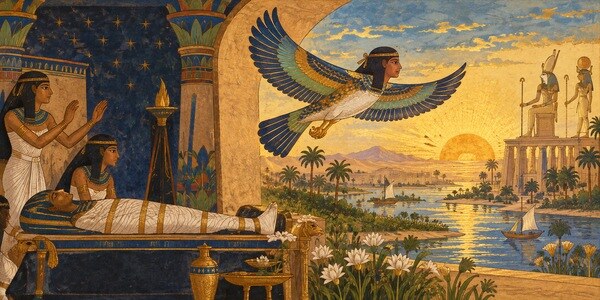
The ba depicted as a bird with a human head is among the most striking symbols of the Egyptian afterlife. In funerary images, the bird can hover above the mummy or move between the tomb and the outside world. It indicates that the deceased should not remain permanently confined to an underground dwelling. They desired freedom of movement, access to light, and participation in the worlds of the living and the gods.
Some spells insist that the ba be able to reunite with the body. This relationship is essential: freedom of movement did not eliminate the need for a preserved funerary foundation. The deceased needed to be mobile and complete at the same time. Egyptian religious thought did not regard these goals as contradictory.
The ba bird also illustrates the Egyptian ability to express theological ideas through clear visual symbols. Flight represents movement between worlds, while the human head preserves individuality. The viewer sees change and continuity together. The afterlife does not erase personal identity but places it within a new realm of possibilities and dangers.
The Heart as Memory, Intelligence, and Witness
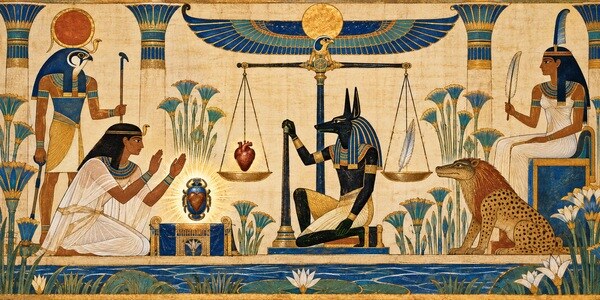
In ancient Egyptian culture, the heart was the center of thought, intention, and moral responsibility. It was not merely a physical organ. Decisions, memories, desires, and actions were associated with it. This is why the heart occupied the decisive position in the scene of posthumous judgment. It testified to the deceased person’s life and had to be weighed against truth and justice.
Spell 30B is especially famous because the deceased addresses their heart and asks it not to testify against them. The essential appeal can be paraphrased: “O my heart, which I received from my mother! Do not rise against me as a witness; do not oppose me before the tribunal.” This is not simply a modern psychological metaphor. It is a ritual formula intended to protect the deceased during a decisive ordeal.
Heart scarabs bearing this text have survived. They were placed with the mummy and served a protective function. The scarab, associated with rebirth, united the symbols of the heart, judgment, and renewal. Object and word again operated together. The deceased did not rely exclusively on memory but was equipped with a physical bearer of sacred knowledge.
The Duat: The Invisible Realm of Transition
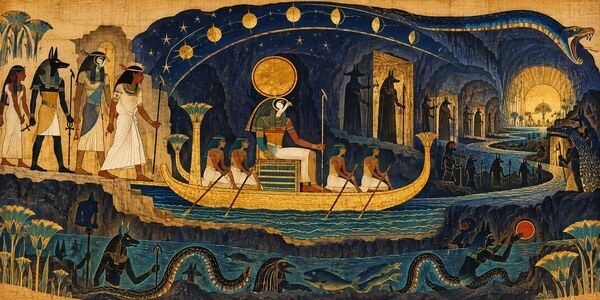
Duat is an ancient Egyptian term for an otherworldly realm associated with the sun’s nocturnal journey, divine places, and the destiny of the dead. It does not correspond exactly to any single modern concept of an underworld. Different texts describe different spaces, gates, waters, fields, paths, gods, and guardians within it. Its geography is religious and symbolic rather than a map of a physical location.
The deceased sought to cross the Duat without being destroyed, captured, or deprived of essential abilities. Spells provided knowledge of obstacles and the names of the beings guarding them. Gates had to be opened, boats reached, and hostile powers neutralized. Knowing the correct words was part of the journey itself.
The Duat was also a realm of regeneration. The solar god passed through it during his nocturnal voyage. Within darkness, the next sunrise was prepared. The otherworld was therefore not exclusively a kingdom of loss. It was a place where destruction and renewal existed together. For the deceased, successfully traversing the Duat meant participating in the cosmic rhythm that restored light each day.
The First Steps After Burial
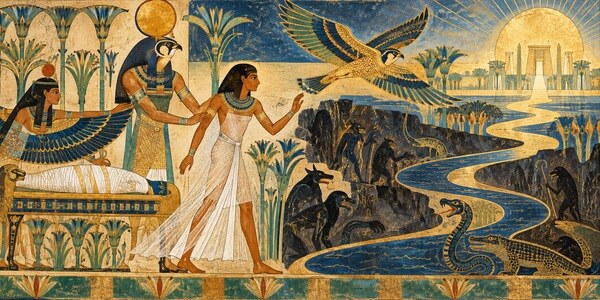
The Book of the Dead does not describe one continuous chronology of events. Its spells offer different protections and possibilities, which could be arranged in different ways. Nevertheless, a central religious purpose emerges: the deceased had to awaken to renewed existence, recover their powers, avoid hostile beings, and find the correct path.
Numerous texts present the deceased as someone no longer reduced to a helpless corpse. They speak, know names, possess power, and address the gods. Spell 17, one of the collection’s most important compositions, contains complex statements concerning divine origins and identities, accompanied by explanations. Its manuscript variations reveal the richness of Egyptian theological tradition.
The deceased did not seek merely to avoid death as an event. They wished to escape the “second death”: the final destruction of posthumous existence. This theme appears in different forms and demonstrates that a desirable afterlife was not automatically guaranteed. Protection, ritual preparation, knowledge, and successful participation in divine order were required.
The Power of Names and Knowledge
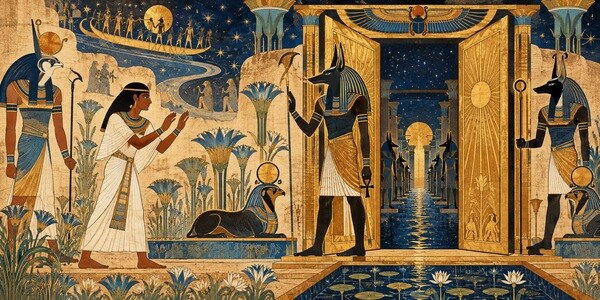
In ancient Egyptian religion, a name was an essential component of existence. Knowing the name of a god, guardian, or sacred place meant being able to establish a proper relationship with it. In some spells, gates and their guardians demand that the deceased pronounce particular names. The deceased demonstrate their preparation through knowledge endowed with ritual force.
This knowledge was not identical to modern information memorized for an examination. It formed part of sacred action. A name disclosed a power’s identity and position within the cosmic order. An incorrect word or lack of necessary knowledge could be portrayed as dangerous. Scribes therefore included formulas granting the deceased the right to pass.
One characteristic motif is that objects and parts of sacred places can themselves ask questions. A gate, threshold, or guardian demands recognition. This literary device transforms passage into an encounter with an organized, inhabited, spiritually significant world. The Duat is not an empty expanse but a cosmos in which each place has a name, function, and divine association.
The Gates and Guardians of the Afterlife
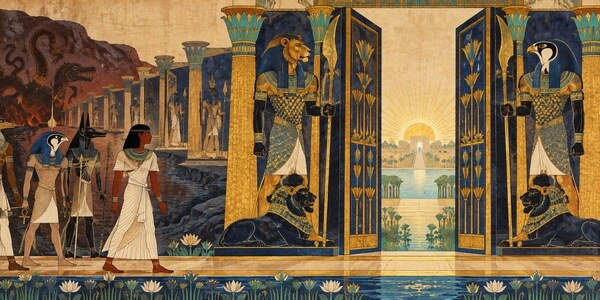
Spells 144–147 are among the compositions concerned with passing through gates and knowing their guardians. The particular structures vary, but the main theme is clear: access to sacred places depends upon correct knowledge and ritual recognition. Some versions present sequences of gates accompanied by the names of guardians, watchers, and heralds.
The deceased approaches a boundary that cannot be crossed through physical force alone. They must introduce themselves correctly and demonstrate that they belong among the justified. Gates separate dangerous regions from places of blessedness, while guardians protect sacred order. Obstacles are therefore elements of the otherworld’s organization rather than arbitrary punishments.
Images of guardians often combine human and animal features, weapons, and unusual names. Their frightening appearance has a protective function. It indicates that sacred space cannot be entered without preparation. These scenes reveal an important feature of Egyptian religion: the terrifying and the beneficial are not always opposites. The power that threatens the unprepared protects the proper order.
Rivers, Boats, and the Crossing of Sacred Waters
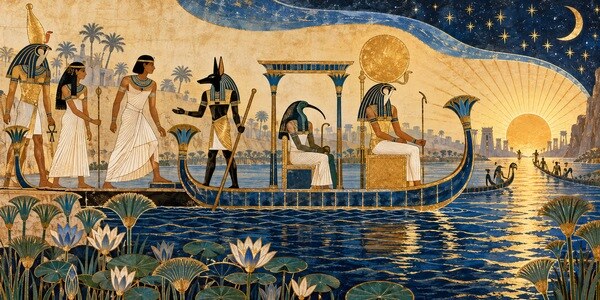
Water was fundamental to Egyptian civilization. The Nile sustained the land’s fertility, and its annual inundation was associated with the renewal of life. Waters, canals, and boats also appeared in otherworldly geography. The deceased had to reach particular shores and obtain passage across sacred spaces.
Some spells contain dialogues with a ferryman or even with the components of a boat. To be admitted, the deceased must know their names and significance. This is a characteristic example of the Egyptian conviction that knowledge and action were inseparable. Requesting passage was insufficient; the traveler had to demonstrate belonging to the proper order.
The boat also symbolized the sun’s movement. Ra traversed the sky and the nocturnal realm in his divine barque. The deceased sought to join this voyage or gain access to the regions through which it passed. Personal destiny was thereby integrated into cosmic destiny. The otherworldly journey of the individual echoed, in religious terms, the passage of light through darkness.
Ra and the Sun’s Nocturnal Rebirth
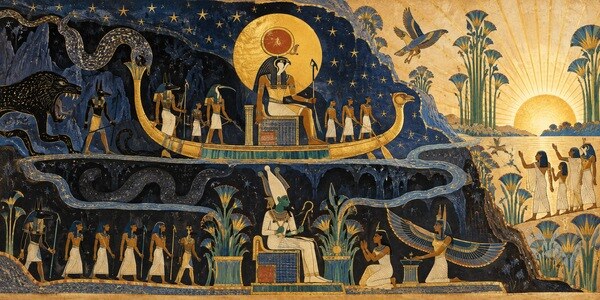
Ra was one of the central deities of ancient Egyptian religion. The sun’s daily movement was understood as a divine process sustaining the world. At sunset, the sun entered the nocturnal realm and faced dangers before appearing again in the east. Other funerary compositions, including the Amduat and the Book of Gates, developed this theme in great detail. They are not identical to the Book of the Dead, although they share images and theological ideas.
In the Book of the Dead, the deceased sought proximity to the solar god, participation in his movement, and access to light. Sunrise represented victory over darkness and the renewal of life. It was not a single event but a daily occurrence that established a model of perpetual regeneration.
Solar symbolism was combined with the Osirian tradition. Osiris was associated with the restoration of the dead, while Ra embodied the cosmic cycle of light. Certain religious conceptions brought their powers together in the nocturnal realm. Their intersection allowed the deceased to participate both in personal resurrection and in the universal order of the world.
Apep: The Enemy of Solar Order
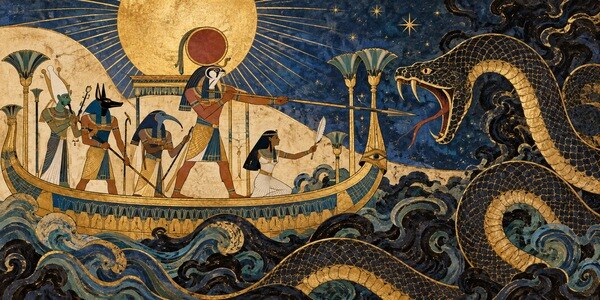
Apep, also called Apophis, was the enormous serpent embodying destructive forces opposed to solar order. In religious images, he threatened Ra’s barque and had to be defeated so that the sun could continue its journey. The struggle against Apep was an important theme in Egyptian cosmology and ritual practice.
The significance of this struggle extended beyond a tale of a hero confronting a monster. It expressed the constant effort required to preserve cosmic order against disintegration. In Egyptian religion, chaos was not merely a distant past definitively defeated at creation. It remained a threat continually repelled through divine action and human ritual.
For the deceased, participation in the sun’s victory meant belonging to the forces of regeneration. Personal survival was connected with the survival of the cosmos. This gave funerary literature its extraordinary scale: individual death was placed within the daily struggle between ordered existence and destruction.
Osiris: The Murdered and Restored Ruler
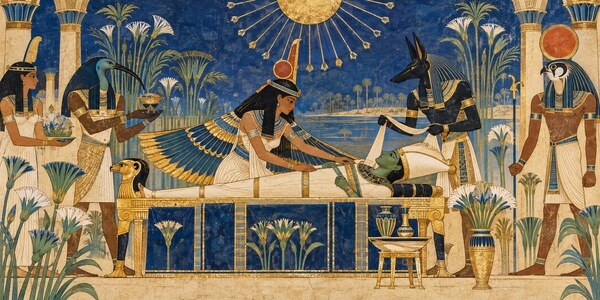
Osiris is among the most important deities for understanding Egyptian ideas of the afterlife. According to mythological traditions, he was murdered by his brother Seth, while Isis and other divine helpers participated in his restoration. Details of the narrative appear in different ancient sources and should not be reduced to one unchanging version. The central pattern remains consistent: death is overcome through gathering, protection, ritual, and divine power.
Osiris became ruler of the kingdom of the dead and the model of posthumous rebirth. Funerary texts often called the deceased “Osiris” followed by their personal name. This associated them with the god’s destiny and offered hope of restored existence.
Osiris was commonly represented as a mummiform ruler wearing a crown and carrying a crook and flail. The green or dark coloring of his face in different works could emphasize rebirth, fertility, and his connection with the earth. He was not merely a terrifying lord of the dead. He was the divine example of the restoration of what had been destroyed and of death’s transformation into a new mode of existence.
Isis and Nephthys: Protectors of Rebirth
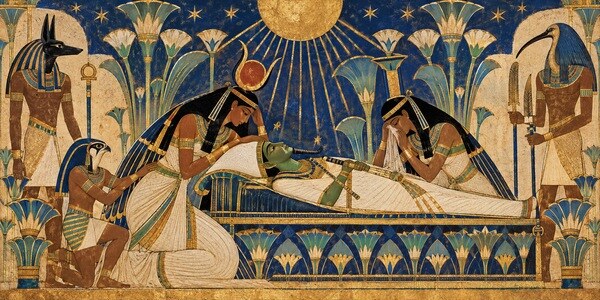
Isis was one of the most significant goddesses in Egyptian religion. Her role in the Osiris myth included mourning, searching, protecting, and restoring her murdered husband. She was associated with the power of sacred speech and the care of Horus, Osiris’s heir. Within funerary tradition, Isis became a figure of protection capable of overcoming destruction.
Nephthys, the sister of Isis, likewise participated in funerary rituals and divine lamentation. The two goddesses were frequently depicted as protectors of the deceased. Their presence demonstrated that rebirth was not the work of one deity alone but resulted from the coordinated activity of divine powers.
The lamentations of Isis and Nephthys carried ritual significance. They were not simply expressions of grief but part of Osiris’s restoration. Within the ancient Egyptian worldview, properly performed mourning, spoken words, and protective gestures could assist the transformation of the deceased. This helps explain the complexity of funerary ceremonies and why their texts functioned as actions rather than mere narratives.
Anubis: Guide to the Hall of Judgment
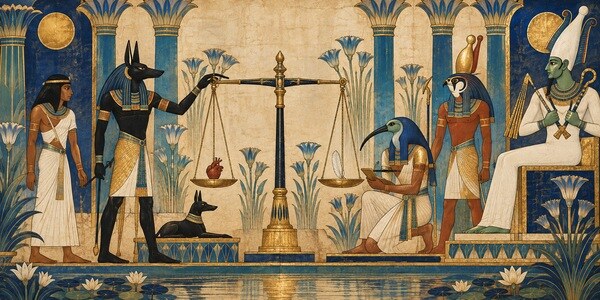
Anubis, the jackal-headed deity, was closely associated with burial, mummification, and the protection of the dead. In judgment scenes, he often led the deceased toward the scales and participated in weighing the heart. His role was not to condemn arbitrarily but to ensure that the sacred procedure was correctly performed.
The jackal occupied a special place in Egyptian funerary symbolism. Animals inhabiting desert regions and the surroundings of cemeteries were associated with the boundary between the living and the dead. Anubis transformed that association into a protective divine function. He stood where the body was vulnerable and transition required care.
In illustrations, Anubis sometimes inspected the scales or steadied their mechanism. This detail emphasized the need for accuracy. Righteousness was not established by a random decision but by symbolic measurement against Ma’at. Anubis guarded the correct procedure and mediated between the deceased and the divine tribunal.
Thoth: The Scribe of Divine Truth
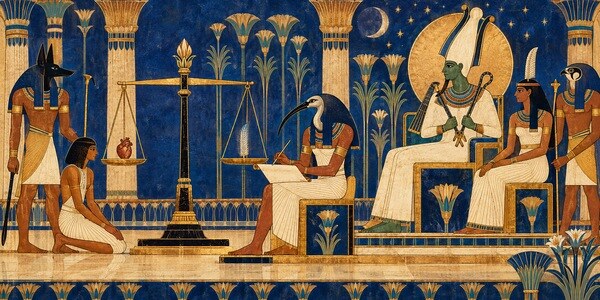
Thoth was the god of writing, knowledge, calculation, and sacred speech. In scenes of the weighing, he was often depicted with the head of an ibis, recording the result of the judgment. His presence emphasized accuracy, testimony, and the proper establishment of truth.
Thoth also played a major role in wider Egyptian mythology. He participated in resolving divine disputes, was associated with the moon, and helped maintain cosmic order. As divine scribe, he preserved what had been established and gave it an authoritative record.
In the hall of judgment, Thoth did not replace Osiris or eliminate the role of Ma’at. He registered the outcome and certified its validity. The scene combined moral significance with administrative precision, a characteristic feature of Egyptian civilization, in which writing, accounting, and order were of exceptional importance. Even judgment in the afterlife was presented as an event requiring proper documentation.
Ma’at: Truth, Justice, and Cosmic Order
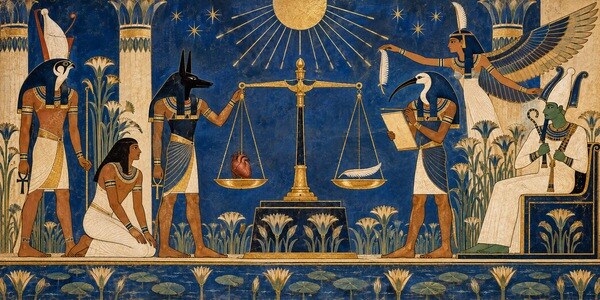
Ma’at was both a goddess and a foundational concept in Egyptian religion and social thought. It encompassed truth, justice, rightness, balance, and the maintenance of cosmic order. Ma’at was not simply a personal virtue. It described how society, kingship, justice, and relationships between humans and gods ought to function.
In the weighing scene, the deceased person’s heart was placed on one pan of the scales, while the other usually held the feather of Ma’at or a symbol associated with her. The comparison indicated whether the person had lived in accordance with proper order. The image was not a mechanical account of physical measurement but a religious visualization of moral responsibility.
Ma’at is essential to understanding the Book of the Dead because it connected personal destiny with social morality. The deceased did not merely need secret names and protective formulas. They had to declare that they had not committed serious offenses against other people, the gods, or the established order. Ritual knowledge and ethical conduct thus met within one religious system.
The Hall of Two Truths and the Great Judgment
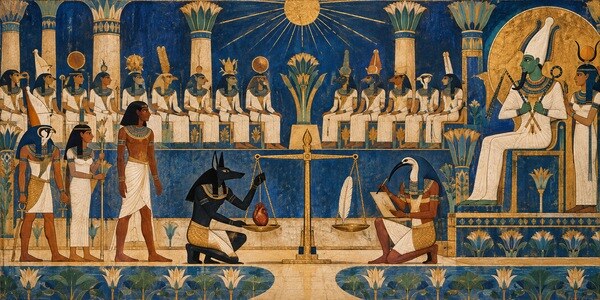
One of the most celebrated scenes in Egyptian art is the weighing of the heart before Osiris. It is associated especially with Spell 125. The deceased enters a sacred hall, stands before the divine tribunal, and delivers declarations of innocence. Anubis participates in the weighing, Thoth records the outcome, and Osiris presides over the final recognition.
The scene commonly includes additional divine figures. Some illustrations feature forty-two divine judges, each addressed by a separate declaration. This does not mean that every historical version of the spell possessed an absolutely identical illustration. Rather, it demonstrates how the moral ordeal was presented as a solemn encounter with the entire divine order.
The language of vindication is also important. An Egyptian expression often translated as “justified” or “true of voice” described a deceased person whose claim had been accepted. Such a person could enter the desired posthumous existence. Judgment was therefore not only a test but also an act of admission into the community of the blessed.
The Negative Confession: Forty-Two Declarations
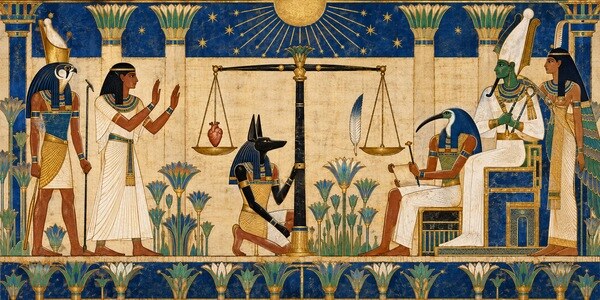
Spell 125 contains the celebrated declarations known in modern scholarship as the Negative Confession. The deceased states that they have not committed specified wrongs. The list is not a modern criminal code but a ritual formula of moral vindication. Its subjects include killing, theft, deception, injustice, violations against temples, and causing suffering.
Several widely attested motifs can be paraphrased briefly: “I have not wronged people.” “I have not stolen.” “I have not killed.” “I have not spoken lies.” “I have not caused hunger.” The precise wording and sequence vary according to manuscript and translation. Their common purpose is to present the deceased as someone who has not violated Ma’at.
These statements reveal the importance of morality within Egyptian funerary religion. The deceased did not claim a favorable afterlife solely through wealth or correctly performed rites. They had to represent their earthly conduct as consistent with truth and justice. This ideal does not establish that all Egyptians lived according to it. It reveals the qualities their society elevated as religiously significant.
The Weighing of the Heart
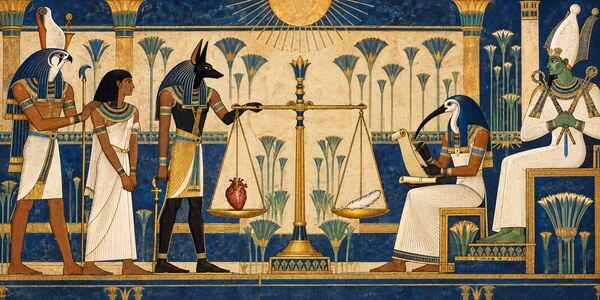
At the center of the judgment scene stood the balance. The heart of the deceased occupied one pan, while the feather of Ma’at occupied the other. Anubis supervised the procedure, Thoth recorded the result, and the deceased awaited the decision. This is one of the clearest visual expressions of the ancient Egyptian conviction that earthly conduct had consequences beyond the grave.
The heart’s weight should not be understood as ordinary physical mass. The scene expressed correspondence between human actions and divine order. When the heart was recognized as conforming to Ma’at, the deceased received permission to proceed toward a favorable posthumous existence. In many images, Horus then presented the individual before Osiris.
The judgment was strikingly concrete. A person was not evaluated solely according to ancestry or social rank. They had to be acknowledged as righteous. At the same time, the scene belonged to a religious system in which properly performed rites and sacred words also mattered. Egyptian conceptions of success after death united moral responsibility, divine favor, and ritual preparation.
Ammit: The Devourer of Hearts
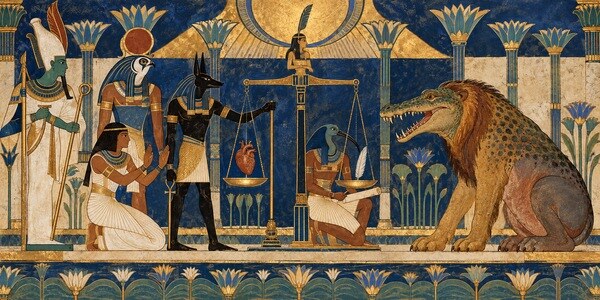
Beside the scales frequently waited the terrifying creature Ammit, whose name is associated with devouring the dead. In illustrations, she combined features of animals including crocodile, lion, and hippopotamus. These were powerful and dangerous creatures familiar to Egyptians from their environment. Their characteristics were brought together in a figure embodying the ultimate threat to the unrighteous deceased.
Ammit was not a goddess of everlasting torture in the sense found in certain later religious traditions. Her role was to destroy the possibility of the desired afterlife when the heart failed the test. Devouring symbolized ultimate loss: exclusion from the continued existence of the blessed.
Ammit’s presence gave the judgment scene dramatic urgency. Its outcome had genuine consequences within the religious system. Righteousness was not merely a commendable quality but a condition for preserving existence. The deceased therefore carried spells protecting the heart and pronounced declarations of innocence. All these actions sought to overcome the greatest danger: final annihilation.
Horus Presents the Vindicated Deceased to Osiris
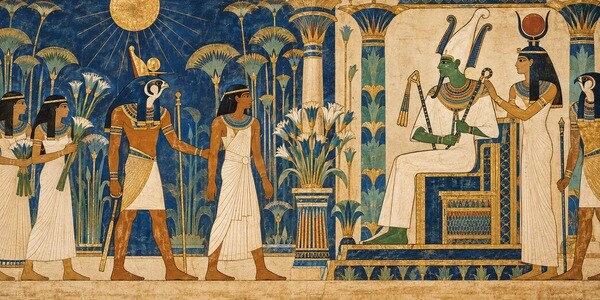
After the successful weighing, numerous illustrations show Horus leading the deceased toward the throne of Osiris. This scene is the solemn conclusion of the judicial ordeal. The deceased is no longer an unknown traveler standing before dangerous gates. They have been acknowledged as righteous and granted access to the divine ruler.
In the principal mythological tradition, Horus is the son and heir of Osiris and Isis. His victory over his father’s adversaries is associated with the restoration of legitimate order. In funerary scenes, he serves as the intermediary who presents the justified individual before the restored divine king.
Personal judgment thus becomes part of the wider Osiris myth. Death is followed by restoration, and disrupted balance by recognized order. Successful passage does not end in an arbitrary reward but in acceptance into a world organized according to the same principles of justice and divine legitimacy that govern the cosmos.
The Field of Reeds: Aaru
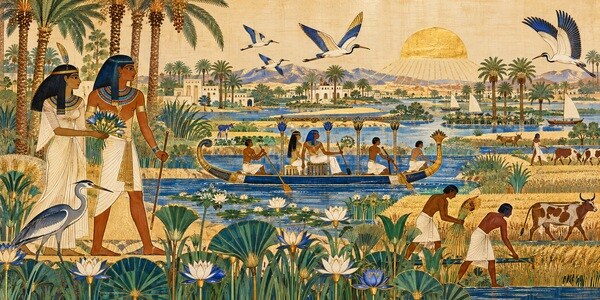
Among the most attractive images of the blessed afterlife is the Field of Reeds, known as Sekhet-Aaru. It was depicted as a fertile region containing canals, fields, islands, and abundance. The deceased could cultivate land, sail in boats, enjoy offerings, and exist in surroundings recalling the most favorable aspects of earthly Egypt.
This image was closely connected to the natural environment of the Nile Valley. For a society dependent upon fertile soil and water, the ideal place of blessedness was not necessarily an immaterial abstraction. It was an ordered, fertile, protected world in which the necessities of life were secured.
Spell 110 is especially important for representations of the fields of the blessed. Its illustrations can show the deceased among canals, fields, and agricultural activities. Text and image together secured access to that region. Eternal life here meant not only escape from death but participation in a flourishing world where cosmic order appeared as fertility, food, and peace.
The Field of Offerings and Eternal Nourishment
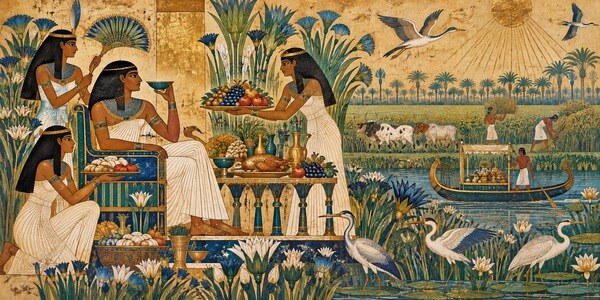
Alongside the Field of Reeds, Egyptian funerary texts describe regions associated with offerings, food, and divine abundance. Eating did not lose its importance after death. On the contrary, the ability to receive bread, beer, water, and other gifts signified continued existence.
This belief explains why tombs contained images of offering tables, provisions, and scenes of presentation. Depicted food served a religious purpose rather than a merely decorative one. Through properly performed rituals and spoken formulas, the deceased received what was necessary for well-being.
Some texts also express the wish that the deceased should not be deprived of water or forced to consume impure substances. Such fears show how concretely Egyptians imagined posthumous existence. Eternal life required protection not only from divine enemies but also from hunger, thirst, immobility, and humiliation. Blessedness was a comprehensive condition of restored human agency.
Shabtis: Helpers in the Afterlife
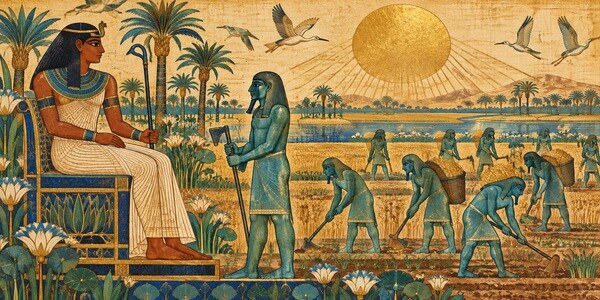
Small figurines known as shabtis or ushabtis were frequently placed in Egyptian tombs. They were intended to perform certain labor obligations on behalf of the deceased in the afterlife. During some periods, the figurines carried tools and inscriptions specifying their function.
Spell 6 was associated with summoning these figures. Its essential motif can be paraphrased as follows: when the deceased is called upon to perform work in the next world, the figurine must answer in their place. Some translations render its brief response as “Here I am.” This concise reply is remarkable because the small object assumes the role of an active substitute.
Shabtis demonstrate that Egyptian blessedness was not always imagined as a world without work. Agricultural duties could continue after death, but the deceased received helpers to undertake them. Wealthy burials sometimes contained large groups of figurines. Their quantity and craftsmanship reflected social status, while their religious purpose remained consistent: securing freedom and well-being for the deceased.
Transformation into a Falcon, Lotus, and Other Sacred Forms
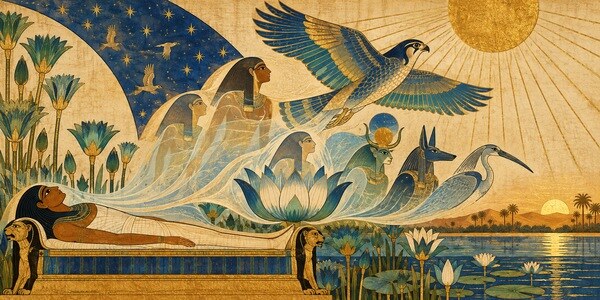
The Book of the Dead contains spells through which the deceased seeks to assume different forms. These include the falcon, the lotus, divine beings, and other symbolic figures. Such transformations should not be interpreted as one compulsory sequence of reincarnations. They represented opportunities to acquire particular powers, freedom, and participation in divine states.
The falcon was associated with the sky, kingship, and Horus. The lotus was connected with rebirth because it opens toward the light and occupies an important place in Egyptian creation myths. Through these images, the deceased sought qualities that overcame the limitations of the ordinary body.
Transformation spells illustrate one of the most distinctive features of Egyptian religious thought: personal identity could remain recognizable while participating in different divine forms. Change did not necessarily mean losing individuality. It was a means of expanding the possibilities of existence.
The Scarab and the Rebirth of Light
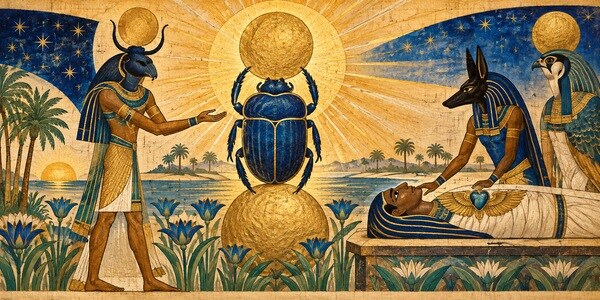
The scarab is one of ancient Egypt’s best-known symbols. Its association with rebirth developed from observations of beetles rolling balls and the emergence of new life. Egyptians connected this image with solar renewal and the god Khepri, whose name was associated with becoming and transformation.
Scarabs were used as amulets in life and in funerary settings. Heart scarabs were especially important and could bear Spell 30B. Their function was to protect the heart during judgment and support the deceased person’s successful passage.
Several central themes of the Book of the Dead converge in this object: the heart as witness, the effective power of sacred writing, and rebirth as the ultimate goal. A small amulet could embody a complex religious system. It is material evidence of how ancient Egyptians translated large ideas about death and eternity into objects intended to accompany an individual person.
Dangers from Serpents, Crocodiles, and Hostile Powers
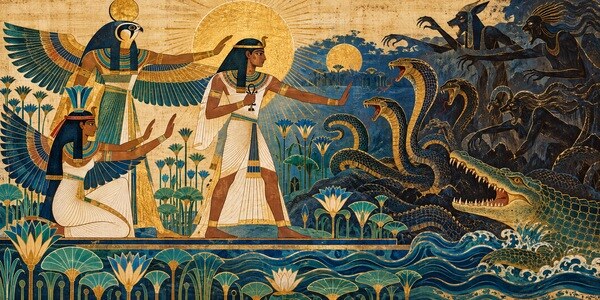
Funerary texts contain numerous spells protecting against dangerous animals and hostile beings. Serpents and crocodiles occupy a particularly important place because they were real threats within the Egyptian environment and also carried powerful religious meanings. In different contexts, they could be protective or destructive.
The spells did not always seek to destroy the dangerous creature. Sometimes the goal was to neutralize it through knowledge, correct address, or identification of the deceased with a divine power. Sacred speech thus brought the threat under control.
There were also formulas against decapitation, loss of abilities, being turned upside down, and other degrading or destructive conditions. These dangers may seem unusual to modern readers, but they reflect ancient fears concerning the disintegration of the person. The deceased had to preserve the head, name, heart, shadow, and freedom of movement. Each protection served the same overall purpose: preventing final destruction.
Protecting the Name and the Shadow
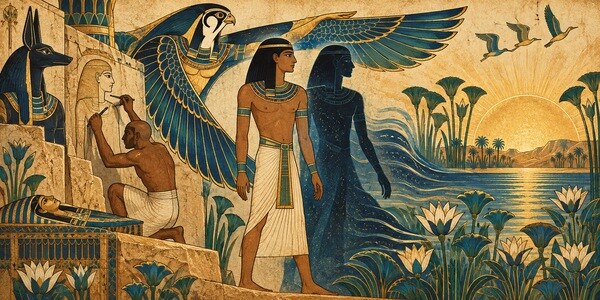
A person’s name held decisive importance in Egyptian religion. It secured recognizability and the continuation of memory. Inscribing names on tombs, statues, coffins, and papyri was not simply an administrative act. It created the possibility that the person would be named and sustained through ritual.
Erasing a name could be regarded as a grave attack upon posthumous existence. Historical examples survive of rulers whose names and images were removed from monuments. Such actions had political and religious dimensions. They reveal how closely remembrance and existence were connected within the Egyptian worldview.
The shadow also appeared among the elements requiring preservation. In certain religious contexts, it was an aspect of the person rather than an incidental physical phenomenon. Spells protecting the shadow demonstrate the multilayered Egyptian conception of human identity. Rebirth required more than the survival of a disembodied essence; it required the protection of all significant dimensions of the person.
Going Forth by Day: The Freedom to See the Sun
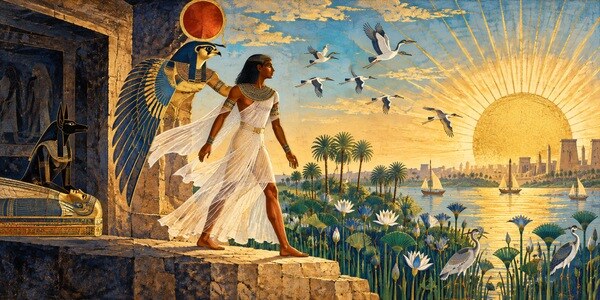
The collection’s ancient title places special emphasis on “going forth by day.” This meant freedom to leave the enclosed tomb and participate in the world of light. The desire appears in numerous formulas securing movement, breathing, and the opportunity to encounter the sun.
This theme shows that the Egyptian ideal of the afterlife was not limited to permanent residence in an underground palace. The deceased wished to travel between regions and gain access to different forms of divine life. Freedom was therefore one of the greatest blessings of rebirth.
Sunlight was not merely a comfort. It signified cosmic renewal and victory over destruction. Seeing the sun meant participating in the rhythm of a world that continued despite individual death. The wish to go forth by day thus condensed the entire hope of funerary literature into a brief formula: the deceased should not remain imprisoned in darkness but should enjoy restored and active existence.
Spell 17 and Identification with the Gods
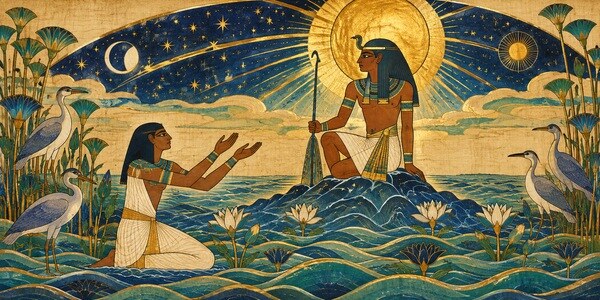
Spell 17 is among the most important and complex parts of the Book of the Dead. It includes theological declarations, identifications with deities, and explanations of religious concepts. In various manuscripts, the text is accompanied by commentaries interpreting particular formulas. This makes it an especially valuable source for understanding how Egyptian priests interpreted their own traditions.
One well-known motif identifies the speaker with the primordial creator god. The sense of the formula can be paraphrased: “I am Atum, when I was alone in the waters of the beginning.” Exact wording differs among manuscripts and translations. What matters is that the deceased speaks through a divine image associated with the world’s original emergence.
This identification should not be read as an ordinary personal claim that the deceased was historically identical with the deity. It belongs to a ritual language through which the person participates in divine powers and states. Spell 17 demonstrates that Egyptian funerary literature was not only a practical guide to avoiding danger. It contained sophisticated ideas about creation, divine identity, and humanity’s place in the cosmos.
Spell 30B and the Appeal to One’s Own Heart
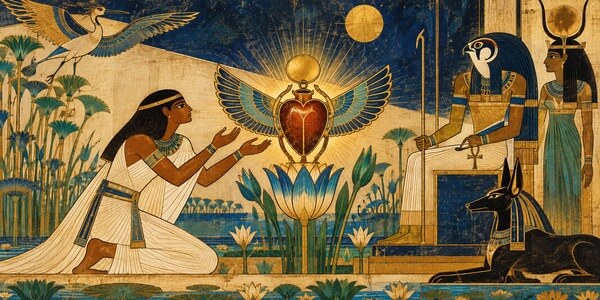
Spell 30B deserves special attention because it addresses not an external enemy but the deceased person’s own heart. The speaker asks the heart not to oppose them during judgment. The formula is known from numerous funerary objects and papyri and is frequently associated with heart scarabs.
A brief paraphrase reads: “O my heart from my mother, O heart of my existence! Do not stand against me as a witness.” The appeal combines intimacy and anxiety. The heart belongs to the individual from the beginning of life, yet in the afterlife it possesses independent power to testify. The deceased cannot reject it and does not wish it to condemn them.
This text reveals an important aspect of Egyptian religious ethics. The truth of a person’s life is not found solely in the words they speak to others. It is preserved in the heart. The spell seeks favorable testimony, but the existence of judgment itself demonstrates that actions matter. Ritual and morality are woven together within a single understanding of responsibility.
Spell 125 as a Religious Document of Morality
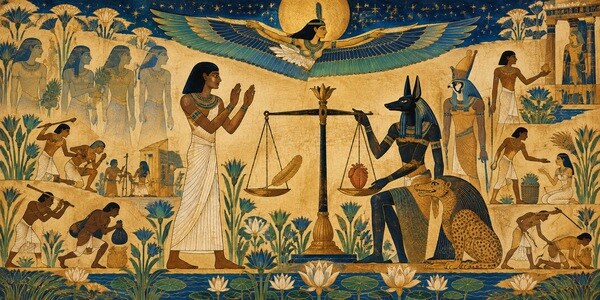
Spell 125 is among the most extensively studied compositions in Egyptian funerary literature. It is valuable not only for the famous scene of the scales but also for its list of moral offenses denied by the deceased. Different versions include formulas concerning violence, theft, lying, misuse of property, improper treatment of temples, and the infliction of suffering.
The short declarations “I have not stolen,” “I have not killed,” and “I have not lied” convey important motifs but do not exhaust the text’s contents. Some statements concern specific social and religious practices of ancient Egypt. They must be considered in their historical setting rather than mechanically transformed into a universal modern list of virtues.
The spell demonstrates that religious hope for eternal life was connected with ideas about just conduct on earth. It does not prove that Egyptian society was free of violence or inequality. It is evidence of the ideal to which funerary culture appealed. A person had to be recognized as conforming to Ma’at, and that righteousness included relationships with other people.
Spell 110 and the Image of the Blessed Fields
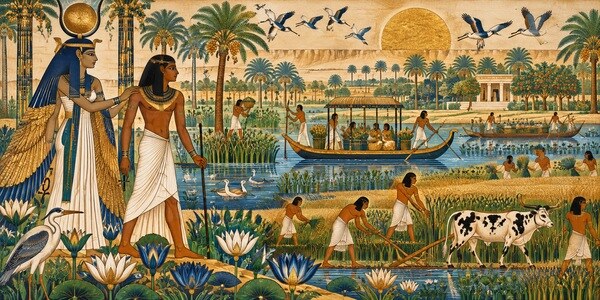
Spell 110 is particularly famous for its depictions of the Field of Reeds. In some papyri it is accompanied by detailed scenes of agricultural work, waterways, boats, and offerings. The deceased appears as a participant in a fertile, well-organized world that continues the most desirable forms of earthly prosperity.
These illustrations are not simply landscape paintings. They establish access to sacred places and show what must be provided for the deceased. The land is fertile, water is available, and necessary activities fall under divine protection. The deceased can participate in this region’s life without exposure to the destructive dangers of earthly existence.
Sekhet-Aaru is an important example of how Egyptian religion connected the afterlife with familiar natural surroundings. For a society whose life depended on the Nile, the blessed world was one of fertility, water, and order. Eternity did not abolish the value of earthly life. It transformed that life into an ideal, protected, and enduring form.
The Papyrus of Ani: The Most Famous Illustrated Witness
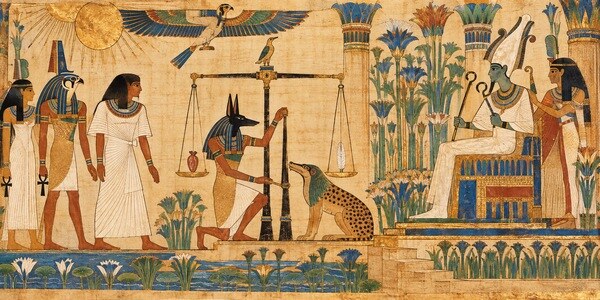
Among the best-known copies of the Book of the Dead is the Papyrus of Ani, produced during the Nineteenth Dynasty of the New Kingdom, approximately in the thirteenth century BCE. It is preserved in the British Museum and is celebrated for its richly colored illustrations. Ani was a high-ranking official, and his papyrus presents both texts and scenes from the journey after death.
The vignette of the weighing of the heart is especially famous. It depicts the deceased, deities, scales, and judicial procedure with remarkable visual clarity. Through this scene, many modern readers immediately recognize the principal elements of Egyptian judgment in the afterlife.
The Papyrus of Ani should not, however, be treated as the only or definitive version of the Book of the Dead. It is a particular historical manuscript created for a particular person. Its beauty and fame make it a useful starting point, but a complete understanding of the tradition requires comparison with other papyri, coffins, and funerary texts from different periods.
The Papyrus of Hunefer and the Scene of Vindication
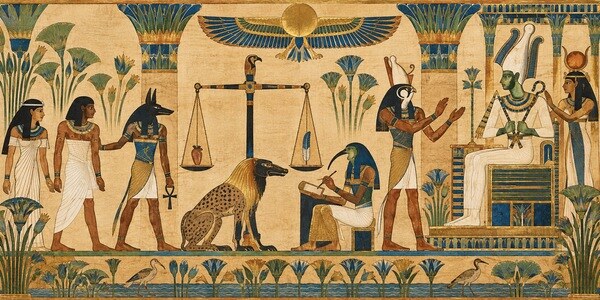
Another important illustrated manuscript is the Papyrus of Hunefer, also dating to the Nineteenth Dynasty. It is especially famous for the judgment scene in which Anubis leads the deceased, the heart is weighed, Thoth records the result, and Horus presents the justified person to Osiris. This composition is among the most frequently reproduced images of Egyptian religion.
The papyrus allows us to follow the visual sequence of the judicial ritual. On one side stands human uncertainty before the test; on the other, solemn acceptance by the divine ruler. The scales connect these two moments and demonstrate that the transition depends on established conformity with Ma’at.
Comparison between the papyri of Ani and Hunefer reveals shared motifs as well as differences in artistic organization. This is an important reminder that Egyptian funerary tradition was diverse. Its texts and images adapted to patrons, workshops, and religious preferences without losing the central ideas of protection, judgment, and rebirth.
Colors, Animals, and the Language of Sacred Images
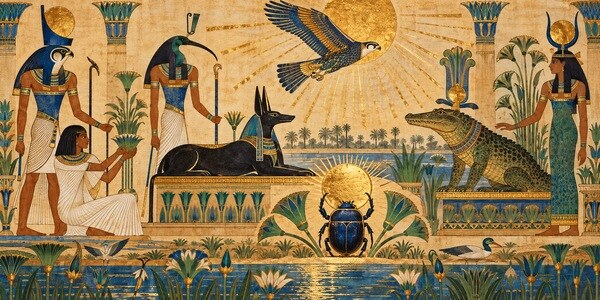
Egyptian funerary art employed established symbolic relationships between image, color, and divine function. Green could emphasize fertility and rebirth; black could evoke fertile soil and renewal; gold could express divine imperishability and solar power. These meanings depended on context and cannot be reduced to a universal chart applicable to every image.
Animal forms also carried rich meanings. The falcon was associated with Horus and heavenly authority, the ibis with Thoth, the jackal with Anubis, and the scarab with Khepri and regeneration. The crocodile could represent danger but was also associated in other religious contexts with the divine power of Sobek. The same animal did not invariably possess one exclusively positive or negative meaning.
This symbolic richness is a key to reading the Book of the Dead correctly. Its images were not arbitrary fantasies. They belonged to a religious visual language developed over centuries. Understanding them requires attention to the scene’s location, the deities’ names, accompanying texts, and the historical period.
Wealth, Access, and Social Differences
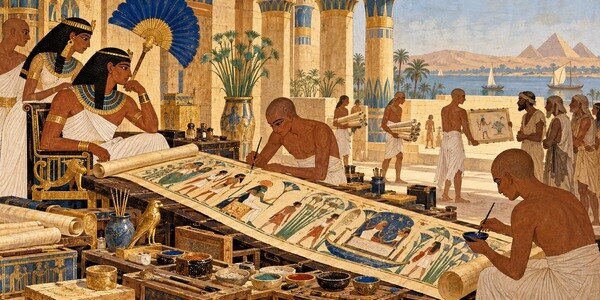
Commissioning a richly illustrated papyrus was expensive. Not every inhabitant of ancient Egypt could afford such an object. Access to elaborate funerary practices depended on social position, material resources, local customs, and historical period. This is an essential consideration when interpreting surviving manuscripts.
When we study papyri belonging to high-ranking officials, we primarily encounter the religious world of people with the means to commission them. This does not mean that the rest of the population lacked funerary beliefs. It means that archaeological evidence has survived unevenly and that material culture reflects social differences.
Over time, funerary texts and practices spread among broader social groups, but it would be inaccurate to assume that all Egyptians enjoyed equal access to them. The history of the Book of the Dead is also a history of scribes, temples, workshops, and families able to finance the creation of sacred objects.
Heka and the Effective Power of Sacred Speech
The ancient Egyptian concept of heka is usually translated as “magic,” but its meaning does not fully correspond to modern notions of magical practice. Heka was a power associated with creation and the effectiveness of divine speech. It could operate through rituals, formulas, amulets, and actions intended to provide protection and restoration.
The Book of the Dead cannot be understood without this religious premise. Its spells were not simply beautiful poems about the afterlife. They were meant to help the deceased overcome danger, receive nourishment, protect the heart, and reach divine places. The effectiveness of correctly written and spoken words belonged to the collection’s religious logic.
It is inaccurate to oppose Egyptian magic mechanically to religion, as though they occupied completely separate spheres. Within the ancient Egyptian context, ritual, prayer, myth, and magical formula frequently worked together. Their common purpose was to establish the correct relationship between humans, gods, and cosmic order.
The Book of the Dead and Other Books of the Afterlife
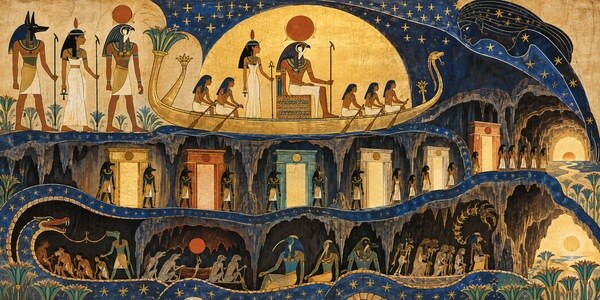
Egyptian religious literature also contains important funerary compositions such as the Amduat, the Book of Gates, the Book of Caverns, and the Book of the Earth. These are particularly associated with royal tombs of the New Kingdom and descriptions of the solar god’s nocturnal journey. They present the afterlife through complex sequences of places, hours, gates, and divine encounters.
The Book of the Dead has a different character. It is a collection of spells intended for an individual deceased person, not a unified composition necessarily describing the twelve hours of night. The various corpora share themes, but their contents should not be combined without distinction.
This clarification is especially important in popular accounts of Egypt. Images of the nocturnal world, the solar barque, and underground regions are often attributed indiscriminately to the Book of the Dead. A historically accurate approach examines each corpus according to its structure, purpose, and period. Doing so reveals the true richness of Egyptian thought about death.
Is There a Single Sequence to the Journey?
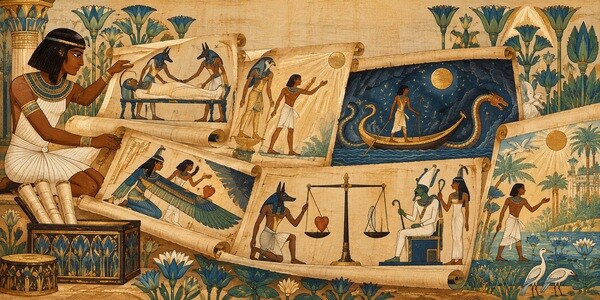
Modern readers often expect the Book of the Dead to recount the soul’s experience from the first to the final moment after death. Ancient papyri were not organized in this way. They contained texts with different functions, selected and arranged according to the conventions of a particular period and the patron’s requirements.
A general model can nevertheless be outlined: preparation of the body, restoration of abilities, passage through dangerous places, protection of the heart, vindication before Osiris, and access to blessed existence. This model is an analytical summary, however, not a literal sequence written identically in every ancient copy.
This feature does not diminish the collection’s value. It demonstrates its practical character. The texts were selected as instruments of posthumous protection and regeneration. The deceased required different capacities rather than knowledge of only one linear story. Individual spells could therefore circulate independently and be combined in different manuscripts.
The Deceased as Justified and Their New Status
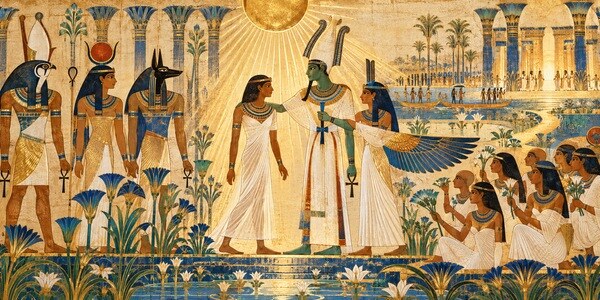
Following successful judgment, the deceased could be described as justified, vindicated, or “true of voice,” depending on the translation of the Egyptian expression. This was an important religious status. It signified that the person had been recognized as conforming to divine order and could participate in favorable forms of posthumous existence.
Vindication involved more than escaping punishment. It opened access to divine places, offerings, light, and the community of the blessed. The restored deceased sought to become an akh: an effective, transformed being capable of existing in the world of the gods.
The journey’s conclusion therefore involved a change of status. The person passed from the vulnerability of death into recognized participation in cosmic order. Their name, body, heart, and capacities were protected, and the religious texts had fulfilled their purpose. Eternal life was understood as restored wholeness and belonging within the divine world.
Eternity as Continuous Regeneration
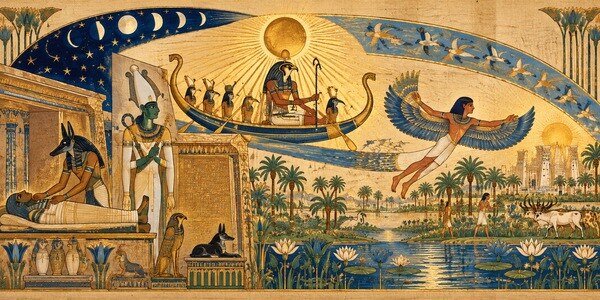
Ancient Egyptian concepts of eternity had several dimensions. They included the stability of divine order and the cyclical renewal of the world. Within funerary religion, these aspects met in the deceased person’s desire both to remain preserved and to be reborn. Osiris represented enduring restored existence, while Ra embodied the continual return of light.
This model explains why funerary texts combined static and dynamic images. The mummified body had to be preserved, but the ba needed freedom of movement. The tomb had to remain intact, but the deceased wished to go forth by day. The name had to be remembered, but the person could assume different divine forms.
Eternal life was therefore not monotonous timelessness. It meant preserving identity through continued participation in cosmic order. Egyptian religious thought did not eliminate the apparent opposition between permanence and change. It united them in the image of a being protected against final destruction while continually renewed.
What Archaeology and the Texts Actually Establish
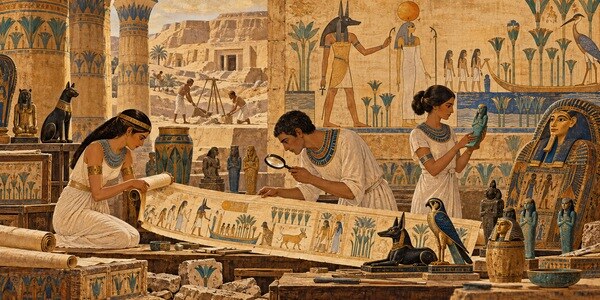
Our knowledge of the Book of the Dead rests on genuine archaeological evidence: papyri, coffins, wall inscriptions, amulets, figurines, and burial complexes. Researchers compare manuscripts and study their language, dating, iconography, and archaeological contexts. This approach makes it possible to reconstruct historical changes in religious practice.
It is essential to distinguish evidence for ancient beliefs from evidence for the actual existence of otherworldly realms. The papyri show what Egyptians believed, desired, and practiced. They do not empirically demonstrate that a person encounters Anubis after death, passes through particular gates, or reaches the Field of Reeds. These are religious representations whose historical existence is beyond doubt, but whose supernatural reality has not been established through scientific methods.
This distinction is the foundation of a reliable account. It allows us to appreciate Egyptian civilization without confusing historical research with unverified assertions. The true richness of the Book of the Dead emerges when it is read as testimony to a sophisticated religious culture developed over many centuries.
The Soul’s Journey in Summary
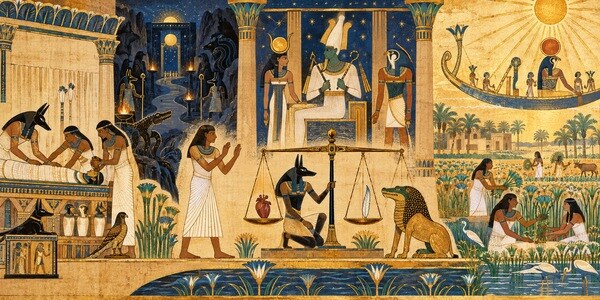
The Egyptian Book of the Dead offers numerous means of passing through death. First, the body is prepared through funerary rites and equipped with protective objects and texts. The deceased must then recover their abilities, preserve the name, heart, and other dimensions of identity, and gain freedom of movement. In the Duat, they encounter sacred places, gates, guardians, dangerous forces, and opportunities to join the solar order.
One central event is the judgment before Osiris. The heart is weighed against Ma’at, the deceased delivers declarations of innocence, and the divine tribunal establishes their righteousness. If successful, they gain access to favorable regions of the afterlife, including the Field of Reeds, and may participate in divine regeneration.
This summary is not a literal scenario common to all ancient papyri. It brings the principal themes of different spells into an intelligible sequence. The Egyptian texts themselves are more varied and often emphasize a particular protection or ability. Their shared goal, however, is clear: the individual must overcome death’s destructive consequences and be restored as an active participant in cosmic order.
The Legacy of the Egyptian Book of the Dead
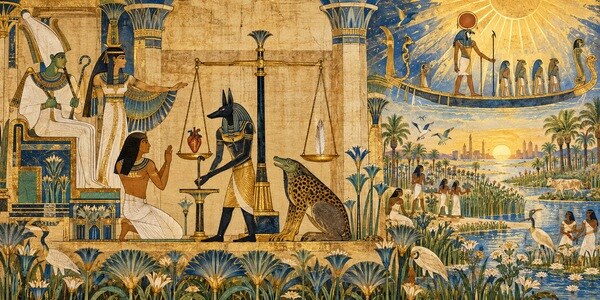
The Book of the Dead is among the most remarkable surviving witnesses to the ways ancient civilizations understood death. It brings together theology, moral ideals, ritual practice, artistic achievement, and an elaborate symbolic language. Its papyri reveal not only fear of destruction but also a profound determination to protect human existence through knowledge, order, and sacred action.
The weighing of the heart remains a particularly powerful image. It places an individual life before the standard of truth and justice. The Field of Reeds expresses the desire for restored prosperity. Ra’s barque represents the hope of daily renewal. Osiris embodies victory over disintegration, while Isis represents the power of protection and restoration. All these images belong to a religious system developed over millennia.
At its heart, the Egyptian Book of the Dead is not merely a collection of spells against the dangers of the afterlife. It is the expression of a civilization for which death demanded preparation, human actions possessed moral significance, and eternal life was inseparable from divine order. Its texts continue to be studied because they preserve an exceptionally detailed picture of ancient Egyptian understandings of identity, justice, the cosmos, and the hope of rebirth.
Author: Vasil Stoyanov