
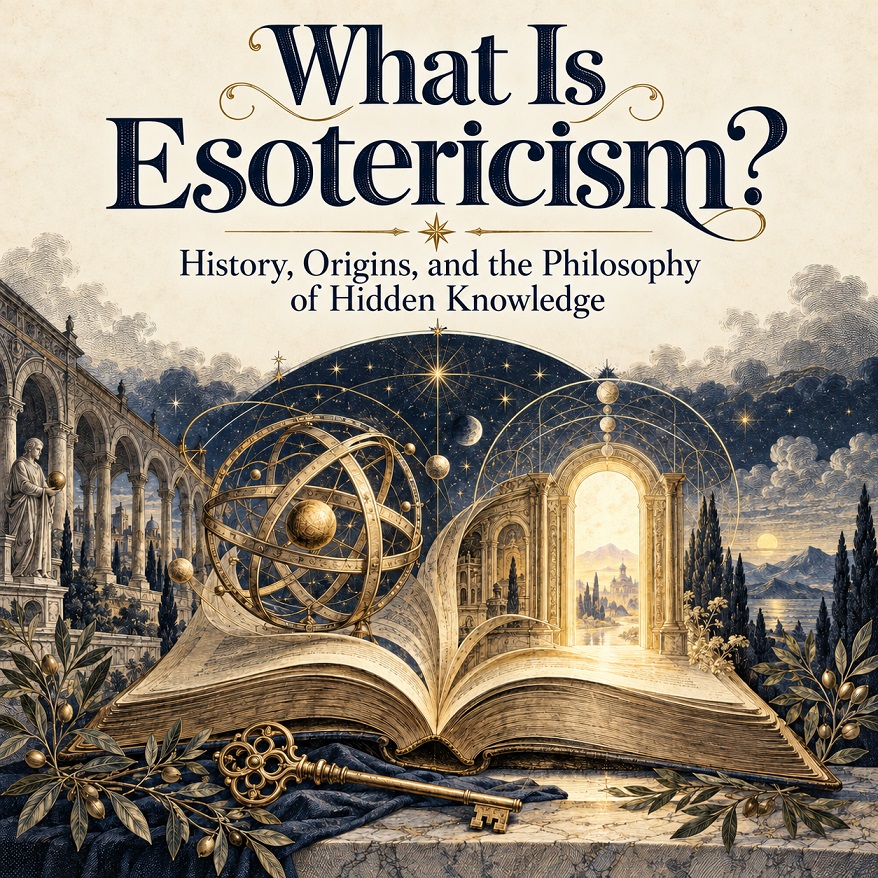
Esotericism is one of the most widely used yet least clearly defined terms in contemporary spiritual vocabulary. It is applied to ancient mysteries, alchemical treatises, astrological systems, Hermetic teachings, Kabbalistic interpretations, occult societies, and modern practices of personal transformation. This diversity raises an important question: what unites such different traditions, and why are they grouped under one name? Answering it requires more than a dictionary definition. We must trace the development of the concept, the ways specialized knowledge has been transmitted, and the philosophical problems around which esoteric teachings have developed.
Popular culture often presents esotericism as a single ancient system preserved continuously by initiated teachers. Historical evidence reveals a more complicated picture. Different movements arose in different periods, sometimes held incompatible views of the world, and frequently disagreed with one another. Some belong to established religious cultures, others developed as alternative currents, and still others are modern reinterpretations of older texts. A shared label does not establish a shared origin or make all their claims equally credible. It identifies a historical and comparative field in which ideas about hidden meaning, spiritual knowledge, symbolic correspondences, and human transformation intersect.
The history of esotericism also matters for understanding contemporary humanity. It shows how people have sought connections between the visible cosmos and an invisible order, between intellect and spiritual experience, and between natural processes and inner life. At the same time, it teaches us to distinguish historically documented practices from legends, philosophical symbolism from empirical claims, and personal experience from universally valid evidence. This distinction makes serious study possible.
What Does the Word Esotericism Mean?
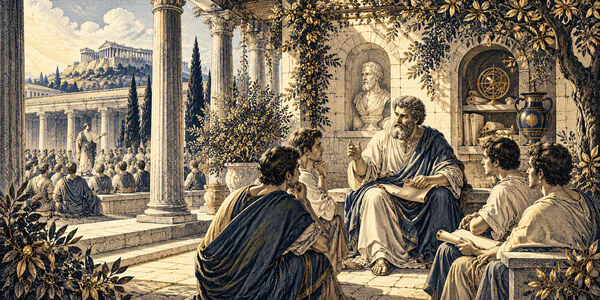
The name derives from the ancient Greek esōterikos, associated with what is internal or belongs to an inner circle. Its counterpart, exōterikos, means external. In ancient intellectual culture, distinctions between inner and outer instruction could indicate different levels of access, audiences, or complexity. This does not mean that ancient Greeks used the modern concept of esotericism to describe a unified spiritual field. A long history of changing meanings separates the ancient word from today’s category.
Modern European concepts of esotericism developed much later, particularly during the nineteenth century, when authors began grouping teachings regarded as internal, secret, or intended for initiates under a common name. Historians of religion subsequently developed the term as an analytical category. It helps researchers investigate particular movements, texts, and practices, although its boundaries remain debated. We must therefore distinguish the ancient Greek linguistic root, the modern use of the word, and the specific historical traditions to which it is applied.
In its broadest sense, esoteric knowledge is presented as accessible through special preparation, interpretation, initiation, or inner experience. Sometimes restrictions are organizational: a community reserves certain rituals for members. Elsewhere they are intellectual: a complex symbolic text requires preliminary study. Another understanding holds that spiritual truth cannot be obtained through reading alone but demands a transformation of perception and conduct. These are not identical arrangements. Secrecy, difficulty, and mystical experience are different characteristics that may overlap without necessarily implying one another.
Esoteric and Exoteric: Two Ways of Transmitting Knowledge
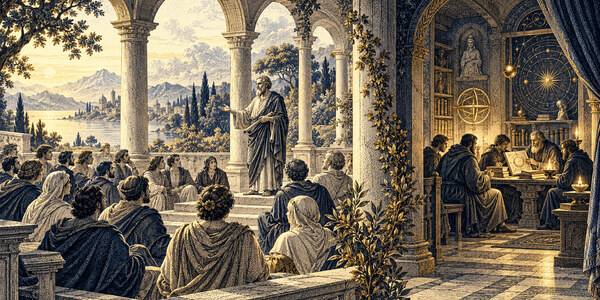
The contrast between esoteric and exoteric teaching is fundamental to the subject. Exoteric teaching addresses a broad audience and presents its principles in an accessible form. Esoteric instruction presupposes a threshold: education, ethical preparation, membership, or familiarity with a symbolic language. This is not necessarily a distinction between truth and error or between superior and inferior knowledge. Primarily, it concerns methods of instruction and conditions of participation.
Comparable distinctions occur in many religious and philosophical settings. Some schools reserve ritual instructions for a restricted community; others employ allegorical interpretations of publicly available sacred texts. Certain traditions guide students through successive stages of learning. Others emphasize that spiritual truth cannot be fully expressed in ordinary language. These models create different relationships between knowledge, authority, and access.
The secrecy of a teaching does not prove its truth. Restricted access can protect complex rituals from misunderstanding, cultivate belonging, or strengthen leaders’ authority. Historical investigation must examine these possibilities separately. The same applies to initiation: it may designate an actual admission ceremony, an educational level, or a metaphor for personal change. Without context, the word becomes a suggestion of hidden prestige rather than an explanation.
Ancient Mysteries and the Limits of Historical Continuity
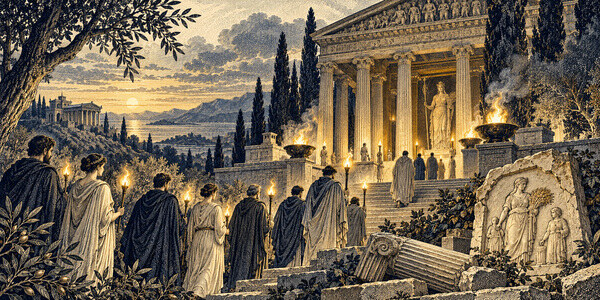
Discussions of esotericism’s origins frequently invoke the mysteries of antiquity. The Eleusinian Mysteries, associated with Demeter and Persephone, are among the best-known examples of rituals requiring initiation and restricting public disclosure of certain elements. Other cults in the Greco-Roman world also featured particular degrees of access, ceremonial actions, and expectations of religious experience. They demonstrate that distinctions between publicly available and restricted religious knowledge have ancient roots.
The historical record does not, however, justify describing all ancient mysteries as branches of one secret organization. They involved different deities, rituals, social conditions, and geographical centers. Evidence is often incomplete because participants were obliged to keep certain matters confidential, while surviving accounts may come from outsiders or later writers. Gaps in documentation cannot responsibly be filled with confident narratives about an uninterrupted hidden tradition.
Later esoteric authors did draw inspiration from the imagery of ancient mysteries. They employed the language of initiation, symbolic death and rebirth, trials, and revelation. This constitutes an important history of influence and reinterpretation. Inspiration, however, is not proof of institutional continuity. An ancient temple, a Renaissance treatise, and a modern fraternity may share themes without an uninterrupted organization having transmitted identical rituals across the centuries.
Alexandria, Late Antiquity, and the Meeting of Philosophical Worlds
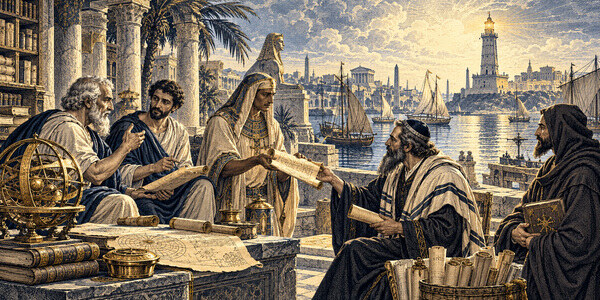
Late antiquity is especially important to the history of teachings later classified as esoteric. Across the Mediterranean, Greek philosophical schools encountered Egyptian religious traditions, Jewish thought, and diverse forms of Christianity. Cities such as Alexandria became centers of intellectual exchange. No single universal system emerged from this environment. Instead, numerous texts and movements explored the nature of divinity, the origin of the cosmos, and the possibilities of human knowledge.
Neoplatonism, associated with Plotinus and his successors, was among the influential philosophical movements of the period. It understood reality through a hierarchy of principles and regarded philosophical life as involving the soul’s return toward its source. Later Neoplatonists developed elaborate accounts of mediation between divine and material reality, including contemplative and ritual practices. Neoplatonism is not simply esotericism in the modern sense. It is a philosophical tradition with its own arguments, texts, and internal disagreements that strongly influenced later esoteric thinkers.
Hermetic writings and various Gnostic movements must be situated within this wider cultural setting. They are not identical, but they address questions that continued to shape European spiritual history: how humanity relates to the cosmos, how ignorance is overcome, what spiritual awakening means, and where the limits of reason lie. Their historical study begins with particular sources rather than the assumption that all speak with one voice.
Hermeticism: The Cosmos as a Living Whole
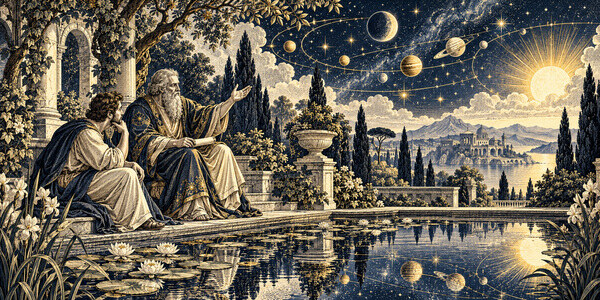
Hermeticism is one of the most influential traditions in the history of Western esotericism. Its name comes from Hermes Trismegistus, a figure combining attributes of the Greek Hermes and Egyptian Thoth. Texts circulated under his name in antiquity and later, addressing divinity, nature, the human mind, and spiritual transformation. Particularly important is the Corpus Hermeticum, a collection of treatises produced in the cultural environment of Roman Egypt during the first centuries of the Common Era.
Hermetic writings often portray human beings as belonging simultaneously to material and intellectual or divine orders. Knowledge is not reduced to collecting information. It has a transformative function: understanding one’s nature entails reconsidering one’s place in the cosmos. Some treatises use dialogues between teachers and students; others develop cosmological narratives or prayers. This literary diversity is an essential characteristic of the tradition.
During the Renaissance, European scholars and philosophers became interested in Hermetic works anew. Marsilio Ficino translated some of them into Latin during the fifteenth century, when they were believed to be extremely ancient. Later philological criticism, especially Isaac Casaubon’s work in the early seventeenth century, demonstrated that their language and ideas belonged to late antiquity rather than the age of the pharaohs. This was a turning point: the spiritual significance readers find in a text must be distinguished from the historical date of its composition.
The popular phrase “as above, so below” frequently summarizes Hermetic thought. It is associated with the tradition of the Emerald Tablet, whose textual history differs from that of the Corpus Hermeticum. The idea of correspondences between levels of reality influenced alchemical, astrological, and occult authors. Yet not every Hermetic school taught an identical system of correspondences, and symbolic analogies are not established laws of nature.
Gnosticism and Knowledge as Liberation
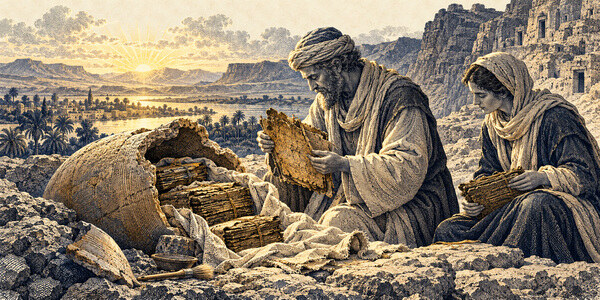
The word Gnosticism derives from the Greek gnōsis, meaning knowledge. Scholars use it to describe certain religious movements and texts from the first centuries of the Common Era, although the scope of the category remains disputed. Researchers emphasize that it has grouped diverse communities with different cosmologies and different relationships to Jewish and Christian writings. It is therefore more precise to discuss specific Gnostic traditions and texts than one unified doctrine with an unchanging set of beliefs.
Some texts describe the human condition as forgetfulness of the soul’s true origin. Salvation is linked to awakening knowledge that reveals spiritual reality beyond the apparent order. Certain works portray the material cosmos as the creation of a lower maker distinct from the supreme divine principle. Others offer different accounts that cannot be reduced to this formula. Every generalization about Gnostic philosophy must therefore be checked against particular sources.
The discovery of Coptic manuscripts near Nag Hammadi in 1945 considerably expanded knowledge of this religious environment. Works previously known mainly through criticism by their opponents became available for direct study. This illustrates why the history of esoteric and related movements cannot rest on legends alone. New sources change our understanding of the past and require established interpretations to be reconsidered.
In contemporary spiritual literature, gnosis often means immediate inner insight. That usage is influenced by ancient ideas but does not coincide automatically with every historical Gnostic teaching. Philosophical self-knowledge, religious narratives of salvation, and modern psychological interpretations of awakening must be distinguished.
Kabbalah: Mystical Interpretation Within Judaism

Kabbalah is a complex tradition of Jewish mystical thought whose development cannot be reduced to popular diagrams of the Tree of Life. Medieval Kabbalah developed in particular Jewish intellectual and religious settings, especially southern France and Spain, drawing on earlier texts, biblical interpretation, and ideas of divine manifestation. One of its most influential literary bodies is the Zohar, which took shape in medieval Spain and is traditionally attributed to the ancient rabbi Shimon bar Yochai. Historical scholarship distinguishes this traditional attribution from the circumstances of its medieval emergence.
Kabbalistic teachings examine the relationship between the unknowable divine source, manifestations of divinity, sacred scripture, and human action. The ten sefirot are particularly important, describing aspects of divine manifestation and relationships between levels of reality. Their meaning varies across authors and schools. Kabbalah is not a single predictive scheme or universal code that can be applied to every religion without context.
During the Renaissance, certain Christian thinkers began interpreting Kabbalistic ideas through their own theology. Forms of Christian Kabbalah consequently developed that were not identical to the Jewish tradition from which they borrowed. Later European occult movements created further adaptations, sometimes called Hermetic Qabalah. The distinction is fundamental: the historical origin of a concept does not make all its subsequent uses equivalent. We must specify whether we are discussing Jewish religious texts, Renaissance Christian interpretations, or modern occult systems.
Alchemy: Between Material Investigation and Spiritual Symbolism
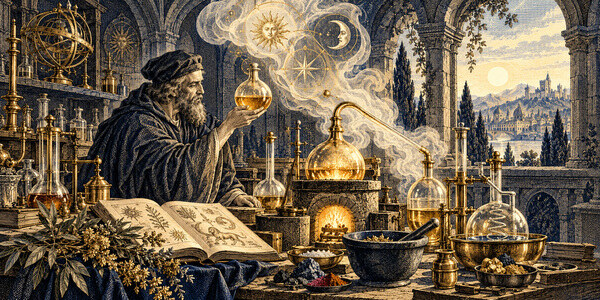
Alchemy is among the most recognizable subjects in esoteric history, but its popular presentation as purely spiritual human transformation overlooks much of its actual practice. Across different cultures, alchemical authors worked with substances, laboratory operations, medical ideas, and theories of nature. They described heating, dissolving, distilling, combining, and transforming materials. Alongside these procedures, they used symbols, allegories, and religious language. Historical alchemy combined varied practical and theoretical aims that cannot be explained by a single formula.
Alchemical traditions developed in the Hellenistic world, Islamic societies, and medieval and early modern Europe. Translations of Arabic and Latin texts played an important role in transmitting knowledge and techniques. One famous objective was producing precious metals through the transformation of other substances, but alchemists were also interested in medicines, elixirs, dyes, and the structure of the material world. The philosopher’s stone acquired different meanings in different works and was frequently surrounded by symbolic language.
Later esoteric interpretations transformed alchemical processes into images of inner change. Operations such as decomposition, purification, and union were understood as stages of personal development. This symbolic use is significant in its own right, but it should not be projected onto every historical alchemist without evidence. Some authors genuinely connected material and spiritual work; others concentrated primarily on substances and practical outcomes. Distinguishing these aims enriches the history of alchemy rather than diminishing it.
Alchemy also belongs to the history of chemistry, but the two are not simply the same discipline under different names. Modern chemistry emerged through new experimental standards, quantitative methods, and theoretical explanations. Alchemical texts can be studied as an important part of the history of material knowledge without accepting their cosmological assumptions as scientifically established facts.
Astrology and Correspondences Between Heaven and Earth
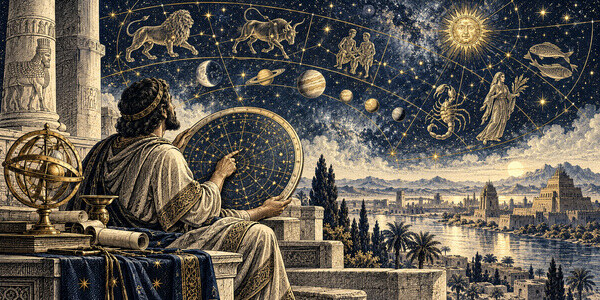
Astrology emerged in ancient cultures where observing the sky had calendrical, political, and religious significance. Mesopotamian traditions interpreted celestial phenomena as signs, while the Hellenistic world developed systems connecting the positions of heavenly bodies with individual destinies. Astrological knowledge subsequently circulated through Greek, Syriac, Arabic, and Latin intellectual settings. Its history is complex and cannot be presented as a single invention by one civilization.
In esoteric teachings, astrology is often connected to the idea that the cosmos forms an ordered whole and that symbolic correspondences exist between its levels. Planets may signify qualities, principles, or powers within a particular philosophical system. Historically, however, astrology was also used to make concrete predictions about individuals, states, and events. Symbolic interpretation and predictive claims are different activities that must be assessed separately.
Modern astronomy investigates celestial bodies through observations, mathematical models, and testable physical theories. Astrological claims about reliably predicting personality traits and life events lack comparable scientific support. This does not erase astrology’s cultural and historical significance. It establishes a boundary between studying a symbolic system and accepting it as an empirically validated method. That boundary is necessary in any serious account of esoteric traditions.
The Renaissance and the Rediscovery of Ancient Wisdom

The European Renaissance transformed how ancient philosophical and religious texts were read and used. Humanists sought manuscripts, compared versions, and translated works that had long been relatively unfamiliar in the Latin West. Platonic philosophy, Hermetic writings, and forms of mystical interpretation entered new relationships with Christian theology. For some Renaissance authors, antiquity signified authority, and recovering lost wisdom was an important intellectual task.
Marsilio Ficino and Giovanni Pico della Mirandola were significant figures in this environment. Their projects differed, but both illustrate efforts to explore harmony between philosophical and religious traditions. Pico showed particular interest in Kabbalistic ideas, interpreting them within his own Christian intellectual program. These attempts at synthesis do not prove that all the traditions examined were identical. They demonstrate a historically specific effort to combine different authorities and interpretive methods.
The Renaissance concept of prisca theologia, or primordial ancient theology, strongly influenced later esoteric movements. In its different versions, the wisdom of ancient peoples was believed to contain common truths that could be recovered. Historians must treat this as the conviction of particular authors rather than an established fact about one prehistoric source of all religions. That is the difference between describing a philosophical program and accepting its claims without verification.
Magic, Natural Philosophy, and the Boundaries of the Invisible
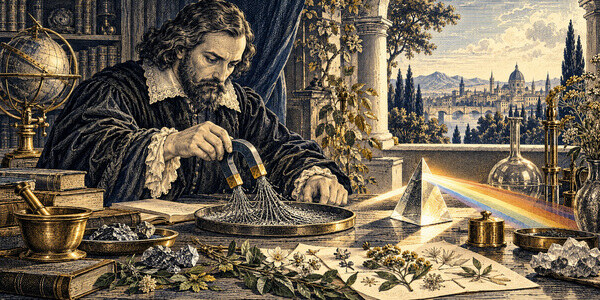
In early modern Europe, the word magic did not refer to one uniform practice. Some authors discussed natural magic, seeking to understand hidden properties and interactions of substances. Others described rituals, prayers, talismans, or attempts to communicate with spiritual beings. Depending on social and religious context, such activities could be defended as philosophical investigations, condemned as superstition, or persecuted as dangerous deviations. A single label conceals substantial differences in their aims and assumptions.
The philosophical question behind many of these practices concerns how much of reality remains inaccessible to ordinary perception. Before the development of modern natural sciences, boundaries between physical explanations, symbolic analogies, and religious causation were drawn differently. This does not mean early modern thinkers universally rejected observation or logic. Many attempted to explain nature using the concepts and methods available to them.
Today, the historical significance of these beliefs must be distinguished from the actual effectiveness of purported magical influences. Symbols and rituals may have psychological, artistic, and social functions without proving that they alter external events through unknown forces. Studying magic as a cultural phenomenon does not require accepting every claim it makes about causation.
Rosicrucianism and the Image of the Secret Brotherhood

In the early seventeenth century, texts appeared in German-speaking lands describing a mysterious fraternity associated with Christian Rosenkreuz. The best-known include the Fama Fraternitatis and Confessio Fraternitatis. They combined ideas of spiritual reform, renewal of knowledge, and social transformation. Their emergence belongs to the specific religious and intellectual environment of early modern Europe, shaped by confessional conflict, scientific change, and expectations of renewal.
The Rosicrucian manifestos prompted extensive discussion and controversy. Readers interpreted them as calls for reform, literary allegories, or evidence of an existing secret community. Historical evidence does not justify taking the legendary account of an ancient brotherhood literally as proof of an uninterrupted organization. What matters is how the texts created an image of hidden wisdom awaiting discovery and intended to serve human renewal.
In subsequent centuries, different organizations adopted the Rosicrucian name and developed their own systems of symbols, rituals, and teachings. Their differences should not be erased. Rosicrucian history illustrates how a literary image, a religious program, and real institutions can become intertwined without being identical. It also demonstrates the power of symbolism: a narrative of spiritual reform continued to inspire new movements long after the original texts appeared.
The Enlightenment, Romanticism, and New Forms of Spiritual Seeking

The Enlightenment is sometimes described as having simply displaced esoteric teachings with rational thought. The actual history is more complicated. During the eighteenth century, scientific and philosophical methods developed, but interest in mysticism, spiritual correspondences, and religious experiences did not disappear. It took new forms and entered into dialogue, sometimes conflict, with changing understandings of reason, nature, and society.
Thinkers such as Emanuel Swedenborg developed distinctive religious cosmologies linking the visible world with spiritual meanings. Other authors sought to renew Christian mysticism or the idea of inner knowledge. During the nineteenth century, Romanticism encouraged interest in symbols, imagination, nature, and experiences of unity. These developments did not create a single esoteric school, but they prepared an environment in which spiritual systems could be reinterpreted outside traditional institutions.
The social position of knowledge also changed. Printing, new urban associations, and expanding literacy allowed ideas formerly circulated within restricted settings to reach broader audiences. The paradox of modern esotericism became increasingly visible: teachings presented as secret began spreading through public books, lectures, and organizations. Hiddenness increasingly referred not to the inaccessibility of a text but to the claim that its true meaning required special interpretation.
Nineteenth-Century Occultism: From Hidden Sciences to Public Movements
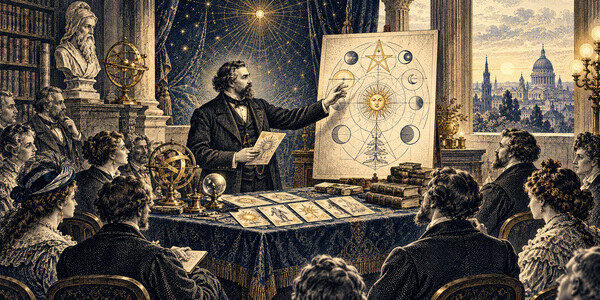
During the nineteenth century, the concept of occultism became especially popular. Derived from a Latin root meaning hidden, it was applied to teachings claiming to investigate invisible forces, symbolic connections, and spiritual laws. The French author Éliphas Lévi played a significant role in shaping modern occult vocabulary. Later thinkers and organizations developed systems combining elements of Hermeticism, Kabbalah, alchemical symbolism, tarot, and ritual magic.
These syntheses were historically new, even when their authors invoked ancient sources. For example, modern occult interpretations of tarot are not identical to the cards’ earlier history as a game. Esoteric meanings developed through specific authors and interpretive traditions. Such cases show how a cultural object can acquire new significance without that significance establishing an ancient origin.
Modern occult societies frequently created stages of instruction, ceremonies, and elaborate symbolic systems. They were influenced by broader developments such as the growth of voluntary associations, interest in comparative religion, and new conceptions of individual spiritual development. Religious convictions, philosophical speculation, and practical techniques could coexist within them. Historical understanding requires tracing which elements were inherited, which were transformed, and which were created in the modern period.
Theosophy and the Search for a Universal Spiritual System
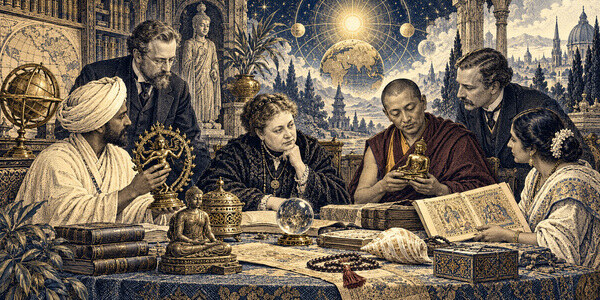
The Theosophical Society, founded in New York in 1875, was among the most influential organizations in modern esoteric history. Helena Blavatsky and other participants developed a program combining religion, philosophy, spiritual development, and comparative study of traditions. Theosophical writers offered expansive accounts of cosmic evolution, human development, and hidden knowledge. These narratives strongly influenced later spiritual movements but do not constitute scientifically established histories of humanity or nature.
A characteristic feature of Theosophy is its effort to present different religions as expressions of a deeper shared wisdom. This approach has an appealing dimension: it encourages interest in cultures beyond one’s own and raises questions about common human spiritual concerns. It also carries serious methodological risks. When complex religious teachings are arranged within a predetermined universal framework, their historical differences can be lost and borrowed concepts reinterpreted without sufficient attention to their original contexts.
Theosophy is also important for understanding how ideas from South and East Asia spread and changed within Western spiritual circles. This was not a simple transmission of Eastern wisdom. It involved translation, selective borrowing, new interpretations, and particular power relations during the colonial era. Serious analysis requires attention to the voices of the traditions from which concepts were borrowed, not merely the interpretations of Western authors.
Why Are Such Different Teachings Called Esoteric?
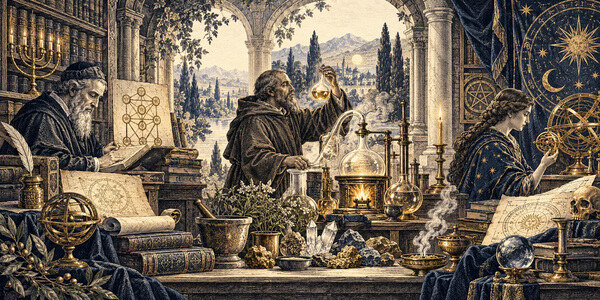
This historical overview demonstrates that esotericism is not one religion with a common founder, canon, and obligatory doctrines. The term groups different currents because of recurring themes and ways of thinking. These include the conviction that visible reality possesses deeper dimensions; interest in correspondences between humanity and the cosmos; the use of symbols for interpretation; the idea of inner transformation; and the belief that certain knowledge requires preparation or initiation.
The scholar Antoine Faivre proposed an influential model for describing Western esotericism, including themes such as correspondences, living nature, imagination and mediations, experiences of transmutation, concordance between traditions, and transmission of knowledge. This model is useful for particular historical materials but is not a universal definition accepted without objection by every scholar. Other approaches examine esotericism through the history of rejected knowledge, social processes of classification, or specific relationships between religion, science, and culture.
Different scholarly definitions are not merely an academic technicality. They protect us from the mistaken assumption that all esoteric traditions necessarily share an identical philosophy. A Kabbalistic commentary on scripture, an alchemical laboratory treatise, and a nineteenth-century occult ritual can belong to the same research field without being parts of one system. The category helps us compare them but must not erase their individual histories.
Symbols as a Language of Inner Knowledge
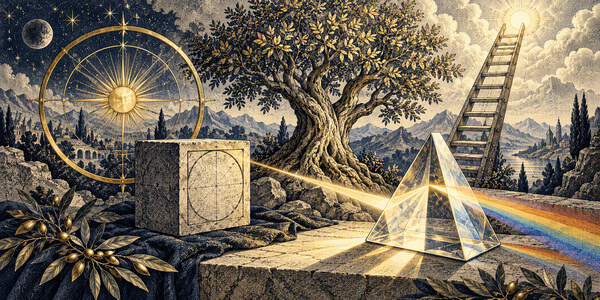
Symbols occupy a central place in many esoteric works. Circles, squares, stars, trees, ladders, light, and paths appear in different texts and images. Their power lies in the ability to gather several layers of meaning into a single form. A circle, for example, can signify wholeness, cyclicality, or cosmic order, but its particular meaning depends on the tradition and work. No universal dictionary can disclose the one true meaning of every symbol once and for all.
Symbolic thinking differs from scientific description. Scientific models are assessed according to conceptual clarity, consistency with observations, and testability. Symbols often serve another purpose: directing attention toward relationships, values, or experiences that resist a single definition. They can be philosophically productive without constituting physical theories. Problems arise when symbolic resemblance is presented as proof of a causal connection between unrelated phenomena.
Alchemical images provide a useful example. They can express processes of transformation through images of death and rebirth, the union of opposites, or purification. Understanding them requires familiarity with the genre, language, and aims of the particular author. Contemporary readers may find inspiration for reflection on personal development, but that reading must be distinguished from an image’s historical meaning. This preserves the richness of symbolism without turning it into an arbitrary explanation of everything.
Microcosm and Macrocosm: Humanity as a Reflection of the World

One of the most enduring themes in esoteric philosophy is the relationship between microcosm and macrocosm. The first means the small world, often understood as the human being, while the second denotes the greater world or cosmos. Different philosophical systems portray humanity as reflecting principles of a larger reality. This idea has many historical versions and cannot be reduced to one formula.
As a philosophical image, the relationship raises questions about humanity’s place in nature. We do not exist outside the world we study: our bodies participate in material processes, and our consciousness develops within biological and social conditions. In this sense, the theme can stimulate reflection on interdependence. Historical esoteric systems, however, often made stronger claims about direct correspondences between planets, organs, personalities, and events. Such claims require independent examination and do not automatically follow from the fact that human beings are part of nature.
The difference between analogy and evidence is decisive. An analogy helps us recognize a similarity and formulate a question. Evidence requires arguments or observations that genuinely support a particular claim. Maintaining that boundary allows us to appreciate the philosophical beauty of cosmic correspondences without attributing unestablished scientific credibility to symbols.
Initiation and the Idea of Human Transformation
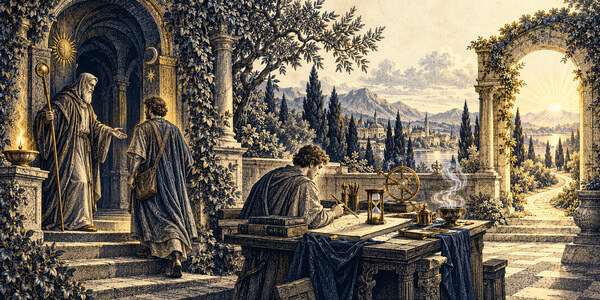
In many esoteric traditions, knowledge is not treated as information simply added to what a person already knows. It is connected to changes in conduct, self-understanding, and one’s relationship with the world. This explains the recurring images of journeys, trials, and initiation. In certain communities, initiation is an actual rite marking entry into a new status. In other texts, it symbolizes spiritual maturation that cannot be reduced to an external ceremony.
The philosophical significance of this idea concerns whether someone can know something deeply without being changed by it. Knowing an ethical principle, for example, does not guarantee that we follow it. A distance exists between intellectual understanding and practical conduct. Some esoteric authors place this distance at the center of training: students must cultivate discipline, attention, and self-observation rather than merely memorize definitions.
A critical perspective is also necessary. Organizations promising higher knowledge through successive degrees can foster strong dependence on leaders’ authority. When every doubt is declared evidence of insufficient spiritual maturity, education ceases to be a free inquiry. A healthy spiritual and philosophical path permits questions, clarity about obligations, and the right to refuse. The value of a practice is not demonstrated by the mystery surrounding its presentation.
Esotericism, Religion, Mysticism, and Philosophy: Where Are the Boundaries?
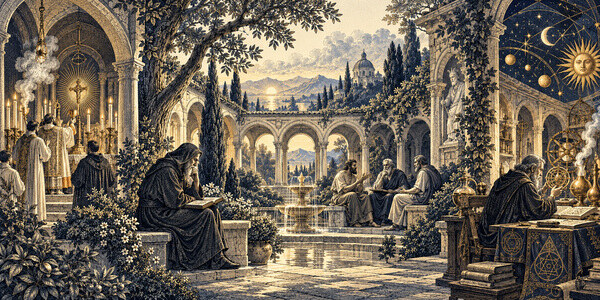
Esotericism is often discussed alongside religion, mysticism, and philosophy, but these concepts are not interchangeable. Religion includes diverse forms of community, ritual, belief, ethics, and relationships with the sacred. Mysticism is generally associated with particular experiences and practices involving direct relationships with divine or ultimate reality. Philosophy develops concepts and arguments to investigate fundamental questions about knowledge, existence, and the good life. Esoteric currents can intersect all these areas without fully coinciding with any one of them.
A Kabbalistic text can belong to a religious tradition while employing complex symbolic philosophy. A Hermetic dialogue can contain cosmological arguments and instructions for spiritual transformation. An alchemical treatise can combine practical operations with allegorical imagery. This intersection of genres and aims makes classification difficult. There is no justification for labeling all such works science, religion, or philosophy in exactly the same sense.
The productive approach is to begin with the specific question. To investigate historical origins, we seek dates, manuscripts, and documentary evidence. To examine a philosophical argument, we evaluate its logic. To study a ritual, we analyze its function for participants. When encountering a claim about physical effects, we ask how it was tested. This prevents the confusion of different standards of truth.
Science and Esotericism: Historical Interaction, Different Methods
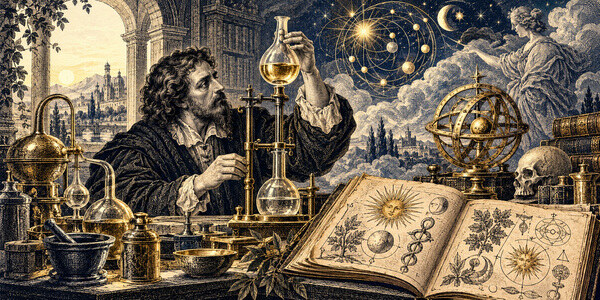
The history of science and esoteric teachings is not a story of two entirely isolated fields. In the early modern world, some thinkers worked simultaneously on mathematics, natural philosophy, alchemy, and theology. Disciplinary boundaries developed gradually, and contemporary categories cannot be mechanically imposed on the past. Yet this historical interaction does not mean that modern science confirms every esoteric belief.
Scientific inquiry requires claims about the observable world to be formulated clearly enough to be tested. Evidence must be independently assessable, and explanations must be compared with alternatives. Esoteric texts often use different forms of language: symbolic, revelatory, allegorical, or grounded in traditional authority. These forms can be subjects of historical and philosophical study, but they do not substitute for empirical evidence.
The use of scientific terms such as energy, vibration, or quantum without precise definitions is particularly problematic. In physics, these words have specific meanings connected to measurable quantities and mathematical models. When used as broad metaphors for mood or spiritual states, they do not automatically acquire scientific authority. An accurate presentation of esoteric ideas must identify when we are discussing a symbol, a personal experience, or a testable claim.
Why Does Esotericism Still Attract People Today?

Interest in esoteric teachings cannot be explained solely by curiosity about secret societies and mysterious symbols. It is connected to enduring human needs: the search for meaning, the desire for personal change, the wish for an integrated understanding of the world, and dissatisfaction with purely utilitarian approaches to life. In societies with access to enormous quantities of information, the question of what experience means remains open. Esoteric narratives provide a language for connecting inner life with larger cosmic themes.
Symbols can function as tools for reflection. The image of a journey, for example, organizes experiences of difficulty, learning, and change into a coherent narrative. The alchemical motif of transformation can help someone describe personal growth without implying that alchemical theories of substances are scientifically correct. Likewise, contemplating a complex diagram may draw attention to relationships and values without proving the existence of an invisible cosmic mechanism.
The appeal of esotericism is also strengthened by promises of access to knowledge unavailable to others. Such promises demand particular caution. Feeling chosen can be psychologically powerful, but it is not a criterion of truth. When a teaching insists that only its followers understand reality, it risks replacing inquiry with membership in a closed group. Mature spiritual interest does not exclude doubt; it uses questioning to reach more accurate understanding.
How to Study Esoteric Traditions Without Misconceptions

The first step is to distinguish sources. An ancient text, a medieval commentary, a Renaissance translation, and a contemporary self-development book are not interchangeable evidence. Each belongs to a particular time and serves a particular purpose. When an author claims to present a teaching thousands of years old, we should examine the earliest surviving texts, their dating, and the history of later revisions. Antiquity is a historical characteristic established through evidence, not a solemn tone.
The second step is to seek different perspectives. It is useful to read both representatives of a tradition and scholars who work with manuscripts, historical documents, and comparative methods. The former show how a teaching is understood from within; the latter help locate it within broader history. These perspectives answer different questions. A participant can explain what a ritual means to a community, while a historian can establish when a particular form of it emerged.
The third step is to separate spiritual value from factual accuracy. A story can be deeply moving without its events being historically demonstrated. A meditative practice may help a particular person develop attention without confirming every cosmological claim made by its school. This distinction is not hostile to spirituality. It protects intellectual honesty and freedom of personal experience alike.
The fourth step is to examine attitudes toward authority. A responsible teacher can explain the origins of their ideas, acknowledge limitations, and welcome questions. Warning signs include demands for unconditional obedience, isolation from loved ones, promises of guaranteed supernatural results, and financial pressure presented as a requirement for higher initiation. No symbolic system justifies abandoning critical thinking or personal boundaries.
Esotericism as a Mirror of the Human Search for Meaning
The history of esotericism is not the history of one unchanging secret transmitted through every civilization. It is the history of many people and communities attempting, in different ways, to understand relationships between the visible and invisible, knowledge and transformation, humanity and the cosmos. Ancient mysteries, Hermetic dialogues, Kabbalistic commentaries, alchemical laboratories, Renaissance syntheses, and modern occult societies belong to different historical worlds. Comparing them is valuable precisely because their differences are preserved.
Esoteric teachings have left an important legacy in religious thought, literature, visual art, and the history of philosophy. They have created images through which generations of readers reflected on self-knowledge, moral responsibility, and the limits of human perception. They have also produced claims about secret powers, universal explanations, and ancient continuities that must be examined rather than accepted because of impressive language. Intellectual seriousness requires recognizing both sides of this legacy.
The essential question is not whether every symbol conceals a mystery, but what we learn by investigating its origins and meanings. Knowledge begins with precise questions: who created a text, in what setting, for what purpose, and how did its readers understand it? From there we can explore philosophical problems that remain significant today. What does it mean to know oneself? How does education and practice change a person? How do we distinguish truth from a persuasive narrative? And how can respect for spiritual traditions coexist with the freedom to think critically?
Esotericism deserves to be studied without sensationalism or unquestioning reverence. Its genuine historical richness needs no invented story of an uninterrupted secret tradition. It can be found in specific texts, complex cultural encounters, symbolic systems, and humanity’s effort to give meaning to existence. Approached with curiosity, precision, and critical thought, hidden knowledge ceases to be a promotional slogan and becomes a serious subject for understanding human culture.
Author: Vasil Stoyanov