
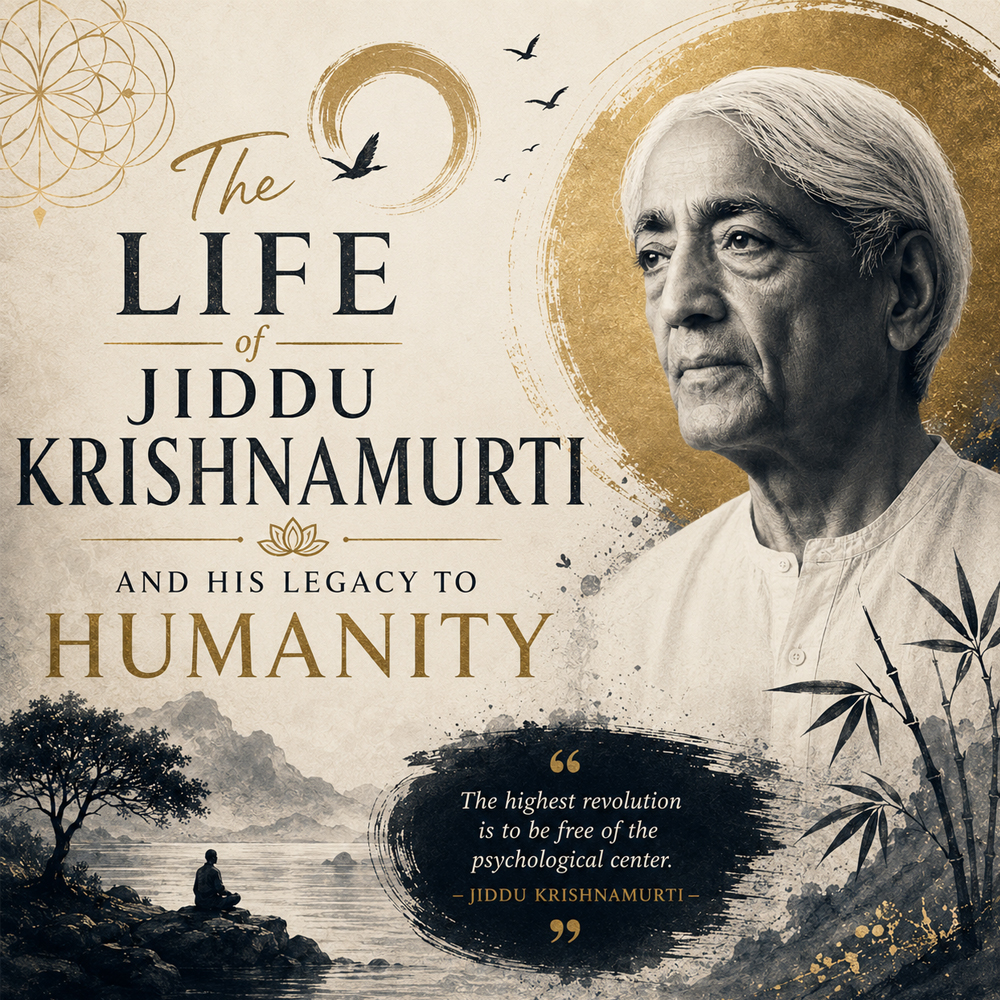
The Day the Awaited Teacher Rejected His Throne
On August the third, nineteen twenty-nine, in Ommen, the Netherlands, Jiddu Krishnamurti stood before an audience expecting far more than another talk. For thousands of people, this young man was the focus of a hope nurtured for years. An organization had been built around him, its very existence tied to the expectation of a World Teacher. People followed him believing that humanity would receive a new spiritual direction through him. He had the opportunity to accept that role and turn their expectations into lasting authority, but instead he chose to dissolve the organization.
His famous statement that truth is a pathless land was no rhetorical ornament. It expressed his refusal to offer his own person as a guarantee of anyone else’s liberation. Krishnamurti did not propose another sect to replace the old one, nor did he rearrange the hierarchy to place himself at its summit. He challenged the very hope that spiritual freedom could be obtained through belonging, following, and submission. This made the event more radical than an ordinary break with an organization: the man around whom the expectation of salvation had been built refused to become its owner.
His life can be told as the story of an extraordinary spiritual thinker, but that approach can easily repeat the very thing he opposed. We can put the man on a pedestal, collect impressive judgments about him, and leave our own consciousness almost untouched. The more important question is why his refusal continues to unsettle us. We want freedom, yet we also want someone to make it safe, predictable, and officially assured. Krishnamurti directs attention precisely to this contradiction and refuses to conceal it beneath a comforting promise.
The Child Who Does Not Yet Know What the World Will Expect of Him
Jiddu Krishnamurti was born on May the twelfth, eighteen ninety-five, in Madanapalle, southern India. His family lived with limited means, and his early years were marked by hardship and loss. Nothing at the beginning of this story inevitably suggests the future image of a brilliant public speaker. Later fame easily changes the way we look backward, as though an exceptional destiny had been obvious from childhood. Yet a child is first a child, vulnerable and dependent on adults, before being made the bearer of someone else’s spiritual hope.
In nineteen hundred and nine, Charles Webster Leadbeater noticed the boy near the beach at Adyar, where the Theosophical Society had its headquarters. Leadbeater was an influential theosophist who claimed clairvoyant abilities, rather than one of the Society’s original founders. The account of Krishnamurti’s exceptionally pure aura belongs to Leadbeater’s judgment and to the theosophical story of the boy’s selection. We cannot present it as an independently established characteristic. What matters historically is that the adults took this judgment seriously and began acting upon it.
From that point onward, an image began to gather around Krishnamurti that was larger than his immediate life. He was no longer simply a boy who needed education and care, but a candidate for an extraordinary destiny. Such expectations can bring support, but they also impose a burden the child has not chosen. Other people begin deciding what his existence means and what form it must take. His later rejection of spiritual authority becomes particularly powerful when we remember how early someone else’s authority entered his own story.
The Theosophical Dream of a World Teacher
The Theosophical Society was founded in eighteen seventy-five and is associated with Helena Blavatsky, Henry Steel Olcott, and other early figures in the movement. It sought connections between religions, philosophical systems, and esoteric teachings. Within certain circles, an expectation developed that a World Teacher would arrive and give spiritual life a new impetus. Annie Besant and Leadbeater played central roles in connecting this expectation with the young Krishnamurti. Within the framework of their beliefs, he was to be prepared for a destiny extending beyond ordinary human life.
In nineteen eleven, the Order of the Star in the East was established, with Krishnamurti placed at its head. The organization had theosophical origins, and its purpose was to prepare the public for the anticipated teacher. Masonic connections among individual figures do not justify calling the Order itself a Masonic lodge. Historical distinctions matter here, because different movements are easily merged into a general image of a mysterious secret organization. The actual story is extraordinary enough without being amplified through inaccurate descriptions.
The strongest element in this dream is not its exotic character, but the human need sustaining it. When the world seems confused, the expectation of an extraordinary leader promises order and meaning. Someone will know what we do not know and assume the responsibility that frightens us. It is precisely this need that Krishnamurti later questions, without limiting his inquiry to theosophy. He sees the same movement wherever a person replaces direct investigation with trust in a figure presented as the possessor of truth.
Being Prepared for a Role You Have Not Chosen
Krishnamurti’s education and preparation took him far from the environment in which he had grown up. He encountered new countries, languages, cultural habits, and people who saw him through the expectation of his future mission. The world outside expanded, while a story written in advance simultaneously closed around his identity. Within that story, every development could be interpreted as a sign that the prophecy was coming true. This is a particular kind of trap, because both success and difficulty can be absorbed into the same explanation.
Imagine a young person repeatedly told that he was born for a particular calling. If he shows talent, it proves the calling, and if he resists, the resistance is described as a necessary stage of preparation. Gradually, it becomes difficult to distinguish his immediate experience from other people’s expectations. This example does not reconstruct Krishnamurti’s private thoughts, which we cannot invent. It illustrates the general psychological burden of a situation in which a person becomes a project before receiving the freedom to investigate himself.
Later, the question of conditioning would become enormously important in his talks. Family, culture, religion, and society supply images of who we are and what we should become. These can be useful for orientation, but they can also replace living observation. A person begins responding to the world through a ready-made identity and stops seeing whatever does not fit within it. Krishnamurti’s rejection of his predetermined role is a concrete historical action that makes this question tangible.
Ojai and the Unexplained Experiences of Nineteen Twenty-Two
In nineteen twenty-two, Krishnamurti was in Ojai, California, with his brother Nitya. There, extraordinary experiences began that biographical accounts associate with what became known as “the process.” These accounts describe intense physical pain, altered states of experience, and a sense of profound transformation. The description of what occurred near the pepper tree in Ojai became particularly well known. This is an important part of his biography, but there is no basis for reducing it to a single certain medical or metaphysical diagnosis.
Events of this kind readily attract the desire to construct a definitive legend. For some, they must prove the intervention of a higher power; for others, they must be explained as an entirely pathological phenomenon. Both approaches can go beyond the available evidence. It is more accurate to acknowledge that the experiences were significant in his life and were described by him and those around him, without assigning them a proven cause. An authoritative account needs clarity about the limits of knowledge, because confidence alone does not produce a fact.
There is another important feature: Krishnamurti did not turn these experiences into a method his audience was supposed to reproduce. He did not offer pain, vision, or ecstasy as an obligatory gateway to freedom. The center of his mature talks remained the observation of everyday consciousness and its movements. In this way, the biographical mystery was not allowed to displace the question he put before the listener. Learning about the extraordinary aspects of his life is one thing; seeing our own thinking is an entirely different task.
Nitya’s Death and the Limits of Promised Security
In nineteen twenty-five, Nitya died, and Krishnamurti experienced a devastating loss. His brother was a loved one and an important source of support in the extraordinary life they were living. Biographical accounts also connect this death with a weakening of his trust in theosophical assurances and expectations. The event should not be used as a convenient scene in which his entire future position suddenly emerges fully formed. His separation from the theosophical model developed over time and involved more than one cause.
Loss brings a person to a boundary that promises struggle to cross. We may hold beliefs about destiny, protection, and meaning, but the death of someone we love is not obliged to conform to them. The difference between actual support and confidence received from someone else’s words is then exposed. This does not mean that all religious responses are without value. It means that no promise can remove the need to encounter what has happened and see what the mind does with pain.
Krishnamurti’s later interest in sorrow was not an abstract reflection by someone who had never been affected. Yet here, too, we must avoid the romantic formula that suffering necessarily gives birth to wisdom. It can close a person down, harden him, and leave him without strength. The significance of his question is whether pain can be seen without immediately being covered by explanation, accusation, or a promise of consolation. This is a difficult question because it demands presence precisely where we most want to escape.
Ommen – The Refusal to Become a Path
The speech dissolving the Order did not present the decision as a sudden whim. Krishnamurti said he had considered the matter for two years, slowly and carefully. Before approximately three thousand members, he rejected the organization as a means of spiritual liberation. He did not insist that his listeners accept a new name or move into another form of belonging. He wanted to end the relationship in which his own person was being used as a support for someone else’s security.
The sharpest part of his refusal concerned following. When a person accepts someone else’s words as the final authority over his inner life, investigation is already subordinated to a result that must be confirmed. He listens to learn the correct answer, rather than to see what is actually happening. Krishnamurti refused to participate in this arrangement as its supreme authority. His position was that spiritual truth cannot be organized in such a way that membership guarantees access to it.
This does not make every organization useless. Transportation, publishing books, and arranging meetings involve practical tasks that can be carried out together. The problem arises when an organizational structure claims to guide human consciousness toward a final inner truth. The means then becomes an object of loyalty, and loyalty itself begins to be presented as development. The distinction between practical assistance and spiritual submission would remain important in the later history of the foundations associated with him.
The Teacher Who Does Not Want Disciples
After Ommen, Krishnamurti continued speaking to people, and this is where the apparent paradox arises. If he rejects following, why does he give talks, and why should we listen to him at all? The question is legitimate and cannot be answered through another assurance of his exceptional nature. The difference is between a person who claims to possess the answer for you and a conversation inviting you to investigate something yourself. Words can direct attention without acquiring the right to replace seeing.
Imagine someone pointing out that your hand is too close to a hot surface. The warning is useful, but the sensation of heat does not belong to the person giving it. If you begin worshiping him and forget to see where your hand is, his words have become an obstacle. An example like this helps clarify the difference between pointing and dependence. It is not a formula for Krishnamurti’s entire body of work, but a way of seeing why listening should not end in reverence.
The difficulty is that the rejection of authority can itself be turned into a new authority. A person begins repeating that he follows no one because Krishnamurti said so, without noticing the contradiction. He creates an identity as an independent seeker and defends it with the same insistence others bring to defending religious membership. The word “freedom” then becomes a badge of group identity. Krishnamurti is hardest to hear precisely when his questions touch the way we have begun using Krishnamurti himself.
What It Means to Hear Rather Than Collect Ideas
In ordinary conversation, we often listen with only half our attention. The other person is still speaking, but we are already preparing a reply, comparing what we hear with familiar ideas, or deciding whether the speaker deserves approval. The words reach us, but the encounter is governed by the mind’s preliminary activity. In spiritual talks, the same movement can look more elevated because it uses a more exalted vocabulary. We are not arguing about a small insult but comparing teachings, yet we may still avoid the immediate question.
For Krishnamurti, listening is connected with a willingness to investigate without immediately enclosing what is said within a conclusion. This does not require credulity or eliminate critical judgment. It requires noticing when judgment has appeared before understanding and is already directing attention. We can reject an idea after examining it, or accept it as a working possibility without turning it into a belief. More importantly, we should not use agreement and disagreement as quick exits from an encounter with reality.
This difference becomes particularly clear with a subject such as jealousy. Learning its definition and remembering what a thinker said about it does not mean we have seen our own movement of comparison, fear, and possession. Real investigation begins when the next situation reveals those movements and we remain attentive to them. The talk is then no longer an object we possess as knowledge. It becomes an invitation to see something that no one else’s words can see on our behalf.
The Conditioned Mind and the Voices We Call Our Own
Krishnamurti repeatedly investigates the conditioning of human consciousness. Language, upbringing, religious environment, national identity, and lived experience all participate in the way we perceive the world. We often accept the reactions we have acquired as direct expressions of our own nature. We say that we simply know what certain people are like, what they deserve, and how we should live. Yet behind this certainty may lie repeated judgments we have never tested through an actual encounter.
Imagine someone proud of thinking independently who nevertheless evaluates every profession according to the prestige assigned to it by his family environment. He chooses an occupation that does not interest him and then calls the choice entirely his own. Another person may reject parental values while organizing his whole life around opposition to them. In the second case, dependence has changed its sign without disappearing. In both examples, the question is how to see the forces already directing our attention and decisions.
Noticing conditioning does not mean rejecting language, knowledge, or human history. Without them, we could not communicate, learn, or carry out life’s practical tasks. The problem lies in the invisible authority of a ready-made image where a situation requires fresh perception. If I believe I already know the person before me, I may hear only what confirms my idea. Freedom in this context begins with discovering the very filter through which I experience the encounter.
The Observer and What He Tries to Control
One of Krishnamurti’s most difficult ideas concerns the relationship between the observer and the observed. In our inner life, we often imagine a separate center that must govern anger, fear, or desire. We say that “I” will conquer my jealousy, as though this governing self were entirely independent of the experience. Krishnamurti asks whether the controlling center is itself made of memories, judgments, fears, and desires. If so, conflict may be a movement within the same consciousness presenting itself as a struggle between two separate forces.
This does not mean that the object before our eyes is physically identical to our body. The subject is the psychological structure of observation and the way past experience creates a center of judgment. The distinction matters because the short formula can easily become a mysterious assertion about the entire universe. Read carefully, the question is more specific: who is the one within us claiming to be separate from fear? If he himself fears losing control, the struggle already contains what it claims it will end.
We can see the difficulty in an ordinary moment of irritation. Anger arises, immediately followed by the image of someone who should not be angry because he is rational or spiritual. We now experience both the original tension and a conflict with our idea of ourselves. Attentive observation can reveal this entire process without making the second voice an infallible judge. This is not a ready-made technique, but an invitation to examine whether inner division actually helps us understand what is happening.
Fear and the Future We Create in Thought
In Krishnamurti’s talks, fear is often investigated in relation to thought and time. What happened yesterday can be carried forward as an expectation of renewed humiliation, loss, or pain. A person then responds in the present to a future that has not yet arrived but is already experienced as a threat. This does not exhaust all the biological and psychological mechanisms of fear. It directs attention to one important aspect: thought’s capacity to sustain danger through its continuous imagined continuation.
Imagine an employee who has received one harsh remark and begins every subsequent meeting convinced that he will be humiliated. He carefully prepares his arguments, but part of the preparation becomes a rehearsal of a catastrophic conversation. During the meeting itself, he hears a neutral remark as proof that his fears are coming true. The actual situation and the accumulated expectation have become difficult to distinguish. In this example, freedom begins with the possibility of noticing how memory has already organized perception in advance.
Such investigation does not remove the need for protection when danger is real. If someone threatens, humiliates, or harms us, clear action may include leaving and seeking help. Observing fear does not mean remaining motionless before everything that produces it. The question is whether we act according to the situation or according to a story that keeps enlarging it. Krishnamurti becomes useful here when he encourages accuracy, rather than when his words are used to reject necessary care.
Pleasure and the Attempt to Repeat Yesterday’s Joy
Krishnamurti considers pleasure as a movement often sustained by memory and the desire for repetition. A pleasant experience leaves a trace, and thought begins searching for a way to bring it back. A distinction emerges between immediate joy and the psychological insistence that it be reproduced. This distinction is not a call to experience the world without beauty or delight. It asks what happens when the pursuit of familiar pleasure becomes the principal organizing force of life.
A person may receive recognition for his work and experience natural joy. He then begins evaluating every new task according to whether it will bring the same admiration. Gradually, his interest in the work itself declines, while attention shifts toward the audience’s response. This is an understandable movement and need not be condemned as a moral defect. Yet if we fail to notice it, we may lose what originally made the work alive and meaningful.
The same structure appears in spiritual seeking. After an extraordinary experience, a person begins measuring every subsequent practice against the possibility of repeating it. The present becomes an unsuccessful version of one remembered moment. The search for freedom can then become the pursuit of a pleasant state under a new name. Krishnamurti’s question is whether we can see this movement without concealing it beneath the prestigious language of spirituality.
Psychological Time and the Promise of Becoming Someone Else
We need time to learn a language, build a house, or recover physical strength. Krishnamurti does not deny these practical processes when he questions psychological time. His interest concerns the movement “I am this, but gradually I will become something else,” used as a guarantee of inner change. He is particularly concerned with whether the ideal of a future state perpetuates conflict with what we actually are. In this way, the promise of tomorrow’s freedom can become a means of avoiding today’s dependence.
Suppose we tend toward envy and establish an ideal of becoming completely generous. Whenever someone else succeeds, the discomfort of comparison appears, followed by condemnation of ourselves for not yet reaching the ideal. Envy is now concealed beneath a second layer of desire to look better in our own eyes. In this example, direct understanding requires seeing comparison without immediately translating it into a plan for becoming a noble person. The question of time concerns precisely this habit of abandoning the present in favor of a promised future.
This does not prove that habits always change instantly or that education, therapy, and sustained work are unnecessary. Such a conclusion would turn a philosophical question into a universal psychological command. It is more accurate to distinguish the gradual process of learning from a moment of clear seeing. A person may spend a long time learning how to communicate yet notice a particular lie without requiring a ten-year plan. Krishnamurti presses upon this moment of seeing because it is precisely the moment we most readily postpone.
Relationship and the Image Standing Between Two People
Krishnamurti places relationship at the center of understanding ourselves. It reveals dependence, fear, the desire for recognition, and the ways we sustain our self-image. Especially important to him is the tendency to relate through accumulated ideas about the other person. A partner becomes a story about who he is, what he always does, and what he will never understand. The encounter itself begins taking place between these ideas instead of remaining open to the living person.
Imagine a couple in which one partner has already decided that the other never listens. Even when real attention appears, it may be treated as pretense or a temporary exception. The other partner, in turn, believes that every remark is an attack and begins defending himself before hearing the question. In this way, both sustain images that manufacture their own evidence of being true. Change requires attention to the actual conversation, rather than merely declaring better intentions.
This does not mean forgetting actual harm or refusing to evaluate behavior. Memory is necessary for protection, agreements, and understanding recurring patterns. The problem arises when an idea becomes untouchable and no new event can alter it. Knowing then becomes a form of closure, and the other person is condemned to appear only as confirmation. Krishnamurti’s question is whether we can see precisely when this is happening.
Love That Is Not Possession
In his talks, Krishnamurti repeatedly distinguishes love from jealousy, fear, and psychological possession. When we say we love, our relationship may also contain a need for the other person to guarantee our own security. Closeness then becomes readily associated with control and the expectation that the person will not disturb the image that reassures us. He asks whether love can be reduced to this dependence. The question is sharp because it touches feelings we usually defend as unquestionably noble.
A parent may want the best for a child while insisting that the child fulfill the parent’s unlived dream. Care and personal desire become so closely intertwined that they are difficult to distinguish. The child receives support, but also a hidden condition: to remain the kind of person who makes the parent feel successful. Seeing this does not mean denying every feeling within the relationship. It means becoming honest enough not to call every form of control love.
Love in this context is not indifference to another person’s fate. It requires attention, presence, and action that takes the person’s actual needs into account. Freedom from possession is not freedom from responsibility, but the possibility of responsibility no longer being subordinated to our own insecurity. This distinction is difficult and cannot be settled through a beautiful sentence. It must be encountered in the moments when the person we love does not act according to our idea of them.
Meditation Beyond the Promise of Reward
Krishnamurti questions meditation when it becomes the mechanical following of a method for reaching a state desired in advance. His attention concerns the whole life of consciousness, rather than a separate hour isolated from the rest of our behavior. If we sustain fear, competition, and dishonesty throughout the day, a special exercise does not automatically resolve their relationships. In this sense, meditation cannot be separated from the way we live. It includes the question of whether the mind sees its own movement without continually forcing it toward a result.
An important part of his language is choiceless awareness, which does not mean abandoning practical decisions. It refers to observation that does not select only the convenient parts of experience and reject the rest before seeing them. We can notice irritation without immediately justifying or condemning it, and this very observation can make action clearer. There is a difference here between complete attention and a concentrated struggle to prevent a particular thought from appearing. The first investigates what is happening, while the second may preserve conflict through the effort to defeat it.
At the same time, his criticism should not be used as a final judgment on all contemplative traditions. They have different purposes, definitions, and historical contexts requiring examination in their own right. What matters in this article is what Krishnamurti himself questions. He challenges spiritual accumulation when a person begins measuring himself through acquired states and levels. Meditation can then become another arena for the very same comparing consciousness from which it was supposed to free us.
Why a Clever Answer Is Not Necessarily Understanding
A person can explain the structure of jealousy brilliantly and remain completely subject to it. He can speak about nonviolence while punishing those close to him with contempt, or defend freedom while fearing every disagreement. This contradiction is not a rare exception but a familiar part of human life. Intellectual knowledge allows us to formulate ideas, but it does not guarantee that we have seen our own reaction as it actually arises. Krishnamurti continually directs the listener toward the difference between the word and the fact.
Once learned, an explanation can even become a means of concealment. When asked why we hurt someone, we begin speaking about conditioning, the unconscious, and society’s limitations. All of these may matter, but in that particular moment they can also serve to distance us from our action. The language of understanding becomes a defense against understanding. This is where spiritual erudition can be more dangerous than ordinary ignorance, because it supplies beautiful reasons for not looking at what is uncomfortable.
The question is not whether to abandon thinking, but whether to avoid putting it in the place of direct observation. Explanation can help us notice a pattern, distinguish concepts, and speak more accurately. Yet when the actual situation arises, we must see what is happening rather than merely recognize a label. The difference resembles the distinction between a description of music and listening to it. Without this distinction, Krishnamurti’s talks easily become a collection of precise words that do not change the way we live.
The Five Saturday Meetings in Sadhguru’s Recollection
Sadhguru recounts that, as a young man of around seventeen or eighteen, he attended five Saturday meetings of a group that listened to and watched recordings of Krishnamurti. After a recording of approximately half an hour, the participants discussed what they had heard. In his judgment, the discussions ended in confusion, and those present did not understand what Krishnamurti was pointing toward. This is Sadhguru’s recollection and assessment of those meetings, rather than proof that no listener anywhere understood the talks. The incident matters precisely as an observation of the gap between being impressed by the speaker and understanding his question.
From this account, we can examine a general difficulty without adding invented details about the participants. When a group encounters complex words, the natural response is to discuss them through other complex words. Each person proposes an interpretation, connects it with a familiar author, and tries to make the statement clearer. This can be useful intellectual work, but it can also take people further from the immediate experience under discussion. After an hour of conversation, everyone knows more about other people’s interpretations without necessarily having seen anything new within themselves.
Sadhguru’s recollection is therefore particularly relevant to a reader preparing to listen to Krishnamurti. We need not abandon discussion, but we can notice when it becomes a competition for the most elegant explanation. A simple question about fear or dependence can be more fruitful than a prolonged argument about which school is closest to him. What matters is whether the words return to the observation of life. If they remain only within a circle of other words, the encounter has passed by what was supposed to be investigated.
The Car on One Wheel and the Path of Jnana
Sadhguru describes Krishnamurti’s approach as jnana marga, a path of knowledge associated, in his account, with an exceptionally sharp intellect. He uses the image of a person capable of driving a car on one wheel, while most people need other faculties as well. This is a metaphor for Krishnamurti’s extraordinary ability, rather than a biographical claim about actual driving. The assessment that such an approach is accessible to exceptionally few people belongs to Sadhguru. Krishnamurti himself did not organize his mature talks as an affiliation with a particular yogic school.
The image raises an interesting question about the difference between possibility and applicability. A task can be accomplished in an extraordinary way by someone with a rare ability without that approach becoming the most suitable one for everybody. In music, some performers perceive complex relationships almost immediately, while others need prolonged practice. This comparison proves nothing about spiritual liberation, but it helps clarify the logic of the assessment. Sadhguru both acknowledges Krishnamurti’s exceptional nature and questions how the listener can reach what he points toward.
It is also important not to reduce jnana to accumulating information or winning arguments. In Indian traditions, the concept has richer meanings connected with knowledge, discernment, and insight. Krishnamurti introduces a further distinction: he investigates thought’s limitations rather than simply assigning it the task of conquering truth. Sadhguru’s assessment should therefore be read as an outside interpretation that illuminates a particular aspect. It does not remove the need to see how Krishnamurti himself distinguishes intellectual explanation from direct understanding.
The Wall of Love and Words as Sharp as a Knife
Sadhguru also retells an encounter between Kahlil Gibran and Krishnamurti, after which the writer described his impression as walking into a “wall of love.” In his account, this presence coexists with words as sharp as a knife. An image emerges of a man whose directness does not exhaust his relationship with people. This wording should remain attributed to Sadhguru’s account rather than being presented as an independently verified, verbatim record of Gibran’s words. Its power comes from the tension between the gentleness of the presence and the uncompromising nature of the question.
From here, we can examine a distinction we often miss in communication. Pleasant words do not always mean care, because they can be chosen to avoid discomfort or obtain approval. A sharp question is not automatically a sign of wisdom either, because it can be a means of humiliation. Its meaning depends on the relationship, the context, and the consequences. A real encounter can be uncomfortable while leaving a person with greater clarity rather than greater dependence on the speaker.
When listening to Krishnamurti, it is useful not to treat either severity or charm as evidence. The question is whether what is said opens observation or merely makes us admire the person saying it. If we admire the knife but fail to see the knot that needs cutting, we have remained at the level of impression. If we use his sharpness as permission to be rude, we have lost what matters. The account of the wall of love is valuable when it encourages attention to this distinction.
Osho – Respect That Does Not Eliminate Objections
Osho’s attitude toward Krishnamurti is more complex than simple praise. In his talks, he describes Krishnamurti as enlightened and acknowledges the force of his message, yet criticizes the way it reaches the listener. According to Osho, Krishnamurti often speaks from the place of his own freedom without providing a transition for someone who remains confused. To express this, he uses the image of a high mountain peak and people still in the valley. This is Osho’s assessment of the difficulty of teaching, rather than a final judgment on Krishnamurti’s work.
In Books I Have Loved, Osho pays particular attention to The First and Last Freedom. He acknowledges the book’s beauty and the truth he perceives in its author’s words while also objecting to his intellectuality. This combination of admiration and criticism is essential to understanding his position. He does not present Krishnamurti as an ordinary theorist lacking spiritual depth. He asks whether the speaker’s depth is itself sufficient to help someone who cannot yet see what is being discussed.
The difference between the two opens a question that need not be settled by choosing a winner. Can a method assist liberation, or does it inevitably risk creating a new dependence? Does rejecting a method protect freedom, or does it leave some listeners without accessible support? These are real tensions in spiritual teaching, and every easy judgment misses one side. For the reader, the most fruitful approach is to notice one’s own relationship with a method: is it being used for investigation, or is it expected to assume all responsibility in one’s place?
Between Assistance and Dependence
The criticisms of Sadhguru and Osho point toward the question of how an extraordinary speaker meets an ordinary listener. A teacher can provide exercises, images, and steps that make complex matters more accessible. These tools have real value when they develop attention and the capacity for independent action. Yet they can also acquire the status of a single gateway that must be guarded by a special community. Assistance then gradually becomes dependence on the form, the guide, and the judgment of whether we are progressing correctly.
Krishnamurti presses precisely upon this danger, and his refusal remains important even for someone who uses a particular practice. We can follow a useful exercise while investigating why we feel afraid when someone questions its authority. We can accept another person’s help without giving that person the right to define our entire inner reality. The difference is not always visible at the beginning. It becomes particularly clear when the helper permits no questions or presents every disagreement as a sign of spiritual immaturity.
On the other side lies the danger of turning independence into a refusal to receive any help at all. A person can insist that he needs nobody while actually fearing closeness, trust, or the acknowledgment of his own difficulty. Freedom then becomes a noble name for isolation. The question of authority requires subtler discernment than accepting or rejecting all teachers wholesale. Its purpose is a clearer relationship with assistance and our own observation, rather than the construction of another unshakable identity.
David Bohm and the Meeting Between Physics and the Question of Consciousness
Among Krishnamurti’s most significant interlocutors was the theoretical physicist David Bohm. Their meeting in nineteen sixty-one began a long series of conversations about thought, time, conflict, and consciousness. Bohm became interested in Krishnamurti after reading The First and Last Freedom. The encounter was not simply a scientist visiting a famous spiritual speaker. It became the beginning of a shared investigation in which both returned to difficult questions and examined the meanings of the words used to raise them.
It is important not to attribute Bohm’s scientific achievements as a whole to Krishnamurti’s influence. Significant work in physics preceded their meeting, including his publications on an interpretation of quantum theory in nineteen fifty-two. Their later dialogue mattered to his philosophical interests and investigation of thought, but it does not replace the scientific history of his work. This distinction protects both men from a convenient legend. A spiritual conversation does not gain scientific confirmation merely because a famous physicist takes part in it.
At the same time, their encounter shows that scientific curiosity is not restricted to questions already possessing a ready experimental answer. A scientist can be interested in the nature of thinking, the assumptions behind perception, and the way language divides experience. What matters is distinguishing the domains of assertion and verification. Bohm and Krishnamurti are interesting precisely as interlocutors who investigate difficulty instead of covering it with mutual admiration. Their conversation is not proof of every conclusion, but material for attentive thinking.
A Dialogue in Which Words Must Withstand Examination
Krishnamurti and Bohm’s conversations have a particular rhythm of pausing, clarifying, and returning to the starting point. One proposes a formulation, and the other asks exactly what it means and what it assumes. Apparently clear words such as “time,” “thought,” and “self” cease to function as ready supports. The reader can become impatient, expecting the conversation to move toward a conclusion. Yet it is precisely this slowing down that reveals how often a conclusion rests on a concept no one has examined sufficiently.
Such dialogue matters beyond philosophical circles as well. In an argument between two people, the word “respect” may mean the right to differ for one and the absence of disagreement for the other. They continue arguing as though they were using one concept while actually defending different conditions. If they stop and examine the meaning, the conflict can take on an entirely different form. This does not guarantee agreement, but it removes some of the argument’s apparent inevitability. Clarity begins with the willingness not to skip over what seems obvious.
For Krishnamurti, shared investigation should not become the collection of arguments for a position chosen in advance. In this sense, the listener is not an audience judging who is more convincing, but a participant observing the same question within himself. This is a different attitude from the usual pursuit of victory in debate. It requires tolerating the possibility that our own favorite formulation may turn out to be inaccurate. That willingness makes dialogue a place of discovery rather than merely a stage for displaying intellect.
Artificial Intelligence and the Question of What Remains for Humanity
As early as the beginning of the nineteen eighties, Krishnamurti spoke about computers and used the term “artificial intelligence.” He was interested in what it meant for humanity that a machine could process knowledge and perform tasks associated with thinking. These conversations belong to the technological context of his time and should not be presented as precise predictions of every contemporary system. His deeper question concerns what we mean by intelligence. If human value is reduced to accumulating and processing information, the machine places an uncomfortable mirror before that self-assessment.
Today, we can examine this question through our own everyday lives without attributing new examples to Krishnamurti. A person receives a ready explanation of a complex subject and can already speak about it convincingly. Yet persuasive reproduction does not prove an understanding of the foundations, limitations, and consequences of what is said. Access to an answer is not identical with judgment, just as access to a description of honesty does not make us honest. The distinction becomes especially important when the convenience of ready-made text begins displacing our own verification.
This is not a reason to reject technology or idealize some pure human spontaneity. Tools can assist learning, creativity, and access to information. The question is how we use them and what we begin expecting from them. If we also hand over the task of deciding what deserves trust, dependence has acquired a new carrier. Krishnamurti remains relevant here through his insistence on distinguishing knowledge as a tool from the living responsibility of human judgment.
Education as the Liberation of Attention
Education is a significant part of Krishnamurti’s work and finds expression in schools established with his participation. Among the best known are Rishi Valley in India and Brockwood Park in England. His interest was not limited to more effective mastery of the curriculum. He asked what environment supports learning without making fear, comparison, and submission its principal driving forces. This is a question about the development of the whole person, to be considered alongside the need for knowledge and practical skills.
When one child is constantly compared with another, curiosity easily shifts toward the child’s own place in the ranking. The child begins studying to avoid being last, earn praise, or escape shame. The result may be a high grade, but the relationship with knowledge has already become associated with anxiety. This does not mean that every assessment is harmful or that differences in learning should be ignored. It means that education needs to examine the psychological price paid for the means it uses.
An adult, too, can remain a student of the same system long after leaving school. He compares salary, recognition, family, and spiritual achievements as though life were an uninterrupted ranking. Someone else’s success becomes a personal threat, while his own occupation loses value unless it places him sufficiently high. Krishnamurti’s question about education reaches this entire organization of life. Can we learn through interest and attention to what is actual, without self-assessment continually governing every encounter with the new?
Nature and Perception That Does Not Rush to Name
In Krishnamurti’s talks and writings, nature is not merely a beautiful backdrop to a spiritual account. Trees, birds, light, and space participate in his attention to the way we perceive. A person can pass a tree, recognize it, and continue without actually looking at it. The name is useful, but it can end the encounter almost as soon as it begins. When the mind immediately places an object into a familiar category, what is happening before the eyes remains almost invisible.
This can be noticed during the most ordinary walk. We know the route so well that our feet move while thought continues yesterday’s conversation or prepares for tomorrow’s. Later, we say that nothing new happened because we did not encounter what was there. Attention to the light on the leaves does not solve every human problem. Yet it shows directly what it means to be in one place while experiencing almost entirely another reality created by thought.
Beauty in this context is not a reward for a correct spiritual technique. It is connected with sensitivity that does not reduce everything to usefulness, possession, and personal evaluation. If every view is merely material for a photograph or proof that we have lived an interesting life, attention remains subordinated to our own story. Encountering nature can reveal this dependence more quietly than a philosophical argument. Sometimes one attentively seen branch says more about our absence from the present than a lengthy explanation of that same absence.
Religious Depth Without a Ready-Made Affiliation
Krishnamurti uses the notion of a religious mind in a way that differs from the usual identification of religiousness with an institution and a belief. For him, investigating truth requires freedom from dogmas accepted in advance. This is his philosophical position and should not be presented as a final definition of all religions. What matters is that he does not reduce human life to what is useful, measurable, and socially approved. He is interested in the possibility of a depth not produced through repeating someone else’s answer.
Here again, a tension arises that cannot be removed with a new label. A person can call himself free of religion while carrying an unshakable system of beliefs about what is possible. Another can live within a religious tradition and seriously investigate his own motives and limitations. Affiliation alone does not describe the whole of inner reality. It is therefore more fruitful to see how beliefs operate than merely to change the name of the camp in which we stand.
Krishnamurti points toward a mind capable of encountering a question without hiding behind ready certainty. This does not mean accepting every unusual claim or abandoning verification. Openness needs accuracy; otherwise, it easily becomes credulity toward the most impressive account. Real investigation allows us to reject a beautiful explanation when its foundations do not hold. Religious depth in his understanding is thus connected with honesty before what is actual, rather than the accumulation of sacred assurances.
The First and Last Freedom – A Book That Does Not Promise Refuge
The First and Last Freedom was published in nineteen fifty-four with a foreword by Aldous Huxley. It became one of Krishnamurti’s best-known books and an important encounter with the questions he raises. The title itself carries a tension between our usual expectation and his position. We often treat freedom as a reward that will arrive after enough correct following. For him, it is connected with the very beginning of investigation, because a mind subordinated to a predetermined answer cannot truly discover.
The book does not offer a convenient image of a spiritual person for the reader to begin imitating. Its questions return to knowledge, fear, relationship, self-knowledge, and the way thought constructs security. This can be liberating, but it can also frustrate someone seeking a clearly laid-out program. The reader encounters an insistence on seeing rather than instructions for becoming. This very feature explains why the book can be highly valued while seeming difficult to use in practice.
Reading it well does not require turning every sentence into a final truth. We can pause at one question and examine what it means in our particular daily life. If we read about dependence, we can see in which conversation today we sought approval instead of saying something honest. If we read about fear, we can distinguish actual danger from the expectation that continually enlarges it. The book then becomes a place of encounter with life rather than another object in the collection of our spiritual identity.
Death and What Wants to Continue Without End
The subject of death is a continuing presence in Krishnamurti’s talks and is connected with the question of how we live. He investigates attachment to our own history, to what we have accumulated, and to the image of a self that wants continuation. This does not negate the biological reality of death or instruct us to disregard life. His interest is directed toward psychologically holding on to the familiar. Can we see how fear of an ending governs the present long before the actual ending arrives?
Daily life offers smaller encounters with the same movement. A relationship ends, a professional role disappears, or a cherished image of ourselves ceases to be convincing. A person can go on inwardly maintaining what no longer exists in its previous form. He carries conversations that will never take place or defends a position that has lost its foundation. In this example, the ending is painful while also revealing how much energy is spent refusing to acknowledge it.
Krishnamurti’s question is not whether we should become insensitive to loss. It is whether we can encounter sorrow and ending without the endless psychological continuation of the familiar. This requires attention and human support, rather than heroic pressure to finish quickly with our feelings. There is no honest way to turn another person’s pain into an opportunity to display philosophical maturity. The investigation itself matters when it increases sensitivity to life rather than distancing us from it.
The Final Years and the Question That Remains Alive
Krishnamurti continued traveling, conversing, and giving talks for decades after dissolving the Order. He met audiences in India, Europe, and the United States, speaking with students, teachers, scientists, and people of different religious convictions. The range of subjects expanded, but the central concern remained steady. He returned to the way human consciousness creates conflict and seeks a way out through the same movements that sustain it. This continuity was not a need to repeat a doctrine, but a return to a problem every new audience brought with it.
In recordings from different years, we can see both the continuity of the themes and changes in the particular investigation. One conversation begins with education, another with fear, and a third with what it means to be intelligent. This is an important reason not to reduce the vast body of talks to a few quotations. A short formulation preserves the force of expression but loses the questions, clarifications, and difficulty involved in reaching it. Sometimes the difficulty within the conversation reveals more than its most memorable sentence.
During his final months, his health deteriorated, and on February the seventeenth, nineteen eighty-six, he died in Ojai at the age of ninety. The cause was pancreatic cancer. The biographical ending is clear, but it does not settle the question of what people will do with the words he left behind. For a man who spent his life refusing to become a path for others to follow, being made into an authority after death is a particularly significant danger. The last chapter of this story also belongs to the way we read it.
A Legacy Without Appointed Guardians of Truth
Krishnamurti expressly insisted that there should be no representatives or authorized interpreters of his teachings. This does not mean that nobody can write about him, compare ideas, or offer a personal reading. The distinction lies in the claim that someone possesses a privileged right to declare what his words must mean for everyone else. A personal interpretation must remain a personal interpretation. If it is presented as an obligatory form of spiritual access, the intermediary restores precisely the structure Krishnamurti opposed.
Foundations, archives, and educational institutions can have the practical task of preserving and making texts and recordings accessible. This work matters because it protects the words against disappearance, inaccuracy, and arbitrary attribution. Yet access to an authentic recording is not a certificate of inner understanding. An organization can safeguard the material without possessing the experience toward which it points. This distinction must remain alive; otherwise, an archive can easily take on the function of a temple with an officially sanctioned meaning.
The same applies to the present article. It can recount historical events, outline questions, and help distinguish between different assessments. It cannot replace our own encounter with the original talks and with actual life. The most honest presentation of Krishnamurti should not conceal this limit. It matters when it leaves the reader more capable of examining, rather than more inclined to accept the next persuasive account.
The Man Beyond Praise and Spiritual Competition
Judgments about Krishnamurti have accumulated from writers, spiritual speakers, scientists, and admirers. Some are well documented; others circulate in different retellings and gradually acquire the appearance of undisputed quotations. A famous person’s admiration can be an interesting part of the story, but it does not establish the truth of every statement. Sadhguru’s and Osho’s words are also valuable as expressions of their own understandings of teaching and liberation. They allow us to see Krishnamurti through different perspectives without requiring those perspectives to be final.
If we turn the encounter between spiritual figures into a ranking, we will miss the questions themselves. We will argue over who is more enlightened, who uses a higher method, and who has received more impressive recognition. This competition can provide a strong sense of belonging while leaving our own dependence almost unexamined. We begin defending our favorite figure as though defending a part of ourselves. Spiritual conversation then repeats the ordinary struggle for prestige in a grander vocabulary.
It is more useful to allow the differences to illuminate a particular difficulty. Sadhguru questions the accessibility of an exceptionally intellectual approach, while Osho raises the question of the transition between the speaker’s position and the listener’s. Krishnamurti, in turn, presses upon the danger of every such support becoming a new dependence. There is a tension between these positions that deserves investigation. It does not disappear through worshiping one figure, and it should not be covered over with the assurance that everyone is saying the same thing.
The Freedom No One Can Experience on Our Behalf
The story begins with a boy upon whom adults place an enormous expectation and reaches a man who rejects the right to be someone else’s spiritual guarantee. Between these two points lie education, travel, extraordinary experiences, loss, and decades of conversations. No single judgment gathers all of this into a definitive portrait. Yet the refusal at Ommen remains a clear sign of the direction in which Krishnamurti wants to turn attention. From the central figure of hope, he returns the question to the person who hopes.
This question appears whenever we seek someone to free us from the need to see our own participation. It appears when we justify harshness by being right, replace love with control, or call fear sensible caution without examining it. It also appears when we accept a beautiful explanation because its author impresses us. Neither a book nor a talk can carry out this observation for us. They can assist the encounter, but they cannot experience it on our behalf.
To hear Krishnamurti means allowing that our own certainty deserves investigation. This does not require abandoning every source of support and standing alone against the world. It requires distinguishing assistance from submission, knowledge from living understanding, and recognition from truth. The words of a man from the previous century can then become an immediate question for today. Freedom begins where that question ceases to be someone else’s philosophy and becomes honest attention to the way we live.
Read More:
- Yoga: Karma, Life, Death, and Rebirth
- Shiva – The First Yogi and Guru, the Originator of Spirituality
- Sadhguru: The Story of His Enlightenment, Vijji, and the Mission of the Dhyanalinga
Author: Vasil Stoyanov