
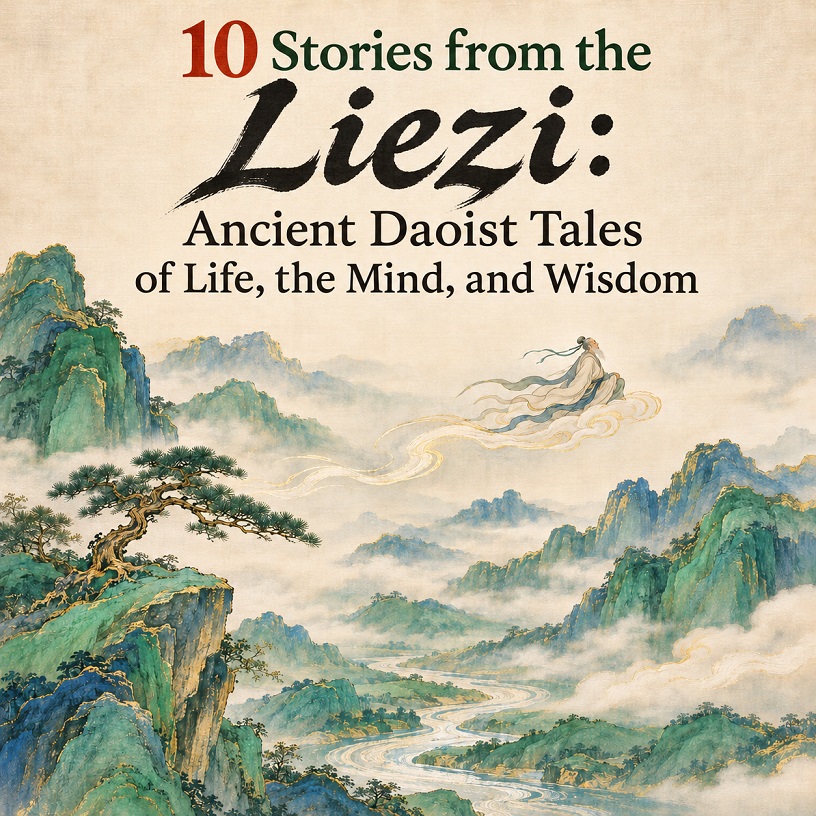
The Liezi (列子) is one of the most fascinating collections in the Chinese philosophical tradition. Traditionally attributed to the sage Lie Yukou, it has survived in eight chapters filled with stories about rulers, ordinary people, musicians, craftsmen, and travelers. Modern scholars regard the surviving text as a work shaped over centuries rather than a book whose authorship can be established beyond doubt as the work of a single individual.
The following ten stories appear in the traditional text of the Liezi. They are presented here as expanded retellings in accessible modern English, preserving their central events, images, and conclusions. They are not literal translations, and any elaborated dialogue or narrative detail should not be mistaken for a quotation from the ancient text. Each tale opens a different window onto the Daoist understanding of effort, fear, attention, knowledge, and the natural course of life.
1. The Old Man Who Decided to Move the Mountains
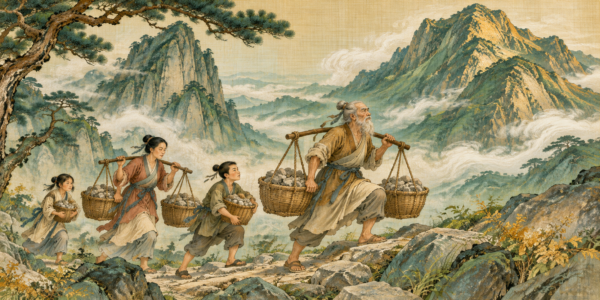
In the northern lands stood two immense mountains, Taihang and Wangwu. They obstructed the paths of those who lived nearby, forcing anyone who wished to travel to make long detours around their slopes. At their foot lived an old man named Yugong, known as the Foolish Old Man. He was nearly ninety years old, and throughout his life he had watched these mountains turn an ordinary journey into an exhausting undertaking.
One day Yugong gathered his family and proposed that they dig away the mountains. He did not merely want to carve a narrow path across a slope. He wanted, little by little, to remove the barrier in front of their home. They would carry the soil and stones far away, toward the shores of the sea. The plan sounded absurd. The mountains were enormous, and the family had nothing but simple tools and the strength of their own bodies.
His wife asked how they could possibly accomplish such a task and where they would put everything they excavated. Her questions were reasonable. Even transporting a single load of earth required a lengthy journey. Nevertheless, the family began working. Sons and grandsons dug into the slopes, broke rocks, and carried away baskets of soil. A child from a neighboring household joined them, delighted to take part.
When another elderly man, called the Wise Old Man, saw what they were doing, he laughed at Yugong. How could someone of such advanced age, whose strength was already fading, hope to remove two mountains? Did he not understand the difference between the brief span of a human life and the massive weight of the earth?
Yugong did not deny that he would die long before the work was completed. Instead, he pointed out something his neighbor had overlooked. His sons would remain after him, and their children would come after them. New generations would continue to be born. The mountains, meanwhile, would not grow taller simply because people were digging them away. Every basket of earth would make the obstacle a little smaller.
In the tale, the spirits associated with the mountains grew alarmed at this determination and reported it to the heavenly ruler. Moved by the old man’s persistence, the ruler ordered powerful beings to carry the two mountains away. The road was finally opened, not because Yugong possessed extraordinary strength, but because he refused to measure the value of an undertaking solely by the length of his own life.
The story does not offer a practical guarantee that persistence will always produce a miracle. It contrasts two ways of seeing a difficult task. One sees only the impossibility of completing it all at once; the other recognizes the reality of every small step. The man called foolish proves capable of thinking beyond immediate advantage and beyond his own lifetime.
2. The Man Who Feared That the Sky Would Fall
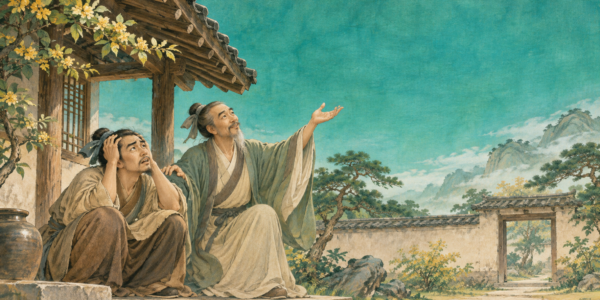
In the state of Qi lived a man troubled by an extraordinary fear. He became convinced that the sky might collapse and the earth might break apart beneath his feet. If that happened, there would be nowhere to hide. The thought followed him constantly. He could not sleep peacefully, lost his appetite, and spent his days expecting a catastrophe for which he had seen no sign.
Another man heard about his distress and decided to comfort him. He explained that the sky was an accumulation of air or vital breath, something within which human beings moved all the time. There was no solid ceiling above them waiting to fall. Every breath, gesture, and step already took place within the very expanse that the frightened man considered dangerous.
But the anxious man had another question. If the sky was not solid, what prevented the sun, moon, and stars from falling? His companion replied that the heavenly bodies belonged to the same celestial order and that there was no reason to fear them. The man then asked about the earth. The other explained that the ground was an accumulation of solid matter on which people stood and traveled without its vanishing beneath their feet.
The reassurance worked. The frightened man became calm, and the person who had comforted him was pleased as well. For a moment, the story seemed complete: an unfounded fear had been replaced by a confident explanation.
Yet the Liezi does not leave matters so simple. In the next part of the tale, another thinker challenges the comforter’s certainty. To declare that heaven and earth can never be destroyed is also to claim knowledge beyond what a person can establish. The world changes, and the limits of human understanding do not disappear merely because we have found words that make us feel secure.
The story therefore cuts in two directions. It criticizes the fear that turns an imagined disaster into continuous suffering. But it also criticizes the confidence with which we replace one unproven belief with another. The man of Qi does not know that the sky will fall; his comforter does not possess absolute knowledge that the world will endure forever.
To live wisely does not mean obtaining a guarantee that nothing will ever change. It means refusing to let uncertainty paralyze us, while also refusing to mistake a reassuring explanation for infallible truth.
3. The Lost Axe and the Suspicious Neighbor
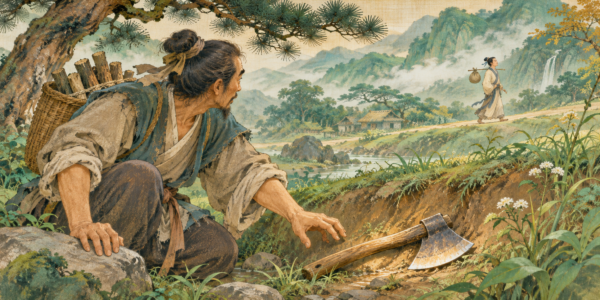
A man discovered that his axe was missing. He looked where he usually kept it, but it was not there. Unable to remember where he had last used it, he began to suspect his neighbor’s son. He had no evidence. He had not seen the boy take the tool, and nobody had reported a theft. The suspicion simply appeared in his mind and soon began to shape everything he saw.
The next day he encountered the boy. The way the boy walked looked to him like the walk of a thief. His expression seemed guilty. When the man heard him speak, even his voice sounded like that of someone concealing a crime. Every gesture, movement, and pause became confirmation of a conclusion already reached.
The boy had not changed his behavior. What had changed was the observer’s perception. Where he had once seen an ordinary neighbor’s child, he now saw a suspicious person. He was no longer testing facts. He was collecting impressions that seemed like evidence only because they agreed with his expectations.
Some time later, the man returned to a place where he had previously been digging and found the missing axe. It had not been stolen. He himself had left it there and forgotten about it. With this discovery, his suspicion collapsed.
When he next met the neighbor’s son, he noticed something remarkable. The boy no longer looked like a thief at all. His walk was ordinary, his face calm, his words innocent. Nothing in his behavior suggested wrongdoing. It was as though the observer were looking at an entirely different person.
Yet the boy was the same. The transformation had taken place entirely in the mind of the man watching him. The tale exposes how easily a prior belief disguises itself as direct perception. We think we are seeing the facts as they are, while in reality we are looking through the lens of our own suspicion.
The original anecdote is brief, but its implications are immense. In personal relationships, public disputes, and everyday judgments, we often decide what is true first and then begin finding confirmation everywhere. The lost axe reminds us that the hardest task is sometimes not finding the missing object, but noticing what our beliefs have done to the world we see.
4. The Man Who Was Friends with the Seabirds
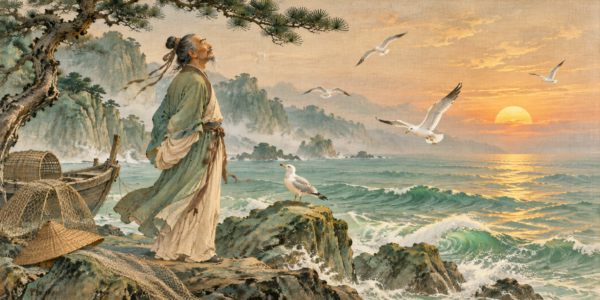
By the seashore lived a man who loved spending time among the gulls. Every morning he went down to the water, where the birds gathered in flocks. They descended around him, flew above his head, and approached without fear. Some came so close that there seemed to be an unusual bond of trust between the man and the birds.
He did not chase them, lure them with tricks, or try to keep them. He was simply present while they moved freely above the sea. There was no contract or promise in this strange friendship. The birds were not his possessions, and he did not behave as their master.
One day his father learned how close the gulls came and asked him to catch a few so that he, too, could enjoy them. The son agreed. On the surface, nothing had changed. The next morning he returned to the same shore, at the same hour, among the same birds.
But this time the gulls did not come down to him. They circled overhead and kept their distance. The man could not catch a single one. The birds that had previously approached freely now seemed to sense that the encounter was no longer the same.
The decisive change in the story is not in the location or even in the man’s visible behavior. It is in his intention. Before, he visited the birds without wishing to possess them. Now he carried the concealed purpose of capturing one. Something that had existed freely had become an object to be acquired.
This is one of the clearest Daoist tales about the difference between natural presence and action dominated by calculation. We need not believe that birds literally read human thoughts to appreciate it. The story uses their response to reveal how the desire to possess a relationship can destroy the very ease that made the relationship possible.
Sometimes what approaches us freely withdraws the moment we begin treating it as something that belongs to us.
5. The Old Man Who Caught Cicadas Without Effort
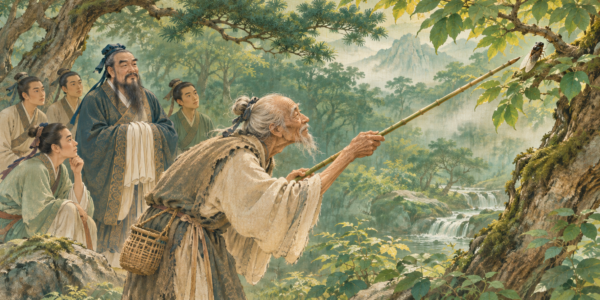
Confucius was traveling with his disciples when he passed through a grove and saw a bent old man. The man held a long pole and used it to catch cicadas with astonishing ease. His movements were precise and calm. He did not run after the insects, swing wildly, or appear tense. He collected them as though reaching for objects conveniently placed before him.
Confucius approached and asked whether he possessed a special method. The old man explained that he had developed his skill through long practice. He began by balancing small balls on the tip of his pole, trying to keep them from falling. Once he could hold two, his movements became steadier. When he managed three, his errors diminished further. When he could balance five, catching cicadas had become remarkably easy.
But practice was only part of his explanation. The old man described how he stood while working. His body was as still as a tree stump firmly rooted in the ground. His arm resembled a dry branch that did not tremble with unnecessary movement. Amid the endless variety of the world, his attention rested entirely on the cicada’s wings.
He was not distracted by the activity around him. He did not compare himself with other hunters, worry about the next insect, or constantly calculate his success. At the moment of action, everything unnecessary fell away. Only his body, the pole, the insect, and the right instant remained.
Confucius turned to his disciples and drew a lesson from what they had seen: the power of undivided attention. The old man had not acquired his skill through secret magic. He had practiced until his movements became natural and had freed his attention from everything that interfered with the task.
In this story, mastery does not mean the absence of work. On the contrary, long discipline lies behind the apparent ease. Yet genuine skill appears when discipline no longer feels like a continuous struggle of will. The practitioner need not consciously calculate every step because the movement has become so deeply learned that he can be wholly present in it.
The tale concerns cicadas, but its meaning is recognizable in music, painting, martial arts, and any craft demanding precision. The lightest action is often the result of the longest training.
6. The Yellow Emperor’s Dream of the Land of Huaxu

The Yellow Emperor was a ruler of immense power. In the early years of his reign, he enjoyed wealth, pleasure, and everything his position made available. Gradually, however, he discovered that abundance brought him no lasting peace. His desires multiplied, while each pleasure lost its force almost as soon as it was satisfied.
He then decided to devote himself to governing. He worked to establish order, settle the affairs of his subjects, and improve the state. Yet this, too, ended in exhaustion. The more he tried to arrange the world according to his own plans, the more he felt the burden of constant intervention.
After years of indulgence and years of strenuous rule, the emperor withdrew from his usual activities. He restrained his desires, quieted his body and mind, and stopped trying to control every event. Then, during a daytime sleep, he dreamed of an extraordinary country called Huaxu.
In that land there was no ruler issuing commands and no population obeying out of fear. Its inhabitants did not strive to dominate one another. They felt no constant need to divide everything into profitable and unprofitable, advantageous and disadvantageous. They lived in harmony with the natural course of things, without turning existence into an endless contest for superiority.
The people of Huaxu were not heroes forever overcoming danger. Rather, they were free from the familiar anxieties and calculating desires that filled the emperor’s world. The account contains wondrous images of beings who move freely, remain unharmed under extraordinary conditions, and know none of the strain that defines ordinary political life.
When the Yellow Emperor awoke, he realized that he had long been looking for order in the wrong places. First he had sought it in pleasure, then in the constant exercise of power. His dream showed him another kind of harmony: one that does not have to be imposed through coercion, but can emerge when unnecessary interference recedes.
In the Liezi, this tale expresses the Daoist ideal of natural governance and action without forcing. It is not a literal political blueprint for a society without institutions. Through his dream, the ruler confronts the limits of his own will and discovers that order does not always increase with the number of commands.
7. The Craftsman Yan Shi and the Mechanical Man
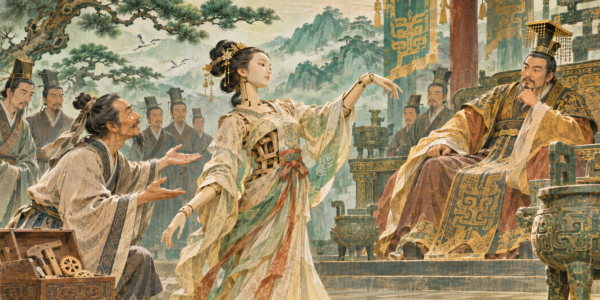
King Mu of the Zhou dynasty was traveling through distant lands when he encountered an extraordinary craftsman named Yan Shi. The craftsman declared that he had something remarkable to show. The king, accustomed to rare objects and impressive entertainments, agreed to examine his creation.
The following day, Yan Shi appeared before the ruler with a figure that looked like a living human being. It stood upright, moved, and appeared so convincing that the king initially took it for an actual companion. The craftsman, however, explained that it was an object made by his own hands.
At the craftsman’s signal, the artificial man began to perform. It walked, moved its head, sang, and danced. Its gestures seemed natural, and its appearance was convincing enough to deceive an observer. The king was astonished that a constructed figure could imitate human behavior so closely.
During the performance, however, the creation began casting flirtatious glances toward the women in the royal entourage. The king became furious. For a moment, he forgot that the figure was a machine and treated its behavior as a deliberate insult. He threatened the craftsman, who hurriedly took the figure apart to show how it had been made.
Before the king’s eyes, the internal components of the device were exposed. The craftsman revealed that the figure consisted of various materials and intricate mechanisms. When he removed certain parts, particular abilities disappeared: its movements and performances depended on the arrangement of the whole. What had seemed an independently living being was the result of carefully combined elements.
The king remained amazed. He had seen more than a toy. The creation raised the question of how reliably we can distinguish a living being from a manufactured one on the basis of outward behavior alone. Yan Shi had not created a biological human being, but he had reproduced enough visible signs of human action to provoke an intensely human reaction.
This ancient tale feels especially relevant in the age of robotics and artificial intelligence. It does not prove that a machine possesses consciousness. Instead, it shows how readily observers attribute intentions to something that behaves like a person. The king becomes angry at a mechanism because, for an instant, he forgets the distinction between convincing behavior and an assumed inner life.
8. The Two Children Who Argued About the Sun
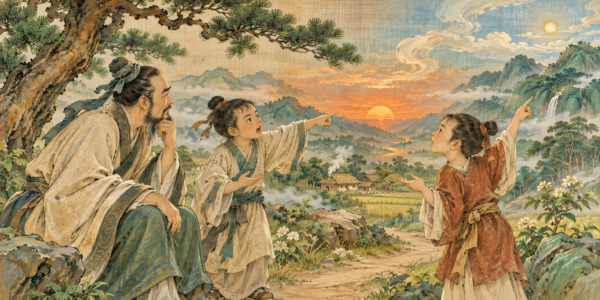
One day Confucius was traveling east when he encountered two children engaged in a lively argument. He stopped and asked what they were disputing. Their disagreement concerned a question that seemed simple but led to conflicting conclusions: when is the sun closer to the earth, at sunrise or at noon?
The first child insisted that the sun was closer at sunrise. In the morning, he argued, its disk looks enormous, while at midday it appears smaller. If nearby objects look larger and distant objects smaller, surely the sun must be nearer when it rises.
The second child disagreed. In his view, the sun was closer at noon because its heat was then much stronger. Morning air was cool, whereas the midday sun warmed the ground intensely. If a nearby fire heats us more than a distant one, why should the same reasoning not apply to the sun?
Both children appealed to observations from everyday life. One relied on apparent size, the other on the sensation of heat. Each had a reason for believing his explanation, and each could identify a weakness in the other’s conclusion.
Confucius listened to their arguments but could not settle the dispute. The children laughed and asked how someone regarded as so learned could fail to answer such a question.
The story is not a lesson in modern astronomy. We now understand that the sun’s apparent enlargement near the horizon is connected with visual perception, while the daily pattern of heating involves the angle of sunlight and the accumulation of warmth. The ancient tale asks a different question: what happens when persuasive observations seem to support opposing conclusions?
Its force lies in the children’s refusal to accept authority as an answer and in Confucius’s inability to turn uncertainty into knowledge. Wisdom does not mean always having a ready explanation. It includes the ability to hear a difficult question and recognize when one’s reasons are insufficient.
9. The Musician Bo Ya and the Friend Who Heard His Thoughts
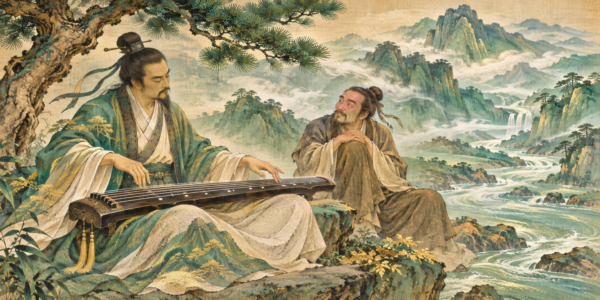
Bo Ya was a skilled musician, celebrated for his mastery of the zither. Yet however beautifully he played, his deepest satisfaction came from the presence of one listener: Zhong Ziqi. This man did not merely enjoy the melodies. He understood what Bo Ya was trying to express through them.
When Bo Ya turned his thoughts toward majestic mountains and began to play, Zhong Ziqi recognized towering peaks in the music. When the musician imagined flowing water, his listener heard the movement of rivers in the melody. Bo Ya did not need to explain in advance what image he intended to convey. His friend recognized the direction of his thoughts through the music itself.
In the account, Bo Ya’s musical imagination ranges across mountains and waters, while Zhong Ziqi continues to grasp the images that inspire him. Whatever the musician turns his mind toward, the listener seems able to follow. Their connection rests not on identical words or lengthy explanations, but on a profound harmony between expression and understanding.
The episode in the Liezi focuses on this extraordinary mutual understanding. Later Chinese traditions tell other famous details about Bo Ya and Zhong Ziqi, including stories associated with the loss of the friend. Those additional elements should not automatically be treated as part of this same passage of the Liezi.
The tale asks what it means for someone truly to hear us. Music is sound, but for Bo Ya it carries images, intentions, and experiences. Zhong Ziqi does not stop at recognizing the notes. He reaches what the musician is expressing through them.
This story became one of the most beautiful Chinese images of deep friendship. Not everyone who listens understands; not everyone who understands the words grasps their meaning. Sometimes closeness reveals itself in the ability to recognize what another person cannot, or does not wish to, express directly.
10. The Swimmer in the Waterfall Who Did Not Fight the Current
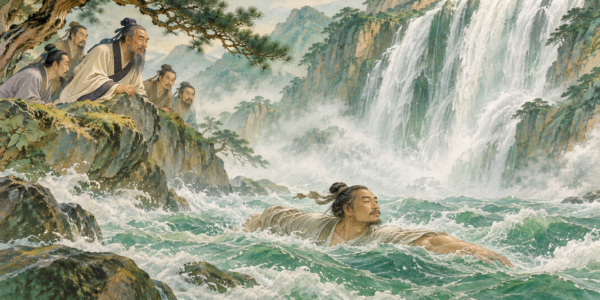
Confucius was watching the waters at Lüliang, where the current was extraordinarily powerful. Water rushed through dangerous rapids and whirlpools in which even experienced swimmers would struggle to survive. As he watched the turbulent river, he noticed a man approaching the water and plunging straight into it.
Confucius was horrified. He assumed that the stranger was desperate and intended to end his life. He sent his disciples downstream to look for the man and help him if possible. But after a while the swimmer emerged unharmed at another point, climbed out of the water, and calmly continued on his way.
Confucius approached and asked how he had managed to pass through such dangerous water. Did he possess a special technique? Had he learned a secret unknown to ordinary people? The swimmer replied that he had no miraculous power and relied on no complicated rules.
He explained that he had grown up beside the water and become accustomed to it. Over time, he had learned to feel the current’s movement instead of resisting it. When the water carried him downward, he followed it; when it lifted him, he allowed himself to rise. He did not insist on imposing his own direction where the river’s force already determined the way.
This did not mean that the swimmer was passive. He knew the water through long experience and acted at precisely the right moments. The difference was that he did not turn every movement into a struggle. Instead of setting his strength against the entire river, he adapted his actions to its rhythm.
His answer expresses one of the most characteristic ideas of Daoist thought: natural action is not the same as inaction. It is action that is not torn apart by unnecessary resistance. The swimmer does not defeat the waterfall. He passes through it because he does not attempt to turn it into a motionless lake.
The story leaves us with an image that remains vivid long after reading. One person sees deadly danger in the water; another knows its movement so intimately that he can live within it. The difference is not that the river has become weaker. It is the way the person enters it.
Author: Vasil Stoyanov