
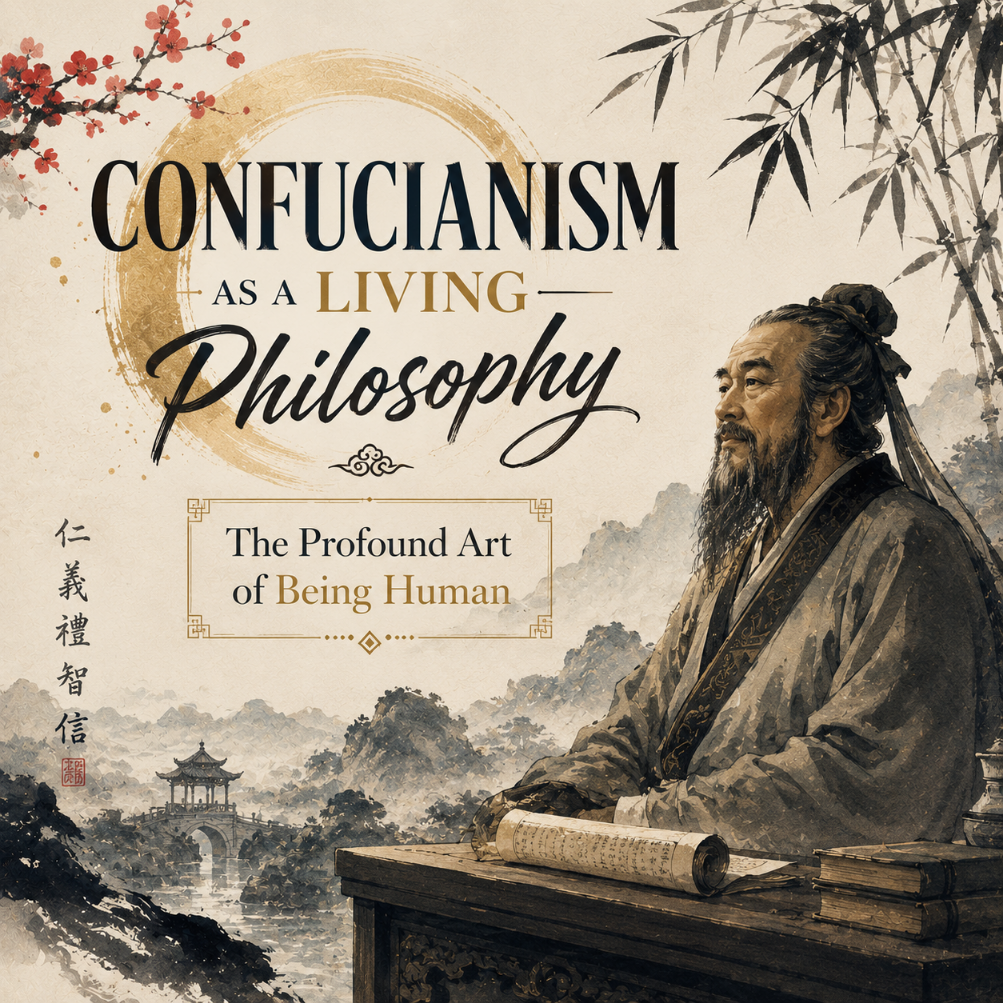
Introduction: Between Being and Right Action
When we attempt to understand Confucianism, we inevitably encounter a paradox: it is a philosophy that does not seek to explain the world through abstract categories, but rather to organize it through human behavior. At its center is not the question “What is reality?”, but “How should I live?”. And precisely here lies both its strength and its difficulty.
Confucius’ thought is not a system that can be locked into definitions. It is rather a flow – a continuous process of self-cultivation, moral alignment, and the search for balance. Confucianism does not offer salvation from the world, but the transformation of the world itself through the transformation of the human being.
This is a philosophy that requires practice. It is not enough to understand it – one must live it.
Historical Context: Crisis as the Beginning of Moral Philosophy
The era in which Confucius lived was a time of deep disintegration. The old order was collapsing, traditional rituals were losing their power, and authority was divided among warring states. This was not merely political instability – it was a crisis of meaning.
People no longer knew how to behave, how to relate to one another, or what it meant to be good. In this context, Confucius’ philosophy emerged as an attempt to restore the moral structure of society.
But he did not propose new laws. He proposed a new understanding of the old ones. For him, the problem was not with the rituals themselves, but with the fact that they had lost their inner meaning. People performed them mechanically, without understanding, without feeling.
Therefore, the task was not simply to restore the rituals, but to restore the spirit behind them.
Ren (仁): Humanity as the Ontological Core of Morality
Ren is the deepest and most difficult concept in Confucianism. It is not merely a virtue – it is the foundation of all virtues. Philosophically speaking, we may say that Ren is the principle that makes a human being truly human.
Ren is not an abstract idea. It is a living experience of connection. It means sensing the other not as an object, but as an extension of oneself. This is a radical ethical position because it removes the boundary between “self” and “other” on the moral level.
Confucius often connects Ren with the principle of reciprocity: “Do not do to others what you would not want done to yourself.” But this is only the beginning. True Ren requires active goodness, not merely refraining from evil.
At its deepest level, Ren is a form of moral sensitivity. It is the ability to respond appropriately to the human situation – not through rules, but through the heart. In this sense, Ren is pre-rational – it precedes logic.
Interestingly, the later thinker Mencius developed this idea by claiming that Ren is innate. He spoke of “the heart that cannot bear the suffering of others.” This means that morality is not imposed from the outside, but grows from within.
But this does not mean that Ren is automatic. It must be cultivated. Without care, education, and practice, it may remain in a latent state.
Ren is a potential that must become reality.
Li (礼): Ritual as the External Form of Inner Harmony
If Ren is the inner core, then Li is its outward manifestation. But we must be careful here: Li is not merely a set of rules. It is a system of meanings that gives structure to human behavior.
Ritual in Confucianism is not limited to religious ceremonies. It includes all forms of social interaction – from the way we greet one another to the way we govern a state. Li is the language of behavior.
But why is this language necessary?
Because human emotions are chaotic. Without form, they can destroy society. Li does not suppress emotions – it channels them. It gives them a structure through which they may be expressed harmoniously.
For example, grief in the face of death is not merely a feeling. It has a ritual form. This form is not artificial – it helps a person experience loss in a meaningful way.
Li also creates predictability. In a world where people know how to behave, trust is created. And trust is the foundation of every society.
But most importantly, Li and Ren are interdependent. Without Ren, ritual becomes empty. Without Li, Ren remains without form.
True virtue emerges when inner feeling and outer action become one.
Yi (义): Righteousness as a Moment of Moral Clarity
Yi is the third key principle that complements Ren and Li. If Ren is the heart and Li is the form, then Yi is the decision. It is the ability to act correctly in a specific situation.
Yi is especially important because real life does not always follow clear rules. Sometimes ritual is not enough. Sometimes a decision must be made that requires moral courage.
Yi is what allows us to choose what is right even when it is difficult. It often comes into conflict with personal interest. It is precisely within this conflict that true character reveals itself.
Confucianism does not idealize easy morality. On the contrary, it recognizes that virtue often requires sacrifice. Yi is the capacity to make that sacrifice.
At its deepest level, Yi is a form of moral intuition. It is not merely logical reasoning, but an integration of knowledge, experience, and character.
The Interaction Between Ren, Li, and Yi: The Trinity of Moral Existence
These three principles do not exist separately. They form a system. Ren provides content, Li provides form, and Yi provides direction.
Without Ren, Li becomes mechanical. Without Li, Ren becomes chaotic. Without Yi, both lose orientation.
This trinity demonstrates how complex Confucian ethics truly is. It cannot be reduced to rules or feelings. It requires balance.
And this balance is not given – it must be achieved.
The Human Being as Process: The Noble Person as a Philosophical Ideal
Confucianism does not believe in a fixed human nature. It sees the human being as a process of becoming. The noble person (Junzi) is the result of this process.
He is not perfect, but he is oriented toward perfection. He constantly observes himself, corrects himself, and learns. His strength lies not in knowledge, but in character.
This ideal is extremely demanding. It assumes that morality is not a choice, but a duty.
Education: The Path from Knowledge to Wisdom
Education in Confucianism is a process of inner transformation. It begins with knowledge, but it does not end there. The true goal is wisdom – the ability to apply knowledge correctly.
This includes self-reflection. Without it, learning remains superficial. Confucius emphasized that one must think deeply about what one learns.
Conclusion: Confucianism as an Endless Moral Path
Confucianism does not offer a final destination. It offers a path – a path of continuous self-improvement. On this path there are no guarantees, but there is direction.
And perhaps this is precisely what makes it so relevant today. In a world of uncertainty, Confucianism reminds us that stability begins within.
That harmony is not something given, but something achieved.
And that being human is the most difficult – and most important – art of all.
Read More:
- Zhuangzi – The Sage of the Free Spirit and the Infinite Tao
- Liezi – The Sage of Wind and Freedom
- Buddhism, Hinduism, and Taoism – “The Deep Differences Behind the Apparent Similarities”
- Lao Tzu: The Sage of Tao and the Secret of Eternal Simplicity
Author: Vasil Stoyanov