
Osho uses stories to speak about the human mind, freedom, fear, and the ability to be truly present in life. In them, ordinary events acquire extraordinary meaning: an empty boat reveals the nature of anger, a frog in a well illustrates the limits of knowledge, and a master archer loses his accuracy precisely when he begins to desire victory too intensely. The following fifteen parables are free retellings of stories Osho uses in his talks. They are not literal translations.
1. The Empty Boat and the Man Who Became Angry at Nobody

A man was crossing a river in his small boat. The water was calm, and he rowed slowly, enjoying the silence. In the distance, he noticed another boat drifting downstream directly toward him.
At first, he was not concerned. The river was wide, and he assumed the person in the other boat would change course. But the distance between the two vessels kept shrinking.
He shouted to warn the stranger. Nobody answered. He shouted again, this time more loudly. The other boat continued approaching as though its occupant were deliberately ignoring him.
The rower began to grow angry. He was no longer thinking about the beautiful river, the fresh air, or the peace of the morning. All his attention was consumed by the supposed insolence of the other person.
Just before the collision, he shouted one last time. Then the two boats struck each other.
The man stood up, ready to pour his anger upon the irresponsible stranger. But when he looked carefully, he discovered something unexpected.
The other boat was empty.
There was no rower who had ignored him. There was no person who had decided to cause him trouble. The boat had simply broken loose from the bank, and the current was carrying it downstream.
At that very moment, his anger vanished.
The collision had been entirely real. His boat might have been damaged. But when he realized that no hostile intention lay behind what had happened, he stopped taking it as a personal insult.
The physical event had not changed. Only his interpretation of it had changed.
If there had been someone in the other boat, the rower would have been convinced that he was the victim of another person’s stupidity or disrespect. But when he discovered that the boat was empty, there was no longer anyone to blame.
Someone fails to greet us, and we decide they despise us. Someone arrives late, and we assume they do not respect us. Someone expresses a different opinion, and we feel attacked.
Sometimes there really is hostility. But sometimes an empty boat is simply drifting toward us.
2. The Frog in the Well Who Did Not Believe in the Ocean

A frog lived in an old well. She had been born there and had never left her small world.
She knew every crack in the stone walls, every place where the water was deeper, and every comfortable stone on which she could rest. For her, the well was entirely sufficient.
One day another frog found her way into the well. She came from the ocean.
The resident greeted her with curiosity and asked where she had come from. When she heard the word “ocean,” she was surprised.
She had never heard of such a place.
The visitor tried to explain that the ocean was an immense expanse of water stretching beyond the horizon. But the frog in the well could not imagine such a thing.
She made a little leap and asked whether the ocean was that big.
The other frog answered that it was incomparably larger.
Then the resident jumped halfway between the two walls.
Was the ocean at least that wide?
Once again, the answer was no.
The frog frowned, gathered her strength, and made the greatest leap she could manage-from one side of the well to the other.
Now she was certain that she had found the proper measure. Nothing could possibly be larger than all the space she knew.
But the ocean frog again explained that the ocean was immeasurably more vast.
At that, the resident grew angry.
She decided the stranger was lying. How could anything exist that would not fit inside the only world she had ever known?
Instead of going out to see for herself, she drove the visitor away.
The frog’s problem was not that she lived in a well. She was not responsible for where she had been born. The problem was that she used the dimensions of the well as an absolute measure of all reality.
Her ignorance became certainty, and her certainty became an inability to hear anything new.
The well may be an education, a religion, a political belief, or a personal history. Its walls are not always visible.
3. The River God Who Discovered How Small His World Was

In autumn, torrential rains began to fall. Small streams became rushing rivers, and the rivers flowed into the Yellow River.
The water rose until the river overflowed its banks. The current became so broad that it was difficult to distinguish animals on the opposite shore.
The river god watched all this with immense satisfaction.
Never before had he seen his domain so extensive. Everywhere around him there was water, movement, and power.
Gradually, he began to believe that nothing in the world could compare with his river.
He admired his own greatness and regarded the enormous flood as proof that he possessed the greatest treasure in nature.
But the water kept flowing.
The river god followed the current eastward until, at last, he reached the sea.
There he stopped.
Before him opened an immeasurable expanse of water. His gaze traveled across its surface, but nowhere could he find the opposite shore.
There were none of the familiar outlines of the river valley. There were no walls enclosing the water. There was no place from which he could take in the whole expanse with a single glance.
At that moment, his pride collapsed.
He realized that he had considered his own river the greatest thing only because he had never seen the ocean.
The river god admitted to the deity of the sea that only now did he understand how limited his ideas had been.
His earlier knowledge had not been entirely wrong. The river truly was enormous. But that did not mean it was the largest possible expanse of water.
As long as a person compares themselves only with what they already know, it is easy to feel that they have reached the ultimate limit.
Encountering something greater changes not only the scale of the world but also one’s relationship to one’s own knowledge.
The river god did not lose his river when he saw the ocean. He lost only the illusion that his river was everything.
4. The Turtle Who Preferred the Mud to the Palace
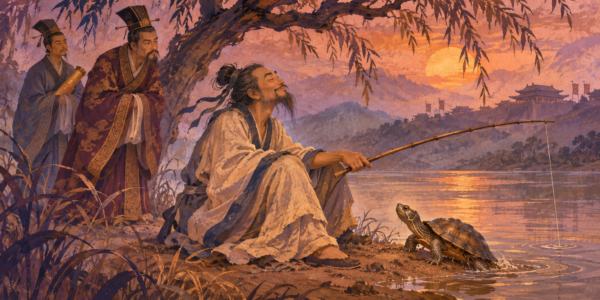
Zhuangzi was sitting beside the Pu River, fishing.
It was a quiet day. He held his bamboo fishing rod and watched the water, with nowhere he needed to hurry.
Meanwhile, the ruler of Chu was searching for a capable person to entrust with the administration of the state. He had heard of Zhuangzi’s reputation as a sage and sent two high-ranking officials with a formal offer.
The messengers found the philosopher on the riverbank.
They told him that the ruler wished to appoint him chief minister-a position that brought power, honors, and influence over the fate of many people.
Zhuangzi did not put down his fishing rod.
Instead of discussing the terms of the appointment, he asked the messengers whether they had heard of a sacred turtle.
It had died many generations earlier, and its shell was kept in a temple. Wrapped in costly fabrics, it occupied a place of honor and received the reverence of rulers and priests.
Then Zhuangzi posed a question.
Which would have been better for the turtle itself-to die and have its shell honored for centuries, or to remain alive and drag its tail through the mud?
The messengers did not hesitate.
Of course the turtle would have preferred to be alive.
Then Zhuangzi made it clear that he chose the same thing.
He did not want honors at court. He preferred the freedom to remain by the river rather than become an ornament of power.
Outwardly, the offer was extraordinarily advantageous. But to the philosopher, it meant losing something he considered more precious than prestige.
People often strive to become important in the eyes of others. They seek positions, titles, and proof that they have succeeded.
But honors come at a price that is not always visible in advance.
The turtle in the temple is famous but dead. The turtle in the mud is unknown but alive.
The story asks whether a person is willing to sacrifice freedom for the admiration of others.
5. The Monkey Who Died Because of Its Own Superiority
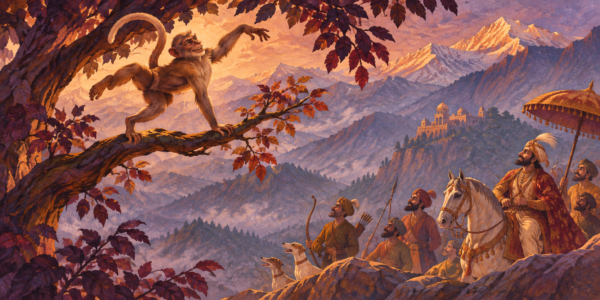
A ruler went hunting in a mountainous region inhabited by many monkeys.
When the animals saw the armed party, they became frightened and fled into the treetops. They hid among the thick branches, where the people could hardly reach them.
Only one monkey remained in the open.
It moved with extraordinary agility. It leaped from branch to branch and seemed deliberately to demonstrate how much faster it was than its pursuers.
The ruler noticed the unusual animal and decided to test its abilities.
He drew his bow and shot an arrow.
The monkey reacted with lightning speed. It managed to catch the arrow before it reached its body.
It was a remarkable feat.
But instead of withdrawing, the animal continued displaying its superiority.
The ruler felt challenged.
He ordered his attendants to shoot at the same time.
Now the monkey had to defend itself not against one arrow but against many arrows coming from different directions.
Its agility was no longer enough.
The animal was struck and fell dead.
Afterward, the ruler turned to one of his companions and pointed to what had happened as a warning.
The monkey possessed genuine skill. But instead of using that skill to save itself, it turned it into a display.
It was precisely the desire to show how capable it was that placed it in danger.
A person can possess extraordinary abilities without feeling a constant need to prove them.
But when skill becomes the foundation of self-esteem, every situation begins to look like a test.
Then even a seemingly harmless challenge can become dangerous.
The monkey did not die because it lacked ability. It died because it could not give up demonstrating its ability.
6. The Archer Who Lost His Skill Because of the Prize
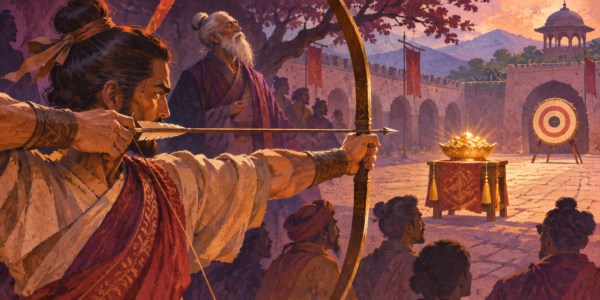
Once there lived an archer whose mastery was exceptional.
When he practiced for pleasure, his movements were calm and precise. He placed an arrow on the string, looked at the target, and shot without hesitation.
His hands did not tremble. His breathing remained steady. There was no unnecessary tension between looking and acting.
One day he was invited to take part in a competition.
The prize was small, and he continued shooting almost as freely as he did during his ordinary practice.
Then, however, the stakes were raised.
Now he could win something valuable.
The archer stood before the target again, but he felt a change. His attention was no longer directed solely toward the arrow and the mark.
He began thinking about the prize.
He imagined the joy of victory and the disappointment of defeat. He wondered how he would look to others if he failed.
His hand became less steady.
The more importance he attached to the result, the harder it became to perform the action that had once come naturally.
His skill had not disappeared. His body was the same, his experience was the same, and his bow was the same.
Only his inner state had changed.
Before, he was shooting. Now he was trying to win.
That difference proved decisive.
One part of his attention performs the action, while another constantly watches what result the action will bring.
Instead of being entirely present, a person begins living simultaneously in the present and in imagined futures.
In this way, the fear of failure becomes one of the causes of failure itself.
The story is not only about archery. It describes an experience familiar to musicians, athletes, performers, and people taking an important examination.
Sometimes a skill works best when we stop using it as proof of our own worth.
7. The Centipede Who Forgot How to Walk

A centipede was moving along a path with remarkable ease.
Its dozens of legs worked in perfect sequence. It did not stumble, hesitate, or experience any difficulty.
Nearby stood a fox watching its movements.
The fox was curious and liked to think about everything it saw. The longer it watched the centipede, the more unbelievable it seemed that a creature could control so many legs.
At last, the fox could no longer contain its curiosity and stopped the centipede.
It asked how the centipede managed to know which leg to move first, which came second, and how all the others fell into the proper order.
The centipede was surprised.
Nobody had ever asked it such a question before.
It had always walked without thinking about exactly how it did so.
But the fox’s question intrigued it.
The centipede decided to observe its own movements in order to discover the answer.
It tried to take a step and began watching its legs.
Which one should move first?
Which one should follow?
What would happen if two legs moved at the same time?
Suddenly, its movements became uncertain.
It grew confused and could no longer walk as naturally as before.
The fox had not taken away a single one of its legs. It had not changed the centipede’s body or placed an obstacle in its path.
It had simply directed the centipede’s attention toward an action that until then had taken place without conscious calculation.
Thinking is valuable when we need to learn something, understand a problem, or make a decision.
But there are moments when constantly monitoring our own actions becomes an obstacle.
A person who thinks about every movement of their feet will find it difficult to dance freely.
A person who constantly checks whether they sound natural may lose the ability to converse spontaneously.
The centipede did not need more information in order to walk. It needed the freedom to do what it already knew how to do.
8. The Artist Who Drew Perfect Circles Without a Compass

In ancient China lived a master known for the extraordinary precision of his drawings.
He could draw circles by hand so perfectly that they looked as though they had been made with a compass.
People marveled at his skill.
It was difficult for them to understand how a human hand, which normally trembles and makes small deviations, could achieve such accuracy without the help of a tool.
Yet the master did not appear particularly tense.
He did not grip the brush in fear of making a mistake. He did not stop constantly to check whether the line was sufficiently correct.
His movement was fluid.
He began the circle and completed it as naturally as though his hand itself knew where to go next.
To observers, the result seemed almost impossible.
But for the artist, the action was not a battle.
A person can become so preoccupied with the desire to achieve a perfect result that the desire itself interferes with the movement.
The master is not indifferent to what he does. On the contrary, all his attention participates in the action.
But there is no constant argument between him and his work.
It is like the feeling of a shoe that fits the foot perfectly. When a shoe is uncomfortable, a person is constantly aware of it. When it fits perfectly, they stop thinking about it.
Similarly, a well-mastered action does not require continuous proof.
The artist is not trying to impress everyone watching him. He simply draws.
And precisely because he does not turn every line into a test of his own importance, his hand remains free.
9. The Ground That Seemed Useless
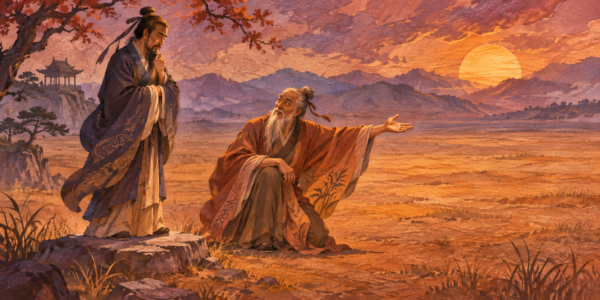
A thinker reproached Zhuangzi for speaking too much about things that had no practical use.
In his opinion, a person should concern themselves with what they can use.
Useful things are tools that do a job, roads along which we travel, and knowledge that helps us achieve a particular goal.
Everything else seems unnecessary.
Zhuangzi did not begin defending the useless with lengthy definitions.
Instead, he proposed a thought experiment.
He asked his companion how much of the earth a person actually uses when standing upright.
The answer was obvious.
Only the small area directly beneath their feet.
Then Zhuangzi asked him to imagine that all the rest of the earth disappeared.
Two small supports remained beneath the person’s feet, while an abyss opened everywhere around them.
At first glance, none of the space being used had been taken away.
The feet were still standing on the same two small places.
But could a person remain standing there calmly?
His companion admitted that they could not.
Without the vast earth around them, the little supports were no longer enough.
Then Zhuangzi pointed out the meaning of the example.
What seems useless is often a necessary condition for the existence of what is useful.
A person uses only a small portion of the earth at any given moment, but the rest is not unnecessary.
If someone considers only what brings money, results, or recognition to be valuable, they will gradually begin to see rest, silence, beauty, and free time as a waste.
But life cannot consist only of activities that produce measurable results.
The space between obligations matters too.
Silence between words is not a defect in conversation.
Rest is not necessarily a missed opportunity to work.
Sometimes what we cannot use directly sustains everything we do use.
10. The Butcher Whose Knife Never Grew Dull

A disciple heard about an extraordinary butcher who was known not only for his profession but also for his awareness.
This seemed contradictory to him.
How could someone who cut up animal bodies every day be presented as an example of inner wakefulness?
The disciple decided to visit him.
When he arrived, he found the butcher at work.
He watched his movements and noticed that they were extraordinarily precise. The man did not act hastily or use unnecessary force.
Every movement seemed carefully adapted to the structure of the body he was working on.
The disciple also noticed his knife.
The blade was in excellent condition, as though it had just been sharpened.
He asked how often the butcher replaced or sharpened it.
The answer surprised him.
The master explained that the knife had been used for a very long time and that the secret of preserving it lay not in constant sharpening but in the way it was used.
He knew the arrangement of the joints and the spaces between the bones. Instead of forcing the blade against hard resistance, he guided it where passage was most natural.
The disciple continued questioning him.
Then the conversation turned to the master’s inner attention.
The butcher did not describe his actions as mechanical repetition. He emphasized that every movement required wakefulness.
In one version of the story, the teacher even sends the disciple to test this wakefulness by directing a sword toward the butcher’s hand. Instead of becoming frightened and losing his presence of mind, the master pays attention to the accuracy of the strike.
The story is unusual and deliberately provocative. It is not a general moral justification for killing animals. Its subject is the relationship between action and attention.
The outward appearance of an occupation does not automatically reveal the inner state of the person performing it.
The story raises a difficult question: is knowing what someone does enough to understand how they are present in their own actions?
The answer does not remove moral responsibility for consequences. It also directs attention toward the quality of consciousness with which a person acts.
11. The Mustard Seed That Became a Tree
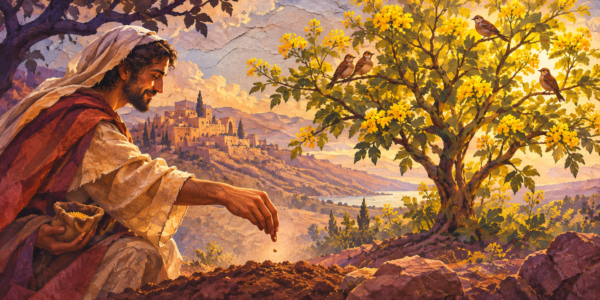
The disciples of Jesus wanted to understand what the kingdom of heaven was like.
They were searching for an image that would help them imagine something of which they had no direct experience.
Instead of offering them a complicated philosophical definition, Jesus used the image of a mustard seed.
It is a small seed that can easily go unnoticed.
A person can hold it between their fingers without seeing anything remarkable in it.
But when the seed falls into suitable soil, a process begins that cannot be recognized from its outward appearance alone.
It sprouts.
A small stem appears, then leaves and branches. The plant gradually grows until it becomes a place where birds can find shelter.
Something that initially seemed almost insignificant reveals possibilities that were invisible in its original form.
The seed is an image of hidden potential.
A person often judges themselves only by what they have already become. They see their habits, limitations, fears, and achievements.
But these visible characteristics do not exhaust their possibilities.
The seed does not resemble the tree that will grow from it.
Someone unfamiliar with plants could not guess, merely from its tiny shape, what might emerge.
There is another important point.
For the plant to develop, the seed must cease to exist in its previous form.
It cannot remain unchanged and become a tree at the same time.
Growth does not mean merely adding new abilities to our old identity.
Sometimes it means letting go of the image we have constructed of ourselves.
12. The Invited Guests Who Had No Time for the Feast
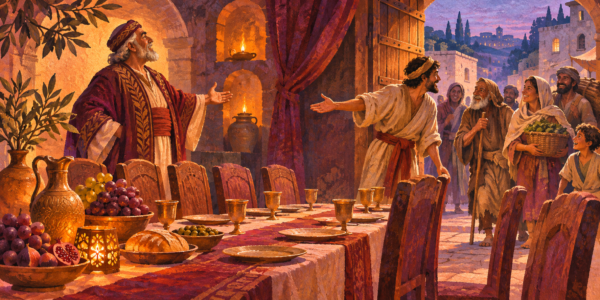
A man decided to organize a great dinner.
He prepared the food, arranged his home, and sent his servant to invite the guests.
Everything was ready.
All that remained was for the people to arrive and share the meal.
But the first person invited explained that he had important business affairs. He was expecting a meeting with people with whom he needed to settle financial matters.
He could not come.
The servant went to the next guest.
He, too, declined. He had recently bought a house and had obligations connected with his new property.
A third person had to organize another gathering.
A fourth was occupied with matters concerning the land he owned.
Everyone had a reason to be absent.
None of the reasons seemed entirely absurd. The people genuinely had work, obligations, and plans.
But the result was the same.
Nobody came.
The servant returned and reported that the invited guests had refused.
Then the host sent him along the roads to bring in other people.
The table was ready, and the feast should not remain empty simply because the original guests were absorbed in their own occupations.
The guests are not deprived of the opportunity to participate in the feast. They simply have something else to do.
There is always another deal, another acquisition, another obligation.
Thus life becomes an endless preparation for a moment that never arrives.
A person promises themselves that they will rest when the work is finished. That they will pay attention to their loved ones when they have more time. That they will begin living more freely when they have achieved sufficient security.
But every completed task makes room for another.
The feast in the story is not merely a dinner. It is an image of the immediate possibility of participating in life.
The invitation is being offered now.
And the guests continue preparing for some future.
13. The Christian Who Met a Zen Master but Saw Only His Own Book

A Christian visited a Zen master.
He brought the Bible with him and wanted to understand how the Buddhist monk would receive the words of Jesus.
For the visitor, this was an important question.
He believed that Christ’s teaching was true, but he also wanted recognition from someone belonging to another spiritual tradition.
He asked the master to listen to a few passages.
The monk agreed.
The Christian opened the book and began reading from the Sermon on the Mount.
After a few sentences, the Zen master interrupted him.
He declared that the person who had spoken these words was enlightened.
The visitor was delighted.
He had received exactly the recognition for which he had come.
But instead of stopping and paying attention to the person before him, he continued reading.
The master again confirmed that the words came from someone with profound spiritual insight.
The Christian was even more pleased.
After the meeting, he left happily, because now he could tell others that a Zen master had acknowledged the greatness of Jesus.
But the visitor had missed the most important thing.
He had been so focused on obtaining approval for his own tradition that he showed no genuine curiosity about the teacher standing before him.
He did not ask himself how this person was capable of recognizing the quality of the words he heard.
He did not become interested in the master’s own experience.
For him, the living teacher was merely a means of confirming the value of a text he already knew.
Is a person searching for truth, or searching for someone to confirm that they already possess it?
When we are attached to a particular idea, even an encounter with something new can become an opportunity to reinforce an old belief.
The Christian left satisfied.
But it is not certain that he left changed.
14. The Drunk Man Who Fell from the Cart
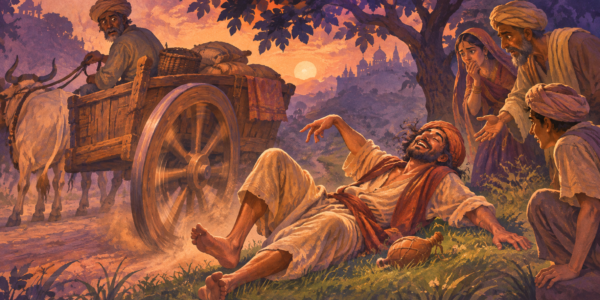
A man climbed into a cart after drinking far too much wine.
As the vehicle moved, he sat loosely and was barely aware of what was happening around him.
He was not thinking about the dangers of the road.
He was not calculating every jolt.
He was not worrying that he might fall.
At one point, the cart jolted violently, and the man fell out.
His body struck the ground.
Such a fall could have caused serious injuries.
But the drunken man escaped relatively lightly hurt.
In the Daoist parable, the reason is not that alcohol makes human bones stronger. His body was no different from the bodies of other people.
What was different was his condition during the fall.
He did not anticipate the impact and had not stiffened with fear.
He was not frantically trying to control every movement.
His body remained relaxed.
In the traditional story, this serves as an image of a person who is not inwardly divided by constant anxiety.
The parable does not recommend drinking alcohol, nor does it claim that intoxicated people are protected from injury. In real life, alcohol increases the risk of accidents and serious harm.
The story uses an exaggerated image to illustrate a psychological state.
When someone lives in constant anxiety, they try to predict and control everything.
But this continual readiness for danger can make them even more tense.
Freedom does not come from losing consciousness but from a deeper presence without unnecessary fear.
The drunken man is merely a symbolic example of the absence of inner resistance.
15. The Astrologer Who Discovered the Footprints of an Emperor
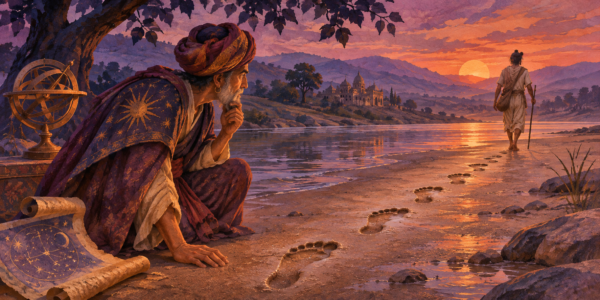
An astrologer completed his long education and set off for home.
He had studied ancient knowledge through which he believed he could recognize a person’s destiny and qualities from various signs.
As he walked along a riverbank, he noticed the prints of bare feet in the sand.
He stopped and examined them carefully.
According to his knowledge, these footprints possessed the marks that tradition associated with a great ruler.
The astrologer was bewildered.
How could a person destined for royal power be walking barefoot on the hot sand?
Should he not be in a palace, surrounded by servants, wealth, and honors?
Curiosity got the better of him.
He followed the footprints.
After a while, he discovered a man sitting peacefully beneath a tree.
It was the Buddha, who had left royal life and taken the path of spiritual seeking.
The astrologer approached and began asking questions.
He wanted to know whether the stranger was a ruler who, for some reason, was traveling without an entourage.
The Buddha answered no.
Then the astrologer suggested that a heavenly being stood before him.
Again, the answer was no.
He continued searching for a definition that would correspond to the extraordinary calm of the person before him.
But every category he proposed proved unsuitable.
Finally, he asked who the man actually was.
The Buddha declined to define himself through the familiar social and supernatural roles.
The astrologer remained confused.
His knowledge allowed him to recognize certain signs. But when he encountered someone who did not fit his expectations, he did not know how to proceed.
The story is not evidence for astrology. It uses the ideas of an ancient tradition to explore the limitations of the categories through which we define people.
We are accustomed to asking what profession someone has, what they own, what position they hold, and to which community they belong.
Such information can be useful.
But it does not exhaust the person.
The astrologer recognized the footprints of a supposed ruler and expected to find someone who possessed power.
Instead, he met someone who no longer needed power in order to know who he was.
Author: Vasil Stoyanov