
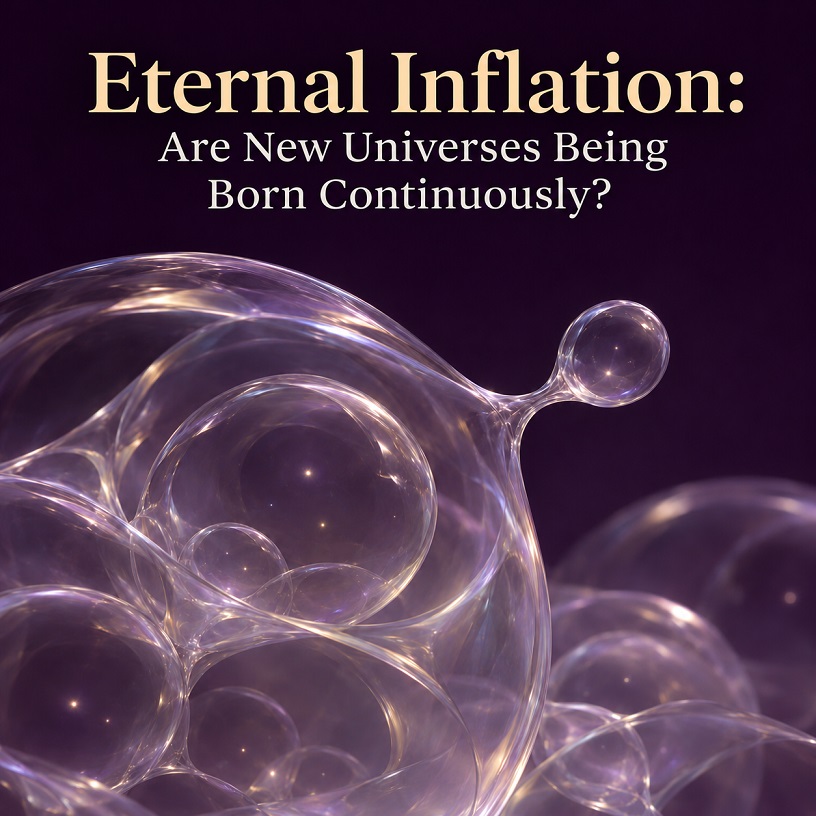
Imagine an ocean in which islands continually appear. Some rise into view, others remain far beyond the horizon, and the water between them expands so rapidly that a traveler from one island could never reach the others. Now replace the ocean with space, the islands with entire universes, and their ceaseless appearance with a process described by one of the boldest ideas in modern cosmology. This is eternal inflation.
The idea emerged from physicists’ attempts to understand the earliest moments of cosmic history. How did the young universe become so uniform across enormous distances? Why is the geometry of space so close to flat? And how did tiny quantum fluctuations become the seeds of galaxies? Inflationary cosmology offers a remarkable answer: at an extremely early stage, space underwent a period of accelerated expansion.
But this idea leads to an even more astonishing question. If inflation ends in some regions while continuing in others, does that mean new cosmic worlds are continually coming into existence? This is where the story of eternal inflation begins-a story in which general relativity, quantum physics, and the limits of observation meet.
Why Cosmologists Introduced Inflation

Let us begin with an ordinary sight: the morning sky. If you measure the temperature of the cosmic microwave background in two opposite directions, you discover that it is almost identical. That seems natural until we consider the distances involved. In the early universe, some regions that we now observe in opposite directions would not have had enough time to exchange light signals in the simplest model without inflation. How, then, did they acquire such similar conditions?
This is the horizon problem. We can compare it to two distant rooms in which thermometers display almost the same temperature, even though the building’s history indicates that there was never an open doorway or shared heating system between them. The similarity demands an explanation.
Another classic question concerns the geometry of space. Observations show that on large scales it is very close to flat. This does not mean the universe is a flat sheet of paper; it means that spatial curvature is small on the scales we can measure. Without a special mechanism, such a condition raises the question of why the early conditions were so precisely arranged.
Inflation offers a common explanation for these difficulties. If a small region underwent exceptionally rapid expansion, it could have stretched to dimensions far larger than today’s observable horizon. A region that was once small enough to attain approximately uniform conditions could become an enormous expanse of space. Similarly, the surface of a large sphere looks almost flat when we examine only a tiny part of it.
The idea of cosmic inflation was developed in the early 1980s. Alan Guth played a central role in its initial formulation, while Andrei Linde, Andreas Albrecht, and Paul Steinhardt contributed to subsequent models. Over time, inflation became an influential research program. It is important, however, to distinguish the explanatory successes of inflationary cosmology from proof of any particular inflationary mechanism. There is no single inflation model that has been conclusively confirmed.
How Space Can Expand So Rapidly

When people hear that the early universe expanded at an extraordinary rate, they often imagine galaxies racing through stationary space like cars on a highway. Inflation describes something different: an increase in spatial distances themselves. It does not involve objects locally breaking the speed-of-light limit.
Imagine raisins in rising bread dough. As the dough expands, the distances between the raisins increase, even though they are not independently moving through it. The analogy has limits, because the universe is not expanding into a preexisting kitchen, but it shows how the medium itself can change the distances between objects.
In many inflationary models, accelerated expansion is associated with the energy of a special field called the inflaton. This field is not an experimentally established particle with measured properties; it is a theoretical ingredient used to describe the mechanism. When its potential energy dominates, space can undergo a period of nearly exponential expansion.
Exponential growth is surprisingly powerful. When a quantity doubles repeatedly, the initial changes appear modest, but the values soon become enormous. Imagine folding a sheet of paper in half, then again and again. Its thickness would increase through successive doublings. Inflation is not literally a folding process, but the mathematical principle of rapidly multiplying a scale helps explain how a microscopic region can expand dramatically.
After the inflationary phase ends in a particular region, the energy that supported expansion must be converted into particles and radiation through processes collectively described as reheating. This leads to the hot state from which the well-studied early evolution of the universe proceeds. The transition matters: in many models, inflation does not replace the hot Big Bang but describes a stage that precedes and prepares the conditions for it.
Quantum Fluctuations: Tiny Random Events with Cosmic Consequences

In everyday life, we are accustomed to thinking of empty space as calm. Quantum physics reveals a more complicated picture. Fields possess quantum fluctuations, and during inflation their effects can be stretched to enormous cosmic scales. Here lies one of the most beautiful connections between microscopic physics and the sky above us.
Imagine a quiet water surface with almost imperceptible ripples. If its image were enlarged billions of times, those tiny irregularities would become prominent shapes. In the inflationary picture, quantum fluctuations are stretched by expansion and can leave traces in the primordial differences in density. Billions of years later, those differences contribute to the formation of galaxies and galaxy clusters.
The cosmic microwave background carries an imprint of such early irregularities. Its temperature fluctuations are extraordinarily small, yet their statistical properties have been measured with impressive precision. Many simple inflationary models predict a spectrum of primordial fluctuations close to what is observed. That is one reason inflation is taken so seriously.
But those same quantum fluctuations also lead toward a more radical idea. In certain models, they influence not only the future structure of galaxies but also the duration of inflation itself. In some regions, the field evolves toward the end of the inflationary phase. In others, quantum variations maintain the conditions for accelerated expansion for longer. From this comes the mechanism known as eternal inflation.
Eternal Inflation: When Expansion Ends Here but Continues Elsewhere
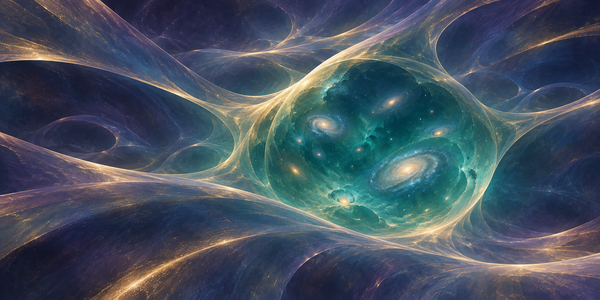
Imagine an enormous garden in which new patches of soil constantly appear. In some places seeds germinate and distinct gardens take shape, while the total area continues growing so rapidly that new patches appear faster than the process finishes everywhere. This picture helps illustrate the basic logic of eternal inflation.
In models of eternal inflation, accelerated expansion ends locally but does not finish simultaneously throughout all of space. While one region enters a phase of hot cosmic evolution, others remain in an inflationary state. If the volume undergoing inflation increases sufficiently rapidly, the process can sustain itself on a global scale.
The word “eternal” has a specific meaning here. It describes a scenario in which inflation continues indefinitely into the future in some regions. It does not establish that the process existed without a beginning in the past. The question of a past boundary to inflationary space is separate and much more difficult.
Different mechanisms have been proposed. In so-called stochastic eternal inflation, random quantum changes in the inflaton field can, in some regions, offset its classical movement toward the end of inflation. In models involving a metastable vacuum state, the local end of inflation can occur through quantum transitions and the formation of bubbles. These pictures are not identical, although popular accounts often represent both using the image of universes coming into existence.
In each scenario, the central idea is that a single cosmic history need not exhaust the entire process. Our observable universe could belong to a region where inflation ended, while other regions beyond its horizon continue to expand at an accelerated rate. This is a mathematical consequence of particular models, not an observed description of all reality.
Bubble Universes and the Question of the Multiverse

The most memorable image of eternal inflation is a sea of bubbles. Within each bubble, inflation has ended and a different local cosmic history has begun. Between the bubbles, inflationary space continues to exist. It is essential to understand that this is a diagram of a theoretical process, not a photograph or proof that the cosmos actually looks this way.
What does “another universe” mean in this context? It does not necessarily mean a completely separate space existing like a planet outside our own. More precisely, it can refer to cosmic regions that are causally isolated or have different developmental histories. In some models, physical conditions and even the effective properties of particles may differ between regions. This depends on the specific theory and does not automatically follow from every version of inflation.
We can use an analogy involving islands separated by an ocean whose distances keep increasing. The inhabitants of one island can observe their own world but cannot reach the others. The difference is that cosmic horizons are not ordinary geographical barriers. They arise from the structure of spacetime and determine which light signals can reach a particular observer.
This raises the intriguing question of whether some bubbles could collide. In certain models, such interactions are allowed and could leave specific traces in the cosmic microwave background. Researchers have searched for these signals, but there is still no generally accepted confirmation of a collision between bubble universes.
Consequently, the multiverse is not an observational fact established in the same way as cosmic expansion or the existence of the microwave background. It is a possible outcome of certain theoretical constructions. Its appeal comes from the way it connects questions about early cosmology, quantum fields, and the nature of physical laws within an extraordinarily broad picture.
How Scientists Test an Idea That Reaches Beyond the Observable Horizon

In science, a beautiful theory must confront measurements. Eternal inflation presents an enormous challenge at precisely this point. If the hypothetical other regions lie beyond our causal horizon, their signals cannot reach us. How, then, can we determine whether they exist?
The first approach is to test the inflationary models from which an eternal regime might arise. The cosmic microwave background provides information about the spectrum of primordial fluctuations, departures from a Gaussian distribution, and other properties. Measurements constrain model parameters and rule out some possibilities. But even a successful inflationary model does not, by itself, prove that inflation was eternal.
The second approach is the search for primordial gravitational waves. Certain inflationary scenarios predict that these could leave a distinctive pattern in the polarization of the microwave background. No such primordial signal has yet been confirmed. However, existing limits on its strength already help physicists assess which classes of inflationary models remain viable.
The third approach involves looking for unusual structures predicted by specific models of bubble interactions. Statistical caution is especially important here. If someone studies a vast map for long enough, they will find circles, spots, and symmetries. To become evidence, such patterns must match a signal calculated in advance and be distinguished from random fluctuations and instrumental effects.
There is also a deeper theoretical difficulty known as the measure problem. If a theory describes an unbounded production of regions, how should we compare the probabilities of different observations? Simple counting can lead to infinities, and different ways of regulating those infinities can yield different results. This is not a minor technicality but a fundamental question about the predictive power of eternal inflation.
We can now see why the scientific debate continues. Some physicists regard eternal inflation as a natural outcome of broad classes of models. Others emphasize that the absence of clear testable predictions and the difficulties involving probabilities limit its status as an established physical theory. This discussion is not a conflict between curiosity and skepticism. It is an effort to determine exactly what the theory explains and how it can be tested.
Was There a Beginning, and Can Time Continue Forever?

Eternal inflation sounds like a story without a beginning or an end. But “continuing forever” does not automatically mean “having always existed.” This distinction is essential. A process can begin at a particular moment and then continue indefinitely into the future. Mathematically, those two properties are independent.
The well-known Borde–Guth–Vilenkin theorem shows that, under certain conditions, spacetimes with positive average expansion along the relevant past-directed trajectories are geodesically incomplete to the past. In ordinary language, this means that such descriptions cannot be extended indefinitely backward along those trajectories within the same classical framework.
The theorem does not prove that the universe emerged from absolute nothingness, nor does it establish a single moment of creation. It identifies limitations affecting a particular class of expanding descriptions. Understanding the earliest boundary requires physics that may involve quantum gravity, a field in which no universally accepted complete theory yet exists.
It is like following a historical route until you reach a place where the map ends. The end of the map is not proof that there is no territory beyond it. But it does not allow us to claim that we know what lies there, either. We need new methods of investigation.
The question of the beginning of time remains one of the deepest in physics. Eternal inflation offers a picture of ongoing production of cosmic regions into the future, but it does not, by itself, definitively resolve what underlies the entirety of spacetime.
Why This Idea Changes the Way We Look at the Cosmos
There is something astonishing about the path that leads us from tiny temperature differences in ancient light to the question of whether countless cosmic regions exist. We begin with measurements so precise that they capture variations of a few parts per million. We continue with equations describing the expansion of space. And finally, we reach an idea that challenges the assumption that the observable universe is the whole cosmic story.
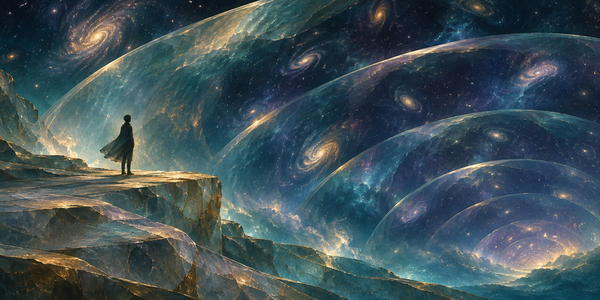
Eternal inflation encourages us to distinguish three different concepts. The first is the observable universe-the region from which light has had the opportunity to reach us. The second is the entirety of space, which could be vastly larger than that region. The third is the theoretical possibility of regions with separate inflationary histories. These ideas are often blended together in popular accounts, but they do not mean the same thing.
Imagine someone standing on a shore who can see only a small portion of the ocean up to the horizon. They know the horizon is not a wall, but they cannot describe every place beyond it based solely on the view before them. Cosmology faces a similar challenge. Our observations are extraordinarily rich, but they are not unlimited.
That is precisely what makes eternal inflation so interesting. It is not merely a fantasy about other worlds. It emerges from specific mathematical models developed to explain the physics of the early universe. At the same time, its boldest implications remain unconfirmed. Science benefits when we preserve both truths: the power of theoretical imagination and the necessity of observational testing.
If convincing evidence connected to such a process is ever discovered, our understanding of cosmic history will expand dramatically. If future observations strongly constrain models of eternal inflation, that too will represent progress. In either case, we will learn more about the origins of structure, the nature of quantum fields, and the early evolution of spacetime.
When we look at the night sky, we see only a small part of what cosmology investigates. Behind the stars and galaxies lies a history of expansion, cooling, and gravitational evolution. Beyond the limits of observation, theory raises questions to which we are still seeking answers. Eternal inflation is one of the boldest attempts to understand how vast that history could be-and how much remains to be discovered.
Author: Vasil Stoyanov