
Every morning, a person awakens in a world of objects, faces, spaces, and events. At night, that same person can experience another world, composed of dreams, while in deep sleep both worlds disappear from immediate experience. Despite these radical changes, the individual recognizes themselves as the same person. What unites such different forms of existence? Is consciousness exhausted by the contents that appear within it, or is its nature deeper than everything perceived?
The Mandukya Upanishad makes these questions the foundation of a comprehensive philosophical inquiry. In just twelve verses, it examines waking, dreaming, deep sleep, and Turiya-the fourth, which cannot be reduced to any of the familiar states. Through the sacred sound Om, the text connects the analysis of human experience with the teaching of Atman and Brahman, arriving at one of the most fundamental ideas of nondual philosophy: the true nature of the Self is not separate from absolute reality.
The Twelve Verses That Transform Our Understanding of Consciousness
The Mandukya Upanishad belongs to the body of Upanishads associated with the Atharvaveda. It is among the shortest principal Upanishads, yet its significance extends far beyond its length. Unlike texts constructed around extensive dialogues, mythological narratives, and ritual instructions, the Mandukya develops its teaching through an exceptionally concentrated sequence of philosophical propositions.
The first verse presents Om as the designation of everything that exists-the past, present, future, and that which transcends the three dimensions of time. The second formulates the great statement ayam atma brahma-this Atman is Brahman. It belongs to the four celebrated mahavakyas, or great sayings, that the Vedantic tradition derives from the principal Upanishads.
Atman denotes the deepest nature of the Self, while Brahman denotes absolute reality, which is not limited by individual forms of existence. Their identity does not mean that the individual personality, with its desires, memories, and beliefs, possesses unlimited power. It points toward the foundation of subjectivity itself, beyond the particular characteristics through which people define themselves.
The second verse also introduces the four aspects of Atman, called padas. The word means a foot, part, or quarter, but this does not imply a physical division of consciousness. The following four verses examine the three ordinary states and their characteristics. The seventh is devoted to Turiya. The final five verses reveal the correspondences between these aspects and Om.
The distinctive place of the Mandukya in Indian philosophy also arises from the fact that it begins with experience accessible to everyone. Waking, dreaming, and dreamless sleep require no prior knowledge of metaphysics. They are natural changes in the way experience unfolds. The Upanishad uses them as the starting point for investigating what lies beyond the changing contents of the mind.
Waking-Vaishvanara and the World of External Forms
The first aspect of Atman is Vaishvanara, associated with the waking state, called jagrat. The third verse describes it as outwardly cognitive, possessing seven limbs and nineteen mouths, and enjoying the gross objects of experience.
Waking is the state in which the senses provide information about the environment, the mind organizes perceptions, and the individual acts through the body. Space possesses stability, events follow a particular sequence, and actions produce consequences. Social identity, professional relationships, and practical life develop within this world.
The nineteen mouths represent the channels through which experience takes place. In classical Vedantic interpretation, these are the five cognitive faculties, the five faculties of action, the five vital functions, and the four aspects of the internal instrument of cognition. The latter comprise the mind, intellect, sense of individual ego, and memory or mental content.
The five vital functions, known as pranas, are designated as prana, apana, samana, udana, and vyana. They describe different directions of vital activity in Indian philosophical anthropology. The cognitive faculties enable perception, the faculties of action allow interaction with the world, and the internal instrument connects incoming information with intentions and previous experience.
The seven limbs extend the description from the individual to the cosmic dimension of Vaishvanara. Vedantic commentaries associate this image with the cosmic person: heaven as the head, the sun as the eye, air as the breath, space as the middle of the body, the waters as the bladder, the earth as the feet, and fire as the mouth. Human existence is examined in its inseparable relationship with the entire manifested world.
This perspective calls into question the customary identification of the Self with physical form. The body is perceived, thoughts are noticed, emotions are experienced, and the conception of personality changes. All belong to the field of experience. The Mandukya directs attention toward the distinction between what appears as an object of knowledge and the very foundation of knowing.
Waking has indispensable practical significance, but it does not exhaust human experience. When sleep arrives, the familiar external foundations of identity cease to organize experience in the same manner. Another world appears in their place.
Dreaming-Taijasa and the World Created by the Mind

The second aspect is Taijasa, associated with dreaming, or svapna. The fourth verse describes it as inwardly cognitive, possessing the same seven limbs and nineteen mouths, but experiencing subtle rather than gross objects. The name Taijasa is associated with light and radiance, pointing toward the inward manifestation of dreams.
In dreams, people see images, hear voices, and experience joy, fear, and wonder. They can find themselves in places they have never visited, converse with people who have long been absent from their lives, or experience events impossible in the waking state. Nevertheless, while a dream continues, its world is often accepted as real.
Taijasa reveals the mind’s capacity to organize an entire field of experience without depending on the immediate perception of corresponding external objects. Memories, impressions, and psychological tendencies assume the forms of images, spaces, and events. The dreamer does not merely observe pictures but occupies a place within them, constructing a temporary identity inside the dream.
The philosophical significance of dreaming becomes especially clear upon awakening. The world that appeared convincing only a moment earlier loses its independent standing. The danger a person faced no longer requires escape. The objects they possessed cannot be found in their room. The experience was real as an experience, but its objects did not possess the status the dreamer attributed to them.
This distinction is central to Advaita Vedanta. The immediate persuasiveness of a phenomenon is insufficient to establish its absolute reality. Dreaming demonstrates how the knowing subject and the objects of knowledge can appear together within a single field of experience without their boundaries being ultimate.
Waking and dreaming are not practically equivalent. The waking world possesses shared stability, regularities, and consequences that are not preserved in the same manner in individual dreams. Their comparison serves a deeper philosophical question: is the stability of a particular world sufficient to make it an independent and absolute reality?
Within a dream, a person can recognize that they are dreaming without the dream immediately ending. Lucid dreaming provides an especially clear example of a change in one’s relationship to experience. The content remains present, but its status is understood differently. The Mandukya does not offer a method for inducing lucid dreams; its interest lies in the nature of knowledge across all states.
Deep Sleep-Prajna and Unmanifest Unity

The third aspect is Prajna, associated with deep sleep, called sushupti. The fifth verse defines this state as one in which the sleeper desires no object of desire and sees no dreams. Prajna is described in terms of unity, undifferentiated cognition, bliss, and as the gateway to the other states.
In waking, experience is organized around numerous external objects. In dreaming, multiplicity unfolds within the inner world. In deep sleep, this differentiation is not manifest. The customary distinction between an observing individual and observed objects, between personal desires and opportunities for their fulfillment, does not take shape.
Upon awakening, people often describe their sleep as peaceful and acknowledge that they knew nothing about what occurred during it. Vedantic philosophy identifies an important problem in this combination of tranquility and ignorance. The absence of differentiated cognitive content is not equivalent to liberation from ignorance concerning the nature of the Self.
Deep sleep temporarily interrupts the manifestation of desires, anxieties, and personal conflicts. It does not, however, eliminate their underlying causes. Upon awakening, people recognize their attachments, fears, and conceptions of themselves once again. Individuality has not been definitively transcended but remains in an unmanifest form.
This explains why Prajna is associated with the causal dimension of existence. In later Vedantic systematization, the gross body corresponds to physical manifestation, the subtle body encompasses psychological and vital functions, and the causal body denotes the unmanifest foundation of individual experience. These concepts describe different levels of manifestation rather than three spatially separate bodies.
The sixth verse expands the significance of Prajna by describing it as the lord of all, omniscient, the inner controller, and the source from which beings arise and into which they dissolve. Here the analysis moves from individual deep sleep to the cosmic causal foundation of the manifested world. In the commentarial tradition, this dimension is associated with Ishvara-Brahman considered in relation to causality and cosmic order.
The bliss of deep sleep differs from pleasure produced by a particular object. It is associated with the absence of manifest tension between desires and their objects. Yet this tranquility is not equivalent to clear self-knowledge. The distinction between unmanifest multiplicity and knowledge of nondual reality prepares the way for understanding Turiya.
Turiya-The Fourth That Is Not Another State

The seventh verse of the Mandukya Upanishad is the heart of its teaching. Turiya means the fourth, but it does not designate merely the next experience after waking, dreaming, and deep sleep. If it were a temporary state arising under particular conditions and subsequently disappearing, it would also belong to the domain of changing experience.
The text reveals Turiya through the successive removal of definitions. It is neither outwardly directed cognition nor inwardly directed cognition, nor a combination of the two. It is not the undifferentiated cognition of deep sleep, but neither is it unconsciousness. It cannot be grasped by the senses, made an object of ordinary interaction, or exhausted through conceptual definition.
This negative form of exposition has a precise philosophical purpose. Every positive description of an object distinguishes it from other objects. If Turiya were defined as an image, sensation, thought, or particular energy, it would already be something perceived and distinguished from the perceiver. The Upanishad points toward a reality that cannot be placed on either side of such a division.
Following these negative descriptions, the seventh verse employs the terms prapanchopashama, shanta, shiva, and advaita-the cessation of phenomenal multiplicity, peace, auspiciousness, and nonduality. It concludes by affirming that this is Atman and that it is to be known.
Nonduality does not simply mean gathering all separate things into one enormous whole. Such a whole would still consist of parts and could be regarded as an object. Advaita denies the ultimate independence of the distinction between the knower and the known. In this philosophy, Turiya is the foundation through which the three states can manifest as experience at all.
The concept of the witness, or sakshin, developed in Vedanta, helps clarify this idea. Thoughts, perceptions, and feelings change, but each is revealed in awareness. The witness is not a small observer hidden somewhere inside the human head. It denotes the very nature of awareness considered independently of its particular contents. In the ultimate nondual understanding, even the distinction between witness and witnessed is not absolute.
Turiya also differs from temporary states of meditative absorption. Deep concentration can interrupt the ordinary flow of thought and alter the perception of the body, time, and space. But every experience with a beginning and an end remains subject to change. The knowledge toward which the Mandukya points is not measured by the duration of an extraordinary experience.
The fourth is therefore a distinctive designation. It is introduced after the three states to distinguish it from them, but it does not stand outside them as a separate domain that must be reached through movement. In the nondual interpretation, Turiya is the nature of Atman, which does not change as waking gives way to sleep and sleep gives way to waking.
Om-The Sound Symbol of the Whole of Reality

The final five verses of the Mandukya Upanishad connect the four aspects of Atman with the sacred syllable Om, also known as pranava. Its three phonetic elements-A, U, and M-correspond to waking, dreaming, and deep sleep. The fourth is designated as amatra, that which has no phonetic measure.
The first sound, A, is associated with Vaishvanara. The ninth verse establishes this correspondence through primacy and pervasiveness. A occupies the initial place in the sequence of sounds and designates the first aspect of the experience under examination. Waking provides the immediate starting point from which the philosophical inquiry begins.
The second sound, U, corresponds to Taijasa. The tenth verse associates this element with elevation and an intermediate position. Just as U stands between A and M, dreaming occupies an intermediate position between the differentiated outward cognition of waking and the unmanifest unity of deep sleep.
The third sound, M, corresponds to Prajna. The eleventh verse establishes the connection through measurement and absorption. As the syllable concludes, the movement of sound reaches its end. Similarly, in deep sleep, differentiated forms of experience withdraw into their causal foundation.
The twelfth verse presents amatra through descriptions that repeat the fundamental characteristics of Turiya: beyond ordinary interaction, the cessation of multiplicity, auspiciousness, and nonduality. The silence accompanying the completion of Om serves as an accessible symbol of that which is not limited by individual phonetic elements. The fourth itself, however, cannot be reduced to the acoustic absence of sound.
This distinction is essential. Sound arises and disappears, while physical silence can also be interrupted. Turiya is not simply the interval between two utterances of Om. The symbol points toward the indivisible foundation of the manifestation and withdrawal of experience, regardless of whether sound, thought, or sensory perception is present at a particular moment.
In practice, contemplation of Om combines concentration on sound with philosophical understanding. Attention follows the arising, development, and completion of the syllable, while the meaning of its elements directs attention toward the three states. The purpose of this contemplation is not merely to produce a pleasant vibration but to investigate the relationship between changing manifestations and their unchanging foundation.
Gaudapada, Shankara, and the Philosophy of Nonduality
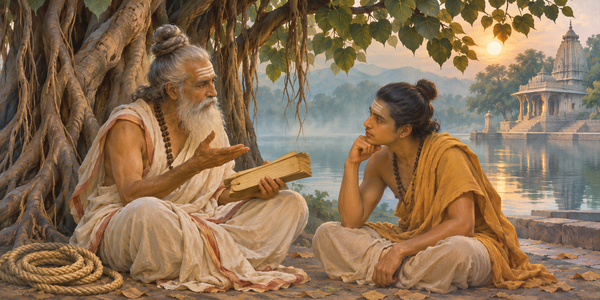
The historical influence of the Mandukya Upanishad is inseparably connected with Gaudapada’s Mandukya Karika, a philosophical work of approximately 215 verses divided into four chapters. It develops the concise propositions of the Upanishad into a systematic investigation of consciousness, appearance, nonduality, and the nature of origination.
The first chapter, Agama Prakarana, elucidates the teaching concerning the four aspects of Atman and Om. The second, Vaitathya Prakarana, investigates the status of phenomena by comparing waking experience and dreams. The third, Advaita Prakarana, develops the nondual argument. The fourth, Alatashanti Prakarana, examines the cessation of apparent movement and the teaching of non-origination.
One of Gaudapada’s most radical ideas is ajativada, the doctrine of non-origination. If absolute reality is nondual and unchanging, it cannot genuinely become something other than itself. The emergence of separate entities possessing independent natures would imply a transformation of the absolute itself. Gaudapada assigns origination and disappearance to the level of appearances rather than to the ultimate nature of reality.
Among the images through which he clarifies this teaching is the space within a clay pot. The walls of the pot create an apparent distinction between internal and external space. When the pot breaks, its space does not undergo a genuine merging with another space. Only the form through which it was perceived as limited disappears. The analogy reveals how individuality can be understood as a conditioned manifestation without Atman being divided into independent parts.
Another characteristic image is the movement of a burning firebrand. When moved rapidly, it produces apparent lines and figures that do not exist as separate objects apart from the movement itself. When the movement stops, the figures disappear. Gaudapada uses this image to investigate the relationship between manifested multiplicity and its foundation.
In the later development of Advaita Vedanta, Shankara systematizes the distinction between the empirical and absolute levels of reality. His commentarial tradition on the Mandukya and the Karika emphasizes the role of ignorance, through which people attribute the characteristics of the body, mind, and individual personality to Atman.
This process is designated by the concept of adhyasa-superimposition or mistaken attribution. The classical example is a rope perceived as a snake in insufficient light. The fear is genuinely experienced, but it arises from misidentification of the object. Knowledge neither creates the rope nor destroys an actual snake. It removes the misconception concerning what is already present.
The same logic determines the understanding of liberation, or moksha. Atman does not become Brahman as a result of spiritual effort. Knowledge reveals their identity, formulated in the second verse of the Upanishad. Practices, discipline, and philosophical inquiry prepare the mind for this recognition, but they do not produce absolute reality as a new result.
Gaudapada employs arguments and terminology that have parallels in Buddhist philosophy, particularly in the analysis of non-origination and appearance. His system, however, retains the central Vedantic proposition concerning Atman. This characteristic is important for distinguishing nondual Vedanta from Buddhist teachings concerning the absence of a permanent, independent self.
Self-Knowledge Beyond Waking, Sleep, and Thought
The Mandukya Upanishad offers a way of investigating identity that begins with immediate experience. People ordinarily define themselves through their biographies, bodies, characteristic thoughts, relationships, and intentions. These characteristics have genuine significance in practical life, but none remains unchanged throughout all states of experience.
In waking, attention can be directed toward the distinction between perception and its content. A sound appears and disappears. A bodily sensation changes in intensity. A thought arises, develops, and gives way to another. Self-inquiry does not require these phenomena to be forcibly stopped. It examines the grounds on which a person accepts any of them as their ultimate identity.
In classical Advaita, this approach is developed through shravana, manana, and nididhyasana-listening to and studying the teaching, reflecting deeply upon its meaning, and sustained contemplation of what has been understood. Study provides the philosophical framework, reflection removes contradictions and doubts, and contemplation addresses persistent habits of mistaken identification.
Meditation on Om has a place in this process because it connects attention with the entire structure of the teaching. It does not require the pursuit of visions, extraordinary sensations, or states completely devoid of thought. Every such phenomenon remains a content of experience and is subject to the same inquiry as ordinary perceptions.
Contemporary sleep research distinguishes several physiological stages, including REM sleep and multiple stages of NREM sleep. Dreams occur during both REM and NREM sleep. Consequently, the philosophical categories of jagrat, svapna, and sushupti do not correspond one-to-one with neurophysiological classifications. The former describe the structure of experience, while the latter investigate measurable processes within the organism.
Neuroscience investigates the mechanisms of perception, memory, dreaming, and changes in conscious access. The Mandukya poses a different question: what is the ultimate status of the knowing subject and its relationship to reality? Distinguishing these levels of inquiry allows the ancient text to be understood in its philosophical depth without confusing its concepts with contemporary measurements of brain activity.
The practical significance of the teaching also emerges in one’s relationship to personal experiences. Fear, success, loss, and joy can occupy a central place at a particular moment without completely defining the nature of the experiencer. Recognizing their transience creates room for a freer relationship with them. It does not eliminate the necessity of action, responsibility, and care for others.
The twelve verses of the Mandukya Upanishad form a complete philosophical path: from the multiplicity of the external world, through the inward manifestation of dreams and the unmanifest unity of deep sleep, to the nondual nature of Atman. Om unites this path in a single symbol, while Turiya reveals its ultimate goal-the knowledge of that which neither arises nor disappears alongside the individual states.
The great statement ayam atma brahma acquires its full meaning here. The absolute is not a distant object that the individual ego must acquire. The entire inquiry is directed toward overcoming a mistaken understanding of the knower itself. The mystery of Turiya lies in the fact that the search for the true nature of consciousness concludes not with the discovery of another object, but with knowledge of the very foundation of every search.
Primary texts: Mandukya Upanishad, verses 1–12; Gaudapada, Mandukya Karika, Chapters I–IV; the commentary on the Mandukya Upanishad and the Karika attributed to Adi Shankara.
Author: Vasil Stoyanov