Linji Yixuan did not leave behind a neatly constructed philosophy, arranged like a garden of stones. He left a crack. A rupture. A break in thought through which something deeper than any word rushes in. In his presence, questions do not find answers – they dissolve.
Born in ninth-century China, during an age when spiritual teachings intertwined with poetry and politics, Linji entered monastic life not as a student seeking knowledge, but as someone who sensed that there was something fundamentally flawed in the very act of seeking itself. He stepped into the monastery carrying a question that could not be articulated and a hunger that no words could satisfy.
His teacher, Huangbo Xiyun, did not comfort him. He did not guide him. He did not explain. When Linji asked about the essence of Buddhism, he received a blow instead of an answer. Not once. Again and again. The blow was not a punishment, but a refusal – a refusal to engage in the mind’s game of wanting to understand, define, and possess.
For a long time, Linji did not understand. Or rather, he understood in the old way – the way that leads nowhere.
He left Huangbo Xiyun’s monastery confused and discouraged. He was neither angry nor enlightened; he simply felt empty in a heavy, burdensome way. He had asked sincerely and received nothing but blows.
Three times.
No explanation.
No guidance.
And the more he thought about it, the less sense it seemed to make.
He left with the feeling that perhaps he simply was not suited for this path.
Along the way, he arrived at the place of the Zen master Dayu. There was none of the excitement one might expect from a meeting between a searching monk and a renowned Zen master. He did not feel that anything momentous was about to happen.
If anything, the meeting felt like a final attempt – or perhaps not even an attempt, but merely a conversation, because he no longer knew what else to do.
Dayu looked at him and asked where he had come from.
– “From Huangbo,” Linji replied.
-“And what did you learn there?” Dayu asked.
Linji did not pretend to understand. Instead, he honestly recounted what had happened at Huangbo’s monastery: he had asked about the essence of Buddhism, and his teacher had struck him. Again and again. And he had understood nothing.
After listening quietly, Dayu said:
– “Huangbo has done everything for you, and yet you are still searching for something?”
At that moment, Linji awakened.
He began to laugh – not out of disappointment, but out of liberation.
Everything he had been holding onto as a question, as tension, as the feeling that he needed to understand, suddenly fell away. For the first time, he saw the situation clearly, without thinking about it. He saw that the moment he had asked the question, he had already separated himself from Zen – placing himself here and the answer somewhere else. He saw that he had been waiting for something more from the blows, some hidden meaning concealed behind them. And he saw that this waiting itself had been the obstacle.
Laughing, Linji replied:
-“Ah! So there is nothing special in Huangbo’s teaching after all!”
But this “nothing” was not disappointment.
It was the exact opposite. It was freedom from the need for there to be something.
Dayu did not congratulate him. In fact, he challenged him:
– “Just a moment ago you said you understood nothing, and now you speak like this?”
Linji answered calmly, without effort:
-“Now I understand.”
From that moment on, Linji no longer taught – he shook people awake.
When a student asked, “What is truth?” he did not begin explaining.
He shouted.
Suddenly. Powerfully. Like thunder breaking across a clear sky.
The shout carries no meaning, yet it carries presence. It cuts through thought the way a blade cuts through a knot. And if the student is ready – even for a single moment – he will see.
Linji did not believe in gradual progress. He did not believe in accumulating wisdom. To him, every idea of a path was already a deviation.
Truth is not a destination waiting somewhere in the future. It is what remains when striving comes to an end. That is why his words often sound like blows:
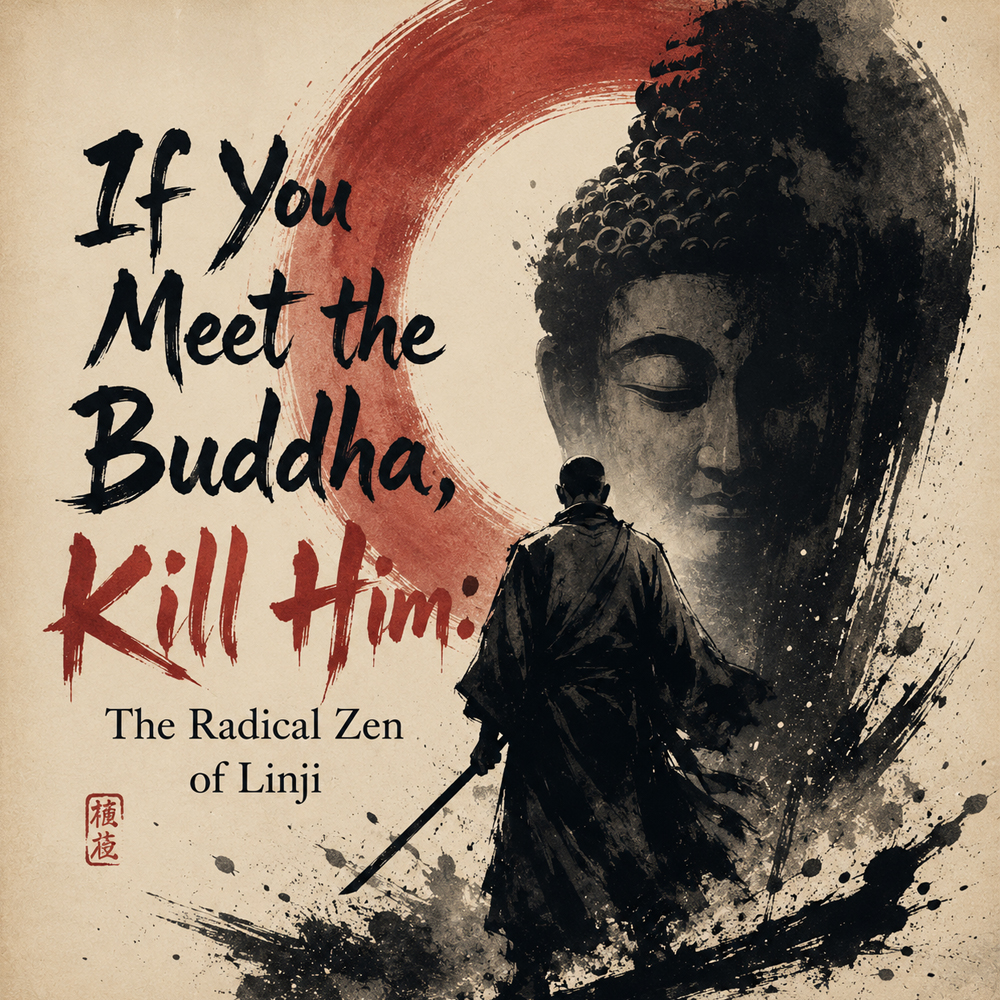
– “If you meet the Buddha, kill him.”
This statement does not destroy – it liberates. It removes the mind’s final support: the belief that somewhere outside ourselves there exists something higher, purer, or more real.
For Linji, even the Buddha can become an obstacle if he is turned into an image, a concept, or an idol. He spoke of the “True Person of No Rank” – a being who carries no titles, seeks no recognition, and is not defined by social roles. A person who simply is. A person who does not try to become anything more than what they already are.
In one story, a monk asks how to follow the Way.
Linji does not answer.
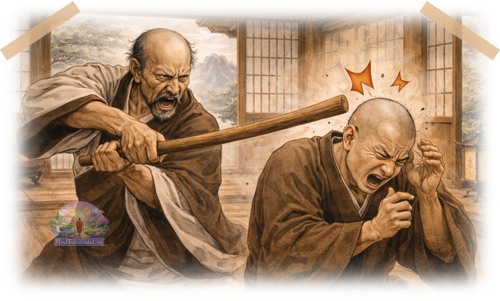
He strikes him.
There is no cruelty in the gesture. Only impatience toward illusion. Toward the belief that there is a path that can be traveled like a distance.
For how can one travel toward something that has never been far away?
Linji’s teachings would later evolve into the school known as Rinzai Zen. Yet Linji himself would likely have rejected the word school. Every system carries a risk. Every form can become a new cage. And yet his influence spread far beyond China – to Japan, to the arts, to the way a sword is held, and to the way tea is poured.
Wherever action must be pure, free of hesitation and untouched by thought, the spirit of Linji is alive.
But perhaps the most important thing about him is not what he created.
It is what he destroyed.
He stripped the mind of its favorite refuge – the belief that meaning is something that must be explained. He leaves us in a world that cannot be captured by words, yet can be fully lived.
“When hungry, eat. When tired, sleep.”
A simplicity that is not shallow, but as deep as bottomless water. There is no attempt to escape life. No effort to improve reality. Only complete presence within it.
Today, in a world where everything is analyzed, categorized, and explained, Linji’s voice sounds almost unsettling. He offers no method to optimize. No technique to master. No promised result. Only an interruption. А shout.
And if, for a brief moment, something within us falls silent, perhaps we will hear what has always been here.
Stories from Linji’s life
There was once a monk who came to Linji with deep respect and equally deep confusion. He bowed and asked:
-“What is the true essence of Buddhism?”
Linji said nothing. Instead, he let out a powerful shout – so sudden that the monk flinched.
Then Linji looked at him calmly and said:
– “That was it.”
There was no explanation. No second chance. If the monk saw it, good. If not, words would not help.
On another occasion, a student insisted:
– “Master, please give me guidance. How should I walk the Way?”
Linji struck him.
Startled, the student asked:
– “Why did you hit me?”
Linji replied:
– “The moment someone asks about the Way, he has already lost it.”
There was also a monk who pursued enlightenment with great determination. He studied, meditated, and deprived himself of comfort. Eventually, he came to Linji and said:
– “I am searching for the Buddha. Where can I find him?”
Linji fixed him with a sharp gaze and asked:
-“Who is the one who is searching?”
The monk fell silent.
In another story, a student complained:
-“My mind is restless. Please calm it.”
Linji said:
– “Bring me this mind, and I will calm it for you.”
The student reflected, searched, and searched again – but could find nothing he could actually bring.
After some time, he said:
– “I cannot find it.”
Linji replied:
– “Then it is already at peace.”
Read More:
- Zen: The Path Beyond Words – History, Development, and the Living Presence of Awakening
- Hakuin Ekaku – The Great Master Who Revived Zen in Japan
- Buddha – The Story of Siddhartha Gautama and His Enlightenment
- Huineng – The Extraordinary Story of the Sixth Zen Patriarch
- Bassui Tokushō – From Demon Child to Great Zen Master
- Bodhidharma – The Fierce Zen Master Who Brought Buddhism to China
- Bankei Yōtaku and the Unborn Mind: Suffering and Truth in Zen
Author: Vasil Stoyanov