Early Life
Bassui Tokushō was born in Nakamura, a district in Sagami Province, in present-day Kanagawa Prefecture, in 1327. His mother dreamed that she would give birth to a demon child. Unable to shake off her fear of this omen, she abandoned the newborn Bassui in a nearby field. Servants of the family found the child there, took him in, and raised him. When Bassui was four years old, his father died.
Three years later, during a memorial service for him, Bassui asked the attending priest how his father would eat the offerings placed on the altar. When he was told that his father’s soul would eat them, he asked:
– “What is this thing called a soul?”
This was the beginning of an inquiry that would haunt him for most of his life.
When he was about nine years old, he became terrified by teachings about the agony of the three evil paths in Buddhism, which led him to delve even more deeply into the meaning of “soul.”
After several years, his search led him to another question:
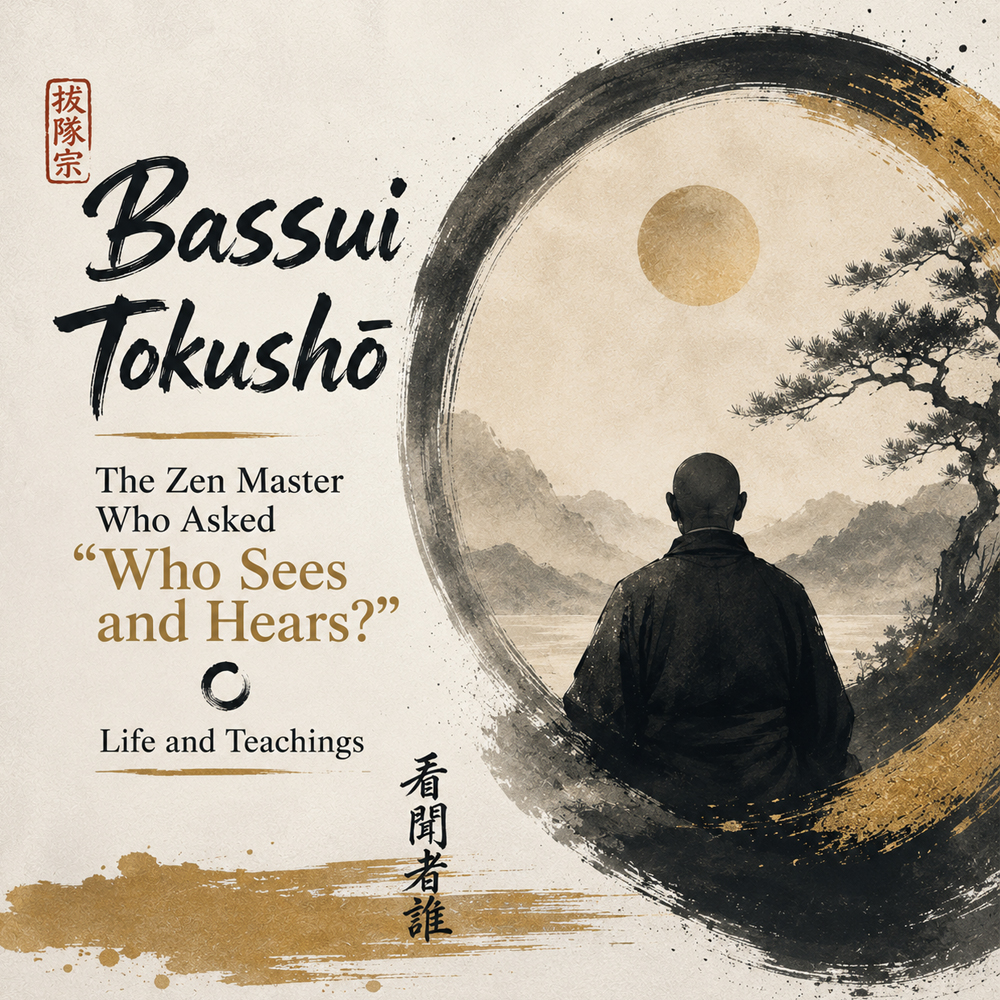
– “Who is the one who sees, hears, and understands?”
For long periods, he sat in meditation, forgetting his own body, until one day he realized that there was nothing anyone could understand about any soul. With this new perspective on the emptiness of all things, Bassui no longer felt the burden of body and mind, and his doubts about the Buddha Dharma – the truth, the teaching of the Buddha – temporarily dissolved.
Bassui’s Monastic Life
This period of peace lasted until one day he read in a famous book:
– “The mind is the host; the body is the guest.”
His doubts began to rise again. If the mind is the host, he thought, then it is impossible for everything to be empty. The host must be the master who sees, hears, and understands that all things are empty. But who, then, is this master?
Bassui could not free himself from this new doubt.
At around the age of twenty, he went to study under the Zen master Ōkō. However, he did not shave his head or become a monk until he was twenty-nine. When he finally formally became a monk, he had little attraction to the rituals and superstitions that often surrounded religion in his time.
He neither wore his robes nor recited the sutras like the other monks. Instead, he practiced meditation uncompromisingly, completely forgetting wind, rain, and cold.
This was Bassui’s path throughout his entire life as a Zen practitioner.
Spiritual Awakening
At around the age of thirty, Bassui experienced satori, which was confirmed by Kōzan Mongō. Around this time, he finally began wearing Buddhist robes.
After spending a year with Tokukei, practicing intensive zazen, Bassui went to Kōhō Kakumyō, a famous and respected teacher. Studying under him, he experienced another profound awakening at the age of thirty-two, which Kōhō confirmed.
Afterward, Bassui once again began wandering and built a hermitage in Nanasawa. For many years he lived in such hermitages throughout Japan, while his reputation as a clear and direct teacher spread by word of mouth.
Over time, it became impossible for him to continue living in hermitages because of the enormous number of people coming from all over Japan to see him. He eventually moved to Enzan, where he built a temple and gathered many students.
Final Words and Writings
In 1387, at the age of sixty-one, while sitting in Zen meditation among his followers, Bassui turned to them and said twice:
– “Look straight ahead. What is this? Look in this way, and you will not be deceived.”
Then he died.
A year before his death, one of his students compiled a collection of stories, Bassui’s words to his students, and their questions. This collection became the book known as Mud and Water. Here are several excerpts from it.
– “Even someone who has committed the most terrible crimes is a Buddha if he changes instantly and becomes enlightened. But this does not mean that you should commit evil under the pretext that you will become enlightened. When you deceive yourself and fall into evil paths, even the Buddhas and patriarchs cannot help you.
It is like a child sleeping beside his father and dreaming a nightmare in which he is beaten or becomes ill. Although he cries out for his parents to help him in his suffering, since they cannot enter his dream, even his mother and father cannot help him. Even if they have medicine, they must first wake him up.
If a person can awaken through his own power, he can avoid the suffering in dreams without the help of others. In the same way, if you realize that your own mind is Buddha, you can suddenly avoid being constantly drawn into the cycle of life and death.
If the Buddhas could help us, how could anyone go to hell?
You must realize this truth for yourself.”
– “It is said that there have been Buddhas and patriarchs who based their teaching on existence – this is completely wrong. What other kinds of living Buddhas and patriarchs do you believe in?
If you believe in painted and sculpted images of the ancient Buddhas and bodhisattvas, then you should not say that you believe in living Buddhas, but rather that you believe in gold, silver, copper, iron, wood, stone, paper, clay, and so on.
These images and sculptures of the Buddhas are products of human minds. Wooden Buddhas never created human beings.
What you must realize is that the mind is the mother and father of all Buddhas, the master of all things.”
– “If you wish to harmonize with the path of no-mind while still harboring attachment to forms, it is like trying to strike fire from a stone at the bottom of the ocean.
Although it is a stone at the bottom of the ocean, if you take it and place it on dry land, and then strike it, you will immediately create fire.
Although every stone possesses the nature of fire within itself, while it is submerged in water, it cannot produce a spark.
All people are endowed with a spiritual inclination toward awakening, but without removing feelings of attachment to all forms, they cannot give rise to that awakening.”
Read More:
- If You Meet the Buddha, Kill Him: The Radical Zen of Linji
- Hakuin Ekaku – The Great Master Who Revived Zen in Japan
- Buddha – The Story of Siddhartha Gautama and His Enlightenment
- Huineng – The Extraordinary Story of the Sixth Zen Patriarch
- Zen: The Path Beyond Words – History, Development, and the Living Presence of Awakening
- Bodhidharma – The Fierce Zen Master Who Brought Buddhism to China
- Bankei Yōtaku and the Unborn Mind: Suffering and Truth in Zen
Author: Vasil Stoyanov