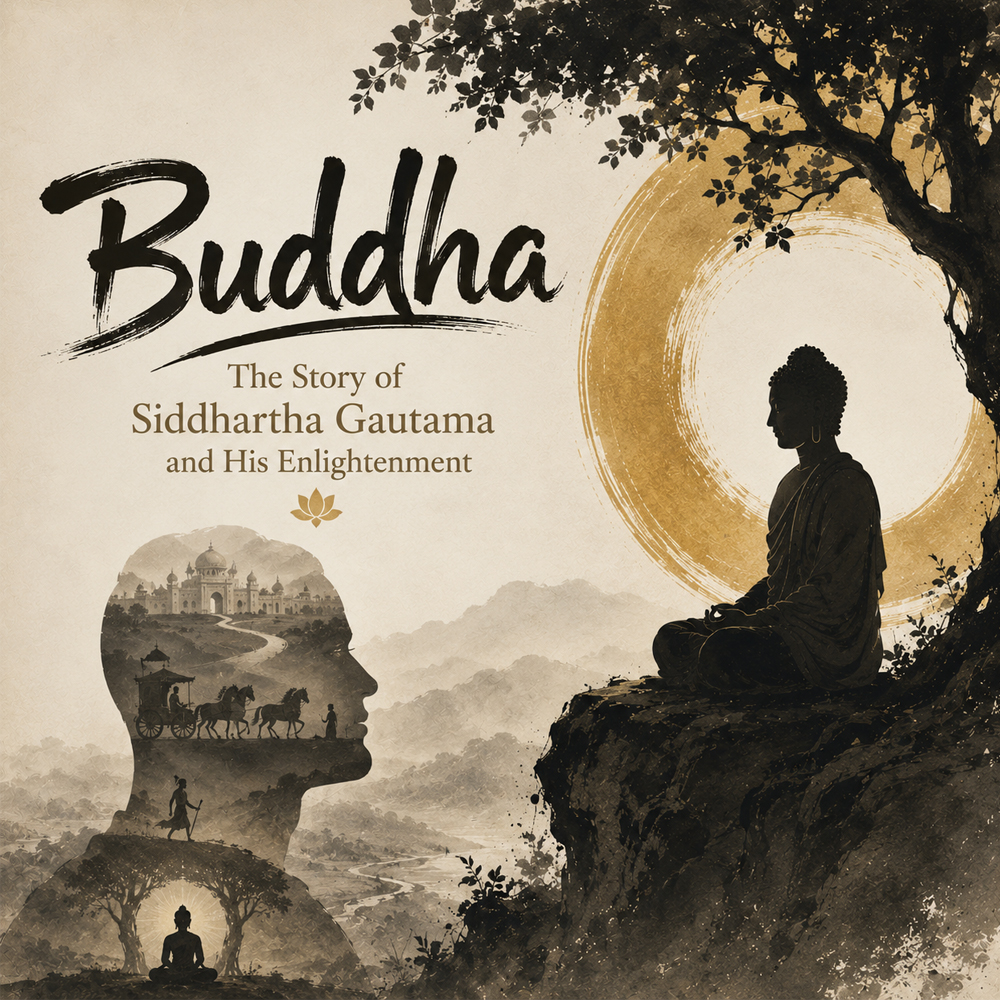
The name of the man known as “Buddha” is Gautama Siddhartha. The term “Buddha” comes from Sanskrit and is composed of two separate words: buddhi and dada. Buddhi means intellect, while dada means “above” or “beyond.” The word “Buddha” is used for anyone who has transcended their intellect.
For this reason, both in the past and in the present, there have been many “Buddhas.” Gautama Siddhartha is one of the people who reached the state of “Bu-ddha.” Followers of Buddhism often use different expressions when referring to him, such as “World-Honored One” or “Tathagata.”
The word “Tathagata” comes from tathata, which refers to reality beyond conceptual definition. It is usually translated as “suchness,” in the sense that the world is neither this nor that – it is simply as it is. “Tathagata” means “the one who is such.”
After Gautama Siddhartha attained enlightenment, it took him a long time to systematize his realization into a teaching, which later became the religious and philosophical system known as Buddhism.
The Beginning
About 2,500 years ago, when Gautama’s mother was pregnant with him, she met a yogi and prophet who foretold that she would have a son who would become either a great emperor or a great sage.
Gautama’s father was the king of a small state. When he heard this prophecy, he arranged everything so that his son would never encounter the pain and suffering of the world, because those things could become the trigger that would turn him into a great sage. His father wanted his son to inherit the kingdom, not to follow a spiritual path.
For this reason, from the moment Gautama was born, everything around him was perfect. Everything was done for him so that he would have no worries. His father did everything possible to make his surroundings beautiful, so that he would never need to leave the palace.
When he was nineteen, his father married him to a beautiful young woman, who bore him a son.
One day, Gautama was left alone and asked his servant to take him around the city in a carriage. This was the first time he had left the palace.
During the ride, he noticed an old man using a stick to walk. Gautama was puzzled and asked:
– “Why does this man look like that and walk like that? What is wrong with him?”
His servant answered:
– “This man is simply old, and his body is weakening.”
Gautama asked:
– “Old? Will I become like that too?”
The servant replied:
– “Yes. Everyone grows old, and the body loses its vitality.”
This realization shook him deeply, because until that moment he had always been young, strong, and full of life.
After some time, he saw a seriously ill man lying on the ground and asked:
– “What is wrong with this man?”
The servant answered:
– “He is sick. And this can happen to anyone.”
Gautama asked again:
– “Can this happen to me too?”
The answer was:
– “Yes.”
Later, they passed by a place where public cremations were performed – a tradition still characteristic of India today. Gautama saw a body being carried and asked:
– “What is wrong with this one? Why are they carrying him?”
The servant replied:
– “This man is dead.”
Gautama asked:
– “What does it mean to be dead?”
The servant explained:
– “It means that you no longer exist. And this happens to everyone, without exception.”
For a young man just entering his twenties, who had always lived in luxury and far from suffering, this experience completely overturned his inner world.
He began asking himself questions such as:
– “What am I doing? What is the meaning of all this? What is life?”
The desire to find answers became so strong that he could not sleep. His mind was entirely consumed by what he had seen, and he experienced deep inner suffering.
Eventually, unable to bear it any longer, he left his wife and his infant child one night.
In Search
At the time Gautama Siddhartha left the palace, hundreds of different yoga schools already existed in India, based on the sacred Vedic texts. Each of them explored a different aspect of yoga – an extremely vast and profound science.
Driven by his intense inner search, Gautama began traveling from one school to another. He studied and practiced different methods with extraordinary dedication, without compromise and without rest. In the process of his search, he reached various states of samadhi – deep states of meditation. Although these states were pleasant, he realized that they were not the final liberation he was seeking.
His goal was complete liberation – not a temporary experience, but a final solution to the problem of suffering.
Eventually, Gautama became a samana – a wandering ascetic who stayed nowhere and did not beg for food. The samanas sought to overcome the basic human instinct for survival. Most of them still stayed near villages and towns, because people at that time respected seekers of truth and voluntarily offered them food.
Gautama, however, chose an extreme path. His longing for truth and liberation was a matter of life and death. He moved completely away from populated places and wandered as a samana for four years. During this period, his body became extremely exhausted – he became literally skin and bones, as he is depicted in some statues.
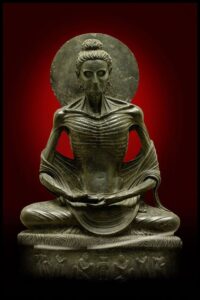
[Gautama as a samana]
Enlightenment
At one point, while in an extremely weakened state, Gautama had to cross a small river that was only knee-deep. As he crossed it, his legs could no longer hold him, and he grabbed a branch sticking out over the water so he would not fall.
At that very moment, a question arose in his mind:
– “What am I actually searching for? I go from school to school, starving and walking – but what am I striving toward?”
Then he came to a deep realization – that there was nothing to be searched for. Truth had always been here, before his eyes, but he had not recognized it.
This insight gave him the strength to cross the river and sit beneath a tree known as the Bodhi tree.
Sitting beneath it, he made a final decision:
– “Either I will realize the truth here and now, or I will die in this place.”
This absolute determination became the key to completely overcoming the ego and the idea of “I.” When it comes to the outer world, time is needed, but the inner world is not governed by the same laws – there, everything can happen instantly if the will is strong enough.
Enlightenment is not a gradual process, but a single moment. A process may lead to it, but the event itself happens suddenly. A person is either enlightened or not – everything else is a play of the mind.
In that moment, Gautama Siddhartha became Buddha. The individual “I” ceased to exist, and only the “Tathagata” remained – the state of reality as it is: indivisible, non-dual, and whole.
His consciousness was illuminated by a new reality – the only reality – and he merged completely with it.
At that time, he already had several followers who were also samanas and had been with him during the previous years. When he opened his eyes, they noticed something extraordinary in him – an unusual radiance, a kind of “aura” that could not be mistaken.
They approached him, expecting to hear the great teaching. But Buddha smiled and said:
– “I am hungry. Let us cook and eat something.”
His followers did not understand this and left him, thinking he had lost his mind. After years of effort and suffering, they expected something different, but they received simplicity.
The Teaching and the Legacy
Later, Buddha established himself as one of the greatest spiritual teachers, with many followers even during his lifetime.
For about forty-five years, he gave discourses, offered guidance, and created a system of methods aimed at attaining enlightenment.
According to Buddhist scriptures, after his enlightenment he remembered up to 100,000 of his previous lives. Through his practices and later development, he acquired various “supernatural” abilities, but he did not give them significant importance in his teaching.
The peak of his teaching manifested in the tradition we now know as Zen. Other branches spread throughout Asia and developed in different ways. In Tibet, Buddhism acquired a mystical and occult character, while in Japan it focused on Nirvana.
According to some enlightened teachers from this tradition, Buddha had access to all levels of existence. He is regarded as a fully complete being.
When a person reaches the state of “Buddha” and leaves the physical body, this is the final end of the cycle. He cannot return to the world. This state is called Nirvana – complete liberation from the wheel of karma and rebirth.
There are different levels of existence beyond the material, but Nirvana is beyond all of them – beyond existence and non-existence itself.
Buddha entered Nirvana at around the age of eighty. Before that, he told his disciples:
– “Today is the final day – if you have questions, now is the time to ask them.”
During those forty-five years, the teaching we now call Buddhism developed significantly. The later “Buddhas,” who attained enlightenment through this system, created their own ways of transmitting the teaching.
Thus Buddhism spread more and more, without losing its essence – whether practiced in Tibet, China, India, Japan, or the West.
There are also many stories from Buddha’s life after his enlightenment – for example, his meeting with his wife and son, the recognition of Mahakashyapa as his first fully enlightened disciple, and the story of a disciple who lived for a time with a woman of loose conduct, after which she herself wished to become his follower.
Conclusion
The life of Gautama Siddhartha Buddha represents an extraordinary possibility for understanding human nature beyond the intellect.
This possibility, however, cannot be fully realized until one truly immerses oneself in it.
His stories and teaching reveal not merely a philosophy, but a path toward the direct experience of reality as it is.
Read More:
- If You Meet the Buddha, Kill Him: The Radical Zen of Linji
- Hakuin Ekaku – The Great Master Who Revived Zen in Japan
- Buddhism, Hinduism, and Taoism – “The Deep Differences Behind the Apparent Similarities”
- Huineng – The Extraordinary Story of the Sixth Zen Patriarch
- Bassui Tokushō – From Demon Child to Great Zen Master
- Bodhidharma – The Fierce Zen Master Who Brought Buddhism to China
- Bankei Yōtaku and the Unborn Mind: Suffering and Truth in Zen
- Nansen: Zen Koans, the Story of the Cat, and the Power of the Ordinary Mind
Author: Vasil Stoyanov