Sufism – The Secret Pulse of the Islamic Soul
There is something almost elusive about Sufism – something that cannot be fully explained in words nor confined within academic definitions. It is a tradition that is experienced more than understood. Yet throughout the centuries, people from different cultures and religions have attempted to describe this inner mystical dimension of Islam, which places love, the experience of God, and inner purification above external forms and dogma.
Sufism is not merely a religious school or a philosophical movement. It is a path – deeply personal, sometimes painful, yet ultimately filled with indescribable beauty. It is the path of the heart, leading beyond the letter of the law toward the essence of Divine Presence. Along this path we encounter stories of wandering dervishes, poets writing in ecstasy, teachers speaking through paradoxes, and students seeking not knowledge, but transformation.
The Origins – Between Asceticism and Love
The history of Sufism begins during the first centuries after the emergence of Islam. Within the early Muslim community, there appeared individuals who felt that outward adherence to religious rules was not enough. They sought a deeper connection with God – one measured not by rituals, but by an inner state of being.
These early Sufis were ascetics. They wore coarse woolen garments – from which the very word Sufi is believed to derive (from the Arabic suf, meaning “wool”). They lived simply, often in poverty, avoiding worldly pleasures. Yet this asceticism was not an end in itself. It was a means of freeing the soul from attachments that prevent it from turning fully toward God.
One of the earliest great figures of Sufism was Rabia al-Adawiyya, an eighth-century female mystic who changed the direction of the tradition. While the early ascetics focused primarily on fear of divine punishment, Rabia introduced the idea of love for God as the highest spiritual goal. She declared that she did not wish to worship God out of fear of Hell or desire for Paradise, but simply because she loved Him.
A famous legend tells that Rabia once walked through the streets carrying a torch in one hand and a bucket of water in the other. When people asked her why, she replied:
– “I wish to burn Paradise and extinguish Hell, so that people may love God for His own sake.”
The Golden Age of Sufism
As time passed, Sufism developed and began attracting scholars, poets, philosophers, and mystics. Various Sufi orders emerged, each with its own traditions, practices, and teachers. Yet all shared one common aim: the direct experience of God.
One of the most influential figures of this period was Al-Ghazali. He was a renowned scholar, theologian, and professor who, despite his fame and intellectual accomplishments, experienced a profound spiritual crisis. He felt an inner emptiness that knowledge alone could not fill.
This crisis led him to abandon his prestigious career and embark upon the Sufi path. He spent years in retreat, travel, contemplation, and spiritual practice. Eventually, he concluded that true knowledge is not merely intellectual – it must be lived and experienced.
Through his writings, Al-Ghazali succeeded in reconciling orthodox Islam with Sufi mysticism, making Sufism far more acceptable within the broader Islamic world.
Yet if there is one name that has become synonymous with Sufism throughout the world, it is Jalal ad-Din Rumi.
Rumi – The Poet of Divine Love
The story of Rumi is almost legendary. Born in the thirteenth century, he was initially a respected scholar and religious leader. His life changed completely when he encountered the mysterious wandering dervish Shams of Tabriz.
Their meeting has often been described as a spiritual earthquake.
Shams was no ordinary teacher. He shattered Rumi’s assumptions, challenged him relentlessly, and forced him to question everything he thought he knew. A profound bond developed between them – one often described as a form of spiritual love.
After the mysterious disappearance of Shams, Rumi began composing poetry filled with longing, grief, ecstasy, and transcendence. His verses speak of love as a path toward God, the dissolution of the ego, and the unity of all existence.
One of his most famous metaphors compares the human soul to a drop of water dissolving into the ocean. Within this image lies the essence of Sufism: the disappearance of the individual self within the Divine Presence.
The Dance of the Dervishes – Movement Toward Infinity
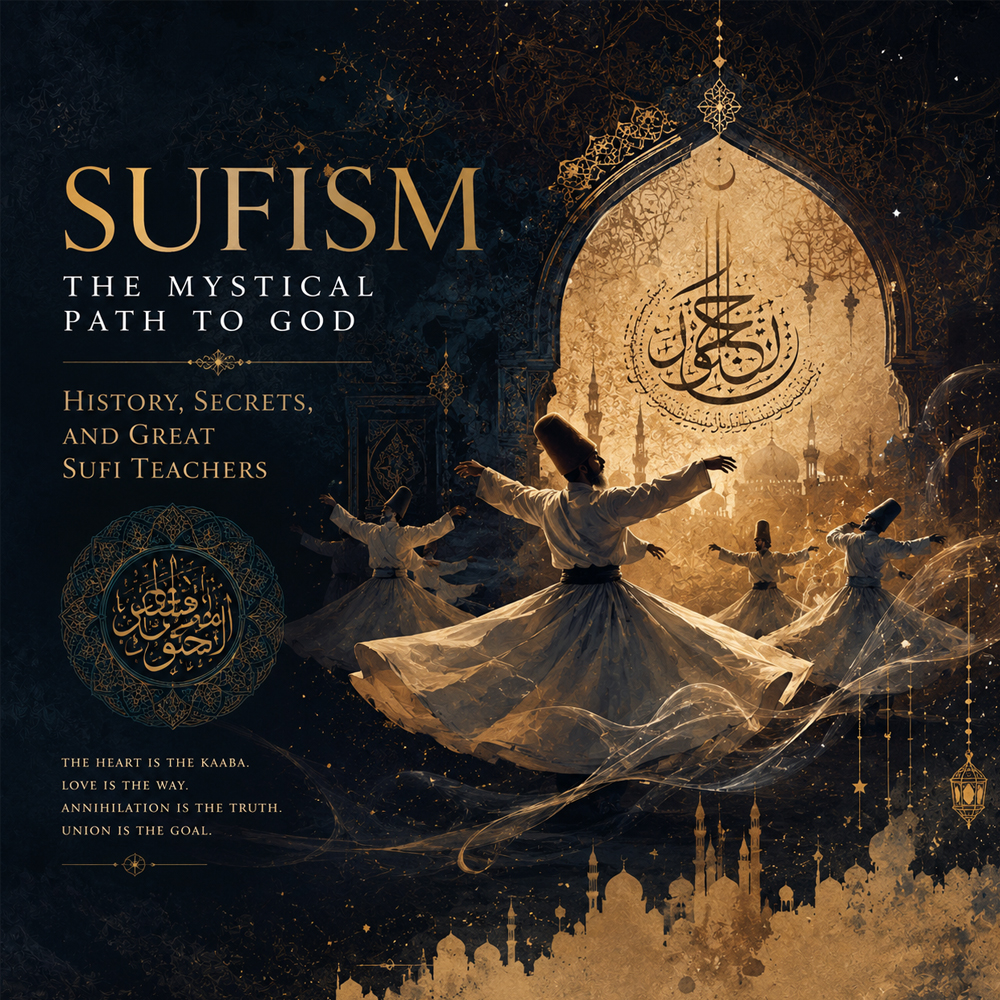
One of the most recognizable Sufi practices is the whirling dance associated with Rumi’s Mevlevi order.
This dance is far more than an artistic performance. It is a form of meditation.
The dervishes spin in circles with one hand turned toward the heavens and the other toward the earth. This posture symbolizes the connection between the Divine and the human world. Through continuous spinning, practitioners enter a state of spiritual absorption in which the sense of individual identity gradually dissolves into a greater rhythm.
To an outside observer, the practice may appear strange or exotic. For the Sufi, however, it is a means of experiencing what words can never adequately express.
Mysteries and Legends
Sufism is rich with stories, parables, and paradoxes. These stories are not meant to be understood literally. Rather, they are intended to shake habitual patterns of thought and open new perspectives.
One such story tells of a student who asked his teacher:
– “How can I find God?”
The teacher led him to a river and suddenly pushed his head beneath the water. He held him there until the student desperately struggled for air. When he finally released him, the student gasped:
– “Why did you do that?”
The teacher replied:
– “When you desire God as intensely as you desired that breath, then you will find Him.”
Such stories are characteristic of the Sufi tradition. They rarely provide direct answers. Instead, they provoke inner realization.
The Sufi Orders – Different Paths Toward One Goal
Over time, various Sufi brotherhoods, known as tariqas (“paths”), developed. Each maintained its own lineage of teachers, practices, rituals, and methods of instruction.
Yet despite their differences, all pointed toward the same goal: union with God.
Some orders emphasize silent meditation. Others focus on the repetition of divine names (dhikr). Still others incorporate music, poetry, and movement.
What unites them is the conviction that truth cannot be imposed from the outside. It must be discovered within.
Sufism and Conflict with Orthodoxy
Sufism has not always been welcomed by religious authorities.
Its emphasis on personal spiritual experience occasionally brought it into conflict with orthodox interpretations of Islam. Some Sufis were accused of heresy.
The most famous example is Al-Hallaj, who proclaimed:
– “I am the Truth.”
For Al-Hallaj, this statement expressed complete union with God. To the authorities, however, it sounded blasphemous.
He was executed, yet his words endured, becoming a symbol of the ultimate degree of mystical realization.
Sufism Today – Between Tradition and Modernity
In the modern world, Sufism continues to exist in many forms.
In some countries it remains an active religious tradition. In others it functions more as a cultural, philosophical, or spiritual movement.
What is remarkable is that Sufism attracts many people outside Islam as well. Its universal themes of love, unity, self-transcendence, and inner transformation resonate across religious boundaries.
The poetry of Rumi, for example, is read throughout the world. It speaks in a language that transcends culture and creed.
Conclusion – A Path Without End
Sufism is not something that can be learned in the conventional sense. It is a path that must be walked.
It begins with a question and often ends not with an answer, but with a transformation.
It is the path of doubt, love, loss, and discovery.
It is the path upon which one loses oneself in order to find something infinitely greater.
Perhaps this is the secret at the heart of Sufism: the more one tries to grasp it intellectually, the more it slips away. Yet the more one allows oneself to experience it directly, the closer one comes to what the Sufis call the Truth.
Read more:
- Jalal ad-Din Rumi – “The Poet Who Turned Pain into a Path to God”
- Farid ud-Din Attar – “The Mystic Who Turned the Soul into a Journey”
- G.I. Gurdjieff – The Mystic, Occultist, and Teacher of the Fourth Way
Author: Vasil Stoyanov