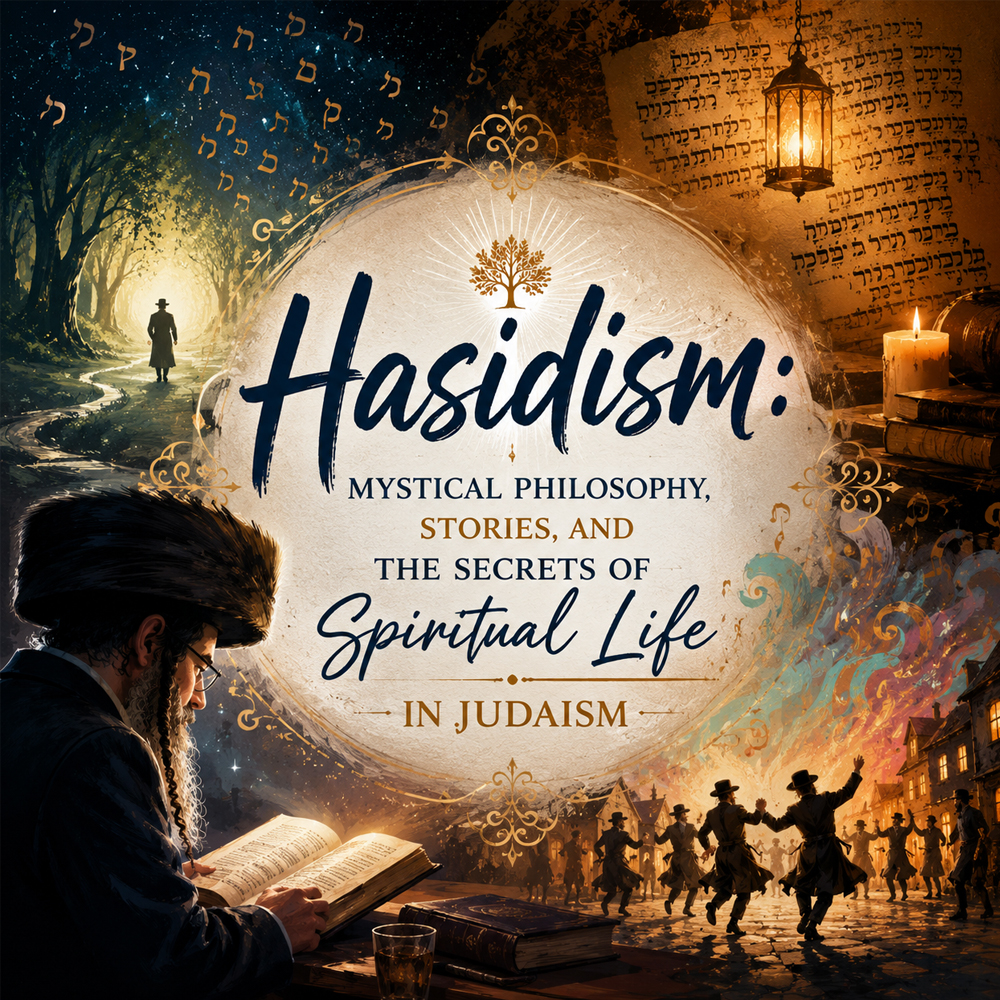
Hasidism is one of the most fascinating, controversial, and at the same time deeply human phenomena in the history of Judaism. It is not merely a religious movement, but a complete way of life, a spiritual philosophy, and a social structure that has left a lasting imprint on millions of people over the past three centuries. To truly understand its essence, it is not enough to view it solely as a historical movement or as a collection of religious practices. Hasidism must be felt as an inner experience – an attempt to connect with the Divine through joy, humility, and profound personal devotion.
In the Hasidic tradition, it is often said that truth is not learned through words alone, but through experience. An old Hasid once asked his teacher why people read so much yet understand so little. The teacher calmly replied, “Because they read with their eyes, not with their hearts.” Within this brief statement lies the entire tension between knowledge and the living experience of meaning – a tension that Hasidism seeks to overcome.
Historical Roots and the Emergence of the Baal Shem Tov
The eighteenth century in Eastern Europe was a period of severe social and spiritual hardship. Jewish communities faced poverty, uncertainty, and a growing sense of alienation from religious life. It was in this context that Israel ben Eliezer, known as the Baal Shem Tov, emerged – a man who transformed not only Jewish teaching but also the very tone in which people spoke about God.
He did not preach through abstract concepts but through closeness and immediacy. For him, spirituality was not distant or rigid; it was something that even the simplest person could experience. As a result, people who had long felt excluded from religious life began gathering around him.
One of the most memorable stories about him tells of a humble woodcutter who did not know how to pray. Every morning, instead, he would play his flute and simply say, “Lord, I do not know the words, but I know that I love You.” When scholars condemned him, the Baal Shem Tov defended him, saying, “His flute opens the heavens more than your books.”
This story is more than touching – it reveals the revolutionary spirit of Hasidism, which places the heart above formalism.
The Democratization of Spirituality
Hasidism fundamentally changed the understanding of who has access to spirituality. Previously, spiritual life was often associated with scholarship, learning, and belonging to an intellectual elite. Ordinary people frequently felt excluded.
The new movement reversed this perspective. It taught that every soul has a direct relationship with God. This did not mean that knowledge lost its value, but rather that it was no longer the only path.
A student once asked the Baal Shem Tov, “Who is closer to God – the great scholar or the simple person?” The teacher answered without hesitation: “The one who thinks of Him most often.”
This response dismantles hierarchy and shifts the center of spirituality from the mind to the heart and attention.
Devekut: Constant Communion with the Divine
The concept of devekut – continuous attachment to God – lies at the very heart of Hasidism. It is not a state reserved for prayer or special occasions. Rather, it is a way of living in which every action can be infused with meaning.
Hasidic teachers insisted that spirituality should never be separated from everyday life. On the contrary, it should be woven into it. A person can remain connected to the Divine even while performing the simplest tasks.
A rabbi was once seen repairing his shoes with extraordinary concentration. When asked why he devoted so much attention to such an ordinary task, he replied, “While I stitch my shoes, I stitch my soul to God.”
This metaphor illustrates how deeply spirituality is woven into the act of living itself.
The Tzaddik: The Spiritual Center of the Community
At the center of Hasidic communal life stands the tzaddik, the spiritual leader. He is not merely a teacher but a bridge between people and God. Hasidim believe that the tzaddik possesses a special spiritual connection that enables him to guide and inspire others.
The relationship between Hasidim and their tzaddik is deeply personal and often emotional. He is not simply an authority figure but someone to whom people turn for advice, comfort, and spiritual direction.
There is a story about a man who traveled a great distance to see his tzaddik. Upon arriving, he received no special teaching. He merely sat and watched the tzaddik drink tea, speak with visitors, and smile. As he prepared to leave, the man said, “I learned more than I did from all my books.”
The story suggests that the deepest teachings are sometimes transmitted without words.
Joy as a Spiritual Path
One of the most recognizable features of Hasidism is its emphasis on joy. In a world often marked by suffering, this may seem paradoxical. Yet this is precisely where its strength lies.
Joy in Hasidism is not naïve cheerfulness. It is a conscious choice – a way of remaining connected to life and to God regardless of circumstances.
One day, a student approached his teacher feeling depressed and discouraged. Instead of offering comforting words, the teacher began to dance. Confused, the student asked why. The teacher replied, “Sadness closes the doors. Joy opens them.”
This simple scene demonstrates that joy is not merely an emotion but a spiritual instrument.
Conflict with Tradition and the Mitnagdim
Hasidism was not accepted without resistance. Traditional religious leaders, known as the Mitnagdim (“opponents”), viewed it as a threat. They feared that its strong emphasis on emotion might weaken discipline and scholarly study.
This conflict was not merely theological – it reflected a deeper question about what spiritual life should look like.
In one brief but telling exchange, an opponent of Hasidism remarked, “You sing too much.” A Hasid responded, “And you think too little about what you sing.”
The dialogue reveals both the differences and the complementarity between the two approaches.
The Diversity of Hasidic Dynasties
After the death of the Baal Shem Tov, Hasidism developed into numerous dynasties. Each cultivated its own style, teachings, and spiritual emphasis. Some focused more heavily on mysticism, others on ethics, and still others on communal structure.
This diversity demonstrates that Hasidism is not a monolithic system but a living and dynamic tradition.
A student once asked his teacher why there were so many different paths within Hasidism. The teacher pointed to a forest and said, “Look at how many paths run through it. They all pass through the same forest, but each is different.”
This image remains a powerful symbol of spiritual diversity.
The Power of Stories
Stories occupy a unique place in Hasidic tradition. They are not merely supplements to doctrine; they are at its very heart. Through stories, truths can be conveyed that are difficult to express in any other way.
These narratives combine simplicity and depth. They often contain paradoxes that encourage both reflection and feeling.
A rabbi was known for gathering his students every evening to tell stories. One day, someone asked why he did not teach them more complicated subjects. He replied, “A story enters where an argument cannot.”
This sentence explains why Hasidism remains so vibrant – it speaks directly to the heart.
The Trials of History
Hasidism endured tremendous historical challenges, particularly during the Holocaust. Entire communities were destroyed, traditions disrupted, and worlds erased.
Yet something survived – not institutions or buildings, but the inner spirit itself.
One of the most powerful stories illustrating the resilience of Hasidism tells of a Hasid in a concentration camp who whispered prayers every night. When asked how he could still believe in such a place, he replied, “This is exactly where I must believe.”
The answer seems almost impossible, yet it reveals the profound strength of Hasidic faith.
Hasidism in the Modern World
Today, Hasidism continues to exist and evolve. Communities around the world preserve their traditions while confronting the challenges of modern life.
Some choose a more isolated lifestyle, while others seek balance between tradition and contemporary society. Yet all face the same question: how can one remain faithful to one’s essence in a changing world?
A young man once asked his Hasidic grandfather how to live in the modern age. The grandfather answered, “Be in the world, but do not let the world be in you.”
The wisdom of that advice remains relevant today.
Conclusion: The Path of Sincerity
At its core, Hasidism rests upon a simple yet profound idea: a person can draw close to God through sincerity – not through perfection, but through genuine presence.
It is a path that does not require becoming someone else. On the contrary, it requires meeting oneself.
Perhaps this is best expressed in a final story. A student asked his teacher, “Where is God?” The teacher replied, “Wherever you let Him in.”
These words remain a quiet reminder that spirituality is not a distant destination but a possibility that begins within the human heart.
Read more:
- Sufism: The Mystical Path to God – History, Secrets, and Great Sufi Teachers
- Zhuangzi – The Sage of the Free Spirit and the Infinite Tao
- Jalal ad-Din Rumi – “The Poet Who Turned Pain into a Path to God”
- Sadhguru: The Story of His Enlightenment, Vijji, and the Mission of the Dhyanalinga
Author: Vasil Stoyanov