
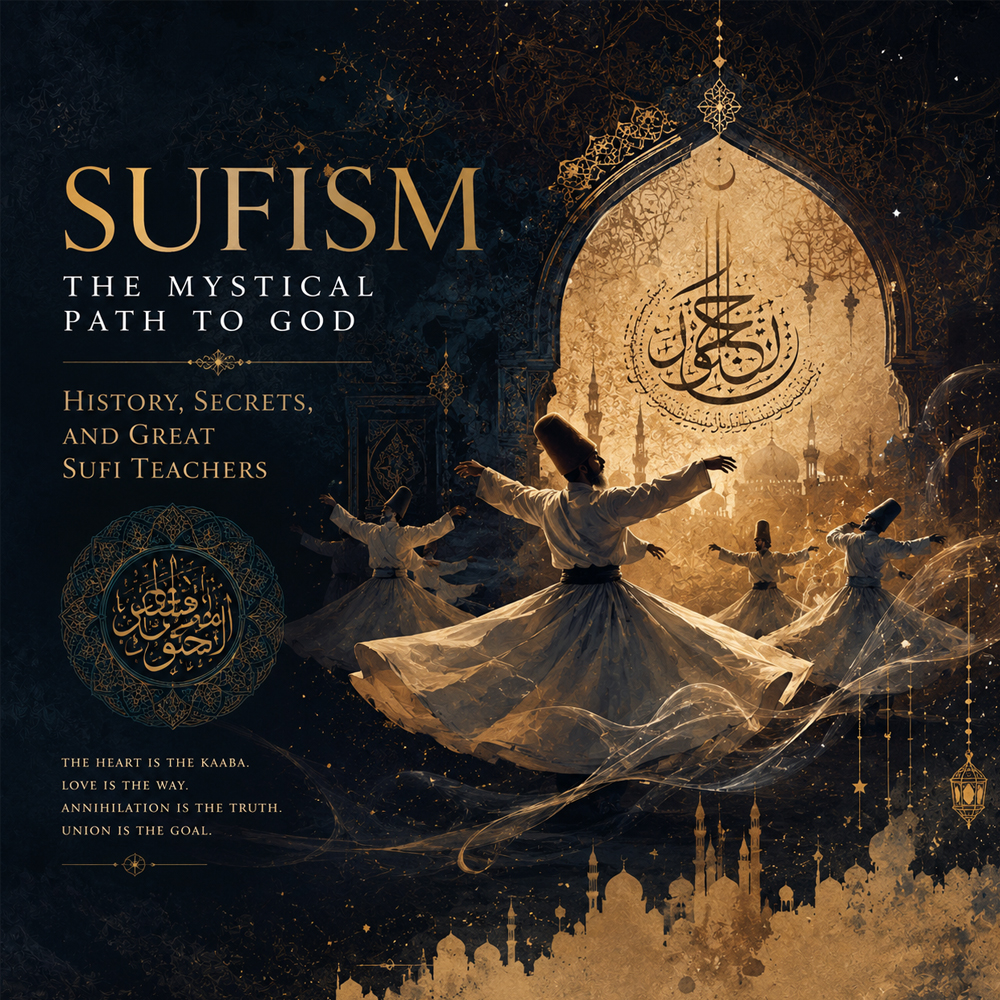
Part One: When the Soul Is No Longer Satisfied with Words
In one of the most powerful parables of the Sufi tradition, Rabia of Basra walks with fire in one hand and water in the other. People ask where she is going with these strange burdens and what she intends to do with them. She explains that she wants to burn Paradise and extinguish Hell so that people will stop turning to God for a reward or out of fear of punishment. Then the question will remain that no promise and no threat can answer on anyone’s behalf: can a person love God for God’s own sake? The parable turns an extraordinary scene into a test of the deepest human motives.
Rabia al-Adawiyya is among the great figures of early Islamic spirituality, and her image remains inseparably linked with selfless love for God. In Sufi memory, she stands as a woman who holds an uncomfortable mirror before piety. A person can spend a lifetime in prayer and still be consumed by self-interest. They can renounce earthly pleasures while calculating future heavenly pleasures with the same persistence. Rabia directs attention toward the love that frees worship from this hidden bargain.
This is where one of the deepest movements of Sufism begins: the passage from outward action to its inward substance. Two hands can offer the same piece of bread, yet one seeks gratitude while the other responds to hunger. Two people can recite the same prayer, yet one thinks about the impression they are making while the other is wholly absorbed in turning toward God. From a distance, the actions look identical because the eye sees the gesture and the ear hears the words. The Sufi question begins where that observation ends: what is actually happening within the person performing them?
This makes Sufism both penetrating and demanding. It places even the things a person takes the greatest pride in under scrutiny. Virtue, knowledge, asceticism, and spiritual zeal can become refuges for vanity when they serve as proof of personal superiority. A person gives up one ornament and immediately begins adorning themselves with the act of renunciation. The inward path requires this movement to be noticed as well, because the most persistent dependencies know how to present themselves as freedom.
What Sufism Actually Is
Sufism is the mystical dimension of Islamic spirituality, in which faith develops as a path of inner purification, love, and knowledge of God. The Arabic term “tasawwuf” denotes the tradition of this spiritual work rather than a single system established by one founder. Over the centuries, it takes different forms among different communities, teachers, and brotherhoods. Its life unfolds through prayer, spiritual guidance, moral discipline, poetry, and practices of remembrance of God. An encounter with Sufism therefore requires us to see an entire spiritual culture that cannot be contained within one ritual or one celebrated verse.
At the center of this culture lies the aspiration for faith to embrace the whole person. The mouth professes belief, the body participates in worship, and the intellect studies the teachings, but the heart must awaken as well. If these movements remain disconnected, a person lives in fragments and begins to feel the painful distance between their convictions and their behavior. They know what they revere, yet often serve something else through their daily choices. Sufi work addresses this distance and makes overcoming it the task of a lifetime.
Here, the word “mystical” means the pursuit of direct spiritual knowledge experienced in one’s relationship with God. For the Sufi, knowledge about love does not exhaust love itself, just as a description of water does not quench thirst. Study remains necessary, but a person must be transformed by what they study. They can speak convincingly about humility and become angry at the first slight they encounter. Such moments reveal how far their knowledge has reached and where it still stands only at the threshold.
This is the source of the distinctive power of Sufi language. It speaks of a path because knowledge requires movement; of a mirror because a person must become capable of perceiving; of thirst because the search begins as a need. These images do more than embellish a dry explanation: they convey relationships that are difficult to capture in a definition. Everyone knows the difference between observing a fire and feeling its warmth on their skin. Sufi literature uses this familiar distinction to describe the transition from religious knowledge to its living inward reality.
The Splendor of the World and the Hunger of the Soul
The early history of Sufism unfolds in the Islamic world, where ascetic devotion gradually develops into a rich tradition of mystical love and knowledge. The first generations of spiritual ascetics place strong emphasis on moral seriousness, restraint, and accountability before God. Later, these aspirations acquire an increasingly developed language for the states of the heart and movement along the spiritual path. Teachers and communities pass on their experience, and enduring forms of instruction and fellowship emerge around them. Personal devotion thus gradually becomes a tradition that can be inherited, studied, and practiced.
To understand the force of this aspiration, we need only look at a familiar human experience. A person works toward something they consider decisive, achieves it, and feels a brief satisfaction. Then life resumes its old tension, and their gaze is already fixed on the next acquisition. The house is larger, their position more secure, and recognition more widespread, but the inner demand does not fall silent. It then becomes clear that increasing one’s possessions and bringing peace to the soul are different tasks.
Sufi asceticism concerns itself with the power attachment holds over a person. An object acquires this power when, without it, a person no longer knows who they are or what they are worth. The same can happen with social standing, the approval of others, and even the idea of one’s own righteousness. Loss is no longer experienced as a change in circumstances but as the collapse of the self. Spiritual restraint creates a space in which this dependency becomes visible and can be weakened.
Imagine a merchant who counts his profits every evening and carries his calculations even into his sleep. One day, he closes his shop, but his mind continues bargaining, calculating, and worrying about the goods. His body has left the marketplace, while his attention remains locked inside. This simple image explains why withdrawing from the world does not, by itself, resolve the question of attachment. The real work begins with what a person carries within them when all the outer doors have already been closed.
The Heart as a Place of Knowledge
In the Sufi vocabulary, the heart, called “qalb,” has a meaning that extends beyond the usual opposition between feeling and reason. It denotes the inner center through which a person turns toward God and perceives the spiritual meaning of their life. When Sufi teachers speak of purifying the heart, they include intentions, attention, moral condition, and the capacity to respond. This work therefore cannot be reduced to cultivating pleasant emotions. It concerns the way a person sees, desires, judges, and acts.
The image of the mirror makes this idea easy to understand. A mirror can be intact and still fail to reflect clearly because its surface is covered in dust. A person, too, can possess a sharp intellect and a rich memory while their perceptions remain clouded by envy, fear, or a desire for dominance. They receive information about the world but filter it through their own dependencies. Polishing the heart is an image for the labor through which this inward obscurity is removed.
Envy, for example, changes the very act of seeing. Another person’s success ceases to be someone else’s joy and begins to look like a personal humiliation. The observer searches for a flaw, devalues the achievement, and feels relief upon finding a reason to diminish it. None of these movements is caused by the success itself. They arise from the condition of the observer’s heart and reveal how powerfully inner life shapes the world a person experiences.
The same happens with pride, which turns an ordinary conversation into a contest. A person listens only while preparing their own objection and understands only what they can use to gain the upper hand. Gradually, even those closest to them become an audience before whom they must defend their image. They possess words but lose the encounter those words should have made possible. Purifying the heart also begins with recovering the ability to be present with another person without constantly placing oneself between them and one’s attention.
The Nafs and Its Talent for Changing Clothes
Among the central concepts in Sufi spiritual work is “nafs,” which in this context denotes the human self in its desires, impulses, and states. Sufi teachings pay particular attention to its tendency toward complacency, possessiveness, and self-justification. It knows how to turn an immediate desire into a convincing argument and find a noble name for an ignoble motive. A person wants to prevail but calls it defending the truth. They want to be noticed but describe their behavior as serving the common good.
The difficulty lies in the fact that such justifications often sound convincing even to the person creating them. They do not constantly regard themselves as a deliberate deceiver. More often, they experience the convenient version of their motives as the only obvious one. A sincere conviction that they are acting rightly therefore does not bring spiritual inquiry to an end. They need the ability to examine what that conviction conceals as well.
This ability is tested particularly clearly when someone does good and receives no gratitude. As long as gratitude seems assured, motives can remain comfortably indistinguishable. When it fails to arrive, hurt, irritation, and the desire to withdraw help emerge. The person then sees that an unspoken price had been attached to the good deed. Sufi self-observation uses such discoveries as the beginning of work because they reveal something that confident reasoning could easily overlook.
The nafs retains its power when a person enters a spiritual environment as well. The desire to be the wealthiest can become the desire to be the most enlightened, while the pursuit of social influence can adopt the language of spiritual authority. Renunciation of luxury can become an extravagant image of one’s own modesty. A person begins comparing how long they pray, how little they own, and how deeply they understand. The same competition thus continues under new names, while genuine humility remains outside their field of vision.
Repentance as a Change of Direction
The spiritual path needs a moment when a person stops justifying everything they do. In the Sufi tradition, repentance, “tawba,” is a fundamental movement of returning to God. It includes acknowledging a wrongful act, abandoning it, and resolving to change direction. The feeling of guilt alone does not accomplish this task, because a person can experience emotional remorse and resume the same behavior at the first convenient opportunity. Change gains substance when it begins to shape their decisions.
Consider someone who frequently hurts their loved ones with angry words. After every outburst, they feel ashamed, promise to change, and gradually calm down. At the next irritation, they once again treat their feelings as sufficient grounds for attacking the other person. The circle closes because remorse has served to relieve an unpleasant experience without changing their relationship with anger. The true return begins when they take responsibility for the moment before the words as well, when a choice is still available.
This gives repentance a practical depth. It can require an apology, repairing harm, returning what was taken, or abandoning a habit that repeatedly leads to the same failing. No inward emotion cancels the obligation owed to the person who has been harmed. Spiritual life gains credibility through such actions because conviction confronts its own cost within them. Returning to God is also expressed in the way a damaged human bond is restored.
Repentance opens another possibility as well: a person can stop turning yesterday’s behavior into a final judgment on their entire life. Acknowledging guilt is necessary, but relentless self-abasement can also keep them trapped in self-absorption. They continue staring at their own downfall while the necessary action remains undone. Returning requires them to lift their gaze enough to repair, learn, and move forward. Responsibility thereby gains a future instead of remaining confined to the repetition of the same shame.
Sincerity Without Witnesses
The Sufi concept of “ikhlas” points toward purity of intention and sincere devotion to God. Its test begins where the possibility of receiving recognition disappears. As long as there is an audience, moral action also carries a social reward that easily mingles with the original motive. When no one is watching, this mingling becomes harder to conceal. A person is left facing the question of whether doing good still holds the same value for them.
Someone discovers an error that gives them an undeserved advantage and has the opportunity to keep silent about it. No one demands an explanation, and circumstances offer a convenient excuse to carry on. If they choose honesty, they will suffer a real loss, with no guarantee that anyone will appreciate their decision. This is precisely what makes the moment so revealing of character. Here, virtue ceases to be a beautiful idea and becomes a choice with consequences.
Sincerity becomes more complicated, however, when a person begins admiring their own sincerity. They help in secret and then spend a long time savoring the thought of how pure their conduct was. The outward audience has disappeared, but the inward spectator continues applauding. Sufi work reaches into this quiet scene as well, because vanity does not necessarily require other people’s eyes. It can sustain itself through the endless inward narration of one’s own greatness.
Maturity therefore appears in the ability to do good and allow it to fulfill its purpose. The hungry person has received food, the burden that was eased has become bearable, and restored trust has begun to grow. These consequences have a value of their own that is not increased by the doer’s prolonged self-admiration. Gradually, their attention can become free of the question of how they appear in their own eyes. Service then acquires a simplicity that Sufi teachings hold in high regard.
Why Love Changes the Question Itself
Rabia places love at the center of the spiritual relationship and thereby changes the way worship is understood. Fear directs a person toward danger, while hope of reward directs them toward what they will receive. Love turns attention toward the beloved and begins rearranging the entire field of desire. A person no longer measures every action solely by the benefit that will return to them. A relationship emerges in which presence and devotion have a meaning of their own.
This can be understood through an ordinary human experience, without that experience exhausting its religious significance. When someone visits a sick loved one, they may initially think about duty, time, and inconvenience. Deep affection gradually displaces these calculations and directs their attention toward the needs of the person before them. The effort remains real, and fatigue does not disappear, but being there is no longer experienced as a series of losses. Love transforms the meaning of the same actions that appear unchanged from the outside.
On the Sufi path, love for God has a similar power to transform prayer, restraint, and moral work. They cease to be merely obligations a person fulfills in order to get them over with. Gradually, they become ways of sustaining a relationship they consider essential above all others. This does not mean constant emotional excitement, because love must also endure the hours of dryness, fatigue, and distraction. Its depth is revealed in the constancy with which a person returns to the beloved when pleasant feelings no longer carry them.
Here, spiritual life acquires a steadiness that does not depend entirely on mood. A person does not stop caring for a loved one simply because today they do not feel yesterday’s tenderness. In the same way, devotion requires faithfulness through changing inward states. Sufi love includes the flame of longing but also the patience to remain true to one’s direction. This connection between passion and constancy is what makes it capable of transforming a life instead of remaining a brief intoxication.
Junayd and the Sobriety of Deep Experience
Among the great early Sufi teachers, Junayd of Baghdad holds a distinctive place through his emphasis on sobriety and spiritual discipline. His approach connects inward mystical experience with faithfulness to Islamic teachings and moral obligations. He becomes one of the principal figures to whom the later Sufi tradition turns for authority and guidance. In this approach, the intensity of an experience does not release a person from the need to live responsibly. Depth must find expression in a steady character and clear conduct.
This emphasis matters greatly because extraordinary experience easily captivates the imagination. A person can feel intense rapture, a sense of closeness to God, or a sudden inward illumination and take it as the definitive completion of the path. The following day, however, the same human relationships await them, requiring patience, honesty, and attentiveness. If the experience does not reach into those relationships, a gulf remains between spiritual memory and everyday character. Sobriety requires that gulf to be noticed and overcome.
This is one of the most serious tests of spiritual maturity. A person must be able to endure disagreement without immediately turning the other person into an enemy of truth. They must keep their promises, acknowledge their mistakes, and treat those from whom they expect no benefit with dignity. Such actions rarely appear impressive before an audience, but they reveal how far inward work has become part of character. Patience in a difficult conversation often says more than an account of an extraordinary state.
Sobriety also prevents spiritual language from becoming a convenient refuge. A person can speak of eternity while neglecting a specific duty, or of love for all humanity while humiliating the person beside them. Grand words create a vast space in which petty behavior can easily disappear from view. Discipline brings attention back to that behavior and insists that meaning be embodied. Spiritual stature is thus also measured by the ability to be dependable in ordinary life.
Adab and the Art of Being Present
In Sufi culture, “adab” denotes proper conduct, spiritual courtesy, and attentiveness to relationships. It includes the way a person listens, speaks, receives guidance, and takes their place among others. The outward gesture matters because it can cultivate or undermine the inward disposition. Constant interruption, for example, reinforces the habit of considering one’s own thought more important than another’s. Attentive listening gradually develops the capacity for a different kind of presence.
Adab also appears in the ability to refrain from using another person’s weakness as a stage for one’s own strength. Someone makes a mistake, and you have the opportunity to correct them privately or humiliate them before everyone. In either case, you can speak words that are true, but the relationships you create will be different. One action serves to put things right, while the other adds the pleasure of dominance. Spiritual courtesy requires precisely this addition to be noticed.
It also concerns the moment in which you speak. A person in deep grief does not always need an immediate explanation of their suffering. Sometimes the first necessity is for someone to stay beside them, bear the silence, and help with whatever the day requires. A beautiful spiritual thought can become an escape if it serves to end the uncomfortable encounter with another person’s pain. Adab cultivates sensitivity to the person themselves so that knowledge can be offered as care.
Such cultivation also changes one’s relationship with one’s own voice. A person begins to understand that they do not have to fill every silence or prove their understanding in every conversation. They can ask a question, wait for the answer, and allow what they hear to affect them. This seems simple until one notices how strongly vanity resists such waiting. Within this small discipline lies part of the larger work of freeing attention.
The Threshold Where Real Change Begins
After their first encounters with the ideas of Sufism, a person can easily feel exhilarated by their beauty. Love without bargaining, the heart as a mirror, and freedom from vanity sound like the promise of a deeper life. Then an ordinary day arrives in which someone overlooks them, work goes wrong, and another person’s success stings. That day is precisely what turns the promise into an actual task. The path begins to take shape when a person recognizes in their own reaction what they have previously read about with admiration.
They notice that they desire gratitude more strongly than they have admitted. They see that they listen impatiently and often defend their own dignity by wounding someone else’s. They discover how quickly a good mood can be taken away by a single word that fails to meet their expectations. These discoveries dismantle the comfortable belief that maturity has already been achieved, but they provide material for real work. At last, the person begins encountering themselves in their actions rather than only in their own description.
From this point onward, love, repentance, sincerity, and spiritual courtesy cease to be separate, beautiful concepts. They come together in the concrete question of how the next hour is to be lived. That question concerns whether anger will be given complete power over words, whether a mistake will be acknowledged, and whether another person’s need will be noticed in time. Every such decision leaves a trace in character and prepares the next decision. The Sufi path is built through this constancy until the inward disposition gradually begins to shape the whole of life.
The parable of Rabia remains at this threshold like a fire illuminating motives. It brings a person back to the question of what remains of their devotion when reward, fear, and self-admiration fall away. The answer cannot be contained in a confident sentence because it must be lived through thousands of concrete encounters and choices. This is precisely why Sufism speaks of a path on which love learns to be faithful and the heart learns to be awake. The next step leads toward the practices through which this wakefulness is cultivated: remembrance of God, attention, spiritual guidance, and the profound transformation of the human self.
Part Two: The Practices of Awakening and the Disappearance of the Inner Master
A day can be filled with hundreds of actions, yet a person can experience it as though they were barely present at all. They have spoken, worked, eaten, and crossed streets, but their attention has constantly been elsewhere. While someone speaks to them, they prepare their reply; while walking, they relive yesterday’s argument; while resting, they calculate tomorrow’s difficulties. Gradually, life becomes a place through which the body passes while the mind inhabits its own endless reflection. The Sufi practice of remembrance begins by interrupting this scattered state.
The Arabic word “dhikr” means remembrance or mention, and in Sufi life it denotes turning toward God through His names, prayer formulas, and wakeful attention. This remembrance has dimensions of speech, heart, and conduct. A person recites, listens, concentrates, and gradually learns to maintain the connection between what they say and how they live. The practice takes different forms in different Sufi communities, including aloud or silently, alone or with others. Its shared direction is to bring attention back to God instead of allowing it to follow every desire and anxiety that arises.
Repetition plays an important role because human attention has already been trained through repetition. Someone spends years telling themselves they are not valued enough, another continually revisits the memory of an insult, and a third mentally lists everything they still do not possess. Inner life thus acquires an enduring rhythm that shapes perception and behavior. Dhikr introduces a consciously chosen direction into this movement. Instead of allowing anxiety to be the only voice that returns again and again, a person renews their remembrance of what they have devoted their life to.
At first, the words can be recited while the mind repeatedly wanders. The practitioner notices this wandering and brings their attention back without turning every distraction into a reason for despair. Returning is itself part of the work, because steady presence is developed through practice. Over time, they begin to recognize more quickly the moment when the mind has left whatever they are doing. This ability also becomes valuable beyond the time of prayer, when they need to listen attentively, work conscientiously, or interrupt anger as it begins to arise.
When Prayer Extends Beyond Its Appointed Time
The Sufi aspiration toward constant remembrance gives ordinary actions a new depth. After prayer ends, a person returns to people, obligations, and difficulties, which reveal what remains of the experience. If attention to God is confined to a single hour, the rest of the day easily falls under the authority of old habits. Spiritual practice must therefore enter the way a person trades, promises, responds, and treats another’s vulnerability. Remembrance reaches its fullness when it begins to guide choice.
Imagine a craftsman working on an object intended for someone he will never meet. No one watches every movement of his hand, and he has the opportunity to conceal a flaw. If he regards his work as a responsibility before God, an unseen mistake does not become insignificant simply because the customer will not notice it immediately. Carefulness gains a foundation that extends beyond the fear of inspection. In this way, the workshop becomes a place of moral practice, and the quality of the object bears witness to the quality of attention.
The same happens at home, where a person’s spiritual self-image often faces its most difficult test. Before strangers, they can easily maintain courtesy because they feel the gaze of others and want to make a good impression. Among those closest to them, they relax this discipline and begin treating their patience as an inexhaustible resource. Remembrance of God calls into question this presumed right to be careless precisely with the people who trust them most. It requires the same moral seriousness when a person is visible to the world and when the door of their home closes.
Daily life thus ceases to be an interruption of the spiritual path. A conversation, a purchase, care for the sick, and a promise kept become places where devotion takes concrete form. A person begins observing whether their inward turning has consequences for whoever stands before them. This makes the practice more demanding because it no longer has a clearly defined boundary beyond which responsibility ends. The entire day becomes a space in which attention can be lost and recovered.
Muraqaba and the Courage to Remain Still
The practice called “muraqaba” is associated with vigilant inward attention and the awareness of standing before God. In it, a person withdraws from constant outward activity to gather their attention and observe their own condition. This withdrawal reveals how many inner movements usually remain hidden beneath the noise of the day. One anxiety has been drowned out through work, one grievance through conversation, and one feeling of emptiness through constant entertainment. When the noise subsides, these movements emerge with all their insistence.
The first encounter with silence is often an encounter with one’s own restlessness. A person sits quietly, but tasks, memories, desires, and unfinished conversations begin lining up within. They discover how difficult it is to endure a few minutes in which there is nothing to acquire, prove, or complete. The stillness of the body illuminates the movement of the mind and removes the convenient possibility of attributing it solely to external circumstances. Silence reveals what a person carries within them even when nothing outside is pressing upon them.
At this moment, the temptation arises to return immediately to familiar activity. They check their messages, discover a suddenly important task, or decide that the practice does not suit them. In this way, they avoid encountering what has begun to reveal itself. Sustained attention requires them to remain long enough to distinguish an impulse from a necessity and a feeling from a command. Gradually, a space emerges between an inward movement and the action that usually follows it.
This space has enormous moral significance. Anger can arise without immediately becoming an insult, and fear can be felt without dictating every decision. A person begins noticing their own states as something toward which they have a relationship and a responsibility. They are no longer compelled to justify every reaction by saying that this is simply who they are. Vigilance opens the possibility of cultivating character through conscious choice.
Taking Account After Sunset
In Sufi moral work, an important place belongs to “muhasaba,” the inward examination of one’s actions. A person looks back over the day and considers the words, decisions, and intentions that filled it. They observe where they acted honestly, where they yielded to habit, and where they concealed self-interest behind a noble explanation. Such observation requires specificity because the general admission that everyone makes mistakes can easily leave one’s own mistake untouched. The work begins by clearly naming what happened.
In the evening, a person remembers a conversation in which they interrupted a colleague and claimed credit for shared work. During the day, they explained their behavior as a necessary matter of haste, but in the quiet examination they also see the desire to be noticed. The discovery is unpleasant because it disrupts their comfortable image of their own fairness. Yet it identifies a precise point at which the next action can be different. In the morning, they have the opportunity to restore the other person’s credit and repair the relationship they have damaged.
Taking account is meaningful when it leads to such change. If a person merely revisits their mistakes and blames themselves for them, inward observation can become another form of fruitless self-absorption. After recognition comes the question of what must be done. Some actions require repair, others a clear boundary, and still others a new habit that will interrupt a recurring weakness. Evening attentiveness thus prepares tomorrow’s conduct.
This practice also reveals the recurring conditions in which a person falters. They notice that they become rude when tired, exaggerate before certain people, or begin feeling envious after prolonged comparison with others’ lives. They now possess a more accurate picture of their own vulnerabilities. They can change the conditions, prepare their response, and recognize the dangerous movement earlier. Spiritual work gains continuity because observation becomes knowledge of one’s own habits.
Why the Path Needs a Guide
A person struggles to see, on their own, everything they conceal from themselves. They can be perceptive about other people’s motives and astonishingly inventive in justifying their own. Spiritual guidance therefore holds an important place in the Sufi tradition. The teacher, called a “shaykh” or “pir” in different cultural settings, guides the student in practice and in recognizing inward obstacles. The relationship involves instruction, trust, and the gradual cultivation of the ability to accept an uncomfortable mirror.
True guidance does not always resemble an answer that satisfies curiosity. The student wants to discuss elevated states, while the teacher directs their attention toward an unfulfilled promise. They ask about the secrets of contemplation and receive a task to care attentively for someone in need. Such redirection reveals the difference between spiritual interest and spiritual readiness. The desire to speak about depth can coexist with an unwillingness to bear the most ordinary responsibility.
The guide also matters because they can distinguish progress from self-suggestion. A person sometimes takes an intense feeling as proof that they have become wiser, while their behavior reveals growing intolerance. At other times, they experience a difficult period and decide that everything they have achieved has been lost, even though they are already responding more maturely to their trials. An outside perspective helps distinguish an impression from an actual change. The student thus learns to assess the path by its fruits.
Trust in a guide requires a moral foundation because spiritual authority touches human life deeply. The teacher bears the responsibility of directing attention toward God and the student’s growth rather than toward their own greatness. The relationship deteriorates when dependency is maintained as an end in itself or the guide’s personal will is placed above all moral judgment. Mature instruction develops honesty, responsibility, and discernment. Its purpose is for the student to become more awake in their life rather than lose their conscience under another person’s power.
Community as a Mirror of Character
Solitary practice can create a calm that appears steady as long as no one disturbs it. A person feels patient in the silence of their own room, but an encounter with another temperament quickly reveals the limits of that patience. The other person speaks more slowly, understands differently, makes mistakes, and has needs that do not fit our convenience. This is precisely why companionship with others on the spiritual path has such a strong formative power. It brings to light qualities that solitude can leave unnoticed.
In Sufi circles, spiritual companionship and conversation are often associated with the concept of “suhba.” The student listens to guidance, participates in shared practice, and observes how those with more experience turn teachings into conduct. Some learning comes through words, and some through the presence of a person who maintains composure in difficulty. The way they receive disagreement or attend to a guest can convey more than a lengthy explanation. A living example shows how spiritual concepts work in a concrete situation.
At the same time, community requires the student to accept that they are not the center of every encounter. Sometimes their task goes unnoticed, sometimes someone else receives attention, and sometimes a shared decision does not match their preference. These moments bring to light expectations they had not recognized. Their irritation reveals where service had been tied to recognition or control. If they remain attentive to this discovery, shared life becomes an extension of inward practice.
The maturity of a spiritual community is also visible in its treatment of weakness. When a mistake becomes merely an occasion for humiliation, people learn to conceal themselves. When it is accepted without any accountability, instruction loses its direction. A combination of clarity and mercy is needed, allowing the truth to be named and the person to continue growing. The community thereby creates an environment in which honesty matters more than an appearance of perfection.
The Service That Interrupts Self-Absorption
A person can devote a great deal of time to their own spiritual condition and gradually lose sensitivity to the life around them. They monitor whether they are calm, whether they have progressed, and whether their experience is deep enough, while another person’s need remains in the background. Sufi service, called “khidma,” interrupts this enclosure through concrete work for others. It directs the hands and attention toward something that needs to be done. A person steps out of the constant measurement of themselves and encounters an actual necessity.
Someone must prepare the food, clean the place where the community gathers, or help an elderly person get home. Such tasks require no extraordinary experience and rarely offer a dazzling spiritual story. They do, however, require time, care, and a willingness to set aside personal convenience. This willingness reveals the place another person occupies in our life. Service turns compassion from a feeling into useful action.
It also teaches attention to detail. If you bring water to a thirsty person, you must notice whether they can hold the vessel. If you help someone who is ill, you must hear what they actually need instead of imposing your own idea of help. If you take on a task, you must finish it so that someone else is not forced to repair your carelessness. These details cultivate presence because care requires the real person to be seen.
Service has a particular power when it offers no opportunity for a grand self-image. Repeated work gradually wears down the desire to experience every good deed as a personal feat. What remains is the task, the need, and the quiet satisfaction that something necessary has been done. A person begins to understand the value of constancy that does not rely on exhilaration. In such work, spiritual life finds a support that endures even on days without inspiration.
Inward Stations and the Visitations of Grace
Sufi literature distinguishes spiritual stations, called “maqam,” from states, called “hal.” Stations are associated with steadily cultivated qualities and the work of the spiritual path. States denote experiences that arrive as gifts and cannot be possessed on command. This distinction helps the student avoid confusing the intensity of a single moment with the maturity of their whole character. Rapture can be profound while patience remains fragile.
A person sometimes experiences prayer with extraordinary clarity and a sense of closeness. Then comes a day when the same words seem dry and attention continually falls apart. If they assess everything solely by the intensity of feeling, they begin pursuing the first experience and despising the second. The practice itself thus becomes a search for a particular inward pleasure. Distinguishing between a station and a state returns attention to the qualities that must be cultivated regardless of mood.
Patience, for example, develops through the way a person endures delay, difficulty, and disappointment. It is not proved merely by a feeling of calm during a favorable hour. Gratitude also gains depth when a person begins noticing what they have been given without constantly devaluing it through comparison. Trust in God is tested where effort is necessary but the outcome remains beyond complete human control. Such qualities become steady through many concrete decisions.
This understanding frees the student from the need to prove continually how extraordinary their experience is. They can receive an intense spiritual moment with gratitude and continue their work after it passes. They can move through dryness without turning the absence of rapture into a judgment upon the entire path. What remains important is the question of what is growing in their character and how it affects the people around them. Constancy begins to carry greater weight than a dramatic account of their own state.
Fana and the Falling Away of Self-Assertion
Among the deepest concepts of Sufism is “fana,” which names the extinguishing or disappearance of self-centered presence in turning toward God. Sufi authors approach this concept in different ways, including as a transformation of qualities and as the loss of ordinary self-awareness in mystical experience. In its practical moral dimension, what stands out is freedom from the constant insistence that everything serve the personal “I.” A person ceases to make their own desire the final measure of reality. Attention opens toward a relationship that exceeds that measure.
The ordinary self continually appropriates what happens. It asks how it appears, what it will receive, who has overtaken it, and why it has not been sufficiently recognized. Even when it concerns itself with God, it can seek primarily its own elevation and security. Fana points toward an interruption of this insistent centrality. In the language of love, the beloved fills attention so fully that constant concern for one’s own image recedes.
This transition can be approached through moments in which a person is wholly devoted to something meaningful. A musician stops monitoring how every movement appears and gives themselves to the music. Someone rescuing another person from immediate danger acts with attention to the need without composing a story about their own courage. Such experiences show that self-absorption is not the only possible way of being present. The Sufi concept carries this direction into the depths of the relationship with God.
In moral life, the falling away of self-assertion appears as freedom from the need for every action to confirm one’s own superiority. A person can acknowledge that someone else is right without experiencing it as the destruction of their dignity. They can do good without insisting that it be added to their image. They can accept their limitations and continue serving with what they actually possess. The person thus retains their abilities while the power of self-glorification weakens.
Baqa and the Return with a Transformed Heart
The concept of “baqa” means abiding, and in Sufi language it is associated with life after the transformation described through fana. It points toward the steadiness of a person whose presence is now shaped by turning toward God. The path reaches its fullness in the ability to bring this change into the world of relationships and actions. A person returns to work, conversation, and responsibility with a different inward foundation. What has been experienced must find lasting embodiment.
They continue distinguishing what is just from what is unjust and taking the necessary action. Freedom from vanity does not remove the ability to take a clear position. What changes is their relationship with conflict, because defending justice no longer necessarily requires the pleasure of humiliating an opponent. A person can be firm without nurturing malice and merciful without abandoning responsibility. This combination demands far deeper maturity than the appearance of calm that avoids every difficulty.
Baqa also gives meaning to the return to the ordinary. After an intense inward experience, a person must once again buy bread, keep a promise, and care for someone. It is precisely in these actions that the steadiness of transformation is tested. If everything profound remains locked within the memory of a single hour, life outside it continues in the old way. Abiding means that the new disposition finds expression even when the day offers nothing extraordinary.
Spiritual work thus arrives at a very concrete form of presence. A person listens more attentively, responds less hastily, and bears responsibility for their words more honestly. Their inward freedom becomes tangible to others through the way they live with them. They do not have to explain their experience continually because its consequences are already speaking. The heart that has been learning to remember begins turning that remembrance into character.
When Experience Searches for Language
And yet the deepest experience does not always remain silent. It searches for an image, a rhythm, and a word through which it can reach another person. Here, Sufi poetry opens an immense space for love, separation, thirst, and return. Within it, the lover speaks of the beloved’s absence, the traveler crosses a desert, and the bird searches for the way home. These images bring human vulnerability and spiritual longing together in a shared language.
After the discipline of attention, it becomes clearer why Sufi verse has such power. It arises within a tradition that examines intentions, cultivates presence, and places love at the center of the relationship with God. Its beauty therefore carries the weight of a real search rather than serving merely as skillful ornament. A single image can open a question that a lengthy explanation has left closed. Separation becomes the language of longing, and longing becomes a force that moves a person beyond their habitual life.
From here, the path enters the world of Rumi, Shams of Tabriz, and Attar, where the spiritual search takes some of its most moving literary forms. Love begins speaking through encounters, losses, fire, and journeys. Birds gather for an impossible expedition, while a single human encounter overturns the life of a scholar and preacher. The practices of gathering attention prepare the ground for this language because a person has already begun recognizing their own scattered state. Now the power of longing unfolds before them – a longing that can turn an entire life into a movement toward the Beloved.
Part Three: Rumi, Attar, and the Love That Turns Life into a Journey
In 1244, two people meet in Konya whose spiritual companionship will leave a profound mark on world literature. Jalal al-Din Rumi is already a respected religious scholar and guide, surrounded by students. Shams of Tabriz is a wandering spiritual seeker sharply critical of ostentatious piety and imitative spirituality. Their encounter transforms the direction of Rumi’s life and becomes a focal point of his poetic inspiration. From this companionship unfolds a language of love that will reach far beyond the boundaries of their city and age.
To understand the power of such an encounter, we must consider what it means for one person to change the very way another asks their questions. Usually, we seek someone who will add something to our already ordered world. We receive information, revise a particular idea, and continue living within the familiar structure. But there are encounters in which the structure itself begins to tremble. Something once considered sufficient suddenly proves to be only a beginning, and life reveals a depth that the previous explanations were too narrow to contain.
This is the significance of Shams in Rumi’s spiritual history. He becomes a presence through which what has been learned must be lived with renewed intensity. Knowledge can no longer remain calmly arranged, because love demands the whole person. In this encounter, Rumi’s spiritual authority does not disappear, but it acquires a different inward movement. The poet begins speaking from a place where thought, longing, and devotion intertwine.
A person easily imagines spiritual growth as the accumulation of answers. They believe they will become wiser once they possess enough explanations of life, God, and their own existence. Rumi’s story points toward a more dramatic change, in which the familiar answer can lose its authority over the living question. A search then begins that is no longer satisfied merely by correctly spoken words. The heart demands what the intellect has long named from a distance.
The Absence of Shams and the Birth of the Poetic Voice
After periods of close companionship, Shams disappears permanently from Rumi’s life in Konya. Rumi searches for him, and the sense of loss finds expression in numerous poems. His great collection of lyric poetry remains associated with Shams’s name and spiritual presence. In these verses, absence acquires a voice that expresses both human pain and longing for the divine. A particular encounter thus becomes the source of poetry with an immense spiritual reach.
Absence has a distinctive way of changing attention. While a loved one is near, their presence can gradually become part of the ordinary arrangement of the day. After separation, that same day fills with places that recall them. A sound, a street, or an unfinished thought acquires a weight it did not have before. A person discovers how deeply the relationship has entered their way of perceiving the world.
Sufi poetry draws on this human reality to speak of spiritual longing. Absence reveals the strength of the relationship and turns the search into a constant inward movement. The Beloved no longer stands in only one place toward which footsteps can be directed. Their trace begins to be sought in everything a person encounters. The pain of separation thus expands attention and carries it beyond the habit of seeing the world as a collection of useful objects.
This, however, does not make suffering automatically transformative. Loss can imprison a person in bitterness, in the continual reconstruction of the past, or in the desire for everything to return exactly as it was. Rumi’s poetic path reveals a different movement: absence acquires a form through which it can be shared and given meaning. Pain becomes a creative act that reaches the pain of others. From a personal wound emerges a language in which other people recognize their own search.
The Reed Flute and the Song of Separation
The Masnavi, Rumi’s great spiritual work, begins with the voice of the reed flute. It has been separated from the place where it grew, and its sound tells the story of that separation. In this opening image, longing for one’s origin becomes music that reaches the listeners. The flute carries both the pain of being torn away and the possibility of expressing that pain. From its very first movements, the poem thus places the reader before the question of separation, belonging, and return.
The image is powerful because absence acquires a voice within it. The listener hears a sound, and behind that sound lies the story of a severed bond. This gives the music a depth that cannot be measured solely by the pleasure of its sound. The flute becomes an image of a person who carries the feeling that their life has a deeper foundation than its immediate circumstances. Longing directs them toward that foundation and makes the question of meaning unavoidable.
Such longing also arises in moments when, outwardly, everything appears to be in order. A person has received what they were striving for, but satisfaction does not fill the entire space of their life. They feel a need that does not coincide with the ordinary desire for another possession or another measure of recognition. This need can appear as a thirst for truth, for belonging, or for a relationship that embraces their whole existence. The Sufi image of the flute gives language to this profound human lack.
It is especially significant that the poem begins with an invitation to listen. Before explanation comes the willingness to hear the voice of longing. This changes the relationship with spiritual language, because the listener must allow the image to reach their own experience. If they remain merely an outside observer, they will understand how the metaphor works but will not feel why it concerns them. Listening becomes a first step toward recognizing their own song of separation.
Why Love Speaks Through Fire and Wine
Sufi poetry often uses images of fire, wine, intoxication, and burning to convey the power of spiritual love. These images belong to a world in which inward change is experienced as something capable of disrupting ordinary self-possession. Fire transforms what it touches, while intoxication changes the familiar arrangement of perception. In poetic language, they express the power of a relationship that can no longer be held at a safe distance. Love is presented as an event that affects the very constitution of a person.
Fire is a particularly precise image of change because it combines light, warmth, and the destruction of an old form. When a person is deeply affected by something meaningful, they do not remain entirely the same observer they were before. Some preferences lose their weight, others acquire new meaning, and previous priorities are rearranged. The poet uses fire to show this irreversibility. After a true encounter, life can no longer be arranged as though nothing has happened.
The image of intoxication conveys another aspect of love: the interruption of constant calculation. A person who guards against every deep relationship can maintain control, but pays for it through the narrowness of their experience. They admit only what does not threaten their comfortable self-image or require too much devotion. Poetic intoxication opens a space in which this cautious self-enclosure recedes. Attention is captivated by something that proves more important than continually managing the impression one makes.
Here it becomes clear why Sufi poetry cannot be contained within the calm language of definitions. A definition arranges things, while a verse can stir the very person reading it. An image of a burning heart sometimes reaches an experience that a long sequence of concepts leaves untouched. This is the power of poetic language: it awakens participation and turns understanding into an encounter. The reader begins to feel the question rather than merely possess its explanation.
The Story That Gets Through Our Defenses
Sufi authors use parables and stories because a person often defends themselves against direct instruction. If told that they are vain, they immediately begin listing evidence of their modesty. If accused of fear, they find reasonable grounds for every retreat. A story about another person takes a different route because, at first, it requires no admission. The listener follows what happens and only afterward recognizes their own behavior within it.
Imagine a story about a man who spends the entire day improving the sign outside his workshop while the commissioned work remains unfinished. He makes sure the lettering is beautiful, displays his craftsmanship, and attracts admiration from passersby. In the evening, the customer arrives, and the man has nothing to hand over. The listener immediately sees the gap between presentation and purpose. Later, the same image can return when they spend more time creating an impression than fulfilling their responsibility.
This ability is precisely what gives a parable its lasting power. It does not end with the first understanding, because it can be recognized again under different circumstances. A person hears the story when young and sees one meaning, while years later their experience allows them to see another. The image remains the same, but their life gradually reveals new ways of relating to it. In this way, the story becomes a companion to inward work.
The Sufi story often combines seriousness with wit. Laughter interrupts self-importance and allows a person to notice how absurd some of their own pretensions appear. Through a smile, they can accept what they would reject as an accusation. After the laughter, the precise question posed by the story remains. Wit thus becomes an instrument of insight as well as entertainment.
The Birds Who Wanted a King but Did Not Want to Set Out
In The Conference of the Birds, Farid al-Din Attar turns the spiritual search into a great allegorical journey. The birds gather to seek their king, and the hoopoe tells them about the Simurgh and calls on them to set out toward him. Before the journey begins, each presents the reasons why it cannot depart. The nightingale is absorbed in its love for the rose, while the falcon is content with its closeness to an earthly ruler. The hoopoe answers their objections through teachings and stories that reveal the hidden power of attachment.
The opening of the poem reveals one of the most familiar contradictions in human life. A person declares that they want change but wants it to happen without disturbing the habits that hold them back. They want freedom while defending their dependencies as a necessary part of their identity. They want to travel far but insist that every step preserve the comfort of the place from which they depart. The desire for a path thus becomes a lengthy explanation of why the journey cannot yet begin.
The birds are compelling because each has an argument that sounds convincing from its own perspective. Attachment rarely presents itself as bare weakness when a person speaks about themselves. It acquires a history, a dignity, and an explanation that makes it seem indispensable. One dependency is called loyalty, another caution, and a third a reasonable approach to life. Attar turns these justifications into living images through which the reader can see them at work.
The hoopoe’s strength as a guide lies in its ability to direct attention beyond the objection itself. It considers not only the words but what keeps the bird in place. The conversation thereby becomes a revelation of the relationships between desire, fear, and attachment. Every reason for refusing begins to show what has acquired supreme authority in the speaker’s life. Before the journey through space can begin, this inward immobility must be overcome.
The Nightingale Who Turned Love into a Boundary
The nightingale is a particularly revealing image because its obstacle appears beautiful. It is devoted to the rose and can speak of its feelings with sincere rapture. In its own eyes, this love is sufficient reason to remain where it is. The hoopoe, however, directs attention toward the limitation concealed in complete submission to a transient object. Beauty has become a boundary beyond which the nightingale refuses to look.
This image raises a question that extends beyond the poem itself. Love can expand a person, but it can also become a way of enclosing the entire world around a single desire. Everything else then loses value, and relationships are measured according to whether they sustain the cherished image. A person begins defending their own absorption by calling it depth. They love intensely, but the strength of the feeling alone does not reveal how free and mature the relationship is.
Here we see the difference between loving a living person and depending on what that person allows us to experience. When the other person stops fulfilling the expectation, dependency quickly turns into accusation. The beloved must remain precisely as expected so that the lover’s inward comfort is not disturbed. They gradually become the guardian of someone else’s mood. Deep love requires the ability to see them beyond the role assigned to them by our desire.
The story of the nightingale points toward this wider task. Beauty should open an attention that can continue to grow. If it becomes a final possession, a person begins protecting their experience more fiercely than encountering reality. Even rapture can then prove to be a form of immobility. The path requires love itself to be freed from the need to hold the world within a single unchanging picture.
The Falcon and the Comfort of Another’s Power
The falcon offers a different kind of refusal because its satisfaction comes from closeness to an earthly ruler. It already possesses a position that sets it apart and sees no reason to put that position at risk. In this image, the spiritual search encounters attachment to prestige and influence. A person has gained a place near power and begins treating that place as a sufficient answer to the question of their own worth. Dependency is thus disguised as an attained height.
Such proximity easily changes human behavior. Someone begins speaking confidently because an influential person stands behind them, and gradually stops distinguishing their own judgment from their patron’s interests. Another person’s approval becomes the foundation of their security. They defend their position even when they must remain silent about a truth they clearly see. Gradually, the price of privilege is paid through the surrender of inward independence.
The image of the falcon also shows how difficult it is to leave the comfort of recognition. The loss of status can seem like the loss of the self when identity has been built around another’s gaze. A person is then defending more than a job or a social role. They are defending the story through which they explain why they matter. The path toward a deeper foundation becomes difficult precisely because it requires that story to cease being their only support.
Attar places such images at the beginning of the journey because the obstacles were already present in the birds’ lives. The expedition will not create them; it will reveal them and demand a response. Every bird carries its own reason to remain and its own idea of what it cannot lose. The shared goal does not erase these differences but brings them to light. The journey thus becomes a test of what each has placed at the center of its existence.
The Seven Valleys and the Transformation of the Search Itself
The path to the Simurgh passes through seven valleys that represent different dimensions of spiritual transformation. Attar speaks of seeking, love, knowledge, freedom from attachment, unity, bewilderment, and spiritual poverty with the extinguishing of self-centeredness. The poem turns these dimensions into a landscape that must be traversed. The reader thereby sees spiritual movement as an experience that affects the whole traveler. The valleys give form to change rather than leaving it as an abstract promise.
The image of the valley itself has a particular power. Within it, the traveler cannot see the entire route, and progress requires crossing the actual terrain. A person cannot experience the whole journey merely through a description received from a safe place. They must encounter what the next step reveals. The poem thus distinguishes knowledge of the direction from actual movement toward it.
The search itself also changes along the way. At first, a person often wants an answer that can be added to their life as a new possession. They expect to return with knowledge capable of strengthening their existing self-image. Deep change affects the seeker themselves and renders some of their original expectations insufficient. At a certain point, it becomes clear that the goal cannot be attained without changing the way they wish to attain it.
The presence of bewilderment among the valleys is especially revealing. A person usually associates maturity with complete confidence that everything has already been put in order. Bewilderment denotes an encounter with a depth that existing categories cannot exhaust. It requires an attention capable of remaining open without immediately turning the experience into a convenient formula. Knowledge thereby gains space instead of being confined by the desire to make everything appear definitively mastered.
The Thirty Birds Before the Simurgh
After the arduous journey, thirty birds reach the goal. In their encounter with the Simurgh, they see their own reflection, and the poem draws on the resemblance between his name and the Persian words for “thirty birds.” This ending brings the seekers and the sought together in a single astonishing image. The journey reveals its inward dimension precisely at the moment when the outward destination appears to have been reached. The birds arrive transformed and encounter a meaning they could not have seen when they first set out.
The ending does not mean that the expedition was unnecessary. It is precisely the path traveled that makes recognition possible and changes those who stand before it. Had the birds remained among their original justifications, they would have preserved the same limited way of seeing. The goal would have remained a distant image shaped to fit their desires. Transformation makes possible an encounter that a simple explanation given beforehand could never replace.
This is one of the deepest ideas of the spiritual journey. A person often wants to know everything they will find in advance so they can decide whether setting out is worthwhile. Yet some meanings can be fully understood only after life has developed the capacity to receive them. Patience is known differently after hardship has been endured, and mercy acquires a different weight after one’s own fall. The path prepares the very sight through which the goal will be recognized.
The thirty birds also form a community that has passed through the trial together. At the beginning, each defends its separate reason to remain, while the final image brings them together. This gives the poem a meaning that extends beyond solitary personal achievement. Others are no longer merely an audience for someone’s progress or an obstacle to it. The shared journey proves to be part of the very form of the discovery.
Beauty as a Doorway to Greater Attention
Rumi and Attar show why beauty occupies such a powerful place in Sufi culture. It can interrupt everyday distraction and make a person more fully present. A verse, a melody, or an image halts the habit of judging everything solely by its immediate usefulness. For a moment, the world ceases to be merely a collection of tasks and means. An attention emerges that allows meaning to be felt.
Beauty, however, also places a test before the person who encounters it. They can use it as a pleasant refuge without allowing it to change their relationships and decisions. They can feel rapture at verses about love while remaining indifferent to the needs of someone close to them. They can be moved by the image of the journey and continue defending every form of their own immobility. The experience then remains a brief ornament to life rather than becoming the beginning of movement.
The true power of poetry appears when an image continues working after the reading ends. The nightingale appears when a person turns attachment into an excuse. The falcon returns when prestige demands that they silence their conscience. The flute sounds again when what they have achieved fails to answer their deeper longing. The literary world thus begins illuminating actual life with a precision that outlasts the initial exhilaration.
This makes Sufi poetry particularly suited to listening. Rhythm, image, and narrative can remain in memory and return at the right moment. A person does not have to reconstruct the entire explanation to recognize the question. It is enough to remember the bird that wants to reach the king but does not want to leave its comfortable place. An entire inward situation can be gathered into this brief image.
The Love That Gives Life Direction
In Rumi, longing unfolds as a voice seeking the Beloved, while in Attar the search takes the form of a great expedition. In both cases, a person is called to move beyond comfortable enclosure within their own expectations. Love has power because it makes something else more important than continually preserving the existing self-image. It creates a direction in which effort acquires meaning and loss can become part of transformation. Life thus begins to be experienced as a movement with an inward purpose.
This direction changes a person’s relationship with time. A day is no longer measured solely by the number of tasks completed or pleasures received. The question of what has happened to the person who lived through it also becomes significant. That question concerns whether they have seen more clearly, loved more maturely, and freed at least some part of their attention from its old narrowness. In such a life, even an ordinary hour can carry movement toward something essential.
Sufi poetry leaves a person facing precisely this possibility. It gives them images through which to recognize their longing, but directs them toward a path that must be lived. After the song of the flute and the flight of the birds, the question remains of how the spiritual search will find a place among real people and historical circumstances. There, love encounters society, tradition, difference, and power. The final part of this path leads toward the Sufi brotherhoods, the dance of the dervishes, and the legacy of a spirituality that continues to confront a person with the responsibility to transform their way of life.
Part Four: The Dervishes, the Spiritual Brotherhoods, and Life After Awakening
The white robes spread with every turn, gradually tracing flowing circles around the bodies of the dervishes. Music sets the rhythm, the steps maintain balance, and the movements follow an established order. For the observer, the scene has an extraordinary beauty because it combines constancy and lightness, discipline and fluidity. At the center of the ceremony, however, lies a spiritual direction that extends beyond the visible movement. The body participates in turning toward God, and the whirling receives its meaning through the attention that fills it.
This ceremony is associated with the Mevlevi order, which grew around Rumi’s legacy and was organized by his followers after his death. Called “sema,” it includes music and established ritual movements through which a person’s spiritual ascent is expressed. Within it, love, remembrance, and devotion take bodily form. This is also the source of the widely used name “whirling dervishes,” through which the Mevlevi tradition has become recognizable around the world. The ceremony is also inscribed on UNESCO’s Representative List of the Intangible Cultural Heritage of Humanity.
Whirling offers a powerful image of human life because everything around us is in motion. Days succeed one another, circumstances are rearranged, relationships move through closeness and distance, and the body continually changes. Amid this change, a person seeks a foundation that can sustain their direction. Without such a foundation, every new event draws them toward a different center. Today their life is governed by fear, tomorrow by recognition, and afterward by the desire to possess more.
In this sense, the dervish’s movement can be read as an image of a life that changes around a steady spiritual orientation. The body moves, but the practice requires gathered attention and balance. Presence must be maintained within movement itself, as well as in stillness. This gives the ceremony a significance that can also be recognized beyond it. A person, too, must find a way to remain faithful to what matters most while life continually changes its outward form.
When Spiritual Experience Finds a Home
To be passed down through generations, the spiritual path needs enduring forms. The encounter between teacher and student can be profound, but both their lives have limits. After them, ways of learning, practicing together, and preserving the inheritance must remain. In Sufi history, such forms develop through the brotherhoods known as “tariqas.” The word “tariqa” means path and denotes a spiritual school with a particular lineage of guidance and established practices.
The brotherhood turns the personal search into a relationship with a tradition that existed before the individual student. The student receives guidance, enters a shared rhythm of practice, and encounters people at different stages of the path. This allows them to see their own difficulties as part of a wider human experience. Their distraction, impatience, or desire for recognition no longer appears to be an entirely unfamiliar obstacle. There are words, observations, and ways of working with these difficulties that have been passed down through generations.
The places of Sufi communal life receive different names in different regions, including tekke, khanqah, and zawiya. Within them, the spiritual tradition acquires a visible home and a space for encounter. Guidance, prayer, music, and companionship can come together here according to the character of the particular community. The place itself carries the memory of those who have lived and practiced within it. In this way, an inward direction becomes inscribed in architecture and in the cultural life of society.
The home of a tradition has value when it keeps its purpose alive. Every established form can be practiced attentively, but it can also become a habit from which participation has disappeared. A person knows when to stand, what to recite, and how to behave, while their inward disposition remains unchanged. Outward continuity then conceals inward immobility. Inheriting a practice therefore requires every generation to renew the meaning that made it necessary.
Different Paths Within One Spiritual Tradition
The Sufi world includes many orders, among them the Qadiriyya, Naqshbandiyya, Chishtiyya, Shadhiliyya, and Mevlevi. They have different histories, geographical distributions, and characteristic ways of teaching. The Naqshbandi tradition is known for its emphasis on silent remembrance, while the Mevlevi tradition develops a distinctive musical and ritual culture. The Qadiriyya bears the name of Abd al-Qadir al-Jilani and spreads across many regions of the Islamic world. The Chishti tradition develops a particularly strong presence in South Asia.
This diversity shows why a single outward image cannot represent all of Sufism. A person who knows only the whirling dervishes can easily begin associating every Sufi practice with dance. Another who has encountered a tradition of silent contemplation can be surprised by the powerful musical expression of a different community. These differences belong to a spiritual culture that has developed historically through many forms. Understanding requires seeing the direction of a practice together with the particular ways in which it is expressed.
Diversity also raises a question about human capacities. One person concentrates more deeply through silence, another is profoundly affected by the rhythm of collective recitation, and a third reaches an important meaning through a poetic image. The tradition offers different entrances into work that must embrace attention, intention, and conduct. The entrance itself, however, is insufficient if a person remains fascinated only by its form. What matters is what develops through it and how that development appears in life.
Here, a useful question arises for every spiritual school. The question is whether its practice cultivates greater clarity, responsibility, and the capacity to care, or merely creates a powerful sense of belonging. Belonging can support a person, but it can also release them from the discomfort of observing themselves. They begin feeling that they are right because of the name of the community to which they belong. The spiritual path must then return them to their own participation, because another’s inheritance cannot perform the inward work on their behalf.
Al-Ghazali and the Crisis of a Successful Life
The story of Abu Hamid al-Ghazali reveals how deep the gap between outward success and inward fulfillment can be. He attains a prestigious teaching position in Baghdad and gains considerable influence as a religious thinker. In his own account of his spiritual crisis, he examines the motives that had driven his teaching and pursuit of status. In 1095, he leaves his position and devotes himself to travel, seclusion, and Sufi spiritual work. Later, he teaches again, while his life and writings connect religious knowledge with a profound examination of moral and inward life.
This story is compelling because the crisis arises at a place that appears, from the outside, to be an achieved goal. The person already possesses what others spend years striving for. Recognition confirms their abilities, and their position creates a clear story of success. It is precisely then that the question arises of whether this success corresponds to their deepest intention. Outward confirmation ceases to be enough when a person begins examining the foundation upon which they have built their life.
Such a question is difficult because it concerns both the future and the past. If a person sees that they have been driven by vanity, they must reconsider more than their next action. They must endure a change in the story of everything they have taken pride in until now. This requires courage because the comfortable story has served as a support for their identity. Refusing to defend it at any cost opens the possibility of a more honest life.
Al-Ghazali gives this question intellectual and spiritual weight. His example shows that profound knowledge does not release a person from the need to examine their own motives. The intellect can be exceptionally developed while the inward direction remains divided between devotion and personal ambition. The next step then requires a change in the way of life, beyond another explanation. Knowledge reaches its fullness when a person begins living according to what they truly acknowledge as essential.
Ibn Arabi and the World as a Field of Meaning
Another great horizon of Sufi thought opens in the works of Ibn Arabi. In his teachings, the divine names occupy a central place in understanding the relationships between God, the world, and the human being. A person has the capacity to develop qualities through which their life becomes more fully aligned with spiritual truth. Knowledge includes the transformation of character and the unfolding of virtues. The question of reality is thus inseparably connected with the question of what kind of person the one who knows it becomes.
This connection changes the relationship with spiritual thought. The reader is invited to do more than construct a convincing picture of the world. They must examine how their own presence participates in that picture and what possibilities remain undeveloped within them. If they speak of mercy but never show compassion, their knowledge has remained separate from their character. If they reason about generosity but every loss closes them in suspicion, work lies ahead that concepts alone cannot accomplish.
The idea of the continual renewal of creation also holds an important place in Ibn Arabi’s thought. Reality is not presented as a motionless object that a person has understood once and now possesses in their mind. Every moment carries a uniqueness that requires open attention. From this emerges a relationship with the world as a continual unfolding of meaning. Spiritual vision must remain alive so that it does not replace this reality with its own frozen conception.
The practical power of such a view becomes apparent in our treatment of other people. The person before us is not exhausted by yesterday’s mistake, by a single role, or by the label we have assigned to them. They have a history, an inward complexity, and a possibility of change that our judgment does not always encompass. This does not remove the need to distinguish between actions and take responsibility for our relationships. It requires judgment to remain attentive instead of becoming the final confinement of a living person within a ready-made description.
Sufism Among People, Cities, and Power
The spiritual brotherhoods are part of social life and share its tensions. They can be places of learning and mutual support, while also standing in relationships with political forces, patrons, and local communities. Their history includes both withdrawal from political struggle and participation in it. In some cases, Sufi leaders become associated with power and social movements. Historical Sufism must therefore be considered a living human tradition acting within concrete circumstances.
This gives particular weight to the question of independence. When a spiritual community receives support from an influential patron, it also gains opportunities to develop. Alongside them arises the risk that gratitude will become an obligation to remain silent. Authority can gradually be used to advance an interest unrelated to the original spiritual task. The community must then distinguish necessary support from a price that threatens its own purpose.
A similar test arises within the organization itself. Every community needs order, but order can become an end in itself. A person begins defending their position, established relationships, or the prestige of the institution more fiercely than the truth it is meant to serve. A painful gap then emerges between teaching and conduct. A spiritual tradition preserves its vitality through the ability to name such discrepancies instead of concealing them behind its own name.
This makes the historical inheritance more serious than a romantic picture. It contains beautiful poetry and powerful examples of devotion, but also human choices with social consequences. Understanding it requires seeing both the ideals and the ways people have embodied them. Spiritual meaning thereby acquires real weight. It must endure the encounter with a life in which decisions affect other people as well.
The Traces of Sufism Close to Home
For the Bulgarian reader, Sufism also has a nearby geographical dimension. Its inheritance is present in the spiritual history of the Balkans, including through Bektashi and other Sufi communities. It has left traces in religious culture, in places of veneration, and in the memory of different Muslim populations. The Balkan world is part of the larger history of this tradition, rather than merely a distant observer of its development. This allows Sufism to be encountered through places, names, and customs that belong to the nearby cultural landscape.
Such proximity changes the way a spiritual culture is perceived. It ceases to be merely an image from a book about Persia or a ceremony in Konya. A person begins seeing that the histories of different traditions intersect in the same regions through which they themselves pass. An old spiritual center can carry the memory of encounters, labor, and devotion that have taken place there for generations. The landscape acquires depth when it is also read as human memory.
This offers an opportunity for a more mature relationship with cultural difference. Instead of reducing another tradition to a few unusual symbols, it can be approached through its own language and historical life. A person does not have to share every belief to understand the seriousness of the search behind it. Attentive understanding allows difference to be seen clearly and humanely. Respect thereby acquires substance instead of remaining a general word of courtesy.
The Modern Person and the Hunger for Depth
Today, a person has enormous access to words about spirituality. In a few minutes, they can read dozens of quotations, hear teachings from different traditions, and gather images of calm, love, and freedom. This abundance creates opportunities, but it also presents a distinctive problem. The impression of understanding can grow more quickly than actual change. A person accumulates a language of depth while their attention remains fragmented.
The Sufi inheritance requires time because its images are connected with a way of life. A verse by Rumi can move the reader immediately, but the relationship it expresses must be recognized within their own choices. The birds’ expedition can be retold in minutes, while giving up a longstanding dependency requires constancy. Between exhilaration and transformation stands the work of participation. This work is what gives weight to beautiful words.
Modern distraction has another distinctive feature: a person constantly sees other people’s versions of a good life. Successes, experiences, and images pass before them, offering new reasons to be dissatisfied with their present. Attention is trained to leave what they have and seek value elsewhere. Even rest can thus become filled with comparison. The spiritual path raises the question of how to restore the ability to experience life fully.
This ability also includes accepting one’s own finitude. A person cannot be everywhere, read everything, or experience every possibility. If they refuse to accept this, every decision will seem like an unbearable loss of all the other decisions. Devotion requires a chosen direction and the willingness to follow it long enough. Life thereby gains depth through faithfulness to what is essential instead of scattering itself in an endless pursuit of the next impression.
Death and the Question of What Has Been Loved
The spiritual path acquires a particular clarity before the fact of death. Death sets a limit to postponement and reveals that life is not an endless reserve of time for future change. A person can spend years promising that one day they will live according to their true values. Yet every day that passes is already part of their actual answer. Finitude makes the question of direction immediate.
Acquisitions then come to be measured differently. Possessions, position, and recognition can have practical value, but they cannot by themselves answer the question of how a life has been lived. A person must look toward the relationships they have created, the harm they have repaired, and what they have given their attention to. Here, the actual history of their love is revealed. It is written through their time and actions, regardless of the beautiful intentions they have reserved for the future.
Remembering death can restore precision to choice. An argument loses some of its apparent importance when seen within the scale of a limited human life. A postponed apology becomes more necessary, and the opportunity to be with a loved one gains weight. This does not remove daily tasks, but arranges them according to a deeper foundation. A person begins distinguishing what merely occupies their time from what truly deserves to be lived.
Within this horizon, Sufi love reaches its most serious form. It must be deep enough to give life direction and faithful enough to endure its transience. Beautiful feeling is tested through loss, responsibility, and limited time. It then becomes clear whether a person has loved only the pleasant experience or has built a relationship that extends beyond it. Love acquires value through the life it has made possible.
The Path That Finds Its Fulfillment in a Way of Life
At the beginning of this spiritual story, Rabia carried fire and water to raise the question of love without bargaining. After her, the discipline of attention, the power of guidance, and the work of transforming character unfolded. Rumi gave longing a voice, while Attar turned the search into an expedition that changes the travelers themselves. The brotherhoods created homes for the tradition, and the dervishes expressed their turning toward God through movement. All these forms lead toward the question of what happens to the person who truly participates in the path.
The answer must be visible in their life. It appears in the way they use their power, in their treatment of another’s weakness, and in their ability to fulfill their responsibility when no one is watching. It appears in the courage to acknowledge a mistake and the willingness to repair its consequences. It appears in whether their love expands another person’s freedom or confines them within their own desire. Here, spiritual knowledge acquires its human credibility.
Sufism leaves behind an immense inheritance of thought, poetry, music, and communal life. Its deepest invitation, however, addresses the person who today possesses attention, time, and the possibility of choice. They can begin seeing more precisely what governs their life and what truly deserves their devotion. They can turn what they have recognized into action and gradually give love an enduring place in their character. The path then ceases to be a distant story and begins to be written through their own life.
The final step returns a person to the people with whom they must live. Before them stand an ordinary conversation, an unfulfilled promise, another’s need, and work waiting to be completed. It is precisely there that the heart receives the opportunity to show what it has learned. It can bring greater clarity, mercy, and faithfulness into the next action. The love that began as longing for God thus gradually fills life with presence.
Read more:
- Jalal ad-Din Rumi – “The Poet Who Turned Pain into a Path to God”
- Farid ud-Din Attar – “The Mystic Who Turned the Soul into a Journey”
- G.I. Gurdjieff – The Mystic, Occultist, and Teacher of the Fourth Way
Author: Vasil Stoyanov