
Introduction: What Is the “Self,” Really?
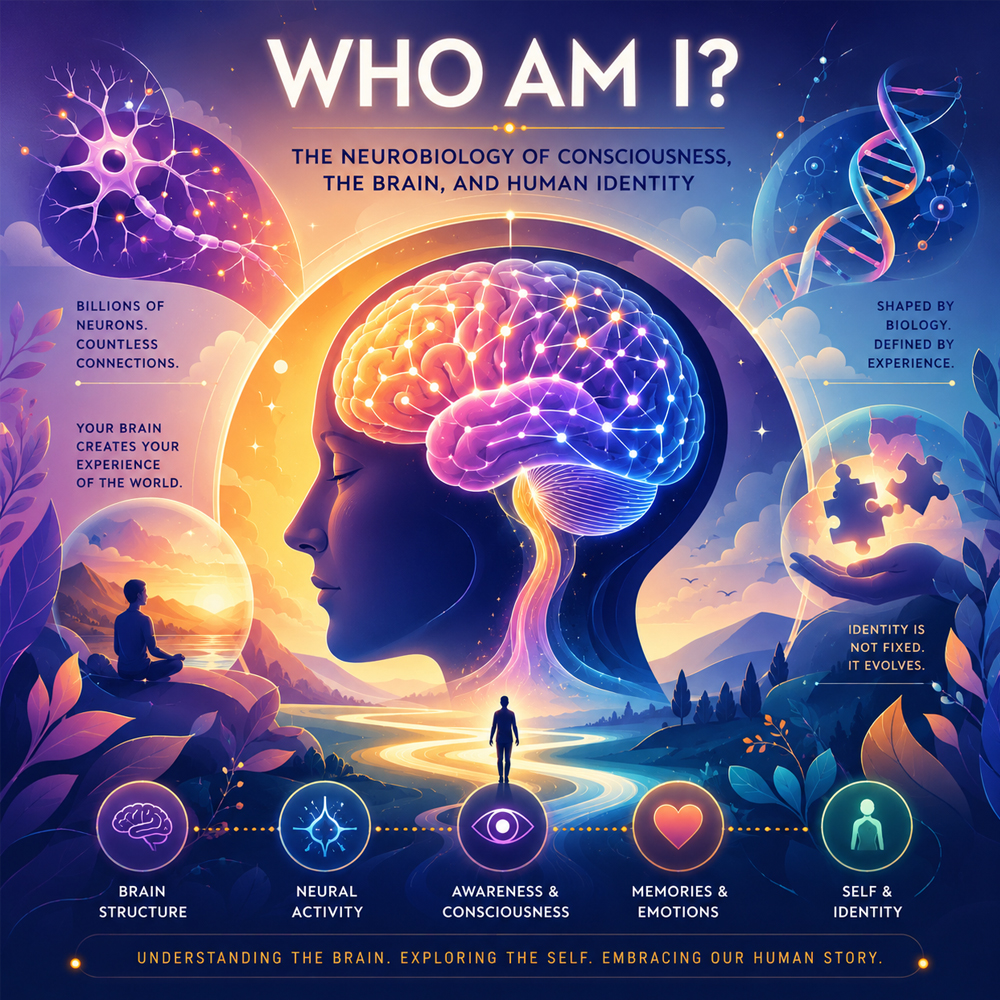
The study of the human brain may not be all that different from the study of what we perceive as the “self,” only viewed through a neurobiological lens. At first glance, the definition of the “self” appears vague, because nothing we can identify seems to fully qualify as the self itself. When we experience an emotion, we say, “I feel.” When we speak, we say, “I am speaking.” There always seems to be an “I” in our minds that exists separately from our actions, emotions, and thoughts – or at least that is how it appears to us.
The great yogis of the East were able to explain, from a philosophical perspective, that what we call the “self” is not fundamentally separate from the very actions it performs. The mental division between the self and an action, emotion, thought, or reaction is an illusion created by the mind. Modern science now shines a bright light on this insight, revealing why it is true and what conclusions we should draw from it.
The Most Complex Mechanism: How the Human Brain Works
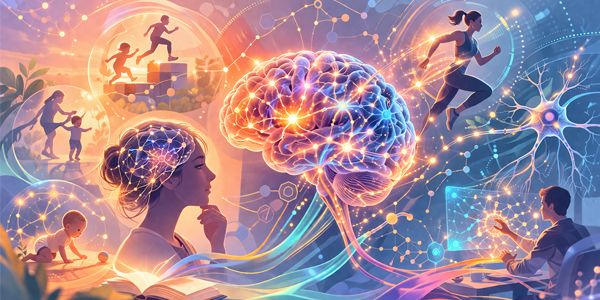
The human brain is composed of approximately 85 billion nerve cells, known as neurons. Each neuron has the capacity to form around 10,000 branches that connect it to other neurons. These connections are called synapses, and they serve as pathways for the electrochemical signals through which neurons communicate. In other words, the human brain is capable of creating more than one quadrillion synaptic connections.
When we practice a new skill, repeated training does not create “muscle memory,” because memory is not stored in the muscles. Every action we perform establishes communication pathways between specific neurons located in different regions of the brain. The more frequently an action is repeated, the stronger these pathways become. Over time, extensive networks of connections are formed between particular groups of neurons. Each network is responsible for a specific aspect of who we are. In many ways, these synaptic networks are what constitute the self.
Once the connections within a network become sufficiently strong, the function it governs drops below the level of conscious awareness. When we perform something on autopilot, it is executed far more quickly, accurately, and efficiently than when we do it consciously. Numerous studies in neuroscience have demonstrated that professional athletes, for example, perform a large portion of their movements unconsciously. This allows them to bypass slower conscious thought processes and react rapidly and effectively during competition.
This is one of the brain’s remarkable strategies for learning to perform many tasks simultaneously. For an infant, walking, running, jumping, and developing bodily coordination are challenging tasks. Over time, however, synaptic networks are formed that become so strong that these actions no longer require the same conscious effort. The child begins to move their arms and legs in ways that automatically maintain balance, without having to think about every movement. This frees up attention for learning new skills, such as properly using eating utensils, which eventually also become automatic.
In this way, the brain is constantly refining and improving itself. Synaptic connections that remain unused for long periods gradually weaken and deteriorate, resulting in forgetting. The removal of old connections creates opportunities for new ones to form, reducing the burden placed on neurons and allowing the brain to adapt continuously.
Most adults rarely realize how many millions of processes occur every second in their brains simply to raise an arm. Some modern computer processors contain a number of transistors comparable to – or even exceeding – the number of neurons in the human brain. Each transistor can transmit signals roughly ten million times faster than a single neuron. Yet even the most powerful computers remain extraordinarily far from matching the brain’s ability to perform such a vast number of operations simultaneously.
This is because the brain possesses an astonishing number of connections between its neurons, enabling massive parallel processing. Digital processors, by contrast, primarily operate in a sequential manner and cannot achieve the same level of simultaneous information processing found in biological neural networks.
The human brain surpasses digital computers not only in its processing architecture but also in its remarkable efficiency. It requires only about 20 watts of power to function, whereas large-scale computing systems can consume hundreds of thousands of watts to perform their operations.
Inner Conflict: How the Brain Makes Decisions
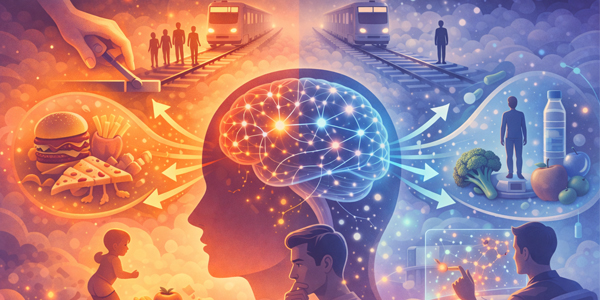
The brain creates neural networks that, through repeated activation, gradually fall below the threshold of conscious awareness. Many of these networks are associated with our mental and emotional responses. For example, when you see your favorite high-calorie food, one neural network may prompt you to think, “Go ahead and eat it.” At the same time, another network may become activated and tell you, “Resist the temptation – you’re on a diet.”
In other words, the adult brain has already developed numerous networks that can be activated simultaneously by the same stimulus, creating the experience of inner conflict. The network that ultimately prevails is the one that determines the reaction and the decision that follows.
What determines which neural network will dominate in a given situation is the intensity with which it engages the emotional centers of the brain. One of the most well-known experiments illustrating this principle involves two thought exercises.
In the first scenario, a person is asked to imagine observing a train traveling down a track toward four individuals who are unaware of the danger. Their deaths are inevitable unless the observer pulls a nearby lever that diverts the train onto a different track, where only one person is standing. In both cases, a death is unavoidable – either one person dies or four. More than 90 percent of participants readily decide to pull the lever, reasoning that it is better for one person to die than for four people to lose their lives.
The experimenters then present a second scenario. Once again, the participant imagines watching a train heading toward four unsuspecting people. This time, however, the participant is standing on a bridge above the tracks. In front of them stands another person whose body weight would be sufficient to stop the train if pushed onto the tracks. At this point, the percentage of people willing to sacrifice the individual drops dramatically, even though the fundamental dilemma remains the same: either one person dies or four.
When confronted with the first scenario, the brain tends to treat it as a purely logical problem, making the more rational choice relatively easy. In the second scenario, however, the brain no longer perceives the situation as an abstract exercise. The individual is required to participate directly, physically, and personally. As a result, not only are the regions associated with logic activated, but so are those linked to emotion.
Consequently, when we experience an internal conflict, the neural network that most strongly engages the emotional centers of the brain is often the one that prevails. This is one reason why people frequently have inaccurate expectations about how they would behave in certain situations. While imagining a scenario, the emotional component is often absent from the decision-making process. However, when the situation actually occurs and action is required, emotional systems become involved, often altering the decision entirely.
In rare cases where the emotional regions of the brain are damaged, individuals may become incapable of making decisions. Decisiveness becomes extraordinarily difficult because the rational mind continuously evaluates and re-evaluates different possibilities. Without the emotional processes that normally provide a final sense of certainty or commitment, reaching a decision can sometimes become nearly impossible.
Free Will and Unity: The Connection Between the Brain and the World
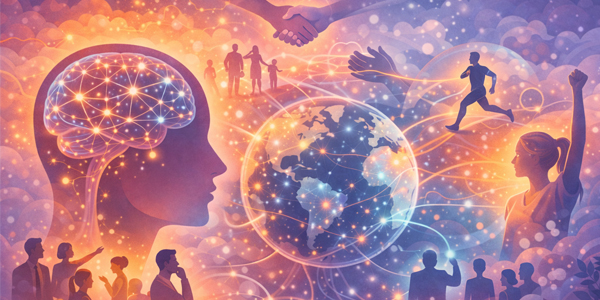
The world around an individual shapes the brain – its skills, beliefs, opinions, and values. In turn, these internal structures determine how a person responds to the world, and those responses go on to influence and transform the world itself. Depending on the culture and traditions in which a person is raised, the brain develops specific patterns of reaction. For example, an intense desire for fame may emerge if fame is regarded as one of the highest values within that environment.
The brain’s response to such conditioning is to seek ways of attaining what it has been taught to value. Through its efforts to achieve these goals, it alters the world around it. Those changes, in turn, influence both the individual and future generations. The human being – or the brain – is not something separate from the world. The world and the brain are part of the same dynamic, ever-changing reality.
The Social Brain: Why We See Stories Everywhere
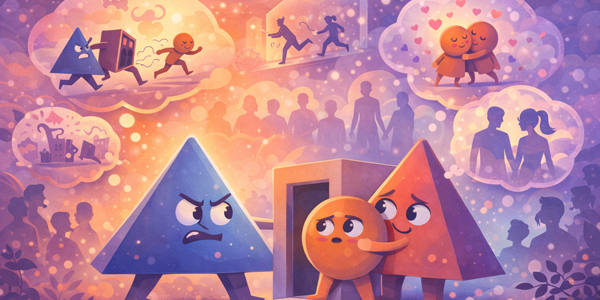
Human beings are inherently social creatures. The fact that we can watch movies in which the main characters are trains, rabbits, toys, or airplanes – and still perceive them as experiencing suffering, pursuing goals, and living meaningful lives – suggests that the human brain is fundamentally social in nature.
In 1944, psychologists Fritz Heider and Marianne Simmel created a short animated film. In it, two simple geometric shapes – a triangle and a circle – meet and begin moving around one another. Soon, a larger triangle appears on the scene and starts pushing and intimidating the smaller one. The circle quietly escapes and hides inside a rectangular enclosure, closing the door behind it, while the larger triangle drives the smaller one away.
The larger triangle then positions itself menacingly outside the rectangle where the circle is hiding. It breaks through the door and begins chasing the circle, which frantically searches for another way to escape. Just when the situation appears hopeless, the smaller triangle returns. It opens the door, and the circle rushes toward it. Together, they close the enclosure behind them, trapping the larger triangle inside.
Now confined, the larger triangle begins smashing angrily against the walls. Outside, the smaller triangle and the circle start moving around one another once again. When people watched this short film and were asked to describe what they had seen, they spoke of a love story, a conflict, a pursuit, and ultimately a victory.
The purpose of this experiment was to demonstrate how effortlessly our brains perceive social meaning in the world around us. All that reaches our eyes are moving shapes, yet we automatically infer intentions, motives, emotions, and narratives. The brain cannot simply observe movement without interpreting it through the lens of its own conditioning and programming, which has been shaped by the surrounding world.
This tendency lies at the root of countless stories and myths humans have created about the stars, the sky, trees, and nature as a whole. Considering that survival depends on making rapid judgments about who is a friend, who is a threat, what is beneficial, and what is dangerous, the brain’s inclination toward social interpretation appears entirely natural.
The infant brain is social as well, revealing that our social nature is not merely a product of experience but a quality deeply rooted in our biology. In one experiment involving infants less than a year old, researchers presented a puppet show in which one teddy bear played the role of a villain while another acted as the hero. After the performance, both bears were offered to the infants, who consistently reached toward the “hero.”
This mechanism, through which the brain searches for meaning in everything it encounters, is also essential for effective human communication. Our senses detect the nonverbal signals expressed through another person’s body language, while the brain interprets and assigns meaning to them. Without this ability, we would struggle to recognize sarcasm, irony, or subtle emotional cues. We would be unable to tell when someone is angry, happy, fearful, or sad.
Although we are rarely aware of it, the brain processes an extraordinary amount of information beneath the level of conscious awareness. This hidden processing makes communication with others far more efficient, intuitive, and meaningful.
Empathy: Why We Feel the Pain of Others
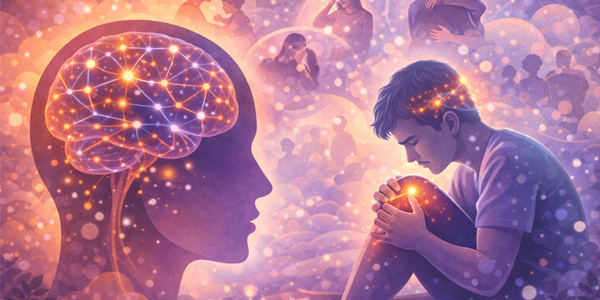
There is no single, isolated region of the brain responsible for processing pain. Instead, painful experiences activate several different brain areas that work together in a coordinated manner. This interconnected network is known as the pain matrix.
When you observe someone else experiencing pain, this pain matrix becomes activated in your own brain, causing you to experience a form of pain as well. If the pain you are witnessing is physical, the matrix is not activated in a way that produces the sensation of physical pain in your body. However, you do experience its emotional component. This phenomenon forms the foundation of empathy.
To empathize with another person literally means, in a neurological sense, to experience a version of their pain. This ability evolved because it enhances our chances of survival. When you possess a mechanism that allows you to “step into another person’s shoes,” it becomes much easier to predict what they are likely to do next. As we have already seen, the emotional dimension plays a crucial role in decision-making, and understanding another person’s emotional state provides valuable insight into their future behavior.
Who Am I? The Neurobiological Answer
Neurobiology tells a fascinating story about the self. It suggests that what we call the “self” is, in essence, a vast collection of millions of complex neural networks constantly responding to the world around them. It is a story of electrical impulses racing through delicate biological structures, giving rise to perception, emotion, decision-making, and our experience of reality itself.
The “self” is electricity and matter.
Read More:
- Why the Brain Searches for Meaning in Everything – The Scientific Explanation
- How Social Media Changes the Brain: Dopamine, Attention, and the Collapse of the Inner World
- How Consciousness Emerged: Why Humans Developed It and What It Means
- Inside the Human Connectome Project: Revealing the Brain’s Hidden Connections
- Free Will or Determinism: Do We Have Real Choice According to Physics and Neuroscience?
Author: Vasil Stoyanov