
In this article, we will explore a collection of short Zen stories – small parables carrying profound lessons. Some may make you smile, others may invite reflection, and a few might even change the way you see your everyday life.
1. Let Go of What You No Longer Carry
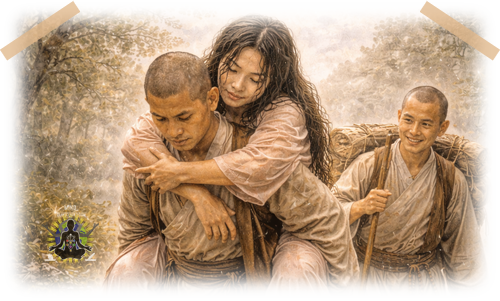
Once, Tanzan and Ekido were traveling together along a muddy road. Heavy rain was still falling.
As they came around a bend, they encountered a beautiful young woman wearing an elegant silk kimono. She needed to cross the muddy path but hesitated, unwilling to soil her fine clothing.
„Come along, young lady,“ said Tanzan immediately.
Without hesitation, he lifted her in his arms and carried her across the mud to the other side.
Ekido was shocked, but he remained silent. He said nothing for the rest of the day.
That evening, when they arrived at a temple where they would spend the night, he could no longer contain himself.
„We monks are not permitted to be close to women,“ he said to Tanzan. „Especially young and beautiful women. It is dangerous and contrary to our teachings. Ascetic discipline is an essential part of Buddhism. Why did you do that?“
Tanzan looked at him calmly and replied:
„I left the girl there hours ago. Are you still carrying her?“
The Lesson
Much of our suffering comes not from what happens to us, but from our inability to let go of what has already passed. We carry old arguments, mistakes, regrets, and judgments long after the event itself is gone.
Tanzan carried the girl across the road and then moved on. Ekido carried her in his mind for the rest of the day.
Zen reminds us that freedom often begins the moment we stop carrying what no longer exists.
2. The Overflowing Teacup
A European professor traveled to Japan to learn about Zen philosophy from a renowned Zen master.
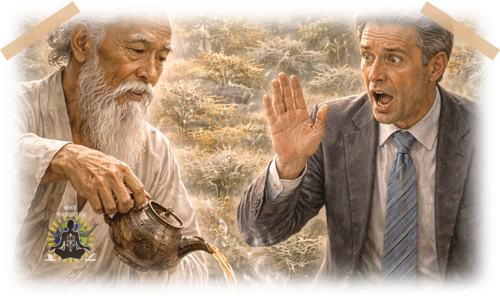
The professor sat down across from the master, eager to discuss Zen and understand its teachings. The master quietly began pouring tea into the professor’s cup.
The tea rose steadily until the cup was full.
Yet the master continued pouring.
Tea spilled over the rim and onto the table. It kept flowing, overflowing more and more until the professor could no longer remain silent.
„Stop!“ he exclaimed. „Can’t you see that the cup is already full? It can’t hold any more tea.“
The Zen master calmly replied:
„And how can I show you Zen when the mind you have brought here to discover it is already full of opinions and preconceptions?“
The Lesson
One of the central teachings of Zen is the importance of approaching life with a beginner’s mind. When we believe we already know everything, we leave no room for learning, growth, or genuine understanding.
Like the professor’s cup, our minds can become so full of assumptions, beliefs, and judgments that new wisdom has nowhere to enter.
Sometimes the first step toward understanding is not acquiring more knowledge, but emptying ourselves of certainty.
3. The Coffin
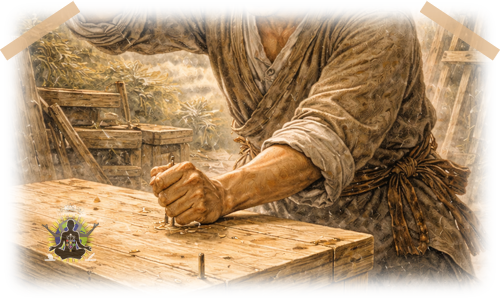
There was once an old farmer who had become so elderly that he could no longer work in the fields. Instead, he spent his days sitting on the porch, quietly watching his son labor from sunrise to sunset.
As the years passed, the son grew increasingly resentful. Every day, while working tirelessly in the fields, he would glance toward the porch and see his father sitting there.
„He just sits there all day and does nothing,“ he would think to himself.
With each passing day, his frustration grew stronger.
Finally, one day, his anger got the better of him.
He built a wooden coffin, carried it to the porch, and placed it in front of his father.
„Get in,“ he said.
The old man calmly climbed inside without protest.
The son closed the lid and began carrying the coffin toward a nearby hill. As he approached the top, he suddenly heard a gentle knocking from inside.
He stopped and opened the coffin.
His father looked up at him and said:
„I know you’re planning to throw me off the hill. But before you do, may I offer you a piece of advice?“
The son hesitated.
„Go ahead.“
The old man smiled and replied:
„Throw me off if you wish. But it’s a good coffin. Keep it. Your children may need it one day.“
The Lesson
The way we treat others often becomes the example from which future generations learn. Children absorb far more from our actions than from our words, and the attitudes we show toward our parents may one day be reflected back toward us.
This Zen story reminds us of the cyclical nature of human behavior. Kindness, respect, resentment, and cruelty rarely end with a single person – they tend to echo through generations.
Before judging those who came before us, it is worth remembering that one day we may stand exactly where they stand now.
4. When Hungry, Eat; When Tired, Sleep
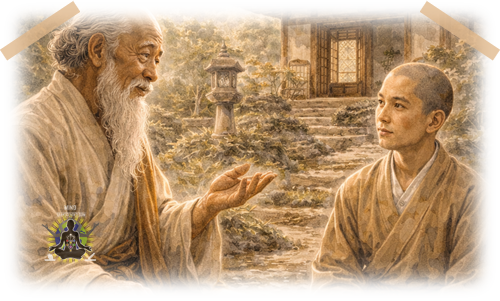
A Zen student once approached his master and asked him to explain the essence of Zen.
The master looked at him and replied:
„When you are hungry, eat. When you are tired, sleep.“
The student was disappointed by the answer.
„But doesn’t everyone do that?“ he asked.
„No,“ the master replied. „When most people eat, they do not simply eat. They think about ten thousand other things. When they sleep, they do not simply sleep. Their minds wander through countless dreams and worries.“
The Lesson
Zen teaches the art of being fully present. Most people spend their lives physically in one place while mentally somewhere else – replaying the past, worrying about the future, or imagining situations that do not exist.
The master points to a simple truth: peace is often found not by doing more, but by giving our full attention to what is already happening.
When you eat, simply eat. When you walk, simply walk. When you listen, simply listen.
The present moment is the only place where life actually exists, yet it is often the place we spend the least time.
5. The Wooden Bottle
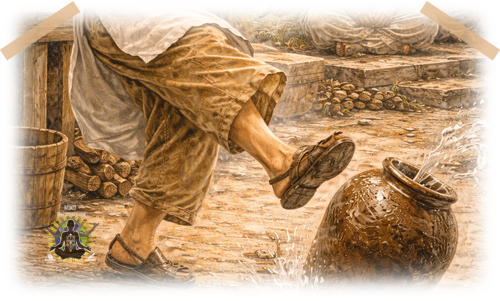
There once lived a Zen master who had become so respected that he attracted a great number of students. As he grew older, he decided to find a successor – someone capable of carrying on his teachings after he was gone.
To discover who among his students truly understood Zen, he devised a simple test.
One day, he placed a wooden bottle before him and addressed his disciples:
„Without making any assertion or denial, tell me – what is this?“
The senior monk stepped forward first. After a moment of reflection, he answered:
„It cannot be called a piece of wood.“
The master remained silent. He did not accept the answer.
A little later, the monastery’s cook approached. Without saying a single word, he kicked the bottle over and walked away.
The master smiled and immediately approved of him.
The Lesson
Zen often points beyond words and concepts. The senior monk tried to solve the master’s challenge through clever reasoning, but in doing so remained trapped within language and abstraction.
The cook, on the other hand, responded directly to reality itself. Rather than describing the object or debating its nature, he engaged with it immediately and without hesitation.
This story reminds us that wisdom is not always found in analysis. Sometimes our endless attempts to define, categorize, and explain reality prevent us from experiencing it directly.
Zen encourages us to encounter life as it is – not merely as an idea in our minds, but as a living reality unfolding in the present moment.
6. The Wild Strawberry
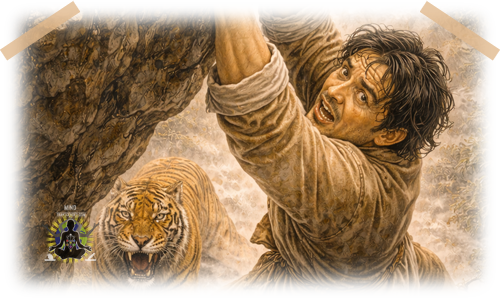
One day, while walking through the wilderness, a man suddenly came face to face with a fierce tiger.
Terrified, he turned and ran.
The tiger chased him relentlessly until he reached the edge of a steep cliff. Desperate to escape, the man grabbed hold of a vine hanging over the edge and lowered himself down.
There he hung, suspended above a deadly drop.
Above him stood the tiger, waiting.
As he clung to the vine, he noticed two mice emerging from a hole in the cliff face. One white and one black, they began steadily gnawing through the vine.
His situation seemed hopeless.
Above him was the tiger.
Below him was the abyss.
And the vine holding his life was slowly being chewed away.
Then, as he looked around, he noticed a ripe wild strawberry growing from the cliffside.
Stretching out carefully, he plucked it.
He placed it in his mouth.
It was unbelievably delicious.
The Lesson
This is one of the most famous Zen stories because it captures the human condition in a remarkably simple image. The tiger represents the dangers and uncertainties of life. The cliff symbolizes the inevitability of death. The two mice, often interpreted as day and night, constantly gnaw away at the time we have left.
Yet despite all of this, there is still the strawberry.
Most people spend their lives worrying about what might happen tomorrow or regretting what happened yesterday. Zen reminds us that life is happening now. Even in the midst of uncertainty, fear, and impermanence, there is still beauty to be experienced.
The strawberry symbolizes the present moment. No matter how fragile life may be, there is always something to appreciate, something to savor, and something worth being fully present for.
The man could not escape the tiger, the cliff, or the mice. But for one perfect moment, he tasted the strawberry – and that was enough.
7. The Enlightened Monk
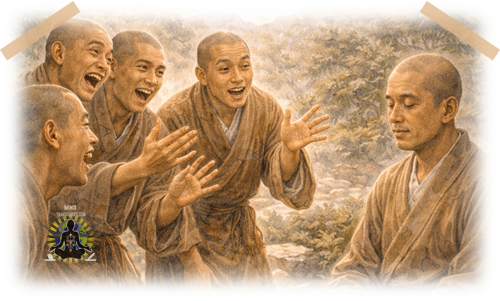
One day, the Zen master of a monastery announced that one of the younger monks had attained a high level of enlightenment.
The news spread quickly throughout the monastery. Curious and excited, several monks went to meet him.
„We heard that you have become enlightened,“ they said. „Is it true?“
„Yes,“ the monk replied.
The others looked at him with admiration.
„And how do you feel?“ they asked.
The monk smiled and answered:
„Miserable, as always.“
The Lesson
Many people imagine enlightenment as a permanent state of bliss, happiness, or emotional perfection. They assume that an enlightened person no longer experiences sadness, frustration, fear, or discomfort.
Zen challenges this assumption.
Enlightenment does not necessarily change the circumstances of life, nor does it magically erase every human emotion. Rather, it changes one’s relationship with those experiences. The enlightened person no longer fights reality, clings to pleasure, or resists discomfort in the same way.
The monk’s answer is humorous, but it points to a profound truth. Enlightenment is not about becoming someone else. It is about seeing reality clearly and accepting it as it is.
The weather still changes. The body still ages. Difficult emotions still arise.
What disappears is the illusion that life must be different before we can be at peace.
8. This Too Shall Pass
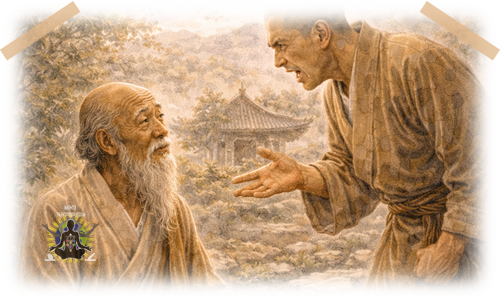
A student once went to his Zen master and complained:
„My meditation is terrible. I feel distracted all the time. My legs hurt, my mind won’t settle, and sometimes I keep falling asleep. It’s awful.“
The master listened quietly and then replied:
„It will pass.“
A week later, the student returned, this time glowing with excitement.
„My meditation is wonderful!“ he said. „I feel so peaceful, so alive, so present. Everything feels effortless. It’s amazing.“
The master smiled and gave the very same answer:
„It will pass.“
The Lesson
One of the deepest insights in Zen is the understanding of impermanence. Every experience, whether pleasant or unpleasant, eventually changes and fades away.
When we are suffering, we often believe the pain will last forever. When we are happy, we secretly hope the feeling will never end. Both assumptions lead to disappointment because neither reflects the true nature of reality.
The master’s response is not pessimistic. On the contrary, it is liberating. Difficult moments pass, but so do moments of joy, success, excitement, and comfort. Recognizing this helps us avoid becoming trapped by either despair or attachment.
Zen teaches us to appreciate every experience without clinging to it. The storm passes. The sunshine passes. The only constant is change itself.
When we truly understand this, we become less afraid of difficult times and less dependent on pleasant ones.
9. The Flag and the Wind
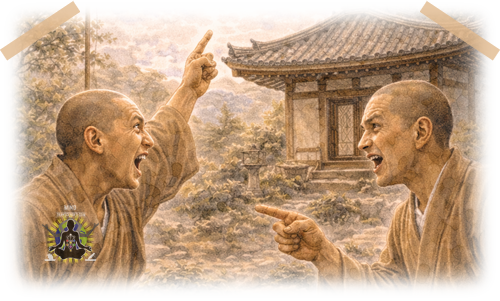
Two Zen students were standing near the monastery, watching a flag fluttering in the breeze.
„The wind is what is moving,“ said the first student confidently.
„No,“ replied the second. „The flag is what is truly moving.“
The two continued arguing, each convinced that he was correct.
As their debate grew more intense, a Zen master happened to walk by and overheard the discussion.
He stopped, listened for a moment, and then said:
„Neither the flag nor the wind is moving.“
The students looked at him in confusion.
The master continued:
„What is moving are your minds.“
The Lesson
Zen often challenges our habit of dividing reality into fixed categories and becoming attached to our interpretations of what we perceive. The two students were not really arguing about the flag or the wind. They were arguing about their own ideas.
The master’s response points to a deeper truth: much of what disturbs us does not come from the world itself, but from the thoughts, judgments, and stories we create about it. Our minds are constantly labeling, comparing, analyzing, and defending positions.
In many situations, the real conflict exists not in reality but in the interpretations we impose upon it. The world simply is. It is often our attachment to being right that creates unnecessary tension and confusion.
Zen invites us to notice the movement of the mind before becoming trapped within it. When we become aware of our thoughts instead of identifying with them, a deeper sense of clarity and peace begins to emerge.
10. The Scorpion
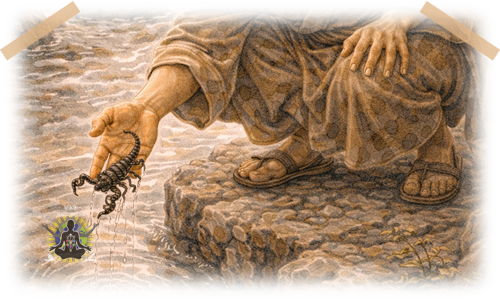
Two monks were washing their bowls in a river when they noticed a scorpion struggling in the water.
Without hesitation, one of the monks reached down, lifted the scorpion from the river, and placed it safely on a nearby rock.
As he did so, the scorpion stung him.
A short while later, the scorpion slipped back into the water and began drowning again.
Once more, the monk reached into the river and rescued it.
Again, the scorpion stung him.
The other monk watched this happen and finally asked:
„My friend, why do you keep saving the scorpion when you know it is in its nature to sting?“
The monk smiled and replied:
„Because it is in my nature to save.“
The Lesson
This story is not about allowing others to harm us without boundaries. Rather, it points to a deeper question: should we abandon our values simply because others act according to theirs?
The scorpion acts according to its nature. It does not know how to do otherwise. The monk, however, also acts according to his nature. Compassion is not something he practices only when it is convenient or rewarded. It is an expression of who he is.
Many people allow the behavior of others to determine their own. They respond to anger with anger, cruelty with cruelty, and selfishness with selfishness. In doing so, they gradually become shaped by the very qualities they dislike.
Zen teaches that true character is revealed when circumstances challenge it. The monk does not stop being compassionate simply because compassion causes discomfort.
The lesson is simple yet profound: do not allow the actions of others to dictate the kind of person you choose to be.
11. The Desire for Air
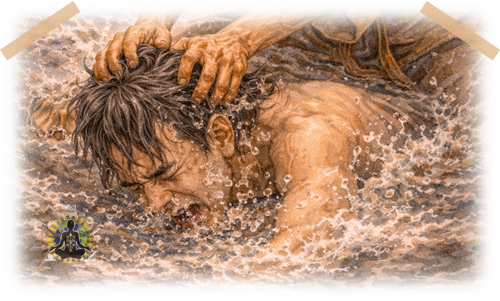
An old ascetic was standing beside a river when a young man, captivated by the presence and serenity he radiated, approached him.
„Wise elder,“ the young man said, „I see something extraordinary in you. You are not an ordinary man. I want to become your student so that I may discover what it is that you possess and radiate.“
Without saying a word, the old man suddenly stood up, grabbed the young man by the neck, dragged him into the river, and plunged his head beneath the water.
The young man struggled violently.
He kicked, thrashed, and fought desperately to free himself, but the old ascetic held him there.
After what felt like an eternity, the old man finally pulled him back to the surface.
The young man gasped desperately for air, coughing and struggling to catch his breath.
Only after he had calmed down did the old ascetic speak.
„Tell me,“ he asked, „while you were under the water, what did you desire more than anything else?“
„Air!“ the young man replied without hesitation.
The old man nodded.
„Good. Then go home and return to me when you want what I have as much as you wanted air.“
The Lesson
Many people say they want wisdom, enlightenment, peace, success, or truth. Yet often these desires are merely preferences rather than genuine commitments. We want them only as long as they do not require too much sacrifice, effort, or discomfort.
The old ascetic’s lesson is that profound transformation demands more than curiosity. It requires an intensity of purpose so powerful that it surpasses distraction, laziness, fear, and doubt. When a person truly longs for understanding with the same urgency that a drowning person longs for air, obstacles begin to lose their power.
Zen repeatedly emphasizes direct experience over intellectual interest. Reading about wisdom is not the same as seeking it. Admiring enlightened people is not the same as walking the path yourself.
The story reminds us that extraordinary results rarely come from casual desire. They arise from wholehearted dedication. When the search for truth becomes as essential as breathing, real transformation becomes possible.
12. First the Experience, Then the Method
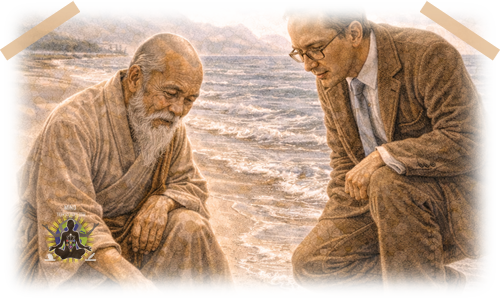
A university lecturer from the West found himself traveling through Japan and decided to take advantage of the opportunity to meet a Zen master.
As fate would have it, he encountered one sitting quietly on a beach.
After some casual conversation, the lecturer finally asked:
„Can you explain what Zen is?“
The master closed his eyes.
Five minutes passed in silence.
The lecturer’s patience quickly ran out.
„Why are you silent?“ he said irritably. „Is this what Zen masters do? Pretend to be mysterious and speak nonsense? Anyone could call himself a Zen master. I asked you a question, and you just sit there saying nothing.“
The master calmly picked up a stick and wrote a single word in the sand:
Meditation
The lecturer became even more frustrated.
„I ask you about Zen, and you write ‘meditation’ in the sand?“ he snapped. „Are you making fun of me? This is a complete waste of time.“
The master looked at him and replied:
„First, I showed you what Zen is, but you could not see it. Then you asked me the same question again, so I pointed to the method by which it may be discovered.“
The Lesson
One of the central themes of Zen is that truth cannot always be transmitted through words. Some experiences must be lived rather than explained. The lecturer expected a definition, a theory, or a philosophical system. Instead, the master offered direct experience through silence.
The problem was not that the answer was absent. The problem was that the lecturer was looking for it in the wrong place. His mind was searching for concepts while the master was pointing toward awareness itself.
When the lecturer failed to recognize the lesson contained in silence, the master offered him a second answer: meditation. Not because meditation is Zen itself, but because it is one of the paths through which a person may discover the reality to which Zen points.
Zen often distinguishes between the finger and the moon. Teachings, books, words, and methods are merely fingers pointing toward something deeper. The mistake is to become so focused on the finger that we never look at the moon.
Sometimes the answer we seek is already present before us. We simply lack the stillness required to notice it.
13. Beyond Coming and Going
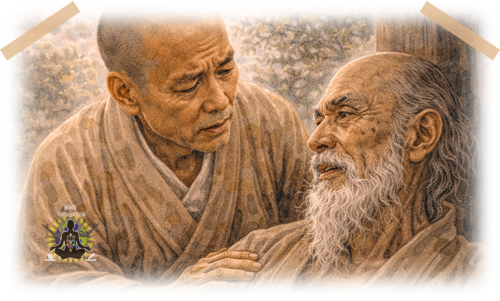
Shortly before the Zen master Ninakawa was about to die, another renowned Zen master, Ikkyū, came to visit him.
As they sat together, Ikkyū asked:
„Shall I accompany you?“
Ninakawa replied calmly:
„I came here alone, and I will leave alone. What help could you possibly give me?“
Ikkyū smiled and said:
„If you truly believe that you come and go, that is your illusion. Let me show you the path beyond coming and going.“
With those words, Ikkyū revealed the truth so clearly that Ninakawa simply smiled, gently shook his head, and passed away.
The Lesson
Zen teachings often challenge the way we think about life and death. Most people see themselves as separate individuals who arrive in the world at birth and depart from it at death. From this perspective, existence appears as a journey with a clear beginning and a clear end.
Zen invites us to look deeper.
Who is it that comes? Who is it that goes? When we examine our experience closely, we discover that everything is constantly changing. Thoughts arise and disappear. Emotions come and go. The body changes from moment to moment. Even the person we believe ourselves to be is never exactly the same from one instant to the next.
For Zen, the deepest reality lies beyond these changing forms. It is not something that is born, nor something that dies. It exists prior to all distinctions, including life and death, arrival and departure.
Ikkyū’s final teaching to Ninakawa points toward this timeless dimension of existence. The realization was not expressed through a long philosophical explanation but through a direct insight that transcended words.
Ninakawa’s smile suggests that he understood.
When the illusion of coming and going disappears, there is nothing left to fear. Life and death become movements on the surface of something far deeper – something that has never arrived and can never leave.
- 5 Zen Stories from Ikkyū Sōjun, the Rebel Monk Who Defied Tradition
- Here and Now: Zen Stories That Reveal the True Nature of Life
- The Story of Nagarjuna and the Thief
- 3 Rare Eastern Spiritual Stories That Can Change the Way You See Life
Author: Vasil Stoyanov