Introduction: The Philosopher Who Changed the Way Humanity Thinks
Plato is one of the most influential figures in the history of human thought because his philosophy is not limited to isolated questions about knowledge, morality, or politics. He attempts to build a comprehensive understanding of reality that connects the visible world, the human soul, justice, love, the state, and the eternal order of being. For more than two millennia, philosophers, theologians, scientists, and mystics have returned to his dialogues, because the questions he raises remain at the core of humanity’s search for truth.
For Plato, philosophy is not merely an intellectual activity or a contest of arguments. It is a transformative path through which a person frees themselves from the illusions of the sensory world and gradually directs their soul toward what is eternal, true, and good. The true philosopher is not the one who has accumulated the most information, but the one who has turned their inner gaze from shadows toward the light.
Many of Plato’s ideas may seem abstract, but behind them lies a deep existential concern. What is truly real? Can a person attain certain knowledge? What makes a life good? Why is justice more valuable than success and power? What is the fate of the soul, and how can love elevate a person beyond their limited existence?
The Historical World in Which Plato’s Philosophy Was Born
Plato was born around 427 BCE in Athens, during a period of political conflict, cultural flourishing, and deep social instability. Athens was a city of democracy, theater, art, and philosophical debate, but also a society shaken by wars, struggles for power, and moral uncertainty. The Peloponnesian War between Athens and Sparta left severe consequences and undermined the belief that political success is necessarily based on justice and reason.
Plato came from an aristocratic family and was likely prepared from a young age for a public and political role. However, events in Athens gradually convinced him that politics without philosophy easily turns into a struggle for influence, manipulation, and personal gain. He saw how democratic institutions could be used by eloquent individuals who attract the majority without necessarily serving the truth.
The most profound event that shaped his philosophical path was the death sentence of Socrates. For Plato, the fact that society could condemn a just and wise man revealed the tragic gap between political power and true knowledge. After the death of his teacher, he began to search even more insistently for an answer to how both the human soul and the state should be structured so that they do not fall under the rule of ignorance and passions.
Socrates as Teacher and Spiritual Center of the Platonic Dialogues
Socrates is the central figure in almost all of Plato’s early and middle dialogues. He left no written works of his own, so much of what we know about his philosophy comes through the texts of his student. Yet Socrates in the dialogues is not only a historical figure but also a symbol of the philosophical life.
Socrates does not present himself as a wise man who possesses all the answers. On the contrary, his wisdom begins with the recognition of his own ignorance. He asks questions, exposes contradictions in the beliefs of his interlocutors, and forces them to realize that the words they use with confidence often conceal vagueness.
This approach has deep spiritual significance. A person cannot begin the journey toward truth while believing they already possess it. Acknowledging ignorance is not a defeat, but a liberation from the illusion that our opinions are sufficient.
From Socrates, Plato inherits the conviction that caring for the soul is more important than accumulating wealth, prestige, and power. A person may be successful in the eyes of society and yet live an inwardly ruined life. True philosophy begins when the question “How do I appear to others?” is replaced by “What has my character become?”
Dialogue as a Form of Philosophy
Plato does not present his ideas in the form of dry treatises, but writes dialogues in which different characters argue, question, err, and gradually reach deeper understanding. This literary form is not accidental. It shows that truth should not simply be delivered as ready-made information, but must be discovered through living thought.
The reader of Plato does not always receive a final answer. Some dialogues end in apparent impasse, where the participants realize they cannot give a satisfactory definition of virtue, justice, or knowledge. This unfinished state has an educational purpose, as it encourages us to continue the philosophical conversation within ourselves.
Dialogue implies that no person is self-sufficient in the search for truth. We need the questions of others, their objections, and the ability to see our own beliefs from different perspectives. Philosophy is not a monologue of the ego, but a shared movement toward greater clarity.
This style also protects Plato’s thought from excessive simplification. He allows different voices to express their positions, and sometimes even the weakest or most problematic argument contains a grain of truth. Thus, the reader is compelled to think, rather than merely repeat the author’s conclusions.
The Theory of Forms and the Existence of Invisible Reality
The most famous part of Plato’s philosophy is the theory of Forms, also called Ideas. According to him, the sensory world we see around us is changeable, imperfect, and temporary. Everything material arises, develops, decays, and disappears, and therefore cannot serve as the foundation for absolute and unchanging knowledge.
Behind the multitude of particular things, Plato posits the existence of eternal and perfect Forms. There are many beautiful objects, faces, and actions, but all are beautiful to different degrees and in different ways. Beauty itself, however, is not any one of them, but the eternal Form through which we recognize beauty in its various manifestations.
Similarly, there exist Forms of justice, goodness, equality, the circle, and all fundamental essences that cannot be reduced to concrete sensory examples. A drawn circle is never mathematically perfect, yet the mind can grasp the perfect circle. This shows that reason has access to a reality that transcends visible objects.
For Plato, Forms are not merely human concepts invented for convenience. They are more real than sensory things because they are unchanging, eternal, and independent of individual opinions. The material world is real only insofar as it participates in them and reflects them imperfectly.
The Visible and the Intelligible World
Plato divides reality into two main levels. The first is the visible world, perceived through the senses, where everything is in constant motion. The second is the intelligible world, revealed through reason and containing the eternal Forms.
The senses give us opinions because the objects we observe are constantly changing. Something may appear beautiful to one person and ugly to another, large in comparison to one object and small in comparison to another. Sensory perception depends on perspective, conditions, and time.
Reason, however, strives for what remains the same. Mathematical truth does not change according to the observer’s opinion. Justice may be applied imperfectly, but the very question of what is just presupposes a standard that transcends the momentary desires of the majority.
This division does not mean that one should simply despise the material world. Rather, it should be used as a starting point for deeper knowledge. Visible beauty can awaken a longing for beauty itself, and a just action can direct the mind toward the eternal Form of justice.
The Allegory of the Cave and the Captivity of Human Consciousness
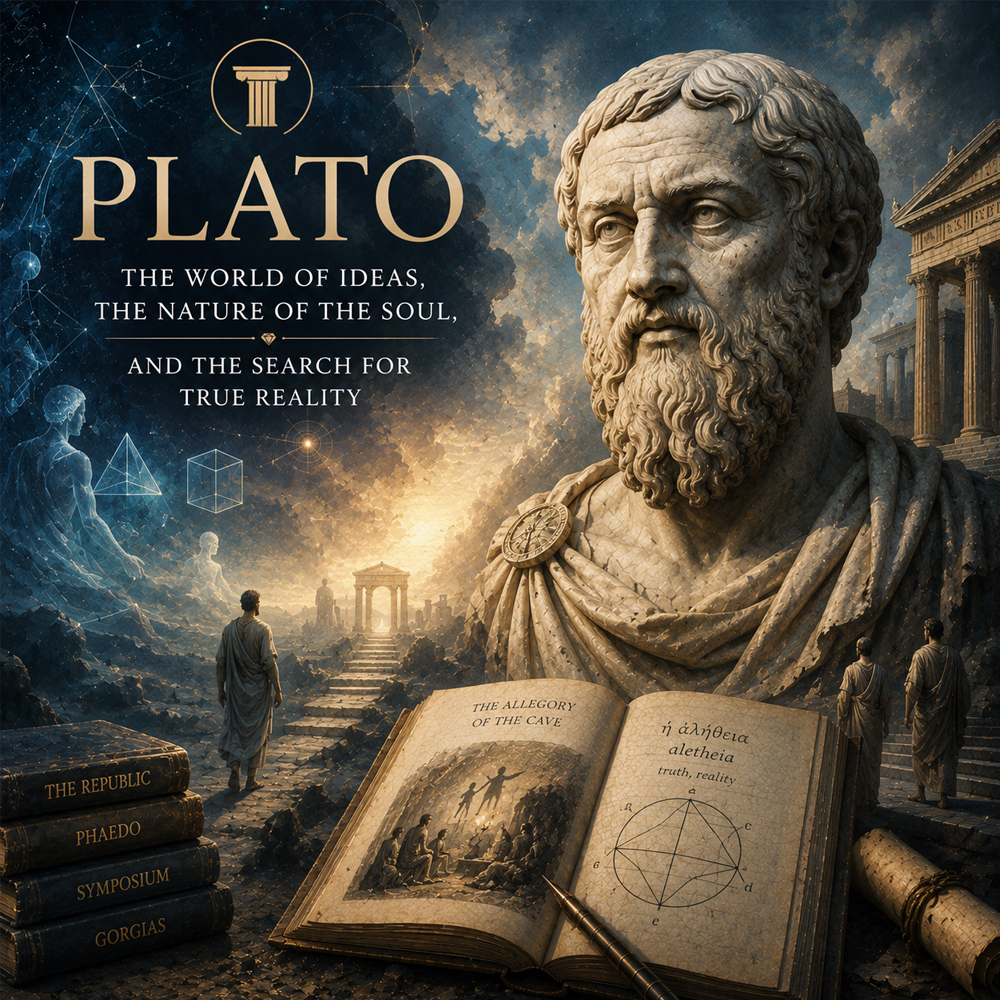
One of the most powerful images in all of philosophy is Plato’s allegory of the cave, presented in The Republic. Plato asks us to imagine people who have been chained since childhood in an underground cave, able to look only at the wall in front of them. Behind them burns a fire, and between the fire and the prisoners pass various objects whose shadows are projected onto the wall.
For the prisoners, these shadows are the whole of reality, because they have never seen anything else. They give them names, argue about them, and consider the wisest person to be the one who best predicts their movement. They do not realize that what they take as real is only a reflection of a deeper reality.
If one of the prisoners is freed and forced to turn toward the fire, the light will initially cause pain to his eyes. Leaving the cave will be even more difficult, as sunlight will blind him. Gradually, however, he will begin to see real objects, the sky, and finally the sun itself as the source of light.
This allegory describes philosophical awakening. A person lives among opinions, cultural habits, desires, and images that they take for the whole of reality. Truth is initially painful because it destroys the familiar and requires us to abandon our certainty.
The Return of the Philosopher to the Cave
The story of the cave does not end with the philosopher’s personal liberation. The freed individual must return to the other prisoners and tell them what he has seen. But when he re-enters the darkness, his eyes will temporarily be unable to distinguish the shadows as well as before.
Others may consider him confused or damaged by his journey outside. They will prefer the familiar world of shadows and may even resort to violence against the one who tries to free them. In this image, one can easily recognize the fate of Socrates, condemned by those he sought to help.
For Plato, philosophical knowledge carries responsibility. The wise person should not simply escape society and enjoy personal contemplation. They must return and serve the community, even when faced with misunderstanding.
This shows that Plato’s philosophy is not an individualistic spirituality. Knowledge of the good must be transformed into just action. The person who has seen the light has an obligation to help others turn toward it.
The Form of the Good as the Highest Reality
At the summit of Plato’s philosophy stands the Form of the Good. It is not just one idea among others, but the source through which all other Forms become knowable and real. Plato compares it to the sun, which illuminates visible objects and makes sight possible.
Just as the eye cannot see without light, reason cannot know without the Good. The Good gives order, meaning, and truth to all reality. It is not merely a moral rule, but the highest principle of being.
People often pursue wealth, pleasure, or power, believing these will make them happy. But without understanding the Good, these things can be used destructively. Knowledge without the Good can become cunning, and power without the Good can become tyranny.
Thus, the philosopher does not seek knowledge of isolated facts alone. They strive to see how everything is connected to the highest meaning. To know the Good is to understand not only what exists, but also how one should live.
The Nature of the Human Soul
Plato sees the soul as the true center of the human being. The body is temporary, changeable, and subject to material needs, while the soul possesses the ability to know eternal truths. It does not fully belong to the sensory world, because within it there is a longing for the unchanging and the perfect.
In various dialogues, Plato presents arguments for the immortality of the soul. Our ability to recognize absolute equality, beauty, or justice suggests that the soul was somehow connected to these Forms before earthly life. Learning can therefore be seen as recollection of truths that the soul already knows deep within.
This teaching changes the understanding of human life. Earthly existence is not our entire reality, but a period of testing, education, and orientation. A person must care for their soul, because its condition is more important than external success.
Death is not necessarily annihilation, but the separation of the soul from the body. The philosophical life is preparation for this separation, as it teaches a person not to be entirely governed by bodily desires. This does not mean hatred of life, but liberation from the slavery of the transient.
The Three Parts of the Soul
In The Republic, Plato divides the human soul into three parts: rational, spirited, and appetitive. The rational part seeks truth and should govern the whole person. The spirited part is associated with courage, anger, honor, and the ability to defend what one believes is right.
The appetitive part includes bodily desires, the pursuit of pleasure, wealth, and possession. These desires are not necessarily evil, but if they gain complete control, the soul becomes chaotic. A person may know what is good and yet be carried in another direction by uncontrolled passions.
Justice within the individual arises when each part performs its proper function. Reason governs, the spirited element supports it, and desires are kept in measure. This is not suppression of human nature, but its harmonization.
Injustice is an inner disintegration in which lower desires seize power. A person may appear outwardly free and successful, but if they are a slave to their passions, they live in spiritual disorder. True freedom is the order of the soul, not the ability to follow every impulse.
The Chariot of the Soul
In the dialogue Phaedrus, Plato uses another famous image to describe the soul. It is depicted as a chariot driven by a charioteer and pulled by two horses. The charioteer symbolizes reason, while the two horses represent different forces within human nature.
One horse is noble, disciplined, and oriented toward honor and the good. The other is unruly, rebellious, and driven by passions. The task of the charioteer is not to destroy the horses, but to guide them so that the chariot rises toward the contemplation of truth.
This image shows how complex the inner work of a human being is. Reason does not rule automatically, but must develop strength, clear direction, and self-discipline. If it loses control, different desires begin to pull the soul in opposite directions.
At the same time, Plato does not present the human being as pure reason without passions. The energy of the soul comes precisely from the forces symbolized by the horses. The goal is not destruction, but transformation and harmony.
Eros as a Longing for Beauty and Immortality
In the dialogue Symposium, Plato explores the nature of love, or Eros. It is not presented merely as romantic or physical attraction, but as a deep longing for beauty, goodness, and immortality. A person loves because they feel a lack and strive toward what can make them more whole.
Eros is a mediator between poverty and wealth, between ignorance and wisdom. It does not fully possess beauty, but desires it. In the same way, the philosopher is neither completely ignorant nor perfectly wise, but someone who loves and seeks wisdom.
Plato describes a spiritual ascent, often called the ladder of love. A person is initially attracted to the beauty of a single body, but gradually realizes that beauty appears in many bodies. Then they turn toward the beauty of souls, laws, knowledge, and finally toward Beauty itself.
This does not mean rejecting personal love, but expanding and purifying it. Physical attraction can be the beginning of a path that leads to the contemplation of spiritual beauty. Love becomes a force that elevates a person from the particular to the universal.
Knowledge as Recollection
In the dialogues Meno and Phaedo, Plato develops the idea that true learning is recollection. The soul has contemplated the Forms before its embodiment, but after birth it forgets this knowledge. Properly asked questions can gradually awaken this hidden understanding.
This idea is illustrated through a conversation with an uneducated boy who, with the help of Socratic questioning, arrives at a geometric truth. Socrates does not give him the solution directly, but guides him so that he recognizes the correct answer himself. This is meant to show that knowledge is not mechanically inserted into the soul from outside.
Education, according to Plato, is not the filling of an empty vessel. It is the turning of the soul toward the direction in which it can see the truth. The teacher does not create sight, but helps the student turn toward the light.
This understanding remains highly relevant today. True education should not produce people who merely memorize information. It should develop the ability for independent thinking, recognition of the good, and inner transformation.
Justice in the Individual and the State
In The Republic, Plato examines what justice is and why a person should be just even when they could act unjustly without punishment. To clarify the issue, he compares the structure of the human soul with the structure of society. The state is like an enlarged image of the individual.
Plato divides the ideal society into three main groups. The ruling philosophers correspond to reason, the guardians and warriors to the spirited part, and the producers to the appetitive part. Justice arises when each group fulfills its proper role and does not attempt to take over another’s function.
This theory may seem too rigid from a modern perspective, but its core idea is psychological. Plato believes that social disorder arises from the same confusion that destroys the individual. When the desire for wealth or power governs instead of reason, both the soul and the state fall into disintegration.
Justice, therefore, is not merely external obedience to laws. It is harmony, in which each force is placed in the right relation to the whole. A person is just when they are inwardly ordered, and a state is just when it is governed by knowledge of the common good.
The Philosopher-King
One of Plato’s most famous and controversial ideas is that states will not be freed from evil until philosophers become rulers or rulers genuinely begin to philosophize. This does not mean that anyone familiar with philosophical terminology is fit for power. Plato refers to a person who has devoted their life to truth and the good.
An ordinary politician often seeks popularity, wealth, or personal power. The philosopher-king must rule not because they crave the position, but because they understand the just order and are willing to serve. It is precisely their reluctance to use power for personal gain that makes them suitable for it.
Plato realizes that those who most strongly desire power are often the most dangerous rulers. The tyrant sees the state as a means to satisfy personal passions. The philosopher sees governance as a heavy responsibility toward the whole.
Here again, knowledge and morality meet. It is not enough for a ruler to be intelligent, because intelligence can serve evil. They must be transformed by knowledge of the good and have ordered their own soul before attempting to order society.
The Critique of Democracy
Plato is known for his critique of democracy, shaped largely by the political experience of Athens and the condemnation of Socrates. He sees democracy as a system that places excessive emphasis on freedom without always requiring knowledge, discipline, and inner measure. When all desires are treated as equally valid, society may lose the ability to distinguish the good from the merely pleasant.
Plato compares the democratic state to a colorful marketplace of different ways of life. At first glance, it appears attractive because it allows great diversity. But without inner order, freedom can gradually turn into chaos.
In such chaos, people begin to long for a strong leader who promises order and protection. Thus, according to Plato, democracy can degenerate into tyranny. The tyrant initially presents himself as a defender of the people, but gradually destroys the freedom he claims to protect.
This critique should not be understood as a rejection of all democratic governance. It is a warning that political freedom cannot endure without education, virtue, and the capacity for rational judgment. A society is free only if its citizens are not slaves to their own passions and manipulation.
The Tyrant as the Most Unfree Person
For Plato, the tyrant appears powerful outwardly, but is in fact the most unfree person. He may command armies, punish enemies, and possess immense wealth, but inwardly he is ruled by insatiable desires and fear. The more power he gains, the more he fears losing it.
The tyrannical soul lacks inner order. Reason has become a servant of passion and uses its intelligence to justify violence and deception. Such a person cannot experience true satisfaction, because every fulfilled desire gives rise to another.
Plato shows that injustice harms above all the person who commits it. Outwardly, he may escape punishment, but inwardly he becomes divided, suspicious, and dependent. Thus, the greatest punishment for evil is the very condition of the soul that evil creates.
This idea lies at the heart of Platonic ethics. Justice is not valuable only because it brings social approval. It is the health of the soul, while injustice is its disease.
Education as the Turning of the Soul
In the ideal state, education plays a central role because it determines what kind of people will govern and what desires will dominate society. Plato does not understand education merely as professional training. It must shape character, taste, reason, and one’s relationship with truth.
Music, poetry, physical training, mathematics, and dialectic perform different functions in human development. The body must be disciplined, the emotions educated, and the mind gradually directed from concrete things toward abstract truths. The goal is not the accumulation of skills, but the harmonious formation of the soul.
Plato is deeply sensitive to the influence of the stories a society tells. Myths, poetry, and art can shape young people’s ideas about the gods, heroism, fear, and virtue. For this reason, he believes that culture is never completely neutral.
His approach to controlling poetry is controversial, but behind it lies an important question. How do the images and stories we constantly encounter transform our character? Plato understands that the soul is educated not only through arguments, but also through what it loves, admires, and repeatedly encounters.
Plato and the Nature of Art
Plato’s relationship with art is complex. On the one hand, he uses myths, dramatic imagery, and literary mastery, making him one of the great writers of antiquity. On the other hand, in The Republic, he criticizes imitative art for being removed from the truth.
If a material object is an imperfect reflection of an eternal Form, then an artistic representation of that object is a reflection of a reflection. An artist can depict a bed without possessing the knowledge of the carpenter who makes it or the philosopher who understands its essence. Art can therefore create the appearance of knowledge without genuine understanding.
Plato also worries that tragedy and poetry stir passions that a rational person should govern. When spectators surrender themselves to another person’s grief, anger, or desire, they may strengthen the same forces within their own souls. Art therefore possesses immense moral power.
Yet this criticism reveals precisely how seriously Plato takes art. He does not consider it an insignificant form of entertainment, but a force capable of shaping societies and souls. The question for him is not whether art has influence, but toward what that influence is directed.
The Cosmos as a Living and Rational Order
In the dialogue Timaeus, Plato presents a cosmological account of the creation and order of the universe. The cosmos is not meaningless chaos, but an ordered whole shaped according to eternal models. A divine craftsman, known as the Demiurge, does not create the world out of absolute nothingness, but orders preexisting matter according to the Forms.
The Demiurge is good and therefore desires the world to be as perfect as possible. The cosmos is described as a living being possessing soul and reason. This picture shows that, for Plato, nature is permeated by order, proportion, and intelligence.
The human soul is connected to the cosmic soul and can discover within itself the same rational structures. The study of mathematics, the movement of celestial bodies, and the harmony of nature is not merely a scientific activity. It possesses spiritual value because it attunes the human mind to the order of the whole.
Plato’s cosmology exerted enormous influence on later philosophy and theology. The idea of a rationally ordered universe that can be understood through mathematical relationships would remain important to the development of science. Even when his specific cosmological views were abandoned, the conviction that nature possesses a rational structure continued to live on.
Myths as the Language of the Inexpressible
Despite his devotion to reason, Plato frequently uses myths. He tells stories about the fate of the soul after death, the original division of human beings, Atlantis, the chariot of the soul, and the choice of a new life. These stories should not be understood only as literal descriptions.
Myth appears where logical argument reaches its limits. It does not replace reason, but helps direct it toward realities that are difficult to contain within precise definitions. An image can awaken an intuitive understanding that remains inaccessible to dry proof.
Plato knows that the human soul is not moved by logic alone. It needs symbols, examples, and stories that connect an idea with imagination and emotion. His philosophy therefore combines rigorous dialectical analysis with poetic power.
This combination is one of the reasons his dialogues continue to have such a strong effect. They speak not only to reason, but to the entire human being. Plato does not merely explain philosophy; he creates an experience of philosophical searching.
The Academy and the Birth of the Philosophical Community
Plato founded a school in Athens known as the Academy, which became one of the most important centers of ancient thought. It was not a university in the modern sense, but a community devoted to philosophy, mathematics, astronomy, politics, and the study of nature. Thinkers who would have an enormous influence on history were educated there, including Aristotle.
The Academy embodies the conviction that philosophy requires prolonged study and a shared life of thought. Wisdom is not achieved through a brief moment of inspiration, but through years of discipline, dialogue, and investigation. A person must gradually prepare the soul for higher truths.
Mathematics holds a particularly important place because it carries the mind beyond the sensory world. The geometrical figure studied by the mathematician is not the particular imperfect drawing, but the ideal structure grasped by reason. Mathematics therefore prepares the soul for the philosophy of Forms.
The Academy also demonstrates that knowledge is a communal endeavor. Truth does not belong to an individual as private property. It is sought through generations of thinkers who debate, correct one another, and continue the questions of their teachers.
Plato’s Attempt to Unite Philosophy and Politics
Plato was not satisfied with theoretical reflections on the ideal state alone. Tradition tells of his journeys to Sicily and his attempts to influence the government of Syracuse. He hoped that a young ruler could be educated in philosophy and transformed into a more just leader.
These attempts ended in disappointment and revealed the difficulty of applying ideals to real political life. Power, personal ambition, and conflicts within the royal court do not easily submit to philosophical principles. A person who possesses power does not automatically become wise merely because they have heard the truth.
This experience probably deepened the realism of Plato’s later thought. In the dialogue Laws, he proposes a more practical model of government in which good laws and institutions play a greater role. The ideal of the philosopher-king remains, but there is a stronger recognition of the limitations of human nature.
This history reveals an enduring difficulty. Philosophy seeks truth and goodness, while politics often operates through compromise, interest, and force. Plato never abandons the conviction that the two must be united, but his personal experience demonstrates how difficult this is.
Plato’s Influence on Christianity
Although Plato lived centuries before the emergence of Christianity, his ideas had an enormous influence on Christian philosophy and theology. The distinction between the visible and invisible worlds, the belief in the immortality of the soul, and the pursuit of the highest Good created a language through which many Christian thinkers expressed their faith.
Neoplatonism, developed later through thinkers such as
There are, of course, important differences between Plato and Christianity. The Christian faith places a strong emphasis on creation, the Incarnation, the resurrection of the body, and the personal relationship between God and humanity. Platonic philosophy often views the body and matter with greater suspicion.
Despite these differences, Platonism gave Christian thought a powerful metaphysical framework. It helped express the idea that the visible world does not exhaust reality and that the human soul is directed toward an eternal source of truth and goodness. This influence continues to be felt in the Western spiritual tradition today.
Plato and the Modern World of Images and Shadows
The allegory of the cave appears especially relevant in the modern age. People today spend an enormous part of their lives surrounded by screens, advertisements, social media, political messages, and carefully selected images. They often do not encounter reality directly, but rather interpretations, filters, and shadows of it.
Like the prisoners in the cave, people can argue fiercely about images without asking who creates them or what lies behind them. Popularity is easily confused with truth, visibility with value, and repetition with knowledge. Plato’s question of whether we are looking at things themselves or only at their shadows becomes increasingly important.
Philosophical liberation today requires not only access to information, but the ability to think critically. A person may be overwhelmed by facts and still remain inside the cave if they cannot distinguish truth from manipulation. The quantity of information does not guarantee wisdom.
Plato would remind us that turning toward the light can be painful. Questioning the beliefs of our own group, our desires, and the image we have created of ourselves requires courage. Without this turning, however, freedom remains nothing more than movement among shadows.
The Relevance of Plato’s Critique of Desire
Modern culture often presents freedom as the ability to pursue every desire. The more choices, pleasures, and possessions a person has, the freer they are assumed to be. Plato, however, would question this understanding.
If our desires constantly multiply and each one demands satisfaction, we do not become free, but dependent. We begin to serve appetites that can never be completely satisfied. External abundance may conceal profound inner poverty.
True freedom, according to Plato, requires reason to order desires according to the Good. This does not mean a life without pleasure, but the ability to distinguish which pleasures strengthen the soul and which destroy it. Measure is a condition of freedom, not its negation.
This idea is especially important in a society that continually creates new needs. Advertising, social comparison, and the pursuit of recognition can keep the soul in a permanent state of dissatisfaction. Platonic philosophy offers liberation through turning away from endless consumption and toward what possesses genuine and lasting value.
Philosophy as Preparation for Death
In Phaedo, Socrates says that true philosophers practice dying. This statement may sound grim, but its meaning is not a rejection of life. The philosopher learns to free the soul from absolute dependence on the body, fear, and material attachments.
Death reveals the limits of all external achievements. Wealth, fame, and social status cannot be preserved forever. If a person has built their entire identity upon them, the thought of death will inevitably fill them with terror.
The philosophical life seeks what death cannot easily render meaningless. Truth, virtue, and the condition of the soul possess a deeper value than temporary acquisitions. Caring for the soul is therefore preparation for facing death without the feeling that we have missed the entire meaning of life.
Socrates calmly accepts his own death because he believes injustice is more terrible than dying. It is better for a person to suffer evil than to become unjust themselves. In this choice, Platonic philosophy is transformed from theory into testimony.
Why Plato Continues to Be Read
Plato continues to be read because his questions do not belong only to ancient Athens. What is reality? How can we distinguish knowledge from opinion? What is justice? How should a person be educated? Who deserves to govern, and how does power corrupt the soul?
These questions appear in every age in new forms. Modern science changes our understanding of nature, but it does not eliminate the question of what makes knowledge true. Democratic societies grant political rights, yet continue to struggle with manipulation, ignorance, and populism.
Plato is also important because he refuses to separate intellectual life from moral life. For him, it is not enough to think correctly if we live unjustly. Truth must transform character, or else it remains incomplete.
His dialogues also teach us intellectual humility. They reveal how easily people use words such as goodness, freedom, love, and justice without having examined their true meaning. To read Plato is to allow his questions to destroy our false certainty.
Plato’s Legacy
Plato’s influence on Western civilization is so great that almost every major field of philosophy bears traces of his thought. Metaphysics, epistemology, ethics, political philosophy, aesthetics, and the philosophy of education continue to discuss questions he formulated with extraordinary power. Even philosophers who reject him often think within a space he helped define.
Aristotle developed his own philosophy through a critique of the theory of Forms. The Neoplatonists deepened the mystical and metaphysical aspects of Plato’s thought. Christian, Islamic, and Jewish philosophers used Platonic ideas in their attempts to unite reason with revelation.
In later centuries, Plato inspired Renaissance thinkers, idealists, Romantics, mathematicians, and political philosophers. His idea that the visible world expresses a deeper order found different reflections in science, art, and spirituality. Even modern debates about universals, consciousness, and mathematical objects often repeat Platonic questions in new forms.
His legacy is not a ready-made system that must simply be accepted. It is a living challenge to think beyond the immediate, to question opinion, and to seek the relationship between truth, goodness, and beauty. Plato remains not only a historical figure, but a conversation partner for every generation attempting to understand itself.
Conclusion: Plato and the Turning of the Soul Toward the Light
Plato is a philosopher of turning. He believes that the human soul is not entirely blind, but often looks in the wrong direction. It is turned toward the shadows of pleasure, fame, power, and public opinion, while the light of truth remains behind it.
Philosophy does not place sight into the eyes of the soul, but teaches it how to turn. This movement is difficult because it requires us to leave the familiar behind and acknowledge that many of our confident beliefs may be nothing more than shadows. Yet it is precisely within this difficulty that true freedom begins.
For Plato, knowledge, morality, and spiritual life cannot be separated. To know the Good means gradually transforming oneself in accordance with it. A person who speaks beautifully about justice while living unjustly has not yet truly understood it.
Plato reminds us that the visible world does not exhaust reality, that the soul is more than its temporary desires, and that love can become a path toward eternal beauty. He confronts us with the question of whether we are prepared to leave our own cave, endure the pain of the light, and return to others not with pride, but with responsibility.
That is why Plato remains one of the most profound philosophers in history. He does not merely offer a theory of the invisible world, but a call to inner awakening. His philosophy begins with the questions of Socrates, passes through the shadows of the cave, and ends with the eternal longing of the soul for truth, goodness, and beauty.
- Plato: The World of Forms, the Soul, Life, and Human Nature
- Plato: 50 Timeless Quotes on Wisdom, Justice, and the Human Soul
- Aristotle: The Four Causes, the Nature of the Universe, and the Divine
- Plotinus: Beyond the Spiritual and the Material
Author: Vasil Stoyanov