
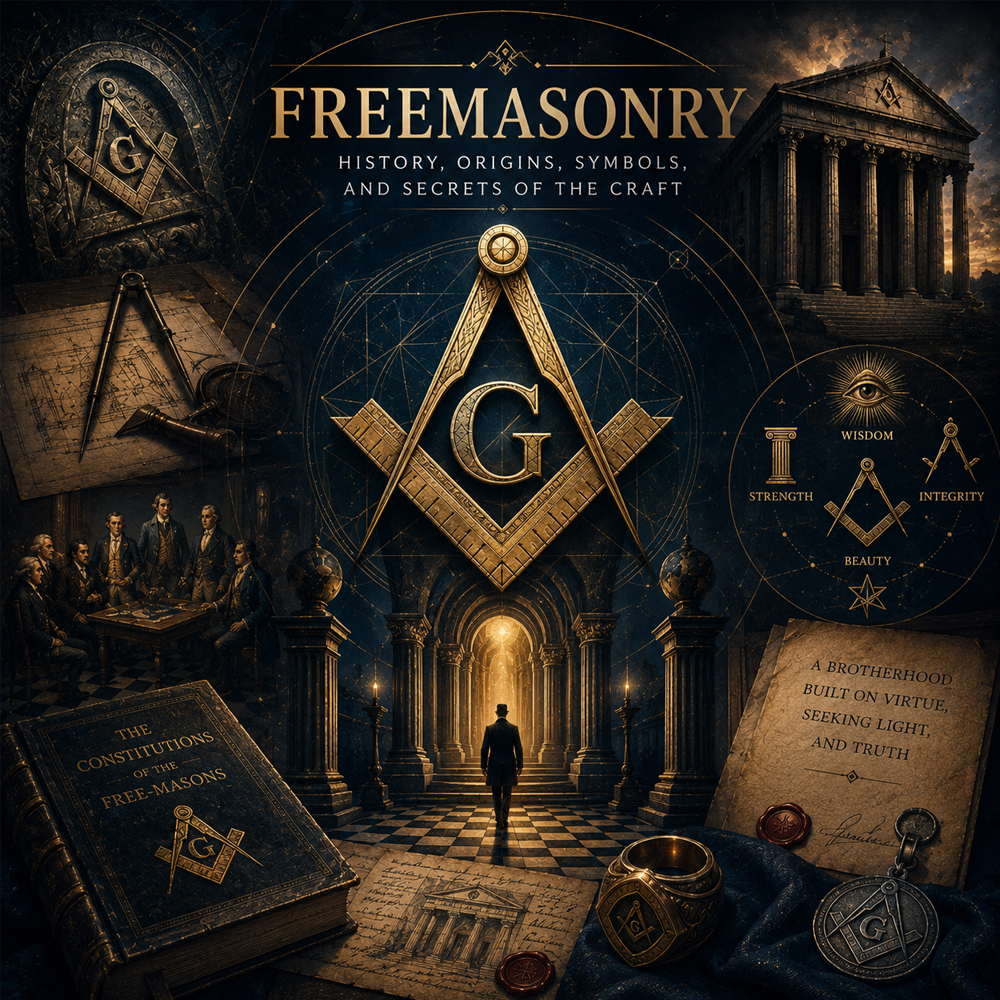
What Is Freemasonry
Freemasonry, also known as the Craft or Freemasonry, is one of the most recognizable and at the same time most misunderstood fraternal movements in the history of the Western world. For more than three centuries, it has attracted public interest with its rituals, symbols, moral teachings, and closed meetings. For some, Freemasonry is a philosophical school for moral self-improvement; for others, it is an influential international network; and for still others, it is a mysterious organization surrounded by countless legends and conspiracy theories.
In its broadest sense, Freemasonry can be defined as an organized brotherhood that uses the imagery, tools, and language of traditional stonemasonry to convey moral and philosophical ideas. Instead of building physical temples, the modern Mason symbolically works on shaping his own character. The rough stone becomes an image of the imperfect human personality, and the process of shaping it represents the pursuit of wisdom, self-discipline, honesty, and inner harmony.
Masonic organizations themselves usually present Freemasonry not as a religion or a political movement, but as a fraternal and moral system. Among its core values are integrity, friendship, respect, charity, and service to society. The United Grand Lodge of England, one of the most influential Masonic jurisdictions in the world, describes Freemasonry as one of the oldest secular fraternal organizations and emphasizes its focus on personal development and social responsibility.
However, there is no single global Masonic organization that governs all lodges and all members. Freemasonry is a broad international tradition composed of many grand lodges, orders, ritual systems, and independent jurisdictions. Some recognize each other, while others differ in terms of religious requirements, the participation of women, the permissibility of political and philosophical discussions, and the interpretation of Masonic principles.
This internal diversity is one of the reasons why Freemasonry is difficult to define in a single sentence. It is at once a fraternal community, a symbolic system, a moral teaching, a ritual tradition, and a social institution. To understand it more deeply, it is necessary first to examine the complex question of its origins.
Between History and Legend
The origins of Freemasonry are surrounded by numerous narratives that blend historical facts, symbolic traditions, and romantic speculation. At various times, authors have linked Masons to ancient Egyptian priests, the builders of Solomon’s Temple, the philosophical schools of antiquity, the Knights Templar, medieval alchemists, and mystical brotherhoods of the Renaissance. Such theories contribute to the mysterious image of the organization, but most of them cannot be proven through reliable historical documents.
Masonic symbolism does indeed contain images that refer to the Bible, ancient architecture, and various philosophical traditions. However, this does not necessarily mean that there is a continuous organizational connection between modern Freemasonry and all these ancient societies. A tradition can adopt symbols from the past without directly descending from the organizations originally associated with them.
For this reason, historians usually distinguish between the legendary history of Freemasonry and its documentable history. The legendary narrative plays an important role in Masonic rituals and in shaping the symbolic identity of the brotherhood. Historical research, on the other hand, relies on preserved statutes, records, registers, letters, diaries, and other documents that allow for a relatively reliable reconstruction of the development of the lodges.
Even early encyclopedic studies of Freemasonry acknowledge that its exact origin cannot be definitively established, as some of the earliest documents have been lost. This leaves room for various hypotheses, but it does not mean that all theories have equal historical value. The most convincing connection leads to the professional communities of medieval stonemasons and builders, from which the later symbolic lodges gradually developed.
Medieval Stonemasons and Cathedral Builders
During the Middle Ages, the construction of cathedrals, castles, monasteries, and public buildings required highly specialized knowledge. Master stonemasons needed to understand geometry, proportions, labor organization, and the properties of different materials. Their skills could not be acquired quickly but were passed down through long training, practical work, and gradual initiation into the secrets of the craft.
Workers involved in large construction projects often lived and worked far from their native places. Around building sites, temporary or permanent communities formed, with a clear hierarchy among apprentices, journeymen, and masters. To maintain the quality of work, it was necessary to establish rules for training, payment, professional conduct, and recognition of qualifications.
The word “lodge” did not originally mean a philosophical brotherhood. It could refer to the structure or space near the construction site where craftsmen stored their tools, prepared stone, discussed work, and trained younger members of the trade. Gradually, the term came to be used for the organized community of stonemasons itself.
These professional communities had their own rules, traditions, and methods of recognition. In a society without modern diplomas or centralized professional registers, a traveling craftsman needed a way to prove his level of skill. Certain words, signs, or practical tests could serve as means by which members of the trade recognized the abilities and status of an unfamiliar worker.
From this arises one of the possible historical foundations of later Masonic passwords, signs, and recognition rituals. In the medieval context, such methods were not necessarily expressions of political conspiracy but ways to protect professional knowledge and limit access to the craft by unqualified individuals. Over time, these practices acquired new symbolic and ceremonial meanings.
The Meaning of the Term “Freemason”
The term “Freemason” itself is subject to various linguistic and historical interpretations. One common hypothesis links it to craftsmen who worked with “freestone,” a type of stone suitable for precise carving and decorative architectural elements. Another explanation suggests that certain highly skilled stonemasons were “free” to travel between different construction sites and were not permanently bound to a single estate or feudal lord.
Regardless of its exact etymology, the concept of freedom gradually became a central symbol in Masonic tradition. It came to be understood not only as physical or professional independence but also as inner freedom from ignorance, prejudice, uncontrolled passions, and moral bondage. In this sense, a Freemason is someone who strives to master himself before claiming to influence the world.
In later Freemasonry, the word “mason” also acquires a metaphorical meaning. The true construction is no longer carried out with mortar, stone, and physical tools, but through work on the human personality. The temple to be built is the moral individual and a more just society, and the material for this construction consists of one’s own thoughts, decisions, and actions.
This reinterpretation did not occur suddenly. It was the result of a gradual process in which professional lodges began to admit individuals who did not practice the stonemason’s trade. This transition from operative to speculative Freemasonry laid the foundation for the modern organization.
Operative and Speculative Freemasonry
In historical studies, the terms “operative” and “speculative” Freemasonry are often used. Operative Masons were actual stonemasons and builders who worked with physical materials and applied professional architectural skills. Speculative Masons, on the other hand, use the language of construction as a system of symbols through which they reflect on morality, human character, and the meaning of life.
Speculative Freemasonry does not abandon the tools of the old craft but changes their meaning. The square is no longer just a tool for checking right angles but a reminder that human actions should be just and upright. The compass is not only used to draw circles but becomes a symbol of moderation, self-control, and the limits that a rational person sets on his own desires.
This transition likely occurred gradually during the 17th and early 18th centuries. Lodges began to admit nobles, merchants, scholars, soldiers, clergy, and members of the educated classes. They did not participate in masonry work but were interested in the brotherhood, its moral ideas, ceremonies, and symbolic language.
Official Masonic histories acknowledge that the exact mechanism of this transformation is not fully understood. Surviving documents show the presence of non-operative members in early lodges but do not reveal a single moment when the professional organization suddenly became a philosophical brotherhood. It is more likely that over decades both forms coexisted, with the symbolic element gradually becoming dominant.
The Role of Scotland in Early Masonic History
Scotland holds a particularly important place in the early documented history of Freemasonry. Some of the oldest lodge records and regulations have been preserved there, allowing researchers to trace the organization of the stonemason trade and the gradual admission of non-craftsmen. The Scottish tradition shows that well-organized local structures existed even before the creation of the first Grand Lodge in London.
In the late 16th century, William Schaw, who held an important position at the Scottish royal court and was responsible for construction activities, drafted regulations for the organization and conduct of stonemasons. These documents, known as the Schaw Statutes, governed relations between lodges, the training of apprentices, and the responsibilities of masters. Although primarily belonging to the professional world, they demonstrate a developed organizational culture that could later be reinterpreted within speculative Freemasonry.
Scottish lodges gradually began to admit members who were not professional masons. These “accepted” members were often individuals of social standing, education, and interest in philosophy or local political life. Their presence changed the social composition of the lodges and expanded their functions beyond regulating a trade.
The Grand Lodge of Scotland was established in 1736, but its official history traces the roots of Scottish Freemasonry much earlier. The preserved local traditions and documents are among the strongest arguments supporting the theory of gradual development from professional stonemason lodges to the modern symbolic brotherhood.
England and the Rise of Club Culture
The development of speculative Freemasonry in England must be viewed in the context of significant social changes during the 17th and early 18th centuries. This was a time of scientific discoveries, religious conflicts, political revolutions, and the gradual emergence of new forms of social interaction. Coffeehouses, clubs, scientific societies, and philosophical circles became places where people from different backgrounds could exchange ideas.
After decades of religious and civil conflict, British society developed a need for spaces where differences could be temporarily set aside. The Masonic lodge offered precisely such a symbolic environment. Within it, members were expected to meet as brothers, regardless of profession or social rank, provided they accepted the basic moral principles of the brotherhood.
This does not mean that early Freemasonry was fully democratic in the modern sense. Membership was often accessible mainly to men of certain social standing, financial means, and good public reputation. Nevertheless, the lodge created a ritual space in which, at least symbolically, the aristocrat, merchant, officer, and craftsman could regard each other as equals within a brotherhood.
The combination of old craft symbolism and the new club culture of the Enlightenment proved highly attractive. Freemasonry offered a sense of antiquity and continuity while simultaneously promoting ideas of reason, moral improvement, tolerance, and mutual assistance. It was within this social atmosphere that the creation of the first Grand Lodge became possible.
The Creation of the First Grand Lodge in 1717
On June 24, 1717, the feast day of St. John the Baptist, representatives of four London lodges met at the Goose and Gridiron tavern near St. Paul’s Cathedral. They decided to form a common structure and elected Anthony Sayer as their first Grand Master. This event is generally regarded as the founding of the first Grand Lodge in the world and a turning point in the history of organized Freemasonry.
It is important to understand that Freemasonry itself was not invented in 1717. The four lodges already existed, and the traditions on which they were based were older. What was new was the creation of a central coordinating body capable of uniting lodges, establishing rules, appointing or recognizing leaders, and facilitating the spread of a relatively unified Masonic system.
Initially, the organization was associated with London and Westminster, but its influence quickly grew. The creation of a Grand Lodge provided a model that was soon adopted in other parts of Great Britain, Europe, and the world. Lodges could now receive official charters, and affiliation with a recognized Grand Lodge became a primary source of organizational legitimacy.
The event of 1717 acquired an almost mythical status in Masonic historiography, but modern researchers approach some details with caution. Part of the narrative was recorded years later, and not all circumstances can be confirmed through contemporary documents. Nevertheless, there is little doubt that in the early 18th century, the institution that laid the foundations of the modern system of Grand Lodges emerged in London.
Anderson’s Constitutions and the Formation of Masonic Tradition
One of the most important documents in early Masonic history is the collection known as “The Constitutions of the Free-Masons,” published in 1723. The text is most closely associated with the Scottish Presbyterian minister James Anderson, although its compilation was the result of broader activity within the London Grand Lodge. The Constitutions contain a legendary historical narrative, rules of conduct for Masons, and principles for the governance of lodges.
The historical section traces the art of masonry back to biblical and ancient times, but it should not be read as a modern academic study. It creates a grand genealogical narrative through which the young organization connects itself to the history of architecture, geometry, and civilization. Such an approach was typical of an era in which institutions sought prestige through supposed ancient origins.
Of greater historical significance are the moral and organizational rules. They call upon the Mason to obey the moral law, to be a peaceful citizen, and to avoid behavior that could disrupt harmony within the lodge. Particularly important is the idea that people can be united around shared moral principles, even when they differ in their specific religious beliefs.
The Constitutions of 1723 are often viewed in connection with the spirit of the Enlightenment. They do not eliminate the religious dimension of Freemasonry but attempt to create a space of relative tolerance in a society that had experienced severe conflicts between faiths. The United Grand Lodge of England also emphasizes the importance of this document for the development of early Masonic culture and its rapid spread.
What Is a Masonic Lodge
The lodge is the basic organizational unit of Freemasonry. The term can refer both to the local group of members and to the physical space where they hold their meetings. A Grand Lodge typically unites and governs multiple individual lodges within a particular country, region, or Masonic jurisdiction.
Each lodge has leaders and officers whose roles are defined by the respective tradition. At its head usually stands the Worshipful Master, assisted by wardens and other officers. The titles and specific duties may vary, but the structure follows the symbolic model of organized construction work, in which each participant has a place and responsibility.
Meetings may include administrative matters, the initiation of new members, the performance of rituals, charitable activities, lectures, and social interaction among the brethren. Part of the work is formal and ceremonial, while another part resembles the activities of a traditional civic or charitable association. The combination of ritual and social community is one of the main features that distinguishes the lodge from an ordinary club.
For members, the lodge also has a deeper symbolic meaning. It represents an ordered space in which the chaos of the outside world is temporarily replaced by rules, measure, and harmony. The architecture, the arrangement of participants, and the objects used transform the meeting into a kind of moral drama in which ideas are not only explained but experienced through action.
Is Freemasonry a Secret Society
One of the most frequently asked questions is whether Freemasonry is a secret society. The answer depends on the meaning assigned to the word “secret.” The existence of Masonic organizations, the addresses of many lodges, the names of some of their leaders, their charitable initiatives, and much of their history are publicly accessible.
On the other hand, certain rituals, recognition signs, passwords, and details of initiation are traditionally not disclosed to non-members. Members pledge to keep some elements of the ceremonies private, although over the centuries many descriptions of these rituals have been published. For this reason, Freemasonry is often described not so much as a secret society, but as a society with secrets.
The distinction is important. A completely secret organization would conceal its very existence, structure, and goals. Masonic lodges, especially in the modern world, often maintain public websites, organize open days, publish historical materials, and provide information about their charitable activities.
Secrecy in Freemasonry serves primarily a ritual and symbolic function. It creates a sense of seriousness, belonging, and personal experience that should not be diminished by prior detailed disclosure. However, this culture of discretion is also one of the main reasons why suspicions and conspiracy theories arise around the brotherhood.
The Main Masonic Degrees
At the core of most traditional Masonic systems are three symbolic degrees. They are usually called Entered Apprentice, Fellow Craft, and Master Mason. These degrees are inspired by professional development in old craft communities, but in modern Freemasonry they represent stages of moral and symbolic education.
The degree of Entered Apprentice represents the beginning of the journey. The new member symbolically enters a world whose language and meanings he does not yet fully understand. The main themes are self-knowledge, discipline, silence, and the need to recognize one’s own incompleteness.
The degree of Fellow Craft is associated with the development of knowledge and abilities. In the traditional craft, the journeyman has completed initial training but has not yet reached full mastery. Symbolically, he is encouraged to study the world, develop his intellect, and gain a deeper understanding of the principles underlying moral life.
The third degree, Master Mason, addresses themes such as death, fidelity, loss, and spiritual rebirth. It is connected with the legendary story of Hiram Abiff, the master builder of Solomon’s Temple in Masonic tradition. Through this ritual narrative, the Mason confronts the idea that true integrity must be preserved even in the face of fear, suffering, and extreme circumstances.
The Legend of Solomon’s Temple
Solomon’s Temple occupies a central place in the symbolic world of Freemasonry. According to the biblical account, the temple was built in Jerusalem during the reign of King Solomon as a sacred place for the presence of God. In Masonic tradition, its construction becomes an image of collective labor, sacred geometry, order, and the pursuit of perfection.
Particularly important is the figure of Hiram Abiff, who in Masonic rituals is developed far beyond the brief biblical references to the craftsmen involved in the temple’s construction. The Masonic legend presents him as an exceptional builder and guardian of certain master knowledge. His fate becomes a moral narrative about fidelity to one’s word and the triumph of principle over fear.
This legend should not be understood as proof that the Masonic organization was actually founded in the time of King Solomon. Its function is symbolic rather than historical. The temple represents both the human personality, society, and the idea of an ordered cosmos in which every part has its place.
Through the image of the temple, Freemasonry transforms moral development into a process of construction. A person does not receive a finished character but must gradually build it. Every action becomes a stone, and every decision either contributes to the stability of the inner temple or weakens it.
The Great Architect of the Universe
One of the most well-known expressions in Freemasonry is “The Great Architect of the Universe.” It denotes the supreme principle or divine reality in which the Mason believes, without necessarily defining God through the doctrines of one specific religious denomination. In this way, people from different religious traditions can participate in the same lodge without being compelled to abandon their own faith.
The image of the architect is natural for an organization that uses the symbolism of construction. The universe is presented as an ordered structure in which law, proportion, and meaning can be discovered. A person who strives to live a moral life symbolically attempts to work in harmony with this higher order.
In traditional, or so-called regular, Masonic jurisdictions, candidates are generally required to profess belief in a Supreme Being. The lodge, however, is not supposed to determine exactly how they should understand that being. A Christian, Jew, or Muslim may recognize in the Great Architect the God of their own religious tradition.
Other branches of Freemasonry adopt a more secular or philosophical interpretation and do not necessarily require religious belief. This difference is among the reasons why some Grand Lodges do not recognize one another. Consequently, the expression “The Great Architect of the Universe” does not have precisely the same meaning in every form of Freemasonry.
Initiation as a Symbolic Beginning
Entry into Freemasonry traditionally takes place through initiation. The candidate does not simply receive a membership card, but undergoes a ritual ceremony symbolizing the transition from ignorance to knowledge. The exact details differ among jurisdictions, but the central idea is that the individual is beginning a new stage in their moral life.
The ritual uses symbols of darkness and light, restriction and freedom, questioning and revelation. The candidate is placed in an unfamiliar situation so that they may temporarily step outside their everyday habits and experience the meaning of the ceremony more deeply. Initiation is not intended to transmit secret scientific information, but to leave a lasting moral and emotional impression.
An essential element is the voluntary nature of admission. In the traditional Masonic understanding, a person should seek membership on their own initiative and should not be persuaded through promises of material gain or social influence. The candidate declares that they are approaching the brotherhood of their own free will and with a desire for self-improvement.
This does not mean that everyone who expresses an interest is automatically accepted. The lodge may examine the candidate’s character and reputation, speak with them, and vote on their admission. The idea is that brotherhood depends upon trust, and a ritual promise has value only when it is made by someone capable of understanding its moral weight.
The Moral Meaning of the Masonic Path
Behind the historical debates, ceremonial forms, and mysterious symbols lies a relatively simple idea: the human being is unfinished and both can and should work upon themselves. Freemasonry does not promise automatic enlightenment, nor does it claim that a single ritual can transform someone into a wise or virtuous person. It provides a symbolic language through which moral work can be understood as a continuous lifelong process.
The Mason is encouraged to observe their own shortcomings, master their passions, and treat others with justice. The tools of the stonemason continually remind them that good character must be measured, corrected, and refined. Like a building, the human personality cannot remain stable when its foundations are built upon deception, arrogance, and irresponsibility.
Brotherhood also plays an important role in this process. A person finds it difficult to see all of their weaknesses alone, while the community provides examples, correction, and a sense of responsibility. In the ideal Masonic model, differences among members do not disappear, but are subordinated to the higher principle of mutual respect.
Thus, the early history of Freemasonry reveals a transition from the construction of external temples to the symbolic building of the human personality. The medieval craft provides the language, the Enlightenment adds the philosophical environment, and the lodge transforms these elements into an organized tradition. To understand the full meaning of this tradition, its symbols, rituals, philosophical ideas, and influence on public life must be examined in greater depth.
Masonic Philosophy and the Idea of Inner Construction
Freemasonry is often perceived as an organization shrouded in secrecy, yet its philosophical core is far more understandable than public imagination suggests. At its foundation lies the idea that the human being is an unfinished entity who must consciously work on themselves. This work is not a one-time act but a continuous process of moral shaping, self-observation, and overcoming inner weaknesses.
The Masonic image of the rough stone is one of the clearest symbols of this philosophy. In its natural state, the stone is coarse, uneven, and unsuitable for inclusion in a harmonious structure. In the same way, a person left entirely to their impulses, fears, and desires struggles to achieve inner order and a stable moral character.
The shaping of the stone symbolizes the discipline through which a person gradually transforms their weaknesses into virtues. Anger must be turned into strength, greed into moderation, pride into dignity, and ignorance into a desire for knowledge. Freemasonry does not view the human being as hopelessly fallen, but as material that can be shaped through reason, effort, and perseverance.
This philosophy is closely related to much older moral traditions. Similar ideas can be found in Stoicism, ancient ethics, Christian asceticism, and Enlightenment philosophy. Freemasonry does not create an entirely new doctrine of human character but gathers various moral ideas into a unified symbolic system that makes them easier to remember and personally experience.
Light as a Symbol of Knowledge
Among the most important images in Masonic tradition is light. It symbolizes knowledge, truth, moral awakening, and liberation from ignorance. The candidate who approaches initiation is symbolically in darkness and is gradually introduced into a space of greater understanding.
This darkness should not be understood merely as a lack of information. It represents the state of a person who lives without examining their own motives, without questioning their prejudices, and without seeking deeper meaning. Light is not simply intellectual knowledge but the ability to see more clearly both the world and oneself.
Masonic light is not granted fully at once. Each degree and each new understanding reveals only part of the path. A person may receive the symbols, but must discover their meaning through reflection and behavior.
Thus, light becomes a goal that continually recedes as one approaches it. The more a person understands, the more clearly they realize the limits of their own knowledge. This idea protects Masonic philosophy from claiming ultimate wisdom and encourages humility before the complexity of life.
The Square and the Compasses
The most recognizable symbol of Freemasonry is the combination of the square and the compasses. These tools originate from the practical work of stonemasons, but in speculative Masonry they acquire moral meaning. They represent two different but complementary aspects of human life.
The square is used to check right angles and the accuracy of construction. In a moral sense, it reminds us that human actions should be just, honest, and upright. To live by the square means to measure one’s actions against a moral standard, not merely immediate advantage.
The compasses draw circles and set boundaries. Symbolically, they are associated with self-control, moderation, and the ability to limit one’s desires. A person who knows no limits easily becomes a slave to their own passions, even if they appear outwardly free and strong.
Together, the square and compasses represent the balance between right action and inner restraint. One symbol directs us toward our relationships with others, while the other concerns the governance of ourselves. Without justice, self-control can become cold detachment, and without self-control, good intentions are easily undermined by impulsiveness.
The Letter G and Its Meanings
In some Masonic traditions, the letter G appears between the square and compasses. It can be interpreted as a reference to God, especially in the English-speaking world, where the word “God” begins with this letter. At the same time, G is often associated with geometry, which in Masonic symbolism represents the foundation of the building art and the ordered cosmos.
Geometry holds special significance because it demonstrates how reason discovers order in space. Through it, the builder can create harmonious forms, measure distances, and unite separate parts into a whole. In Masonic philosophy, this becomes an image of the human mind, which must bring order to the chaos of desires and contradictions.
However, the letter G does not appear in all Masonic systems and should not be regarded as a universal sign. Its meaning varies depending on jurisdiction, ritual, and cultural context. This is another example of how Freemasonry preserves a common core while allowing different symbolic interpretations.
The essential point is that the symbol points to the idea of a rational and ordered principle. Whether understood religiously, philosophically, or geometrically, it reminds us that human life should not be built randomly. Just as a building requires a plan, so too does character require conscious direction.
The Hammer and the Chisel
The hammer and chisel are among the clearest symbols of personal effort. The hammer represents willpower, energy, and determination, while the chisel embodies reason, knowledge, and precision. Strength alone is not enough, because without direction it can destroy rather than shape.
The chisel without the hammer is also powerless. A person may know what needs to be changed within themselves, but without will, knowledge does not lead to action. Thus, the two tools represent the necessary combination of understanding and practical effort.
The blows on the stone must be measured. Too weak a strike changes nothing, while too strong a blow can split the material. This idea applies to self-discipline, which must be consistent but not destructive.
A person striving for moral development should treat themselves neither with excessive indulgence nor with merciless severity. True improvement requires honesty, patience, and proper balance. Masonic symbolism reminds us that character is built through many small and precise actions, not through sudden promises.
The Plumb Line, the Level, and Equality Among People
The plumb line is the tool that shows whether a line is vertical and true. In Masonic symbolism, it is associated with integrity, stability, and uprightness of character. A person must remain upright even when external circumstances pressure them to compromise their principles.
The level, on the other hand, is associated with equality. It reminds us that all people share the same human nature and are ultimately subject to the same limitations. Wealth, power, and titles may create temporary differences, but they do not eliminate mortality or moral responsibility.
In the Masonic lodge, this idea is expressed through the ritual equality of members. They may belong to different professions and social classes, but within the symbolic space they address one another as brothers. This equality does not eliminate all hierarchies but aims to place human dignity above external status.
The ideal has not always been fully realized in historical practice. Many lodges were accessible mainly to privileged men and reflected the prejudices of their time. Nevertheless, the symbol of the level contains a universal idea that often transcends the limitations of the institutions that use it.
The Checkered Floor and the Opposites of Life
In many Masonic temples, the floor is depicted as alternating black and white squares. This checkered pattern symbolizes the duality of human life. Joy and suffering, light and darkness, success and failure, hope and fear constantly intertwine in human experience.
The meaning of the symbol is not that good and evil are equally valuable. Rather, it reminds us that life unfolds among opposites and that a person must learn to move through them without losing inner balance. Wisdom does not consist in avoiding all suffering, but in the ability not to be completely destroyed by it.
The checkered floor can also be understood as a symbol of the limited human perspective. What appears today as misfortune may tomorrow prove to be the beginning of change, while apparent success may lead to pride and downfall. A person rarely sees the entire pattern while experiencing only a single square.
In the ritual space, members move across this floor, symbolizing movement through the contradictions of existence. They cannot remain only in the white and avoid the black. Their task is to maintain direction regardless of changing circumstances.
The All-Seeing Eye
The All-Seeing Eye is among the most popular symbols associated with Freemasonry, although it has a much older and broader cultural origin. In Christian art, the eye within a triangle often symbolizes divine providence and the presence of a higher moral gaze. In Masonic symbolism, it reminds us that human actions are not hidden from conscience or from the supreme principle.
Its meaning is primarily moral, not political. The eye should not be understood as a sign that Masons observe society or control a secret system. It directs attention to personal responsibility and to the impossibility of completely erasing moral wrongdoing through external concealment.
A person may deceive others, but cannot indefinitely escape their own conscience. For this reason, the eye becomes a symbol of inner observation. It represents that part of the self that continues to distinguish right from wrong, even when society does not see the act.
Later popular culture has turned this image into the center of numerous conspiracy theories. Its association with banknotes, state symbols, and architecture is often used as evidence of supposed Masonic influence. In reality, the symbol has a much broader history, and its presence alone does not prove a connection to Freemasonry.
Acacia and the Idea of Immortality
Acacia is an important symbol, especially in the degree of Master Mason. It is associated with the legend of Hiram Abiff and with themes of death, memory, and hope for spiritual continuation. The plant is chosen for its resilience and its ability to remain green under harsh conditions.
Symbolically, acacia represents that within a person which is not entirely destroyed by physical death. This can be understood religiously as the immortality of the soul, but also philosophically as the continuation of a person through their deeds, influence, and the memory they leave behind. Human life is limited, but its moral significance can extend beyond its duration.
Acacia also reminds us of the need to build something lasting. Wealth, fame, and social status are temporary, while the consequences of good or bad actions may endure long after death. Thus, the symbol shifts attention from external success to inner value.
The theme of death is not presented solely as a threat. It serves to awaken a person from the illusion of having infinite time. When mortality is recognized, choices gain greater weight, and life can be lived more consciously.
Rituals as Moral Theater
Masonic rituals are often perceived from the outside as strange ceremonies filled with archaic language, symbolic gestures, and dramatic scenes. Their function, however, is not merely to impress or maintain an atmosphere of mystery. They represent a kind of moral theater in which philosophical ideas are transformed into personal experience.
A person can read a book about courage, loyalty, or death, but ritual attempts to place them symbolically in a situation where these ideas are felt more deeply. Through carefully arranged actions, questions, and images, the participant temporarily becomes part of a narrative. This creates emotional memory that ordinary explanation cannot always achieve.
Ritual also builds a sense of continuity. The member performs ceremonies that, in various forms, have been carried out by generations before them. They feel part of a tradition that transcends their personal biography and connects them with people from other times and places.
This continuity does not mean that rituals have never changed. They have been edited, expanded, and adapted to different cultural conditions. The idea of a completely unchanged ancient ceremony is more a part of Masonic mythology than a historically proven fact.
The Masonic Oath and the Meaning of One’s Word
Promises and oaths play an important role in Masonic rituals. They express the candidate’s decision to follow certain moral rules, to be loyal to the brotherhood, and to keep entrusted ritual details confidential. In traditional society, an oath carries far greater weight than it often does in modern everyday speech.
A given word is presented as part of character. When a person makes a promise, they do not merely utter a sentence but create a moral obligation. Breaking a promise harms not only others but also the inner integrity of the individual.
Some older formulations of Masonic oaths contain dramatic symbolic penalties. Critics often use these as evidence of a coercive nature. In Masonic explanations, these penalties are traditionally understood as symbolic and do not represent actual sanctions that the lodge has the right to enforce.
In modern jurisdictions, the wording can vary significantly, and some of the more extreme expressions have been removed. The core meaning remains the binding of personal honor to one’s promise. The value of secrecy lies not so much in its content as in testing a person’s reliability.
Freemasonry and the Enlightenment
Freemasonry developed as a social phenomenon during a time when Enlightenment ideas were transforming Europe. Reason, scientific inquiry, religious tolerance, and criticism of inherited authority gained increasing importance. Lodges became places where these ideas could be discussed and experienced in a fraternal environment.
Not all Masons were Enlightenment philosophers, and not all Enlightenment thinkers were Masons. Nevertheless, there is a clear similarity between certain Masonic principles and the spirit of the age. Particularly important is the belief that people with different religious views can be united by a common moral law, and the idea that individuals can improve themselves through education.
Lodges created spaces for interaction among people from different social backgrounds. Aristocrats, merchants, scholars, officers, and educated craftsmen could build connections and exchange ideas. These networks sometimes facilitated the spread of books, scientific views, and political concepts.
However, it should not be assumed that every lodge was a center of revolutionary activity. Many were moderate, loyal to existing authorities, and focused on charity and fraternal interaction. The connection between Freemasonry and the Enlightenment is real, but diverse and cannot be reduced to a single political project.
Freemasonry and the Emergence of Conspiracy Theories
Few organizations have generated as many conspiracy theories as Freemasonry. The reason lies not only in the real presence of Freemasons among political, cultural, and economic elites, but also in the nature of the brotherhood itself. Closed meetings, ritual oaths, symbols, and international connections create an ideal environment for assumptions that behind the visible structure there exists a deeper and hidden center of power.
Human imagination struggles to accept gaps in historical knowledge. When it is unclear who made a particular decision, how certain political connections were formed, or why influential individuals belong to the same organization, it is easy to assume secret coordination. Freemasonry offers a ready-made narrative in which symbols, oaths, and fraternal loyalty become evidence of an invisible plan.
Not all suspicions are entirely unfounded. Any closed network of influential individuals can be used for mutual support, granting privileges, or concealing irregularities. However, isolated cases of abuse do not prove the existence of a unified global conspiracy, just as corruption in one institution does not prove that all similar institutions are part of a single secret system.
Conspiracy narratives usually eliminate complexity. They present history as the result of the will of a small group, rather than as an interaction of economic interests, social conflicts, cultural ideas, and random events. This simplicity makes such theories appealing, but rarely makes them historically convincing.
Freemasonry and the Illuminati
One of the most widespread claims is that Freemasons and the Illuminati are the same organization or two parts of a common secret structure. The historical Bavarian Illuminati were founded in 1776 by Adam Weishaupt and existed as a separate secret society aiming to spread rationalist and Enlightenment ideas. The organization was banned by authorities in the 1780s, and there is no reliable evidence that it has continued to operate uninterrupted to the present day.
Some members of the Illuminati did indeed have connections with Masonic lodges. Weishaupt and his associates attempted to use existing Masonic networks to expand the influence of their own society. However, this does not mean that Freemasonry as a whole was subordinate to the Illuminati or that the two organizations were identical.
Later conspiracy theories gradually merge all secret societies into a single narrative. Freemasons, Illuminati, Templars, bankers, revolutionaries, and ancient mystical orders are portrayed as different names for the same force. This picture is impressive as mythology, but it does not withstand serious historical scrutiny.
The real history is more fragmented. Secret societies often compete, divide, and pursue different goals. Even when they use similar rituals and symbols, this does not mean they are governed by the same leadership.
Freemasonry and World Governance
Another popular theory claims that Freemasonry controls governments, banks, media, and international institutions. As evidence, people often point to well-known Freemasons who held high public office, as well as the presence of geometric or occult symbols in architecture and state emblems. Such an approach treats any similarity or personal membership as confirmation of a preselected theory.
The real influence of Masonic networks should not be ignored. In certain historical periods, lodges brought together individuals with access to power, education, and financial resources. Such an environment naturally creates opportunities for connections and mutual assistance.
However, this is different from centralized global governance. Masonic jurisdictions are numerous, often disagree on fundamental issues, and sometimes refuse mutual recognition. There is no single supreme authority capable of issuing orders to all lodges and all Freemasons worldwide.
Moreover, members themselves hold diverse political, religious, and economic views. In history, Freemasons have stood on opposing sides of wars, revolutions, and social conflicts. If the organization were a unified global center, such deep contradictions would be difficult to explain.
Symbols on the American Dollar
The All-Seeing Eye and the unfinished pyramid on the Great Seal of the United States are often presented as evidence of the Masonic origin of the American state. These symbols do indeed carry meanings that can be compared with Masonic tradition, including providence, order, construction, and the pursuit of perfection. However, they do not belong exclusively to Freemasonry and have broader religious and artistic origins.
The All-Seeing Eye appears in European Christian art before its widespread use in Masonic contexts. The triangle may symbolize the Trinity, and the eye represents God’s presence and providence. The unfinished pyramid, in turn, represents a state that continues to be built.
The fact that some of the American founders were Freemasons contributes to the natural overlap of similar ideas and imagery. This does not necessarily mean that the symbols are a secret code of submission to a Masonic center. Many of the values of Freemasonry, the Enlightenment, and early American republicanism originate from the same cultural environment.
When a symbol has multiple historical uses, it cannot automatically be attributed to a single organization. Similarity may indicate a shared language of the era rather than hidden institutional power. Historical analysis requires tracing the specific origin of each image rather than drawing conclusions based solely on visual resemblance.
Freemasonry and the Knights Templar
The legendary connection between Freemasons and the Knights Templar is one of the most captivating stories surrounding the brotherhood. According to some versions, surviving Templars went into hiding after the dissolution of the order in the 14th century and passed their secret knowledge to Scottish or European stonemason lodges. Thus, Freemasonry is presented as a hidden successor to the medieval knightly order.
No reliable documents have been found to prove a continuous organizational link between the Templars and early Masonic lodges. Knightly symbolism became more prominent in certain Masonic systems in the 18th century, when Europe showed increased interest in medieval orders. This symbolism was likely adopted and developed rather than inherited through an unbroken secret lineage.
The image of the Templars is particularly suitable for Masonic mythology. They were knights associated with the Temple of Solomon, possessed an international structure, and were persecuted by secular and religious authorities. All these elements naturally fit into a narrative of a secret brotherhood that survived a historical catastrophe.
Today, there are Masonic orders that use Templar names and ritual imagery. This demonstrates symbolic continuity but does not prove direct historical succession from the medieval order. The distinction between a ritual heir and an organizational heir is essential.
Freemasonry and Alchemy
The connections between Masonic symbolism, alchemy, and esoteric teachings also attract significant interest. Alchemy is not only concerned with attempts to turn metals into gold; in some forms, it uses chemical processes as a metaphor for spiritual transformation. This idea is close to the Masonic transformation of the rough stone into a perfect form.
In the 17th and 18th centuries, philosophers, scientists, and esoteric thinkers often participated in more than one intellectual circle. Ideas from Hermeticism, Rosicrucianism, alchemy, Kabbalah, and Christian mysticism could move between different societies. Freemasonry developed part of its symbolic language in an environment where such teachings were known and discussed.
This does not mean that every lodge represents an alchemical or occult school. The basic Masonic degrees are usually focused on moral and fraternal principles rather than secret laboratory practices. Esoteric interpretations are stronger in certain ritual systems and among specific authors.
Freemasonry provides a sufficiently rich symbolic language to be understood on different levels. One member may see it primarily as a moral brotherhood, while another may discover a mystical path of spiritual transformation. This multiplicity is part of its strength, but also a source of ongoing debate.
Is Freemasonry a Religion
Freemasonry traditionally denies being a religion. It has no unified doctrine of salvation, offers no unique revelation, and does not require all members to accept the same concept of God. The lodge is not meant to replace the church, synagogue, mosque, or any other religious community.
At the same time, Freemasonry uses prayers, sacred texts, rituals, and language related to God and immortality. This leads some critics to define it as a parallel or hidden religion. According to them, it offers a moral and spiritual system that could gradually replace a specific religious faith.
Freemasons themselves usually distinguish between a universal moral framework and religious dogma. They argue that Freemasonry does not tell a person who God is, how He should be worshipped, or how salvation is achieved. Its goal is to unite believers from different traditions around shared principles.
This distinction does not convince all religious institutions. For some, the very idea that different concepts of God can be placed under the common term “Great Architect” is already problematic. The dispute is not only organizational but concerns the very understanding of religious truth.
The Catholic Church and Freemasonry
Relations between the Roman Catholic Church and Freemasonry have historically been highly conflictual. As early as the 18th century, papal documents condemned the membership of Catholics in Masonic organizations. Among the reasons cited are secret oaths, religious relativism, and suspicion that lodges might act against the authority of the Church.
The conflict intensified in the 19th century, when some continental Masonic organizations supported secular states and the limitation of church influence. In countries such as France and Italy, Freemasonry was sometimes associated with anti-clerical political movements. Thus, theological differences became intertwined with concrete struggles for social power.
Catholic criticism does not apply equally to all Freemasons as individuals, but to the principles and obligations of membership. According to the Church’s position, a Catholic cannot, without contradiction, accept Masonic religious universalism alongside the Church’s understanding of revelation. From a Masonic perspective, such criticism is often seen as a failure to distinguish fraternal tolerance from theological mixing.
This conflict shows that Freemasonry is not simply a neutral club. Its understanding of religious tolerance has philosophical consequences that some traditional religions cannot accept. Therefore, relations between the lodge and the Church remain one of the most significant issues in the history of the brotherhood.
Orthodoxy and the Masonic Tradition
Orthodox churches also generally take a critical stance toward Freemasonry. The reasons are similar to some Catholic objections but are expressed within the context of Orthodox theology and church life. Masonic secrecy, religious universalism, and ritual brotherhood are seen as incompatible with full membership in the church community.
From an Orthodox perspective, the truth about God cannot be reduced to a general abstract principle acceptable to all religions. Christian revelation has specific content that cannot be replaced by a universal symbol such as the Great Architect. For this reason, some church authors view Freemasonry as a form of spiritual relativism.
Freemasons, on the other hand, may argue that the lodge does not require an Orthodox Christian to change their faith. It only demands respect for the beliefs of other members and avoidance of theological disputes within the ritual space. This is precisely where the main difference between the two positions lies.
For Freemasonry, religious tolerance allows for a shared brotherhood beyond doctrinal boundaries. For traditional Orthodoxy, unity cannot be achieved by setting doctrinal truth aside. Therefore, the tension is fundamental and difficult to resolve through assurances of good intentions alone.
Freemasonry and Islam
Attitudes toward Freemasonry in the Islamic world are diverse and depend on historical and political context. In the 19th and early 20th centuries, Muslim intellectuals, statesmen, and reformers participated in lodges. For some, Freemasonry served as a means of contact with European culture, modernization, and ideas of social reform.
Other Muslim authors view it as a foreign and potentially colonial structure. The international connections of lodges raise suspicions that they serve European political interests. Their religious symbolism may also be seen as incompatible with Islamic monotheism.
In some countries, Freemasonry is banned or heavily restricted. The reasons include not only religious objections but also fear of independent organizations operating outside state control. Authoritarian regimes often view any international and discreet network with suspicion.
As with Christianity, there is no single unified reaction among all Muslims or all Islamic societies. History includes both active Muslim Freemasons and strong religious condemnations. This diversity once again shows that Freemasonry cannot be evaluated outside its specific historical context.
Freemasonry and Politics
Officially, many regular lodges prohibit political debates during their meetings. The reason is clear: partisan conflicts can destroy fraternal harmony and turn the lodge into an instrument of a particular movement. A Freemason may have political beliefs, but should not use the ritual space for political agitation.
In practice, the boundary between Freemasonry and politics is not always so clear. When influential statesmen, judges, military officers, and entrepreneurs belong to the same network, their relationships can inevitably have political significance. Even without formal decisions, personal trust can facilitate informal influence.
In some countries, Masonic organizations openly support certain social principles, including secular education, civil liberties, and the separation of religion and state. Continental Freemasonry sometimes participates more actively in political debates. This distinguishes it from Anglo-American jurisdictions, which emphasize formal political neutrality.
Therefore, it cannot be said that Freemasonry is entirely apolitical, nor that it functions as a unified political party. It is more accurate to view it as an environment in which certain ideas and social connections can acquire political significance. The specific outcome depends on the country, the era, and the nature of the particular lodge.
Freemasonry and Democracy
Freemasonry is often associated with the development of democratic and liberal ideas. The lodge uses elected offices, rules of governance, and symbolic equality among members. These practices create a culture of participation that, in certain historical contexts, can support broader concepts of civic governance.
Ideas of brotherhood, freedom of conscience, and moral dignity also align with the principles of modern democracy. Freemasons have participated in movements for independence, constitutional reforms, and secular education. This influence is particularly visible in the 18th and 19th centuries.
At the same time, Freemasonry has not always been democratic in the modern sense. Membership has often been restricted by gender, social status, race, or religious requirements. Some Freemasons have supported monarchies, colonial empires, and authoritarian regimes.
Therefore, Freemasonry should not be seen as the sole source of democratic ideas. It is one of many institutions through which these ideas have passed and taken social form. Its historical significance is real, but not exclusive.
Authoritarian Regimes and the Ban on Freemasonry
Freemasonry has often been persecuted by authoritarian and totalitarian regimes. The reason is that it represents an independent organization with international connections, internal rules, and loyalty that is not entirely subordinate to the state. Such autonomy is unacceptable to regimes that seek to control all social structures.
Fascist, Nazi, and communist authorities in various countries have banned or restricted Masonic lodges. Nazi propaganda in particular strongly associated Freemasonry with Judaism, liberalism, and international conspiracy. This image was used to justify repression against real and alleged Freemasons.
Communist regimes also viewed lodges as bourgeois and potentially hostile organizations. They did not accept independent brotherhoods with secret rituals and international affiliations. Masonic structures were dissolved, their property confiscated, and members could be monitored or persecuted.
These repressions do not automatically prove the virtue of every lodge. However, they show that Freemasonry indeed possesses a form of civic autonomy that totalitarian power perceives as a threat. The history of persecution is an important part of understanding the brotherhood in the 20th century.
Main Criticisms of Freemasonry
One of the most serious criticisms concerns the lack of transparency. When judges, politicians, police officers, or high-ranking officials belong to a closed organization, society has a legitimate interest in whether this membership influences their professional decisions. Discretion may protect personal ritual experience, but it should not conceal conflicts of interest.
Another criticism is directed at the elitist nature of some lodges. Although Freemasonry speaks of equality, membership often requires recommendations, financial means, and social reputation. This can create a closed circle in which privileged individuals reinforce each other’s influence.
There is also the issue of the gap between high moral ideals and the actual behavior of members. Membership in Freemasonry does not guarantee virtue, just as belonging to a religion does not guarantee holiness. History knows Freemasons who have served society, and others who have engaged in morally questionable actions.
Criticism is necessary when it is based on evidence and clear social principles. It becomes misleading when every mistake of an individual member is presented as proof of the nature of global Freemasonry as a whole. The distinction between an institutional problem and a universal conspiracy is crucial.
Why People Become Freemasons
The motivations for joining Freemasonry are diverse. Some people seek community, friendship, and a sense of belonging. In modern society, where traditional bonds often weaken, the brotherhood can provide a stable social environment.
Others are attracted by history, ritual, and symbolism. Freemasonry offers an experience of continuity with the past that is lacking in many modern institutions. Ceremonies create the feeling that important moral ideas can be experienced, not just read about.
Some members seek personal development and philosophical discussion. The lodge can be a place where character, responsibility, and the meaning of social life are explored. For others, charity and public service are the main motivation.
There are also individuals who likely join for prestige, connections, or expected professional benefits. This contradicts the official ideal but cannot be excluded. As with any human organization, declared principles and personal motives do not always fully coincide.
How One Becomes a Freemason
The process of admission depends on the specific jurisdiction and lodge. Typically, a candidate must express interest on their own initiative, contact the organization, and go through conversations with its representatives. The traditional principle states that a person should join of their own free will, not through pressure or promises of advantage.
Candidates are expected to have a good reputation and be capable of assuming the moral and financial responsibilities of membership. In regular male jurisdictions, belief in a supreme being is usually required. Other organizations have different conditions and may admit women, atheists, or individuals without a specific religious affiliation.
After the interviews, the lodge usually votes on the application. This procedure aims to protect trust within the community but may also create an impression of exclusivity. Admission is not an automatic right but a decision of the local group.
Once approved, the candidate undergoes initiation and gradually progresses through the basic degrees. They are expected to study the symbols, attend meetings, and participate in lodge activities. Freemasonry is not presented as passive membership, but as a continuous path of participation and reflection.
Freemasonry in the Modern World
Today, Freemasonry continues to exist in many countries, but its social role is changing. In some places, it remains an influential and well-organized tradition with a large membership. In others, it struggles to attract younger generations and gradually loses public visibility.
Modern individuals have access to many alternative forms of communication and personal development. The internet, professional networks, volunteer organizations, and various spiritual movements fulfill some of the functions that once made the lodge particularly attractive. Freemasonry must explain why its ritual and fraternal form still matters.
Some organizations respond with greater openness. They open historic buildings to visitors, publish materials, organize lectures, and emphasize their charitable activities. This reduces some of the mystery but can strengthen public trust.
Other lodges prefer more traditional discretion. They believe that ritual loses its power when turned into a public spectacle. Thus, modern Freemasonry moves between the need for transparency and the desire to preserve the personal nature of initiation.
Freemasonry in the Age of the Internet
The internet has fundamentally transformed the culture of Masonic secrecy. Rituals, historical documents, symbols, and critical studies can now be accessed with only a few searches. A person can read alleged versions of Masonic ceremonies without ever having entered a lodge.
This does not mean that initiation has become entirely meaningless. Freemasons often emphasize that reading a ritual is not equivalent to experiencing it personally within a real community. Just as the script of a play cannot replace a theatrical performance, a written text cannot reproduce the full atmosphere of the ceremony.
The internet, however, also amplifies conspiracy theories. Images are removed from their original context, unrelated symbols are connected arbitrarily, and unverified claims are circulated as historical facts. Algorithms often promote increasingly dramatic content because it attracts attention.
As a result, Freemasonry has become both more accessible and more misunderstood. There has never been so much information available, yet quantity does not guarantee quality. The ability to distinguish between reliable sources, historical documents, and speculation is more important than ever.
Masonic Secrecy in the Modern Context
In the past, Masonic secrecy included specific signs, words, and ritual details. Today, many of these have been published, yet the principle of discretion remains. The essential question is no longer merely whether a password is known, but whether personal trust among members is preserved.
The lodge can provide a space in which people discuss personal matters and share their experiences. Such confidentiality has value, provided that it does not conceal actions affecting the public interest. The boundary between personal discretion and unacceptable opacity must be clearly understood.
Modern democracy demands high standards from those who hold public office. If membership in an organization may create a conflict of interest, it should be disclosed in accordance with the law and professional regulations. Ritual secrecy cannot take precedence over public accountability.
This is one of the main challenges facing Freemasonry today. To preserve trust, it must demonstrate that fraternal loyalty does not override the law, justice, or professional ethics. Otherwise, its own symbols of uprightness and proper measure would lose their meaning.
Does Freemasonry Possess Secret Knowledge?
Many people expect Freemasonry to preserve ancient knowledge about the universe, the human soul, or the hidden forces of nature. In reality, its fundamental moral ideas are widely known and appear in numerous philosophical and religious traditions. Integrity, moderation, brotherhood, and the pursuit of knowledge are not secrets in themselves.
The secret lies more in the way these ideas are organized and experienced. Ritual transforms abstract principles into a symbolic biography. A person does not merely hear that they should work upon themselves, but passes through images that present this work as a process of construction.
Some additional Masonic systems develop more complex esoteric interpretations. They may include Hermetic, Kabbalistic, alchemical, or chivalric ideas. This does not mean, however, that all Freemasons receive a single unified secret doctrine.
The deepest “knowledge” in Masonic philosophy is probably not information, but self-knowledge. A person may learn the symbols in a short time, but understanding their own weaknesses can require an entire lifetime. In this sense, the secret is not hidden behind a closed door, but within the difficulty of transforming oneself.
What Freemasonry Can Offer the Modern Individual
In a world of rapid information and short attention spans, Freemasonry offers a slow and structured path. It requires consistency, participation, and the gradual understanding of its symbols. This rhythm may appear old-fashioned, yet that is precisely what makes it valuable to people seeking a deeper experience.
The fraternal community also responds to a genuine modern need. Many people live amid constant communication but lack lasting relationships. The lodge can provide a space of trust, mutual support, and shared responsibility.
The philosophy of the rough stone remains understandable today. Human beings continue to struggle with anger, pride, fear, and greed, regardless of technological progress. Symbolic language reminds us that external development does not guarantee inner maturity.
These potential benefits, however, are realized only when the organization lives according to its own ideals. If the lodge becomes a club for influence and personal advancement, its symbols lose their moral power. The true value of Freemasonry is measured not by the number of its famous members, but by the character it helps to build.
Why Freemasonry Continues to Inspire Fear
Freemasonry combines several elements that naturally provoke fear: secrecy, ritual, symbols, international connections, and influential members. Even when each of these elements has an ordinary explanation, their combination appears extraordinary. Society often fears structures that it cannot fully observe.
Historical memory also plays an important role. During periods of revolution, political crisis, and religious conflict, Freemasonry has been accused of destroying the established order. These accusations are passed from one generation to another and continue to exert influence even after their original context has been forgotten.
Popular culture further intensifies the mystery. Novels, films, and television series present Freemasons as guardians of ancient secrets or architects of global conspiracies. Fictional stories gradually become intertwined with historical perceptions.
Fear is also sustained by Freemasons themselves when they refuse to explain clearly enough what their organization represents. Silence may be dignified in a personal context, but in public it is often interpreted as an admission of guilt. Transparency does not eliminate every suspicion, but it reduces the space available for speculation.
Why Freemasonry Continues to Attract People
The same qualities that frighten some people attract others. Secrecy creates a sense of depth, while ritual promises an experience different from everyday life. Symbols allow for multiple interpretations and create the feeling that a greater moral order exists behind the visible world.
Historical continuity is also powerfully attractive. A member feels connected to generations of people who have used the same tools and images. In a society characterized by constant change, such a connection with the past provides a sense of stability.
Freemasonry also offers an identity without necessarily demanding complete abandonment of other affiliations. A person may remain a Christian, Muslim, Jew, scholar, businessperson, or artist while also being a Freemason, provided that the relevant jurisdiction permits it. This flexibility helps explain the international spread of the tradition.
Finally, there is the promise of personal transformation. Although Freemasonry does not guarantee enlightenment, it presents life as a construction project in which every person is responsible for their own part. This image is simple, yet it possesses enduring psychological power.
Myths and Reality
The most reasonable approach to Freemasonry requires both critical thinking and restraint. It is not necessary to accept the official self-presentation of every lodge without question. Every organization, particularly one that includes influential people and maintains discretion, deserves public scrutiny.
At the same time, it is unreasonable to explain every historical mystery through a Masonic conspiracy. The absence of evidence is not evidence of perfect concealment. A theory that declares every refutation to be part of the conspiracy can no longer be tested and therefore leaves the field of historical inquiry.
Reality is less dramatic, but more interesting. Freemasonry is a human institution composed of ideals, ambitions, friendships, weaknesses, and internal conflicts. It can be both a school of moral reflection and a network vulnerable to abuse.
Neither demonization nor romantic idealization helps us understand it. History must be separated from legend, and symbols from political evidence. Only then can Freemasonry be examined as a genuine historical phenomenon rather than as an empty screen onto which collective fears and hopes are projected.
Freemasonry as a Mirror of Society
Freemasonry often reflects the society in which it exists. In a liberal environment, it may emphasize tolerance and civic participation. In a conservative environment, it may defend tradition, order, and religious faith.
When society is corrupt, Masonic networks may also be used for personal gain. When civic culture is strong, the lodge may serve as a space for charity and responsibility. The organization is not isolated from the moral quality of its members or from the institutional environment surrounding it.
This explains why the image of Freemasonry differs so greatly from one country to another. In one place, it may be regarded as a respected charitable tradition, while in another it may be synonymous with hidden influence. Both perceptions may contain part of the historical reality.
To ask whether Freemasonry is entirely good or evil is too broad a question. It is more meaningful to examine how a particular lodge operates, what standards it follows, and how its members use their connections. The moral value of an institution is revealed through its practices, not merely through its symbols.
Freemasonry and the Eternal Striving to Build
The image of construction is the reason Masonic philosophy has remained understandable throughout the centuries. Every person inherits material they did not entirely choose: their character, family, society, and historical circumstances. Their freedom is expressed in the way they work with this material.
The rough stone is not an accusation, but a beginning. It contains the possibility of form, yet that form cannot emerge without effort. In the same way, human potential is not realized through intentions, but through consistent action.
A temple is also never built by one person alone. Masonic symbolism reminds us that personal improvement has a social dimension. A well-shaped stone must be capable of taking its place among the others without damaging the structure as a whole.
This image contains both an individual and a social ethic. A person must build themselves while also contributing to a world in which others can live with dignity. This is the strongest and most universal idea of Freemasonry.
Conclusion: What Freemasonry Truly Represents
Freemasonry cannot be reduced either to a secret government or to an ordinary charitable club. It is a historically developed fraternal tradition combining craft symbolism, Enlightenment ideas, ritual initiation, and moral teaching. Its forms differ according to country, historical period, and particular jurisdiction.
Its historical roots lead back to the professional communities of stonemasons, but its modern content is primarily symbolic. Physical construction becomes a moral metaphor, while the builder’s tools become signs of justice, moderation, and self-discipline. The Freemason is called to work upon themselves as a master craftsman works upon stone.
The influence of Freemasonry on history is real, but it should not be exaggerated. Individual Freemasons have participated in revolutions, government, science, and art, but this does not prove the existence of a unified global plan. More often, the brotherhood has functioned as an environment for connections, ideas, and personal belonging.
Criticisms of Freemasonry should not be ignored either. Closed networks can produce favoritism, conflicts of interest, and public distrust. An organization that speaks of integrity must be especially careful not to transform fraternal loyalty into a justification for injustice.
At the same time, conspiracy theories often reveal more about society’s fears than about Freemasonry itself. They express anxiety that important decisions are being made by people who cannot be observed. This concern is understandable, but it should be directed toward evidence rather than mythological explanations.
Freemasonry continues to exist because it offers something that the modern world has not completely replaced. It combines ritual, history, community, and moral symbolism into a unified path. For some, it is a relic of the past, while for others it remains a living school of character and brotherhood.
Its deepest question is not who governs the world behind closed doors. The question is how a person governs themselves, what they build through their life, and whether they can transform their own shortcomings into material for a better character. This is the question represented by the rough stone, the square, the compasses, and the unfinished temple.
Ultimately, Freemasonry remains both a historical institution and a symbol of humanity’s striving for inner construction. Its secrets may be revealed on paper, but the meaning of its symbols cannot be acquired through information alone. It becomes real only when the idea of moral construction is transformed into an actual way of life.
Author: Vasil Stoyanov