
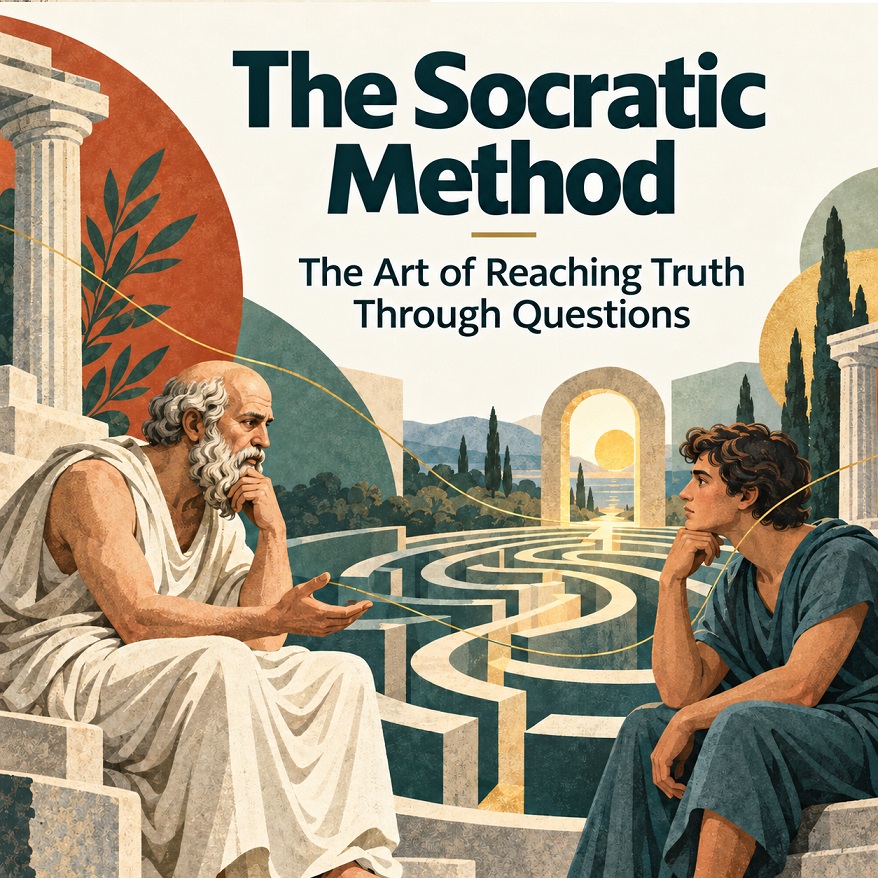
Sometimes the most powerful answer begins with a well-asked question. In a world where people constantly defend opinions, beliefs, and ready-made explanations, the ability to stop and ask “Why?” can transform an entire conversation. More than two thousand years ago, Socrates made precisely this ability central to philosophical inquiry. Instead of offering truths to memorize, he encouraged his conversation partners to examine the foundations of what they believed they knew.
The Socratic method is not merely a debating technique or a way of making someone uncomfortable. It is an exercise in clarity, intellectual honesty, and critical thinking, in which every claim must withstand careful examination. Its purpose is not necessarily to arrive at a final answer during the very first conversation, but to distinguish sound reasons from apparent certainty. Questions thus become a path toward a deeper understanding of both the world and ourselves.
This article continues our philosophical journey after encountering Socrates as a person and before entering the world of Plato. Here, the focus is on the art of philosophical conversation itself: how it works, why it reveals contradictions, and what we can learn from it today. We will explore its historical roots, its principal steps, its possibilities, and its limitations. We will also see why admitting that we do not know enough can be the beginning of genuine knowledge.
Why Socrates Preferred Questions to Ready-Made Answers

Socrates lived in Athens during the fifth century BCE, when public speaking played an enormous role in political and social life. Citizens debated justice, government, virtue, and success, while persuasive speech often brought influence and prestige. In such an environment, a person could appear wise simply because they spoke confidently. Socrates directed attention toward a more difficult question: whether genuine understanding actually stood behind those confident words.
In Plato’s dialogues, he often begins a conversation with a seemingly ordinary request for a definition. He asks what courage, justice, piety, or friendship is, and his conversation partner usually believes they know the answer. Rather than immediately rejecting the response, Socrates examines its implications through further questions. Gradually, the conversation reveals whether the original confidence was justified.
Importantly, Socrates does not invariably present himself as someone who possesses ultimate truth. He often emphasizes his own ignorance and invites the other person to investigate the problem together. Whether this attitude is always entirely sincere or sometimes also serves an ironic purpose remains a matter of philosophical interpretation. Its central meaning, however, is clear: beliefs should be examined rather than accepted merely because of the speaker’s authority.
What Exactly Is the Socratic Method?

Today, the name “Socratic method” covers several related practices of inquiry through questioning. In the ancient dialogues, its most characteristic feature is testing claims for logical consistency. Socrates accepts a proposed definition, draws out its consequences, and compares them with other beliefs held by his conversation partner. If a contradiction appears, the definition must be revised or abandoned.
This practice is associated with the Greek term elenchus, which can mean examination, refutation, or testing. We should not imagine the method as a mechanical formula applied in exactly the same way every time. Plato’s dialogues portray varied conversations in which questions serve different purposes and follow different directions. What they share is the demand that thoughts be justified and contradictions not be concealed.
Modern educational practices often use the phrase “Socratic method” to describe guided learning through a sequence of questions. This application is inspired by the ancient model, but it is not completely identical to the historical conversations of Socrates. A teacher may use questions to guide students toward particular knowledge, whereas Plato’s early dialogues often end without a final solution. Recognizing this distinction helps us understand both the method’s legacy and its development.
The First Step: Clarifying What We Are Claiming

Many arguments begin before the participants have clarified the meaning of their central words. One person speaks of freedom as the absence of restrictions, while another understands it as the ability to make rational choices. Both may defend their positions with conviction without realizing that they are using different definitions. The Socratic approach begins by asking exactly what the concept under discussion means.
If someone says, “A true friend always supports me,” we can ask what “supports” means. Must a friend approve of every action we take, including when we are wrong? Or does the most important kind of support sometimes consist of honest disagreement? Just a few questions can reveal that the original definition is too broad or imprecise.
Clarification is not a minor linguistic detail but a condition for meaningful conversation. Without it, we risk constructing elaborate arguments on words that different people understand differently. A good definition should capture what is essential without including obviously unsuitable cases. Even when we fail to formulate it completely, the attempt itself makes us think more precisely.
The Second Step: Discovering Hidden Assumptions

Behind every confident claim are assumptions that often remain unspoken. When someone asserts that a wealthy person must necessarily be happy, they may be assuming that happiness depends primarily on material opportunities. If we say that the majority is always right, we assume that popularity is a reliable criterion of truth. Socratic questions make these assumptions visible and open to examination.
We can ask what evidence supports a particular belief and whether it would remain true under different circumstances. We can also distinguish personal experience from the general rule we derive from it. A single example may be important, but it is not always sufficient for a universal conclusion. Once we uncover hidden assumptions, we begin to see where an argument is strong and where it requires further justification.
The Third Step: Testing an Idea with Examples and Exceptions

After a definition has been proposed, we should examine whether it works in different cases. If courage is defined as the absence of fear, we can consider someone who does not recognize danger. Is that person’s fearlessness enough to make them courageous? And what should we say about someone who experiences fear but acts wisely to protect others?
Such examples are not merely rhetorical traps but tools for examining a concept. They reveal whether a definition includes cases it should exclude or excludes cases that seem essential. When we discover a mismatch, we can revise the formulation. This process often brings us closer to a better understanding, even without providing a final answer.
The Fourth Step: Following the Consequences of Our Beliefs

A claim may appear acceptable on its own while leading to difficult consequences. If, for example, we accept that justice always means repaying everyone according to how they have treated us, the question arises whether we should respond to injustice with further injustice. If we answer yes, we may find ourselves in conflict with the belief that a just person should not do wrong. Tensions of precisely this kind are important to Socratic inquiry.
Following the consequences requires patience and a willingness to consider uncomfortable possibilities. It is not enough to defend a statement with elegant words if it contradicts our other fundamental principles. Questions help us see the overall structure of our beliefs. The clearer that structure becomes, the easier it is to recognize where change is needed.
Elenchus: How Contradiction Reveals the Limits of Knowledge

One characteristic result of a Socratic conversation is the discovery of a contradiction between different claims accepted by the same person. For example, someone may declare that courage is always beneficial and then acknowledge that reckless action sometimes causes harm. If they also consider recklessness a form of courage, their beliefs begin to conflict. The conversation’s task is to identify exactly where the inconsistency arises.
A logical contradiction shows that at least some of the accepted statements cannot all be true at the same time and in the same sense. It does not, however, automatically establish which premise is mistaken or which alternative theory is correct. Successfully refuting one definition is therefore not equivalent to possessing complete knowledge of the subject under investigation. This limitation matters if we want to use the method honestly rather than as a tool for apparent victory.
Aporia: The Moment When We Are No Longer Certain

In several of Plato’s early dialogues, the conversation ends in a state of aporia, a perplexity in which participants realize that their previous answer was inadequate. This can be unpleasant, especially for someone accustomed to considering themselves knowledgeable. Suddenly, familiar words lose their apparent clarity, and confidence gives way to questions. Yet this very moment can mark the beginning of genuine philosophical development.
Aporia is not empty confusion, nor is it proof that all opinions are equally false. It means that a particular line of explanation has reached a limit and must be reconsidered. In science, a similar situation may arise when observations do not match a theory’s expectations. In personal life, it appears when we discover a gap between our values and our own behavior.
Socratic courage consists not only in asking difficult questions of others. It also includes a willingness to remain without a comfortable answer for a while. Someone who cannot tolerate uncertainty easily returns to the first familiar explanation. Someone who accepts it as part of inquiry may reach a more mature understanding.
Socratic Irony: Why the Philosopher Sometimes Presents Himself as Ignorant

In Plato’s dialogues, Socrates often begins by admitting that he does not know enough and expressing a willingness to learn from his conversation partner. This stance can be understood as sincere intellectual humility, but it sometimes also has an ironic dimension. The person claiming to possess knowledge gradually proves unable to defend their definition. The roles of teacher and student are thus unexpectedly reversed.
It is important not to reduce Socratic irony to mockery or feigned naivety. It serves a philosophical function when it reveals the distance between confidence and genuine understanding. At the same time, its use can create tension if the conversation partner feels trapped. A modern dialogue inspired by Socrates should therefore combine critical examination with respect.
Maieutics: Can a Teacher Help a Thought Be Born?

In Plato’s dialogue Theaetetus, Socrates compares his philosophical activity to the art of midwifery. Just as a midwife assists at birth, he describes his role as helping thoughts emerge and be examined. This metaphor is called maieutics and is one of the most influential images of philosophical education. It emphasizes that people should not simply receive ready-made statements but actively participate in building their own understanding.
The metaphor does not mean that every idea arising in the mind is necessarily true. In the Theaetetus, philosophical examination also involves testing whether the newly born thought is sound or mistaken. A good question helps us not only formulate an idea but also discover its weaknesses. Maieutics thus combines creative thinking with critical examination.
An Example of a Socratic Conversation About Justice

Let us imagine someone claiming, “Justice means always telling the truth.” Rather than rejecting the claim, the questioner can begin by asking whether the word “always” allows any exceptions. They can then propose a case in which someone requests information in order to harm an innocent person. Would it be just to provide that information simply because it is true?
If the conversation partner answers no, the original definition must change. Perhaps justice requires telling the truth except when doing so would facilitate an unjust act. But this formulation also raises questions about intentions, consequences, and our right to judge the actions of others. The conversation does not end with an easy victory but reveals the complexity of the concept.
This example is a modern illustration of the reasoning process, not a verbatim dialogue of the historical Socrates. Its purpose is to show how a universal claim can be examined through a particular case. The same approach can be applied to concepts such as freedom, responsibility, courage, and happiness. In each case, questions should serve clarification rather than manipulation of the answers.
How to Distinguish the Search for Truth from the Desire to Win an Argument

A conversation may outwardly resemble a Socratic dialogue while having a completely different purpose. If we ask questions solely to confuse someone, embarrass them, or demonstrate our superiority, we turn the method into a rhetorical weapon. Genuine inquiry requires a willingness to subject our own beliefs to the same examination. Without that reciprocity, conversation easily becomes a contest of outsmarting one another.
A useful guide is whether we are prepared to acknowledge a strong argument when it comes from the other person. Another is whether we ask questions whose answers genuinely interest us or merely seek a trap prepared in advance. We can be demanding toward ideas while remaining considerate toward the person defending them. This distinction makes critical dialogue more productive and less destructive.
The Socratic Method and Critical Thinking

Critical thinking includes the ability to distinguish claims from evidence, recognize hidden assumptions, and examine whether conclusions follow from arguments. The Socratic method develops these abilities through active conversation rather than simply memorizing rules. It teaches us not to treat authority, popularity, or confidence as sufficient evidence. Instead, it directs attention toward reasons, logic, and possible objections.
At the same time, the method does not replace empirical investigation when a question requires facts about nature or society. Logical analysis can uncover a contradiction in an explanation, but conversation alone cannot measure the temperature of a star or the effectiveness of a medicine. Such questions require observations, experiments, and reliable data. Socratic questions can help us formulate good hypotheses, but they do not remove the need to test them.
The Place of Questions in Education

In the classroom, the Socratic approach can transform a student’s role from passive listener to active participant. Instead of immediately providing the answer, a teacher can ask how a student reached a particular conclusion. Further questions can draw attention to overlooked cases, insufficient evidence, or alternative interpretations. Learning thus becomes an exercise in justification rather than mere memorization.
This approach requires careful consideration of students’ ages, preparation, and emotional environment. Constant challenges can discourage a learner who does not yet have enough knowledge or fears making mistakes in front of others. A good teacher uses questions to support understanding, not to demonstrate superiority. Combining clear explanations, respectful dialogue, and independent reasoning is often more useful than applying any single technique mechanically.
Questions in Everyday Life: From Conflict to Understanding

The Socratic approach can also be useful outside philosophy and the classroom. When a disagreement arises with someone close to us, instead of immediately defending our position, we can ask how they understand the situation. We can clarify which particular action upset them and what expectations lie behind their reaction. Sometimes the conflict turns out to arise not from incompatible values but from different assumptions.
Such questions should be asked with a genuine desire to understand. If we use a calm tone only to lead someone toward a predetermined answer, the conversation loses the trust it needs. Not every emotional situation is suitable for extended logical analysis, especially when someone first needs to feel heard. Philosophical clarity is most useful when combined with human sensitivity.
How to Ask Better Questions

A good Socratic question is clear, open, and directed toward a specific claim. Instead of asking, “Don’t you understand that you’re wrong?”, we can ask, “What reasons lead you to that conclusion?” Instead of “How can you believe that?”, we can ask, “What would make you reconsider your position?” Wording matters because it can open space for reflection or provoke a defensive reaction.
It is useful to alternate questions about definitions, reasons, examples, consequences, and possible alternatives. We can ask whether a rule holds in every case and how we would recognize an exception. We can also examine whether we distinguish what we know from what we merely assume. Most importantly, questions should follow the logic of the conversation rather than a prepared script that ignores the answers.
The Limits of the Socratic Method

Although powerful, the Socratic method does not automatically solve every philosophical or practical problem. Identifying a contradiction can show that certain beliefs are incompatible without telling us which new theory to accept. Moreover, people do not always use concepts through strict definitions, and some questions require historical, scientific, or social knowledge. Logical consistency alone is insufficient if the starting assumptions are factually false.
There is also a danger that conversation becomes endless questioning in which no claim is accepted even provisionally for the sake of shared inquiry. Such a practice can create the impression that all knowledge is impossible. The historical Socrates, however, is not merely a symbol of destructive doubt but of the search for better foundations for life and thought. The method is meaningful when criticism leads toward more responsible understanding rather than doubt for its own sake.
From Socratic Questions to the Philosophy of Plato

Socrates left a legacy that we know primarily through his students and contemporaries. Plato transformed philosophical conversation into a literary form through which he explored virtue, knowledge, the soul, and the structure of reality. In many of his works, Socrates continues asking questions, but broader philosophical constructions gradually appear. The method of examination thus becomes a starting point for a systematic search for truth.
This transition is especially important for the history of philosophy. The question “What is justice?” can lead to questions about the nature of the good, the structure of the soul, and the foundations of social order. The search for stable definitions can direct thought toward the distinction between changing things and what Plato will call Ideas or Forms. Not all these views can be attributed to the historical Socrates, but the connection between the two philosophers is central to the development of ancient thought.
The Art of Remaining Open to Truth

The Socratic method teaches us that philosophy begins not with a display of knowledge but with a willingness to examine it. It requires courage to ask uncomfortable questions, but also humility to accept when our own answers do not withstand scrutiny. In this process, a mistake is not necessarily a defeat but an opportunity to think better. The most important victory is not over our conversation partner but over our own premature certainty.
Having come to know Socrates as a person and explored his way of thinking, the next step in our philosophical journey naturally leads to Plato. With him, questions about virtue and knowledge unfold into an ambitious philosophy of truth, the soul, and reality. Yet the Socratic lesson remains essential there as well: every great theory begins with a question we refuse to ignore. Sometimes the right question is the most important step toward truth.
Author: Vasil Stoyanov
Socrates, Plato, and Aristotle – The Path to a Meaningful Life
Test your knowledge
Answer every question correctly to complete the journey and unlock your badge.
Mark the core articles as read to unlock the test. Supplemental Premium reading is optional.