

Sufi stories are not ordinary tales. They are crafted to touch not only the mind, but something deeper within the human being. They often begin as simple narratives and end as questions directed back at ourselves.
In Sufism, wisdom is rarely transmitted through dry explanations. Instead, teachers use symbols, paradoxes, and unusual situations that gradually reveal their meaning. This is precisely why these stories have survived for centuries and continue to inspire people around the world.
1. The King and the Dervish
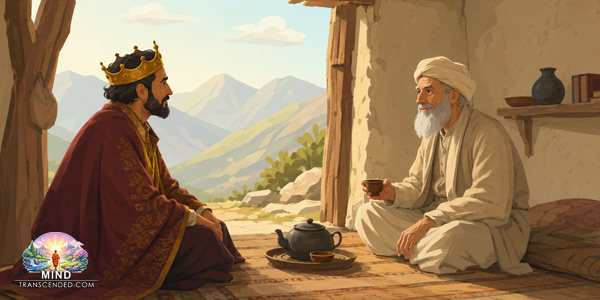
A powerful king heard of a dervish who lived in the mountains and was renowned for his extraordinary wisdom.
People said that he possessed nothing – no house, no wealth, no servants – and yet he was more peaceful than any ruler.
The king decided to visit him personally.
After a long journey, he arrived at a small hut made of mud and wood. Inside, the dervish sat calmly on the floor, drinking tea.
The king looked around in surprise.
“Is this your home?”
“Yes,” replied the dervish.
“But there is nothing here.”
The dervish smiled.
“You do not have many things with you either.”
“I am only a traveler here,” said the king.
“So am I.”
These words unsettled the ruler.
He spent the night in the hut, but he could not sleep. He thought about his palaces, his treasures, and his armies. Everything he possessed suddenly seemed temporary.
The next morning, he asked:
“How is it possible to live without fear of the future?”
The dervish poured himself another cup of tea and calmly replied:
“Because nothing that can be taken away is truly mine.”
The Lesson
Sufism teaches that much of human suffering comes from attachment to temporary things. True freedom begins when we stop building our identity around what we possess.
2. The Teacher and the Closed Door
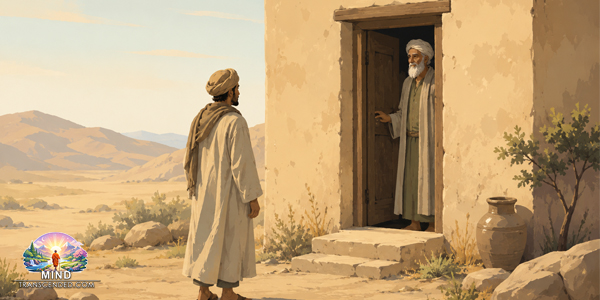
A young man set out in search of a great Sufi master.
After years of traveling, he arrived at a monastery in the middle of the desert.
He knocked on the door.
“Who is it?” asked a voice from within.
“It is I. I have come to learn the truth.”
Silence followed.
Then the voice replied:
“There is no room here for two.”
The door remained closed.
The young man was furious. He believed he had traveled a great distance and deserved to be welcomed. But no one opened the door.
He stayed near the monastery for days. Then weeks.
Gradually, he began to observe himself – his anger, his pride, and his desire to be recognized as “spiritual.”
Months later, he knocked again.
“Who is it?”
After a long silence, the man answered softly:
“I no longer know.”
The door opened.
The old master greeted him with a smile.
“Now you may enter.”
The Lesson
According to the Sufi tradition, the greatest obstacle to truth is the ego – the image we hold of ourselves.
3. The Tale of the Reed Flute
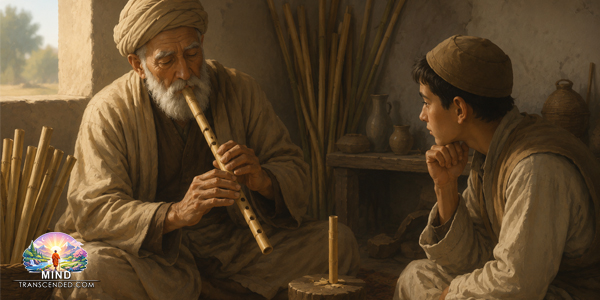
In a small village lived an old craftsman who made flutes from reeds.
People came from far away to hear his instruments, for their sound was extraordinarily beautiful and filled with sorrow.
One day, his apprentice asked:
“Master, why do all your flutes sound as though they are weeping?”
The old man picked up a piece of reed and said:
“Because every flute has been cut away from its field.”
Then he carved holes into it and continued:
“For the reed to sing, it must first be wounded.”
He began to play.
The melody was so deep and haunting that the apprentice felt an inexplicable sadness rise within him.
“People are the same,” said the master. “The soul remembers its source and spends its whole life longing to return to it.”
The Lesson
This story echoes the teachings of Jalal ad-Din Rumi. In Sufism, the human soul is often described as having been separated from the Divine and spending its life searching for the way back home.
4. The Man Who Carried Stones
There was once a man who constantly complained about how difficult his life was.
He felt exhausted, unhappy, and resentful toward the world.
One day, he met a dervish.
“Why do you suffer so much?” the old man asked.
“My life is far too heavy.”
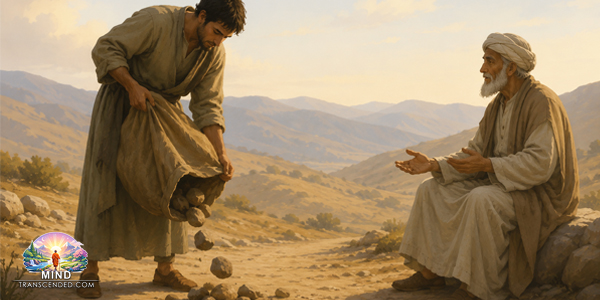
The dervish handed him a sack filled with stones.
“Carry this with you.”
The man became angry.
“My life is already burdensome enough!”
But the old man insisted.
After several hours of walking, the traveler could barely move.
“I can’t go on any longer!”
“Then open the sack,” said the dervish.
Inside, each stone had a word written on it:
“resentment,” “envy,” “fear,” “pride,” “the past,” “guilt.”
The man began throwing the stones away one by one.
With each stone he discarded, his steps became lighter.
When the sack was finally empty, he asked:
“Why didn’t you tell me this from the beginning?”
The dervish replied:
“Because some lessons must be felt, not explained.”
The Lesson
Sufi stories often remind us that we carry much of our own suffering. By letting go of resentment, fear, guilt, and attachment to the past, we discover a freedom that was available to us all along.
5. The Mirror of the Heart
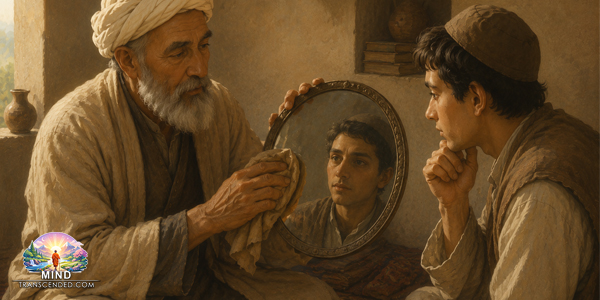
A young student lived with a renowned Sufi master.
Although he had studied sacred texts for many years, he felt no inner peace.
One day, he asked:
“Master, why do I not experience the truth that everyone speaks of?”
The teacher handed him an old mirror covered in dust.
“What do you see?”
“Nothing clearly.”
The old man slowly began to clean the mirror.
“And now?”
“I can see my face.”
The teacher said:
“The heart is the same. When it is covered with anger, fear, and pride, it cannot reflect the truth.”
The Lesson
In Sufism, the heart is regarded as the spiritual center of the human being. It must be cleansed and polished before it can perceive reality clearly.
6. The Sage’s Silence
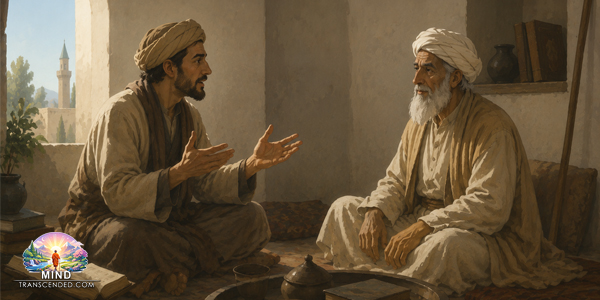
A renowned scholar came to a Sufi sage to debate with him.
For hours, he spoke about philosophy, religion, and knowledge.
The sage remained silent.
At last, the scholar grew irritated.
“Why do you say nothing?”
The old man calmly asked:
“If a cup is already full, what happens when you pour more into it?”
“It overflows.”
“Exactly.”
The scholar fell silent.
For the first time, he began to listen.
The Lesson
True learning begins only when a person lets go of the need to always be right.
7. The Last Lesson
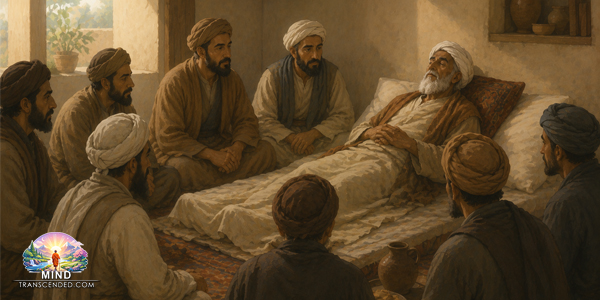
An old Sufi master sensed that the end of his life was approaching.
His disciples gathered around him, waiting for his final words.
Each hoped to hear a great secret.
The master looked at them and asked:
“When you were hungry, what nourished you?”
“Bread,” they replied.
“And when you were thirsty?”
“Water.”
He nodded.
“The truth is simple. It is only the human mind that makes it complicated.”
Then he closed his eyes.
The disciples sat in silence for a long time.
At last, one of them whispered:
“We spent years searching for something far away, when it had been right in front of us all along.”
The Lesson
Sufism does not seek complex theories, but the direct experience of life, presence, and reality.
8. The Candle and the Butterflies
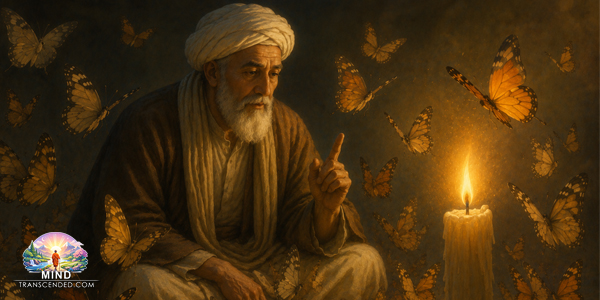
Once, a group of moths wanted to understand the nature of fire.
They gathered together and decided to send one of their number to investigate.
The first moth approached the flame, felt its warmth, and returned.
“Fire is something warm and bright,” she said.
But the old sage among the moths shook his head.
“You have not understood.”
The second moth flew closer. Her wings were lightly singed, and she barely managed to return.
“Fire burns and causes pain,” she said.
Again, the sage replied:
“You have not understood.”
Then the third moth flew straight into the flame.
The fire consumed her, and she vanished into the light.
The old sage whispered:
“Only she understood.”
The Lesson
In Sufism, truth cannot be fully understood through thought or observation alone. It must be experienced directly and completely.
9. The Gardener and the Withered Tree
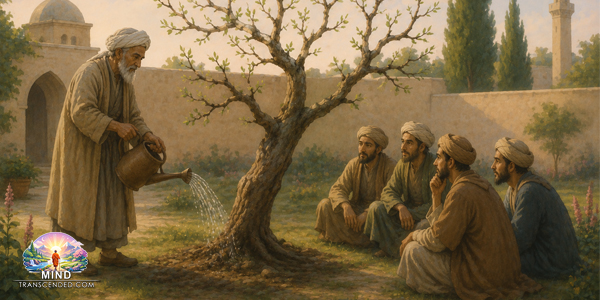
In the courtyard of an old Sufi monastery stood a tree that appeared completely dead.
The disciples constantly urged the gardener to cut it down.
“It is dead,” they would say. “It is only taking up space.”
But the old gardener refused.
Every morning, he watered the tree, trimmed its branches, and loosened the soil around its roots.
Nearly a year passed.
Then one spring, the disciples were astonished to see tiny green leaves appearing on its branches.
“How did you know the tree was still alive?” they asked.
The gardener smiled.
“I wasn’t certain. But I knew that as long as there was even the slightest chance of life, it deserved care.”
Then he added quietly:
“It is the same with people.”
The Lesson
Sufi wisdom teaches patience and compassion. Sometimes the people who seem the most lost are the very ones who need love, care, and time the most.
10. The Traveler and the River

A man wandered through the desert for many years in search of wisdom.
Eventually, he came upon a wide river, but there was no bridge.
An old dervish sat on the bank.
“How can I cross?” the traveler asked.
“Step into the water,” replied the old man.
“But I do not know how deep it is.”
The dervish smiled.
“No one can measure a river from the shore.”
The traveler was afraid, but he took the first step.
The water reached only to his knees.
A few steps later, it rose to his waist.
Then, after walking a little farther, he discovered a shallow path leading all the way to the opposite bank.
When he reached the other side, he turned around to thank the old man.
But the dervish was gone.
Only the sound of the river remained.
The Lesson
Many people wait for complete certainty before making a change in their lives. Sufism teaches that the true path reveals itself only after the first step is taken.
- 3 Rumi Stories That Guide the Heart Toward God
- 15 Wise and Humorous Stories of Nasreddin Hodja
- 5 Sufi Wisdom Stories That Will Change the Way You See Life
Author: Vasil Stoyanov