
Introduction
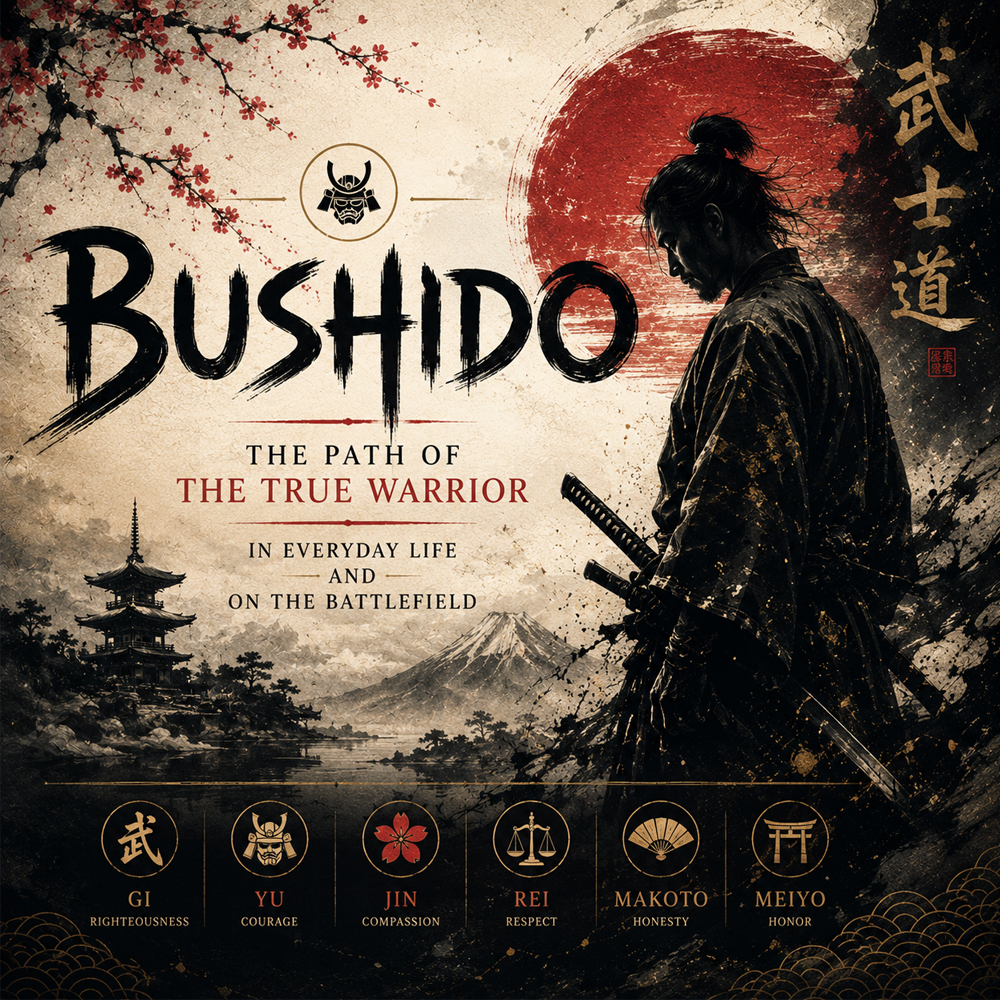
When people hear the word “samurai,” they usually imagine a man clad in armor, carrying a razor-sharp katana, and facing death with unwavering courage. This image is so powerful that it has long transcended the borders of Japan and become a universal symbol of honor, discipline, and self-sacrifice. Behind the legends, films, and romanticized portrayals, however, lies a complex historical reality that developed over many centuries. At the heart of that reality stands Bushido-a moral and spiritual code that shaped the behavior of the samurai and left a profound mark on Japanese culture.
Bushido is often translated as “The Way of the Warrior,” but this definition is far too brief to capture its true essence. It was not merely a set of rules for the battlefield. Bushido represented a complete philosophy of life, death, honor, duty, and personal development. It combined ancient Japanese traditions, Confucian ethics, Zen Buddhist spirituality, and the realities of a military aristocracy that ruled Japan for centuries.
The history of Bushido did not begin with the publication of a book or the proclamation of an official law. Its origins can be traced much further back, to the period when the first warriors began to emerge as a distinct social class. To understand the true meaning of Bushido, we must follow the development of the samurai from their earliest roots to the era in which they became the rulers of Japan. We must also examine how various philosophical and religious traditions influenced them and how the ideal of the warrior gradually evolved into that of a person who was both fearless in battle and morally responsible in everyday life.
The Origins of the Samurai and the Rise of the Warrior Class
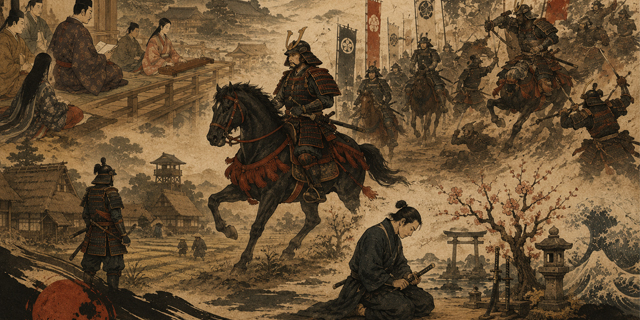
The roots of the samurai class can be traced back to the Heian period, which began in the late eighth century. During this time, the Japanese emperor formally ruled the country from the capital of Kyoto, but real power in the distant provinces often rested in the hands of local nobles and military leaders. Vast distances, limited communication, and frequent conflicts between influential clans created a need for professional warriors who could protect the lands and interests of their lords.
The word “samurai” comes from an old Japanese verb meaning “to serve.” Originally, samurai were not independent heroes but loyal retainers of aristocratic families. Their primary duties were to guard their masters’ estates and participate in military campaigns. Over time, these warriors began to develop an identity distinct from that of the court aristocracy in Kyoto.
While the nobles in the capital devoted themselves to poetry, music, and ceremonial life, provincial warriors lived in a world of constant uncertainty. They had to be prepared to fight at any moment, excel in horsemanship, and master a variety of weapons. This harsh way of life gradually shaped the values that would later become the foundation of Bushido.
In the twelfth century, conflicts between the powerful Taira and Minamoto clans led to a series of wars known as the Genpei War. This struggle changed Japanese history forever. After the victory of the Minamoto clan in 1185, its leader, Minamoto no Yoritomo, established the first military government, the Kamakura Shogunate. Although the emperor remained on the throne, real political power passed into the hands of the warrior class.
This marked the moment when the samurai ceased to be merely armed servants and became the ruling elite of Japan. Along with their new political role, they began to develop a distinct cultural identity. Although this identity did not yet have a clearly defined code, it already contained the essential ideas of loyalty to one’s lord, personal courage, and readiness for self-sacrifice.
The Early Ideals of the Samurai
The first samurai were not philosophers. They lived in a world where survival often depended on the ability to act decisively and without hesitation. As a result, their earliest values were closely tied to the practical demands of warfare. Courage was essential because fear could lead to defeat. Loyalty was equally important because no army could function without trust between lord and vassal.
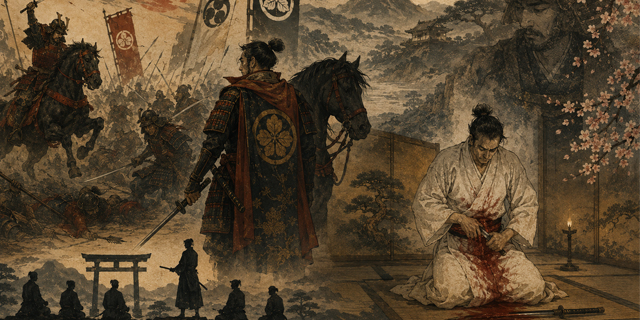
Many early chronicles contain stories of warriors who chose death over dishonor. These accounts reveal that long before the emergence of Bushido as a formal concept, there already existed a deep conviction that honor was more valuable than life itself. For the medieval Japanese warrior, the loss of reputation could be more devastating than physical death.
One of the most famous figures of this era was Minamoto no Yoshitsune, a legendary commander who won decisive victories for his clan. Despite his military achievements, he eventually fell out of favor with his brother Yoritomo and was ultimately forced to take his own life. His story remains deeply embedded in Japanese memory as an example of the tragic fate of a man who remained faithful to his honor even when betrayed by his own family.
These early legends played a crucial role in shaping samurai culture. They provided models of behavior and demonstrated what it meant to be a worthy warrior. Although Bushido had not yet been formally defined, many of its core elements were already beginning to take shape.
The Influence of Confucianism and the Moral Dimension of Warrior Life
As time passed, the samurai sought not only military justification for their role in society but also moral and philosophical foundations. Here, Confucianism exerted a profound influence. Originating in China through the teachings of Confucius, this philosophy emphasized social order, respect for authority, family loyalty, and moral duty.
When Confucian ideas reached Japan, they gradually found a place within samurai culture. For warriors, Confucianism provided an intellectual framework that justified their social position and defined how an honorable person should behave. It transformed military service into something more than a practical necessity; it became a moral obligation.
The concept of loyalty became especially important. In the Confucian tradition, faithfulness to one’s ruler and respect for superiors were considered fundamental virtues. The samurai adopted these principles and made them central to their worldview. A lord was no longer merely the person who rewarded military service. He became the object of almost sacred devotion.
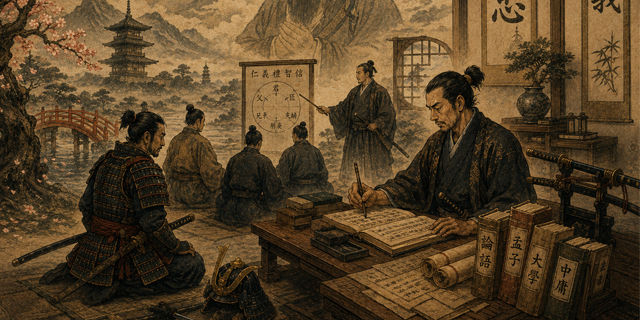
Over the following centuries, many samurai thinkers devoted themselves to studying Chinese classical texts. A warrior was no longer expected to be merely strong and brave. He was also expected to be educated, knowledgeable about history, ethics, and governance. Gradually, the ideal emerged of a person who combined the sword and the brush, martial skill and intellectual refinement.
This transformation had enormous significance for the future development of Bushido. The code began to extend beyond purely military virtues and evolved into a system for cultivating character. A samurai was expected not only to conquer enemies but also to master himself.
Zen Buddhism and the Conquest of the Fear of Death
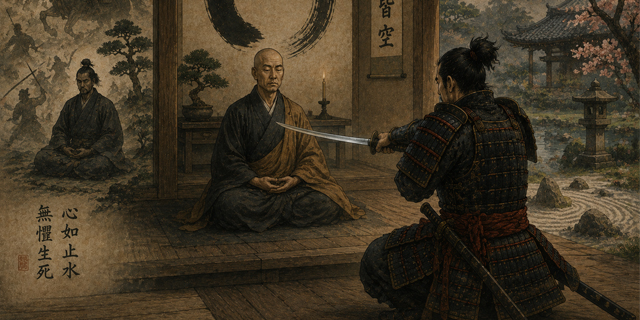
If Confucianism provided the samurai with a moral structure, Zen Buddhism offered them spiritual depth. This tradition entered Japan from China during the twelfth and thirteenth centuries and quickly gained followers among the warrior class.
Zen emphasized direct experience, self-discipline, and freedom from attachment. Rather than focusing on complex doctrines, it encouraged meditation and immediate awareness of reality. For samurai, these teachings had immense practical value.
On the battlefield, excessive thinking could be fatal. A warrior needed to act instantly and without hesitation. Zen practices helped cultivate a state of inner clarity in which actions arose naturally and fearlessly. This is one reason why many samurai became patrons of Zen monasteries and devoted time to meditation.
Particularly important was Zen’s attitude toward death. Buddhism teaches that all things are impermanent and that attachment to life is a source of suffering. For the samurai, this meant that the fear of death had to be overcome. A person who had accepted the inevitability of death could act freely and decisively.
There is a famous story about a Zen master who was threatened by an armed samurai. The warrior pointed his sword at the teacher and declared that he could kill him in an instant. The master calmly replied that he too could be killed in an instant. This complete absence of fear affected the samurai far more deeply than any threat could have. The story illustrates the ideal of spiritual tranquility that Zen brought into samurai culture.
The Birth of the Idea of Bushido
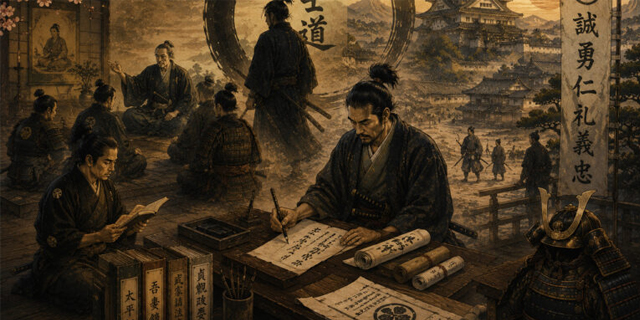
Interestingly, the samurai themselves did not widely use the term “Bushido” for many centuries. The values that we now associate with it existed long before the word became popular. They were transmitted through traditions, military chronicles, family teachings, and personal examples.
It was not until the Edo period, which began in 1603, that the idea of Bushido started to take shape as a more clearly defined philosophical system. During this era, Japan entered a long period of peace under the Tokugawa Shogunate. Paradoxically, it was precisely the absence of war that forced the samurai to reconsider their identity.
For generations, they had been warriors. But what did it mean to be a warrior when there were no battles to fight? The answer gradually emerged in the belief that a true samurai must follow a moral path regardless of whether he held a sword in his hand or governed a province.
Bushido thus evolved into a comprehensive philosophy of life. Honesty, courage, compassion, courtesy, sincerity, and loyalty came to be regarded as essential virtues. A warrior was expected to practice them every day, not only during times of war. Through this transformation, Bushido became far more than a military code. It became a guide for living with integrity, discipline, and purpose, shaping not only the samurai class but also the broader cultural identity of Japan.
Bushido in the Age of Peace and Its Transformation into a Moral Code
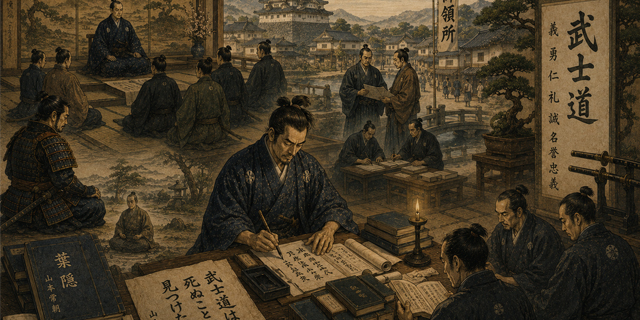
The Edo period, which lasted from the beginning of the 17th century to the middle of the 19th century, was one of the most fascinating eras in the history of the samurai. After centuries of almost continuous warfare, Japan entered a long period of political stability. The Tokugawa shogunate succeeded in imposing strict control over the country, and major military conflicts between feudal lords virtually disappeared. This created an unusual situation. Samurai, who for generations had defined themselves through warfare, were forced to find a new purpose for their existence.
Many of them began serving as administrators, judges, advisors, and government officials. Instead of spending their days on the battlefield, they managed lands, collected taxes, and dealt with social and political matters. At first glance, this might seem like a departure from the warrior tradition, but in reality, it was during this period that the idea of Bushido developed most intensely. While samurai values in earlier centuries had been largely practical, they now began to be organized, analyzed, and explained in written works.
Samurai thinkers started reflecting on what distinguished a true warrior from an ordinary person. The answer was no longer found solely in martial skill. Increasing emphasis was placed on character, discipline, and moral responsibility. A true samurai was expected to control his desires, place duty above personal gain, and live in such a way that his actions served as an example to others.
This was also the period in which several influential works appeared that would shape later understandings of Bushido. Among them, the most famous is Hagakure, a collection of reflections by Yamamoto Tsunetomo. Although the text was not widely known immediately after its creation, it later became one of the most frequently cited sources on samurai philosophy. It contains the famous statement that “the way of the samurai is found in death.” This idea is often misunderstood. It does not advocate self-destruction but rather a willingness to place duty above one’s own life. A samurai should be so devoted to his principles that fear of death never influences his decisions.
From a modern perspective, such views may seem extreme, but within the context of the time they served an important purpose. They reminded the warrior class that its role was not based on wealth or privilege but on service and responsibility. Bushido gradually evolved into a moral framework that preserved the identity of the samurai during an era when their military purpose was no longer as obvious as before.
The Story of the Forty-Seven Ronin – The Most Famous Example of Bushido
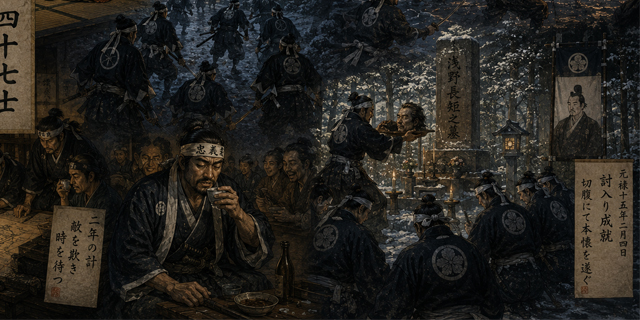
Among all the stories associated with samurai honor, none has left a deeper mark on Japanese consciousness than the tale of the Forty-Seven Ronin. Taking place in the early 18th century, it is still told today as a powerful example of loyalty, sacrifice, and devotion to the principles of Bushido.
The events began in 1701 when the daimyo Asano Naganori was humiliated by the court official Kira Yoshinaka. After enduring repeated provocations, Asano lost his composure and attacked Kira inside the shogun’s palace. Although the wound was minor, drawing a weapon within the palace was considered a serious crime. Asano was sentenced to commit seppuku, ritual suicide, and his lands were confiscated.
The death of their lord turned his retainers into ronin-masterless samurai. According to the law, they were expected to accept their fate and continue their lives as ordinary citizens. However, a group of forty-seven men led by Oishi Yoshio chose a different path. They believed that their lord had been treated unjustly and that their duty demanded revenge.
For nearly two years, the ronin carefully prepared their plan. To avoid suspicion, some of them deliberately adopted carefree lifestyles. Oishi himself frequented taverns and pretended to have abandoned any thoughts of vengeance. His behavior convinced his enemies that the threat had passed.
When the right moment finally arrived, the ronin gathered and attacked Kira’s residence. After a fierce struggle, they succeeded in finding and killing him. They then carried his severed head to the grave of their lord and placed it there as a symbol of fulfilled duty.
The authorities faced a difficult dilemma. On one hand, the ronin had broken the law. On the other hand, their loyalty embodied the very ideals that society associated with samurai honor. In the end, they were permitted to commit seppuku rather than be executed as criminals.
The story of the Forty-Seven Ronin became legendary even during the lifetimes of those involved. For many Japanese people, it represents the very essence of Bushido. These men were willing to sacrifice their lives not for personal gain but for a sense of duty that they placed above everything else. Regardless of the various interpretations that have emerged over the centuries, the story remains one of the strongest testimonies to the influence of samurai ethics.
Seppuku and the Samurai Understanding of Honor
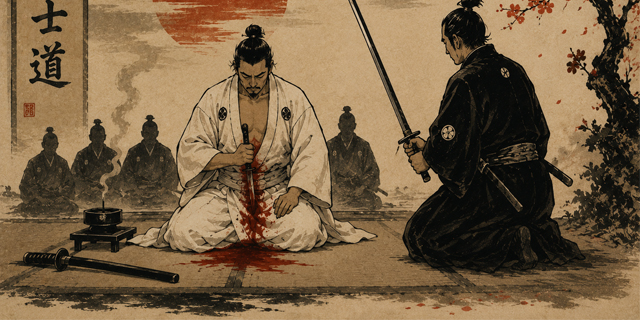
One of the most famous and often misunderstood practices associated with the samurai is seppuku. In the West, it is frequently portrayed simply as a form of suicide, but within samurai culture its meaning was far more complex. Seppuku was a ritual act through which a person demonstrated a willingness to take responsibility for his actions and preserve his honor even in the final moments of life.
The practice originated during the medieval period and gradually became an established part of warrior tradition. In a world where reputation determined social standing, the ability to choose one’s own death was regarded as the ultimate proof of dignity. A samurai preferred to die by his own hand rather than face public humiliation or capture.
The ritual itself was highly formalized and symbolic. It involved special clothing, a farewell poem, and the presence of witnesses. Often, a trusted assistant stood nearby to end the samurai’s suffering at the appropriate moment. Every aspect of the ceremony emphasized the belief that even death should be faced with composure and dignity.
Numerous stories tell of individuals who committed seppuku after military defeats or political conflicts. Some of these accounts became legendary. They reveal how deeply rooted the belief was that honor held greater value than physical existence. Although the practice may seem alien to the modern world, it illustrates the profound connection between personal responsibility and the samurai concept of morality.
It is important to note that seppuku was never an everyday occurrence. Even among samurai, it was considered an extreme measure. The very existence of such a practice demonstrates how deeply the values of Bushido penetrated the lives of the warrior class. For these men, honor was not an abstract concept but a reality worth paying the highest possible price to preserve.
Samurai as Scholars, Poets, and Artists
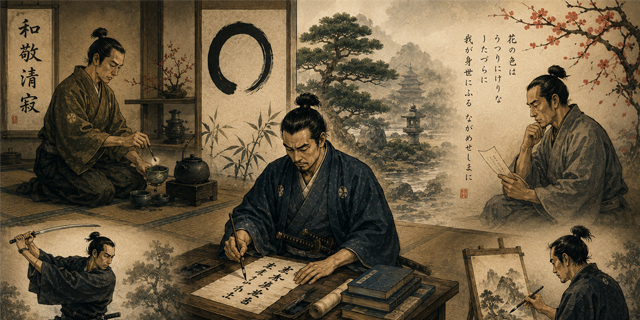
Popular images often portray samurai solely as warriors, but the reality was far richer. Especially during the Edo period, many members of the warrior class devoted a significant portion of their lives to education and the arts. This was not viewed as contradictory to their martial identity. On the contrary, it was believed that a person should cultivate both body and spirit.
Many samurai studied calligraphy, poetry, and literature. They believed that beauty and discipline were closely connected. Composing a short poem required the same concentration and self-control needed to master the sword. This relationship between artistic expression and martial skill became a distinctive feature of Japanese culture.
The tea ceremony exerted a particularly strong influence. At first glance, it appears unrelated to warfare, yet samurai found within it values that aligned perfectly with their worldview. Simplicity, respect for others, and attention to every detail were regarded as exercises in self-discipline. Through such practices, a warrior learned to remain calm and focused regardless of circumstances.
There are many stories of famous samurai who combined martial excellence with artistic talent. Some left behind poems that are still studied today. Others produced paintings or philosophical writings. These examples demonstrate that the ideal samurai was not merely a man capable of fighting and killing. He was expected to be a cultured and moral individual who continuously worked toward self-improvement.
The Decline of the Samurai Era
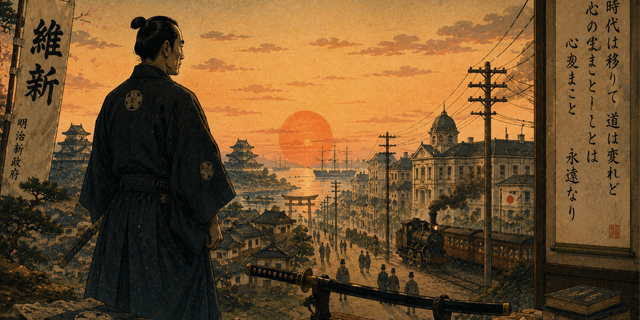
During the 19th century, Japan entered a period of dramatic transformation. After centuries of relative isolation, the country was forced to open its ports to foreign trade. This marked the beginning of changes that gradually dismantled the old feudal order.
The reforms of the Meiji era fundamentally reshaped Japanese society. Central authority was strengthened, a modern army replaced traditional warrior forces, and samurai privileges began to disappear. They were no longer viewed as an indispensable ruling class. The new state required engineers, teachers, entrepreneurs, and modern military officers rather than hereditary warriors.
For many samurai, these changes were painful. They lost not only their social status but also the way of life that had defined their identity for generations. Some adapted successfully and became government officials or businessmen. Others struggled to accept the new reality.
One of the most famous examples is Saigo Takamori. Initially, he supported the modernization of Japan, but he later became disillusioned with the direction the country was taking. In 1877, he led a rebellion against the government. Although the uprising ended in defeat, Saigo became a symbol of the samurai spirit and is often referred to as “the Last Samurai.”
His fate reflects the end of an era. The samurai ceased to exist as a social class, but the values they had cultivated over centuries did not disappear. Instead, they continued to survive in various forms within Japanese culture.
The Legacy of Bushido in the Modern World
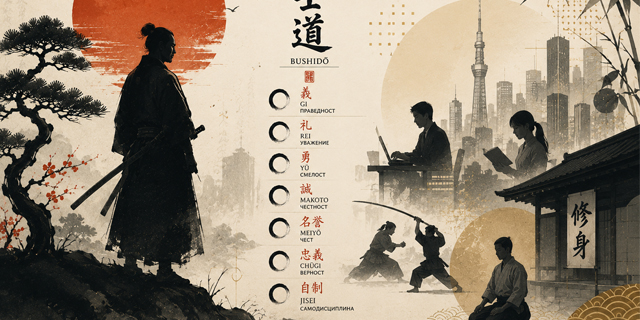
After the disappearance of the samurai class, Bushido did not remain confined to history books. On the contrary, many of its principles continued to influence Japanese society. Ideas such as discipline, respect, responsibility, and devotion to duty became embedded in the national culture.
During the 20th century, the concept of Bushido was interpreted and used in different ways. Sometimes it was presented as a source of moral inspiration, while at other times it was employed for political purposes. This demonstrates how powerful the image of the samurai remained within the public imagination.
Today, interest in Bushido extends far beyond Japan. People around the world study its principles as a system of personal development. Of course, modern interpretations often differ from historical reality. Few people would literally embrace the idea of sacrificing their lives for a lord. Nevertheless, values such as honesty, self-discipline, and perseverance remain highly relevant.
Modern martial arts also carry the imprint of the samurai tradition. Although most practitioners will never participate in actual combat, they pursue the same kind of inner refinement that was central to Bushido. The goal is not to defeat others but to become a better version of oneself.
Conclusion
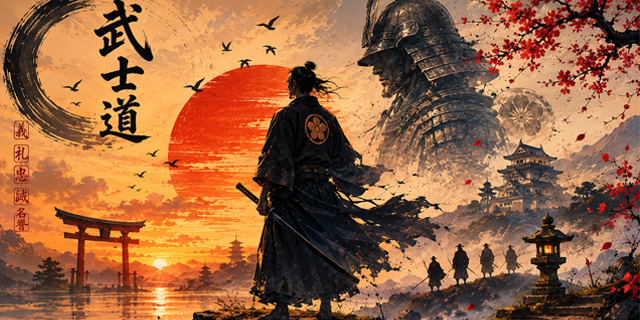
The history of Bushido is the story of the development of a unique cultural and moral tradition. It began amid the harsh realities of medieval Japan, where the first samurai defended the lands of their lords. Over time, they were influenced by Confucianism, which introduced ideas of moral duty and social order, and by Zen Buddhism, which taught inner calm and freedom from the fear of death.
Gradually, these influences merged into the concept of Bushido-a path that transcended martial skill and became a philosophy of life. The samurai was no longer merely a man with a sword. He became an individual striving for honesty, self-control, loyalty, and continuous self-improvement. The stories of Yoshitsune, the Forty-Seven Ronin, and Saigo Takamori reveal different aspects of this ideal and demonstrate how deeply it penetrated Japanese culture.
Although the age of the samurai has long passed, the legacy of Bushido continues to endure. It reminds us that true strength is not measured solely by physical power or military victories. Real strength is revealed in a person’s ability to remain faithful to their principles, take responsibility for their actions, and preserve their dignity even in the most difficult circumstances. That is why the story of Bushido continues to inspire people today-not as a relic of the past, but as a testament to the timeless pursuit of honor, discipline, and inner excellence.
Author: Vasil Stoyanov