
Yoga is one of humanity’s most remarkable spiritual and philosophical inheritances. Its history encompasses more than two millennia of documented texts and practices, while some of its formative ideas reach into earlier religious traditions of India. Within this heritage, the human being is understood neither simply as a body to be strengthened nor merely as a mind to be filled with information. Human life is regarded as capable of profound transformation in the way it perceives itself, the world, and existence itself.
In contemporary culture, yoga is often associated with flexibility, physical postures, and relaxation. These are only particular expressions of a much wider tradition. In Indian intellectual history, yoga can signify discipline, concentration, sustained practice, a spiritual path, and liberation from the inner dependencies that perpetuate suffering. It is not a single unchanging doctrine. Different schools offer different accounts of consciousness, reality, and the ultimate human goal, yet they share the conviction that understanding must be cultivated through lived practice.
What makes yoga worthy of such deep admiration is its courage: it does not stop at asking what the world is, but also asks how a human being should live in order to see clearly. This article traces yoga’s history, philosophical foundations, and principal paths. It offers an introduction to the deeper study of the Bhagavad Gita, Patanjali, Hatha Yoga, and traditions of the subtle body, while preserving the distinctions between their teachings instead of forcing them into an artificially unified system.
What Does the Word Yoga Mean?
The Sanskrit word yoga is associated with the verbal root yuj, whose range of meanings includes yoking, joining, applying, and concentrating. From this linguistic foundation emerged a rich spectrum of philosophical uses. Depending on the text, yoga can designate a method, a discipline, control of attention, meditative concentration, or a state of spiritual attainment. The popular explanation that yoga means simply union captures an important symbolism but does not exhaust the word’s historical meanings.
This diversity matters. When Patanjali describes yoga in terms of the stilling of the movements of consciousness, he speaks the language of systematic meditative discipline. When the Bhagavad Gita presents yoga as the art of acting without enslaving attachment to results, it describes a way of living in the world. When later Hatha texts explain techniques involving the body and breath, they employ the word for concrete practices of transformation. A single term encompasses several distinct spiritual projects.
This is precisely what makes yoga extraordinary. It has preserved a broad aspiration toward inner freedom while developing numerous ways of pursuing it. We encounter yoga in the silence of meditation, ethical discipline, devotion to the divine, philosophical investigation, and attentive physical practice. Historical accuracy requires these paths to be distinguished; respect for the tradition requires each to be understood on its own terms.
Indian Civilization and the Birth of Spiritual Discipline
Understanding yoga begins with the intellectual and religious world of ancient India. Questions concerning life, death, ritual, consciousness, and liberation were explored there over many centuries. Vedic traditions developed elaborate ritual practices and conceptions of cosmic order. Later, the early Upanishads directed attention toward inner knowledge and the relationship between human existence and ultimate reality.
Alongside these developments arose movements of renunciants, ascetics, and wandering thinkers, broadly associated with the shramana traditions. Buddhism and Jainism emerged in this environment and developed sophisticated systems of ethical discipline, meditation, and liberation. Yoga took shape through sustained interactions among different Indian communities, not as an isolated invention produced by one individual at a single historical moment.
Yoga’s origins are sometimes linked directly to images from the Indus Valley Civilization. Certain archaeological objects do depict seated figures, but their meaning remains a matter of historical interpretation. They do not establish the existence of a fully developed system identical to modern yoga. A more secure history begins with texts that clearly describe contemplative practices, discipline, and philosophical aims.
Such scholarly precision does not diminish the greatness of yoga’s history. It makes that history more impressive by revealing the many generations that participated in its development. Yoga is not a frozen relic. It is a living intellectual and practical heritage in which teachers debated, devised new methods, and reconsidered what they had inherited.
The Upanishads and the Discovery of the Inner World
The Upanishads occupy a special place in the development of Indian spiritual thought. Their attention increasingly moves from the external performance of ritual toward questions about the knower, consciousness, and ultimate reality. What remains constant amid the changes of body and thought? What does it mean to know oneself? What is the relationship between individual existence and the universal ground of reality? These questions created the philosophical atmosphere in which many yogic ideas acquired their depth.
The concepts of atman and brahman are central to numerous Upanishadic teachings. Atman designates the deepest dimension of the self, while brahman refers to ultimate reality in differing philosophical interpretations. Some texts develop an understanding of their identity, which later becomes decisive for Advaita Vedanta. Other traditions describe the relationship between the individual and the absolute differently. No single Upanishadic interpretation should be projected onto every path of yoga.
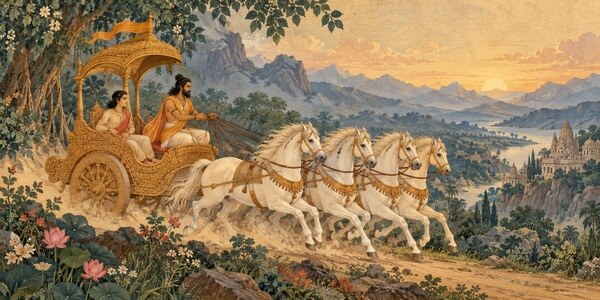
In the Katha Upanishad, the human being is depicted through the famous image of a chariot. The body is the chariot, the senses are horses, the mind is the reins, and discriminating intelligence is the charioteer. The image expresses the idea that without discipline, the forces of human life pull in conflicting directions. Through clear judgment and trained attention, they can follow a meaningful course. It remains one of the most powerful and accessible images of spiritual self-governance.
Other Upanishadic texts discuss breath, concentration, and contemplative states. They already display an ambition to transform direct experience rather than merely formulate philosophical beliefs. Yoga gradually becomes a bridge between knowledge and life. Truth must be understood, but it must also change how a person thinks, desires, and acts.
From Suffering to Freedom: Yoga’s Great Question
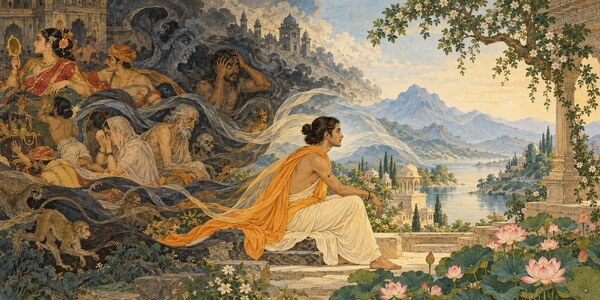
Different yogic systems begin with a profound observation: human life is marked by dissatisfaction, fear, attachment, and mistaken understanding. Our desires continually change. What delights us is impermanent. The body ages, relationships transform, and the mind constructs stories that we mistake for final truths. Spiritual discipline emerges from the refusal to accept these patterns as the only possible form of existence.
In Indian philosophical contexts, liberation is often called moksha, while the classical yoga of Patanjali gives particular importance to kaivalya. These terms are not entirely interchangeable. Different schools explain freedom differently: as the discrimination of pure consciousness from nature, as knowledge of ultimate reality, as devotion and nearness to the divine, or as overcoming ignorance and binding action.
What these perspectives share is the conviction that human unfreedom is not merely an external circumstance. It is sustained by the way we perceive ourselves. When every thought appears to be an unquestionable truth and every desire an order, the capacity for conscious choice diminishes. Yoga offers methods for examining and transforming that dependency. Its aim is not simply temporary rest, but a deeper change in our relationship with experience.
This does not mean that meditation can solve every problem of life. Illness, social injustice, and material hardship require concrete responses. Yoga adds another dimension to external effort: the ability to observe how fear, pride, attachment, and confusion influence our decisions. The combination of practical discipline and philosophical ambition reveals its extraordinary strength.
The Bhagavad Gita: Yoga in the Midst of Life’s Battle
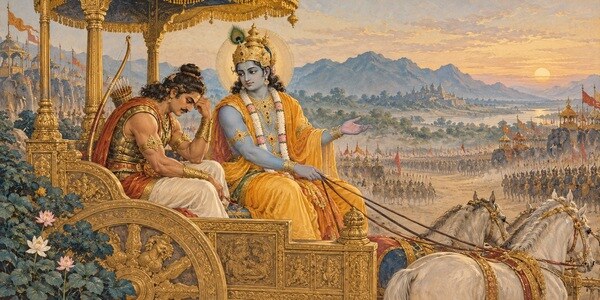
One of the most influential texts in yoga’s history is the Bhagavad Gita, a part of the great Sanskrit epic Mahabharata. Its action unfolds immediately before a battle. The warrior Arjuna is torn by moral doubt because his opponents include relatives, teachers, and people dear to him. He sees the destruction ahead and loses his resolve. His charioteer Krishna responds with teachings about action, knowledge, devotion, and the nature of human existence.
The brilliance of this philosophical setting lies in its tension. The spiritual question does not arise in a sheltered mountain cave but at the heart of a tragic choice. Arjuna does not ask how to escape the world. He asks how to act when every decision carries consequences. Krishna’s answer does not erase the situation’s complexity. It raises the relationship between duty, intention, attachment, and spiritual clarity.
The Bhagavad Gita presents interconnected paths later associated with Karma Yoga, Jnana Yoga, and Bhakti Yoga. Action becomes spiritual discipline when it is not governed by craving for personal reward. Knowledge releases the individual from mistaken conceptions of existence. Devotion transforms the relationship between the human being and the divine. The text is not merely a catalogue of techniques but a dramatic investigation of spiritual life under the demands of responsibility.
The greatness of the Bhagavad Gita lies in its refusal to oppose inner development absolutely to active life. It shows that one can work, carry responsibilities, and participate in society while investigating one’s motives. This teaching has profoundly influenced later interpretations of yoga and deserves an extended study in its own right.
Karma Yoga: The Art of Acting Freely

Karma Yoga is the path of action understood as spiritual practice. Its central idea is neither inactivity nor mechanical obedience to duty. It investigates how a person can act responsibly without turning the outcome into the sole measure of personal worth. In ordinary life we frequently tie our inner peace to success: recognition makes us content, while failure can make us regard ourselves as failures.
Karma Yoga proposes a different relationship. Action should be attentive, competent, and ethically considered, while the practitioner learns not to be wholly governed by hunger for reward. This is not indifference to consequences. Responsibility requires that consequences be anticipated. The distinction is between serious effort and inner enslavement to one particular result.
This philosophy possesses remarkable practical beauty. A teacher can teach with full attention without measuring human worth through every student’s grade. A physician can work responsibly without interpreting every difficulty as proof of personal inadequacy. A parent can love and care without demanding that a child become an extension of the parent’s ambitions. These are contemporary illustrations of the spirit of Karma Yoga, not replacements for its historical religious meaning.
Action released from obsessive self-concern does not lose its power. It gains clarity. A person ceases to spend so much energy defending an image and can devote more attention to the task itself. Karma Yoga thus reveals one of spiritual life’s most surprising paradoxes: freedom does not always require leaving the world. It can begin by transforming how we participate in it.
Jnana Yoga: The Courage to Know Yourself

Jnana Yoga is the path of spiritual knowledge and discrimination. It questions our habitual assumptions about identity. Who are we beyond names, roles, habits, and continuously changing thoughts? What exactly do we know when we say I? In philosophical traditions associated with Vedanta, these questions acquire special depth and are pursued through textual study, reasoning, and contemplation.
Jnana does not mean merely accumulating information. A person can know numerous definitions of consciousness and still remain completely subject to fear, envy, or pride. Spiritual knowledge concerns the transformation of our very understanding of reality. In certain schools this includes realizing the identity of atman and brahman; other philosophical systems interpret the relationship between the individual and the absolute differently.
The path of knowledge demands intellectual honesty. It does not allow every comforting idea to pass as truth. We must distinguish observation from assumption, experience from its interpretation, and persuasive argument from the desire to be right. In this sense, Jnana Yoga is both philosophical and existential discipline.
Its beauty lies in the conviction that the question Who am I? is not a minor psychological curiosity. It can transform how a human being experiences an entire life. Yet the answers offered by different schools must not be confused. Yoga becomes richer when its distinct philosophical voices are allowed to speak clearly.
Bhakti Yoga: The Spiritual Power of Love and Devotion
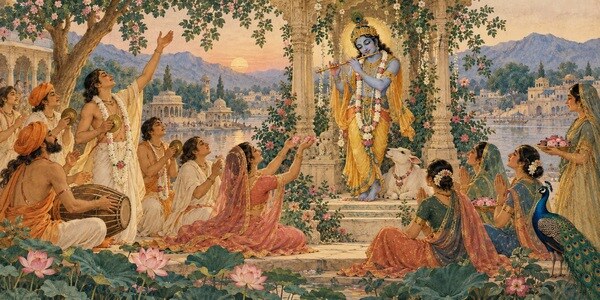
Bhakti Yoga is the path of devotion to the divine. It occupies an important place in numerous Hindu traditions and demonstrates that spiritual development cannot be exhausted by intellectual analysis or ascetic discipline. The human heart also possesses a language of understanding: gratitude, affection, trust, admiration, and the willingness to serve.
In different Bhakti traditions, devotion may be directed toward Krishna, Rama, Shiva, Devi, or other divine manifestations according to the theology of the particular community. Chanting, prayer, ritual worship, remembrance of the divine name, and communal celebration can form part of this path. Spiritual practice here is not solely an isolated investigation of the mind, but a living relationship in which love transforms human motivation.
The history of Indian devotion is filled with poets, saints, and religious movements that transformed spiritual experience into music and words. Their works reveal how philosophy can become song and a metaphysical question can become a personal prayer. Bhakti is essential to understanding yoga because it reveals a dimension that modern physical practice often leaves outside the frame.
Devotion does not necessarily mean abandoning reason. At its finest, it involves ethical responsibility, humility, and concern for others. Love of the divine must also transform one’s treatment of human beings. Bhakti Yoga shows that spiritual freedom can be pursued not only by loosening attachments but by redirecting the heart toward what the tradition regards as highest.
Patanjali and Yoga as a Philosophical System
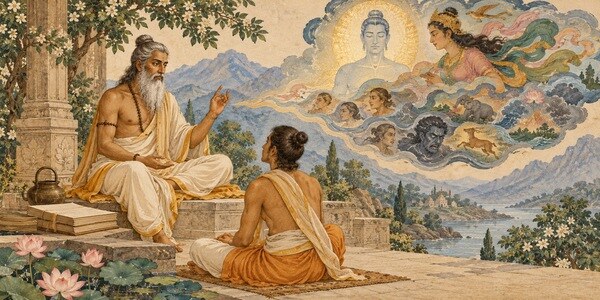
Among the most significant works in yoga’s history are the Yoga Sutras, traditionally associated with Patanjali. This brief and remarkably concentrated text systematizes teachings on consciousness, suffering, discipline, and liberation. The work’s dating and composition are subjects of scholarly investigation, but its influence on later understandings of classical yoga is undeniable.
One of its best-known formulations is yogaś citta-vṛtti-nirodhaḥ, commonly rendered as the stilling or cessation of the movements of consciousness. The term citta refers to the complex field of mental processes, while vritti describes its modifications and activities. This is not an ordinary invitation to think less. The text examines the deep connection between the functioning of consciousness and the mistaken identification of the observer with its experiences.
The philosophical framework of classical yoga is closely connected to Samkhya. It distinguishes purusha, the principle of pure consciousness, from prakriti, nature and its manifestations. Liberation is attained through clear discrimination between them. This doctrine is not identical to nondual Vedanta, which offers different accounts of the individual and the absolute. Such differences are not minor details; they belong to the heart of Indian philosophical history.
Patanjali presents a disciplined path incorporating ethics, bodily steadiness, work with breathing, management of attention, and profound contemplation. His system’s importance lies in combining a philosophical diagnosis with practical methods. It describes not only the causes of human confusion but also a structured approach to overcoming them.
The Eight Limbs of Yoga: A Map of Inner Discipline
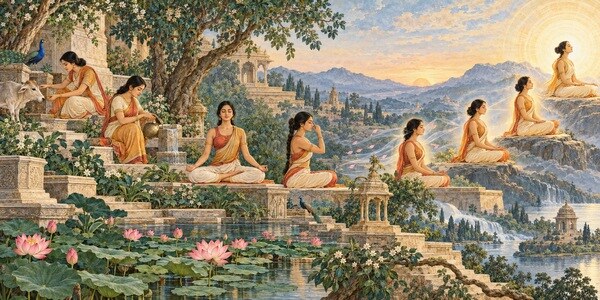
Patanjali’s classical system is known for yoga’s eight limbs, or ashtanga: yama, niyama, asana, pranayama, pratyahara, dharana, dhyana, and samadhi. They are often presented as eight steps, but are better understood as interconnected dimensions of a discipline. Ethical behavior, bodily steadiness, and meditative concentration are not an accidental collection of exercises. They form a comprehensive approach to human experience.
Yama includes restraints concerning nonviolence, truthfulness, nonstealing, sexual or ethical restraint, and nonpossessiveness. Niyama describes personal observances such as purity, contentment, disciplined effort, study, and dedication to Ishvara. These principles place ethics before the pursuit of extraordinary experiences. Someone indifferent to the consequences of their actions cannot replace moral responsibility with technical excellence in meditation.
In the classical context, asana is primarily associated with a steady and comfortable posture suited to practice. Pranayama concerns the regulation of breathing. Pratyahara involves withdrawing or reorienting sensory attention so it is not continually captured by external stimuli. Dharana is concentration, dhyana is meditative contemplation, and samadhi is deep absorption, described in different forms and degrees.
This structure explains why yoga cannot be reduced to gymnastics. The body is present, but it is not the sole goal. Breathing matters, but does not independently replace philosophical understanding. Meditation is essential, but does not cancel ethics. The system’s magnificence lies in its insistence that human development should encompass how we act, perceive, think, and relate to others.
Ethics as the Foundation of Spiritual Freedom
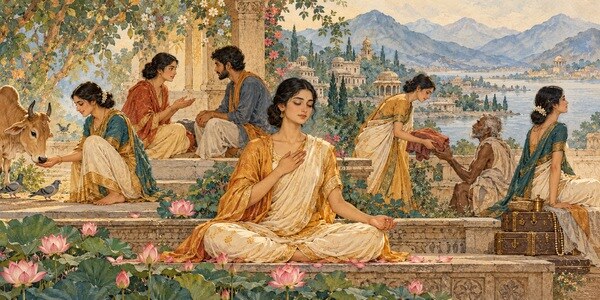
One of the most valuable ideas in classical yoga is its placement of ethical discipline at the beginning of practice. Nonviolence, truthfulness, and nonstealing are not decorative virtues attached to concentration techniques. They establish conditions for a clearer and less conflicted life. A person who constantly deceives, harms, or attempts to possess everything perpetuates fear and inner tension that obstruct concentration.
Ahimsa, the principle of nonviolence, holds a special place. It has a long history across Indian religious traditions and appears in different forms. In a yogic context, it reminds us that spiritual strength is not measured by the capacity to dominate. It includes the ability to reduce unnecessary suffering caused by actions, words, and intentions.
Satya, truthfulness, asks not only that we avoid lies but also that we develop honesty about our motives. Asteya, nonstealing, draws attention to the limits of our desires. Aparigraha, nonpossessiveness, examines dependency on accumulation. These principles speak directly to contemporary life, saturated with comparison, competition, and continuous consumption.
The strongest lesson is that yoga begins not with an impressive posture but with our relationship to the world. A person can be exceptionally flexible while remaining cruel or dishonest. From the standpoint of classical spiritual discipline, such physical ability is insufficient. Authentic practice is also recognized by whether conduct becomes more responsible and attention more lucid.
Meditation and the Art of Attention
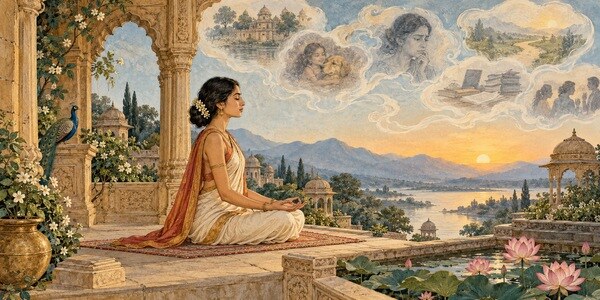
Meditation occupies a central place in many yogic traditions, but it is not one universal technique. Different schools employ concentration on breathing, mantra, an image, a philosophical question, or the direct observation of conscious experience. What they share is training attention so that it is not continually diverted by incidental impressions and automatic reactions.
In everyday life the mind constantly moves among memories, expectations, and judgments. This ability is necessary for planning and learning, but becomes a source of distress when every thought is granted unconditional authority. Meditative practice creates the possibility of observing thoughts as events within experience rather than identifying with them completely. This discipline demands patience, not spectacular results.
Contemporary scientific research investigates particular meditative practices in relation to stress, attention, and psychological well-being. Findings depend on the method, duration, and population studied. Scientific evidence for specific effects does not automatically establish the metaphysical teachings of ancient texts. These fields ask different questions and must remain distinct.
Meditation’s true dignity does not lie in promising that anxiety will never return. It lies in the possibility of developing a more conscious relationship with our own reactions. Yoga offers a remarkably valuable exercise: remaining with reality long enough to see it before surrendering to the first impulse.
Hatha Yoga and the Historical Rediscovery of the Body
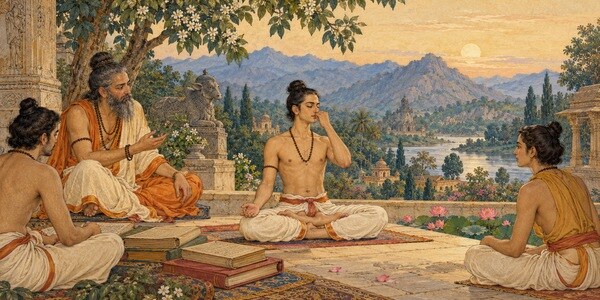
Hatha Yoga developed in medieval India through traditions that attached special importance to bodily and breathing techniques. Significant texts include the Hatha Yoga Pradipika, Gheranda Samhita, and Shiva Samhita, composed in different periods and presenting different practices and theoretical emphases. Their history is complex and cannot be reduced to a single founder or an uninterrupted line of transmission.
Depending on the text and school, Hatha Yoga includes asanas, pranayama, mudras, bandhas, and cleansing practices. In historical sources its purpose is often associated with transforming vital processes, stabilizing the mind, and attaining advanced meditative states. The modern understanding of Hatha Yoga as a slow-paced class of physical exercises is a product of later developments and does not exhaust its traditional meaning.
It is especially important to recognize that in historical Hatha Yoga the body is not merely an obstacle to spirituality. It becomes part of the practical field through which a person works with attention, breathing, and perceived vital processes. This approach represents one of the great innovations in the development of yogic traditions. The body becomes a participant in spiritual discipline rather than something to be ignored.
Some traditional techniques involve breath retention and other intensive methods that are unsuitable for unsupervised experimentation. Historical admiration does not require uncritical repetition of every described practice. Responsible study distinguishes the spiritual goals of ancient texts from questions of safety and applicability in contemporary circumstances.
Asana: From the Steady Seated Posture to Modern Practice
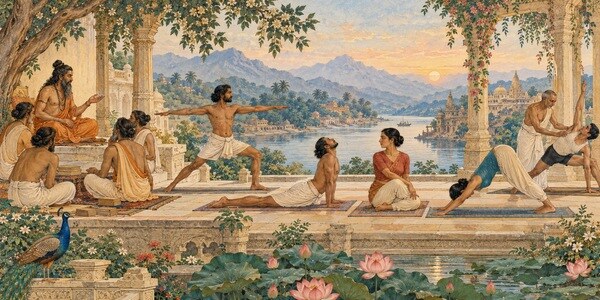
Asana is among the most recognizable words in contemporary yoga. Today it refers to a wide variety of bodily postures that develop mobility, strength, coordination, and bodily awareness. Historically, however, the meaning and number of asanas changed. In Patanjali’s classical text, the emphasis is on steadiness and comfort, while later Hatha works describe a wider range of bodily forms.
During the nineteenth and twentieth centuries, physical yoga underwent significant transformations in India and beyond. These developments involved encounters between traditional yogic teachings, physical culture, gymnastic methods, national movements, and new educational institutions. Teachers such as Tirumalai Krishnamacharya and his influential students participated in the emergence of styles that transformed yoga’s international image.
This development does not make modern practice inherently inauthentic. It demonstrates that traditions have histories. Some present-day sequences of postures are comparatively recent, while other elements have older roots. Respecting yoga means understanding its capacity to change. Historical truth is more interesting than a legend of a completely immutable system practiced identically through every century.
When performed sensibly and adapted to individual capabilities, physical practices can offer valuable opportunities for movement and attention to the body. They should not become competitions in flexibility. Pain is not proof of spiritual progress, and difficult postures are not prerequisites for deep practice. In yoga’s spirit, the body deserves respect rather than violence in pursuit of an idealized image.
Breath as a Bridge Between Body and Attention
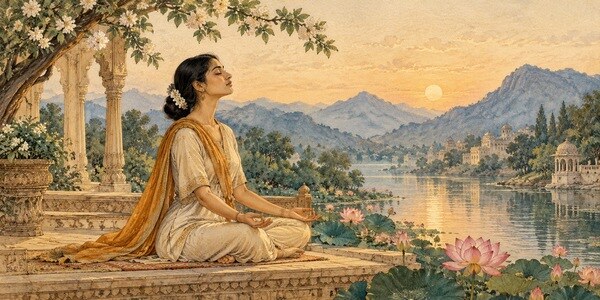
Breathing is among the most immediate phenomena of human life. It continues without constant conscious control, yet it can be observed and, within limits, regulated. This characteristic makes it an important object of yogic practice. Pranayama encompasses varied historical techniques for working with breathing rhythms, including changes in the duration of inhalation and exhalation and, in certain traditions, breath retention.
In traditional systems, prana is not simply another word for oxygen. It belongs to philosophical and religious conceptions of vital activity. Modern physiology describes breathing through gas exchange, nervous regulation, and numerous measurable processes. These two languages should not be declared identical. The traditional concept of prana has its own history, while scientific claims require independent evidence.
Simple forms of calm observation of breathing can support attention to the present moment. Intensive breathing exercises, however, are not universally safe. Prolonged retention, forceful breathing, and techniques that cause dizziness demand particular caution and competent guidance. Spiritual discipline is not measured by how severely we can strain the body.
The beauty of breath in yoga lies in its closeness. No special possession is required to notice it. It accompanies joy and sorrow, stillness and movement. As attention returns to breathing, a person discovers an immediate connection between bodily existence and inner life. This is a simple but profoundly evocative image of the unity of practice and everyday experience.
Mantra, Sound, and the Power of Repetition
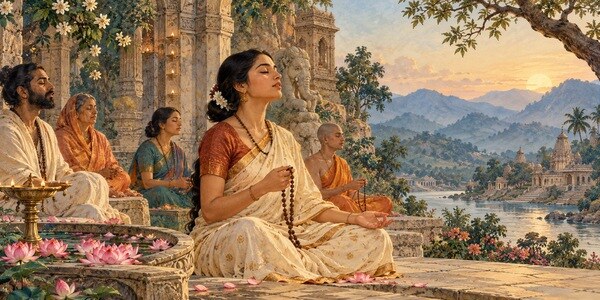
In numerous Indian religious and yogic traditions, sound carries spiritual significance. Mantras may be employed in ritual, prayer, meditation, and devotion. Some are associated with particular deities, others with philosophical formulas or sacred syllables. The best-known example is Om, which occupies a special place in a range of Hindu texts and practices.
Repeating a mantra establishes a rhythm of attention. Rather than following an endless succession of incidental thoughts, the practitioner returns to a particular sound or verbal formula. Within religious contexts this action may possess theological meanings extending far beyond psychological concentration. For some communities, a mantra is an address to the divine, not simply an acoustic instrument.
This diversity deserves respect. Sacred formulas are not decorative sounds stripped of cultural context. They belong to particular traditions, teachers, and communities. Responsible study begins by understanding their use and meaning, not by promising automatic miracles.
Mantra practice reveals another aspect of yoga: attention can be trained through rhythm and repetition. The human being is not merely a thinking creature but one who listens, speaks, and experiences sound. This relationship among language, memory, and spiritual orientation is an important part of the richness of Indian culture.
Different Philosophies Behind the Shared Name of Yoga
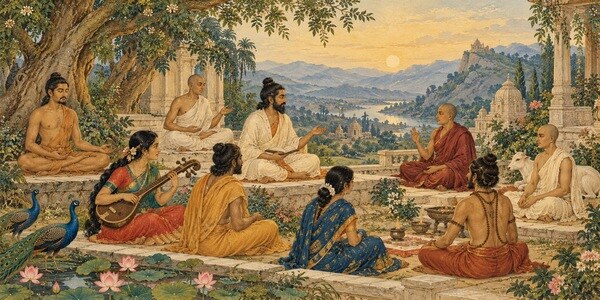
One of the most common mistakes in presenting yoga is to claim that all its paths teach exactly the same philosophy. Historical sources show otherwise. Patanjali‘s classical yoga is associated with the distinction between purusha and prakriti. Nondual Vedanta develops an understanding of ultimate reality in which the individual self is interpreted differently. Theistic Bhakti traditions emphasize the relationship between the devotee and the divine.
Tantric and certain Hatha traditions employ additional conceptions of the body, energy, ritual, and liberation. Buddhist meditative systems also share historical environments and techniques with the Indian yogic world, while developing their own philosophical positions, including critiques of the idea of an unchanging individual self. Jain practices place particularly strong emphasis on nonviolence and ascetic discipline.
This diversity is not a weakness. It bears witness to a culture in which the deepest questions were debated with exceptional seriousness. The schools did not merely repeat ready-made answers. They argued about the nature of knowledge, the causes of suffering, the structure of reality, and the possibility of freedom.
For contemporary readers, this history offers an important lesson: respect for yoga does not require erasing differences. Genuine admiration begins when we allow each tradition to speak in its own voice. The overall picture then becomes richer, clearer, and far more compelling than any simplified formula.
Yoga, Religion, and Philosophy: Relationships Beyond a Single Label
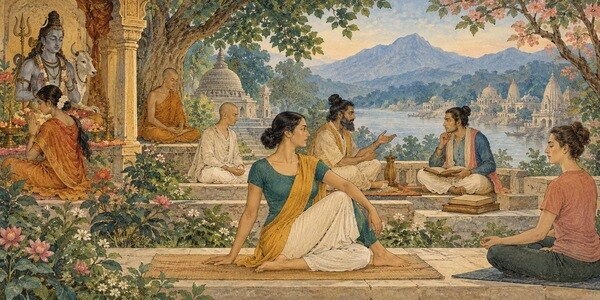
Yoga is frequently presented as a system of personal development entirely independent of religion. That description reflects certain modern secular uses, but it cannot be projected onto its entire history. Many yogic texts are deeply connected with Hindu religious teachings, beliefs about karma and rebirth, deities, rituals, and liberation. Other practices developed in Buddhist, Jain, and varied ascetic settings.
At the same time, yoga has a clearly philosophical dimension. It raises questions about knowledge, personhood, causality, and consciousness. Its teachers produced arguments, commentaries, and sophisticated conceptual systems. This intellectual labor is inseparable from practical methods. Yoga is not solely religious ritual, but neither is it simply a physical technique.
A contemporary person can attend yoga classes without accepting a particular theology. That is a genuine form of cultural development. Yet studying history requires acknowledgment of the religious roots of many practices. Otherwise the tradition risks being presented as if it were invented entirely for today’s wellness marketplace.
The most respectful approach is to make distinctions. Physical practice, philosophical study, religious devotion, and meditative discipline can overlap, but they are not identical. Such clarity enables people of different convictions to explore yoga without distorting its history or assigning meanings that do not belong to a particular tradition.
From India to the World: The Modern History of Yoga
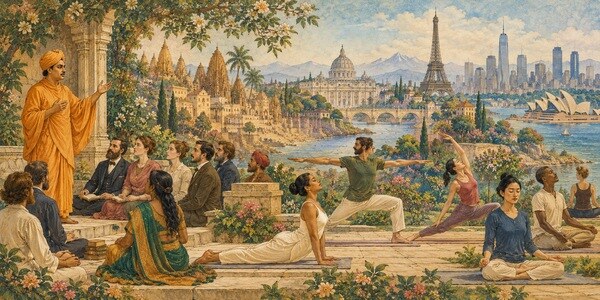
Yoga’s international spread accelerated during the nineteenth and twentieth centuries. Indian spiritual teachers, reformers, and intellectuals introduced different aspects of the tradition to new audiences. Swami Vivekananda played an especially important role in popularizing a particular understanding of Raja Yoga and Indian philosophy in the West. His lectures and books helped establish the image of yoga as a universal spiritual path accessible beyond specific local communities.
Later, the development of postural yoga transformed the international picture. Teachers and institutions in India devised new forms of instruction, while their students spread these approaches around the world. Schools emerged in different countries emphasizing precision in postures, dynamic sequences, breathing, relaxation, or meditation. This variety is the result of historical change, not evidence of a single eternal and unchanged program.
Globalization brought both opportunities and difficulties. It made practices accessible to millions, but sometimes separated techniques from their philosophical and religious contexts. Commercial promises of a perfect body and instant enlightenment can overshadow yoga’s ethical and contemplative dimensions. Important questions also arise concerning cultural respect, historical recognition, and teachers’ responsibilities.
The history of modern yoga deserves admiration not because it is without problems, but because it demonstrates a tradition’s ability to travel across cultures and generate new forms. That very vitality calls for historical memory. By understanding yoga’s journey, we can appreciate contemporary practices without forgetting their complex roots.
Science and Yoga: What We Can Responsibly Claim
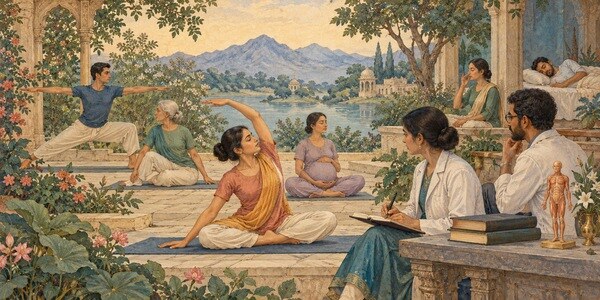
Contemporary science investigates certain yoga-related practices in connection with physical activity, stress, sleep, pain, and quality of life. Some studies report beneficial results for particular populations and outcomes, but the quality of evidence varies. Scientific literature often groups very different programs under the label yoga, making comparisons and broad conclusions difficult.
It is essential to distinguish researched or established effects of particular exercises from the spiritual claims of philosophical schools. A study of mobility or stress does not establish prana as a physical energy, nor does it prove a metaphysical account of liberation. Scientific inquiry and traditional spiritual philosophy employ different standards for substantiating their claims.
Yoga is not a substitute for medical diagnosis or treatment. Practices should be adapted to age, physical condition, and individual limitations. Illness, injuries, pregnancy, or specific health concerns require appropriate professional judgment. Breathing techniques and intensive physical practices warrant particular care.
Such responsibility does not diminish yoga’s value. It protects the tradition from exaggeration. A heritage with such a rich philosophical and practical contribution has no need for unsupported promises to deserve respect. Its historical significance and human appeal are impressive enough in themselves.
Why Yoga Continues to Inspire Modern Humanity
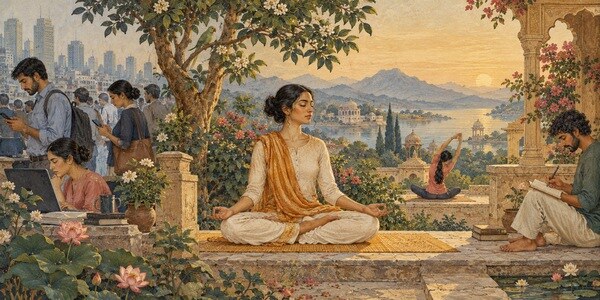
We inhabit a world that constantly demands attention. Screens, notifications, work responsibilities, and social expectations create a sense of uninterrupted movement. In such an environment, the idea that a person can consciously stop, observe, and choose how to act becomes especially powerful. Yoga offers no magical escape from modernity. It offers discipline through which we can participate in life with greater clarity.
Its appeal also comes from bringing together different dimensions of human experience. The body has its place, but does not exhaust the person. Thinking matters, but is not the only route to understanding. Love and devotion possess spiritual value, but do not abolish ethical responsibility. Action is necessary, but need not become enslavement to results. Within this diversity, different people discover different entrances into practice.
Especially moving is the idea that inner freedom requires training. It does not appear merely because we have read an inspiring sentence. Persistence, observation, honesty, and a willingness to encounter our limitations are necessary. Against a culture of instant gratification, this approach offers a deeper understanding of development.
Yoga continues to inspire because it does not regard the human being as a finished product. It sees a person capable of learning. This conviction is not naive optimism. It recognizes difficulty while insisting that the way we meet difficulty can be transformed.
How to Begin Studying Yoga with Respect and Clarity
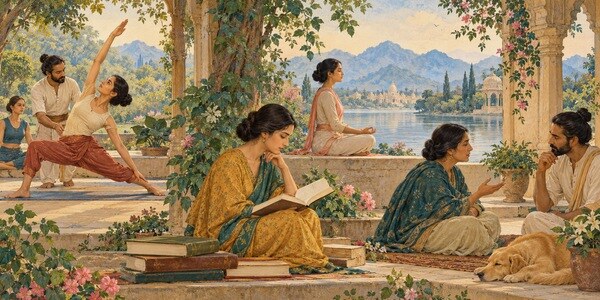
The first step is to distinguish your own purpose. If you seek physical activity, choose a qualified teacher who adapts exercises to individual capabilities. If philosophy interests you, turn to foundational texts and reliable commentaries. If you seek meditative practice, understand the particular method and the tradition in which it developed.
The second step is to recognize that different paths are not interchangeable. The Bhagavad Gita is not a manual of contemporary asanas. The Yoga Sutras are not a catalogue of flexibility exercises. Hatha texts are not identical to the philosophy of nondual Vedanta. Every work deserves to be read in light of its own aims and historical context.
The third step is to cultivate patience. A complicated posture, unusual breathing technique, or impressive spiritual vocabulary is not required to begin paying attention to life. We can practice moderate movement, set aside time for quiet observation, and investigate our own reactions. The essential task is not to confuse external appearance with inner depth.
The fourth step is to preserve intellectual honesty. A responsible teacher does not demand unconditional obedience, promise miraculous cures, or treat every question as proof of spiritual inadequacy. Healthy practice permits inquiry, respects personal boundaries, and acknowledges the need for professional assistance beyond its competence.
Finally comes the most important step: allow study to influence conduct. If practice does not make us more attentive to others, more willing to acknowledge mistakes, and more responsible in our actions, it remains incomplete. Yoga is most impressive where philosophical understanding begins to take human form.
One Tradition, Many Paths, and a Shared Aspiration Toward Liberation
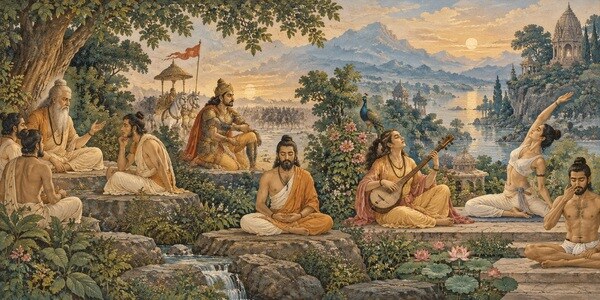
After this journey through yoga’s history, an extraordinary picture emerges. We see Upanishadic thinkers investigating the nature of the self; Arjuna seeking right action at a tragic moment; Patanjali systematizing the discipline of consciousness; devotional poets turning love into a spiritual language; and Hatha traditions developing complex methods involving body and breath. These are not identical teachings, but they belong to a vast history of human searching.
Admiration for yoga is admiration for this history of perseverance and imagination. Generations of practitioners devoted their lives to asking whether human beings can become freer from fear, confusion, and attachment. They created philosophical systems, rituals, meditative methods, poetry, and bodily disciplines. Some of their convictions differ profoundly, but all testify to the seriousness with which spiritual life has been explored.
Yoga is not merely an inheritance from the past. It continues to ask questions just as meaningful today: What governs our attention? Why do we identify so easily with passing experiences? How can we act responsibly without becoming obsessed with recognition? What does it mean to know ourselves? And what freedom becomes possible when we stop mistaking every desire for our deepest identity?
The answers offered by different yogic schools deserve independent study. The Bhagavad Gita will lead us toward the philosophy of action, devotion, and choice. Patanjali will introduce the discipline of the mind and the classical understanding of liberation. Hatha Yoga will reveal the historical importance of body and breath, while traditions of chakras and prana will bring us into the diverse Indian conceptions of the subtle body. Each subject is a world in itself, deserving attention beyond brief definitions.
This is where the real journey begins: not with a promise of instant perfection, but with respect for a great tradition and a willingness to ask deeper questions. Yoga reminds us that human life can be more than a succession of automatic reactions. It can become a conscious path-a path of discipline, knowledge, action, love, and the continual expansion of inner freedom.
Author: Vasil Stoyanov