
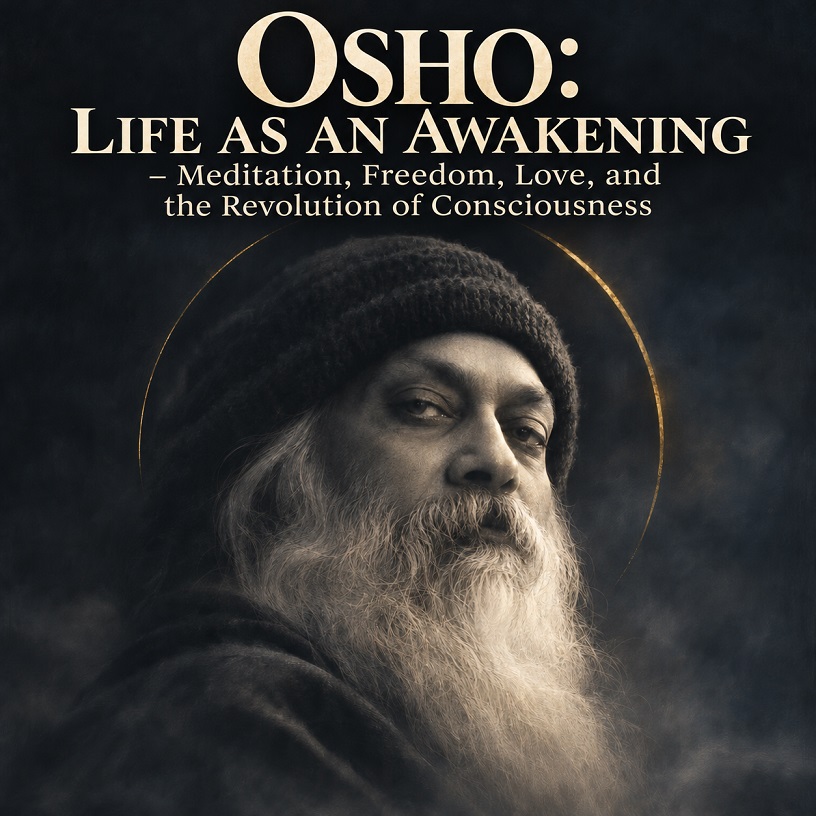
Some spiritual teachers transmit an inherited tradition; others transform the search itself into an event. Osho belongs to the latter group. His voice emerged in India during decades of profound social change, when ancient religious ideas encountered modern science, Western psychology, political revolutions, and new questions about individual freedom. Rather than offering another closed system of rules, he directed attention toward the person living behind those rules: toward fear, desire, attachment, the capacity for love, and the possibility of being fully present.
His discourses range from the Buddha and Mahavira to Lao Tzu, Zen masters, Jesus, Sufi mystics, Kabir, and modern psychotherapy. He speaks of silence in the language of someone who loves laughter; of liberation without rejecting life’s pleasures; and of meditation not as an escape from the world, but as a different way of inhabiting it. This extraordinary meeting of ancient and modern perspectives helps explain why his words continue to reach readers of very different backgrounds.
A complete portrait, however, also requires a careful distinction between Osho’s personal recollections, established historical facts, traditional teaching stories, and the serious controversies surrounding his communities. He repeatedly challenged followers not to replace their own understanding with obedience to authority. His life and legacy therefore deserve to be approached with receptiveness to his spiritual ideas and accuracy about the historical record. Brief formulations of his ideas in this article are interpretive paraphrases, not verified verbatim quotations from particular editions; traditional stories are identified as parables rather than presented as documented episodes of his life.
From Chandra Mohan Jain to Osho: The Life of an Uncompromising Thinker
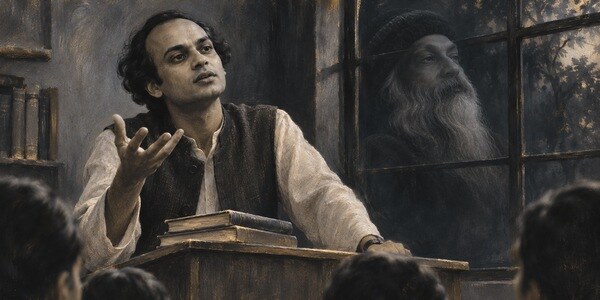
Osho was born on December 11, 1931, in Kuchwada, in what is now the Indian state of Madhya Pradesh, under the name Chandra Mohan Jain. His childhood unfolded in an environment where religious customs, family relationships, and village life were closely intertwined. In his later recollections, he portrayed his early years as a time of pronounced independence and resistance to explanations that demanded obedience without understanding. These recollections are part of his spiritual autobiography and should be read as personal testimony rather than independently verified records of every encounter.
A defining theme appears in those childhood stories: an unwillingness to accept a claim as true merely because it comes from an elder, priest, or respected teacher. He asks questions about death, fear, God, and the purpose of rituals. The young Chandra Mohan is not simply portrayed as rejecting tradition. He wants to understand why traditions exist and whether the truths repeated with such confidence have actually been experienced. The distinction between secondhand knowledge and direct realization would become one of the most enduring themes of his teaching.
He studied philosophy and earned a master’s degree at the University of Sagar in 1957. He subsequently taught philosophy, including in Jabalpur, before dedicating himself increasingly to public lectures and spiritual work. His academic background gave him familiarity with different philosophical systems, but he did not remain within the boundaries of university debate. Instead of explaining a philosopher solely through technical concepts, he used philosophical ideas to awaken questions that listeners would have to ask themselves.
In his spiritual autobiography, Osho assigned special significance to an experience on March 21, 1953, which he described as enlightenment. He recounted a period of intense inward searching followed by deep silence and a transformation in his perception of himself and the world. This is his testimony concerning an inner experience, not a supernatural event that historical methods can independently verify. Its significance for his teaching is unmistakable: thereafter, he spoke of meditation not merely as a philosophical subject, but as the center of human life.
During the 1960s, he became known through public discourses and appearances at religious and philosophical gatherings throughout India. At this stage he was often called Acharya Rajneesh, with acharya being an honorific for a teacher. Later he became widely known as Bhagwan Shree Rajneesh, and in the final years of his life adopted the name Osho. These changes reflect stages in his public identity, not three separate teachings. His central concern remained the possibility of freeing oneself from conditioning, understanding the mind, and discovering wakeful presence.
His early speeches drew particularly strong reactions when he discussed religious hypocrisy, sexuality, marriage, and social morality. His criticism was not restricted to a single religion or institution. He challenged orthodox religious authorities and political ideologies alike, especially when they promised future happiness in exchange for present submission. Such positions brought him a growing audience and determined opponents. In the cultural climate of mid-twentieth-century India, these statements were impossible to ignore.
His approach to belief is especially revealing. He distinguished living trust from a conviction that forbids questioning. A belief, in his analysis, often supplies a ready-made answer before personal understanding has begun. Trust, by contrast, is the capacity to encounter the unknown without constant defensive resistance. One recurring idea can be paraphrased as follows: do not borrow another person’s eyes when you can learn to see for yourself. This helps explain why his discourses do not offer a definitive list of doctrines for followers to memorize.
Osho spoke for decades, and a substantial portion of the books published under his name consists of edited transcripts of oral discourses and question-and-answer sessions. This matters for how they should be read. He did not compose every volume as a systematic academic treatise. He addressed particular audiences, responded to specific questions, improvised, told stories, and sometimes deliberately sharpened a proposition to disrupt habitual thinking. Consequently, isolated statements can appear contradictory when removed from their context. At one moment he emphasizes discipline; elsewhere he attacks mechanical discipline. He speaks about the importance of a teacher while warning against dependence upon teachers. For him, the decisive distinction is between action born of awareness and action imposed from outside.
His public presence also differs markedly from the image of the stern ascetic. Osho delighted in paradox, humor, and sudden reversals of perspective. In his discourses, spiritual seriousness does not exclude laughter. He uses comedy to expose the ease with which even the search for enlightenment becomes another competition of the ego. He tells stories about people who want to become holy but cannot bear the thought that their neighbor might become holier; about students seeking silence while talking endlessly about it; and about believers defending God with anger, as though the divine required their insults. Such stories are not decorative interruptions. They are part of his method of making an inner contradiction visible before the mind can conceal it.
At the heart of his public teaching lies an unusual combination of intellectual breadth and insistence on direct experience. He cites philosophers, scriptures, poets, and mystics, but repeatedly returns listeners to a simple question: what is happening within you now? One can know the history of meditation without ever meditating, memorize definitions of love without loving freely, and defend silence as an ideal while remaining inwardly entangled in arguments. For Osho, knowledge gains its deepest significance when it becomes conscious living.
Meditation as the Art of Being: Silence, Witnessing, and Dynamic Practice
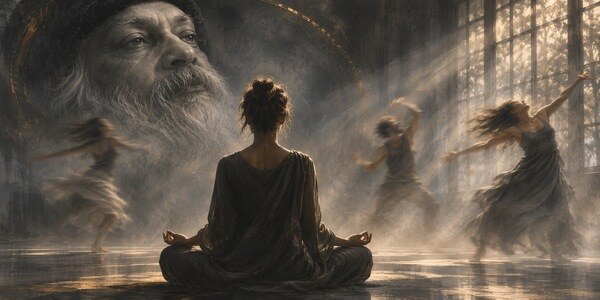
The most enduring thread in Osho’s teaching is meditation. Despite his fame for provocative remarks about society, religion, and sexuality, his spiritual work revolves around the possibility of observing consciousness without being continuously absorbed by its contents. He uses terms such as witnessing, awareness, and presence to describe a condition in which thoughts, emotions, and bodily sensations arise and pass while attention remains awake.
In ordinary life, people frequently identify with each thought that appears. When fear arises, they experience themselves as fear itself. When anger arises, they behave as though their entire world consists of anger. When jealousy appears, they treat the temporary feeling as evidence about another person’s character. Osho directs attention toward the possibility of stepping back: seeing fear as an experience, anger as an energetic movement, and jealousy as an inner process. This does not mean suppressing emotions or excusing harmful conduct. It means interrupting the automatic connection between impulse and action.
One of his recurring ideas can be paraphrased as an invitation to observe the mind rather than wage war against it. This expresses an important difference between meditation and forced self-control. Someone who tries to stop every thought through sheer will creates another internal conflict. Now there are not only thoughts, but also persistent dissatisfaction that the thoughts continue. Observation does not demand that thinking disappear immediately. It changes one’s relationship to thinking and gradually weakens the authority of automatic reactions.
Osho often employs the image of the sky and passing clouds. Thoughts resemble clouds moving across the sky; awareness is the open space in which they appear. This is a metaphor, not a neurological description of the brain. Its practical strength lies in illustrating the possibility of inner distance without alienation. The sky does not have to chase away clouds in order to remain the sky. Similarly, a person can observe anxiety without making it the entirety of their identity.
These ideas have deep roots in Buddhist and Indian contemplative traditions, but Osho presents them in language adapted to modern life. He argues that many people live in such constant nervous activity that they cannot easily move from an agitated day into motionless sitting. This conviction informs his interest in active meditations, in which movement, breathing, sound, and expression precede a period of silence. He presents these practices as contemporary methods created for particular psychological and cultural conditions, not as exact reconstructions of a single ancient ritual.
The best-known example is Osho Dynamic Meditation. It is commonly organized into five successive stages lasting approximately one hour in total: intense irregular breathing, expression of accumulated emotions, rhythmic jumping accompanied by sound, a sudden stop into stillness, and a concluding period of dance or celebration. Detailed instructions are supplied by the practice’s organizers. Intensive breathing and physical exertion are not appropriate for everyone. People with cardiovascular, respiratory, neurological, or other medical conditions should seek professional guidance before considering such activities; meditation does not replace medical care.
The method’s logic is striking. Instead of demanding immediate tranquility from an agitated person, it begins with the person’s existing condition. Movement and sound create a transition toward stillness. The contrast between activity and sudden stopping makes silence more perceptible. This reveals a characteristic feature of Osho’s approach: he does not treat the human body as an obstacle to be defeated, but as part of the path toward awareness.
Another well-known practice is Osho Kundalini Meditation, involving bodily shaking, dancing, silent observation, and rest in stillness. Its name refers to Indian spiritual concepts, but this particular sequence is a modern practice associated with his movement. Other meditations employ sound, breath, movement, laughter, crying, or simple sitting. Their shared principle is not that every exercise produces identical results for every participant. Rather, awareness can be explored through different forms of experience.
Osho devotes considerable attention to meditation as a quality that does not end when an exercise concludes. Sitting with closed eyes is preparation, but the real test arrives during conversation, work, disagreement, or an ordinary meal. If someone is attentive only in a designated room while living mechanically everywhere else, the division between practice and life remains intact. He therefore speaks of conscious walking, listening, eating, loving, and working. Here his approach converges with many contemplative traditions: meditation is not merely an isolated activity, but a transformation of one’s relationship to all activities.
A Zen parable that Osho retells in different forms concerns a student who asks a master about enlightenment. Instead of providing a complex theory, the master draws attention to an ordinary action: eating, walking, or performing daily work. The lesson is that the mind continually escapes whatever it is doing. While eating, it thinks about tomorrow; while walking, it revisits yesterday’s argument; while listening, it prepares its reply. The story is not a documented episode from Osho’s biography. It is a traditional teaching image through which he demonstrates how presence transforms ordinary action into practice.
He extends the same principle to emotions. Anger, in his approach, should neither automatically be condemned as a sin nor recklessly discharged upon other people. It should be understood. What triggers it? What happens in the body? Which wounded expectation lies behind it? When attention remains with such questions, an automatic reaction ceases to be the only possibility. This does not relieve anyone of responsibility for their behavior. It demands greater responsibility, because the excuse of having lost control is no longer sufficient.
The same applies to sadness and fear. Osho does not portray inner silence as perpetual cheerfulness. Human life includes loss, loneliness, and painful transitions. The difference lies in how these conditions are experienced. Suppression can turn them into hidden influences upon behavior; attentive recognition allows a more mature response. His language is spiritual and philosophical rather than a clinical diagnostic system. In cases of serious psychological distress, meditative methods are not substitutes for qualified care.
One paradox in his teaching is that meditation cannot be acquired like a possession. A person can learn a technique, attend sessions, and set aside time, but cannot command awareness to arrive on schedule. Excessive hunger for results produces new tension. A central idea can be rendered this way: when silence becomes a prize to be won, the pursuit itself begins to carry you away from silence. The distinction is between making conditions favorable for practice and trying to manufacture a particular inner state through force.
Osho consequently presents relaxation, play, and celebration as allies of meditation. Music and dance often form part of the daily programs in communities associated with him. This is surprising to those who associate spiritual life exclusively with dark rooms, prohibitions, and severe asceticism. For Osho, vitality is not the enemy of awareness. The difficulty is not dancing, but dancing mechanically; not laughing, but using laughter to escape oneself. When presence accompanies an action, even joy acquires a contemplative dimension.
He repeatedly warns against turning meditation into a new identity in which one takes pride. The spiritual ego can feed upon any practice. It compares experiences, collects titles, talks about degrees of enlightenment, and secretly enjoys a sense of superiority. His jokes about solemn meditators often target precisely this trap. Outward calm is not proof of inner freedom when the longing for recognition remains untouched.
Equally important, witnessing does not require indifference. Observing feelings does not mean ceasing to love. Refusing to identify completely with thoughts does not mean abandoning rational judgment. On the contrary, clearer perception can allow action with less fear, defensiveness, and haste. Awareness is presented as the foundation of fuller participation in life, not a shelter from its difficulties.
This connection between meditation and everyday experience may be the most accessible doorway into Osho’s legacy. Readers need not accept every claim he makes about religion, society, or psychology to understand his question: how much of life do we actually experience, and how much passes in automatic reaction? The question is simple, yet its careful exploration can have profound consequences. It brings spiritual inquiry down from distant abstraction to the way we look, listen, speak, and choose in the present moment.
Love, Freedom, and the Courage to Live Without a Mask

Love occupies an enormous place in Osho’s discourses. He does not regard it solely as a romantic feeling between two people. He describes it as a way of relating to life, involving intimacy, trust, respect for freedom, and the ability to refrain from treating another person as property. He challenges the notion that jealousy and control are inevitable proofs of powerful love. In his understanding, love loses its vitality when it becomes a system of surveillance and fear of loss.
This position emerges from his broader criticism of conditioning. People grow up surrounded by expectations about what a good son, proper spouse, respectable woman, successful man, or worthy believer should be. Some expectations support responsible relationships; others turn personality into an endless performance. Osho asks what remains of love when two people encounter one another primarily through the roles they play. Genuine closeness, he insists, requires the possibility of being seen without continually defending an image.
One of his central ideas can be paraphrased this way: love is not a cage in which another person is kept, but a space in which that person can grow. This does not mean relationships have no boundaries or that promises are meaningless. It highlights the distinction between freely chosen commitment and obedience extracted through fear. Love is tested not only in moments of tenderness, but when another person disagrees, expresses a different desire, or needs time alone.
Osho frequently connects love with solitude, distinguishing the pain of abandonment from the capacity to be alone. Someone unable to remain comfortably in their own company can easily turn a partner into a remedy for inner emptiness. The relationship then carries an impossible burden: the other person must constantly supply meaning, security, and self-worth. The capacity for solitude does not deny intimacy. It allows intimacy to become a freely chosen meeting rather than a desperate dependence.
Sexuality is another recurring subject. Osho became famous for openly criticizing religious repression of sexual desire. In early discourses subsequently published under titles associated with the theme of moving from sex toward higher consciousness, he discusses sexual energy as part of human nature that need not be declared impure. He argues that shame and repression can generate inner conflict, while awareness supports a more mature relationship with the body and desire.
His positions provoked intense debate, especially in traditional social settings. Some listeners found open discussion of sexuality liberating; others considered it a challenge to established moral standards. His entire teaching, however, cannot be reduced to this subject. Sexuality is one area in which human beings may be conditioned by fear, guilt, and automatic reactions. His principal concern remains awareness. Contemporary readers should also distinguish his philosophical statements from established medical or psychological conclusions.
He uses the term tantra in a broad spiritual sense, emphasizing the possibility of transforming human experience through awareness rather than automatically rejecting it. This is part of his own modern interpretation and does not encompass the historical diversity of Indian and Tibetan tantric traditions. In academic usage, tantra includes complex ritual, philosophical, and contemplative systems that cannot be reduced to sexual practices. The distinction matters because Osho’s popularity influenced modern Western understandings of the term.
For Osho, freedom is not simply the ability to do whatever one desires at any moment. He connects it with responsibility for one’s own life. Someone who follows every desire mechanically remains dependent on impulses. Someone who obeys every external command without reflection remains dependent on authorities. Freedom begins when one sees clearly what drives one’s behavior and becomes capable of conscious choice. This explains why he criticizes repression and thoughtless indulgence alike.
He treats fear of public opinion as a major obstacle to authentic living. People often abandon interests, talents, and convictions because they dread losing approval. His discourses encourage listeners to recognize the cost of this continuous adaptation. Outwardly, a person may appear successful and respected while inwardly feeling that they are living someone else’s script. Osho’s question is not whether society is unnecessary, but whether a person can participate in it without losing individuality.
Creativity becomes important in this context. For him, it does not belong exclusively to painters, poets, and musicians. Creativity is a quality of how something is done. A cook can prepare food creatively, a gardener can tend plants attentively, a teacher can avoid mechanical repetition, and a parent can listen to a child as a distinct person. What matters is that the action be alive rather than merely copied from an established pattern.
Osho does not automatically oppose pleasure to spirituality. He questions the idea that suffering is a prerequisite for inner development. Joy, beauty, music, and celebration can coexist with meditation. This does not mean that every pleasant experience is spiritual or that pleasure solves human problems. It means that refusing joy is not, in itself, evidence of wisdom.
One of his most characteristic images is Zorba the Buddha. It combines Zorba, a figure associated with love of earthly life, food, dance, and immediate experience, with the Buddha as a symbol of awareness and inner freedom. Osho uses this image to reject the division between someone who enjoys life and someone who seeks spiritual awakening. His ideal is a person who can be both vibrant and contemplative, embodied and attentive, joyful and inwardly free.
This concept also has a cultural dimension. Osho argues that the modern world has achieved remarkable material possibilities without resolving inner restlessness. At the same time, he criticizes spiritual traditions that reject the body and earthly existence. Zorba the Buddha represents his attempt to imagine a human being who need not choose between science and meditation, pleasure and silence, individuality and compassion. It is a philosophical ideal, not the description of an historically established human category.
Love and meditation frequently appear in his discourses as complementary paths. Love moves toward another person, while meditation turns toward direct knowledge of oneself. Without love, meditation can become cold self-sufficiency; without meditation, love can be consumed by jealousy and fear. This is part of his spiritual philosophy, not a universal psychological law. Its value lies in reminding readers that closeness and inner independence need not be enemies.
His remarks about parents and children are particularly revealing. He criticizes the tendency of adults to turn children into extensions of their own ambitions. Parents can provide care, education, and boundaries, but cannot live their children’s lives for them. Here his theme of freedom takes a practical form: respect for individuality begins long before adulthood. It requires recognizing that another person possesses a distinct temperament and path.
At the same time, his philosophy of freedom must be examined critically wherever spiritual ideals meet actual power relationships. Any community can speak of freedom while imposing strong expectations of obedience. The ideal of autonomy is persuasive only when it applies to the teacher, the organization, and the right of followers to ask difficult questions. This standard becomes especially important when examining the history of Osho’s movement.
Stories That Break the Habit of Thinking in Familiar Ways

Storytelling is among Osho’s most memorable characteristics. He draws upon Zen parables, Sufi anecdotes, Indian legends, stories about the Buddha and Mahavira, accounts of mystics, and comic scenes from everyday life. Some have identifiable literary origins; others circulate in multiple versions and cannot be treated as reliable biography. His purpose is not always to report an event. It is to create a moment of recognition in which the listener suddenly sees a familiar pattern of behavior.
A famous Zen parable describes a professor who visits a master to learn about Zen. While the visitor talks about his knowledge, the master pours tea into his cup and continues pouring after it is full. The professor protests that no more tea can fit. The master demonstrates that a mind filled to the brim with its own conclusions has no room for a new way of seeing. Osho uses stories of this kind to explore the difference between accumulating information and becoming receptive to unfamiliar experience.
The lesson is not that knowledge is useless. The professor need not forget everything he has learned. He must stop using his knowledge as an impenetrable defense against new experience. Osho repeatedly challenges the self-confidence that supplies an answer before the question has even been heard. In spiritual life this happens easily: someone reads many books about meditation and begins judging the experiences of others without patiently observing their own consciousness.
Another traditional Zen story concerns two monks who encounter a woman beside a river. One carries her across the water, and the monks continue their journey. Hours later, the other rebukes him for touching a woman despite monastic rules. The first replies that he left her at the riverbank, while his companion is still carrying her in his mind. Osho uses this image to illustrate how mental attachment can endure far longer than the action itself.
The story is not an invitation to disregard ethical obligations. It directs attention to the mechanism through which an experience is repeatedly recreated after it has ended. A person may have physically left a situation yet continue reliving it through anger, guilt, or a need to be right. Osho finds here a clear example of witnessing: noticing when the mind keeps holding something that life has already left behind.
Nasreddin Hodja frequently appears in the Sufi anecdotes Osho enjoys retelling. Nasreddin is simultaneously comic and perceptive, apparently foolish yet able to expose the foolishness of others. In one widely circulated story, he searches for a lost key beneath a streetlamp. Asked where he actually lost it, he answers that it happened inside his house, but there is more light outside. Osho uses such stories to reveal our tendency to search for answers where searching is convenient rather than where the problem originates.
The key can represent inner peace. A person looks for it in public recognition, a new possession, the next achievement, or an authority’s approval because these things are visible and measurable. Yet the anxiety troubling them may require examining personal expectations and fears. The parable does not prove that external circumstances are irrelevant. It shows how easily we confuse the convenient place to search with the actual place of loss.
Another recurring teaching story concerns someone who wants enlightenment as quickly as possible. The student asks a master how many years of practice will be required. Upon hearing a certain number, the student promises to work twice as hard. The master replies that the process will then take even longer. The paradox exposes the danger of turning spiritual practice into a race. Effort matters, but impatient pursuit of a result can strengthen precisely the ego one hopes to understand.
Osho also draws upon Buddhist stories in which the answer arrives through a change of perspective rather than abstract theory. In the traditional parable of the poisoned arrow, an injured person insists on learning the identity of the archer, the material of the bow, and every surrounding circumstance before permitting treatment. The story warns against postponing necessary action through endless speculation. In Osho’s discourses, such images support his criticism of philosophizing that substitutes for lived experience.
Yet his position is not simply anti-intellectual. He himself speaks at length about philosophy, quotes texts, and compares traditions. His criticism targets the moment when thinking becomes a way of avoiding life. If someone endlessly analyzes love but cannot be honest in a relationship, knowledge becomes a defensive wall. If someone discusses death in elegant concepts but cannot confront personal fear, philosophy has failed to perform a transformative function.
Some of his stories concern sudden Zen awakenings. A student hears a sound, sees a falling leaf, or receives an unexpected reply and experiences a radical change of understanding. These episodes belong to the literary and spiritual tradition of Zen. They should not be interpreted as a universal prediction that every practitioner will undergo a mystical event upon hearing a particular sound. For Osho, their significance lies in demonstrating that awareness does not always follow a predetermined intellectual sequence.
He also favors stories about masters who refuse to let students turn the spiritual path into worship of the teacher. Sometimes the master answers abruptly, sometimes declines to provide a ready-made solution, and sometimes sends the student back to an ordinary task. In these stories, the teacher’s authority is not meant to replace personal perception, but to awaken it. This raises one of the most difficult questions in spiritual guidance: how can someone accept help without surrendering independent thought?
Laughter is essential to this approach. Osho tells jokes even after lengthy philosophical discussions. Sudden laughter interrupts the listener’s habit of transforming every sentence into solemn doctrine. Humor reveals that the mind can be observed not only through serious concentration but also through a moment of release from its own pretensions. Someone able to laugh at personal vanity has already begun to see it from a certain distance.
His stories often avoid ending with an elaborate moral to be memorized. Instead, a final sentence reverses the entire situation. The listener first laughs at the character and then realizes that they behave in exactly the same way. The story thus does more than communicate a lesson: it creates an experience of recognition. This explains why many readers remember his parables long after forgetting the philosophical terminology surrounding them.
There is, however, a danger in the popular circulation of these stories. Countless parables and short phrases are attributed to Osho online without reliable sources. Some are ancient stories he retold; others are edited extracts from discourses; still others have no established connection with him. Distinguishing original thought, traditional parable, and unverified quotation matters. It does not diminish the stories’ power; it allows them to be appreciated without turning the teacher’s name into an unquestionable seal of authenticity.
His storytelling method can be understood as a meeting of philosophy and theater. Voice, pause, humor, imagery, and unexpected endings work together. The listener does not merely receive a proposition about freedom, but witnesses a scene in which freedom is lost. Rather than hearing only a definition of meditation, they encounter a story showing how the mind escapes the present. Rather than being told that pride is an obstacle, they meet a character whose pride is both absurd and recognizable. This is part of the enduring literary strength of his discourses.
Pune, the Commune, and the Attempt to Create a New Spiritual Environment
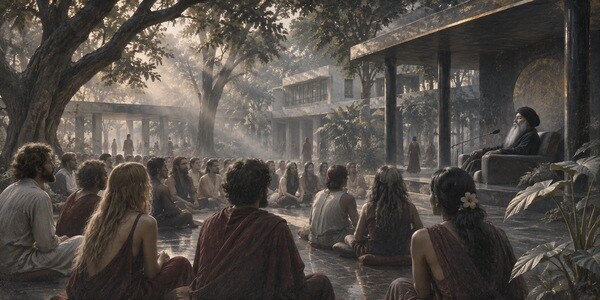
In 1974, Osho established his ashram in Pune, India. It gradually developed into an international center attracting followers from many countries. Meditation sessions, discourses, group activities, and personal-development programs took place there. For many visitors, Pune offered an encounter with a culture in which spiritual searching was not separated from the body, emotions, music, or relationships.
A defining feature of this environment was the interaction between Eastern contemplative traditions and Western psychological methods. During the 1970s, human-potential movements, group therapy, and experimental approaches to self-exploration spread across different parts of the world. In Pune, some of these approaches were incorporated into a spiritual framework centered on Osho’s discourses. Certain participants found this combination liberating, while particular practices and group methods also attracted criticism concerning safety, boundaries, and intense emotional effects.
Community life included forms of work understood as opportunities for meditation in action. Participants carried out practical tasks, maintained facilities, organized events, and contributed to daily operations. The underlying idea was that awareness should not remain confined to the meditation hall. One can observe oneself while cleaning, cooking, building, or speaking with another person. This reflects Osho’s conviction that ordinary labor can become spiritual practice when performed attentively.
Such communities nevertheless raise difficult questions about power and dependence. When a charismatic teacher occupies the center, personal inspiration can become an organizational hierarchy. Any system promising freedom should also be judged by how it handles disagreement, personal boundaries, and the right to leave. The history of Osho’s movement contains both accounts of profound personal transformation and grounds for critical examination of group relationships.
In Pune, Osho also reinterpreted the idea of the sannyasin. In classical Indian contexts, sannyasa is often associated with renunciation of worldly attachments and certain social roles. Osho’s new sannyasin was not necessarily expected to abandon work, family, or pleasure. The aim was to live consciously in the world. This reinterpretation belonged to his wider effort to connect spiritual practice with modern existence.
His followers used distinctive symbols and clothing, with the movement’s outward forms changing across different periods. Orange and reddish garments and medallions bearing the teacher’s image were characteristic of the early years. Such elements created a sense of belonging while raising questions about the compatibility of individual freedom with strong collective identity. That tension remains essential to understanding the movement.
Osho described the commune as a laboratory for a new way of living. Participants were encouraged to explore not only religious ideas but also relationships, work, creativity, sexuality, and personal responsibility. Such an experiment attracted people who felt constrained by conventional institutions. Yet it also required clear boundaries, competent administration, and accountability, because spiritual ideals alone cannot prevent abuses.
During this period his discourses reached an increasingly international audience. They were recorded, transcribed, translated, and published. Their oral origin gives them a distinctive immediacy. Readers often feel they are witnessing a conversation rather than studying a formally organized lecture. Osho moves from philosophical argument to parable, from scripture to joke, from psychological observation to a personal question. This freedom of form contributes to his appeal but frustrates attempts to extract a single perfectly systematic doctrine.
Among his well-known discourse series are interpretations of the Dhammapada, the Tao Te Ching, Zen stories, Sufi parables, and various Indian spiritual texts. He does not approach them exclusively as a historian. A passage frequently becomes the starting point for a contemporary interpretation. This helps ancient ideas reach new audiences, but his readings should not be confused with academically established meanings of the original works. Osho is a creative interpreter, not a neutral historian of religions.
His relationship to the Buddha is particularly revealing. He repeatedly returns to Buddhist awareness, nonattachment, and observation of the mind. Yet he does not attempt to reproduce the exact rules of a particular Buddhist school. He selects ideas he considers transformative and presents them within his own spiritual framework. He follows similar approaches with Lao Tzu, Kabir, and Sufi mystics. The result is a broad conversation among traditions, but also a highly personal interpretive system.
This helps explain why readers from different religious backgrounds recognize familiar concerns in his books. A Christian may recognize the question of love; a Buddhist, attention to the mind; a yoga practitioner, the importance of practice; and a nonreligious reader, the critique of social roles. The common language is human experience. Osho addresses fear of death, loneliness, the need for recognition, the longing for freedom, and the possibility of living more consciously. These themes reach beyond membership in any single institution.
Rajneeshpuram: The Great Experiment and Its Grave Contradictions

In 1981, Osho moved to the United States, where his followers established a large community in Oregon known as Rajneeshpuram. The project sought to create a largely self-contained environment with housing, infrastructure, agriculture, and spaces for meditation. A settlement emerged in the high-desert landscape, attracting international attention both for its organizational scale and for growing tensions between the movement and local authorities.
Rajneeshpuram is an essential part of Osho’s history and cannot be omitted from a serious portrait. The project demonstrated the organizational energy of his followers, but it also became the setting for grave crimes. In 1984, members of the commune’s leadership deliberately contaminated food at restaurants in Wasco County, Oregon, with Salmonella bacteria in an attempt to influence local elections. Hundreds of people became ill. The episode remains among the best-known biological attacks carried out in the United States.
The crimes involved figures within the community’s leadership, including Ma Anand Sheela. Investigations established other serious offenses. These facts should not be concealed out of admiration for Osho’s spiritual ideas. Responsibility must nevertheless be described accurately: a crime committed by members of a movement does not automatically establish the teacher’s personal participation. Questions about his knowledge, control, and moral responsibility remain central to historical assessments.
During part of this period, Osho maintained a public silence while other figures handled organizational affairs. This circumstance has been interpreted in different ways. Some see it as evidence of distance from day-to-day management; others ask how such a concentration of power could develop in a community founded on ideals of awareness and freedom. Neither interpretation removes the need to examine documentation, legal proceedings, and testimony.
In 1985, Osho was arrested on immigration-related charges. Following legal proceedings, he entered into an agreement concerning immigration violations and left the United States. The events surrounding Rajneeshpuram brought the American experiment to an end and became a turning point in his public biography and the world’s perception of his movement.
The history of Rajneeshpuram demonstrates a fundamental distinction between spiritual teaching and institutional practice. Ideas about awareness, freedom, and love may be philosophically compelling while an organization proclaiming them permits dangerous concentrations of power and serious abuses. This distinction is not an excuse; it is necessary for precise analysis. Critical examination is especially important when discussing a teacher who repeatedly urged people not to submit blindly to authority.
The perspective of those harmed also matters. Oregon residents who became ill are not a minor footnote in a dramatic story about a spiritual commune. They were people who suffered real consequences from criminal acts. A portrait of Osho would be incomplete if fascination with a charismatic personality erased their experience. Responsible historical writing must acknowledge that reality.
After leaving the United States, Osho traveled during a period marked by difficulties obtaining permission to remain in various countries. He eventually returned to India and reestablished his center in Pune. His final years included further discourses, meditation programs, and the continuing work of an international community. The name Osho became the principal name by which he would be known after his death.
These years also revealed that his influence no longer depended entirely on his physical presence. Recordings, books, meditation programs, and international networks continued beyond any one location. The modern history of spiritual movements is closely connected with the ability of ideas to spread through media, translations, and organizations. Osho is a striking example of that transformation.
The Final Years, Death, and the Continuing Life of His Discourses

Osho died on January 19, 1990, in Pune, India. His final years were accompanied by health problems and various public claims concerning the causes of his deterioration. Some of these claims, including suspicions of poisoning, have not been established as proven historical facts. In examining his life, the distinction between documented events, personal beliefs, and later interpretations remains essential.
After his death, the Pune center continued under evolving organizational arrangements, while his discourses circulated in numerous languages and editions. Published volumes address meditation, love, creativity, religious traditions, psychology, society, and philosophy. Some readers encounter him through brief excerpts; others through complete lecture series. The difference matters: an isolated sentence can sound like an absolute maxim, whereas the full discourse reveals context, humor, and the development of an argument.
One of the greatest difficulties in his contemporary reception is the enormous number of unattributed or incorrectly attributed quotations. Social media frequently compresses complex reflections into a few words placed over an attractive photograph. His criticism of dogmatic thinking can thus paradoxically become another collection of dogmas. A more reliable approach is to read complete discourses and verify the origin of particular formulations.
Osho also left a significant mark on popular meditation culture. His active practices, language of witnessing, and image of spirituality that does not require abandoning joy have reached far beyond his immediate followers. That influence is a cultural fact, not proof that every psychological or philosophical claim he made has been scientifically confirmed. The benefits and risks of particular meditative methods should be assessed through evidence relevant to those methods, not merely through the teacher’s reputation.
For many readers, the most valuable aspect of his legacy is the way he raises the question of authenticity. He argues that someone can spend an entire lifetime fulfilling other people’s expectations without noticing how little they understand their own desires and fears. In his discourses, this question appears through many images: the overflowing cup, the clouds of the mind, dancing, silence, free love, and the teacher who refuses to provide a ready-made answer. Each points toward the possibility of living with greater attention.
His unusual relationship to religious traditions also deserves consideration. He speaks with interest about mystics while resisting the institutional transformation of their experiences into rigid systems. For him, the Buddha matters not because he founded an organization, but because he symbolizes awakening. Lao Tzu matters not as a set of compulsory formulas, but as an image of naturalness and action without coercion. Sufi stories are valuable not as proof of historical miracles, but as ways of revealing the paradoxes of the human mind. These are Osho’s interpretations, distinct from the traditions themselves, and they help explain the wide horizons of his work.
Death appears throughout his discourses. He treats it as an inevitable dimension of life and encourages listeners to acknowledge impermanence instead of continually pushing it out of awareness. In his view, fear of death can also be connected with fear that life has not been lived fully. This is not a universal explanation for every form of anxiety, but it poses a powerful existential question: what does it mean to live without continually sacrificing the present to the future?
In this sense, his spirituality concerns not only meditative experiences but also time itself. Human beings live between memory and anticipation. The past offers a ready-made identity; the future promises that one day everything will be resolved. The present moment often goes unnoticed. Osho does not deny the need to plan or learn from experience. He asks whether a person can genuinely be here while planning, remembering, and acting.
His treatment of enlightenment is similarly paradoxical. He describes it as a profound inner possibility while warning against turning it into another achievement. If spiritual awakening is imagined as a medal that will make someone more important than others, the desire is already captured by comparison. His teaching stories therefore include students who lose their way precisely when they begin taking pride in their progress. Awareness is not a social title.
This criticism also matters for the way Osho himself should be read. His words need not be treated as infallible in order to be meaningful. Indeed, his insistence on personal understanding requires readers to compare, verify, and distinguish useful spiritual guidance from statements that fail historical or scientific scrutiny. Such an approach is closer to his stated ideal of independence than unconditional praise.
Osho remains a figure who cannot be reduced either to a handful of inspirational sentences or to one period in his movement’s controversial history. He was a philosophically educated speaker, creator of modern meditative practices, provocative critic of social roles, inventive interpreter of spiritual traditions, and central figure of an international community whose history includes serious abuses. All these dimensions belong to the same historical portrait.
Read attentively, his discourses reveal a persistent invitation to direct observation. It is not enough to speak about freedom when decisions are dictated by fear. It is not enough to defend love while trying to possess another person. It is not enough to know a great deal about meditation without ever sitting with one’s own thoughts. It is not enough to call oneself spiritual when the label serves as a claim of superiority. Such questions give his work a force that does not depend upon belonging to any particular organization.
His most characteristic gesture is to return responsibility to the listener. A teacher can tell stories, provoke reflection, suggest methods, and ask questions, but cannot experience another person’s life on their behalf. From this perspective, the spiritual path is not a collection of borrowed truths. It is an ongoing investigation into how we perceive, react, love, and fear. Osho offers many entrances to that investigation, yet his most consistent theme remains the need to see with one’s own eyes.
His legacy continues to attract attention because it places spirituality at the heart of everyday existence. Silence does not belong exclusively to monasteries. Joy is not necessarily an obstacle to inner depth. Love need not mean control. Knowledge is not the same as lived wisdom. And freedom does not begin with a declaration, but with recognizing what governs us from within. These are the questions through which his voice continues to engage contemporary readers.
Ultimately, the most important outcome of encountering Osho is not whether readers adopt a particular identity or join a community. It is whether they begin paying closer attention to their own lives. His stories invite us to laugh at our pretensions; his meditative ideas encourage us to see thoughts without constant struggle; his reflections on love challenge unnecessary control; and his criticism of ready-made answers reminds us not to exchange personal responsibility for comfortable belonging. Wherever these questions lead toward greater clarity, compassion, and independence, his work continues to fulfill its most meaningful purpose.
Author: Vasil Stoyanov