
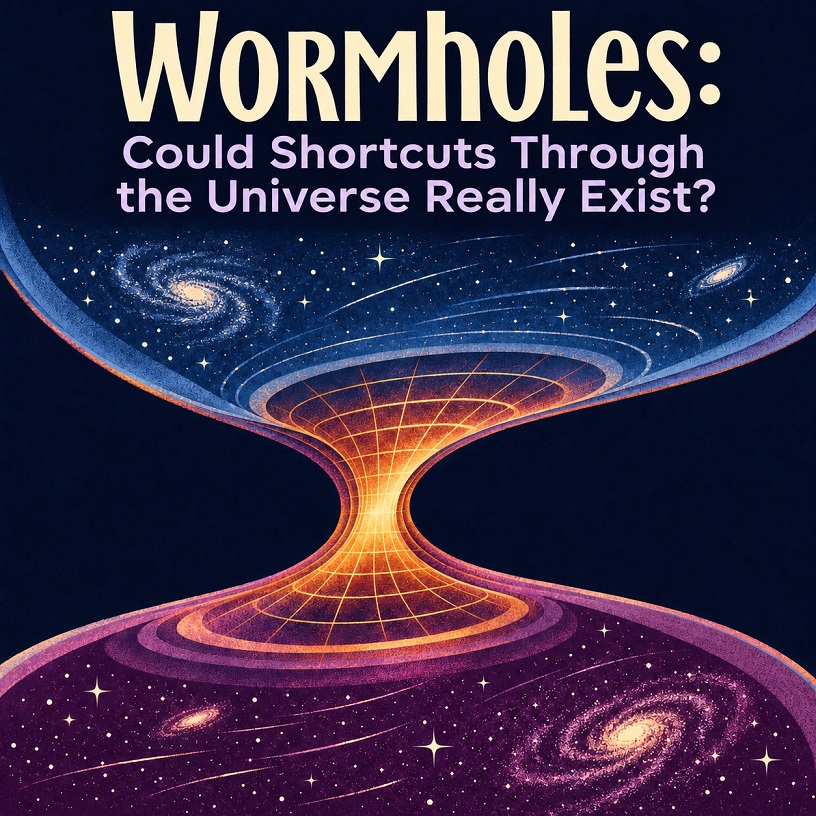
Imagine two stars separated by thousands of light-years, yet connected by an unusual passage that makes the journey between them far shorter. This sounds like science fiction, but the possibility has a legitimate place in mathematical studies of gravity. Such hypothetical passages are called wormholes.
The idea is fascinating because it challenges our intuition about distance. Yet there is an enormous difference between a geometry that equations can describe and an object that actually exists in nature. No wormhole has been conclusively observed, and creating or maintaining a traversable one would require physical conditions we do not know how to achieve.
What might these structures look like? Why are some non-traversable, while others require negative energy? Could telescopes, gravitational waves, or the behavior of light reveal one? And what do modern investigations connecting wormholes with quantum physics actually demonstrate? The answers illuminate a remarkable boundary between established science and unverified possibilities.
1. What Exactly Is a Wormhole?
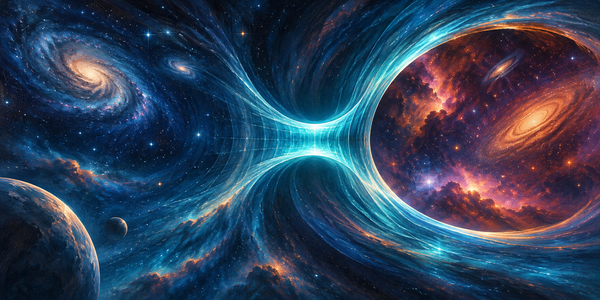
A wormhole is a hypothetical structure connecting two regions of spacetime through an unusual geometrical passage. The regions might be very far apart along an ordinary route but connected by a shorter internal path. Theoretical descriptions often refer to two openings, called mouths, joined by a throat.
A familiar analogy involves marking two points on a sheet of paper and folding the sheet so the points approach each other. A passage between them could then be much shorter than the route along the sheet. This is only a visual metaphor: the actual geometry does not require space to be literally folded into an external dimension.
The essential point is that distance depends on the geometry of the route followed. Two locations may be far apart along one path and closer along another if the structure of space permits that connection. A wormhole represents an extreme example of this possibility.
The crucial qualification is that not every wormhole is traversable. Some mathematical solutions describe bridges that neither light nor matter can cross. Others are designed to allow passage but require extraordinary physical conditions. Calling a wormhole a tunnel through the universe should therefore never be mistaken for evidence that usable cosmic tunnels exist.
2. Where Did the Idea of Cosmic Bridges Come From?
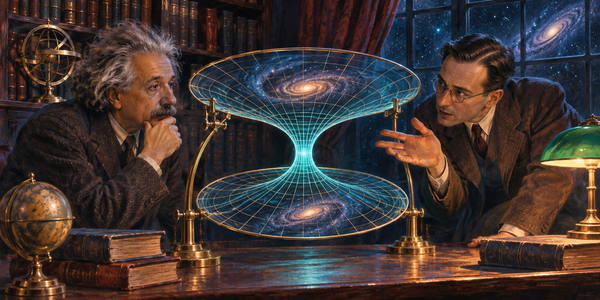
The mathematical origins of wormholes lie in investigations of gravitational solutions during the first half of the twentieth century. In 1935, Albert Einstein and Nathan Rosen published a study of a geometrical construction that later became known as the Einstein–Rosen bridge. It remains an important historical precursor of modern wormhole models.
The Einstein–Rosen bridge is not a ready-made route for spacecraft. In its standard interpretation, it is associated with an idealized black-hole geometry and does not allow an observer to travel safely from one exterior region to the other.
Later, physicists began investigating a much broader range of geometries. A particularly influential contribution came from Michael Morris and Kip Thorne in 1988, when they formulated conditions for a traversable wormhole. Rather than assuming such an object exists, they asked what properties a tunnel would need in order to permit an observer to pass through it.
The subject consequently developed from a curious feature of mathematical solutions into a research area involving classical gravity, quantum field theory, holographic models, and the stability of unusual geometries. Its scientific value does not depend on wormholes eventually becoming a means of transportation.
3. What Would a Traversable Wormhole Look Like?
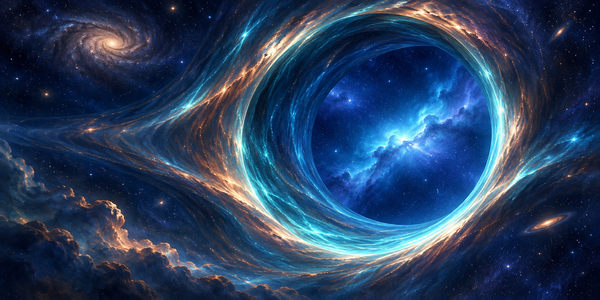
In idealized models, a traversable wormhole has two mouths connected by a throat. A traveler could enter one mouth, move through the internal region, and emerge from the other. This describes a mathematical scenario, not an observed object.
Several conditions would have to be satisfied. The throat must not collapse while something passes through it. There must be no impassable horizon preventing escape. Tidal forces-the differences in gravitational acceleration acting on different parts of a body-must be weak enough not to destroy a traveler.
Size is equally important. A geometry that allows a microscopic signal to pass is not necessarily suitable for a person, a probe, or a spacecraft. Both the diameter of the opening and the properties of the entire internal route matter.
Its visual appearance would not be uniquely determined. Wormholes are frequently illustrated as glowing circles or spherical portals, but these are artistic interpretations. The actual appearance would depend on how light moves around and through a particular geometry. Strong optical distortions, multiple images, and unusual rings of light are possible in some models.
4. Why Is Stability Such a Major Obstacle?
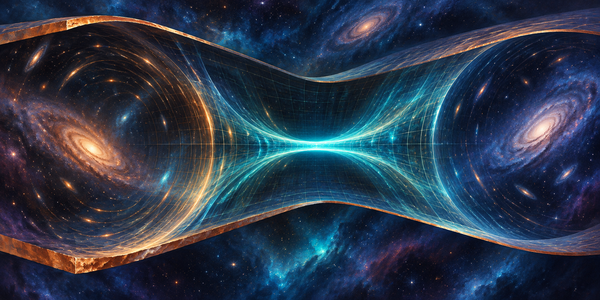
Imagining a tunnel is straightforward; showing that it could remain open is far more difficult. In many solutions, gravitational dynamics cause the throat to close or produce a structure that does not permit causal passage.
In certain idealized cases, a bridge exists as part of a geometrical description, yet no observer can cross it. Spatial connectedness alone is therefore insufficient. There must be a physically allowed trajectory along which light or matter can actually reach the other side.
Even if an initially traversable configuration can be constructed mathematically, it must withstand disturbances. Radiation, moving matter, and quantum effects may alter the geometry. Some solutions are stable only under highly idealized assumptions, while others require carefully adjusted parameters.
The question is therefore not merely whether a wormhole can be written down in equations. It is whether one can form, persist long enough, and remain traversable under realistic physical influences. No known model has yet become an experimentally confirmed natural mechanism for doing so.
5. Exotic Matter: What Does Negative Energy Mean?
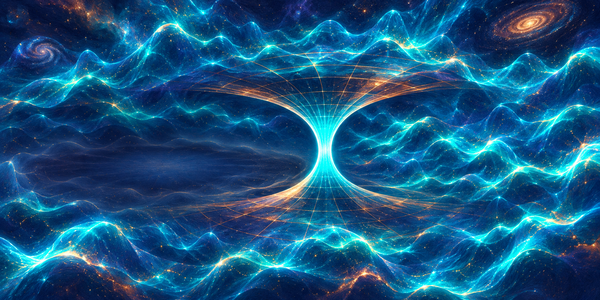
One of the most discussed features of classical traversable wormholes is the need for an unusual distribution of energy and stresses near the throat. In standard Morris–Thorne models, this involves violating what physicists call the null energy condition.
Popular explanations often say that exotic matter or negative energy is required. These phrases can create a misleading impression. They do not refer to a known substance that can simply be mined and installed inside a tunnel. They describe particular mathematical properties of energy, pressure, and stress.
Ordinary matter does not readily provide the required behavior. Certain quantum states can exhibit locally negative energy densities relative to an appropriate reference vacuum configuration. But this does not mean unlimited quantities of negative energy can be freely produced.
Even if suitable quantum effects exist in principle, their scale, duration, and controllability remain major problems. The gap between a small laboratory quantum effect and maintaining a vast stable cosmic passage is enormous. Exotic matter is therefore one of the central obstacles to the idea of a usable wormhole.
6. What Does the Casimir Effect Have to Do with Wormholes?
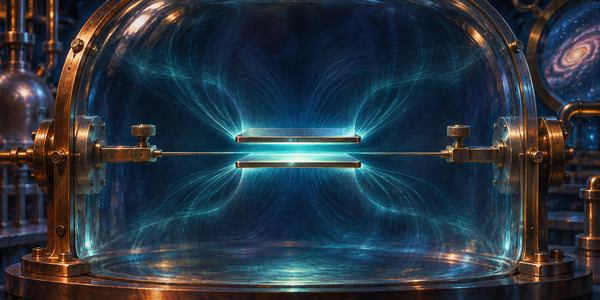
The Casimir effect is a real quantum phenomenon frequently mentioned in discussions of wormholes. Under certain conditions, closely spaced surfaces change the allowed quantum states of the electromagnetic field, producing a measurable force between them.
In idealized configurations, the vacuum energy between the surfaces can be described as lower than a chosen reference value. This is one reason the effect appears in discussions of negative energy density.
However, the distinction is essential: the Casimir effect has been measured, whereas a traversable wormhole has not. The existence of particular negative quantum energy contributions does not demonstrate that they can be accumulated and arranged to support a macroscopic tunnel.
Quantum inequalities studied in theoretical physics constrain the magnitude and duration of negative-energy effects in various settings. Such constraints make it difficult to turn laboratory phenomena into a technology for interstellar travel. The Casimir effect is an important part of quantum physics, not proof that wormholes can be built.
7. Could Nature Create Wormholes on Its Own?
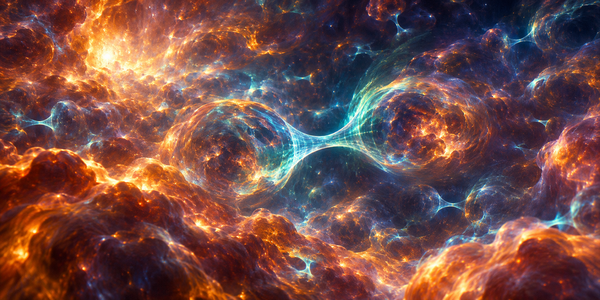
If wormholes exist, an obvious question is how they might form. One possibility discussed in theoretical research involves conditions in the very early universe, when temperatures and energy densities were extraordinarily high. Another involves a still-unknown quantum structure of gravity.
Researchers sometimes discuss quantum foam, a hypothetical microscopic variability of spacetime geometry near the Planck scale. This is a conceptual picture, not a directly observed description of space. We do not know whether such fluctuations include genuine tunnels or whether any could survive.
Even if microscopic passages formed naturally, expanding them to astronomical or human scales would present a separate problem. Stability would be necessary, perhaps alongside a particular energy configuration that has not been established in nature.
At present, there is no confirmed mechanism for the formation of astrophysical wormholes. Their natural origin is a scientifically investigated hypothesis rather than an established fact.
8. What Is the Difference Between a Wormhole and a Black Hole?
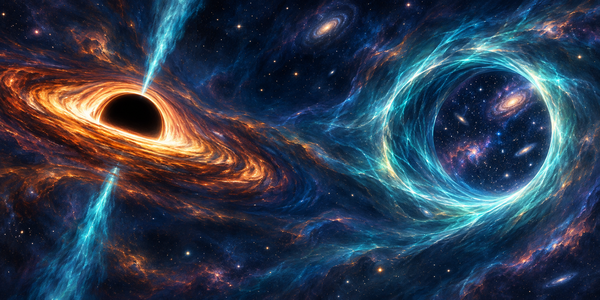
Black holes are real astrophysical objects supported by powerful observational evidence. Scientists investigate them through the motion of nearby stars, radiation from hot matter, images of their surroundings, and gravitational waves from mergers of compact bodies.
Wormholes are different. They are hypothetical geometrical connections between regions of spacetime, and no astrophysical wormhole has been confirmed. Some mathematical black-hole solutions contain bridge-like structures, but this does not mean observed black holes are portals.
In the standard description of a non-rotating black hole, the event horizon marks a boundary beyond which light cannot reach distant exterior observers. Crossing that horizon does not provide any known safe route to another star system.
The distinction matters because popular illustrations often use similar visual effects for black holes and wormholes. Observing strong gravitational distortion is not enough to establish the presence of a traversable tunnel.
9. How Could a Telescope Detect a Wormhole?
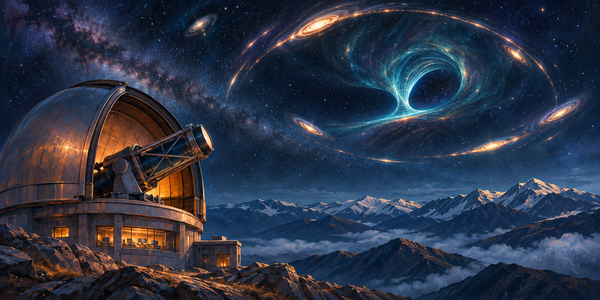
If sufficiently large wormholes exist in nature, they might influence light from surrounding stars and galaxies. Strong gravitational fields alter the paths of light rays and can create magnified, distorted, or multiple images of distant sources.
This process is called gravitational lensing. It is already observed around galaxies, galaxy clusters, and compact massive objects. Some wormhole models predict distinctive lensing signatures that could, under certain conditions, differ from those of an ordinary black hole.
The difficulty is that unusual light patterns rarely have only one possible explanation. Different mass distributions, plasma effects, and other compact objects can produce similar observational features.
A convincing detection would require agreement among several independent observations and a reliable theoretical model. Researchers would also have to rule out more conventional astrophysical explanations. No observation has yet been accepted by the scientific community as proof of a wormhole.
10. Could Gravitational Waves Reveal Such Structures?
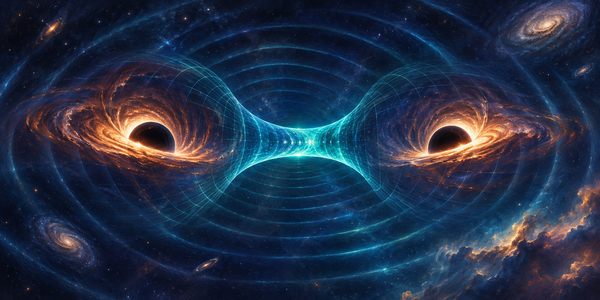
Gravitational waves are propagating disturbances in spacetime geometry generated by accelerating massive systems. Their direct detection opened a new way of studying compact cosmic objects.
When two black holes merge, the resulting system undergoes a period of damped oscillations, often called ringdown. The shape of this signal depends on the properties of the object and its surrounding geometry.
Some theoretical models suggest that exotic compact objects, including certain wormholes, could produce different spectral characteristics or additional delayed signals. These are sometimes discussed as gravitational-wave echoes.
Searching for such effects is challenging. Signals are weak, detector noise is complex, and predictions depend strongly on the model chosen. There has been no generally accepted detection of gravitational-wave echoes demonstrating the existence of wormholes.
Nevertheless, gravitational-wave astronomy is a promising tool for testing alternative models of compact objects. It may help researchers rule out certain hypothetical structures or place limits on the properties they could possess.
11. Could We Actually Travel Through a Wormhole?
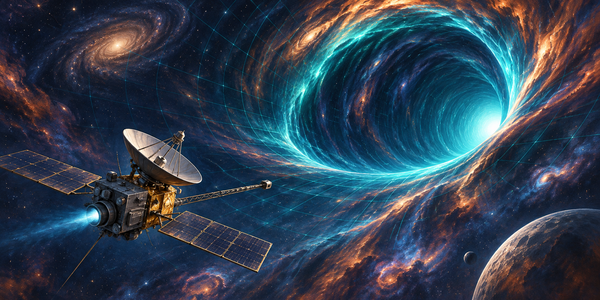
Traveling through a wormhole would require far more than locating an entrance. Even if a traversable geometry exists, its throat must be sufficiently wide, remain stable, and avoid exposing travelers to destructive tidal forces or intense radiation.
We also do not know whether its two mouths would be located anywhere accessible. A passage might be microscopic, short-lived, or connected to regions beyond our observational reach.
No spacecraft has ever used a wormhole. We have no method of creating one, safely enlarging it, or controlling the location of its mouths. Even the idea of placing an opening near a distant star presupposes abilities for which no known technology exists.
The scientifically accurate answer is therefore twofold. Some mathematical models permit passage; whether nature realizes those models is unknown. Wormhole travel remains hypothetical, however convincing it appears in films.
12. Could a Wormhole Shorten Interstellar Distances?
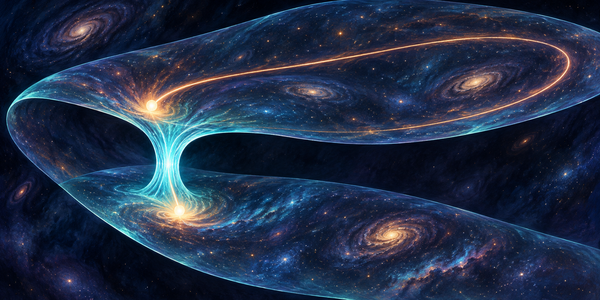
If two distant regions were connected by a traversable wormhole, the internal route could be shorter than the ordinary journey through space. In that scenario, a traveler would not need to exceed the speed of light locally to arrive sooner than a signal following a much longer external path.
This is a geometrical possibility, not an established method of faster-than-light propulsion. A spacecraft would move through the passage according to local physical constraints, while the global geometry would change the route’s length.
The possibility becomes especially striking when considering distances of hundreds or thousands of light-years. Ordinary travel across such distances presents enormous challenges even for future technologies. A genuinely short tunnel would radically alter our understanding of how accessible distant stars might be.
But this prospect is conditional. Stable traversable tunnels have not been shown to exist, and there is no demonstrated way to position their mouths where we want them. Shortening interstellar distances remains a consequence of certain models, not a practical technological plan.
13. Quantum Entanglement and the ER = EPR Idea
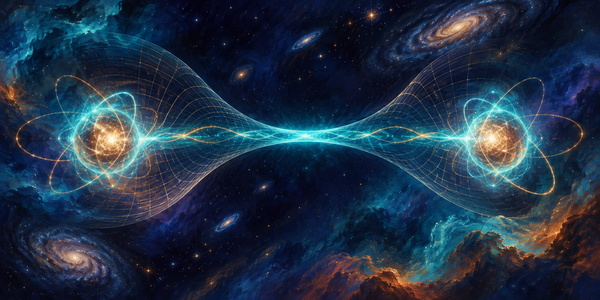
One of the most discussed modern ideas connects wormholes with quantum entanglement. In 2013, Juan Maldacena and Leonard Susskind proposed the ER = EPR hypothesis, exploring a possible relationship between Einstein–Rosen bridges and certain entangled quantum systems.
Quantum entanglement means that a composite system has a shared quantum state that cannot be reduced to independent states of its individual parts. Measurements on such systems can reveal correlations that have no ordinary classical explanation.
ER = EPR suggests that, under certain conditions, quantum correlations and geometrical connectedness may be different expressions of a deeper physical structure. This is a remarkable research direction, but it does not mean every pair of entangled particles forms a visible tunnel.
Quantum entanglement alone does not permit controlled faster-than-light communication, and the hypothesis does not establish the existence of traversable cosmic wormholes. Its significance lies primarily in attempts to understand how geometry and quantum information might be connected.
14. What Did the Quantum Processor Experiments Actually Show?

In 2022, researchers reported an experiment using a quantum processor to implement a highly simplified quantum system mathematically related to models of traversable wormholes. The result attracted considerable attention because it was discussed using concepts from quantum gravity.
Some popular headlines implied that scientists had created an actual wormhole. That is not true in the literal physical sense. No tunnel was opened in cosmic space, and no portal formed through which material objects could travel.
The experiment explored the behavior of a quantum system that, within a particular theoretical framework, has an analogy to information transfer through a traversable wormhole. Such simulations are valuable because they allow features of complex mathematical models to be studied under controlled conditions.
At the same time, the interpretation of that experiment and the extent to which it genuinely reproduced gravitational dynamics have been debated in the scientific literature. These studies do not confirm astrophysical wormholes. They demonstrate ways quantum technologies may help investigate ideas associated with quantum gravity.
15. What Would Happen to Light Near a Wormhole?
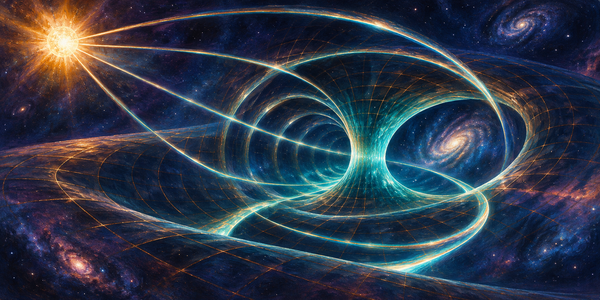
Light is one of our most important tools for studying distant cosmic objects. As it passes through a region of strong gravity, its trajectory may bend significantly. This allows otherwise invisible objects to be studied through their effects on radiation from other sources.
Near a hypothetical wormhole, light would follow the geometry of the particular model. In some cases, rays might travel around the compact structure, form rings, or reach an observer by several different routes.
For a traversable wormhole, some light might pass through the throat from the other side. An observer could then, in principle, receive images of objects outside their ordinary surrounding region of space.
Although impressive, the resulting images would depend on the geometry’s parameters, the light sources, and the observer’s position. There is no single universal visual portrait of a wormhole. An unusual light pattern alone would therefore not constitute conclusive evidence of one.
16. Could Wormholes Be Extremely Small?
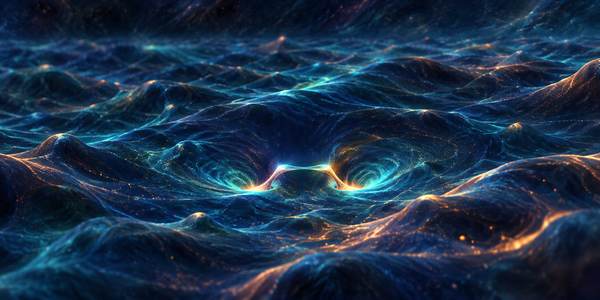
Nothing in the general concept of a wormhole requires it to be large enough for a spacecraft. Some speculative models consider microscopic structures far smaller than anything directly observable.
At extremely small scales, quantum effects become especially important. Classical descriptions of smooth spacetime are likely to require a more fundamental theory in this regime, but the correct theory has not yet been established.
A microscopic wormhole would not automatically be stable or traversable. A hypothetical structure might survive for an extraordinarily short time or fail to permit information transfer in any usable sense.
Researchers sometimes discuss the possibility of enlarging a tiny wormhole. That would require control over gravitational geometry and energy conditions that we do not possess. No experimentally demonstrated procedure for such enlargement exists.
17. Why Does Science Fiction Portray Wormholes So Differently?
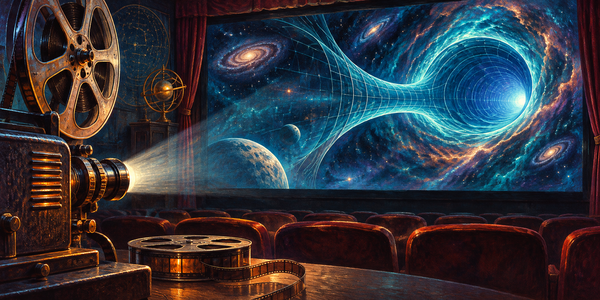
In films and literature, wormholes usually appear as spectacular portals, glowing spheres, or passages that can be opened on command. These images are powerful because they turn abstract geometry into something visible and intuitive.
Science fiction frequently bypasses the most difficult physical questions: where the energy supporting the tunnel comes from, how its collapse is prevented, how safe passage is ensured, and how its mouths end up at exactly the desired destinations.
This does not make fictional portrayals worthless. They can stimulate curiosity about real physics and inspire questions that might otherwise seem too abstract. But an artistically convincing depiction is not scientific evidence.
The most useful approach is to treat such portrayals as thought experiments. They allow us to imagine the consequences of traversable tunnels without assuming the necessary technology is already possible.
18. What Would the Discovery of a Real Wormhole Mean?
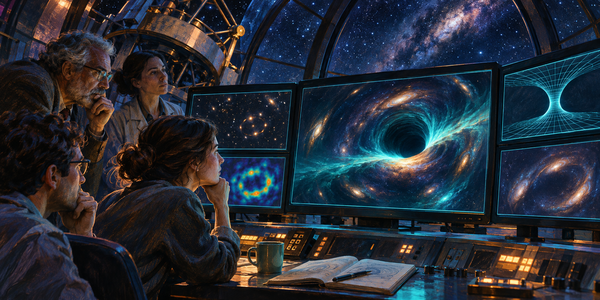
Confirming the discovery of a wormhole would be one of the most significant events in the history of physics. It would demonstrate that nature realizes geometrical structures currently known mainly through theoretical models.
But an initial discovery would not necessarily establish that the object was traversable. Scientists would need to determine its size, stability, gravitational properties, and interaction with light and matter. Independent observations and comparisons with competing explanations would be essential.
If researchers established that the structure genuinely connected distant regions, the implications for our understanding of the universe’s global geometry would be profound. Demonstrating traversability would raise even deeper questions: what physical conditions support the passage, and why does it remain stable?
Even then, practical travel would be a separate challenge. Discovering a natural phenomenon does not immediately give us the ability to use it technologically. The history of science shows that fundamental discoveries and their applications may be separated by decades or centuries of research.
19. What Do We Know for Certain, and What Remains Hypothetical?
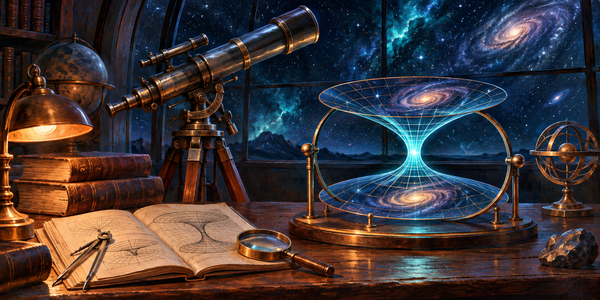
We know that modern gravitational theory admits mathematical solutions with unusual geometrical connectedness. We also know that researchers have developed detailed models of traversable and non-traversable wormholes. These are genuine achievements in theoretical physics.
We know that quantum theory permits nontrivial vacuum properties, including certain negative-energy contributions under specific conditions. The Casimir effect is an example of a measurable quantum phenomenon. But it does not establish that the conditions necessary for a macroscopic passage can be realized.
We do not know whether wormholes exist in nature. We do not know how they would form, whether they could remain stable in a realistic environment, or whether any would permit a human being-or even a controllable signal-to pass through. We have no confirmed astronomical observation of such an object.
Research into quantum entanglement, holographic models, and quantum-processor simulations is important, but it must not be presented as proof that tunnels through the universe have already been discovered or created. Much of the scientific progress in this area consists of understanding the mathematical possibilities and constraints more precisely.
20. Why Do Wormholes Continue to Fascinate Scientists?
Wormholes are interesting for reasons extending far beyond the dream of rapid interstellar travel. They raise questions about the nature of space, the relationship between geometry and quantum information, and the boundaries of familiar physical laws.
Theoretical models serve as laboratories of thought. They allow physicists to examine the consequences of particular equations, determine which energy conditions are necessary, and investigate why some configurations become unstable. Even when a model cannot be realized in nature, studying it can reveal important limits of the underlying theory.
New astronomical observations and quantum experiments also provide tools for increasingly rigorous tests. Future data may rule out particular hypotheses or reveal unexpected phenomena demanding new explanations.
Perhaps wormholes will never turn out to be real passages for spacecraft. Perhaps nature allows only microscopic or non-traversable structures. Or perhaps future physics will uncover something we cannot yet predict. For now, the essential task is to preserve the distinction between imagination, mathematical possibility, and experimental evidence.
That boundary is precisely where the fascination of wormholes lies. They remind us that the universe may be far stranger than it appears, while every bold idea must still face the tests of science.
Author: Vasil Stoyanov